Latest News

Research Briefs, Science & Technology

Are deep-ocean microbes waiting for lunch?

The deep ocean—at least 200 metres below sea level—is home to an organic carbon pool comparable in size to the atmospheric carbon reservoir. This carbon pool has remained consistent in size for millennia. If just one per cent of the deep-ocean carbon were released in the atmosphere through microbial respiration, it would equal a year’s worth of human greenhouse gas emissions. Yet, the mechanisms that keep this carbon stable for so long remain unknown.

During his postdoctoral fellowship at the McGill Geomicrobiology Lab in the Department of Earth and Planetary Sciences, Richard LaBrie and his collaborators investigated whether bacteria in the deep ocean are too starved to decompose dissolved organic carbon (DOC), offering an explanation as to why the carbon pool has not shrunk.

LaBrie’s hypothesis relates to the priming effect, which was introduced in soil science a century ago.

“The priming effect is the addition of simple or moderately complex organic molecules that help microbes degrade more [persistent] carbon that would not be degraded otherwise or within [a given] context,” LaBrie said in an interview with The Tribune.

The addition of exogenous organic compounds makes it easier for microbes to eat their lunch.

To test his hypothesis, LaBrie collected water from 2,500 metres deep in the Antarctic Ocean and added different compounds separately to the samples: Glucose; amino acids, a substitute for dissolved organic nitrogen; glucose 6-phosphate, a substitute for dissolved organic phosphorus; and a mix of amino acids and glucose 6-phosphate.

“Nitrogen and phosphorus are both very important for microbial growth, [so] we thought that they could also help bacteria break that energy barrier,” LaBrie explained.

At several time points, the researchers analyzed DOC, cell abundance, and the microbial community composition in water.

Surprisingly, they found no evidence of the priming effect, as bacteria did not degrade the deep seawater DOC after the addition of exogenous carbon sources.

“The addition of [the organic carbon] compounds did not bring the carbon below the background level, but we did find some very interesting results,” LaBrie elaborated.

Contrary to expectations, glucose 6-phosphate was the least usable carbon compound, even though phosphorus is usually the most limiting nutrient—meaning the essential nutrient—in the deep ocean.

“In contrast, it was the amino acids that were first consumed and resulted in the highest increase in cell abundance,” LaBrie added. “So, there was maybe a larger limitation in nitrogen than in other compounds, like phosphorus or pure carbon.”

The microbial community composition analysis further revealed that different microbes consumed DOC under different treatments. They also found evidence of competition between two microbes in the amino acid and glucose 6-phosphate treatment.

“We think these types of relationships between microbes are important for deep ocean cycling,” LaBrie said.

A limitation of the experiment is that it only tested simple carbon molecules. To build on this work, LaBrie plans to do another priming effect experiment in the St. Lawrence estuary. This time, he will add more complex carbon compounds to deep-estuary water samples.

“When the molecules are more complex, the microbial communities need to produce enzymes to cut these molecules down before they can consume them,” LaBrie said. “By producing these enzymes, they could also break down more complex molecules that are in their vicinity, […] [degrading] what is already present in the ecosystem.”

The findings have implications for geoengineering, a branch of science that explores approaches to counteract climate change. One of the most studied geoengineering techniques is the enhancement of ocean primary productivity. This inevitably results in some of the carbon made by producers sinking into the deep ocean and contributing to the carbon reservoir, keeping carbon away from the atmosphere.

If the priming effect is absent, as LaBrie’s findings suggest, then the persistent deep-ocean carbon will not be released into the atmosphere, even with the addition of DOC produced by primary producers. As a society, it is our role to determine whether such geoengineering technologies are ethical.

Out on the Town, Student Life

Happy hour, happy life: A guide to 5 à 7 in the city

After a long day of classes, extracurriculars, and small talk, McGill students often find themselves in search of an affordable, relaxing outing. While the low prices at Gerts and Blues can make for a cost-effective evening, The Tribune has compiled a list of restaurants and bars throughout Montreal that also offer discounts and deals. This fall, escape the McGill bubble and enjoy some new eats and cheap drinks. 

Lola Rosa 

Though technically still within the McGill sphere, located just a block down from Milton Gates, Lola Rosa offers a variety of plant-based menu items from tacos asada to curry, gyro to braised tofu. The restaurant also offers a selection of desserts and caffeinated beverages, serving an excellent cappuccino. While the food is delicious, and the ambiance is warm and intimate (with a range of music choices from Addison Rae to Grimes), it is also economical for broke university students, who can receive a 15 per cent discount with a McGill student ID. For those who live far away from campus, Lola Rosa is the perfect spot to unwind after a day of classes and catch up with a friend over a $14 CAD platter of nachos. If caffeine alone fails to ease your day, Lola Rosa also offers alcoholic coffee beverages. 

Le Majestique Bar

For delicious seafood on a budget, Montreal is home to many restaurants that offer deals on oysters—but the atmosphere in Le Majestique is unbeatable. Their typical price for oysters is $3.75 CAD, which drops down to $2.50 CAD for their happy hour deal between 5:00 p.m. and 7:00 p.m. The space, although not particularly spacious, is always bustling with large crowds until 3:00 a.m. Begin your night with an economical platter of oysters and signature cocktails, transitioning into a longer night of casual partying. 

Urbanista 

If you’re in search of a hot pregame bar or simply an evening of many cheap cocktails, Urbanista, located in the heart of the Plateau area, is the ideal place to go. Their happy hour, from 5:00 p.m. to 9:00 p.m., promotes two-for-one cocktail deals—an ideal arrangement for students on a budget. With booths lining the bar and eclectic, vintage lights hanging from the ceiling, Urbanista curates a laid-back vibe conducive to a night of tipsy chatting among a large group. 

Bar Bootlegger

In competition with Le Majestique, Bar Bootlegger is yet another Montreal bar that offers happy hour deals on oysters—but their happy hour menu extends past the $1 CAD oysters, including deals on drinks as well. Available every day of the week between 5:00 p.m. and 7:00 p.m., Bootlegger sells local beer or cider pints for only $5 CAD and signature cocktails for $13 CAD, rather than their usual pricing of around $19 CAD per cocktail. On Tuesdays, enjoy free entry to the spot, with live jazz performances starting at 9:00 p.m. 

Barbossa 

Barbossa is a known favourite among McGill students. Free entry before 10:00 p.m. is not the only deal this spot offers: It also provides a variety of happy hour deals—$10 CAD martinis all night on Mondays; $10 CAD margaritas on Tuesdays; $10 CAD espresso martinis on Wednesdays. From Thursday through Saturday, Barbossa promotes two-for-one cocktails between 8:00 p.m. and 10:00 p.m. Any day of the week, stop by Barbossa for great deals on drinks and enjoy music from local DJs. Whether you are in the mood for a martini or an amaretto sour, jazz music or house, Barbossa has it all, coupled with a groovy, checker-printed dancefloor. 

Behind the Bench, Football, Sports

Dynasty in demise: Kansas City in trouble

The Kansas City Chiefs are off to a slow start, having just picked up their first win of the season against the New York Giants. Only 10.1 per cent of teams who start 0–2 have ever made the playoffs. However, never before has an 0–2 team had Patrick Mahomes, so one would imagine they will be okay. Then, why the slow start if the Chiefs have Mahomes? 

The team has certainly felt the temporary loss of their top two receivers Rashee Rice and Xavier Worthy, due to suspension and injury, respectively. Rice is clearly the team’s best receiver, with well over a thousand career receiving yards in only twenty games. Worthy, on the other hand, is a speedster who racks up yards after the catch, and a gadget guy who can take screen passes and end-arounds for big plays. 

In the absence of the two, the Chiefs’ offence currently looks toothless. They are a bit of a one-trick pony, focusing on throwing short passes underneath. In the team’s first win against the Giants, Mahomes only had five completions which travelled more than eight yards in the air, and fifteen of his twenty-two completions travelled five yards or fewer, with eight even going behind the line of scrimmage. 

Chiefs fans can expect improvement when Rice and Worthy return, but they will still have other problems on offence with their run game. This offseason, the Chiefs traded away four-time All-Pro guard and massive offensive contributor Joe Thuney to cut costs as Mahomes’ new contract kicks in. As for the team’s running back talent, Isaiah Pacheco and Kareem Hunt are simply not good enough. Opposing defences have been playing two high safeties against the Chiefs, limiting passing windows downfield, as well as playing nickel personnel that use an extra defensive back instead of a bigger body near the line. The lack of rushing threat has made it far too easy for opposing defences to stop the Chiefs’ already struggling passing attack. 

The other side of the ball has also been a problem for Kansas City, as their defence lacks real difference-makers outside of Chris Jones and Trent McDuffie. The main issue has been down on the line of scrimmage. Jones is an elite player, but the rest of the defensive line has looked rough, with the exception of the team’s win against a bad Giants team. Opposing offensive lines have dominated the non-Jones linemen on runs, and the Chiefs’ defensive front has failed to pressure the quarterback on passing downs. 

Against bad quarterbacks, you can rely on the blitz, but when you play MVP-calibre quarterbacks like Josh Allen and Lamar Jackson in the playoffs, the Chiefs will need to get pressure on them with four rushers to leave seven defenders in coverage. The Chiefs have lost a lot of talent in recent years as they try to build a roster around Mahomes. While the size of his new contract has certainly not helped, the real issue is that the Chiefs simply have not drafted well enough. As long as Mahomes is on the team, their championship window is open. But, they need to hit on more picks. 

As for this season, the Chiefs will get Rice and Worthy back and should make the playoffs—barring a Mahomes or Jones injury—but their path to the Super Bowl does not look great. With the Buffalo Bills sitting at 4–0, becoming the number one seed in their conference is a long shot for Kansas City. Winning the American Football Conference (AFC) would likely require beating both the Baltimore Ravens and Buffalo, whereas if the Chiefs had the top seed, they would only need to beat one or the other. No team in the AFC is without its weaknesses, but—as currently constructed—fans should not expect the Chiefs to be the conference’s Super Bowl representative, let alone to beat the National Football Conference’s best in the big game.

Out on the Town, Student Life

 How to prepare for Piknic Electronik

There are many annual events in Montreal that you don’t want to miss out on: Piknic Electronik is one of them. Let’s demystify this iconic event so that you’re fully prepared for your night at Parc Jean-Drapeau. From metro lines to dress codes, The Tribune has put together a guide for everything you need to know to have a well-prepared, stress-free experience. 

Tickets

First order of business: Tickets. General admission tickets start at $24 CAD, and many McGill students choose to purchase them in the fall, while classes are in session. Don’t stress about buying tickets super early: In an interview with The Tribune, Natasha Pfeffer, U2 Arts, said that she bought her tickets last-minute and still managed to attend in the Fall semester.

“I booked my ticket about a week before I went, and I went September 14, so late summer, early fall season, and this is my first time going.” 

However, if you’re set on a specific night, the Piknic Electronik website drops tickets well in advance. 

Piknic Electronik runs every Sunday for six months, from May 18 to Oct. 12, so there are plenty of opportunities to attend. Going at the beginning of the fall semester, before the stress of school hits, is a great way to enjoy the weather with your friends. 

Transportation

If you’ve heard about Piknic, you might know that it takes place on an island, and it’s not exactly walkable from campus. Most students take the metro, where a one-way ticket costs $3.75 CAD, or use their OPUS card. This fee is often more affordable than services like Uber, even if you’re travelling in a group. At the end of the day, taking the subway is much more convenient—but it’s also fun. When taking the metro, be ready for noise, energy, and speed to secure a coveted seat. 

“My best transportation tip is to take the metro with friends. Don’t go alone because the hectic aspect can get really scary,” Pfeffer suggested.

It’s also important to note that you will need to switch lines at the Jean-Drapeau (Yellow Line) metro stop, so make sure you have your route nailed down beforehand. But don’t stress—if you and your friends had a little too much fun at the pregame, you can always just follow the crowd.

Packing

When it comes to packing, Piknic has restrictions on bag sizes, so pack light and prioritize the essentials. Besides, you don’t want to carry a bag that weighs you down and limits your dance moves. Luckily, the venue allows you to bring non-alcoholic sealed beverages, so it’s a good idea to pack a plastic water bottle—hydration is always key. 

“All I really needed was my phone and ID,” Pfeffer told The Tribune

You want to worry less about what to pack and more about what to wear. Outfits can vary depending on who’s DJing that night. At some events, you’ll see funky, eclectic accessory choices. At others, you might spy event-goers rocking sweatpants. But most of the time, you can count on spotting fun hats, face gems, and shimmery scarves.

Weather

Before you plan out your night, remember to check the weather. Oftentimes, especially deeper into fall, the weather is anything but sunny and pleasant. Don’t dress for a delightful spring day if the forecast calls for torrential rain. Don’t be afraid to pack ponchos or umbrellas—you’ll still look great. Prioritize comfort over everything; it’s hard to enjoy the music and vibes of Piknic Electronik when you’re freezing to the bone.

No matter what you choose to wear, what you pack, or how you get there, Piknic Electronik is an exciting event that you shouldn’t miss out on, and it’s sure to be full of excitement and amusement for you and your friends.

Commentary, Opinion

Sportswashing will not cleanse Israel of its genocide

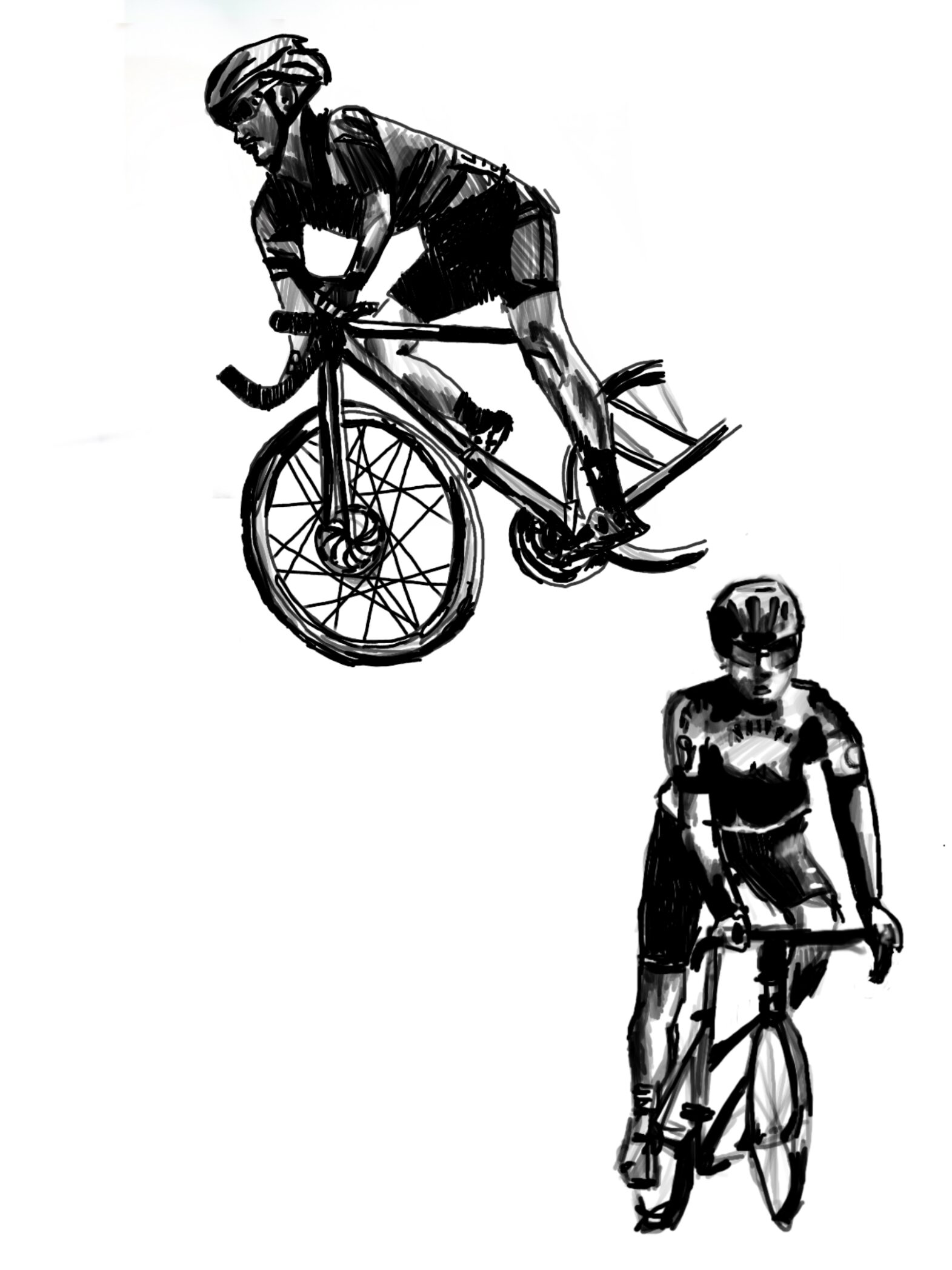
Events meant to celebrate athleticism are too often exploited to burnish the reputations of countries responsible for humanitarian crises. On Sept. 14, seven protesters were arrested at the Montreal Cycling Grand Prix. They were rallying against the participation of the Israel—Premier Tech (IPT) cycling team in the race. The arrests were for obstruction, according to police reports, and the demonstrators mostly cooperated to avoid harm. The protesters opposed the presence of the team given Israel’s genocide in Gaza. The participation of IPT in a similar cycling event in Madrid was also met with protests of the same conviction. These protests bring attention to a common issue in the sports world: Sportswashing—the use of sport to alter the image of a sponsor or government. 

These protesters should not be criticized for the politicization of an event that is already inherently political. While sports could just be a celebration of skill and athleticism, they are often much more than that due to national representation.

Though IPT is a cycling team, its presence at the event can be seen as a political statement. While IPT is not directly tied to Israel, some members of the group—such as co-owner Sylvan Adams—consider themselves representatives for Israel. Adams has previously referred to himself and the team’s riders as self-appointed ambassadors for Israel. While Israel might not be actively sponsoring the Grand Prix, IPT’s participation ensures that Israel’s image is being promoted nonetheless. Thus, the protesters’ presence only ensured that their condemnation was heard in a typically depoliticised environment curated by corporations—in this case, a corporation representing Israel. 

This issue is not exclusive to Israel; countries have long used sportswashing to improve their image. The 1936 Olympic Games in Berlin were infamously used as a way to project an image of a strong and united Nazi Germany all while the nation was actively persecuting its Jewish and Roma communities. In recent years, human rights activists have accused Saudi Arabia of sportswashing by hosting sporting events including golf and soccer leagues to distract from the nation’s human rights abuses: These include the discrimination against LGBTQ+ communities, as well as the assassination of Jamal Khashoggi

However, in the sports world, Israel’s human rights abuses, including the displacement of 90 per cent of Gaza’s population, are not criticized nearly as much as other countries perpetrating horrific violence at this scale. 

Other countries condemned by sporting committees have been banned from events in which Israel is allowed to participate. Russia, for instance, has been banned from a plethora of international sporting events since 2022, due to its ongoing invasion of Ukraine. Yet, despite being responsible for the death of more than 60,000 Palestinians in Gaza, the international community does not hold Israel to the same standard. Instead, they welcome Israeli teams with open arms to their fields, arenas, and starting lines. 

In any situation, the use of sports to generate undeserved good press trivializes the sport and the hard work of its athletes. IPT should be made completely aware of the impact that it has on global politics, recognizing that the protesters at the Grand Prix were right to call it out for its ties to Israel. If the protesters were not there, IPT would have continued to promote Israel’s image unchallenged. Because of this, sports cannot be apolitical. All participants in sports should be held to the same standards as the governments they choose to support.

Montreal, News

The Tribune Explains: The upcoming Montreal municipal election

The race for Montreal’s next mayor kicked off on Sept. 19, following current mayor Valérie Plante’s announcement last year that she would not be running for a third term. Montreal’s municipal election day will be held on Nov. 2, 2025. The Tribune explains how to navigate voting.

How can I vote? 

Voting on election day will take place from 10:00 a.m. to 8:00 p.m. on Nov. 2 at local polling stations. Advance polling is also scheduled from 12:00 p.m. to 8:00 p.m. on Oct. 26.

For the first time, students from 16 Montreal post-secondary institutions, including McGill, will be able to vote on their campuses on Oct. 24, 27, 28, and 29.

If one is unable to vote in person for health or mobility reasons, they can register to vote by mail or by mobile.

Montrealers can register to vote through an online video conference call before Oct. 15 at 6:00 p.m., or in-person at a commission of revision between Oct. 11 and Oct. 16. Voters can also check online to see if they are already registered. 

You must be registered to vote.

Who is eligible to vote? 

To be eligible for registration, a voter must be a Canadian citizen who is at least 18 years old by Nov. 2, reside in the territory of the City of Montreal, and have lived in Quebec for at least six months prior to the election. Moreover, one must not have lost their right to vote due to legal incapacity or guardianship.

Who are the candidates? 

There are currently five candidates running for mayor: Luc Rabouin for Projet Montréal; Soraya Martinez Ferrada for Ensemble Montréal; Craig Sauvé for Transition Montréal; Jean-François Kacou for Futur Montréal; and Gilbert Thibodeau for Action Montréal

Luc Rabouin, the current borough mayor for the Plateau-Mont-Royal, was selected by Projet Montréal as Valérie Plante’s successor. Rabouin is running on a platform to offer discounted transit fares for low-income users, add more public bathrooms across the city, and add 1,000 BIXI stations to Montreal over the next four years, ensuring all Montrealers have a BIXI station within a 15-minute walk of their homes. 

Soraya Martinez Ferrada resigned from her role as former federal tourism minister in Justin Trudeau’s Liberal cabinet to run for Montreal mayor with Ensemble Montréal. Her key campaign promises include using artificial intelligence to enhance traffic management and construction planning, and conducting a review of the city’s bike paths to eliminate any dangerous ones. Moreover, she is concerned with tackling youth crime and homelessness, aiming to create more non-market housing that also offers social support to its residents.

Craig Sauvé is a city councillor for Montreal’s Sud Ouest borough. He was a former member of Projet Montréal, and left the party after a sexual assault allegation, which he has categorically denied. He ran for the New Democratic Party in the riding of LaSalle-Émard-Verdun in the most recent federal election. Some of Sauvé’s key campaign promises include taxing the “ultra-rich” to reinvest the resulting money in social housing, establishing a night mayor, and “standing up” to François Legault’s Coalition Avenir Quebec provincial government on its supposed neglect of Montreal’s infrastructure, citing the province’s abandoned tramway project in LaSalle and Lachine. Recently, Sauvé has denounced the provincial government’s directive banning the use of gender-neutral language in official state communications, calling it divisive and stigmatising.

Jean-François Kacou is running for mayor with Futur Montréal, a party founded by civil rights activist Joel DeBellefeuille and community leader Matthew Kerr. He is originally from the Ivory Coast and was a former executive director of Ensemble Montréal. His platform includes making police and fire department equipment up-to-date and electrifying the entire bus network.

Gilbert Thibodeau is running again under the Action Montréal banner after receiving one per cent of the vote in the 2021 municipal elections. He believes Montreal requires more efficient financial and infrastructural management.

Art, Arts & Entertainment

‘The Lost Paintings, a Prelude to Return’ grapples with past histories and lost art

The Montreal, arts interculturels’ (MAI) recent exhibition, The Lost Paintings, a Prelude to Return, brings together an expansive range of art to create a compelling and powerful showcase. Featuring works by 53 Palestinian artists, the exhibition showcased a diverse range of media, including photographs, sculptures, paintings, and multimedia pieces. The collection reimagines the works of the Palestinian-Lebanese artist Maroun Tomb, whose 1947 exhibition of 53 oil paintings in Haifa was lost during the Nakba. Curated by Rula Khoury, Joëlle Tomb, and Haidi Motola, The Lost Paintings attempts to reclaim this past by having each artist draw inspiration from Tomb’s painting using the few remaining records and archival documents. 

The exhibition was deeply engaging, as the curators drew from pieces across time and settings, blending together the works of rising and established artists from across generations. While these pieces were stylistically varied, they all drew on central themes of loss, memory, and time through rich imagery and visual storytelling. 

Weaving and embroidery were used across multiple pieces, such as Landmark, Nardeen Srouji’s sculpture of industrial metal sheets embroidered with brightly colored wool thread, and Farid Abu Shakra’s Embroidered Landscape, which consists of four copper prints embroidered with colourful thread and punctured holes to create patterns and images of birds. These works reference traditional forms of embroidery in Palestine by engaging with the practice itself and using these familiar patterns and motifs. 

More contemporary pieces balanced artistic tradition throughout the exhibition. The collection featured large-scale installations made with unconventional materials, such as Mary Tuma’s The Road to Stella Maris. Tuma’s piece is a metal framework from which orange and cream crocheted ropes hang down over a blue print of the ocean waves, incorporating other materials such as candles and compasses. This collection of materials and forms made for a dynamic exhibition.

While landscapes are a form that can often easily be overlooked, many pieces in The Lost Paintings make the land the central figure of their designs, creating a sense of both instilled beauty and loss. Antoine Elias Raffoul’s black-and-white ink drawing, Back to 55: An Imaginary Mediterranean Landscape, uses artistic techniques he learned in 1955 from Maroun Tomb. Sandra Tomb’s oil painting of lush green forest, Under the Oak Trees with a Basket of Watermelons, brings a sense of hopefulness to an exhibition that is sombre and heavy. The work’s warm, earthy palette and thick, heavy brush strokes give the landscape a glowing effect. These landscapes vary in stylistic qualities and materials, yet all display a clear care and concern for the land.

One of the most striking pieces in the exhibition was Faissal El-Malak’s multimedia art piece, Hadar Hacarmel: I never thought I would ever find you, yet here you all are. It combines personal testimony, newspaper articles, and visual media to tell a greater story. The mix of media forces the viewer to ponder the work longer and engage with the emotional stories of displacement and loss. These raw and powerful testimonies bring a personal dimension to the overwhelming tragedies represented across the exhibition. The heavy use of writing also contrasts with many of the other visually based works in the gallery. The image of the cursor hovering over the buildings in El-Malak’s work gestures to a sense of forced distance from these landscapes and the role of technology in the contemporary age, bridging the gap between past histories and contemporaneity.

This collaboration weaves together different stories and histories in a powerful way, attempting to reanimate the nearly lost legacy of Maroun Tomb. Viewers are reminded of the importance of art in documenting the experiences of individuals and the sorrow attached to the loss of Tomb’s works. Each piece provides a significant contribution to the exhibition as a whole and highlights the power of storytelling through art. 

The Lost Paintings, a Prelude to Return is open until October 4th.

Creative, News

Hundreds attend counter-protest for transgender rights, in photos

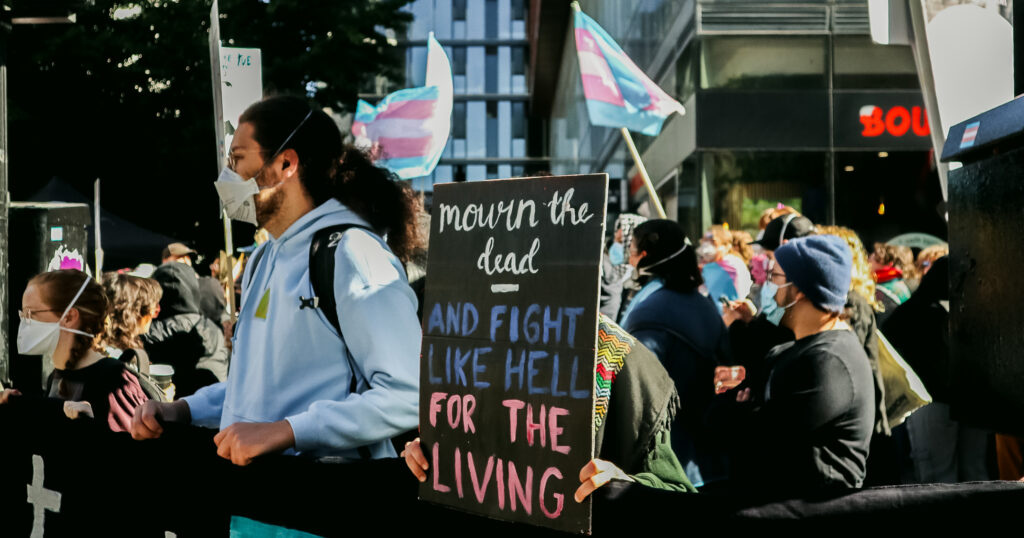
On Sept. 20, approximately 250 counter-protestors gather around 10:00 a.m. in preparation for the arrival of Ensemble Pour Protéger Nos Enfants (EPPNE) members. EPPNE held a demonstration an hour later to oppose the inclusion of 2SLGBTQIA+ identities in sexual education in primary or secondary school.
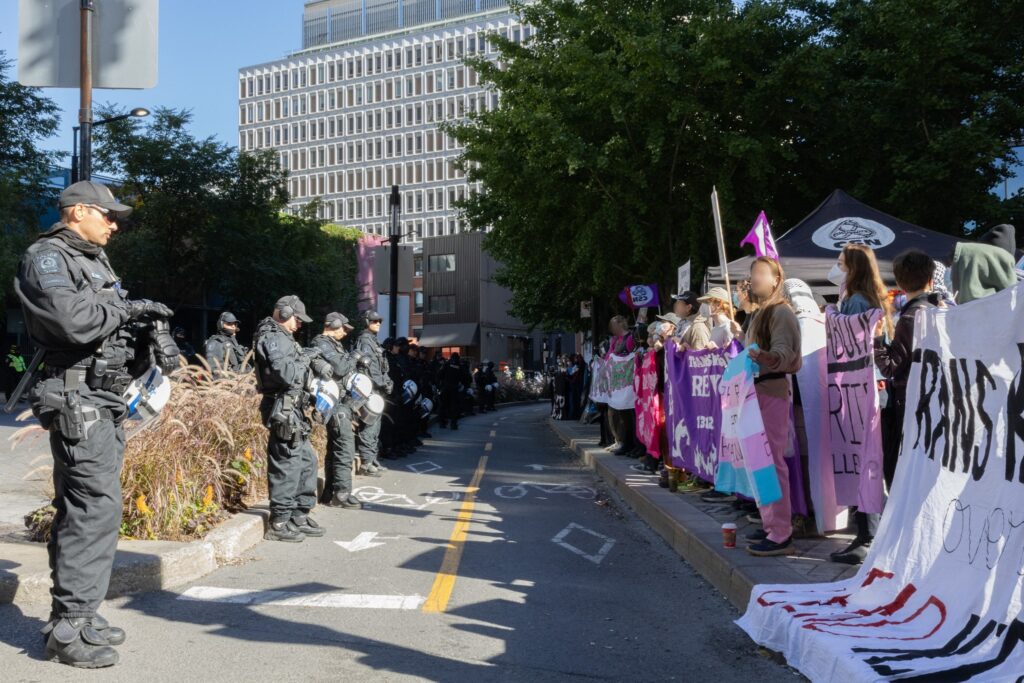
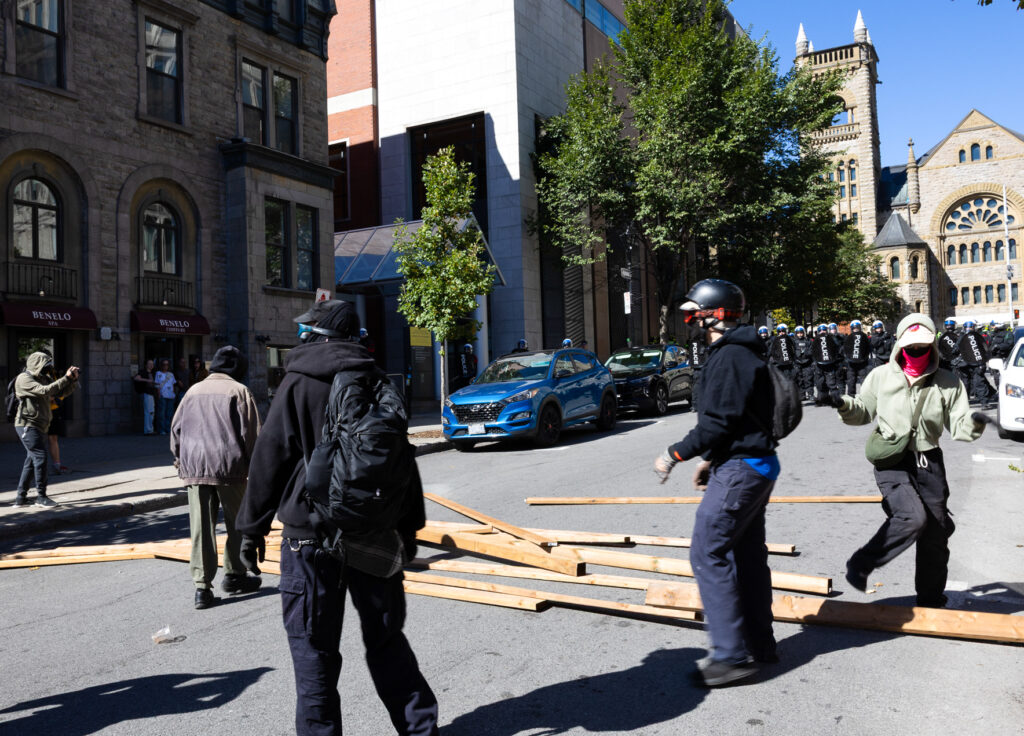
While counter-protestors chant across the slowly growing group of EPPNE demonstrators on de Maisonneuve Blvd., at least 40 police officers in riot gear position themselves on the street, facing the counter-protestors. The police are armed with short and long-range tear gas launchers, which were deployed one month ago against Rad Pride marchers, inadvertently injuring a 10-month-old when tear gas was launched into a crowd of bystanders.
Around 30 members of EPNNE gather in Norman Bethune Square for their third annual demonstration. While the organization claims not to defend homophobic or transphobic ideas, they maintain that gender affirming responses in schools are experimental treatment or abuse.
The EPPNE emphasizes the rights of parents to regulate and control their children’s education. On the testimonial section of EPPNE’s website, parents lament their alienation from children brainwashed by gender ideology, not acknowledging that the alienation may come from their own lack of acceptance.
Transgender Day of Remembrance, coming up on Nov. 20, honours the memory of those lost to anti-transgender violence around the world and calls for action to protect transgender people. The counter-protest was held in honour of Sam Nordquist, a transgender man who was kidnapped, tortured, and killed earlier this year after local authorities neglected to undertake due diligence on several occasions.
Jean-François Roberge, Quebec’s French-language Minister, is set to present legislation banning the use of gender-neutral language in official messages. Although Roberge says the move aims to simplify and clarify communication, its material effect regresses the French language and alienates individuals identifying outside of the gender binary.
One counter-protestor converts EPNNE’s phrase “Leave the kids be!” to “Leave the trans kids be!” EPNNE’s messaging in favour of banning trans identities at school encourages violence and bullying towards transgender youth and hinders their self-acceptance.
A group of counter-protestors place planks of wood on Crescent St. between themselves and the advances of riot police holding shields. The group of counter-protestors was forced to retreat to de Maisonneuve Blvd. when officers charged towards them while hitting their batons against their shields.
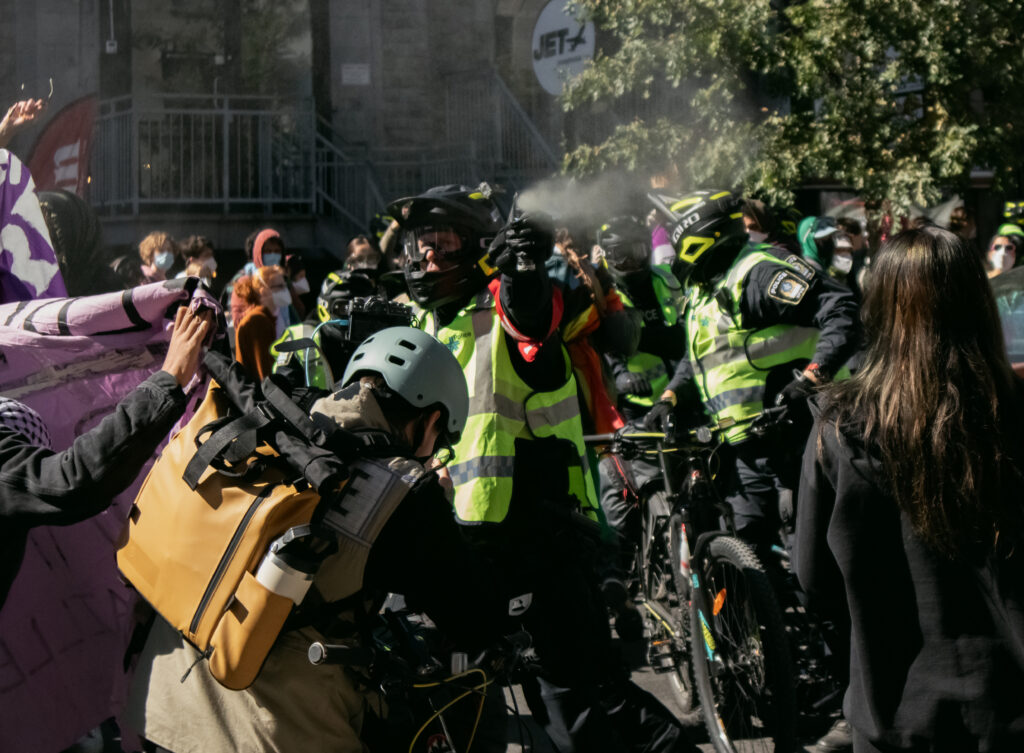
Around noon, officers used pepper spray to push back a group of protestors trying to advance up Crescent St. towards Sherbrooke St. The brutal tactic is common practice for the SPVM, who attempted to break up last year’s counter-protest against transphobia in the same manner.
From Alberta to the United States, anti-trans legislation is appearing throughout North America, targeting educational settings, healthcare providers, and parental and civil rights. Organizations like the Transgender Legal Defense & Education Fund and Egale gather policy experts, lawyers, educators, and organizers to work towards protecting and defending transgender people at all levels of government.
Counter-protestors gather in front of the Roddick gates across from a small group of remaining EPNNE demonstrators around noon, marking the end of the march. Among the chants from counter-protesters, they use, “Queer power,” ”Trans rights are human rights,” and “We’re here. We’re queer. You can’t make us disappear.”
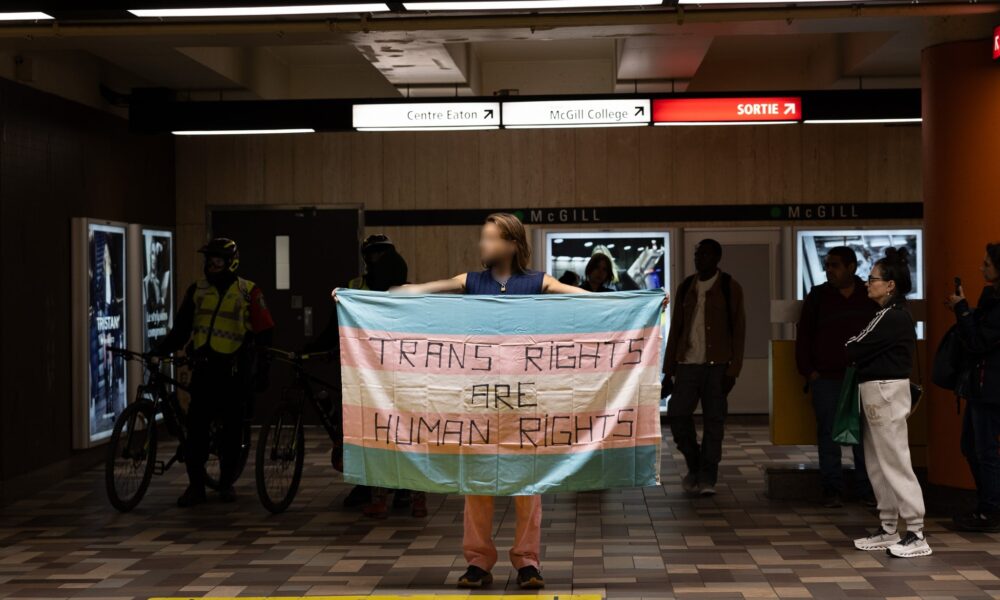
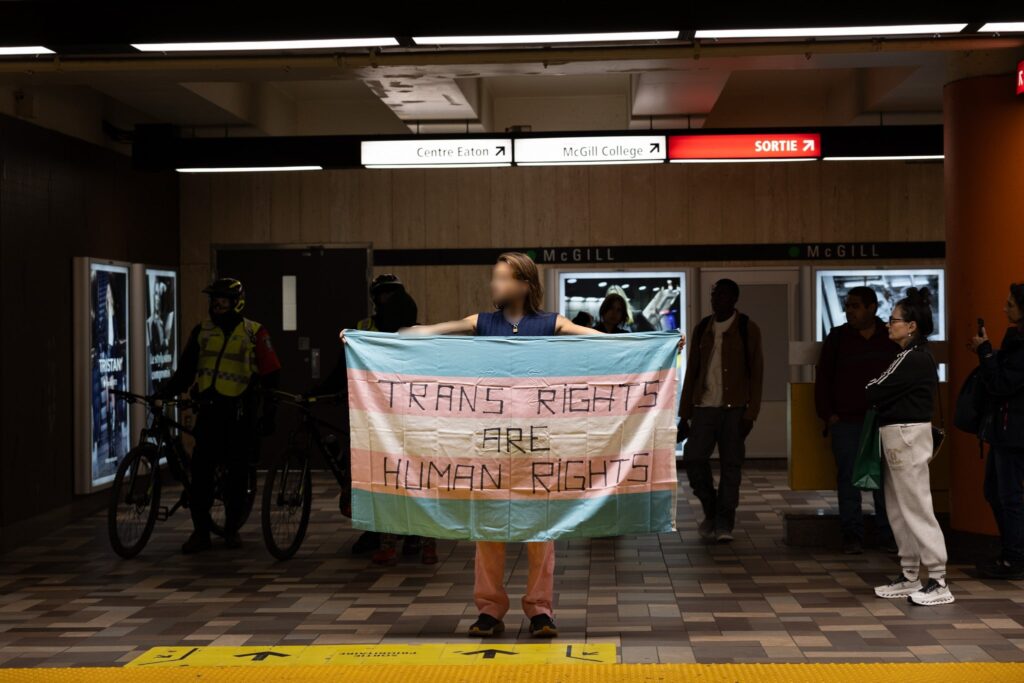
A counter-protester holds a transgender pride flag with the message, “Trans rights are human rights,” inside McGill metro station following the end of the demonstration and counter-protest. In an interview with The Tribune, Celeste Trianon, a front-line advocate for the counter-protest and founder of a legal clinic that supports trans individuals, said, “Schools are already unsafe for trans kids… will [schools] actually protect children, or will [schools] put them in further danger?”

Features

Cher Chez Gautier: Milton-Parc’s next community initiative

Reviving a historical landmark to reclaim public space

Author: Asher Kui, News Editor 

You pass by this intersection daily—whether on a BIXI bike back to your Plateau apartment, or on your stream of grocery shopping activities at Metro and Dollarama in the Complexe La Cité. Yet it rarely registers in your memory, silently blending into your daily routine. Where is it?

On av. du Parc, coin de la rue Milton, are the premises of what used to be Chez Gautier. Originally a fur trading store, it was later turned into a sewing machine shop before pastry chef Moïse Gautier acquired it in 1976. Gautier, who owned the Belgian pastry shop right next door, transformed the small space into a Parisian-style café, which in the 1980s and 1990s attracted many locals and tourists. While it was rumoured that in 2012, his daughter Stéphanie Gautier took the business into her own hands and renovated it in her father’s legacy, Chez Gautier ultimately shut down indefinitely a year later. A real estate developer purchased the property in 2013, and it has remained vacant ever since—along with its unused parking lot.

For 12 years, the empty property has been left abandoned while its futility continued to bring harm to the community socially and environmentally. Today, the Milton-Parc community has spoken: The Chez Gautier campaign petitions for the property located at 3487 av. du Parc to be transformed into a housing program to accommodate the community’s growing needs.

Since 2019, asking rents on the Island of Montreal have surged by 71 per cent. Centraide Montreal announced in 2023 that 360,000 households, representing one in five across the city, cannot afford rent and basic necessities. Amid the soaring housing costs, the Chez Gautier campaign calls on the city to take concrete action. The first step of the campaign is to pressure the city to acquire the land from private estate developers, ensuring its service to the community’s urgent needs.

//Expropriation as a political tool//

In an interview with //The Tribune//, Jacob Réal, Membership Delegate of the Chez Gautier campaign, explained that one of the campaign’s core goals is to set a political example for affordable housing in Montreal.

“The project is part of a fight for decommodifying housing on the Island of Montreal. We aim to establish a political precedent that expropriation of unused land is a possibility in constructing more social housing in the heart of Montreal,” Réal said. “The way of solving a housing crisis [should be] […] a confrontation between locals and land speculators.”

Expropriation is defined as a municipality’s forcible acquisition of private land for public utility through compensating the landowner financially. The Chez Gautier campaign urges Montreal’s city council to use Articles 51 to 56 of the Loi sur la Société d’habitation du Québec to acquire and expropriate the vacant property. While this legal tool exists, the city council has rarely applied it in Montreal’s housing context, making the campaign an ambitious one.

Sophie Keenan, Campaign Assistant of the Chez Gautier Campaign, wrote to //The Tribune// that the campaign remains in its early stages, with a focus on pushing the city to obtain the land.

“Right now the campaign is focused on pressuring the city to expropriate the lot, which would be a precedent-setting victory [….] This is a long-term project,” she wrote. 

To move toward this goal, the campaign is engaging in community outreach and petitioning for enough signatories to trigger a legal process. Yet expropriation raises questions about political will and public perception. Réal highlighted how expropriation, although an effective measure, may be received poorly in the community.

“While [expropriation] is possible, [the city] has never done it because it can be viewed as aggressive towards the neighbourhood’s landowners,” he said. 

While expropriation may face resistance, other recent government actions show where priorities lie. The Coalition Avenir Québec (CAQ) recently drafted a new regulation that reduces the number of variables when calculating annual rent increases—a move many Montrealers see as yet another sign of how the city’s policies favour landlords over tenants.

“We need to change the narrative that the way out [of a housing crisis] is to collaborate with real estate developers and speculators, as they are incentivized to maintain a housing crisis [….] We are trying to use expropriation and direct government action to create a mixed-use neighbourhood that encourages developers to incorporate affordable housing into the city,” Réal said.

In June, the Milton-Parc Citizens’ Committee (MPCC) finalized the Chez Gautier petition, which has since been in circulation around the neighbourhood. Réal noted that the majority of Milton-Parc residents support the project.

//Private landowners vs public need// 

The push to transform Chez Gautier has not been without resistance. While many in Milton-Parc view the campaign as an opportunity to reclaim long-abandoned space for the community, others are concerned about what new housing might bring to the neighbourhood.

Réal acknowledged that some worry the project might increase the number of unhoused individuals in the area, but he described those concerns as out of touch.

“There are a few neighbouring groups that are vocally against the project, but their point of view is, frankly, not in tune with reality. They accuse us of wanting to establish a second La Porte Ouverte […] or even working in secret for them.”

La Porte Ouverte is a shelter that supports people experiencing homelessness, offering different events to accompany unhoused individuals towards a better quality of life. Yet a group of nearby residents has complained that La Porte Ouverte’s presence has attracted people experiencing homelessness to the neighbourhood. 

Benjamin Forest, associate professor at the Department of Geography at McGill, wrote to //The Tribune// explaining that in urban theory, people experiencing homelessness are usually not in neighbourhoods with high housing costs.

“[Unhoused peoples’] locations are influenced both by the location of services available and by policing decisions [or in other words, whether] the police permit [them] to stay,” Forest wrote. “Social services tend to be located in low-income areas and police will typically funnel the homeless into lower income areas.”

Nadine Mailloux’s report //Don’t Look the Other Way// investigates a complaint made by a group of Milton-Parc citizens, which calls the homelessness situation in the neighbourhood a crisis due to the severity of safety problems, insalubrity, and violence. While the complaint ultimately aims to change the government’s approach to ending chronic homelessness, it nonetheless reflects a tension common in many urban areas, where anxiety about safety and cleanliness overshadows evidence of the systemic conditions that sustain homelessness.  

Moreover, homelessness affects Indigenous Peoples in Canada disproportionately. According to the 2018 census enumeration of unhoused persons, Indigenous Peoples made up 12 per cent of Montreal’s people experiencing homelessness, while representing less than one per cent of the city’s population. This stark disparity illustrates that homelessness cannot be reduced to mere neighbourhood-level complaints—it is tied to Quebec’s colonial legacy that continues to challenge and discriminate against Indigenous Peoples.

Still, Keenan emphasized the importance of not drawing preliminary conclusions based on demographics, as this may manifest false assumptions. The information must be handled with care.

“I push back against highlighting a specific group as the most ‘unhoused’ […] as these types of assumptions turn into misconceptions and stereotyping that we have been working to unpack in our community engagement,” Keenan said. “Wherever they might hail from, we want to propose a systemic solution to a systemic problem, aiming to avoid talking points that lean too heavily on identity politics frameworks while striking a balance of recognizing specific needs and specific ways of living.”

Keenan affirmed that through the Chez Gautier campaign, the Milton-Parc neighbourhood will reap benefits no matter what form of housing program it assumes.

“No matter whether the lot becomes a co-op for elderly people, non-profit housing for low income families, or permanent housing for unhoused Indigenous individuals, it will positively impact the safety and well-being of the neighbourhood,” she said. “Safe and comfortable housing cannot be more of a detriment to the neighbourhood than an ugly, abandoned lot which continues to negatively affect the health and perception of the neighbourhood.”

//Environmental stakes and urban development//

Chez Gautier also claims that the empty parking lot contributes to the urban heat island effect, negatively impacting the health of residents. Low-income families are disproportionately affected due to limited access to air conditioning, while the elderly are vulnerable due to reduced heat tolerance.

In an interview with //The Tribune//, Raja Sengupta, associate professor in the Department of Geography and the Bieler School of Environment at McGill, clarified that the urban heat island effect is actually a nighttime phenomenon.

“All of the solar radiation that’s falling on the concrete around us, especially in downtown Montreal, is going to heat up and get stored,” he said. “The tall concrete structures absorb all that energy [which is released] for the next four or five hours. At 1:00 a.m. at night, that’s when the night temperature is six to seven degrees warmer [than rural areas].”

He continued to explain that the intensity of the urban heat island effect depends on two factors: Sky view and vegetation. While the Chez Gautier campaign affirms that constructing a building on an empty parking lot may ameliorate the urban heat effect, Sengupta’s research provides an insightful imperative.

“Put green roofs on top, and you [may] see a reduction of what is called surface urban heat island. If you were to convert the parking lot into a green park […] the nighttime temperature [may be reduced] by one degree,” Sengupta said. “Why not more? The area has other buildings. [Putting vegetation on one building] is not going to [instantly] bring the temperature down by 9 degrees.” 

While one project cannot undo the structural drivers of the urban heat island effect, each redevelopment may promote positive change and continue a trend of ecological urbanism. Choosing to incorporate green design elements—such as a rooftop garden—is a huge leap towards improving the quality of life of Milton-Parc residents.

When navigating between fostering social and environmental improvement along with conserving the city’s patrimony, Réal expressed his skepticism toward the city council.

“The city poses extremely strict regulations on certain individuals, but gives a lot of freedom to developers, often distributing exemptions,” he said. “The only way to preserve the character of a neighbourhood is to involve the local community in decisions that involve development.”

The Chez Gautier campaign stresses that both environmental and heritage concerns must shape development decisions, and that community participation is essential to building an ecological and patrimonial future. 

//A long-term vision for Chez Gautier//

Keenan maintained that Chez Gautier will be a long-term project, and that predicting a calendar as of today is unrealistic.

“If the petition succeeds and the city moves forward to expropriate the lot, we will confer with experts to conduct the necessary studies and community consultations,” Keenan wrote. “It is hard to know what a realistic timeline will be at this current stage, but the project will most likely have multiple phases over multiple years.”

In the meantime, McGill students have plenty of opportunities to get involved in the Milton-Parc community. The Milton-Parc Food Bank and Midnight Kitchen are food cooperatives that work to increase food accessibility in the neighbourhood. Art Hives brings residents together through art sessions, while La Porte Ouverte is seeking volunteers to support its mobilization and administrative efforts.

Too often, students remain in the McGill bubble, detached from the realities of the city. But it’s time for McGill students to stand up for their community. Our strength lies in our numbers. McGill’s enormous student population must show the community that we care. Sign the Chez Gautier petition, keep up with information, and volunteer. Milton-Parc’s future is in our hands. 

Keenan called for McGill students to approach the people experiencing homelessness with empathy and compassion.

“This area is so populated by young people but many of these [unhoused] individuals go ignored for most of the day [….] Saying hello and offering a smile to individuals who reside on the sidewalks on their walks to and from school is a very simple start for students,” Keenan wrote.

“Remove your bias from pretending that poverty is invisible,” she wrote. “Human kindness does not always require pocket change.”

//For more information and instructions on signing the petition and subscribing to their newsletter, visit the Chez Gautier website.//

//*Quotes from Jacob Réal were translated from French.//

Science & Technology

When will the Generative AI bubble pop?

With the increasing presence of Artificial Intelligence (AI) in everyday life, professors are grappling with the extent to which AI should be allowed in the classroom. Some allow AI as long as usage is disclosed, some strictly prohibit it, and others view it as a tool that encourages students to cheat themselves out of an education. Despite mixed perspectives from its professors, McGill has taken a definitive stance: Integrating AI use into academia. 

The university promotes AI usage in its new module on MyCourses titled “Generative AI for Teaching and Learning,” where students and professors alike can explore McGill’s recommended Generative AI (Gen AI) prompts. 

The module, designed by Associate Director of Learning Environments for Teaching and Learning Services Adam Finkelstein, offers a variety of services, including prompts to help create semesterly study plans and guides to navigating tricky social situations. 

“In 2023 the [Academic Policy Committee’s] Subcommittee on Teaching and Learning (STL) created a working group on AI that drafted recommendations on using Gen AI for teaching and learning at McGill. One of the key recommendations, later received by Senate, was to develop an ongoing university-wide awareness program on using Gen AI in teaching and learning,” Finkelstein wrote to The Tribune.  

The module focuses on three key areas: Vitality of using AI ethically and responsibly; Gen AI for teaching support; and Gen AI for student learning support. Finkelstein emphasized the importance of including AI ethics at the beginning of the module, focusing on AI malfunctions like bias and hallucinations, as well as prioritizing safe AI use to protect users’ privacy. 

“Part of the rationale for providing examples of how to use Gen AI to support learning is to help close the gap between the students that are already successfully using AI to support their learning and those that have never used it at all,” Finkelstein noted. 

Despite controversy among professors and students alike surrounding the extent to which AI should be used in the classroom, Finkelstein maintained that the university must evolve alongside technology. 

“AI is here, in almost everything we do, so we need to address it head on and not try to avoid the dialogue on its impact.” 

This rhetoric echoes debates that took place following the invention of pocket-sized calculators and their potential use in schools throughout the 1970s. Many worried that calculators would stunt students’ computational abilities and make them overly reliant on machines, preventing them from learning through mistakes. Today, calculators are not only accepted but required for many courses. 

However, AI is not the calculator. In fact, calculators are still disallowed in early education to emphasize the importance of young students learning fundamental math skills. The difference with AI is that it has the potential to serve not just as a calculator—an instrument to cut out the middle man of tedious arithmetic—but as a convoluted, robotic writer. While McGill’s Gen AI module encourages the use of AI to cut out the tedium of creating study guides and increasing memory and retention, does it act as a method of damage control, reducing stress and thus reducing cheating? Or does it risk acting as a gateway drug of AI reliance, diminishing students’ necessary exercise of critical thought? 

Considering the controversial and highly-debated nature of AI-use in academia, The Tribune sat down with Renee Sieber, associate professor jointly appointed in the School of Environment and the Department of Geography. Named one of the Top 100 Brilliant Women in AI Ethics for 2025, Sieber provided helpful insight into what a future of AI, or a lack of one, could look like. 

“Well, first of all, a calculator does not reason,” Sieber told The Tribune concerning the comparison with the calculator. “We tell calculators to do a bunch of steps, but what we’re instead doing is giving the reasoning over to AI, so these are not the same thing.” 

Not only is Gen AI incomparable to the calculator, but its side effects are far more detrimental. Sieber emphasized the need to think more critically and ethically about AI use—an aspect she feels is missing in McGill’s Gen AI module. 

“There are always problems when one talks about ethics in the classroom, especially in reference to technology, that it is shelved to the last possible moment, compressed into the last week or a single class, instead of being infused, diffused in all aspects of the technology,” Sieber said. 

Furthermore, Sieber raised concerns with widespread Gen AI use: On a global scale, AI adoption among larger firms has already been declining since the middle of 2025, as 95 per cent of Gen AI adoptions have found 0 per cent return on investments. Beyond the implications of Gen AI shrinking the entry-level job market, there is a chance that the implementation of Gen AI itself will also soon shrink. 

“The venture capitalists that are pumping enormous amounts of money in […] haven’t seen the investment,” Sieber noted. “And when we have this infrastructure, whether it’s a data centre or it’s money—when these run out, what’s going to happen?” 

McGill’s Gen AI module encourages AI use among professors—a priority that Sieber worries will result in decreased demand for teaching assistants (TAs). The module for teaching includes sections describing Gen AI use for creating course outlines, developing assessments, and assuring clarity. There are also sections describing how to design AI in or out of a course. 

“What makes me very distrustful is that […] the subtext of those modules is you don’t need teaching assistants anymore. You can use the AI to do the work of the teaching assistants or to do your own evaluations.” 

She goes on to describe the likely low lifespan of Gen AI, as investment returns are underwhelming and datacentres are running out of internet content to harvest. Her worry is that modules, such as this one, will discourage the hiring of TAs and other teaching support, which will be detrimental in the case that Gen AI dies out sooner than expected. 

“It has enormous, incalculable implications for education. So you destroy the infrastructure of education, […] and then we have to regenerate everything. Sometimes you can’t regenerate stuff,” Sieber urged. “You can’t regenerate that stuff after it’s been hollowed out so much.” 

Sieber concluded by describing another key aspect she feels the module is missing: How Gen AI can shape how one thinks. Gen AI is often denoted as an objective source, but Sieber argues that this is not completely the case. She references instances where Gen AI has filtered out events of radical activism concerning the protection of the environment, focusing instead on smaller ‘band-aid’ fixes. Though these filters can seem negligible, the wider impact has slow and worrying effects. 

“It is changing our brains cognitively and what we think is acceptable in subtle ways,” Sieber described. “You tell the technology something which feeds something back to you, and you get shaped in how you think about the world.” 

While Gen AI may seem like a quick and easy solution to hasten the teaching and learning processes, the downsides heavily outweigh its convenience, branching out to many different areas of harm: Accelerating environmental destruction, gutting the infrastructure of institutions beyond repair, and altering the ability to think critically. In a period where Gen AI is pushed as an inevitable technology that must be integrated into our daily lives, it is important to remember the corruption that is entangled within. The tedium of creating a course outline or a study guide is not the enemy, and it surely is worth the protection of our environment, our universities, and our brains.

Read the latest issue

Read the latest issue