Latest News

Instagram, Student Life

A look into McGill’s fashion scene: ’90s style is back

When walking through the McGill campus for the first time, visitors might be struck by students’ diverse and bold fashion choices. With such an international student body comes a plethora of colours, textures, and attitudes—and students don’t hesitate to break nearly every fashion boundary out there. Among the most popular trends of the past few years are alternative looks from the ‘90s. From all-denim outfits to scrunchies galore, students are repping looks reminiscent of their favourite sitcoms and old photo albums. The McGill Tribune spoke to students on campus who embrace ‘90s grunge about what they wear and what it means to them.

(Jasmine Acharya / The McGill Tribune)

Emily Mernin, U3 Literature

“I have this great chair in my apartment that I always try to dress like.”

Edna Wan, U3 Literature

“I made this dress this summer, and this jacket, my grandma made for me [….] I had a dream the other day that instead of going to grad school, I went to textile design school.”

Micah Flavin, U3 Psychology, Education, & Anthropology

“I lived a few years ago at a […] therapeutic life sharing community, where I was helping people get dressed in the morning and that was actually a big moment where I understood fashion, and, what we wear and why we wear it in a different way [….] I think if you can actually take a moment in the morning and see where you are actually at, [it’s] a good exercise in self inquiry.”

(Jasmine Acharya / The McGill Tribune)

Michaela Drouilard, U1 Classics

“These pants are from a vintage shop from my home town of Windsor. This jacket was eight dollars from Value Village. The reason I have a flip phone is because this summer, when I was in [Los Angeles], I was really focused on my [smartphone] and was on social media [a lot, so] I threw my phone in the ocean. [When] I came back, I had this flip phone already […] and now I am living a better life.”

Adam Elder, U1 English Literature

“I am a green earth-tone type of man. I got these shoes in Scotland. And you know, the pants are Levi’s. I [am wearing] some plaid socks, a Hanes t-shirt, and then a good old Banana Republic jacket.”

Sasha Huebener, U2 English & Communications

“I am wearing these really extra shoes, and I know Halloween is over, but I’m still about it [….]  Aimee Song from Song of Style is my go-to for when I don’t know what to wear, and Alexa Chung, she’s cool.”

(Jasmine Acharya / The McGill Tribune)

Kyra Kwak, U2 Gender Studies & International Development

“I usually try to go for a colour palette. Today I was feeling neutral tones. I thrifted these [boots] and just got paint all over them. This [skirt] is stolen from my roommate [and] this coat is thrifted, [but originally] from Old Navy somewhere. [My shirt] is from my grandma, and I made it into some kind of [top], and this [ring] is a gift from my parents”

Martin Law, U3 Urban Systems

“I like to skate, so most of what I wear are skate brands, I guess. I just slap on whatever feels right. It was really cold today so this is a thick jumper and it feels cozy [….] I stole this [hat] from my roommate.”

Features

Climate barbies and superheroes

The tension was palpable at a Nov. 3 press conference in Vancouver when Environment Minister Catherine McKenna stood up to a reporter from Rebel Media, asking that the organization refrain from calling her a “Climate Barbie.” The initial comment resulted in a ferocious back-and-forth exchange in which the Rebel reporter, Christopher Wilson, claimed that he had never personally used the derogatory nickname—a blatant lie. The term has been used repeatedly by the reporter on his Twitter account. McKenna’s risk in making this statement was clear, and things got pretty awkward. Yet McKenna, more than most, understands that sometimes women need to brave discomfort and ridicule to stand up for their right to be treated as legitimate politicians.

McKenna assumed office in October 2015 as Liberal Member of Parliament (MP) for Ottawa Centre and was appointed Minister of Environment and Climate Change in Trudeau’s Cabinet the following month. As a leading female figure in federal politics, she is keenly aware of the ingrained sexism.

In the House of Commons, this often takes the form of disproportionate heckling toward female MPs during question period. Bullying has only worsened in the age of social media, when private citizens turn to Twitter and other online platforms to perpetuate sexist rhetoric.  

“[When] I went into this job, […] I don’t know that I expected that some people would decide that it was OK to call me names, and make fun of the way that I dress, or speak, or look,” McKenna said in an interview with The McGill Tribune. “I’m quite happy to take people on, or have discussions about policy […] but having to also do this rear guard action about things that are completely irrelevant to what you’re trying to do […], that is tough.”

Former MP Rona Ambrose is one of only three women in Canadian political history to serve as Leader of the Opposition. She was a strong champion for women’s rights during her 13 years in politics in her various positions in the Cabinet and as leader of the federal Conservative party from November 2015 to May 2017. Before leaving politics, she introduced the groundbreaking Bill C-337, legislation that would institute mandatory sexual assault training for judges. The bill passed unanimously in the House of Commons in May, but has yet to go through the Senate.

Martlets, Sports

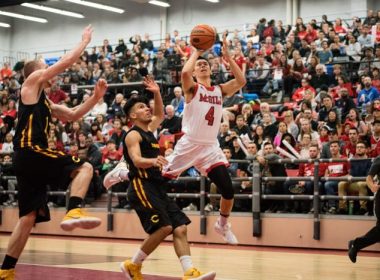
McGill Martlet volleyball defeats Gee-Gees at home

On Nov. 10, the McGill Martlet volleyball team (5-1) soundly defeated the University of Ottawa Gee-Gees (2-5) in straight sets. The Martlets’ commanding offence was too much for the Gee-Gees, propelling McGill to a quick victory.

McGill came out strong and maintained a lead across all three sets. The Martlets repeatedly dug balls up and hit well against their opponents. Second-year Claire Vercheval praised the team’s consistent, solid performance.

“We applied the game plan right from the get-go,” Vercheval said. “We didn’t start slow, and we really played our own game.”

The first set was a close contest. McGill maintained a lead for the majority of the stanza, but Ottawa managed to close the gap near the climax of the set. In response, the Martlets made effective use of their timeouts to remain calm and focused, winning the first set 25-23. Martlets Head Coach Rachele Beliveau highlighted the stretch as a key moment of the game.

“Volleyball is a game of concentration and momentum,” Beliveau said. “So [by] stopping the momentum from the time out, refocusing on our side, [we could] go back and play the game.”

McGill dominated the remaining two sets, winning 25-15 and 25-20. Over all three, McGill’s offence was lethal. Vercheval led the attack with 13 kills, and was particularly dangerous for the Martlets, scoring points from both the front and back rows.

Fourth-year setter Thara Dawoodjee explained that any time Ottawa’s offence heated up, McGill shut them down quickly.

“We were just confident in our abilities so we were able to side-out really fast,” Dawoodjee said. “If they went on a run, we were able to just kind of snap [their] streak and get back and side-out.”

Solid defensive play further supplemented the Martlet offence. Libero and graduate student Marjolaine Ste-Marie led the team with eight digs, while second-year Rowan Fletcher, who led McGill with three blocks, shut the door on the Ottawa attack at key moments in the game.

Despite the strong showing, the team still has progress to make.

“There’s still a lot of things to work on,” Beliveau said. “We don’t play [a] perfect game yet [….] Certainly we’re going to keep working on defence, which was one of our weakest skills, [and] we want to keep a good offence and keep working on it.”

On Nov. 12, the Martlets faced off against the Sherbrooke Vert et Or, defeating them 3-1. The team’s next home game is on Nov. 24 against the Vert et Or.


Moment of the game

At match point in the first set, second-year Rowan Fletcher stuffed an Ottawa hitter with a monster block to win the set for the Martlets.


Stat Corner

Despite a 42-26 deficit in total digs across all three sets, the Martlets outscored the Gee-Gees in both kills (36-24), and total points (48-34).


Quotable

“When you try to jump in the air, you really try to look [where defenders’] hands are [.…] When the ball comes to me, it’s like ‘okay [their] hands are there’ and I’m going to go over there.” – Second-year power hitter Claire Vercheval, on her approach to hitting the ball.

Arts & Entertainment, Film and TV

‘The Florida Project’ finds grace in the kitschy margins of America’s Sunshine State

In his previous film, Tangerine (2015), director Sean Baker generated instant buzz by using an iPhone 5S to capture the intimate stories of transgender sex workers. It is a loud and frantic work, but through the grounded perspective of a phone camera, the under-represented voices on screen become undeniable. His latest effort, The Florida Project, the story of a young girl’s life in an extended-stay motel, does away with clickbaity filming techniques in favour of regular old 35mm—but sacrifices no authenticity in the trade-off. 

The film follows Moonee (Brooklynn Prince), a six-year-old living with her young single mother Halley (Bria Vinaite) in the Magic Castle Motel, a garish purple building in the gaudy state of Florida. The film gives little information on the family’s background, and Baker instead chooses to focus on the motel itself as his main subject. Other children come in and out of the motel’s periphery, various situations and vignettes roll by, but the film remains anchored by the beautifully tacky locales of its Disney World-adjacent setting. The children propel the camera’s movement, lending an outlook that transforms a region thought of by many as a wasteland into a huge-yet-homey escape. Baker, along with cinematographer Alexis Zabe, film gift shops and strip mall monstrosities as if they were glorious landscapes, dropping the viewer into the oversized world of a child, and creating a palpable sense of loss when it inevitably begins to shrink.

Just like in Tangerine, Baker has strong empathy for his actors in The Florida Project, and allows them to fully inhabit their characters without resorting to expositional dialogue to flesh them out. Aside from a small role played by Get Out’s Caleb Landry Jones, the only established actor in The Florida Project is Willem Dafoe as the motel’s manager Bobby. For a man famous for his unsettling face, Dafoe’s performance is genuinely heartwarming. Dafoe plays off of his co-stars and scenery with compassion, making his performance worth much more than star power. The truly marquee performances of the film, however, are those of newcomers Prince and Vinaite. The two have a natural chemistry, and while their lack of film experience shows in small doses,—some moments can seem ham-fistedly sweet—their relationship becomes completely engrossing over a two-hour span. 

The film builds to a powerful climax, and though its plodding pace and lived-in world are some of its major strengths, the gut-punch of an ending can at times seem, tonally, like a different story entirely. This world thrives on repetition, with much of its power coming from familiar neighbourhood sights. The ending’s diversion from that structure feels more like a departure rather than a natural progression. There are clear moments of development scattered throughout—mostly regarding the effects of Halley’s dissolving relationship with the motel—but the amount of time allotted for them paying off feels particularly rushed. So much space is allowed for growing with the characters at their own pace that the narrative has to catch up a little too quickly. 

Any narrative problems the film encounters, however, are only noticeable because Baker has created such a real world—making filmic set pieces seem unnecessary. Grounded indie films too often feel the need to surround their realism with well-worn structures and clichés, and it is refreshing to find one that, for the most part, feels genuinely inhabited and natural. By leaning into its world and its characters, The Florida Project takes an area defined by preconceptions of its insignificance and injects it with an undeniably real scale and personality.

The Florida Project is currently screening at Cinéma du Parc and the Cineplex Odeon Forum.

Soccer, Sports

#WNTRivalry: A new chapter in Canadian women’s soccer?


Canada
1


United States
1


On Nov. 9, over 28,000 excited fans gathered in BC Place in Vancouver, hoping to cheer the Canadian women’s national soccer team on to victory against their American counterparts. In the end, the Canadians were held 1-1 in the first of two matches last week. Canada’s strong play was a marker of something bigger—their desire to establish themselves as consistent, legitimate contenders on the international stage.

Though only a friendly match, the hype for the game was considerable. Ever since Canada’s landmark bronze medal finish at the 2012 London Olympics—plus Christine Sinclair’s historic hat trick in the semifinals—the women’s national soccer team has held a special place in the hearts of Canadians. A generation of young female players look up to this team and have been inspired by their play for years. The marketing team capitalized on fans’ excitement, with the hashtag #WNTRivalry trending on Twitter before the game.

Canada hasn’t played the United States since last year, but welcomed the opportunity to play the best women’s team in the world. The Americans, too, were anticipating the chance to play on away turf, as this game marked only their seventh game beyond their borders since they won the FIFA Women’s World Cup in Vancouver in 2015.

The game got off to an exciting start, with both teams scrambling to make an early mark. In the early minutes, American striker Megan Rapinoe found the inside of the far post, but the shot defied the laws of physics, deflecting away from the goal line rather than behind it. Though neither team was able to maintain consistent possession, the Americans penetrated the Canadian defensive line with a number of dangerous through balls. In the 31st minute, after an unsuccessful clearance by Canadian keeper Stephanie Labbé and her defenders, American striker Alex Morgan muscled her way in the box to strike a bouncing ball into the back of the net.

Despite the opposing goal, Canadian heads remained high. Though struggling to maintain possession, the Canadian team moved the ball well on the ground and increased its offensive efforts. The arrival of left-winger Adriana Leon onto the field in the 31st minute brought a burst of intensity up top. Forward Nichelle Prince patiently and persistently troubled the American defence down the right wing, creating a number of opportunities for the Canadians. Though they were one goal down at halftime, the Canadians had outshot the Americans five to four.

The second half opened the same as the first closed, with Canada pressing forward for an equalizer. The team’s efforts were rewarded after defender Rebecca Quinn pinged the ball off the crossbar, allowing Leon to poke the ball over the line during the ensuing scramble in the box in the 56th minute of play. The Americans responded with substitutes Carli Lloyd, Taylor Smith, and Christen Press, who brought energy onto the pitch at the 65-minute mark.

As both teams pushed on for a winning goal, more chances opened up. Canadian striker Meagan Kelly joined the game and, racing forward on a bouncing through ball, was denied the game-winner by U.S. goalie Alyssa Neaher, who pushed it just wide of the post.

The Canadians, though disappointed to not come away with the win, were pleased with their performance. Historically, the U.S. has dominated Canada in soccer: Canada’s last win was in 2001, and overall they’ve lost 49 of their 59 matchups against the Americans. With such a record, the two teams could barely be considered competitive rivals, the Nov. 9 game showed otherwise. With only 19 months remaining before the 2019 FIFA Women’s World Cup, Canadian soccer fans were given a glimpse of a newly competitive team—one that is capable of topping their best-ever fourth place World Cup finish in 2003. Perhaps this marks the start of a new chapter for Canadian women’s soccer, where the #WNTRivalry could legitimately become just that.

Ask Ainsley, Student Life

Ask Ainsley: How do I leave my friend group?

Dear Ainsley,

I have been thinking about moving on from my friend group for a while, because they aren't really serving me anymore, and I think it's time. The hard part, though, is that we've been a set group of friends for years, and I'm not sure how to casually distance myself. How do I make it clear that I need to grow and do what's best for me without burning bridges?

Sincerely,

Wanting to Leave (WTL)


Dear WTL,

It’s great that you’re prioritizing your needs and recognizing that you need to make a change in order to better yourself. I wish I could give you a simple answer to this question, but unfortunately it’s rather circumstantial. I think the first thing you should do is think about why you want some distance from these friends—did they do something to hurt you? Or are you just feeling annoyed or bored by them? Take the time to figure out what it is that you value in a friend—or group of friends—that you don’t seem to have already.

There are a few things to consider before cutting yourself off from your friend group. If you’re simply feeling like you don’t have much in common with them anymore, or you’re feeling unstimulated when you’re around them, this is actually quite common. In fact, research shows that the average person only has one to two close friends who they feel completely comfortable around, but the other friends in our lives serve meaningful purposes in other ways, and are not to be discounted. However, if you find that something traumatic has happened or that your friends are toxic, it is probably more important for you to leave than if you’ve simply grown bored with your friend group.

Also, there’s more to friendship than just the way your friends are “serving” you. Remember that friendship is a two-way street; you have to put in just as much effort as they do, and your behaviour affects your friends’ lives as much as theirs does yours. By leaving your current group for your own reasons, you will probably hurt them.

Rather than completely switching out of your friend group, you could first try focusing on making new friends and adding more supportive people to your life. Keeping others’ feelings in mind, branching out and making new friends is always great—but this should not be done at the expense of your existing friendships. Joining extracurriculars or taking on a part-time job are both good ways of making friends. This way, you’ll meet people with similar passions to yours, which will lead to more meaningful friendships.

Before deciding to leave your group of friends, it would be beneficial for you to be upfront and talk to them about how you’re feeling in order to see if your friendship is salvageable. It’s much better to address the issues you have now than to leave problems lingering without answers, as this will most likely cause more tension between you which might cause you to lose each other permanently. When speaking to your friends about how you’re feeling, remember to use “I” statements, like “I feel sad when you do this,” in order to avoid making them feel guilty or targeted. If you want to save your friendships, addressing your issues is important no matter how difficult it is. And even if it doesn’t work out, knowing you did what you could will leave you with a clear conscience.

Lastly, it’s important to understand that now that you’re older, friends are a lot more permanent and meaningful than in your younger years. Although this is great in many ways, it also means that ending a friendship might be unexpectedly painful and have longer lasting effects. In order to avoid feeling guilty or sad, try and think about how you’ll feel in the future by distancing yourself from someone—and even more if you decide to cut them out of your life completely. It’s important for you to make decisions that will benefit you in the long run, even if they are hard.

Sincerely,

Ainsley

Point-Counterpoint, Sports

Point-counterpoint: Should fans bandwagon or remain loyal to losing teams?

Hop on the bandwagon: Sports fans deserve fan freedom

Gabe Nisker

For the most part, watching professional sports and talented athletes is an excellent source of entertainment. However, it’s not always fun if your team doesn’t win. We cheer for teams precisely because we hope they’ll win. Ultimately, though, we set ourselves up to be hurt, as most seasons end in disappointment. Most teams suffer through down years, only to get to the playoffs—or, even worse, the finals—and lose. Just ask Golden State Warriors fans about how it feels to blow a 3-1 NBA Finals lead. As a fan, there’s one easy alternative to heartbreak—bandwagoning. This way, you can cheer for whoever you want, whenever you want.

There’s nothing like watching a game with no emotional involvement. Although you’re likely to pick a side during the game, ups and downs don’t take the same toll they would on an invested supporter. Consider Game 5 of the 2017 MLB World Series, a closely contested back-and-forth championship bout, ending in a 13-12 extra-inning Houston Astros victory. Unaligned baseball fans didn’t want the craziness to stop. Astros and Dodgers fans, however, couldn’t wait for the end—but only if their team came out on top. When it comes to raising the trophy at the end of the season, most teams go home disappointed. It’s far more likely that your team will be in that camp.

One solution is to pick a set of favourite players. It starts when you become a sports fan. There’s a quality you like in certain players, usually the one that reminds you of yourself. Then, you get attached to these players. It’s actually quite OK to follow them, even if they wear different uniforms.

The word bandwagon shouldn’t have such a negative connotation. Cleveland Browns fans will tell you that their day will come—and that they could never respect someone who walked away when the team hit rock bottom. But, as a sports fan, it’s so much easier to enjoy yourself when you’re winning. There’s more fun to be had in joining the winning side. The highs and lows may not be what you get from commitment to a single franchise, but the consistency far outreaches anything fan monogamy gets you. Winning is just much more fun than losing.


Fans should stick with their teams through thick and thin

Jordan Foy

It feels great to support a successful team, but there’s much more to being a fan than winning. Hopping on the bandwagon is exciting and easy, but it denies the development of a personal connection with a team.

Sticking to one team lets you get to know the players, coaches, and staff more intimately. It is uniquely gratifying to watch the career of an athlete develop, especially if they stay with one team for a long time.

Everyone knows who the superstars are, but some of the less talented professional athletes can be characters, and it can be just as entertaining—if not more—to cheer for them throughout the season. Some teams even have zany traditions, such as the fans of a Nashville Predators who throw catfish on the ice.

Imagine being a fan of a team like the Toronto Maple Leafs, and watching them draft the likes of Auston Matthews and Mitch Marner. If they ever do win it all, the satisfaction will be unparalleled for fans who stuck with the Leafs for the long haul. The years of suffering aren’t always in vain.

Being a loyal fan is a lot like being in a relationship with a person. There are ups and downs, and over time you make memories. At times, it is incredibly frustrating, but when your team finally does succeed, it’s much more rewarding. Take the Chicago Cubs recent World Series victory in 2016 to end a 108-year championship drought. The emotional journey had immeasurable significance for those fans who had stuck with them through thick and thin.  

If your team is in a rut, there’s always hope for the future. Every season is a new beginning—and a chance to move beyond the mistakes of the previous one. Being loyal brings more depth and emotion for sports fans to enjoy.


Editor’s pick:

Sports aren’t always about winning—in the end, it’s much more fulfilling to forge a personal connection with a team.


Baseball, Sports

ExposFest fundraiser makes it clear: Montreal misses its Expos

In 2004, the Montreal Expos left for Washington D.C., leaving the city—and its die-hard fans—without a baseball team. Since then, fans have filled the void elsewhere, with the Toronto Blue Jays exhibition games in late March, or sports memorabilia shows such as the Sports Collectors International at Centre Pierre-Charbonneau. ExposFest, a family fundraiser organized by Expos superfan Perry Giannias, also serves to fill this niche.

“This is my Sunday at the ballpark,” Giannias said with a smile, as hoards of fans lined up at his booth.

As part of ExposFest fundraising efforts, Expos legends—pitcher Ross Grimsley, second-baseman Rodney Scott, outfielder Otis Nixon, and Quebecois pitcher Claude Raymond—gathered to sign autographs and chat baseball with passersby.

In 2015, Giannias’ niece passed away after a year-long battle with Diffuse Intrinsic Pontine Glioma (DIPG), a rare terminal brain cancer. ExposFest was born the following spring as a way to raise funds to combat the disease. Giannias told The McGill Tribune that baseball and his family are two of his greatest passions, and that combining the two in ExposFest was the perfect marriage.

“This was about making a difference down the road,” Giannias said.

Capitalizing on the Expos nostalgia he and many others feel, the main event—held in the spring—brings former Expos into town for autograph signings and family fun. Other fundraisers, like the one at Collectors International, keep the Expos’ legacy alive through the rest of the year.

The smiles on faces young and old brightened the room, as parents introduced their children to their favourite ballplayers or reminisced about days spent at the Olympic Stadium. The memories of summers past filled the air, as tales of classic Expos seasons in the 1980s and 1990s were shared by both fans and former players.

As the afternoon wore on, the conversation at the booth turned to Major League Baseball today. Whenever the topic of those pesky Washington Nationals arose, Giannias shook his head in disdain. Clearly, the team’s departure from Montreal is still a sore spot for many Expos fans across the city, but Giannis is certain Montreal will get a team within five years. He pointed to the support his fundraisers get as proof that the fanbase is still alive and well.

Until then, his presence in the community will not waver, as he continues fundraising and adding to his massive memorabilia collection of over 1,000 monumental jerseys, baseballs, bats, helmets, gloves, and even bases. When asked about his favourite items, Giannias was naturally indecisive.

“You are asking me the equivalent of, ‘which son do I like better?’” Giannias said.

(Gabe Nisker / The McGill Tribune)


He eventually named Maurice Richard’s only childhood baseball glove as one of the coolest items in his possession. Some of his pieces have been displayed at Montreal City Hall, or in Cooperstown at the Baseball Hall of Fame.

It’s an impressive collection—quite like the impressive collection of fans who gather every year to look back on the baseball team the city once cherished. ExposFest has now raised $215,932 for DIPG, and donations are accepted at www.childrenfoundation.com/fundraiser/kat-dipg/. More information about the event is available at exposfest.com.

Montreal, News

Projet Montreal to pursue sustainability initiatives in Plateau-Mont Royal

Following Projet Montreal Leader Valérie Plante’s win in the city-wide mayoral election on Nov. 5, other Projet Montreal candidates swept elections for Borough Mayor, City Councillor, and Borough Councillor in Plateau-Mont-Royal on the same day. The candidates’ victories signal resounding approval of their platforms to improve the economic and environmental sustainability in the borough, where many McGill students live.     

This is a party that cares about accessibility for everyone,” Kiana Saint-Macary, U3 Arts and Sciences and Projet Montreal volunteer, said. “I’m ecstatic about the election results.”

Running for his third term as mayor of the Plateau-Mont Royal borough, which encompasses the Milton-Parc, Plateau, and Mile End neighbourhoods, Luc Ferrandez garnered 65.6 per cent of the vote, defeating Équipe Coderre opponent Zach Macklovitch. The Projet Montreal candidates running for the six other council positions in Plateau-Mont Royal won by similar margins. Ferrandez pledged to carry on with the environmentally-friendly transportation policies that characterized his tenure.  

Beyond the highly-discussed Pink Metro Line, Projet Montreal officials have proposed several other plans to improve transportation in the Plateau-Mont Royal. During his previous terms as borough mayor, Ferrandez lowered speed limits and made many streets one-way to improve biker and pedestrian safety. To build on Ferrandez’s policies, Projet Montreal officials have suggested installing a bike lane heading east on Avenue des Pins.  

“With the collaboration of [the Montreal city council], we'll be able to move quickly on having a secure cycling path that will be helpful for a lot of McGill students who need to go east,” Jeanne-Mance Borough Councillor Maeva Vilain said.

Projet Montreal’s focus on public transportation has impressed many students concerned about the environment, who contend that these projects will reduce the carbon footprint of commuters by providing more alternatives to driving and by shortening travel times. Andrew Figueiredo, U2 Arts, volunteered with Denis Coderre's Plateau team, but agrees with the importance of eco-friendly transit.

“Transportation is so much more than how you get places, it's a matter of sustainability,” Figueiredo said. “The more public transit the better in that regard.”

Projet Montreal officials also emphasized the importance of improving the cleanliness of the Milton-Parc neighbourhood, a frequent point of complaint among residents because of the heavy student presence there. Vilain pointed to a joint project headed by the SSMU Community Affairs Committee and the Projet-led borough government to collect furniture thrown out on the street to clean and sell for future use.

“[Collecting furniture is] beneficial for the cleanliness of the streets but also for environmental issues,” Vilain said. “It's a shame to throw all of that away.”

Yet some students who admire Projet Montreal’s agenda raised concerns about whether the party has sufficient experience to implement their program effectively.

“Most of their candidates were fine and dandy candidates but they weren't people who had a lot of experience, in either government in public services, or even in business,” Figueiredo said. “Many of them were just local activists. There's no problem with that, but when you have a new majority in place, you need to have that experience there.”

Looking forward, Projet Montreal officials expressed the importance of engaging with students and residents beyond the election season.

“I really want people who live in Jeanne-Mance to see that having a university close to them is something positive,” Vilain said. “I want the students to feel aware that they are living in a real neighbourhood and not just on a campus.”

Art, Arts & Entertainment

Artist Profile: Natalie Manchia’s artistry, pragmatism, and success

Entrepreneurial success, artistic ambition, and full-time enrollment can rarely exist in fruitful harmony. Natalie Manchia is a U2 Management student in her third year, combining her business acumen with a love of fashion. She recently created her own line of handcrafted, streetwear-inspired clothing, Natalie Manchia Designs Inc. Over the past year, Manchia’s brand has steadily gained popularity. Her work has been featured on the runways of SynesthASIA, P[h]assion, and Montreal’s Startup Fashion Week. This weekend, The McGill Tribune sat down with her to discuss what it’s like to be a young businesswoman and artist in Montreal.

One of Manchia’s lifelong dreams is coming to fruition. Growing up in Hamilton, Ontario, Manchia always loved doodling and designing; she was taught by her grandmother how to sew an outfit for her teddy bear in the first grade. Her love of the artform was rekindled when she took a fashion course in high school. Around the same time, Manchia began working at a high-end boutique, and says that this is where she learned the most about the fashion industry. The store took a couple clients a day, and employed a skilled seamstress who worked on tailoring upstairs.

Inspired by working at the boutique, Manchia began making one-of-a-kind pieces for herself and her friends. Besides the high school course, she has never received formal training.

"I’ve never learned how to properly sketch something, or what all the proper seams are,” Manchia said. “If you look at the way I create something, the stitching is pretty straightforward. It’s nothing too fancy, and some of the things that are [fancy] I learned on YouTube. Because of that I feel like my process for making things is really unique.”

While studying at McGill, Natalie has experienced tremendous artistic success. She was first approached to show her designs in the SynesthASIA fashion show, and was then featured in a show for P[h]assion, where she is the clothing coordinator.

After positive feedback from these two events, Manchia decided to apply to participate in Montreal’s Startup Fashion Week. She landed a spot as the Showcase Designer in the organization’s launch party this past summer.

Manchia is now in the process of creating a website for her brand, which is scheduled to be out before the new year.

Anything I’ve ever made I’ve only sold through friends, and I wanted to get out of that,” Manchia said. “I know I’m making something worth a certain amount. I know how much time I put into it and the quality of the fabric. People said to me ‘why don’t you do an etsy thing?’ and I said no! If I’m starting a website I want it to be legit. I want it to be like Zara, like Nasty Gal, you google my name and that’s what comes up.”

Living as a student and young female entrepreneur can be difficult. For example, Manchia does not shop for fabric in Montreal anymore, because she has found that her questions about fabric quality and pricing were not being taken seriously. She has also experienced being underestimated in the business world.

"People just don’t see me as a serious businesswoman,” Manchia said. “Yeah I can create and design these things, but I have great ideas. I’m smart. I can balance my own books if I want to.”

The young designer’s next move is an internship in Milan this coming summer. Fueled by her ambition, drive, and creativity, Manchia’s line is sure to be a hit when her website is launched.

"This is my dream,” Manchia said. “And if it takes me longer to get there that's ok, because at least I know where I want to go.”

Read the latest issue

Read the latest issue