Latest News

Student Life

Getting inked: The realities of tattoos in the workplace

The growing prevalence of tattoos in North American media and in society at large has made them an attractive option for students today. Increasingly, figureheads of social and political importance have revealed their tattoos to the public, including Canadian prime minister Justin Trudeau and Samantha Cameron, wife of the Prime Minister of the United Kingdom; however, tattoos still carry with them the possibility of discrimination from employers, which can be limiting for many in the choice of whether or not to get inked. 

One precaution commonly taken before getting a tattoo is to locate it strategically so that it can be covered up, if need be, for professional and formal environments. For some, finding a location on their body that can be easily hidden is a preliminary step to getting a tattoo. 

Trudeau, for example, has been cited as the only world leader with a tattoo known to the public. This does not mean that no other world leaders have tattoos, but rather that he is the only one who has made it publicly known. In the world of politics and other white-collar careers, visible tattoos are not widely acceptable, and may be seen as a sign of informality or disrespect for the profession. 

“Depending on the industry, tattoos can be more or less acceptable,” Cindy Mancuso, Arts and Diversity advisor at the McGill Career Planning Services (CaPS), said. “Students need to use their good judgment when going for an interview. Most individuals I’ve seen with tattoos have them in places that are easily hidden. For most interviews, we suggest that individuals [err] on the side of dressing up if they are not sure what the attire should be. Unless someone has tattoo sleeves, or tattoos on their hands, face [or neck], they usually get covered up with the appropriate attire.”

Further, in some professions, employers reserve the right to regulate the dress of employees with visible tattoos. Tess Kaiser, U2 Arts, has firsthand experience with such a policy.

“I worked at a German restaurant where the waitresses had to wear dirndls, the traditional German dress,” Kaiser explained. “There were a couple of girls where, even though it was hot and it was the summer, they had to wear shawls because they had tattoos.”

Kaiser also suspected that her employment prospects were decreased because of a tattoo on her upper back. 

“[My tattoo] could have been part of the reason I didn’t become a waitress there,” Kaiser said. “I was never [promoted] when other people were; I was just a busser. They knew that I had a tattoo; I don’t know if that was entirely it, but I’m sure even if I did become a waitress there, it would’ve been an issue. I would’ve had to cover it up.”

The negative societal connotations of tattoos have long-ranging impacts across many fields beyond the service industry. Andrea Terceros, U1 Neuroscience, who has several tattoos on her arms and hands, can anticipate receiving pushback against her tattoos in the medical field. 

“I guess going to [medical] school, there are people who don’t necessarily want to see their doctors with tattoos,” Terceros said. “There’s a bit of a stereotype and a stigma […] [Were I asked to remove my tattoos by employers,] if that’s my dream and they want that, I would probably remove them.” 

On the other hand, many people get tattoos because of the deep personal significance of the image or message in their tattoo. For this reason, it can be upsetting to receive negative feedback from employers. 

“[Tattoos should be treated] as you treat someone’s shirt,” said Jacob Garrah, U1 Environment, in reference to his half-sleeve tattoo. “It’s someone’s personal choice—it should be a total non-issue. If someone was really like, ‘You cannot have that showing, please wear a long-sleeved shirt,’ I’d be a little upset, because it means a lot to me, and I made it very visible for a reason.”

Further, Garrah postulated that regulation or discrimination of employees with tattoos may be a used to hide other social biases. 

“Tattoos can sometimes be an excuse to discriminate against someone,” Garrah explained. “I’m a white male working at a research institute or working in a customer service physical labour environment, they have no reason to discriminate against me, so my tattoo [and] my piercings [are] totally fine. But if someone had that implicit bias against someone, and then they had a tattoo […] it can be like a proxy.”

Though Mancuso suggested that students dress to appeal to employers by hiding their tattoos, she also recognized the agency of employees in choosing how to express themselves. 

“It generally takes 30 seconds to make an impression, so students need to be mindful of what kind of impression they want to make,” Mancuso said. “On the flip side, some people might decide they don’t want to work for a company that may discriminate on the basis of body art—this is valid too. It is a personal choice at the end of the day.”

Behind the Bench, Sports

Training for Super Smash Bros

Nintendo’s Super Smash Bros. has been a staple of many a childhood since the ’90s and beyond. Created by the legendary Masahiro Sakurai, “Smash” presents itself as a cuddly, kid-friendly fighting game wherein a greatest hits of Nintendo characters duke it out for supremacy by attempting to knock each other out of an arena. Past this veneer of simplicity, however, lies one of the most technical fighting games on the eSports scene. 

The classic game franchise contains a number of game-engine glitches and design oversights that allow for the discovery of advanced techniques and typically complex, unnatural looking inputs that push the limits of the game by providing slight character advantages though extra speed, momentum control, or even infinite combos in some cases. Yet all is not sunshine and rainbows in Nintendo-land. While glorious on screen, overexertion on the video-game controllers can damage players’ hands, and cut short many a Smash career. Healthy habits to protect the body, and extensive practice sessions to master complex techniques, are thus crucial to any eSports player preparing to do well on the tournament circuit.

‘Labbing,’ or training against a computer-controlled dummy within the game, is by far the most common method of practice aside from playing friendly matches. Here players can familiarize themselves with nuances of the physics, move set, and combo game of their character through extended iteration.

“I typically like to learn a string of combos that I know will always land, and then repeat them over and over again [until it] becomes muscle memory, so I don’t really have to think about them so hard in a match,” Joshua Loke, a member of the McGill eSports Student Association, explained. “It’s easy to get spammy and just try to rage out all your inputs really fast, so I try to avoid pressing buttons either unnecessarily hard or quickly when I train, though that’s not always easy to do in a match setting.”

Smash’s infamous ‘space animals,’ comprised of Fox McCloud and Falco Lombardi from Nintendo’s Star Fox, have caused many a pro player to get carpal tunnel syndrome on account of their twitchy playstyle, highlighting the importance of fostering calm habits. 

Beyond the basics, ‘labbing’ offers trainers the opportunity to examine ‘frame data.’ Just as a cartoon consists of a bunch of still pictures that are then rapidly shown in succession to produce motion, Super Smash Bros comprises many frames strung together to produce animations, with the amount of frames per second known as ‘frame rate.’ While it may sound trivial, knowing the exact number of frames a move lasts can mean the difference between a $5,000 first place prize and chump change. The need for such technical knowledge offers a pretty high barrier of entry to top-level play in Smash.

Daniel Lim, a frequent visitor of the McGill eSports Associations’ weekly Smash events, testifies to this barrier.

“It takes a really long time to master these techs, like I’ve been playing a year now, and I would say I only have 60 or 70 per cent of them down,” Lim said. “You can practice all these things alone, but in matches timings change depending on the situation; lag is different, for example, depending on if you’re hit higher or lower, and that adaptation is something you can’t train for besides [by] playing.”

Lim went on to describe that the true meta-game of Smash lies not within the physical button presses and combo game, but actually on a mental playing field where comfortable players, so comfortable that their characters are merely extensions of themselves, try to predict opponents and plan out strategies given such extensive knowledge of the same meta-game by both players. Learning how to cope with the mental pressure that tournament hype brings is a crucial skill, one which results in many players opting to bring headphones to their matches in an attempt to stay calm and Smash on. 

Ultimately, eSports–much like regular sports–demand an intense amount of training and dedication from players who want to make a name for themselves, and Smash is no exception: Practice makes (frame) perfect.

Student Life

TEDxMcGill conference inspires innovation across campus

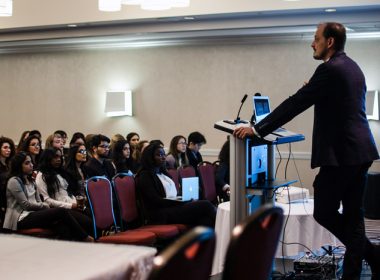
On March 19, the work of executive organizers for the TEDxMcGill conference culminated in a seamless, inspired day, which included eight speeches from innovators across an array of disciplines. Ground-breaking presentations ranged from those by Moon Ribas, a self-identified ‘cyborg’ who can feel the vibrations of earthquakes around the world, to Thione Niang, the founder of Give1Project, a non-profit dedicated to the empowerment of young leaders in communities around the world. 

The event was marked by the theme ‘Paradigm Shift.’ The goal was for the curated selection of speakers to trigger the audience to change the way they think about an array of topics.

"We wanted a theme that made people [not only] reflect and question today, but where we are headed tomorrow,” Cassandra Delage, president of the executive committee, said. “We wanted as much variety as possible [so that] attendees come out of the event with at least one speaker that changed their way of thinking.”

From the moment attendees arrived, there was a parallel sense of innovation across disciplines and even within the venue itself. Le Salon 1861—a former church—has undergone a massive transformation into an impressive, inspiring community space that works to bring people together in the same sense that the church was able to from its origins.

Passion was a common underlying thread that linked all the speakers and their talks. Christopher Emerson, co-founder of SpherePlay—a media player software startup—spoke on the topic of storytelling and its important place in the world. Despite TEDx conferences being an independently run branch of the TED organization—an operation that hosts conferences on a much larger scale intended to inspire and educate—the event’s calibre and the selected speakers’ ability to inspire warranted its association with the TED name. 

“TED represents a bringing together of minds [that are] bursting with ideas,” Emerson said. “I think every single person that gives a TED talk is filled with a message or something that inspires them so much, that they can’t contain it, and it has to erupt out of them [….] Paradigm shifts can come about more powerfully and more effectively when the story is told well.”

Pointing to the fact that some of the most recognized changemakers, from Benjamin Franklin to Nelson Mandela, began at relatively young ages, Niang was acutely aware of the audience demographic and the unique opportunity his story could inspire. After coming up in a poor, 28-person family in Senegal, West Africa, his journey can be equated to those of very recognizable innovators that he used as examples. 

“If you look at history, everything that’s changed has changed through young people,” Niang said. “We are stuck together. If tomorrow is your last, what have we done for [those less fortunate]?”

This sentiment is exactly what Delage had in mind when designing the conference alongside her executive team.

“‘Paradigm Shift’ is relevant to McGill students because they have the power to make the shift or the changes that they wish to see happen,” Delage said, “The goal was to empower and push people to take action. We wanted to open the eyes of students and show them that they have potential to make a difference.”

This sort of excitement and passion sought to inspire students to envision innovative ideas that also might one day land them on a TED stage. Michelle Miakouchkine, U3 Cognitive Science and attendee of the conference, found herself thinking about innovation within education.

“The beauty of this kind of inspiration is that it can be applied to so many fields,” Miakouchkine said. “Personally, I’d love to see ideas on how to improve education as well as [how to] make it more accessible. Education is absolutely critical for any paradigm shift to occur. I think progressing our outlook on education will very quickly accelerate innovation and change in the world.”

According to Miakouchkine, the conference’s message reverberated among the audience of young students and innovators.

“I love how every talk incorporated this idea of challenging the status quo,” Miakouchkine said. “There is always a solution to the world’s most perplexing problems [….] It was deeply inspiring how many of the speakers overcame great challenges, and were met with even greater rewards and lessons afterwards.”

Arts & Entertainment, Music

Artist Spotlight: Elliot Sinclair

With the emergence of Montreal as a hotbed of indie music, a number of up-and-coming musicians have migrated here, looking to make it in the plethora of bars and clubs the city has to offer. Montreal still holds the title as one of the independent music capitals of North America, and has attracted a number of creative minds to the Milton Gates. U0 Arts students Elliot Sinclair, the musician behind Alright, Lights, is no exception.

Coming from Kingston, Ontario, the singer-songwriter’s impressively sophisticated and haunting album, Bloom was released this past January via Soundcloud. For him, coming to McGill wasn’t just about getting an education, but was also about finding a bigger stage for his creative voice.  

“Really [I wanted to come to McGill] because of Montreal,” Sinclair said. “I really wanted to break onto the music scene over here [….] I really like how it’s a hub for music in Canada.”

While Sinclair notes that he is spoiled by the number of venues in the Montreal music scene, he has yet to play any live shows outside of McGill-run coffee houses. Instead, Sinclair is choosing to wait on finding a band before looking for venues to play. 

“I haven’t made much of a conscious effort to search out for ways to expand on my music here, but there are so many places which I can start out,” Sinclair acknowledged. “Right now I’m in a bit of a lull because I’m playing on my own. I enjoy the energy of playing in a live band where people are building off each other’s energy, so I’d really like to find some people to play with first.”

Sinclair’s fascination with the Montreal music scene comes off the back of years of musical experience. After starting to play piano when he was six years-old, Sinclair began writing songs when he was 13 or 14—mainly “because of girls.” Since then, Sinclair has been writing avidly, yet sporadically. Bloom is in fact a compilation of his best works throughout high school up to this point. It reflects the adolescent angst and emotion that many feel at that time, and writing seems to be a therapeutic outlet for these emotions. 

“I didn’t start writing [Bloom] with the thought in mind that I would be creating an album, but then sometime last year, I thought that high school was a pretty crazy time, so I wanted to tell the story of what had happened over the last four years,” he said. “There aren’t clear linear stories or anything like that, but they’re very reflective of times when I was feeling stressed out by things. That’s when I typically find writing easiest.”

While Sinclair’s album may deal with reaching maturity, his awareness of his own creativity is already markedly precocious. He labels his work practices as “scatterbrained,” and readily acknowledges how Bloom is a project that can’t be replicated, given how tied up it is in his past experiences. This kind of outlook is indicative of the organic nature of Sinclair’s music, an entity which develops with his own growth, and is never forced.

“It seems these days, so many young musicians try too hard to appeal to what’s popular, and the stuff that they feel they have to be making in order to gain more listeners,” Sinclair said. “But, I think you just make the music you truly want to be making then it becomes a lot more fun, and less restrictive.”

Sinclair really does seem to be having fun. Whether it’s his occasional partialness to dancing in his bedroom to ’80s hits, seeing punk bands called Diarrhea Planet, or remixing “lullaby” versions of ’90s rap hits, there is a carefree feel to the way Sinclair both consumes and creates music. Because of the kind of organic and comfortable creative process Sinclair has, it might mean that another project won’t come out for a while. Yet behind the scenes it seems like his creative engine is constantly whirring, even though the results may not be as prolific.

“I’d really like to make a concept album at some point,” Sinclair said. “I really like the idea of actually connecting a full on story through an album.”

While this strange mixture of relaxation and passion for music means Sinclair probably won’t be releasing something else for a while, what listeners will see will most likely be a very thoughtful and meaningful project.

Arts & Entertainment, Film and TV

Fokus Film Festival showcases student creativity

Time and time again McGill students prove that the lack of a formal visual arts department is in no way an obstacle to fantastic productions. Fokus Film Festival is just one example of the wealth of creativity at this school, and as the only festival of its kind the submissions are particularly rich and interesting. Now in its 10th year, Fokus showcases student films made in and around the McGill community. The following is a list of a few true standouts of the night. 

Moscow I Miss You by Sashka Avanyan 

The festival opener, Moscow I Miss You by Sashka Avanyan, is a short but sweet tribute to the filmmaker’s homeland. Via screen grabs of Google Street View the audience travels through the streets of Moscow, stopping at personal landmarks along the way. At each landmark an old home photo pops up: The filmmaker in her old apartment, posing in front of the water, or as a child, with her mother. There is a strong sense of duality in this film technique. Google Street View is extremely public and accessible to anyone, but Avanyan’s use of the technology makes each location intimate and personal. On this virtual tour of the city it becomes apparent that revisiting one’s homeland, even virtually, is both painful and comforting. 

Waterway to Stardom: Who is Flood Girl? by Lou Gatti

Lou Gatti’s tongue-in-cheek TVM Special Report seeks out the elusive story behind Flood Girl, the iconic McGillian who in 2013 was swept away by sudden flooding on McTavish. Who is this girl? What were her motives? Her desires? Hopes? Dreams? A former classmate, who preferred to remain anonymous, related her derring-do nature. The source said that they weren’t surprised by this after her “reckless interpretation of metaphor and allusion” in their German literature class. Maybe it was drunkenness, or an unprecedented desire to get across the street to Gerts. Maybe it was bravery, or an ill-informed attempt at internet fame. Whatever the motivation, Flood Girl found her place in McGill lore. Gatti’s short film captures the wonderfully kitschy essence of Flood Girl and McGill’s culture around the tale. 

Smoke Dreams by Cody Lieberman 

Cody Lieberman’s entry into the Avant Garde category is a cross between a nightmare and dream sequence. The short film, like many dreams, cuts between seemingly unrelated images, but seems to follow some sort of subconscious thread. In this case, the apparent thread is highly influenced by David Lynch: viewers see several clips from Blue Velvet and Twin Peaks. There’s also a general sense of disjointed paranoia (Lynch’s signature) that comes through in the film. Clouded by smoke, darkness, and obscured by almost too-loud patches of dialogue, the film doesn’t appear to have a plot. Instead the audience is left with a mysteriously spooky representation of the dream world. 

Karma Police by Ben Koring

Like the documentary entry Waterway to Stardom, Karma Police doesn’t seem to take itself too seriously, and this pays off immensely in laughs. The film features two guardian angels of karma, watching our every move to see if we return that wallet we found on the street, or correct the cashier when they give us too much change. The angels, one an optimistic newbie, the other a cynic who’s reportedly been on the job for 75,000 years, watch their target to determine if he’s a decent guy or a “lost cause.” This clever film gives voice to the eyes in the sky that keeps our consciences in check—although they may not be as straight-edge as we’d expect. 

Basketball, Men's Varsity, Sports

Basketball: Redmen come away from CIS Nationals empty-handed, despite excellent season

The McGill Redmen basketball team suffered two heartbreaking losses at the CIS National Championships in Vancouver; the Redmen gave up a lead in the final minute to lose the quarter-final game 72-69 against finalist Calgary Dinos on Thursday, and then lost the consolation semifinal game 69-68 against the UBC Thunderbirds.

The two tightly contested defeats capped an excellent Redmen season that saw the team go 12-4 in the RSEQ regular season, and storm to an RSEQ title. McGill played with remarkable flexibility all season: They had one of the strongest benches in the country, were dominant rebounders, and were the best fourth-quarter team in the RSEQ.

On Thursday, McGill went up 69-66 courtesy of junior guard Dele Ogundokun’s three-pointer with a minute left. Calgary responded with three big plays, hitting a layup with 46 seconds to go, drawing a foul with 26 seconds to go, and then making a steal with 10 seconds left on the clock, ultimately sealing the game.

“We came here to win the title this year, we didn’t come to play for fifth or sixth, we came here to win,” Coach Dave DeAveiro explained, per McGill Athletics. “To not execute down the stretch is extremely frustrating[….] We can’t help Calgary win games, and I thought tonight we helped Calgary win this game.”

It was back and forth the entire game. McGill led the first quarter 19-15, but trailed by two points at the half. McGill and Calgary were constantly trading leads, taking it to the wire and providing riveting entertainment for the 1,250-strong crowd.

Ogundokun stood out for the Redmen with 19 points on 8-14 shooting, and added four assists. Junior point guard Jenning Leung connected on 5-10 from the three point line to add 15 points for the Redmen, as well as recording five steals. Both players were key for the Redmen all season: Leung’s three-point shooting and ball handling contributed to McGill’s dynamic offence, and Ogundokun’s defensive play on the perimeter and on the boards was a cornerstone of McGill’s defensive dominance.

Against UBC on Friday, McGill dug itself out of a 16 point halftime deficit, only to lose in excruciating fashion 69-68. Ogundokun and Leung starred once again with 15 points apiece. Junior guard Michael Peterkin also contributed 10 rebounds off the bench in a spirited performance. McGill, however, was always playing from behind. The Redmen only led once in the entire game, with a minute and a half left on the clock. The comeback, however, was encouraging and indicative of their mental strength. Redmen Head Coach Dave DeAveiro also used the game as an opportunity to play younger players, and other players who did not see much game time during the regular season.

McGill maintained its rebounding advantage against UBC, and also won the turnover battle 25-17. McGill, however, only shot 35 per cent. from the field in comparison to UBC’s 49 per cent.

The Redmen may have come away from the weekend empty-handed, but they demonstrated all the qualities that will make them an RSEQ and CIS powerhouse in years to come: Excellent, dogged rebounding, accurate three point shooting, and incredible temperament in the fourth quarter. Senior guard Vincent Dufort played his final game as well as guard Tychon Carter-Newman. 

McGill is in a good place, having exhibited consistent RSEQ success. On a national scale, a deep CIS run is required to vindicate the program’s talented foundation.

“We were pretty good this year,” DeAveiro said, per McGill Athletics. “I think we’re getting closer. We played against two very good teams [….] I was proud of what we’re doing and I expect us to be competing for a provincial championship next year and back at Nationals in Halifax.”

Minds and Matters, Podcasts, Science & Technology

Minds and Matters EP. 2: Donald Trump’s psycholgical tactics

[audiotrack title=”Minds and Matters EP. 2: When SSMU is confronted with “external” and “divisive” issues” songwriter=”Chloe Nevitt and Lydia Kaprelian” date=”March 21, 2016″ width=”700″ height=”200″ src=”https://24f2041bb5b609d25f1a97039f71682cc9154421.googledrive.com/host/0B9rQxTeDv2duM0FmSjBSYkZFS1k/TrumpMindsMatters.mp3″ autoplay=”on”]

In Episode 2 of Minds and Matters, the McGill Tribune's Science & Technology podcast, editor Chloe Nevitt and contributor Lydia Kaprelian dive into the psychological tactics that US presidential candidate Donald Trump uses to get people to support him. They look into the nature of these techniques which include repetition, fear-mongering, and ambiguity. 

Montreal, News

Panel discusses legal euthanasia in Canada

McGill's Freethought Association hosted a panel on assisted suicide on March 15 to discuss the federal decriminalization of physician-assisted dying, which will come into effect on June 6 this year, and how this policy will affect Quebec. This follows the Feb. 2015 ruling by the Supreme Court of Canada, instating the right to physician-assisted suicide. Prior to that, Quebec had been the only province to allow terminally ill patients to determine how their life ended..  The panellists addressed issues raised by opponents to medically assisted dying, and discussed necessary changes to Quebec law as a result of federal decriminalization.

Public opinion

Susan Desjardins, who spoke on behalf of Dying with Dignity Canada, an organisation that advocates for physician-assisted dying, addressed concerns of various groups in opposition to the Court's ruling. In one example, she criticised the Catholic Health Sponsors of Ontario for instructing institutions within its purview not to provide access to medical assistance in dying.

"This flies in the face of the views of Catholics polled regarding assisted dying," Desjardins said. "In October 2014, 85 per cent of Catholics polled supported physician assisted dying."

Dr. Carolyn Ellis, associate professor at the McGill Biomedical Ethics Unit, highlighted the difficulties for healthcare professionals to publicly support medically assisted dying even though many polls indicate that most physicians in Quebec are in favour of it.

"It's harder to speak up in favour of it, in fear that then you'll be stigmatized as a doctor who kills,” Ellis said. “The fear factor of human nature leads people to not go public about some important values, but they're willing to participate."

Federal legislation

Desjardins discussed a report by the Joint Parliamentary Committee on Physician Assisted Dying, published on Feb. 25, which made 21 recommendations to assist the Canadian government in its efforts to legislate the decriminalization of physician-assisted dying,.

"The recommendations ensure that the conscience rights of healthcare professionals are protected, that access to assisted dying is monitored, and that the laws and protocols associated with medical assistance in dying are reviewed by parliament on a regular basis" Desjardins  said.

Ellis, who testified at the Joint Parliamentary Committee, discussed the recommendations made on eligibility. She argued that an individual's capacity to consent should be the driving factor in whether or not they're granted authority to consent on their own behalf.

"In Quebec and two other provinces age is a legal factor in whether you can consent for medical interventions,” said Ellis. “The more consistent view would be, if one is able to make the particular medical decision at hand, that they should do so."

Legislation in Quebec

Jean-Pierre Ménard, a specialist in the defence of victims in the health system and professor at Université de Sherbrooke, Université de Quebec Á Montreal, and Université de Montreal, addressed a concern expressed by an audience member regarding abuse of medical assistance in dying.

"Under Quebec Law, nobody can suggest or propose that the patient should have assisted death," Ménard said. "A doctor has to make sure that the patient is totally free of any kind of outside pressure, and that they're fully informed, and a second doctor has to confirm the process."

Ellis mentioned Quebec's role as a leader in this field being the only province currently that permits medically assisted dying. Nevertheless, she claimed that the scope of the provincial law will have to be broadened in order to avoid inconsistency with the forthcoming federal legislation.

"It's very clear from our comments that Quebec Law is inconsistent with this [federal] law," Ellis  said. "It's a much more conservative view and it will need to somehow bring itself into compliance with the forthcoming federal law."


Hockey, Martlets, Sports

Hockey: Martlets fall to Thunderbirds, Tommies despite valiant effort

Thursday

The McGill Martlets hockey team dropped its first game of the CIS Championship weekend against the UBC Thunderbirds. The loss dashed the team’s medal hopes, giving them a best-case-scenario fifth place finish in Calgary, the site of the National Championships.

The Thunderbirds dominated early on in the game, taking a quick 2-0 lead by the end of the first period off of goals by Hannah Clayton-Carroll and Kathleen Cahoon on the powerplay.

McGill looked as though it was going to stage a resurgence after forward Gabrielle Davidson converted on a Stefanie Pohlod opportunity on the powerplay, roofing the puck past UBC’s fruitlessly-sprawled goaltender, Danielle Dube. Less than four minutes later, however, Logan Boyd of the Thunderbirds got a quick shot over the right shoulder of McGill goaltender Taylor Hough to close the second period.

Despite a quick third period goal from centre Melodie Daoust to pull McGill within one goal, UBC played tight defensively and outplayed the Martlets for loose pucks. With just over a minute left, and with Hough pulled for an extra attacker, Cahoon scored an empty net goal for her second of the night, barring McGill’s hopes for a podium finish in the tournament.

“We fought hard all game long,” McGill Head Coach Peter Smith said. “We battled right until the very end. We outshot [UBC], but they kept us to the outside a lot. We needed a bounce and we didn’t get one. Unfortunately, sometimes that’s how the game goes.”

Fifth-year forward Erika Pyke received player of the game honours for the Martlets.

Friday

The Martlets were upset by the St. Thomas Tommies 2-1 in the consolation round, which led to an early exit for last year’s national runners-up.

Near the end of the first period, Davidson got a quick snapshot goal from below the hashmarks, beating Tommies goaltender Taylor Cook blocker side to put McGill up 1-0. Davidson’s goal marked her second of the tournament for the McGill scoring lead on the weekend. After the goal, however, the Martlets took a penalty, shifting momentum towards the Tommies. Kelty Apperson pounced on a rebound on the powerplay, edging the puck past Hough to tie the game.

The second period remained scoreless, despite McGill outshooting St. Thomas 14-9.

Midway through the third, Tommies forward Lauren Henman slipped a pass from Caley Steinert through Hough’s five-hole to jump ahead 2-1. St. Thomas would hang onto the lead for the win.

“I thought there were a lot of good things in that game,” Smith said. “We had so many scoring chances [but] we just couldn’t put the puck in the net.”

Senior forward Olivia Sutter of Red Deer, Alberta was awarded player of the game for McGill.

Stat corner

McGill outshot their opponents 71-49 over the course of the two games. Despite their dominating advantage in shots, the Martlets only managed to score 3 goals on the weekend, two of which came off the stick of graduating forward Gabrielle Davidson.

Quotable

“For our graduating players, they’ve had a great run. They all graduate with a National Championship back in 2014. For our returning players, they see what it takes to get all the way to the top. Quite frankly, I don’t think there’s anything but positives coming out of it”— Smith on the Martlets early exit, and finding the positives in the losses.

Play of the weekend

Davidson scored the first goal of the weekend for McGill, during the team’s attempt to come back from a 2-0 deficit at the hands of UBC.  Davidson roofed the puck from inside the crease over the Thunderbirds goaltender Dube. The goal shifted momentum in favour of the Martlets and set the stage for an attempted resurgence.

Basketball, Martlets, Sports

Basketball: RSEQ Champion Martlets place fourth at CIS Nationals

The 2016 RSEQ champion McGill Martlets traveled to the CIS Final 8 at the University of New Brunswick in Fredericton, New Brunswick as the No. 1 seed. It was their fifth straight RSEQ championship, only the first time that McGill has entered Nationals as the first seed. Last year the Martlets progressed to the final game, but lost in the finals in a tight game to the Windsor Lancers, who won their fifth straight title. This year, McGill went into the tournament last Thursday with a 22-2 overall record against CIS opponents this season. They also had the best defensive record of any team–allowing an average of only 50.7 points per game, and riding a 15-game win streak.

“[We’d] had a target on our back all year so [we were] familiar with the pressure of being a top-ranked team,” veteran Head Coach Ryan Thorne, who is in his 13th year at the helm, said.

The Martlets’ first outing of the weekend came in the quarterfinal against the eighth-seeded hosts UNB. The Martlets came out firing, scoring 20 points in the first quarter with seniors Mariam Sylla and Dianna Ros and junior Alex Kiss-Rusk leading the way, scoring 12, 11, and 10 points apiece for the night. McGill let the home team come back a bit in the second half, but comfortably won 58-52 to progress to the semifinal against the Ryerson Rams.

Thorne, won was named the 2016 CIS Coach-of-the-Year, praised his co-captain Ros’ influence on the players around them.

“That’s veteran leadership out there, that’s maturity,” Thorne said. “There were some key decisions that changed the momentum of the game and that’s why you need her out there in crunch time.”

Saturday’s semifinal against fifth-seeded Ryerson, who were the highest scoring team in the country this year, proved to be a harder challenge for McGill. The Rams’ offence came out strong, outscoring the Martlets 45-28 in the first half for the Martlets’ largest deficit of the season.

“We lost it in the first half,” Thorne said. “We weren’t focused and disciplined and they took advantage of that, creating turnovers and getting transition baskets.”

The Martlets were unable to find an answer in the second half, trailing by 20 at the end of the third quarter and finishing the game down by 15 with a score of 87-72. Ryerson had three players with over 15 points, while junior forward Jennifer Silver’s 21 points led McGill’s losing effort.

“I’m disappointed,” Silver said. “We didn’t do the little things that we talked about pre-game, we didn’t execute the gameplan and we got hurt on the things we were trying to avoid.”

McGill entered the bronze-medal game against the No. 3 seed Saint Mary’s Huskies without Sylla, who succumbed to a knee injury the night before against Ryerson. Kiss-Rusk put up her ninth double-double of the season–scoring 16 points and registering 11 boards–but it wasn’t enough to make up for McGill’s offensive difficulties. The Martlets fell 56-43, their lowest offensive output in four years. Coach Thorne summed up the team’s sentiment after the loss.

“Disappointed, I think that’s the one word,” Thorne said. “We didn’t play well at all through this whole tournament, and having our best player out really showed today. For a team that battled and worked so hard all season long it’s unfortunate, the outcome, but you have to look across the board: Players and coaches, we all could have done better.”

Read the latest issue

Read the latest issue