Latest News

Business

BMW and Nissan Interested in Partnering With Tesla

NG HAN GUAN/ASSOCIATED PRESS
Image: NG HAN GUAN/ASSOCIATED PRESS

This is some dummy copy. You’re not really supposed to read this dummy copy, it is just a place holder for people who need some type to visualize what the actual copy might look like if it were real content.

If you want to read, I might suggest a good book, perhaps Hemingway or Melville. That’s why they call it, the dummy copy. This, of course, is not the real copy for this entry. Rest assured, the words will expand the concept. With clarity. Conviction. And a little wit.

In today’s competitive market environment, the body copy of your entry must lead the reader through a series of disarmingly simple thoughts.

All your supporting arguments must be communicated with simplicity and charm. And in such a way that the reader will read on. (After all, that’s a reader’s job: to read, isn’t it?) And by the time your readers have reached this point in the finished copy, you will have convinced them that you not only respect their intelligence, but you also understand their needs as consumers.

a, News, PGSS

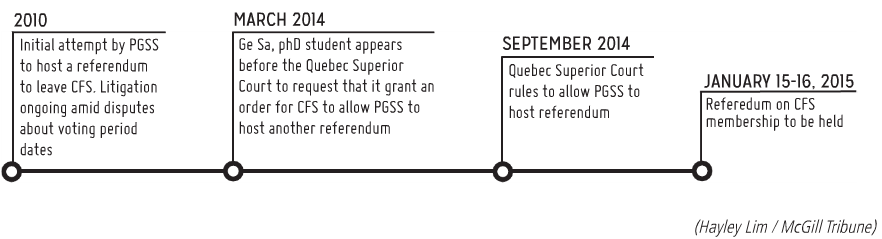
PGSS Council votes to endorse No Campaign for upcoming CFS referendum

Last Wednesday, the Postgraduate Students’ Society of McGill University (PGSS) held an emergency Council meeting regarding an upcoming referendum question on whether PGSS should remain a member of the Canadian Federation of Students (CFS), a national student union. (more…)

a, Behind the Bench, Hockey, Sports

Behind the Bench: Winter ‘not so’ classic

As Troy Brouwer scored the game-winning goal with 13 seconds remaining in regulation, one could almost forget that the NHL’s annual Winter Classic was struggling to maintain its popularity among fans. This year’s game, an outdoor tilt between the Washington Capitals and the Chicago Blackhawks, may have been the most exciting one yet—weather conditions were perfect, the ice was as smooth as any indoor rink, and the ending was wild. Nevertheless, it yielded the lowest ratings in the game’s history. This sparked a debate among executives, media, and fans: Why is the Winter Classic losing its appeal?

The NHL hosts three brands of outdoor games: the Heritage Classic, the Winter Classic, and the Stadium Series. While the wide array does offer a variety of entertaining options for fans, one wonders: Has it become too much? An outdoor game every month reduces the unique nature of the event. Fans start to perceive these ‘special’ games as common occurrences and therefore do not worry about missing one, as the next outdoor game is only a few weeks away. Excitement is easily replaced with indifference. If the NHL were to add something unique to each one of these three brands, fans would not feel as though they were being forced to watch different versions of what is essentially the same game in order to pump up league revenues.

Another issue with the Winter Classic is the fact that the same teams keep participating in it. For instance, the Pittsburgh Penguins and the Chicago Blackhawks have participated in two out of the seven Winter Classics each, while strong American hockey markets like the Minnesota Wild and the St. Louis Blues have yet to have their chance at playing in an outdoor game. While the choice of teams often depends on the availability of sporting venues, it is hard for loyal fans not to perceive the scheduling as favouritism of traditional markets. Additionally, recent matchups at the Winter Classic have not featured any juicy narratives. Perhaps pinning two hated rivals, such as the Montreal Canadiens and the Boston Bruins, against each other would result in added game intensity and increase the excitement among fans.

Finally, the biggest issue with the Winter Classic is probably the environment itself. Most of these games take place in baseball stadiums. The crowd is often far removed from the action on the rink, which dampens the mood considerably. Often, the game must be stopped so that the snow can be removed from the ice surface. The ice itself is often not as smooth as one would typically find in an indoor rink, causing the puck to bounce all over the place and making it very hard for players to complete any passes or plays. All of these interruptions take a toll on the players, and ultimately decrease the entertainment value of the game. While fans at the Winter Classic may be enjoying themselves, the experience for those watching the game at home is not nearly as fun.

Ultimately, the Winter Classic should be yielding better ratings than it has. While the NHL cannot control many logistical and weather-related factors, it does have the power to choose meaningful matchups as well as proper venues in order to maximize the entertainment value of the game. Small tweaks to the current state of the great outdoor game will help to increase the popularity of this event and make the Winter Classic a game that fans look forward to each year.

a, Arts & Entertainment, Film and TV

Pop Rhetoric: Returning to Britannia

In what is supposedly the second golden age of television, the BBC innovates in a market saturated with conventional and mediocre American television. (more…)

a, Features

Stories from our streets: Humanizing the homeless in Montreal

Victor Alinka is sitting alone at the table, focused on his meal. Apprehensively, I approach him and ask if I can join. He flashes a hesitant smile, and I take that as my cue to sit across from him as he continues to eat.

 The room is bustling with activity, filled with people handing out food or taking their breakfast. The majority of the people in the room are homeless—most are carrying everything they own in sacks or backpacks. Victor is imposingly tall, with matte brown hair and a look of weariness permanently etched onto his face.

 “I’m from a small town a few hours away from Montreal,” he tells me. Victor is 23 years old and has been homeless episodically since the age of 18.

 Homelessness in Canada is a constantly evolving and complex issue. The number of homeless persons in Canada has been under heavy scrutiny and debate, but federal estimates are at 200,000. On any given night, 30,000 to 50,000 persons are homeless across Canada.

 Despite it being an issue that confronts us every day, many of us choose to ignore the faces of suffering that fill in the cracks of our society and streets. Every person in Montreal has seen the manifestation of inequality on our sidewalks, whether it is the solitary homeless person next to the gleaming windows of Provigo, or a ragged sleeping bag in a park filled with slow breathing

The public debate about the causes of homelessness is divisive. Traditionally, homelessness has been attributed to the individual—laziness and an inability to ‘work hard’—but the factors responsible for those who live homelessly are far more nuanced than they might appear. While mainstream opinion has progressed towards accepting the systemic causes of homelessness, the actions that we take to prevent and reduce homelessness still leave much to be desired.

Alain Spitzer, Executive Director at the St. James Drop-in Centre—an organization that offers hot meals and other resources to the homeless—believes there needs to be a more well-rounded perspective when looking at these issues.

“The most common misconception that people have about homelessness is that most people who find themselves in this circumstance are in it for predictable reasons,” Spitzer explains. “Homeless folks are not always people who had a difficult upbringing, poor parents, and abusive relationships. Homelessness can occur […] often because of circumstances that we do not directly control. At St. James, we have people who are homeless that were in the army, had high positions in the banking world, [who] served in the police force, and others who [actually] worked in social work before ending up on the streets themselves.”

I call the shelter where I met Victor a few days later to see if I can arrange another meeting. The staff member calls him over and passes the phone to him and we agree to meet the next day.

 We walk into Tim Hortons together and I ask him if he would like to eat anything. “Timbits,” he says, his eyes locked onto the glowing LED menus. We sit down at one of the tables with a box of a dozen chocolate Timbits.

“I didn’t grow up poor, but we weren’t that well-off either,” he says as he bites into a donut. “My dad left me and my mom when I was 12.”

Victor can still clearly recall his father’s interactions with his mother when he was growing up.

“He would come back home […] wasted, and I would hear nothing but yelling coming from their room all night,” he continues.

 When Victor was 12 years old, his father left the family home. “I think my mom was relieved that he left, but him leaving couldn’t erase all the shit that he put her through. She was drinking a lot before he left, and it only got worse after he was gone.”

By the time Victor was 14, his mother’s excessive alcohol consumption and acute liver failure led to her death.

“I had to go live with my uncle [Marcel] after that,” he says. “I remember when the cops told me that he had arrived and I had to pack up everything I had in 30 minutes. I was in Montreal by the next day.”

I try to ask him about his time living with his uncle, but Victor shakes his head and tries to move the conversation along.

 After two years of living with Marcel, social workers took Victor and placed him in a foster home in Montreal’s West Island with a middle-aged couple called the Harringtons. Without any immediate or extended family outside of his uncle and missing father, his social services worker opted for non-kinship foster care independent of his relatives.

“The Harringtons,” he says. “They were great people. For the first time in my life I felt like I was living with people that weren’t total fuckheads.” 

Victor smiles as he reminisces about the camping trips that they would take, and the barbeques in their backyard during the summer. According to Victor, the greatest gift that the Harringtons were able to give him was the gift of normalcy, such as the ability to come back home on a Friday night without fearing for his personal safety.

While his time at the Harringtons was a positive experience, Victor could never alleviate the nagging feeling of being an outsider in a stranger’s home.

After two years, Mr. Harrington accepted a new position with his firm in Paris, and Victor was shuffled into a group foster home. 

“When I look back on it, I don’t think they would have wanted to adopt me,” he says. “Sure, they liked me, but that wasn’t enough for them to make me their son.”

When I ask him if he’s bitter about their departure, he gives me a terse response. “Nah man,” he says. “I wouldn’t have adopted me if I were them. Imagine if [social workers] send [you] a 16-year-old stranger to take care of—are you supposed to feel like he’s your son the next day? I wasn’t happy when they left, but I didn’t expect anything like that from them.”

The various provinces and territories in Canada have differing ‘ages of protection,’ which is the maximum required age that a child must be placed under a guardian’s custody. In Ontario and Quebec, the age of protection is 16 and 18, respectively. 

After two years of living in the group foster home, Victor was out on the streets. Unable to find employment, and with the foster home no longer legally required to care for him, Victor was forced into homelessness. 

A few days later, I meet Victor near the gazebo in a park, which according to him is his preferred “spot.” Surrounding his faded backpack are two empty bottles of beer. He nods when I ask if those are his, and I follow up with asking him how often and how much he drinks. In reply, he shoots me a look that encapsulates both his amusement at my naïveté and his reluctance to give a clear answer.

 Studies of alcohol and drug abuse among the homeless have never resulted in concrete statistics. However, there is a general consensus within studies that homeless persons have much higher rates of substance abuse than the general population of Canada. In a study conducted within the Greater Vancouver Regional area by Goldberg et al, 48 per cent of all homeless persons interviewed reported some dependence on narcotics or alcohol.

Victor himself has stayed off narcotics, preferring to drink instead, mainly due to seeing other homeless persons go ‘over the deep end’ with substances such as heroin. According to Dr. Evan Wood from the University of British Columbia, heroin is seeing a resurgence in Canada and is cheaper and more readily available than ever before.

Victor is aware of his alcoholism, but is also abjectly defeatist. He tells me that he obviously realizes the contradiction of knowing the consequences of alcoholism and being an alcoholic, but drinking is an easy way to relax.

Substance abuse among the homeless has been the frequent target of government social policies in previous years. However, the Canadian government has done little to address the issues in a truly adaptive manner. Due to a lack of focused initiatives,  government efforts lack consistency and long-term perspectives.

“Different people need different interventions,” Spitzer says. “But the social system is becoming increasingly inflexible and attempts to impose structures that are designed as ‘a one system fits all.’ Policymakers need to recognize that the ‘one [system] fits all’ philosophy is dead.”

Homelessness can be a dehumanizing experience. If a person is homeless, they are at the bottom of the socio-economic ladder. Furthermore, they are a low priority for legislators and other citizens, especially in the face of other issues that call out for our attention. The dehumanization occurs when indifference is the main stance of pedestrians towards the homeless. How many times have we all walked by homeless persons, too plugged into our phones and our music, not even willing to give a glance or a nod? Victor adds that small talk, or some other form of acknowledgement, is preferable to treating him as a dusty object on the street—even if the person doesn’t give him money or food.

 Many of us, especially at higher academic institutions, don’t come from broken homes or  struggle to find shelter each night. However, this fact doesn’t excuse the apathy, the lack of effort to at least enter into a conversation—especially when we have the time to—with those who live on the very streets we tread everyday.

Interactions with non-homeless persons in our daily lives are commonplace, but when encountering the poorest and the downtrodden, we often steer clear in order to expunge their situation from our minds. Worse yet is when our apathy turns into annoyance, when we deride them for sleeping on the premises of our institutions or being in our way as we walk on the sidewalk.

In June 2014, a store located on Saint-Catherine street installed spikes on a ledge in front of the store, which was criticized as a method to deter the city’s homeless population from loitering. While the media and many locals were quick to decry the spikes and called for their removal, it is troubling to see that certain members of our community would go so far as building these spikes. Such reactions only further contribute to the dehumanizing experience of homelessness. Even small interactions with those living on the streets, however trivial it may seem to us, are the foundation for our own progression as mindful citizens. Bringing the homeless into our hemisphere of thought can contribute to our own development of compassion and empathy. While small interactions are not the solution to solving homelessness, they are a stepping-stone to understanding the larger systemic inequalities.

I meet Victor again six days later. Victor asks me for a cigarette, so I light one up for him and myself. We both look together towards his former home. We’re in a sleepy suburb street in the West Island, where the front lawns are meticulously manicured, and the only sounds in the air are fallen leaves rustling in the wind.

 Although we only view it from the outside, the Harringtons’ former home immediately exudes an aura of comfort and warmth through its pleasant brownstone exterior, its tall tree in the front lawn, and its rope swing swaying from one of the branches in the breeze. I turn towards Victor, wanting to ask him more about his experience living with the Harringtons.

 Then, I immediately regret asking him to come back here.

 While the rest of his face doesn’t betray any of his inner thoughts, his eyes add to my already mounting feeling of regret and shame. Though he stares at the house with an unwavering glance, the sentiments in his eyes are the furthest thing from happiness. I glance back and forth between him and the house, trying to summon up words to combat the awkwardness of the situation. My shame turns into anger—anger at my own stupidity of convincing someone to relive his past and not realizing how painful that can be.

When I originally asked Victor to take me to his old foster home, it seemed like a good idea. Many other actions we take towards the homeless, such as dropping spare change into a homeless person’s cup, seem kindhearted and make us feel good, but they do little to alleviate the overall issue. A comprehensive recognition of the homeless as people—instead of just as subjects of an article or the recipients of our spare change—can help us recognize that in these actions, we’re not treating them on an equal level, and that they only help to serve our own emotional interests.

“The greatest challenge that many homeless people struggle with is not just economical—it is relational,” Spitzer says. “They need for people around them to see value in them as people. To esteem them is to give them a chance to move forward in a positive way.” 

Victor finishes his cigarette and wordlessly walks away, leaving behind a place that seems so normal to any passerby, but haunts only him with the question: What if things had been different?


a, Science & Technology

The evolution of e-sports

Twelve feet wide, five feet tall, and nine feet deep. The Nimrod computer cast a looming presence at the Festival of Britain in 1951. Nimrod was the first computer designed specifically for playing video games—in this case, the mathematical strategy game Nim.

In Nim’s traditional set-up, two players take turns removing matches from three separate heaps. The winner removes the last object. Compared to the fast pace of first person shooter games—like Call of Duty, and sports simulations, like NHL and FIFA—Nim seems simple. Yet despite its slower game play, Nimrod was an instant sensation at the time.

“Most of the public were quite happy to gawk at the flashing lights and be impressed,” said John Bennett, an Australian employee of Ferranti Nimrod, according to Wired.

It would be another 40 years before the first PlayStation console was released and children would come to eagerly await video games for their birthdays. However, few could have predicted the shift in game-playing culture that Nimrod ultimately helped inspire. 

“Video games are definitely leaning towards multiplayer now more than in the past,” explained Brendan Cordeiro, a U3 microbiology and immunology honours student. “Nowadays, the main selling point of a video game is the multiplayer aspect; in fact, some of the most lucrative games out now don’t even have a single player component and can only be played online.  There is just something really cool about playing with different people across the world and making them really mad when you beat them.”

As the Internet rose in prevalence during the beginning of the 21st century, video games developed a larger online presence. According to a state of the industry report by Netherlands-based company Spil Games, more than 1.2 billion people currently play video games around the world—700 million of whom are playing their games online.

This expansion of online gaming has created an entirely distinct culture. Characterized by the emergence of online gaming communities, children and adults alike now connect through the internet to engage in both competition and camaraderie.

Perhaps the most notorious example of this online culture is Felix Arvid Ulf Kjellberg’s, better known as PewDiePie, who runs a video gaming YouTube channel. Since Aug. 15, 2013, PewDiePie’s channel has 33,641,251 YouTube subscribers, where viewers may watch Kjellberg’s commentary as he plays horror and action video games.

“They’re entertaining,” said Steven Cooper, a U3 mathematics major. “It’s fun to play vicariously through someone else. “More formally known as a ‘Let’s Play (LP),’ PewDiePie’s channel is one of millions of YouTube videos depicting someone playing a video game while commentating. While initially directed towards an older audience, these videos have trickled down to elementary school children. My own brother’s grade 4 class consists of several students that actively watch and contribute to LP videos online—my brother included.

Compared to the ’90s, where children gathered in their homes to play games together, the evolution of online gaming has changed the scope of these activities. Since gamers can now interact with any number of gamers from across the globe—when people do meet in person to play games, they often meet by the thousands.

"This expansion of online gaming has created an entirely distinct culture. Characterized by the emergence of online gaming communities, children and adults alike now connect through the internet to engage in both competition and camaraderie."

Major League Gaming (MLG), an electronic sports organization and the world’s largest competitive video game league, hosts and broadcasts gaming competitions for a variety of popular games, including League of Legends, Mortal Kombat, and Super Smash Bros. Most recently, over 21,000 gamers attended the 2014 Call of Duty Championships in Anaheim, while tens of thousands of viewers consistently stream these events.

The winners of the competition, a group known as ‘Evil Geniuses,’ walked home with $25,000 in prize money—a small portion of the hundreds of thousands of dollars won by professional gamers each year. Considering the hype and sportsmanship qualities now attributed to video gaming, perhaps it is no surprise that colleges in the U.S. are starting to recruit gamers to their programs with hefty video gaming scholarships.

Spearheading this movement is the Robert Morris Illinois University, which created an official video game team this past fall to compete in video game leagues. Thirty-five students received athletic scholarships under the school’s new e-sports program, which covers top-of-the-line game training facilities, and 50 per cent of their tuition, room, and board. Several other American schools, including Kentucky University, have expressed interest in following suit.

This movement parallels current efforts to lobby the International Olympics Committee (IOC) to add e-sports to the Olympics. While the IOC is reluctant to add new games to the event—supporters of chess have been unsuccessful for years—the rapid expansion of gaming from a living room pastime to an electronic sport have provided many gamers with optimism towards this possibility.

“I’m not [sure about] something like the Olympics, but I do think that video game competitions will grow to a more mainstream event,” Cordeiro said. “It used to be that video game competitions would be held in small auditoriums with 50 people watching a handful of players play for a $20 prize. Just two months ago, the world StarCraft championship, a strategy game on the computer, had a prize pool of $250 000, was held in a large convention hall, and was viewed by millions across the world online. So I do think it will eventually be the sort of thing you would see on TV one day, [even if its] not like the NHL.”

a, News, SSMU

ECOLE sustainable housing project gains Independent Student Group status

Educational Community Living Environment (ECOLE), a sustainability initiative, gained Independent Student Group (ISG) status on Dec. 4 during the Students’ Society of McGill University (SSMU) Legislative Council meeting. (more…)

a, Martlets, Men's Varsity, Sports

Week that was for McGill Athletics: January 13

Athletes of the week

Mariam Sylla

It was a bit more than business as usual for star forward Mariam Sylla this weekend. The two-time Athlete of the Week scored her 500th regular season point in a Martlet uniform on Thursday, posting a double double in the lopsided win over Bishop’s. She would record another double double on 10 points and 10 rebounds to sweep the doubleheader on Saturday. Consistency and excellence has become synonymous with the name Sylla; through 16 games this season, she is averaging 12.3 points and 9.8 rebounds per game, and is the driving force behind the Martlets’ success.

Jenning Leung

Leung, a six-foot sophomore guard from the Philippines, came up big time and time again for the Redmen basketball team this weekend, carrying McGill to consecutive victories over Bishop’s. After getting a tough layup to go with a minute left to keep his team in the game, Leung drilled a three-pointer with 4.3 seconds left to seal the win in Saturday’s game. Leung scored 24 points on a hyper-efficient 69 per cent shooting against only two turnovers over the two games.

Beyond the box score

MARTLET HOCKEY

The Martlets returned from winter break with a successful road trip to Ottawa, topping the University of Ottawa 5-2 and beating Carleton 4-2. Both games featured comeback efforts from McGill who  now sit tied with the University of Montreal for the division lead. Saturday’s game saw the Martlets rally from down 2-0 late in the second period to score five unanswered goals. Despite a shaky start to the game, goaltender Brittany Smrke turned in a solid effort for her fifth win of the season, stopping 25 of the 27 shots she faced. McGill was forced to play catch up again in Sunday’s game after falling behind 2-1 in the second period. A three goal outburst in the third period sealed the victory for the Martlets. Senior forward Leslie Oles had a weekend to remember, as she notched two goals and two assists in total, including the game-winning goal against Carleton. The Martlets’ road swing continues Friday with a game against Concordia before finally returning home to take on Montreal Sunday afternoon.

REDMEN HOCKEY

After entering the winter break red-hot, the Redmen have cooled off somewhat, splitting a pair of road games over the weekend. McGill lost 2-1 Saturday to Waterloo before bouncing back with a 6-2 victory over Wilfrid Laurier. The Redmen continued to receive quality goaltending, as both Karel St. Laurent and Jacob Gervais-Chouinard put forth strong performances. Even this far into the season there is no clear number one, but the two are working quite well in tandem. Offensive production came from familiar faces, as centre Cedric McNicoll scored in each game, tallying three goals in total. McNicoll now sits tied for sixth in the OUA scoring race, with 28 points in 18 games so far this season. Third year winger David Rose contributed three points in the win over the Golden Hawks, which pushes his point total to 21. The Redmen return home this Friday for an important match-up with second-place Carleton in the annual Carnival Game.

TRACK & FIELD

The Martlets finished first of five teams and the Redmen finished second overall at the Sherbrooke Invitational meet at the Pavillon Univestrie, on Saturday. The women’s first-place finish was built on the strength of three silver medals, won by Melanie Myrand (1500m), Nicole Bewski (pole vault), and Helena Reinfels (60m hurdles). Myrand, a graduate student from Lachine, Quebec, is also a standout on McGill’s cross-country team. For the men, Vincent Parent led the way with a gold medal finish in the 1500m event, finishing with a time of 3:59.66. Senior electrical engineering student Riley van Ryswyk also came up big for the Redmen, earning a silver medal in the long jump event.

a, Arts & Entertainment

Album Review: Death Grips – Fashion Week

What is Death Grips’ new surprise instrumental album Fashion Week? Juggling many styles and sometimes unfocused, the album itself may not even know what it is. After announcing their break-up and final album on a napkin, this is likely to be the next to last Death Grips release. The last letter of all tracks spell the name of the final album, JENNY DEATH, followed by WHEN, encapsulating how masterful Death Grips—for a reticent band that has been disdainful of media—is at provoking speculation and blog buzz about future releases. For fans of the enigmatic rap duo, this release gives great insight into the group’s creative process.
The most glaring characteristic of the album is the lack of frontman MC Ride’s drill sergeant-barking vocals—or really, any vocals at all. Death Grips’ chopped and sped-up vocal samples gave a lot of its prior releases character, but the human voice in all forms is totally absent from Fashion Week. These tracks run the gambit in quality from more disposable such as “Runway N (1),” which could be the music for a late night Adult Swim animation, to more substantial instrumental beats that have the choppy aggression of earlier Death Grips releases. Some beats, such as the abrasive alarm-like synths of “Runway E (3)” and the oddly industrial yet dancehall-esque “Runway A”, just need the yelling/rapping of MC Ride to be full-fledged quality Death Grips songs.
Death Grips does get creative though, filling the void left by the vocals: “Runway N (2)” is built on an aggressive, throbbing guitar line that propels the track in the absence of MC Ride, and “Runway H’s” cathartic use of guitar strangely recalls some of Deerhoof’s brightest and best guitar lines.
Although the album seems three-quarters formed and inaccessible for new listeners, fans and dedicated listeners will enjoy the variety of tracks and textures. A few may even have the courage to play MC Ride and rap over some tracks.

a, Science & Technology

The power of potatoes

Potatoes, known for their carbohydrate content and delicious role in poutine, have a reputation for being unhealthy with dieters usually avoiding them at all costs. But a team of researchers from McGill University has shown that potatoes may in fact help those trying to slim down.

The team fed a group of mice a high-fat diet for 10 weeks, and then gave  some of the mice an extract they had prepared from potatoes. What they discovered was astounding.

The mice from the control group—which all originally weighed about 25 grams—gained 16 grams of weight. However, the mice that were also consuming the potato extract gained only seven grams.

“Weight gain was inhibited by 50 per cent,” explained associate professor Stan Kubow, principal author of the study.

The idea for the study came about when Kubow and one of his collaborators, McGill associate professor Danielle Donnelly, were on a flight together. Donnelly, whose focus is on improving the nutritional components of strains of potatoes, seemed to be the perfect collaborator for Kubow.

“[Kubow] said he always wanted to work [on the] potato,” explained Donnelly. “We wanted to see how his background as a nutritionist could improve our selection criteria.”

Kubow has spent the majority of his career working with antioxidants, such as polyphenols, which are found in most plants. The two researchers analyzed a variety of cultivated potatoes and compared nutritional values to select for the most abundant and rich polyphenol profile.

“Polyphenols have been implicated with [protection against] obesity, diabetes, and cardiovascular disease,” Kubow explained.

This makes them an ideal candidate for weight-loss studies. The team decided to make an extract of potatoes, increase the concentration of the polyphenols, and then observe the potato’s disease-preventative properties. In order to do this, they approached McGill molecular biologist  and professor Luis Agellon.

“[Agellon and I realized] it wasn’t the fact that [the mice] were inhibited from eating the high-fat diet,” Kubow said. “The weight gain was inhibited primarily [after.]”

Interestingly, it was not a single major polyphenol from the extract that was responsible for the weight loss.

“As a control, we fed the mice the major synthetic polyphenols, and [the mice] didn’t lose as much weight as those fed the extract,” Kubow explained.

Localizing and determining what has been causing the weight loss is the next major goal, explained Donnelly.

“We need to fractionate the extract and see what’s working synergistically or not,” Donnelly said.

According to Kubow, the extract had to be optimized for maximum weight gain prevention, and conducting the animal trials proved to be difficult, but ultimately worthwhile.

At the moment, the dose from the extract would be the equivalent of eating 30 potatoes, which is something that cannot be realistically incorporated into a consistent human diet. Instead, the researchers are hoping to create some sort of dietary supplement.

The researchers are hoping that as more evidence comes out showcasing the benefits of potatoes, their bad reputation will subside.

“Potatoes are extremely important,” Donnelly explained. “A tennis ball-sized potato [provides] about half of the mineral elements [a human needs] for the day.” 

The biopotency of the potato took the team by surprise, because it goes against the commonly held belief that potatoes promote obesity. However, Kubow explained that the French diet—also known as the French paradox, in which French men and women are less likely to lose weight—includes potatoes as a number one source of polyphenols.

The researchers hope to begin clinical trials to test the effects on humans. According to Kubow, one in four Canadians are overweight or obese, and 1.4 billion people in the world are overweight. As such, identifying components in the diet that can protect against obesity is an extremely important field of research.

Read the latest issue

Read the latest issue