


Latest News

a, Student Life

McGill’s exchange experience

As the new semester begins, the McGill community welcomes exchange students here to study for the Winter semester. Exchange students who studied at McGill last semester reflected upon their time here, while also offering advice for this semester’s newcomers.

Helena McNish, a student from the University of Edinburgh, said that she and her fellow exchange students were able to integrate themselves in the McGill environment through clubs and sports teams regardless of their status as temporary McGill students. McNish joined a choir, which meant that she could meet native McGill students and form circles of friends separate from the exchange students she lived with.

McNish said her exchange experience was heightened by McGill’s welcoming environment.

“Everyone seemed really excited to be here and excited about what they’re doing, which is especially great for exchange students,” she said.

Caitlin Scolyer-Gray, an Arts student from the University of Melbourne, echoed the welcoming attitude of McGill’s students.

“People at McGill seem very friendly, interesting, cultured, and really involved in the campus and university community life,” Scolyer-Gray said.

For some, a welcoming and friendly atmosphere is an essential resource to have when moving across the world. Certain McGill groups like the McGill International Student Network (MISN) provide services to help exchange students settle into their temporary home.

In particular, MISN organizes social events that are open to international, exchange, and non-exchange students alike. As one of the biggest student organizations funded by the Students’ Society of McGill University (SSMU), it gives students the opportunity to engage with and fully embrace all that is Montreal and McGill. Their events this past semester have included Restaurant Week, where groups visited a different Montreal restaurant every day, skydiving just outside Montreal, as well as pub-crawls around the city. MISN also seeks to help students explore other parts of Canada and the United States, with trips to Quebec City, New York City, Niagara Falls, and Boston.

For exchange and international students, MISN is a great way to not only participate in exciting and relatively non-expensive trips, but to also socialize and meet friends. Armins Palos, a management student from Lyon, France, remarked that his friend group from McGill was largely made through the MISN.

“My favourite memory on exchange [was definitely] going skydiving,” Palos said. “It was something completely out of my comfort zone, and it was an incredible experience.

Another useful service offered by McGill for exchange students is the Off-Campus Fellows program, which McNish says was a useful resource during her first weeks at McGill.

“When I first got here, we had a day where we got into groups, played games in [Parc] Jeanne-Mance, and walked around Montreal to get a sense of the city,” she said. “It was all done in groups, which was a great way to talk to people. Frosh was fun, but these activities were more useful.”

These resources are useful in addressing issues that many international students—and non-exchange students as well—may face, such as homesickness. Scolyer-Gray remarked that missing family and friends was an obstacle she had to overcome, and was especially daunting when living so far from home.

“I would tell [exchange students] to just take every day as it comes, to not get down on themselves if they feel homesick, to be open to all sorts of new experiences, and to try their best to make the most of their time in Montreal,” Scolyer-Gray said. “[Also]. try to get some travelling done on the weekends.”

According to Hayat Hobbi, MISN’s VP Finance, there are many resources available for exchange students. The Fellowship Program and the Buddy Program are just two of McGill’s many resources. McGill also has a counselling service and a Mental Health clinic located in the Brown Student Services Building. MISN’s office in the SSMU building is open daily from 10 a.m. to 6 p.m., where an executive is always able to chat and work through issues, ranging from homesickness to difficulties with plane tickets and phone bills.

On a logistical level, another struggle for many exchanging students was finding accommodation that fit their preferred lifestyle and budget.

McNish remarked that McGill housing administration can be frustrating, because those who wish to live in McGill residences are often given ambiguous offers as late as June. She found it easier to live in the Varcity515, a student residence that offers fully-furnished, utility-included, shared apartments with two to four roommates. With this service, she was able to book her accommodation in advance and find comfort in an assured living space when she arrived at McGill in the fall.

Other students, such as Palos, who also noted the difficult accommodation situation, turned to companies like Sherpal, which acts as a middle-man between international students and landlords. Students are grouped with other international students, and take a full-day tour of over 20 apartments where they have the opportunity to sign leases on the same day. According to Palos, he found this service useful not only due to its ability to provide apartments; the social aspect of the process created a great way to meet roommates, and was in fact how he found his current roommates. As a member of the MISN, Palos is looking into creating a partnership between MISN and Sherpal in the upcoming semester.

Aside from finding accommodation, another struggle can be acclimatizing to the Montreal weather. However, despite the harsh cold of the city, advice from last semester’s exchange students included taking advantage of Montreal’s beautiful scenery and cultural life.

“Montreal is a beautiful city with great food, culture and a fantastic nightlife,” Scolyer-Gray said. “I think Old Port is the most picturesque part, but Mount Royal is also beautiful, and everything was gorgeous during the fall.”

Exchange is a great way to challenge oneself by being immersed in a foreign environment, meeting people from across the world, and perhaps even learning a new language. While things like the food or the weather may take some time to get used to, most exchange students agree that the memories, friends, and lessons learned made it definitely worthwhile. However, it is the effort that one puts in to discover the Montreal and McGill community that defines the experience for many exchange students. With the plethora of opportunities available for exchange students, a new semester is the perfect opportunity to create memorable and life-changing moments within McGill and Montreal.

a, Chill Thrills, Student Life

Chill Thrills: Skating rinks

The beginning of the Winter semester is the perfect time to participate in various winter activities around Montreal. After all, it is only fitting to take advantage of add/drop period to get outside. One of the easiest and most common ways to unwind on a cool afternoon is to lace up and go skating. Here are some of the most scenic and interesting locations around the city.

Parc LaFontaine

(17-minute bus ride from McGill)

In the winter, the large U-shaped lake in Parc LaFontaine freezes over to make an icy playground. Lush, tall trees surround the lake, which creates a serene and naturally picturesque environment. It is essential to dress warmly, which means mittens, toques, scarves, and warm socks. In this case, layering up is the safest bet, because it has the double effect of cushioning falls as well as protection from Montreal’s harsh cold. There is plenty of room on the ice to accommodate both beginners and skilled skaters. A couple of speakers are located around the ice, blasting a mix of instrumental and classical music. At night, the lake is partially lit up and can still be enjoyed. However, because the rink is outside and the ice is not maintained, it is important to be aware that the surface tends to be bumpy. Freshly fallen snow may pile up and hide the bumps on the surface of the rink. Nonetheless, this location is perfect for a large group of friends. The lake has no admission fee, but skates are $9 per rental. If the exercise proves too tiring or the cold becomes unmanageable, there is a nice restaurant located in the chalet right beside the lake that is the perfect place to refuel.

The Quays Skating Rink

(25-minute bus ride from McGill)

The Quays Skating Rink is located on the edge of the Saint- Lawrence River, and offers a great perspective of the city. There are light decorations all around the rink, which makes it a prime location for photo opportunities. Moreover, there are music-themed nights, such as Urban Sounds Wednesdays or Retro Fridays. A zamboni glides over the ice every few hours maintaining a significantly smoother rink than any other natural rinks. The oval rink has alternating directions to skate in, which changes every hour or so. While most people skate around the edge, the small space in the centre of the rink is great for those who really wish to show off their moves. This location is extremely safe, with skate patrol on duty at all times. Beginners can stay close to the rink barriers as they skate, or even rent pylons to hold onto. Located in Montreal’s Old Port, this rink emanates a romantic atmosphere with beautiful glistening lights surrounding the rink, not to mention the scenic nature of Old Port. Because the Old Port is a popular tourist attraction in Montreal, the rink is usually packed with people. Admission is $7.40 and skate rentals are $9.

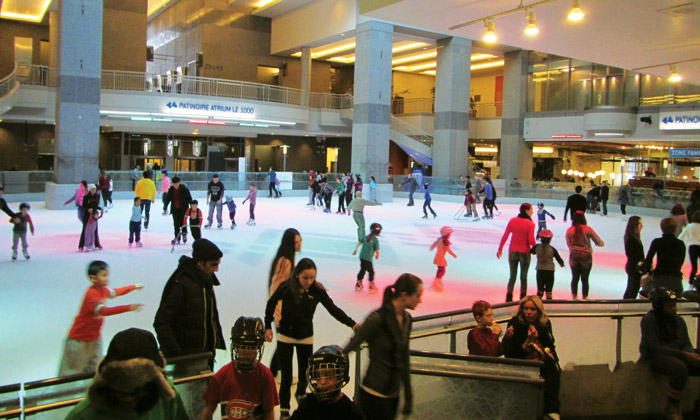
Atrium le 1000

(12-minute walk from McGill)

If the weather is just a touch too cold, the Atrium le 1000 is a beautiful and warm indoor skating arena that is the perfect alternative. The rink is situated at le 1000 de la Gauchetière. While the structure of the building reflects Montreal’s postmodern architecture, the rink inside is just as impressive. A high ceiling with modern glass panels allows sunlight to stream into the large rink and give it a very open feel. A zamboni also regularly maintains the rink. Every few months, the Atrium hosts a themed night where there are door prizes and live performances. The Atrium is a very popular spot in Montreal; the family friendly location is generally more suitable for beginners. Because of this, the rink tends to have more regulations, such as no racing or hand-held devices. For all the foodies out there, a food court with 15 different restaurants surrounds the Atrium. The cost of admission to Atrium le 1000 is $7.50, with skate rentals costing $7. There is also the additional service of skate sharpening available for $7 as well.

a, Men's Varsity, Sports

Game Report: Leung sinks Gaiters at the buzzer


McGill Redmen
62

Bishop’s Gaiters
59

“We don’t like them and they’re probably not big fans of us either,” second-year swingman Michael Peterkin said after back-to-back wins against the pre-season conference favourite Bishop’s Gaiters. After the Dalhousie Rod Shoveller Tournament in Halifax, the Redmen returned from the winter break red-hot, ousting the Gaiters 78-71 at Love Competition Hall Thursday night. Two days later, the teams faced off again in Lennoxville, where a 62-59 victory spoiled the opening of Bishop’s’ new Mitchell Gym.

After opening the season with a nail-biting 60-59 loss to the Gaiters in November, the Redmen had revenge on their minds as they took the court to reclaim the top spot in the RSEQ standings.

“I think our guys were disappointed with the way the game finished the last time,” Head Coach David DeAverio said.

Once again, the Redmen jumped on top early, taking a 10-point lead into the halftime break, but Bishop’s came storming back in the third after a momentum altering alley-oop jam.

“We gave up 30 points in the third quarter,” DeAverio said. “Part of that’s because they’re a good team, [and] we knew they were going to make a run. We just didn’t think they were going to score 30 on us, but for our guys to respond in the fourth quarter and tighten up on defence after giving up 30 points showed a lot of character on their part.”

With the teams going basket for basket late in the game, senior forward and captain Vincent Dufort took control, connecting on back-to-back jumpers to reignite the Redmen offence and give McGill a four-point lead.

“That’s what [Dufort] has to do for us to be successful,” DeAverio said. “His leadership was evident on the floor tonight.”

Second-year centre François Bourque posted his second double-double of the year, while sophomore guards Dele Ogundokun and Peterkin combined for 21 points and eight rebounds. While Jenning Leung’s 12-point performance on Thursday night was impressive, it was on Saturday night that the McGill point guard really made a name for himself.

With time ticking down in the fourth quarter, Leung found himself open with the game on the line and sunk a game-winning three, silencing a crowd of 500 crazed Gaiters fans.

“We didn’t have a specific play,” Leung said. “We were just playing for a good look and [Ogundokun] found me for an open look, I knew time was running down so I took it, and it felt good.”

Leung and Ogundokun were hot all night, combining for 27-points on 41 per cent shooting. Dufort once again came up big for the Redmen, scoring six of his eight points in the second half, while registering a game-high 12 rebounds.

The Redmen seem to have found their point guard of the future in Leung, who has become the starter for McGill after taking over for senior Ave Bross in November.

“It feels really good, being able to contribute to the team’s success,” Leung said. “It’s what I’ve been working for [….] It was a main goal of mine after last season.”

The Redmen have a tough road ahead with back-to-back games against the top-ranked Laval Rouge et Or. Laval squeaked out an overtime victory last time against McGill, but the Redmen will look to continue their strong play against another tough opponent in order to take control of the RSEQ at the halfway point of the season. If the Redmen can stop the Rouge-et-Or’s sophmore guard Karl Bélanger-Demers, McGill should be able to take possession of first place in the RSEQ.

a, Opinion

Commentary: The destructive effects of divestments and boycotts

The Boycott, Divestment, and Sanctions (BDS) movement against Israel has been gaining momentum recently. Around two weeks ago, the student workers’ union of the University of California school system voted favourably on a ballot to support the movement, urging the university and the federal government to divest from stock associated with Israeli institutions. In the same spirit, students at Wesleyan University, a private institution in Connecticut, protested to stop selling Sabra brand hummus in its dining facilities, citing discontent that Sabra is partly owned by an Israeli group with past connections to the military.

As these events have turned heads, students of institutions that have maintained relative silence on the issue, such as McGill, were undoubtedly puzzled by their university’s reluctance to support the movement. This confusion has its roots in the sentiment that there is a moral responsibility for administrations to express their support for the Palestinians in Israel one way or another. However, from a university’s standpoint, it is hard to ignore the ineffective nature of the BDS movement.

The practice of academic boycotting highlights the types of problems that emerge when universities engage in BDS. In 2009, the Canadian Union of Public Employees, a large trade union, called for a resolution for Ontario universities to ban Israeli academics from speaking, teaching, or researching at their institutions. Regardless of where one stands on the issue, it is very difficult to see the practice of academic boycotting as anything other than a blatant violation of academic freedom. This is probably why the proposal was met with strong opposition from politicians and professors on both sides of the political spectrum. If students were to support the BDS movement as a whole, it would make hurtful policies like academic boycotting more acceptable to the public.

The movement harshly divides people on the issue by attempting to defame Israel as a whole instead of encouraging education and open discussion on the subject.

This proposed resolution served to identify the general problem affecting the BDS movement. The movement harshly divides people on the Israeli-Palestinian conflict by attempting to defame Israel as a whole instead of encouraging education and open discussion on the subject. No matter which angle one looks at the movement through, it is an open attack on Israel as a nation. It punishes Israeli scholars abroad who have little to no influence on the occupation of the Palestinian people, and it hurts Israeli businesses and institutions regardless of their stance or involvement in the matter. The purported goal of all this is to put pressure on the Israeli government. However, it comes at the price of trading constructive scholarly dialogue on the injustices being committed by the occupation for a knee-jerk movement composed of outraged picketers and equally hostile opposition. It goes without saying that universities should do all they can do to encourage meaningful education and help build an arena for academic discussions.

There is also great danger in pushing forward such an aggressive, yet popular, agenda. Students often join without being aware of the movement’s real impact. For example, the movement objectively provides a cover for the right-wing ultranationalists in Israel who support the occupation. Many of these ultranationalists accuse the movement of being anti-Semitic; needless to say, this claim helps them gain support from outraged Israelis who would otherwise be against the occupation. To make matters worse, the academic boycott penalizes the most open minded and progressive intellectuals who could otherwise influence the nation. Not to mention that the boycotts will hurt Palestinians employed in Israel businesses as well as subject them to further unnecessary resentment from the Israeli public.

While the ethical motives behind the movement are just, its effects and implications are neither reasonable nor constructive, and students should think twice before bringing it onto their campuses.

a, Sports

10 Things: Weird sports

  1. Headis is a combination of tennis and soccer. It is played with two players, a ping-pong table, and a seven-inch rubber ball. The rules are identical to those of table tennis with one catch: the players can only serve, volley and hit the ball with their heads. The sport was invented in 2009 at the University of Saarbruecken and is most popular in Germany.
  2. Chess Boxing is a head-to-head bout between two contestants, consisting of 11 alternating rounds of chess and boxing. Each round of boxing or chess lasts three minutes and players can win either by knocking out or checkmating their opponent. The World Chess Boxing Organization governs the sport, and a champion in each of three weight classes is crowned at the World Championships each year.
  3. The Wife Carrying Festival is held each year in Sonkajärvi, Finland. Men must carry a female teammate through an obstacle course with fences, sand, water, and other obstacles. The fastest time wins, and first prize is the wife’s weight in beer.
  4. Extreme Ironing transports the age-old homemaking craft to exhilirating places. According to the Extreme Ironing Bureau, extreme ironing is “the latest danger sport that combines the thrills of an extreme outdoor activity with the satisfaction of a well-pressed shirt.” Extreme Ironers have ironed underwater, in the middle of the M1 Motorway, while parachuting, and in various other exotic and life-threatening locales.
  5. Cheese Rolling is an annual event held on Cooper’s Hill near Gloucester, England. A nine-pound round of double Gloucester cheese is rolled down the hill, and competitors race down the hill after it. The first person over the finish line at the bottom of the hill wins the cheese. Due to the steepness of the hill and its uneven terrain, most contestants simply end up tumbling head over heels 200 yards down the hill, to the intense enjoyment of the assembled spectators.
  6. The Redneck Games have been held annually since 1996 in Georgia, and feature events such as the mud pit belly flop, the seed spitting contest, the cigarette flip, the armpit serenade, and redneck horseshoes–horseshoes using a toilet seat instead of a horseshoe.
  7. Taking place in Finland, the land of the indestructible cellphone, the World Mobile Phone Throwing Championships have been testing the limits of the human arm since 2000. Contestants are judged on aesthetics, choreography, and distance. The sport’s roots can be traced back to a phone recycling initiative organized by Nokia.
  8. Uppies and Downies is game that has been played each Easter since medieval times by the residents of Workington in Northern England. Uppies and Downies refer to residents from two different sides of town, with significant socioeconomic and class differences. The only defined rule of the game is to ‘hail the ball’ (throw it up in the air three times) at the opposing team’s goal, on opposite ends of town. Each team is composed of roughly 1,000 Workingtonians and the match usually degenerates to a rather violent scrum until one team experiences a lucky breakthrough.
  9. Shin Kicking is an event at the annual Cotswold Olimpick Games held in Western England since 1612. Contestants pad their shins with as much straw as possible, hold on to each other’s collars and kick their opponent as hard as they can in the shins. Each time the opponent falls to the ground a point is earned.
  10. Toe Wrestling is akin to arm wrestling but instead competitors interlock their big toes across a ‘Toedium’ and try to force their opponent’s foot off. Fans submitted toe wrestling to the International Olympic Committee for inclusion as an Olympic sport in 1997, but their application was, unfortunately, rejected.
a, Student Life

New Year’s resolutions

1. Aman Malhotra, U1 Arts and Science

(Jack Neal / McGill Tribune)

What was your last New Year’s resolution?

Ironically, it was to avoid making unrealistic commitments. How young and naive I was.

Did you maintain it?

My hopeful pledge legitimately lasted until around teatime that very day, at which time I foolishly agreed to make lasagna for dinner. I don’t know how to make lasagna. Rough start to the year.

What is your current New Year’s resolution?

Alongside the classic tradition of “Get Jacked!” I decided that I want to be a less judgemental person. All fingers are crossed here that this one works out.

How do you plan on pursuing it?

By giving myself a broad, reasonable goal, the pressure is taken off. As long as I can see progress and feel like it’s positively affecting my peers and myself, I’m happy.

What is your view of New Year’s resolutions?

It’s helpful! Nobody likes undue pressure at the best of times, and least of all when it feels obligatory. Do yourself a favour and relax. Use your friends and family as motivation, but don’t lament over what they choose to do—that’s their decision. Honestly, New Year’s really cannot be the one chance we have to fire promises at ourselves. As long as I’m optimistic, I can give myself an attainable goal anytime, without having to force it. It’s about being ambitious, but making it something you feel is achievable. That said, be stern with yourself, exercise discipline, and give yourself incentive to avoid wavering from the goal you set—the results will be worth it!

2. Nathalie Cook, U1 Science

(Remi Lu / McGill Tribune)

What was your last New Year’s resolution?

To learn how to skate. Having lived my whole life in France before coming to McGill, I never learned how to ice skate and I was so impressed by and envious of all the amazing skaters over here!

Did you maintain it?

I did keep my New Year’s Resolution. I did so by joining a weekly skating lesson at McGill taught by a student on the McGill Figure Skating Club. I also took advantage of all the beautiful outdoor rinks, such as the one by Old Port and Beaver Lake on Mount Royal.

What is your current New Year’s resolution?

To reduce my general stress level by trying to lead a more balanced life. I have a tendency to get caught up with school and neglect other important things in my life, such as my friends and extracurricular activities.

How do you plan on pursuing it?

I have decided to commit myself to things outside of school. I have joined  the Students’ Society of McGill University SSMU Ski & Snowboard Club, which means I’ll be skiing with my friends hopefully every Saturday of the season. I’ve also started volunteering at the Royal Victoria Hospital once a week.

What is your view of New Year’s resolutions?

I think that the concept of it is useful because it allows people to start off the new year with a specific goal in mind. This helps us stay motivated, especially when most of us are returning from two weeks of festivities spent with friends and family.  I would advise people to set specific short-term goals, rather than ambiguous long-term ones. Specific goals are easier to attain and people will feel motivated to continue pursuing them. Also, make sure that your [resolutions] are realistic­— it’s better to start small than to give up after a couple of weeks!

3. Meghan Collie, U1 Arts

(L-A Benoit / McGill Tribune)

What was your last New Year’s resolution?

[It] was a pretty long list, but it basically included all the basics. Eat healthily, work out more, keep my grades up. There were some other more personal ones too, like reminding me to talk to my family while I’m away at school more.

Did you maintain it?

I didn’t keep it to the extent that I would’ve liked and probably benefitted from. I entered 2014 a[…] high on the clean slate feeling everyone gets at the beginning of a new year, but I quickly got really stressed from dealing with first year, living in a residence, and having a long-distance relationship. I think it fell apart because I never viewed my resolution as a lifestyle change, but simply something to do because it was the start of a new year.

What is your current New Year’s Resolution?

I resolved to focus more on myself this year. A lot of my young adult life has consisted of me focusing on other people and other people’s happiness. This year, I […] decided to be selfish and do what makes me the happiest.

How do you plan on pursuing it?

I plan on approaching everyday with this “do me” attitude, and also making an effort to get to the gym everyday (regardless of how tired I am). It has to be a constant focus in my mind for it to work!

What is your view of New Year’s resolutions?

I think it’s a helpful concept because they inspire people to restart, even though it’s basically a facade (because you could realistically change your lifestyle whenever you wanted). However, the “clean slate” that comes from a new calendar gives people the motivation or the final push to really make a permanent change. [Resolutions are] hard because we […] aren’t very good at breaking habits, but once you do, it’ll become really easy to do the things on your list everyday. You can’t just write down your ideas and expect the existence of a list to change stuff. You have to live and breathe your goals every single day for them to take effect.

4. Julian Paparella, U4 Science

mcgillcatholics.ca
mcgillcatholics.ca

What was your 2014 New Year’s resolution?

I can’t remember exactly how I phrased my resolution last year, but it involved being more present to other people, and, as a person of faith, to God.

Did you maintain it?

It’s still certainly a work in progress!

What is your current New Year’s resolution?

This year I have two resolutions: First, to attend every class; and second, building on last year’s, to be more sincere with myself, with others, and with God.

How do you plan on pursuing it?

The first is extremely easy in theory, but if my past seven semesters are any reliable indication, far more difficult in practice. Thankfully, I don’t have the cruel punishment of 8:30 lectures so that’s already a step in the right direction, but getting to bed at a reasonable hour is probably my biggest strategy and struggle. As for the second, with things that are less concrete than class attendance, such as being more sincere, I think the key is being intentional. In my case, taking time […] to ask: Why am I doing this? What are my motivations? What are my desires? How do I approach others? Am I striving to be myself, and the best version of myself?

What is your view on New Year’s resolutions?

In my view, New Year’s resolutions provide a great opportunity to reflect, to see how you’re doing at life, to do away with the bad, and to strive to grow in the good. Sort of like pruning and fertilizing a prized rose in order for it to grow better, fuller, and more beautifully. For me, the difficulty comes in that the resolutions are so often confined to the New Year. They seem to last barely longer than the descent of the Times Square ball on New Year’s Eve! If I can remember what I’ve resolved to do and keep at it day in and day out (even if I slip along the way), I can get to where I want to be. A healthy combination of patience, realism, and determination is a huge help in this regard.

5. Desiree D’Souza, U3 Arts and Science

(Photo courtesy of DECA McGill)

What was your last New Year’s resolution?

To eat healthier and exercise more often.

Did you maintain it?

I did! I set small goals for myself, and took concrete steps towards making them a reality. I found healthier foods that I liked, and started cooking more […] I took a circuit training class twice a week at the gym that was challenging […] and I’d try to go in twice more and run, or swim some laps. It was difficult at first, but after a while, eating healthy and working out became a habit. Over the summer I worked with a personal trainer, and this year I’m still taking that class and making an effort to eat healthy.

What is your current New Year’s resolution?

My first resolution is to become a morning person. I love sleeping in and often develop a terrible sleeping schedule over the course of the semester. I’ve been reading many articles that talk about the benefits of waking up early in terms of daily motivation, and find myself more productive earlier in the day[…] My second resolution is to read more books. I’ve always liked reading but find that during the semester, I stop reading novels for fun and get buried in course readings and scientific articles, but somehow still have time to watch Netflix. I also bought a lot of books at the Chapter’s closing sale and want to read them.

How do you plan on pursuing it?

By taking small steps. I’ve been trying to wake up during the week at 7a.m. or earlier, and heading to the gym straight away for a morning workout. I let myself sleep in on the weekends, or if I have a late night out, but I want to change my sleeping schedule so that waking up for 8:30 classes becomes a breeze. I also made a list of books that I want to read using the Goodreads app, and have been working through it for the past couple of weeks. I try and read a chapter or so each night. So far, I’ve finished three.

What is your view of New Year’s resolutions?

I think it’s a helpful concept if used correctly. Everyone likes the idea of a fresh start and I think it’s great to set realistic goals to become a better version of yourself, or do something you’ve always wanted to. People don’t necessarily have to wait until the new year to make these goals. It’s good to reflect on your lifestyle once in a while and take actions towards a happier, healthier you.

a, Sports

Sylla reaches milestone in lopsided win over Gaiters


McGill Martlets
85

Bishop’s Gaiters
30

Coming off a narrow defeat at the hands of No.1-ranked Windsor over the break, the McGill Martlets (6-0) reasserted their place atop the RSEQ Conference, blowing out the Bishop’s Gaiters (0-6) 85-30 at home Thursday night. The Martlets were led by Mariam Sylla, who recorded her usual double-double in just 17 minutes. Sylla also scored her 500th career regular-season point late in the fourth quarter after being subbed back into the game in response to “We want Sylla” chants from the spirited crowd.

“She’s an All-Canadian; she’s our best player,” Martlet Head Coach Ryan Thorne said. “If we’re going to do well, it’s going to go through her. As long as she’s productive and high energy, I think we’ll be successful.”

McGill started out strong, outscoring the Gaiters 23-6 in the first frame and dominating the smaller Bishop’s squad on both ends of the court. While there was no shortage of firepower on offence for the Martlets, with a stellar shooting performance from veteran point guard Dianna Ros and the unstoppable combination of Sylla and third-year centre Alex Kiss-Rusk in the post, Thorne maintained that the game plan will continue to revolve around high-intensity defence and rebounding, which lead to steals and fast-break opportunities.

“We’ve got one of the biggest front courts in the conference and we measure up with anyone in the country, so those are the kind of things we expect,” Thorne said. “Once again, coming off the break, those are things we tried to focus on—we have to get better on the boards, box out better—make sure that if we have an advantage there, we have to capitalize on that.”

Thorne’s players are obviously buying into the philosophy, as McGill outrebounded Bishop’s 52-25 and allowed their fewest point total all season while also shattering their own season-high point total of 73. Bishop’s point total didn’t break the double-digit mark until the waning minutes of the first half. Sylla and Kiss-Rusk bruised opposing bigs Danielle Lumley and Naomie Zitt-James under the rim, pulling down a combined 11 offensive boards and extending McGill’s possessions to the point where the shot clock should’ve been unplugged to save energy.

Leading 39-14 at the half, Thorne turned the game over to his bench, and was immediately rewarded as the Martlet reserves outscored the Bishop’s subs by 30 points on the night, shooting 44 per cent from the field.

“We […] played a lot of people today,” Thorne said. “So maybe that’s something I’ve got to learn from, and get more people out there and have more confidence because we can all score.”

Rookie wing Stephanie Blais impressed with a game-high 13 points on 5-for-11 shooting, and sophomore forward Jenn Silver added seven of her own, going 5-for-6 on free throws. In her second year on the team, Silver has shown promising flashes this season, adding an aggressive drive to her game while also getting to the line more frequently.

While the sure-handed Dianna Ros remains the team’s primary ball-handler, Coach Thorne gave 5’3” backup guard Caren-Carissa Tapia a shot to close out the lopsided affair. She made the most of it, scoring five points and dishing out three assists without turning the ball over in her 14 minutes of action.

“This is that return on [her] investment—what [she] does every day in practice that allows [her] to come out in the game and showcase it for you guys,” Thorne commented. “You guys get to see it—I already know who [Tapia] is.”

After picking up a 67-50 victory in the second game of the double-header against Bishop’s on Saturday, the Martlets sit snugly atop the RSEQ. Next Thursday, they head to Quebec City to face off against third-place Laval [3-3], and will look to remain undefeated before returning home on Saturday for a rematch.

guy stares at girl
a, Arts & Entertainment, Theatre

Cock opera takes Old Montreal

Johnny Legdick is a rock opera about oppression, identity, and above all, a man who has a leg where his penis is supposed to be. (more…)

a, Arts & Entertainment, Music

Celebrities You Didn’t Know Could Sing

“Why Do You Let Me Stay Here”

Zooey Deschanel

Released: January, 2008

Zooey Deschanel has garnered massive fame in recent years with her leading role in the successful TV show New Girl. Not everyone knows that she also stars as front-woman in the indie duo She & Him next to accomplished producer M. Ward. The discography is compelling; Deschanel and Ward seem to capture an old-style Americana romance with a perfect mix of spookiness and charm. Deschanel’s warm, buttery vocals have a vintage feel and will endear you through every single one of the pair’s old-school love songs. The single, “Why Do You Let Me Stay Here,” is an intriguing portrait of self-aware feminine naiveté placed over a catchy bouncing melody.

<iframe width=”420″ height=”315″ src=”//www.youtube.com/embed/iYvABfWf6cM” frameborder=”0″ allowfullscreen></iframe>

“I Wish I Was in New Orleans”

Scarlett Johansson

Released: May 16, 2008

Although she is a household name, not many people know that Scarlett Johansson has a music career to go along with her on-screen success. Her iconic, seductive, husky speaking voice transitions surprisingly well into a singing one. This Tom Waits cover from her 2008 studio album, Anywhere I Lay My Head, is hauntingly lovely. The music box track that runs in the background gives it a sort of nostalgic, lullaby feel. Johansson is able to bring deep emotion to this piece; her scratchy and sometimes imperfect vocals are not detrimental, but instead wistfully captivating.

<iframe width=”420″ height=”315″ src=”//www.youtube.com/embed/Cb1V_Gf4904″ frameborder=”0″ allowfullscreen></iframe>

“Sonnetanz (Sun Don’t Shine)” ft. Will Heard

Cara Delevingne

Released: August 20, 2013

With her famous eyebrows and one-of-a-kind look, Cara Delevingne is one of today’s most talked about supermodels. She walked the Victoria’s Secret Fashion Show in 2013,  serves as the face of both DKNY and Burberry, and has won British Fashion Awards’ “Model of the Year” in both 2012 and 2014. She has also made the transition to acting and will be starring in the 2015 film, Paper Towns. Rounding out her package of talents, she sings—and she’s pretty good. In this acoustic duet, “Sonnetanz (Sun Don’t Shine),” with British soul and jazz singer-songwriter, Will Heard, Delevingne showcases her sultry voice while weaving around Heard’s syncopated lines with some serious harmonies.

<iframe width=”560″ height=”315″ src=”//www.youtube.com/embed/dNmpoj2Izwc” frameborder=”0″ allowfullscreen></iframe>

“Ruth”

Michael Cera

Released: August 8, 2014

Who doesn’t love Michael Cera? From Arrested Development to Juno (2007) to Superbad (2007), he’s the guy who relieved our worries: Awkward is, in fact, cool. Last August, in Beyoncé fashion, he released a surprise album. Titled True That, this album serves as a much-appreciated insight into the diverse skill set and emotional depth of this Canadian actor. It is just the kind of music you would picture Michael Cera making in his bedroom—soft, lo-fi, indie-folk infused with pleasant, exploratory instrumentals and bits of profound sampling here and there. The track, “Ruth,” is both melancholic and uplifting; it successfully summarizes the perfect Michael Cera-ness of Michael Cera’s music. 

<iframe width=”560″ height=”315″ src=”//www.youtube.com/embed/DaShMwyjkFY” frameborder=”0″ allowfullscreen></iframe>

a, Science & Technology, Student Research

This month in student research: Jacob Kantorowitz

As a third-year pharmacology major, Jacob Kantorowitz has spent the past year in the Whiteway lab studying an interesting fungus that is genetically similar to yeast-Candida albicans.

Kantorowitz has been researching C. albican fungal infections, which are the cause of thousands of deaths of immunocompromised individuals in Canada every year. C. albican, Kantorowitz explains, will exist harmlessly in the body the majority of the time, and can be found in high concentrations in places like the gastrointestinal tract. Unfortunately, problems arise when there are overgrowths that cause infections.

“One study found that the mortality rate of Canada nosocomial bloodstream infection, BSI, is 40 per cent,” explained Kantorowitz.

His lab is responsible for manipulating C. albican genes into strains that are more easily analyzed during genomics studies. The group uses these gene knockout strains to pinpoint the genes that give C. albican resistance to certain drugs.

“My job is to use this information to develop new synergistic drug candidates,” Kantorowitz said. “We can determine if a strain is sensitive to a drug because the gene will be missing.”

This is due to the fact that the protein that is coding for resistance will be absent, causing the C. albican to lack the resistance, causing it to die. This allows the researchers to extrapolate information about which genes the organism is using to protect itself.

“We can then find chemical inhibitors of the protein causing the resistance,” Kantorowitz said. “That way, the strain is no longer resistant to the drug.”

Part of the research process, explains Kantorowitz, is making mistakes.

“One time, I had just spent all day running an extraction, ran my [polymerase chain reaction] PCR, and needed to confirm the absence of a gene,” Kantorowitz recalled. “I accidentally pipetted the wrong solvent into the wrong well with my supervisor watching behind me—that’s when I had to tell him I ruined 10 hours of work.”

Kantorowitz and his colleagues’ bacteria-fighting lab work is improving people’s lives, but his advice to anyone interested in working in a lab is something many aspiring lab-rats can relate to.

“Look for something that interests you before you commit your time,” Kantorowitz said. “In the short run, it may be harder, but in the long run, you will be a lot happier and enthusiastic about what you are doing.”

He recommends doing research side-projects through McGill while applying or working in a lab, not just casually volunteering.

Kantorowitz, who hopes to eventually become a doctor, says unfair diseases push him to study medicine.

“I believe everyone should have the life span they deserve,” he explained.

Many cancers have terrible reactions to chemotherapy treatment, which is why he believes that preventative medicine is the best solution. Certain diseases treated via genomics could even be reversed.

The opportunities Kantorowitz has had working in his genetics lab have given him the tools he believes will be essential in the future of medicine.

“With one’s genomic information, the possibilities are truly endless,” he said.

Read the latest issue

Read the latest issue