


I’d like to think we live in a country where democracy is valued—a place where all groups are represented equally. (more…)
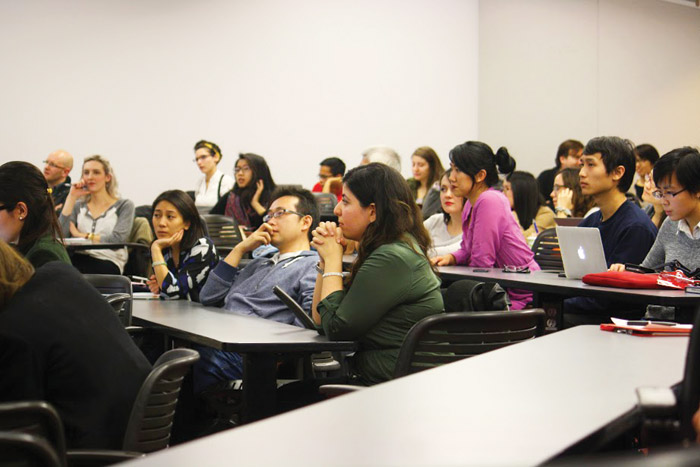
Students hosted a panel discussion on “Building a Culture of Consent on Campus” last Thursday as part of #ConsentMcGill, a week-long event organized and run by McGill students and administration. The panel responded to broad questions relating to the idea of a consent culture before opening up discussion with the audience of about 30 students. #ConsentMcGill was a campaign during Consent Week that sought to educate and increase campus awareness of consent in not only sexual activity, but also as it applies to students’ daily lives. The week included workshops on different aspects of consent and inclusivity on campus, as well as booths providing information to students.
The panel comprised of Alice Gauntley, U2 Arts; Roma Nadeem, U2 Arts; and Jean Murray, U3 Arts, as well as Carrie Rentschler, Director for the Institute for Gender, Sexuality and Feminist Studies (IGSF). The first panel question asked what a culture of consent on campus would look like.
Gauntley stressed the importance of consent in all aspects of students life, citing social activities that may be undesired such as drinking.
“A consent culture should apply in all of our social relationships on a campus, and when that happens on a campus that creates a ripple effect in the larger community,” she said. “ In a culture of consent, we no longer think it’s okay to pressure our friends, to pressure our froshies into drinking more than they want to. I feel like a culture of consent removes the social acceptance behind any manipulative behaviors.”
One discussion question asked how a culture of consent on campus would address issues of sexual violence in the community and beyond McGill. In response, Murray commented that the community is created by the arbitrary merging of many diffuse communities.
“Everybody who comes here was almost certainly raised in a context of normalized gender and […] sexual-based violence,” Murray said. “We must work to create a new collaborative setting where this is not the case through a lot of education and a complete paradigm shift in the immediate community as well as [in]the surrounding area.”
Rentschler brought up the issue of how a large number of sexual assaults on campus are performed by a small number of people, and that a strong consent culture may not help as much in this regard.
“Does this prevent the small group of people who are doing most sexual assault on campus from doing what they do?” Rentschler questioned. “I’m not sure it does. So then there’s the question of how do we mobilize this way of thinking into a convention strategy that actually says ‘This has to stop.’ If we can’t do this through training on how to consent in a relationship, then we need an alternative strategy for doing that as well. I think we build off of this consent culture to do that.”
Murray agreed and gave examples of action which have already been taken, such as including sexual assault education in frosh leader and server training.
“This needs to be an institutional change, it needs to be more than a group of people talking in a classroom,” she said.
Another question raised what advice the panelists could give for cultivating consent on campus, Nadeem said that although most of the focus is on large-scale campaigns, there are individual person-to-person changes people can make to enhance consent on campus and to normalize this amongst young people.
“[Things] such as bodily autonomy [and] asking people if you can give them a hug,” Nadeem listed as examples of ways to enhance consent. “Things like asking a friend if it’s okay to vent to them, if they’re in a good space to hear you rant.”
Murray emphasized the importance of active listening.
“Active listening is huge and it is one of the best things you can do to help people,” she said.
Rentschler said that ideally, people should take responsibility for mistakes or correcting others as a form of education, not shaming.
“We all need to learn how to do this and continue learning,” Rentschler said. “I see consent as a constant process and [….] It’s about ways of being responsive, so if you do do something you should not, you know how to respond.”
A final question asked what the role of accountability is in this possible culture. Gauntley affirmed that everyone is accountable for promoting a culture of consent.
“We are all accountable […] not to perpetuate a culture where consent is not present […] and to find ways to bring it into our lives by offering support for friends,” she said. “It is important that we are all accountable for each other in this culture that we are developing.”
Murray agreed with this sentiment but further emphasized that in the context of McGill hierarchy, more responsibility would lie on those in positions of power.
Following the organized questions, audience members began a dialogue on related topics such as the difficulties involved in holding perpetrators of sexual violence accountable, and how to prevent barriers to access within a culture of consent. The back and forth between panelists and audience members exhibited the interest and understanding developed from this event. Another lesson audience members agreed upon was that being safe is more important than being comfortable, and sometimes having difficult conversations is necessary if it can prevent future violence.
The tractor beam—a long-distance invisible attraction beam—is a legendary staple in science fiction. In real life, moving objects using only light seems absurd, if not impossible. However, in a paper published in Nature Photonics, a team of Australian and American physicists successfully transferred glass marble ten centimetres using only a laser beam.
Light is composed of tiny packets of energy called photons and it is through these that light can move objects. Each of these packets of energy has an associated momentum, so when they hit an object, their momentum is transferred to the object, nudging it forward slightly. Like rolling a bowling ball by throwing billions of dandelion seeds at it, scientists can use these photons to move microscopic objects—but only in the direction of the photons’ velocity.
To move the marbles backward, the team used a different approach. They fired a donut-shaped optical beam that heated up the beads. As the back of the beads heated up, the surrounding air pressure lowered and the beads moved backward. When the researchers adjusted the laser’s polarization, they could change whether the marbles moved forwards or backwards.
This technique may eventually be used for remote particle sampling or even for removing air pollutants.
Jet lag may cause more than just fatigue. In mice, at least, it also makes them more prone to obesity, according to a study published in Nature last week.
Every life form has an internal clock that keeps track of daily cycles, which are known as circadian rhythms. A team of researchers, led by Eran Elinav at the Weizmann Institute of Science in Isreal, has found that these cycles may be connected to weight. The biologists observed that the composition of gut microbes in both humans and mice changes depending on the host’s circadian rhythm.
The team then tested the effect of jet lag on these populations. They simulated jet lag by disrupting the feeding and sleeping cycles of mice, so that the mice were eating when they would usually be sleeping. These chronically jet-lagged mice gained more weight and displayed an increased risk of diabetes compared to the control group. When researchers analyzed fecal samples, they found that the usual fluctuation in the composition of gut microbiota was disrupted in the mice whose internal clocks had been shifted.
This research may help explain why shift workers have a higher risk of diabetes, as well as the association of disrupted sleep with diseases like cancer, obesity, and cardiovascular disease.
Competition between two species of lizards in South Florida has produced a remarkable example of evolution. A study by researchers at the University of Texas at Austin documented how over the course of just 15 years, green anoles in the area have responded to pressure from invasive brown anoles by developing feet that are better at gripping branches.
The change in the lizards’ physiology may not have turned them into an entirely new species, but it is far from insignificant.
“To put this shift in perspective, if human height were evolving as fast as these lizards’ toes, the height of an average American man would increase from about [5’9’’] today to about [6’4’’] within 20 generations—an increase that would make the average U.S. male the height of an NBA shooting guard,” explained lead author Yoel Stuart.
The scientific term for this phenomenon is called character displacement, and describes how species in competition with each other evolve to take advantage of different resources. In the green anole’s case, this means climbing higher up on branches than any nearby brown anoles. The speed with which this evolution has occurred makes it one of the few well-documented examples of character displacement that biologists have observed.
At the Post-Graduate Students’ Society’s (PGSS) General Assembly (GA), held on Oct. 22, students participating in the meeting voted on a reform package of PGSS bylaws, the ratification of the appointment of directors, and discussed the possibility of participating in a protest against provincial austerity measures.
Bylaw reform package
The bylaw reform package was presented by Secretary-General Juan Pinto to the GA.
“This reform package seeks to redress critical issues arising from the composition and jurisdiction of the current Appeals Board,” reads the bylaw package. Other modifications to the package include changes to the number of members of the Internal Affairs Committee and creation of a Vice-Chair position for the Executive Committee.
Karim Bouayad-Gervais of Psychology voiced his concern over a change to bylaw 6.5.3.1, which stated that a judge would be nominated by the Graduate Law Students’ Association for the Appeals Board.
“I don’t think this is a good solution for the root problem we have,” Bouayad-Gervais said. “What we’re doing here is giving a preference for a student association to nominate one member on that committee. If you deem that students from the Law Students Association are more competent because of training to be on this committee, then they should apply like any other members of the Graduate Student Association (GSA) and be selected based [on] competence and not based on what part of the GSA they are coming from.”
In response, Pinto said the reality is the majority of students with legal training will be from the Law Students Association, and stressed that the procedure would not appoint the student to the Appeals Board directly, the procedure would simply result in a nomination.
“We’re not giving the power to one GSA just because we think they fit the criteria better or not. The reality is if you want to find someone who has legal training, who can explain the procedural rules, you will find that the decisions that are being rendered are being rendered in a better way,” Pinto said. “By having a lawyer or having someone with legal training, the procedural matters that are coming forward are easily solvable because in this procedure, the judges are not going to be appointed […] only nominated [….] The Appointments Board reviews the C.V. and decides, and then Council approves it.”
PGSS members voiced concern over certain changes to the bylaws, including sections 6.5.3.1 and 6.5.5.3, as well as sections 9.16 and 9.17, which required consultation by the Chief Justice for most legal actions taken by the PGSS. Motions to vote on those sections separately were not passed, however, and the General Assembly decided to vote on the package as a whole. It was approved by a two-thirds majority.
Austerity measures
The Assembly also passed a motion to oppose the austerity measures imposed by the provincial government on universities and public services and undertake actions in the spirit of the motion.
Andrea Palmer, a graduate student in the School of Social Work, presented the motion to the GA, asking members to vote for PGSS participating in a strike against the budget cuts on Oct. 31.
“Be it resolved that the PGSS oppose the budgetary compressions imposed on universities throughout Quebec, notably McGill as well as on public and social services in general,” she quoted from the motion. “Be it resolved that the PGSS endorse and participate in the Oct. 31 protest against the Liberal budget cuts [… and hold] a one day strike on that day and that PGSS support the strike by disseminating information and encouraging PGSS members at large to take part in it.”
The stikes will be organized by student groups and unions. Palmer emphasized the importance of austerity measures on society.
“I’m a social worker, so I know how these cuts can affect our most vulnerable population, including students; our future generation where education is a right [….]” she said.
External Affairs Officer Julien Ouellet expressed concern at the implications of committing PGSS to a strike, and whether the rally was in line with the society’s image and values.
“I don’t know much about this particular rally, and rallies in Quebec have [a tendency] to get out of hand,” Ouellet said.
The Assembly voted to strike two clauses from the motion that encouraged PGSS members at large to take part in the motion and mandated PGSS to participate in the Oct. 31 protests. A clause stating that the external affairs committee should be encouraged to organize actions in the spirit of the motion was also added. The revised motion was ultimately passed.
Board of Directors
The General Assembly also ratified the appointment of three new Board members to the Board of Directors: Marc Lemieux, Regine Debrosse, and Karim Bouayad-Gervais.
Although most students are still searching for their purpose at university, Pierre Compere, a U1 political science student, has found his calling to make an impact in the world through pursuing creativity and sharing his vision of beauty in the world through his work.
As the head of marketing for Word and Colour—a journal challenging stereotypes regarding minorities, women, and other marginalized groups—Compere is driven not only by the creativity behind the journal, but the themes behind the journal’s work.
“Our goals are to [direct] readers to question their assumptions while also delivering creative, gorgeous, and original e-collaborations,” Compere said.
Originally from Clermont-Ferrand, France, Compere grew up in Waitsfield, Vermont. As a child, his family regularly visited Montreal. It wasduring these visits that Compere fell in love with the city. He decided to study at McGill so that he could be surrounded by the youthful energy and thriving art scene.of Montreal.
“I am fascinated by art because of the creativity it allows for,” Compere said. “To me, the idea of capturing a moment or sentiment and freezing it in time through any artistic medium is fundamental to the human condition.”
An ambitious student, Compere was determined to get a job at Word and Colour. Liam Lachance, the head of Word and Colour, needed a social marketing intern for the summer. Although he had little experience, Compere managed to get an interview. He was determined to walk out of the interview with an internship, and has been working at Word and Colour ever since. Though the promotion to head of marketing was recent, Compere is excited to include even more of his ideas in the journal.
Word and Colour inspired Compere to pursue a job in entrepreneurship. As a witness to Lachance building the electronic journal from the ground up, Compere developed a desire to go into business.
“I’m going to be an entrepreneur,” he said. “If you have an idea, there’s nothing stopping you from manifesting it.”
Compere is looking forward to the excitement of starting a company, pointing out the creativity and vision required for success, and the positives of the freedom that will come from working for himself.
“I’d rather create my own [business],” Compere said. “I don’t like being limited by a set of rules.”
This inclination for a creative workspace has inspired Compere a to pursue a future in the arts.
“I see myself pursuing art in the sense that I see myself pursuing creativity and design,” he said. “I’ll never be a painter or a saxophone player, but I’ll incorporate my vision into everything I do.”
McGil Tribune (MT): What’s your favourite ice cream flavour?
Pierre Compere (PC): Cookie dough.!
MT: What’s your favourite spot in Montreal?
PC: Pikolo Espresso Bar. Amazing coffee and atmosphere. I’ve got a lot of cool memories in that place.
MT: Where would you like to be stranded for the rest of your life?
PC: Maybe Paris or Rome. Somewhere with history.
MT: What’s your favourite food?
PC: Chef on Call, chicken parm sandwich with spicy mayo inside the sandwich. The key is the spicy mayo. Don’t forget it! You might not believe me now, but if anyone actually orders this when they get home at 3:00 a.m. after a night on Saint- Laurent—I told you so.
If T.I., known as the King of the South, has accomplished anything with his latest album, Paperwork, it has arguably been nothing more than demoting him to the title: “Prince of the Disjointed.” The album features a broad spectrum of techniques and musical genres culminating in an uneven sound that is tied together only by the presence of T.I.’s voice.
This is not to suggest that each song is approximately three minutes of wasted talent—“New National Anthem (ft. Skylar Grey)” and “On Doe, On Phil (ft. Trae The Truth)” each make excellent use of the featured artists’ talents for a smooth track with a strong beat and catchy hooks. Unfortunately, the entirely different feel each track has crosses the line of versatility into the realm of messy confusion, forcing what could have been T.I.’s most mature album to date seem more like a singles compilation.
T.I. makes his fatal flaw by wasting Usher’s vocal talents on “At Ya’ Own Risk.” To think that T.I. would have learned his lesson about writing lyrics with rape-undertones after “Blurred Lines” was clearly wishful thinking, as he had Usher warble out, “I don’t care if you’ve got a boyfriend or not, girl/ It’s at ya own risk if you’re kicking with me.”
T.I. claims that Paperwork will be the first instalment of a musical trilogy focused on experimentation and the rapper’s musical development. Let’s hope that in the next two albums, T.I. spends a bit more time focusing on aural unity, allowing for a sound united in its uniqueness, as opposed to divided by its diversity.
Arguably, the most difficult subject to talk about objectively is yourself. Darius Monroe’s debut documentary feature Evolution of a Criminal confirms this idea. Though he places himself squarely at the centre of the film’s narrative as the titular criminal, Monroe evades revealing the motivation behind his actions, resulting in a film that can be maddeningly vague while still being worthwhile—albeit for reasons that aren’t immediately clear.
Produced by legendary director Spike Lee, the film tracks filmmaker Darius Monroe’s life from childhood until today, trying to reconcile his past with his present. Though he is now a burgeoning filmmaker from the prestigious Tisch School of the Arts at New York University, Monroe was first a kid living in extreme poverty in urban Texas. After a burglary worsened his family’s already dire financial situation, Monroe decided to help however he could—though he had a steady job, he began supplementing his income through petty theft. This early thievery culminated with him and two of his friends robbing a bank. He was eventually caught and tried as an adult—despite being 17 years old when the robbery took place—and took a plea-bargain that allowed for reduced time in prison.
Evolution of a Criminal takes the Errol Morris approach to documentary, combining highly stylized re-enactments of the past with present-day interview footage. Monroe interviews family members, classmates, teachers, accomplices, victims, and criminal prosecutors, all of whom display different degrees of sympathy for his crime and how willing they are to forgive him. This aspect is, by far, the best part of the film—the emotional rawness that anyone related to Monroe had about his actions is compounded by the fact that he is also the one interviewing them. Subjects on camera refer to him directly, but the fact that we don’t see the filmmaker’s face in these scenes puts the audience member directly in his shoes.
The flashback and establishing shots throughout the film are remarkably well composed. Scenes from his hometown are shot with a striking orange filter that convey both the nostalgia that comes from reminiscing and the dread that springs from the realization that you can’t change the mistakes of the past, no matter how you frame them. The editing is also uniquely done for what could have been a straightforward documentary. In one of the film’s most powerful moments, Monroe’s drive to prison is intercut with shots of the friends and family he would leave behind, staring pensively away from the camera.
This focus on the supporting players in his life is my main qualm with the film: It never really does what it purports to be doing—which is to show Monroe evolve. Unfortunately, we don’t get to see the evolution of an innocent youth trapped by circumstance into a bank robber, or that of a convicted felon into a talented filmmaker. The problem is that a disproportionate amount of the film’s running time is spent focusing on his bank robbery and the immediate aftermath, allowing no time to delve into how Monroe got from point A to B. Crucial expository information is almost entirely absent—we never find out how much time he spent in prison, what his upbringing was like outside of the fact that he lived in poverty, or how he came to turn his life around. As a result, we never get insight into the crucial decisions that came to define his life beyond a few clichés and platitudes.
Monroe’s strengths as a filmmaker seem to lie more in teasing the emotional truth out of others rather than engaging in deep introspection. Because of this, Evolution of a Criminal can’t claim that it shows the evolution of a criminal—instead it paints a vivid picture of the way one person’s actions affected those around him, something that is emotionally effective in its own right.
Evolution of a Criminal runs until Oct. 30 at 8 p.m. at Cinema du Parc (3575 Parc). Student tickets are $10.

Motion on restricting discretionary funding
The Students’ Society of McGill University (SSMU) Legislative Council tabled and discussed a motion titled Amendment of the Clubs and Services Portfolio By-Law Book at its meeting last Thursday.
Originally moved by VP Finance and Operations Kathleen Bradley and VP Clubs and Services Stefan Fong, the motion sought to limit discretionary funding for projects and events that were in accordance to the services mandate and directly affected students.
Fong elaborated on the bylaw’s purpose.
“The money that is raised by students [through service fees] should be given back to students through the provision of services,” he said. “If the service would like to donate money toward a project that does not directly benefit students, they are welcome to do the fundraising toward that goal and donate the money that is raised off of their efforts.”
An amendment requiring the VP Finance and VP Clubs and Services to present a report regarding the breakdown of each service’s use of discretionary funding at the end of each semester was also passed and added to the motion.
“I do not see this to be an approval process but merely a way of reporting,” Bradley said in response to concerns over potentially infringing upon the services’ financial autonomy. “It is not a judgment of the Council, but more like a transparency process.”
The motion has been postponed until the next Council meeting for the SSMU services to be consulted regarding the amendment.
Discussion on funding for library extended hours
VP University Affairs Claire Stewart-Kanigan explained that students had helped fund extended library hours during exam season for several years.
“All the hours after midnight that the library is open for has been funded by the SSMU Library Improvement Fund for 10 years now,” Stewart-Kanigan said. “There have been concerns over the lack of consideration of these largely security-based expenses as operational costs that the university should be funding.”
The Library Improvement Fund, to which students and alumni contribute, amounts to $650,000 a year. The fund comprises of contributions of $8.50 per full-time student and $4.25 per part-time student each semester, matched equally by alumni donors. According to Library Improvement Fund Coordinator Erin Sobat, the library’s extended hours cost $250,000 a year.
“Students might not be aware that it’s student money that has been running this,” Stewart-Kanigan said. “The option of using this $250,000 for student projects or specific initiatives to improve the library experience [has been overlooked] because of something the university should be funding.”
There was a general consensus that students must be made aware of SSMU’s funding of the extended hours, and should also be encouraged to explore other initiatives that the Library Improvement Fund could sponsor.
SSMU President Courtney Ayukawa further emphasized the importance of students speaking to the administration about a change for extended hours to be recognized as a part of McGill’s operational budget.
“In my opinion, when students care about something loudly enough, the administration does listen and make changes,” Ayukawa said. “However, I would hate for this demand to be loud enough for the university to care [only] after the 24-hour library access has been lost.”
Informal discussion on last week’s General Assembly
The Council agreed that the GA last Wednesday was a success, despite some logistical and procedural issues.
Physical and Occupational Therapy representative Yasmine Hadifi raised concerns about students’ lack of procedural knowledge regarding Robert’s rules. In response to Hadifi, Engineering representative Anikke Rioux suggested better access to Robert’s Rules for the students.
“Hosting some sort of online tutorials to explain Robert’s rules beforehand would be conducive to a more fluid GA,” Rioux suggested. “Assigning councillors certain duties and having us wear an identifiable colour of t-shirts at the GA to help students with questions would [also] be helpful.”
VP Internal Daniel Chaim argued that students’ interest in the motions affected participation in the GA.
“The real conflict wasn’t about the mandate or the program, but that most people were only concerned with one motion,” Chaim said. “A lot of people were upset, but what the SSMU was mandated to do was to entertain the students’ right to voice their opinions at the GA.”
Arts & Science Senator Chloe Rourke applauded the GA’s turnout.
“Being in a building for 10 hours with nearly 800 people is excessive [and] is not really expected of average students [who] showed their commitment towards student politics,” Rourke said.
Arts representative Alexander Kpeglo-Hennessy also commented on the activeness demonstrated by students at the GA.
“[My] constituents were happy that they went in spite of the result because it was an excellent example of students actively participating in a democracy,” Kpeglo-Hennessy said.
Motion to support the #ConsentMcGill campaign
The Council passed a motion supporting the #ConsentMcGill campaign and taking action against sexual violence. Apart from reaffirming SSMU’s support for the campaign, the motion encouraged SSMU to lobby the McGill administration to institutionalize the position of sexual assault response coordinator and to host consent campaigns, education projects, and initiatives based around action against sexual violence in collaboration with student groups on an annual basis. The motion was passed with unanimous support and Council also agreed to be codified as a policy by the end of the year to ensure that its reach remains wide-ranging and effective in the long run.
Eye Know
Artist: De La Soul
Album: 3 Feet High and Rising
Released: March 3, 1989
https://youtube.com/watch?v=Me5uEsbX9eU
This is perhaps the most unabashedly romantic song in the history of rap. De La Soul, the original hippies of hip-hop, crafts a song that tracks the trajectory of a relationship from courtship to marriage with the sincerity that only love can bring. Prince Paul’s production puts the song over the top, laying a whistling refrain over a simple, Steely Dan-sampled beat that simultaneously reminisces about the excitement of falling in love while providing a guiding light for the future.
School Spirit
Artist: Kanye West
Album: The College Dropout
Released: February 10, 2004
https://youtube.com/watch?v=pUMd6rFxS34
Before the beautiful narcissism that has come to define Kanye’s recent work, there was “School Spirit,” a song that serves as his victory lap over higher education and the thematic centrepiece of his debut album. He’s dropped out of school and he couldn’t be happier—now his real life can begin. The soul samples used earlier on the album to sympathize with socioeconomic reality that adult life brings are turned into the stuff of dreams on this track as Kanye triumphantly sinks his teeth into every hypocrisy that he faced in school.
Every Ghetto, Every City
Artist: Lauryn Hill
Album: The Miseducation of Lauryn Hill
Released: Auguest 25, 1998
Cheesy? Maybe. Similar in content to Kanye’s “School Spirit”—though not in tone—this song takes a deep look into the past and sends a thank you note rather than a poison-penned letter. Mixing rap, soul, and R&B in a way that only Hill can, she reflects and expresses gratitude for the things that made her who she is today, from the car jackings and economic strife to Saturday morning cartoons and playing in the park. Carlos Santana’s bouncing guitar keeps the song upbeat as Hill tells the listener that where you come from makes you who you are—for better or worse. You can practically hear her smiling the whole time.
The World Is Yours
Artist: Nas
Album: Illmatic
Released: April 19, 1994
Offering a respite from the mostly depressing content of the rest of Nas’ debut album, “The World is Yours” sees Nas delve into his dreams and take an optimistic look towards the future. Though he struggles throughout the song to reconcile the bleakness of today with the beauty of his tomorrow, the song’s refrain encourages the idea that the world is yours and you can make it whatever you want it to be. The darkness of Queens’ that Illmatic presents may seem inescapable, but hip-hop always offers a way out.