Latest News

a, Martlets, Men's Varsity, Sports

Redmen struggle, Martlets shine in annual Redbird Classic

Martlets

Coming off their third RSEQ Championship in as many years, the McGill Martlets swept the Redbird Classic with wins over Lakehead, Regina, and Toronto.

The Martlets took control of their first game early with an 18-8 lead after the first quarter, but the Lakehead Timberwolves stormed back in the second and McGill went into halftime clinging to a one-point lead. Led by junior centre Alexandria Kiss-Rusk, the Martlets blew the game wide open as they outscored the Timberwolves by 18 in the second half. Kiss-Rusk and reigning RSEQ Player-of-the-Year Mariam Sylla combined for 27 points, and 5’4” point guard Marika Guerin pulled down a game high nine rebounds.

In their second game, the Martlets jumped out to an early lead and never looked back, en route to a 73-41 drubbing of the Regina Cougars. While Sylla had trouble shooting all night—connecting on just one of her 10 attempts—she took advantage of free throws, shooting nine for 10 from the charity stripe. The starters struggled throughout the night, but the bench picked up the slack, scoring 46 of the team’s 73 points. Sophomore guard Carolann Cloutier came off the bench to lead the team with a game high 16 points on 86 per cent shooting, including a perfect four for four from three point range.

Cloutier cooled off in the tournament finale, but the Martlets stayed red-hot, downing the Toronto Varsity Blues 68-59. Sylla led the way with 17 points and 10 rebounds for her second double-double of the tournament. Senior point guard Dianna Ros facilitated the lethal McGill offence with four assists to go along with her 17 points.

The Martlets will head down south to take on the Maine Black Bears, of the NCAA, on Nov. 1 in what will be a good measuring stick for this year’s potent squad. Their RSEQ season kicks off on Nov. 6 at Love Competition Hall against the Bishop’s Gaiters.

Redmen

After back-to-back RSEQ Championships, the McGill Redmen hosted their annual Redbird Classic tournament at Love Competition Hall this past weekend. The Redmen, 3-3 in preseason, opened the tournament against an inexperienced St. Francis Xavier squad. McGill found themselves down by 11 at the start of the fourth quarter, but stingy defensive play allowed the Redmen to claw back and tie it up late. Captain Vincent Dufort led the way with 20 points and 10 boards while sophomore power forward Francois Borque picked up where he left off after his exceptional freshman season, posting an impressive double-double. Borque tied it up at 65-65 with four seconds left, but the X-Men pulled away in overtime en route to a 77-73 victory.

Day two of the tournament saw the Redmen take on the Brock Badgers, and once again McGill fell behind in the first quarter as they dealt with turnover issues and poor shooting. Sophomore forward Michael Peterkin proved to be the spark plug in the second half, catching fire from beyond the arc and scoring 12 of his 16 points from deep. The Redmen stormed back in the second half, finally pulling ahead in the fourth quarter with backup point guard Jenning Leung leading the way. Leung scored a game high 17 points—including two ‘and-one’ plays—as well as a buzzer beating three at the end of the third.

“I’ve been struggling with my shot recently,” Leung said.  “So it was nice to see them finally go in, especially that half court shot. I just saw the ball rolling […] so I decided to pick it up and throw it because there wasn’t much time, and it went in.”

After his big game against the Badgers, Leung found himself in the starting lineup against the CIS top-ranked Ottawa Gee-Gees. The Redmen fell behind early, however, and never got back into it, losing 88-56. It’s early, but the Redmen clearly still have a few kinks to work out if they want to compete for the CIS title this season.

“We’ve got a lot of work to do, but it’s only October,” Coach Dave DeAverio said. “You’re going to make a lot of mistakes in October, as we did last year [….] The idea is to just get better and better every day.”

The Redmen finish off their pre-season in St. Catherines at the RBC Brock Classic, where they will take on Windsor, York, and Ryerson. On Nov. 8, they return home to take on a tough Bishop’s Gaiters team in what could be a RSEQ Championship game preview.

a, Baseball, Sports

Point Counterpoint: 2014 MLB World Series Preview

The McGill Tribune takes a look at the 2014 MLB World Series. Two writers square off to predict whether it’s the San Francisco Giants or the Kansas City Royals who have what it takes to bring home the trophy.

Click each perspective to read more

San Francisco Giants

Elie Waitzer

OFFENCE:

The Giants’ lineup isn’t stacked with big names, but it’s hard to find a real weak spot anywhere in the batting order. As has become expected, General Manager Brian Sabean has pulled a mixed bag of role players out of his hat at just the right time. Rookie Joe Panik has exceeded expectations at second base, and journeyman Travis Ishikawa sent the Giants to their third World Series in five years with a walk-off home run. Homegrown stars such as Pablo Sandoval, Buster Posey, and Brandon Belt should continue to provide the power for this team, and you could make an argument for giving the NL MVP award to free agent-signing Hunter Pence.

DEFENCE:

The Royals’ outfield has undoubtedly been deserving of all the media love it has garnered thus far. In the infield, however, the Giants may hold a slight advantage. In his third full season with the Giants, shortstop Brandon Crawford has provided gold-glove defence in the hole. While Pablo Sandoval might not be the most nimble third baseman, it’s not as though the Royals’ corner infielders are particularly agile themselves.

STARTING ROTATION:

This Giants squad is almost unrecognizable from its 2010 and 2012 World Series-winning teams, but among the few familiar faces, nobody has played a bigger role than Madison Bumgarner. Just four years ago, we watched Bumgarner dominate the Rangers over eight innings in Game Four of the 2010 World Series as a rookie. After posting the best numbers of his young career in the regular season, Bumgarner has been the most effective ace of this post-season, building on his already impressive October resumé. If the Giants can push this series past Game 5 and get two starts out of Bumgarner, veteran starters Tim Hudson and Jake Peavy should be able to pick up the rest of the slack.

BULLPEN:

Like Kansas City, the Giants have two elite set-up men in the form of Jean Machi and Jeremy Affeldt. While their numbers aren’t as good as Kansas’ deadly duo of Kelvin Herrera and Wade Davis, both posted earned run averages (ERA) under 3.00 and should be able to lock down the seventh and eighth innings. Unlike Kansas City, the Giants are sorely missing a reliable closer. The demise of Sergio Romo and his devastating slider forced Manager Bruce Bochy to hand the ninth inning to Santiago Casilla. He’s gotten the job done thus far, but he had previously been known for starting the season in the minor leagues after imploding in 2013.

X-FACTOR:

Baseball analysts often omit the manager’s role in their assessment of a team, arguing that the boss’ effect is negligible. However, when a matchup between two managers is so skewed, it can be a major factor. While Ned Yost has become the first manager to win his first eight games in the post-season, he is widely panned by the sabermetric community for his rigid bullpen use and bunt-happy ways. Giants’ Manager Bruce Bochy, on the other hand, has finished in the top three in Manager-of-the-Year voting five times, and won the award in 1996. His wealth of playoff experience, and his uncanny ability to bring the best out of his players should provide an important edge for the Giants in this World Series.

Kansas City Royals

Adrian Kanowler

OFFENCE:

These Royals are fast. With 153 stolen bases this year, Kansas City easily led the American League in swiped bags. Despite this, they know the old baseball axiom: “You can’t steal first base.” The Royals supplemented their speed by finishing third in the majors in base hits and combining for the second highest batting average. They have truly mastered the art of ‘small ball’—pushing across runs on bloop hits and savvy base running. Kansas City finished dead last in the league in home runs this year, but their bats have suddenly come alive in the post-season, swatting eight home runs over eight games. If they can stay hot, this lineup has everything you need to take a seven game series.

DEFENCE:

From centre fielder Lorenzo Cain robbing extra base hits at the wall to third baseman Mike Moustakas diving over the dugout wall head over heels to grab a foul ball, this Royals team has plus defenders at almost every position. With Gold Glovers at first base, catcher, and left field, this defence continues to impress. The only possible weakness is Norichika Aoki, who is a replacement-level Major League right fielder.

STARTING ROTATION:

The Royals turned heads two years ago with the now infamous trade that sent their top prospect Wil Myers to Tampa Bay for a package centred around James Shields. ‘Big Game James,’ as he’s known, has been terrific for the Royals over the past two seasons. His playoff appearances so far haven’t been dominant, but he’s given the Royals a chance to win in each of them. The rotation behind Shields consists of veterans Jason Vargas and Jeremy Guthrie, who have both been solid in the playoffs, and flame-throwing Rookie-of-the-Year candidate Yordano Ventura, who led the rotation in ERA. They don’t have a true ace, but their rotation is deep and consistent.

BULLPEN:

The Kansas City bullpen is arguably the best in all of baseball. They’re so good that the triumvirate of Kelvin Herrera, Wade Davis, and Greg Holland has earned the nickname ‘The Three-Headed Monster.’ If the Royals have a lead going into the seventh inning, manager Ned Yost can hand the ball to Herrera, and from there, the game may as well be over, as a blown save is a rarity with this trio. Each reliever had an ERA under 1.50 on the year, and both Davis and Holland each struck out over 13 batters per nine innings. This team doesn’t tend to put lots of runs on the board— their dominant bullpen has been possibly the biggest key to the Royals’ success in this post-season.

X FACTOR:

This is a young team, and most of the players have no prior playoff experience. While this hasn’t been an issue so far in the post-season, they’ll be facing a team stocked with players who have invaluable World Series experience. To make the jump to World Series Champions, their three veterans—Alex Gordon, Billy Butler, and James Shields—must step up and deliver. Gordon was the go-to guy in Kansas City this year, leading the team in extra base hits, RBI, and home runs. Butler had a down year, but the veteran designated hitter knows how to hit, and his experience could prove the difference in this matchup.

Editor’s Pick: Giants in 6

a, From the BrainSTEM, Science & Technology

From the BrainSTEM: Gaters, games, ‘n gals

From the lawless wilderness of 4chan boards and subreddits to the relatively tame comment sections of tech websites, a debate is raging about women in gaming: Are women being marginalized and abused, or are the alleged problems a media creation? Unfortunately, a series of recent events proves the former to be true.

The recent internet movement Gamergate—which cites its official purpose as improving advocacy for ethics in video game journalism—has placed a spotlight on this issue. However, the Gamergate movement contains strong undercurrents of misogyny, with blogs like The Verge questioning the legitimacy of the problem.

Gamergate stemmed from a blog post in Aug. 2014, when video game reviewer Eron Gjoni broke up with his girlfriend Zoe Quinn, an independent video game developer. According to the post, Gjoni accused his then girlfriend of having an affair with Nathan Grayson, a video game reviewer who had given Quinn’s latest game Depression Quest a positive review. Rumours began spreading that Grayson positively reviewed the game because of his dealings with Quinn. Gamers everywhere began to scorn her, accusing her of “selling her body for publicity.”

From there, things quickly spun out of control. Anyone vaguely associated with the Quinn controversy was targeted. This included feminist vlogger Anika Sarkeesian, whose YouTube show Feminist Frequency discusses the role of women in video games. In her shows, Sarkeesian argues that women are constantly being portrayed in many games as sexual playthings and victims of violence—including in popular games such as Assassin’s Creed and Grand Theft Auto—to satisfy male desires. Following Gjoni’s accusations, the show’s Twitter page and comment sections were filled with horrifyingly graphic messages and insults—some so violent that Sarkeesian left her home in fear.

So when the University of Pittsburgh conducted a study representing the public perception of the stereotypical gamer, the results were not surprising. Most people pictured gamers as angry young men. However, this perception is inaccurate.

Gamergate, however, has brought the dark underbelly of the gaming world to light. ‘Gaters’—as proponents of the movement call themselves—claim women like Quinn are trying to ruin gaming as we know it, and consequently degrade them for it. What they fail to realize is that female gamers have become intrinsically linked to the gaming world, simply by playing games, whereas Gaters are the ones who represent a diminishing fraction of gamers. It’s time Gaters recognize that women game, too.

Although Gamergate originated as an initiative to advocate video game journalism ethics, the convoluted and mysogynistic version of the movement has garnered intense public support. The American Enterprise Institute, a right wing think-tank, has dismissed opponents of the movement as “feminist tech writers” and “concernocrats” bent on destroying free speech. 

All of this points to a situation rife with misconceptions. Grayson did not write his review to ‘repay’ Quinn. Gaming will not implode, as Gaters claim, if women are in the industry. Gamergate has nothing to do with civil liberties, and everything to do with the objectification of women. The few legitimate arguments about ethics in journalism and the nature of games have been overshadowed by a flow of hateful bile that shows the vile nature of the movement. If anything, Gamergate shows us that in order for women to be treated equally on the internet, the current mindless, misogynist mindset of the Gater must end.

a, Science & Technology

Demystifying vampires

When the word vampire is mentioned, it’s easy to imagine a musky room, candle light, and perhaps, romance. Dracula, a novel written by Bram Stoker, and its multiple contemporary renditions were, at least in Western literature, the first brazen attempt at coupling vampires and humans.

Of course, the association of sex and vampirism was not rooted in the psyche of just one author. In the analysis of the acquisition of these thought-chains, a pattern becomes apparent: People are conditioned to think a certain way.

According to German-American psychologist Wolfgang Köhler, “[The Bouba/Kiki effect provides an example of] non-arbitrary mapping between speech sounds and the visual shape of objects.”

In an experiment, participants were asked to name two shapes as either ‘Kiki’ or ‘Bouba.’ The result demonstrated strong preferences for the round, curved shape as being Bouba—95 per cent—and the jagged, spiky shape as Kiki—98 per cent.

Likewise, the link between vampires and desire is anything but arbitrary. The natural—or in this case supernatural—associations with darkness, blood, puncturing, and feeding, could very easily morph into connections of mystery, pain, and  desire.

Science takes a considerably drier perspective on the vampire myth. According to a paper published by Skeptical Inquirer, simple mathematics disproves the theory that vampires exist. Assuming that the first vampire arrived on Jan. 1, 1600, that it required human blood once a month, and that all humans bitten by vampires would become vampires themselves, the entire human population would be wiped out in less than three years.

There is something to be said about the idea of vampires and their place somewhere between fiction and reality. Specifically,  most—if not all—myths are rooted at least partially in past events. Vampirism is no exception. According to an article published by Neurology, Dr. Gomez-Alonso argues that, “Vampire stories became prominent in Europe at exactly the same time certain areas were experiencing rabies outbreaks. This was particularly true in Hungary between 1721 and 1728, when an epidemic plagued dogs, wolves, and humans, and left the country in ruins [….] Vampires were the sole topic of conversation between 1730 and 1735.”

Fantasies are by definition not real; yet, in the process of thinking and describing these fantasies, it can be easy to become confused  of the extent of a fantasy. A prime example is the medical condition porphyria, a condition that causes seizures, trances and vivid hallucinations. Interestingly, it also causes acute sensitivity to light—where the briefest exposure could lead to blisters on the skin—as well as intolerance to foods containing sulphur. Fittingly, garlic just happens to be very rich in sulphur.

In this way, the supernatural becomes super easy when you break down the facts.

a, McGill, News

What’s happening at McGill

#ConsentMcGill

Oct. 20-24

Various locations on both campuses

This week long campaign aims to draw attention to the importance of consent through workshops hosted by various student groups around campus. It was one of the measures set forth by Ollivier Dyens last semester, following campus-wide scrutiny regarding the administration’s approach to an ongoing sexual assault case against three former Redmen football players.

https://www.mcgill.ca/deanofstudents/consentmcgill

SSMU General Assembly

Oct. 22 4:30 p.m.

SSMU Cafeteria

This event, which takes place once a semester, gives members of Students’ Society of McGill University (SSMU) the opportunity to hear reports from executives on the progress of their work at this point in the year, and to vote on various matters pertaining to the Society. The questions up for vote this semester include: A motion to support the people of occupied Palestinian Territories, a motion for SSMU to join the student coalition Étudiant(e)s Contre les Oléoducs (ÉCO), and a motion that SSMU officially oppose development of military technology on campus.

Safe Space workshop

Oct. 23 2:00 p.m.

McLennan Library Building

Hosted by the Office for Students with Disabilities, this workshop aims to raise understanding of racial and cultural discrimination on campus.

http://www.mcgill.ca/channels/event/safer-spaces-workshop-race-cultural-identity-224794

Glenn Greenwald

Oct. 23 6:00

Pollock Hall

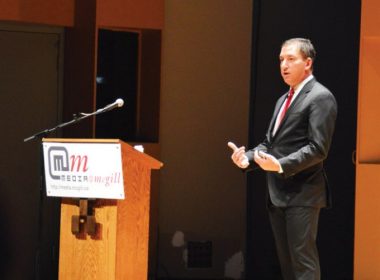
Greenwald, a renowned journalist and lawyer, who broke the story regarding citizen surveillance by the National Security Agency, will be speaking at McGill’s 2014 Annual Beaverbrook Lecture.

Admission is first-come, first-serve.

Conference on Food Security

Oct. 28 6:30 p.m. & Oct. 29 all day

New Residence Hall

This two-day event aims to address matters regarding food availability for the world’s expanding population. It will feature workshops, presentations, and discussions, and will be attended by students, government representatives, and members of NGOs.

Admission for students is $60.

girl sticks her fingers up
a, Arts & Entertainment, Theatre

Superhospital makes an appointment for comedy

It’s fitting that Montreal Improv’s newest show, Superhospital, takes its name from an enormous medical centre that’s currently being constructed just west of the city’s downtown core. For the uninitiated, improvisational theatre—or improv—is a type of performance art in which a group of actors hop on stage with no script, no direction, no concrete plan, and proceed to construct the entire act on the spot with little more than a theme, word, or suggestion from the audience as a starting point. Even though there’s room for sloppy disaster, hilarity almost always ensues.

As the name implies, the show features nearly a dozen improvisers performing a long-form improv in a hospital setting. The twist? Every single actor has a specific character that they’ve developed before the show to embody during the performance. For those purists worried that this gimmick takes the improvisation out of improv, don’t be—everything else is entirely made-up on the spot, with audience members filling out a sheet of paper with a made-up symptom beforehand to be selected by the performers. It assures that the plot is as silly, nonsensical, and down-right funny as it should be.

While I was disappointed that my own suggestion—Compliment Tourette’s—wasn’t selected, the show was consistently funny throughout, providing steady giggles and occasional gut–busters to keep the energy riding high. This isn’t to say that the show is perfect: Many of the performers are amateurs, which became apparent as some scenes petered out into awkward silences or into confused and sometimes outright misunderstood plot points. Fortunately, these instances were few and far between and didn’t damper the overall plot, which was surprisingly coherent—at least as coherent as a plot can be in improv. Furthermore, the pre-established characters lended a much-needed layer of consistency to the structure of the show.

Massive amounts of kudos must be given to the performers, whose relative inexperience is more than made up for with heaps of talent. Every character was fully fleshed out with enough quirks and personality to make them a joy to watch. Each was embraced with an unabashed and enthusiastic sincerity that almost immediately made them feel familiar.

A few standouts were an insecure yet blow-hardy doctor, a dissatisfied janitor who’s tired of being ignored, a sassy secretary with a penchant for dishing out loads of terrifying forms, and a new age doctor who’s love of feng shui is accompanied by her utter lunacy. Special mention should be made of the technical director, whose spontaneous addition of music and lighting effects—which probably surprised the actors as well as the audience—resulted in some very funny moments.

For those of you who consider yourselves connoisseurs of improv, Superhospital is a fantastic show, and its few awkward moments are more than made up for with great jokes and stellar performances from a group of very funny people. For those of you who have never experienced an improv show before, it is a blast and a great way to get into a fun new style of performance. So grab a bunch of friends, fork over eight bucks, and prepare for your life to get significantly more awesome.

Superhospital is performed on the third Thursday of every month at the Montreal Improv Theatre (3697 St. Laurent). Tickets are $8.

a, Men's Varsity, Sports

Split sours homecoming weekend for Redmen hockey

The McGill Redmen (2-2-0) faced two Ontario teams on consecutive nights this past weekend, and split the games, handily defeating the Nipissing Lakers in a dominant 8-1 performance Friday night and falling to the Laurentian Voyageurs 5-2 Saturday night. (more…)

a, Behind the Bench, Hockey, Sports

Behind the Bench: Narrative from nothing

When the Ottawa Senators appointed their superstar forward Jason Spezza captain one year ago, the response from the media was immediately critical. (more…)

a, Arts & Entertainment, Music

Album Review: Hey Rosetta! – Second Sight

When its previous album Seeds (2011) was being recorded, Hey Rosetta! was coming out of a phase where the band had been touring extensively for the first time, and—quite fittingly—planting musical seeds in the towns and cities it performed in. The album, with its oscillation between boisterous anthems and measured melodies, reflected the mindset of a band that was giving audiences exhilarating live shows at night in between the hours of quiet introspection they had on the road. To a certain extent, Second Sight replicates that balance, but the frenetic feeling that characterized the band’s more spirited songs in the past has been replaced by light tones and a controlled electricity that—despite flashes of generic repetition—sparks several quality songs.

Poppy, radio-friendly single “Kintsukuroi” suggested a new musical focus when it was released in August, and with Second Sight, the band shows us that this was indeed the case. Most of seven tracks leading up to “Kintsukuroi” feature a kind of airy instrumentation, dynamic percussion, and middling pace that grow somewhat tiresome and—unfortunately for such a unique, orchestral seven-piece group like Hey Rosetta!—sound reminiscent of other indie acts such as Local Natives (“Promise”) or Vampire Weekend (“Neon Beyond”).

As is usually the case with Hey Rosetta! albums, Second Sight’s best songs are the ones that sound like only they could have written them. “Gold Teeth” combines elements of Seeds’ standouts “Seventeen” and “Young Glass” with the band’s evolved sound to produce a superb song that is bursting with hope and excitement underneath its poised surface. “What Arrows” and “Cathedral Bells” are two of the album’s quietest and strongest tracks, initially carried by Tim Baker’s gentle vocals as soothing music slowly builds up around him.

Even though the sum of its parts isn’t as great as it could be, Second Sight is loaded with good music and good vibes, and at the end of the day, certainly feels like a worthwhile experiment.

a, Science & Technology

The substance of style

Since the invention of the printing press, news media has endeavoured to employ capitation in the interest of magnetizing readers into ratifying their viewpoints and escalating their market share. The McGill Tribune is no exception, as the paper employs strategic readership engagement tactics in order to endue its student body readership with information, material, and divertissement.

Wait, what? That’s the question Harvard professor Steven Pinker asks in The Sense of Style, his latest book related to psycholinguistics. Pinker’s previous book, 1994’s influential The Language Instinct, stated that despite widespread disagreement, our collective language and grammar skills are not devolving, which Pinker, in Sense, reaffirms: Writing is not getting worse—it’s always been bad.

Pinker believes his new book can help. He was introduced to a number of adulations last Friday at a lecture organized by the McGill Writing Centre: A professor at Harvard, one of Prospect and Foreign Policy magazines’ top 100 public intellectuals, one of TIME’s top 100 influential people, and a prolific and popular author. It is this last distinction, however, that really gives Pinker the authority to write about writing; a boastful blurb from The Economist on Sense claims that Pinker writes “like an angel.” Last week’s public lecture gave students the opportunity to see if he speaks like one, too.

Pinker, after acknowledging his connection to McGill—BA Psychology, 1976—in a lecture hall that, according to him, “hasn’t changed in 40 years,” abruptly dove into Sense. The “curse of knowledge,” as Pinker calls it, is a significant cause of bad writing. According to Pinker, contrary to popular belief, writers today aren’t deliberately obscure, nor has their craft been dumbed down by the internet. Instead, Pinker says, bad writing is the difficulty in imagining what it is like for someone else not to know something that the writer knows, because people often project their knowledge, however specific, onto others.

What is to be done about this? Pinker sees some value in traditional ‘prescriptivist’ guides, such as the classic 1959 The Elements of Style by William Strunk and E.B. White. Furthermore, he claims that he doesn’t have the desire, to say nothing of the ability, to supplant The Elements of Style. However, Sense reflects Pinker’s wish for a 21st century style guide.

“[The book uses] the science and scholarship of language, […] modern grammatical theory, […] evidence-based dictionaries, research in cognitive science on what makes sentences easy or hard to read, and historical and critical studies of usage,” Pinker said.

Drawing from these areas has led Pinker to believe that a good model for writing is the so-called ‘classic style’: Simple and concise prose that does away with elaborate filler and meta examination of its subject—the introduction to this article, for example—responsibility-shifting passive voice, and hedging without much opposition. Classic style instead makes liberal use of example, and invites the reader to gaze out of “a window unto the world” through which the writer points directly to topics they are trying to explain, and does so neither by confusing the reader nor insulting their intelligence.

According to Dr. Sue Laver, director of the McGill Writing Centre, The Elements of Style is no longer assigned to McGill undergraduates. Much of the praise for the guide has stemmed from its concise precision; the book heeds its own advice to “omit needless words.” Writing is hard, however, and poor prose has spawned a whole curriculum of courses at McGill to improve writing—and has frustrated Stephen Pinker enough that he felt the need for a new style bible. Brevity and clarity have always been fashionable, but there is no doubt that The Sense of Style will inspire more ink to be spilled on how to write less.

Read the latest issue

Read the latest issue