

Latest News

Science & Technology, Student Research

Blending Western and traditional medicine in Colombia

In 2014, Juan Pablo Pimentel, a PhD candidate in the Department of Family Medicine at McGill, created a pilot exercise that has since become the basis for his PhD thesis. Working with Family Medicine professors Dr. Neil Andersson and Dr. Anne Cockcroft, Pimentel devised a way for medical students in Colombia to engage in training and activities to help close the medical gap between practitioners of traditional medicine and physicians trained in Western medicine. Together with traditional medicine users from the Sabana Centro region of Colombia, cultural safety experts, and senior medical students, Pimentel and his team now have an ongoing trial that will assess the impact of students’ participation in the trainings compared with standard lessons on cultural safety.

“[We came up with] a system in which players engage in competition under pre-defined rules with a common goal in mind,” Pimentel said in an interview with The McGill Tribune

Specifically, the system educated students on the cultural significance of traditional medicine and how to blend it with modern medical practices. In Colombia, where 40 per cent of the population uses traditional medicine methods, this is especially important. Blending traditional and Western medicine has increased awareness of cultural safety in medicine, a term that was developed by Irihapeti Ramsden, a Māori nurse in New Zealand. 

“She developed the concept as a result of the increasing discontent of Māori people with the type of healthcare they were receiving,” Pimentel said. “[It was] totally disconnected from their cultural background.” 

As part of her PhD dissertation, Ramsden wanted to adapt Western medicine to the cultural needs of Māori people, an indigenous people of New Zealand. At its core, cultural safety training dismantles the ethnocentric frame of mindthe tendency of people to view other customs and cultures through the lens of their ownto produce culturally competent health systems. Ramsden believes that by introducing future physicians to different cultures, Western and traditional medicine can exist in harmony with one another. 

Pimentel stressed that traditional medicine is much more comprehensive than many think. 

“We must avoid reducing traditional medicine to medicinal plants,” Pimentel said. “Traditional medicine encompasses many other aspects of life. For example, maintaining a healthy relationship with ourselves, our families and friends, the environment, and the spiritual world.” 

Spirituality and religion play an especially large role in some traditional medicine practices. For example, Catholicism is a major religion in Colombia, and concepts from the faith often blend with cultural health practices; communication with the spiritual world is regarded as an important way to keep a healthy mind.

Pimentel also highlighted the importance of environmental health in Colombian traditional medicine. 

“It is true that, in some cases, traditional medicine can harm the environment, especially when animal products from an endangered species are used,” Pimentel said. “However, traditional health systems […] include environmental health as a prerequisite for human health [.…] Actions such as recovery of native plants and protection of rivers are common health promotion activities.”

Though initially more popular in New Zealand and Australia, many universities in Canadaincluding McGillhave been developing ways to integrate the training into their medical programs. Since 2018, McGill has offered a course called Indigenous Perspectives: Decolonizing Health Approaches (FMED 506). Furthermore, the Royal College of Physicians plan to make cultural safety training mandatory in the near future. 

Latin American countries have been more hesitant to incorporate cultural safety into their medical programs. Pimentel hopes, however, that his thesis will be a step in the right direction. His end goal is to preserve cultural history while creating a happier and healthier world.

News, SSMU

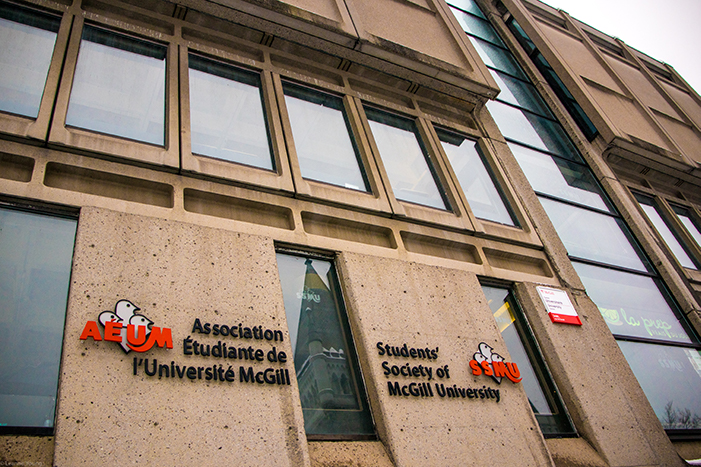
Meet the Students’ Society of McGill University (SSMU) Executives

Bryan Buraga, President

What are your three main goals as SSMU President?

“Three of my main goals include governance reform, advocacy for student issues, and just better communication with the student body. Governance reform is a project that will take about a year to unfold. We are consulting with a lot of different stakeholders here on campus, a lot of different executives and their portfolios to try to figure out how to better structure SSMU form the ground up to allow as many members of our university community to participate. There are student issues as well. There is a lot of mobilisation happening right now [for] divestment and for climate justice so that is something I am working with the rest of the executive team [on] better communicating with the student body. I think [that] there has always been this sort of disconnect between [what we’re actually doing] and what the student body thinks we are doing and I think it is important to let the study body know exactly all of the good things we are doing for them. [We want] to make sure that they know their student rights, but also the ways in which [SSMU] advocates for them, not just at a university level but also at a provincial and national level as well.”

Billy Kawasaki, VP Student Life

You mentioned that there is some friction between clubs and SSMU, especially in light of last year’s sanctions and all the new policies that have been developed. How do you hope to reduce this tension?

“So the policies [that mandate clubs to go to workshops] were in effect before last year, [but] they were just never followed through with. And I think [that] one of the problems is that these policies come forward, and then they say ‘we’re going to mandate clubs to go to workshops,’ but then they never really considered that there are other workshops [clubs] have to go to that are mandated by other policies. And then that becomes like five or six workshops that you have to go to. One of the things that I did is [create] a checklist at the beginning of the year, so that club executives know exactly what they need to do so that they’re not sanctioned. And the club portal will hopefully help with that as well, in terms of onboarding clubs for the workshops, as well as all the forms they need to submit so that we have their contact information.”

Sam Haward, VP Finance

What is the best part of your job?

“The best part of my job is seeing an event happen, to be honest. A lot of what I do is very abstract, [like] I’ll get a cheque request to book a venue. But I don’t see any of that. So just occasionally logging into Facebook, seeing [the Black Students’ Network] or whoever it may be posting pictures of their event, what they did, and how their funding helped them and their operations [….] it is really, really nice to see.”

What is the worst part of your job?

“Sometimes there’s a lot of red tape. We’re a not-for-profit corporation funded [almost] entirely by student fees. So there are some pretty strict restrictions on what we can and can’t do with our money. Sometimes that has a knock-on effect: Students will come here wanting to take on some kind of project, or pay for something [….] and we’re not able to make it happen because of the restrictions placed around us as a student union.”

Adam Gwiazda-Amsel, VP External

What are your three goals for the school year?

“Establishing and promoting a culture of institutional memory. And so that looks a lot [like] my portfolio, doing canvassing work, making sure that students who are coming into McGill know about the different political priorities that students have identified. So that’s one. Another one is like linking the Montreal and McGill communities and establishing our community outreach. And the third one that I stated in my platform is provincial affiliation, or sort of exploring avenues toward working more collectively with other student unions in the province. Because the reality is, if you try to go to a government as a single student union, and especially as an English student union [in a] French province, you don’t get much traction with the government, historically. So, collective organizing, in that sense [….] is a fairly big priority of mine, because we’re kind of flapping in the breeze right now.”

Madeline Wilson,VP University Affairs

Why did you want to work at SSMU?

“I think that, as tacky as it sounds, there are things that I can bring. [Over] the past few years, I’ve been really involved in Academic Affairs at McGill. And honestly, McGill’s fucked up! So I want to do my part to help change that; I think that being on SSMU is one of the most effective ways to do so.” 

Why do you say that McGill’s fucked up?

“McGill’s fucked up because it has no ability to perceive what being a student is like [….] You have a community where 70 per cent of the population, approximately, is students, but most of the decisions that are made are targeted towards the interest of alumni and donors [….] That manifests itself in things like international tuition deregulation, which disproportionately impacts people from low socioeconomic classes [….] and the revisions to Student Services’ Wellness Hub care model, and there’s just no perception of what it must be like to be a student walking through that system. And you just end up with a structure that’s so distant from the people that it’s really supposed to be helping.”

Sanchi Bhalla, VP Internal

What would you say is the biggest challenge of your job?

“The big thing definitely that I’ve noticed is that because my name and face [are]  in every student’s inbox, people who don’t know about SSMU still recognize me. So even just around campus, if I’m running late to class or [if] I’m around Montreal, people who have a problem with SSMU or have a problem with a club or service, even if it’s not on my portfolio, come up to me and [say] ‘Hey you’re the SSMU girl, can you help me out?’ [….] If I am at Nesta [bar and lounge] at 2:45 a.m., I don’t want to help you answer a question about club sanctions but I do recognize that I’m the face you recognize the most. Unless you’re very involved with student government, you probably don’t know the executives or their faces [and] it’s kind of sad. It’s something that I’m working on through the SSMU Instagram [….] It’s just people directing all types of SSMU questions at me because I’m sort of the one that everyone vaguely recognizes. I feel pretty bad if I can’t help them [….] I have my job but I am also a directory of sources you can go talk to.

Album Reviews, Arts & Entertainment

‘Chastity Belt’ is a plaintive meditation on growing up

Since their 2013 debut album, No Regerts, Chastity Belt have been celebrating girlhood in all its irreverence. Borrowing heavily from rrriot-girl predecessors like Sleater-Kinney, the band have toed the line between bold and brazen for most of their career, each of their songs flecked with mischief and bursting with righteous, feminist anger. Their latest work, however, a self-titled 10-track album which dropped on Sept. 20, reveals a gentler and more mature side of the band as the foursome reckons with their impending adulthood.

“Ann’s Jam,” the album’s lush and plaintive opener, finds its narrator recalling a road trip she took more than a decade ago. Frontwoman Julia Shaprio’s once-brassy vocals soften as she sings “We were driving South in your parents’ car / Singing out loud to scratched CDs.” 

Shapiro muses about her younger self with fondness, empathy, and perhaps jealousy, singing, “It was clear then, the sea before the storm / Now there’s a thick fog around everything / And I just kill time by dreading everything / But in that moment, life felt significant.”

Indeed, the album’s greatest success lies ultimately in its awareness of the gravity of growing up. Shapiro’s lyrics radiate with courage as she reckons with the reality that, even after so much evolution, there’s always more growing to do. The album’s closer “Pissed Pants” is a sparse and ambiguous number whose ominous noise harkens back to earlier albums. “Yeah, I saw it coming / I saw it coming, and now it’s gone” sings Shapiro remorsefully before her voice is shrouded by the static, fuzzy guitar.                 

Preoccupied with the past though it may be, Chastity Belt marks the start of a new chapter for the Washington band as they settle into a fuller, more developed sound. Gone are the adolescent larks, but the youthful spirit still remains.

3.5/5 stars

McGill, News

McGill Senate rejects motion to cancel classes on Sept. 27 for Climate Strike

A motion to cancel classes on Sept. 27 for the upcoming Climate Strike was proposed at the McGill Senate’s latest meeting on Sept. 18. Though absent on the official meeting agenda, the motion was proposed by 10 senators the day before the meeting and induced a heated debate before its ultimate rejection.

Principal and Vice-Chancellor Suzanne Fortier acknowledged the importance of addressing threats posed by climate change and praised students mobilizing to advocate for climate action. However, she believes that it is not up to the university to decide how, when, or where McGill students should take action. 

“As a university, we commit to […] working toward our academic mission, and therefore we will have academic activities [….] so it is an extraordinary circumstance that would drive us to cancel those activities,” Fortier said. 

However, Fortier recognised that some students worried about being punished academically for protesting on Friday.

“The Provost has asked all of the teaching staff to be accommodating of students who are wanting to participate in the Sept. 27 march,” Fortier said. “In particular, […] to [ensure] that they will not be negatively impacted by [missing] a test or an exam.”

Fortier proposed that each faculty make the appropriate arrangements to accommodate students wishing to participate in the march by rescheduling assessments on that day. 

“I think we have confidence in the wisdom of our academic staff to make those decisions,” Fortier said. 

Students’ Society of McGill University (SSMU) Vice-President University Affairs Madeline Wilson argued that by dismissing the motion, McGill was falling behind some of its peers, seeing as Concordia University, the Université de Montréal, and Dawson College announced that they would be cancelling classes 11:45 am4:00 pm in support of the march.

However, Dean of Students Christopher Buddle said that McGill was not obligated to follow the decisions of other institutions. Additionally, he said that the Senate meeting was not the right place to make the decision, and that cancelling classes defeats the purpose of a protest.

“Strikes by their very nature are rebellious, and we have to give up something for impact,” Buddle said. “It’s a rebellious act to walk out of class. […] Students walking out of class is central to the strike and […] to the global movement. Climate action is giving up something. Why isn’t this on a Saturday morning? It’s on a Friday when classes are supposed to be happening.” 

Buddle shared his discontent with the widespread cancellation of classes to accommodate social justice movements, emphasizing that as nothing is relinquished in the act itself, the impact of protests are diluted.

Senator Derek Nystrom disagreed, arguing that the concept of sacrificing for protests is inexorably forced upon youth while the root of the problem began with the older generations.

“It is my generation who created the problem of climate change, and I think to [say to] young people [that] ‘this is all on you’ … well, it’s already all on [them],” Nystrom said. “They are the ones who will have to live with the consequences of what we have generated for them.  We have to make a decision as an institution: Are we on the side of the people who are rebelling against this, or are we letting ourselves, with the institutions that are maintaining the status quo, [ask] young people to do the heavy lifting of rebellion?”

Senate ultimately dismissed the motion with support from a number of departments, including the Faculty of Dentistry, that did not wish to close their clinic when appointments had already been made.

Campus Spotlight, Student Life

Signs of the times: 65 years of the Beatty Lecture

While students eagerly await Jane Goodall’s upcoming lecture on Sept. 26, they may be unaware of the history behind the star-studded Beatty Lecture series, named in honour of Sir Edward Beatty. Returning 40 years after her first lecture in 1979, Goodall will be the first repeat speaker in Beatty Lecture history. On the 65th anniversary of the annual event, Goodall’s talk will add to over half a century of seminal lectures by speakers that exemplify their eras. 

The exhibition “With the World to Choose From: Celebrating 65 Years of the Beatty Lecture” will be on display in the fourth-floor lobby of the McLennan Library building until Oct. 31. The vernissage on Sept. 12 launched both the main exhibit and a smaller collection focused on the life and home of former McGill Chancellor and president of the CPR Sir Edward Beatty.  

Curators Frédéric Giuliano and Robin Koning highlighted the Beatty Lecture’s mission to inspire students with 11 quotes from past speakers on the walls surrounding the exhibit. The exhibit draws a timeline from the establishment of the Beatty Lecture fund to promotional material and press from past lectures. In 1952, Dr. Henry A. Beatty donated $100,000 gift to McGill in memory of his brother, Sir Edward Beatty, establishing the Beatty Lecture fund. 

Robin Koning, Digital Marketing & Outreach Associate for the Office of the Vice Principal Research and Innovation, which organizes the Beatty Lecture, spoke on its namesake’s legacy. 

“Back in the day, the Canadian Pacific Railway was one of the largest corporations on the planet, so [Beatty] had a really big job really young,” Koning said. “He dedicated his life to being McGill’s chancellor and the CPR, and he was knighted in 1935 by King George V.”

The exhibit follows the process to select the first speaker before landing on India’s first post-colonial Vice President and President Sarvepalli Radhakrishnan. Original ideas included author T. S. Eliot and pop culture theory pioneer Russel Nye. Frédéric Giuliano, who also works as an archivist at McGill University Archives, cited a letter from then Dean Thompson to the principal.

“This is where the title of the exhibit came from: ‘With the world to choose from, it becomes difficult to select for the Beatty lectureship,’” Giuliano said. 

Selecting the Beatty lecturer has grown into more than just a conversation between senior administrations. Alongside their selection committee, the Beatty Lecture website encourages suggestions from students and faculty alike, reifying the lecture’s multidisciplinary and essentially collective nature. 

“[The Lecture] is truly a campus-wide event,” Koning said. “It [tends to appeal] to a wide variety of people. It’s an event for McGill and for Montreal as well. It does stand unique, [being] so broad and [bringing] in such well known, influential names that are really part of the zeitgeist.” 

With an extensive pool of preeminent scholars to choose from, the Beatty Lecture has historically highlighted people at the forefront of their fields, creating an archive of the last century’s freshest ideas and intellectual conundrums. 

“In the ‘90s, people talked about environmental issues because [these issues] really entered into our popular dialogue,” Koning said. “You have people in the ‘70s [asking] what technology is going to do to us, wondering if we were going to become slaves to [it] since it was the beginning of tech and the first wave of computers. It’s like a timeline of some of the major events that have happened since the ‘50s.”

To access this remarkable timeline, Koning encourages students to explore past lectures on the digital archive on the website.

Science & Technology

The McGill Climate Conference covers climate policy and solutions

On Sept. 12 and 13, 15 speakers from various disciplines participated in the McGill Climate Conference, a comprehensive event spanning six panels held at the McGill Faculty Club. Emphasizing equitability and inclusion, the speakers confronted some of the most pressing issues facing Canada in its transition to a green economy, ranging from carbon pricing and the phasing out of fossil fuels, to closing the partisan divide. 

Former NDP leader Thomas Mulclair opened the event with a speech on cross-party collaboration.

“Few challenges so clearly expose the frailties of our system of government [as climate change],” Mulcair said. 

Mulcair’s speech touched on the Russian Revolution, trailblazing writer Rachel Carson’s work on pesticide usage, and the fight against acid rain in the ‘90s, putting in perspective a history of change and struggle and the advances made possible by political collaboration. Referencing the Trudeau government’s empty promises, Conservative disregard for the climate crisis, and progressive in-fighting between the Greens and the NDP, Mulclair implored Canadian politicians to work together for the sake of the environment. 

The keynote address was followed by speakers Olivier Pineau, the chair in Energy Sector Management at HEC Montréal; and Greg Mikkelson, a professor in the McGill School of Environment, each representing different perspectives on the mitigation of Canadian emissions. While Pineau advocated primarily for reducing consumer demand, Mikkelson emphasized curbing oil sand extraction to cut down the industry’s disproportionate share in Canadian per-capita emissions.

Another panel focused on broader policies, including infrastructures and social impacts surrounding carbon pricing, a fee attached to carbon dioxide emissions. One way of doing this is by adding a carbon tax to the sale and use of fossil fuels. The carbon tax is a flagship policy of the Trudeau government and has been a major source of contention for Conservative premiers opposing the tax in Ontario, New Brunswick, Saskatchewan, Alberta, and Manitoba.

Erick Lachapelle, a professor in the Political Science Department at the Université de Montréal, discussed the factors influencing Canadians’ views of carbon taxes. He has found that, though support for carbon taxation is increasing year-to-year, it remains polarized along partisan lines. Those who oppose carbon taxes largely do so due to increased costs for consumers; however, people are also more likely to favour carbon taxation if they know that their taxes are being put to good environmental uses, such as to fund sustainable energy development and lower the cost of green energy. 

Lachapelle believes that carbon taxation has been molded into a political weapon and urges parties to find areas of agreement.

Normand Mousseau, a physics professor at the Université de Montréal and the Academic Director of the Trottier Energy Institute, covered the hidden costs and inequalities of the carbon tax, which must be accounted for to build a just green economy. For example, someone might be saddled with higher fuel costs but unable to afford a more fuel-efficient car. In Mousseau’s view, the financial onus should not be placed entirely on individuals to change their behaviour: Institutional transformations are necessary to make it easier for people to adapt. For this, civil participation is key.

“The upcoming election is perhaps the most important in Canadian history,” Mulclair said. 

With the Montreal Climate Strike on Sept. 27 and a federal election looming, the ongoing climate crisis has dominated the Canadian consciousness. As an increasing sense of urgency sets in around the country, the McGill Climate Conference and other such forums for discussion and debate of the climate issues that divide the Canadian public are essential for finding lasting solutions.

Campus Spotlight

Waste Educators encourage sustainability

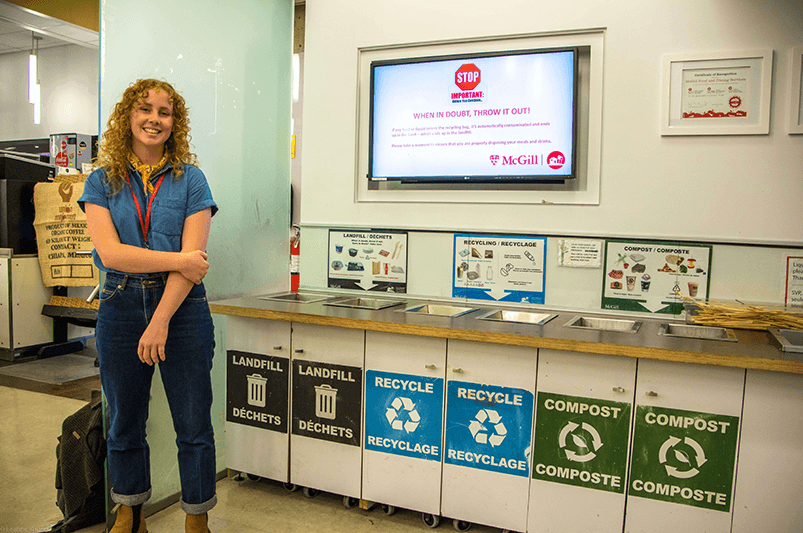
Since 2015, McGill Student Housing and Hospitality has united a team of approximately 30 Waste Educators to engage with students about sustainability and the importance of waste segregation. This team aims to ensure that recyclable or compostable packaging does not end up in landfills. Waste Educators do this by helping first-year students sort their food waste by ecosystem and facilitating casual conversations about sustainable practices. This program takes place at the dining halls in Royal Victoria College, Bishop Mountain Hall, Carrefour Sherbrooke, New Residence Hall, and Douglas Hall three times a day for the first three weeks of the school year.  

Sophie Doyon, a U3 Management student studying Managing for Sustainability with a concentration in Social Enterprise, is the sustainability coordinator for McGill Food and Dining Services. Part of her job is to run the waste education program. 

“The students are very interested, so they’ll ask a lot of questions and the waste educators are there to intervene if they get confused or want help,” Doyon said. “Their main role is to guide the right waste sorting techniques and teach students who are excited to learn about it.”

Doyon explained that recycling and composting are important for reducing the amount of waste that goes into landfills, which limits greenhouse gas emissions. She also emphasized that although sorting your waste is a great step toward sustainability, the best thing to do is reduce your use of disposable goods. 

Energy and enthusiasm from the Waste Educators is crucial for the program’s success. Karan Kumar, a second-year Masters student studying agricultural economics, is one of this year’s Waste Educators. He is passionate about sustainability and believes in the waste education program’s mandate to encourage collaboration.

“It’s a positive campaign that gives hope to the students that, if we take the small steps, we can work towards a sustainable world,” Kumar said. “There’s no blame game. We aren’t creating any hate campaigns over here. We’re just working together.”

The Waste Education program appeals to Kumar because it gives people real, concrete steps to help the environment. 

“Everyone can do it,” Kumar said. “It’s not just people working in education. It’s you, me, doctors, engineers, students, anyone who can take the extra effort to segregate their waste, and not only in dining halls, but in their homes.”

Doyon has had many positive experiences interacting with curious first-years and says that McGill students are open and receptive to the initiative. 

“Young people […] are great at helping the environment,” Doyon said. “They are really are excited to learn, and the more information we give them, the more skilled they are and the better they do at sorting their waste [….] They’re great at it already, so we’re just there to help out.”

Reactions from first-year students have largely been positive: Hannah Klemets, U0 Science, has found the Waste Educators useful for her and her residence peers who want to clear their cafeteria trays properly.

“I’ve seen multiple people almost throw perfectly fine things to recycle or compost in the garbage, so [the waste educators are] helping McGill be better for the environment for sure,” Klemets said.

The Sustainability and Waste Education campaign wants to instill the idea that students have the power to make a positive environmental impact by actively pursuing sustainability in their own lives. Although the McGill Waste Educators are gone for the rest of the year, McGill Dining Services will be hosting Local Food Day, Meatless Mondays, and Fair Trade Week where Waste Educators can continue the food sustainability conversation with students.

McGill, News

Tribune Explains: The AUS Special General Assembly

In anticipation of the Sept. 27 climate strike, Climate Justice Action McGill (C-JAM) has filed a petition to the Arts Undergraduate Society (AUS) calling for its members to hold a general strike. Ahead of the AUS’ general assembly (GA) on Sept 25, The McGill Tribune  looked into what a strike would look like, and what would need to happen in order for a strike to be called.

What is a student strike?

All students attending a Quebec university are entitled to belonging to a student union, such as the Student’s Society of McGill University (SSMU). These unions are protected under the Act respecting the accreditation and financing of students’ associations, which states that student unions are organisations dedicated to promoting students’ interests within their university. However, students are not employees, and therefore cannot benefit from laws that protect workers’ strikes. For example, employers are forbidden from firing workers on a legal strike; however there exists no specific piece of legislation at the provincial or university level that obligates schools to protect the academic standing of students who strike.

Student strikes still have a history of being a successful bargaining tactic in persuading policy changes. For example, the 2012 Maple Spring protests were a significant factor in persuading the Quebec government to rethink tuition increases. Regardless of whether a student strike is called, Montreal’s global climate march intends to proceed as planned.

What has to happen for a general AUS strike?

The AUS has a policy in its constitution that lays out the necessary steps to call a strike. First, a petition must be presented to the AUS’ legislative council with 200 signatures from AUS members—full or part-time students registered in the Faculty of Arts or the Bachelor’s of Arts and Science program. This step has already been fulfilled by C-JAM’s petition. Now, the AUS’ must call for a GA with five days’ notice. Normal quorum for a GA is 150 members; however, because strike votes have a quorum of 500 members. If the GA does not meet quorum, or the GA meets quorum and students vote against striking, the motion to strike will fail. However, if quorum is reached and students vote to hold a strike, the AUS is bound by the GA to call for a strike for all of its members. 

The GA will be held on Sept. 25 at 6:00 pm in Leacock 132. Those who vote at the GA must be AUS members. McGill’s contingent for Sept. 27th’s climate strike will meet on McTavish Street at 11:00 am.

Read the latest issue

Read the latest issue