Procrastinators truly are artists, Sofia Mikton gives us some insight into how they think.
By Sofia Mikton

Published by the SPT, a student society of McGill University

 urban child
November 15, 2025
urban child
November 15, 2025
 Hundreds attend counter-protest for transgender rights, in photos
September 30, 2025
Hundreds attend counter-protest for transgender rights, in photos
September 30, 2025
 Students protest for Palestine at Parliament, in photos
June 21, 2025
Students protest for Palestine at Parliament, in photos
June 21, 2025
Procrastinators truly are artists, Sofia Mikton gives us some insight into how they think.
By Sofia Mikton
 WUSC helps students like Zawadi seize higher opportunities in university
March 10, 2026
WUSC helps students like Zawadi seize higher opportunities in university
March 10, 2026
 Queer McGill’s second annual Black History Month event fosters solidarity and community
February 24, 2026
Queer McGill’s second annual Black History Month event fosters solidarity and community
February 24, 2026
 Club Spotlight: Black Students’ Network
February 3, 2026
Club Spotlight: Black Students’ Network
February 3, 2026
Spring is blooming, and, with it, so are McGill’s many gardens. McGill’s Downtown campus has over 12 gardens; however, many students will typically rush past them without stopping to enjoy the flowers and produce grown on campus. These urban gardens do not just incorporate nature into McGill’s urban campus, but they also function as learning aids for the McGill and greater Montreal communities.
Gardening has certain benefits, such as alleviating stress, improving mental health, and allowing gardeners to become part of a communal environment. According to Amelia Peres, Sustainability Strategy Administrator for the McGill Office of Sustainability, the gardens serve three main purposes for the McGill community.
“The gardens add a lot of life, greenery, and colour, but they are also a really nice way for people to get engaged with sustainability in a tangible way,” Peres said. “The gardens help [people] make good connections. [For example], staff gardens help staff to meet each other, along with integrating student volunteers to build really strong relationships that otherwise wouldn’t exist.”
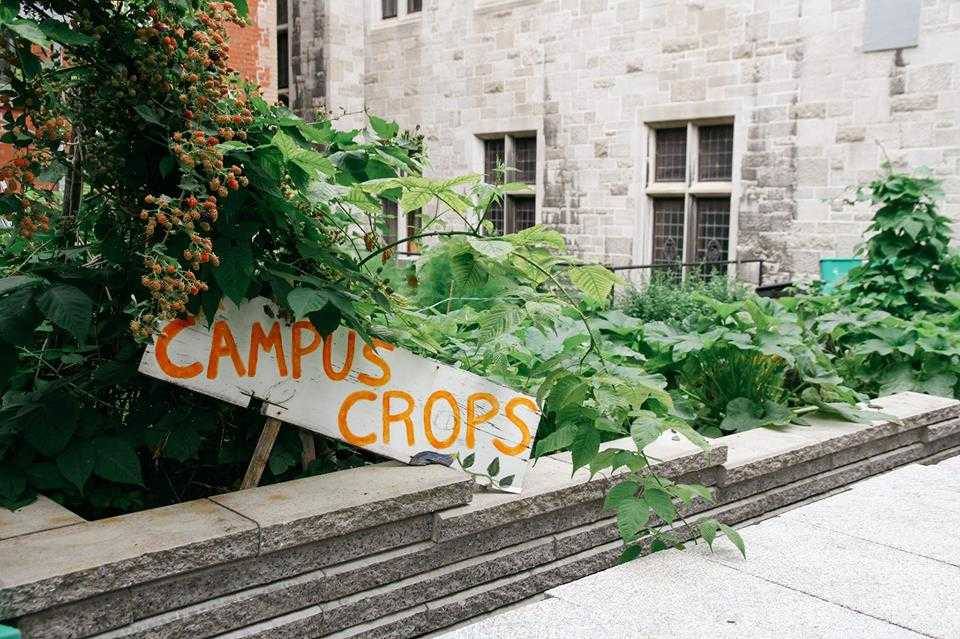
Each of the gardens at McGill serves a different purpose. Some, like the Ecole Garden and Education Outdoor Eco-Learning Garden, are part of learning and teaching initiatives and others are agricultural, such as the Campus Crops plot. One of the most prominent produce gardens on campus is the Edible Campus Area, a space designed to grow fruits and vegetables with minimal environmental impact. The space surrounds the Burnside Building and was originally a collaborative project between the McGill School of Architecture’s Minimum Cost Housing Group and Santropol Roulant, a Montreal community group that runs a number of volunteer-run programs including Meals on Wheels and farmers’ markets. Two years ago, Santropol Roulant returned the garden to McGill, and it has since been shared by campus groups, including the Office for Students with Disabilities and Midnight Kitchen.
Some gardens on campus, such as the Robertson Herb and Scent Garden, are designed to facilitate the process of pollination. In the warmer months, students can observe flocks of butterflies. Others are more education-focused, in order to teach skills related to gardening and to serve as places to share tips and ideas in a communal setting.
“SSMU Daycare’s garden is educational,” Peres said. “This particular garden is about getting the kids into the garden to talk about the benefits of gardening and being outside. Gardening is a really cool way for the kids to learn skills that they can use at other times in their lives.”
While gardening has many functional purposes, it also provides an ideal setting to relax and connect with nature. According to Peres, one of the best places to decompress is the Robertson Herb and Scent Garden, a hidden gem buried between the Davis and Hosmer Houses. The garden organizes its planters into the shape of petals, so that from above, the garden looks like a plant. Nearby is the Downtown campus’ very own secret orchard where students can pick their own apples and pears off of the trees.
For students looking to do more than just smell the flowers, they can get involved by volunteering at a garden or starting their own. As some students move away from Montreal for the summer, many on-campus sites are looking for new volunteers, especially since gardens need extra care and attention in the warm months. Campus Crops is currently looking for new students to get involved to help garden the incoming produce, in addition to Midnight Kitchen.
“The two gardens that are in need of the most students right now are the Midnight Kitchen Garden and Campus Crops. If students are interested in volunteering, they can email them directly,” said Peres. “No prior experience is needed, just excitement.”

 Keep on Commuting
April 5, 2022
Keep on Commuting
April 5, 2022
 Gino McTuff’s journey to the library
March 29, 2022
Gino McTuff’s journey to the library
March 29, 2022


 How can I show you I’m doing better if there’s nothing good for me to do?
April 13, 2026
How can I show you I’m doing better if there’s nothing good for me to do?
April 13, 2026
 Your health, your problem
April 8, 2026
Your health, your problem
April 8, 2026
 On becoming Chinese
March 30, 2026
On becoming Chinese
March 30, 2026
In 2024, Canadarm 3, an artificially-intelligent robotic arm designed and manufactured in Canada, will move autonomously over the surface of a space station orbiting the moon. Designed to operate without human supervision, the arm, and the operating system that controls it, will be trusted with the maintenance of the Lunar Gateway, a deep-space orbital outpost designed by NASA to facilitate the next wave of space exploration.

On March 28, the Quebec government tabled its proposed secularism law, which would bar anyone working in the public sector in a ‘position of authority’—including bus drivers and teachers—from wearing visible religious symbols such as the hijab and kippah. Like the failed 2013 Charte des Valeurs , Bill 21 is a thinly-veiled attempt at marginalizing religious minorities. Between the introduction of Bill 21, the rising numbers of hate crimes, and the recent white supremacist attack on a mosque in Christchurch, New Zealand, hate is increasing, affecting the safety and wellbeing of McGill’s students of colour. All students should do their part to ensure that the campus remains a welcoming environment.
Montreal has the fifth-highest rate of hate crimes in Canada, and Quebec City comes in fourth. Quebec is home to La Meute, a far-right, anti-immigration hate group which former members estimate has 4,000 to 5,000 constituents. In La Meute’s public Facebook group, nearly 200 members celebrated the announcement of Bill 21. McGill does not exist in a vacuum: The increase in hate crimes in Quebec leaves racialized and marginalized students vulnerable to violence and harassment, on and off campus. In September, a white-supremacist group called Generation Identity hung posters spewing racist rhetoric around campus. The Christchurch shooter, who expressed sentiments similar to Generation Identity’s about immigration, donated $2,000 to its Austrian chapter in 2018. Though these hate groups may be a minority in Quebec politics, they can have an outsized influence on citizens’ safety.
“Traditional political parties in Quebec watch what La Meute is saying,” Université de Sherbrooke Professor David Morin, who studies radicalization and violent extremism, said in an interview with Buzzfeed News. “These parties understand that there is an electorate that is sympathetic to what the group says. They know they can seize upon these themes for political gain.”
Premier Francois Legault, leader of the Coalition Avenir Quebec, made a reference to ‘Quebec values’ in a public address about Bill 21.
“We have been debating religious symbols for 10 years,” said Legault. “It’s time to establish rules. Because this is how we live in Quebec.”
Hate groups and mass violence represent the most extreme manifestations of racism, and they are often beyond individual students’ control. However, racism also manifests in more subtle, pervasive ways—and it is important to respond to these everyday instances. Allyship is more than a buzzword: A dedication to advocating for issues that might not affect oneself directly is imperative. Indigenous and non-Indigenous students came together to sign the #ChangeTheName campaign’s open letter and attended the protest, which proved the student body’s support for the cause and highlighted the need for action on the McGill administration’s behalf. Students have demonstrated their capabilities for advocacy through the great attendance of the climate justice walkout on March 15. It is imperative that students continue to put in that same effort to advocate for marginalized students: That means showing up to protests, vigils, other demonstrations.
Supporting the continued existence of on-campus resources for marginalized students—such as the McGill Office for Religious and Spiritual Life, the Muslim Students’ Association, and the Black Students’ Network— is especially important given the rise of hate crimes. Marginalized and racialized students need these safe spaces, and continuing to support them is imperative. McGill’s administration must consider the rise in far-right rhetoric and hate crimes as they restructure the Social Equity and Diversity Education Office (SEDE), which, in addition to providing equity and community outreach programming, is a central hub that can refer students to cultural and religious student groups.
From the provincial government’s support for Bill 21 to the rise of hate crimes, and the prevalence of hate groups in Montreal and Quebec, marginalized and racialized students are increasingly forced to face this sinister reality every day. McGill does not exist apart from the world surrounding it, nor do its students. Action against hate requires collective solidarity, and all students are responsible.

 Varsity or bust: Inside the fallout of McGill Athletics’ restructuring
December 3, 2025
Varsity or bust: Inside the fallout of McGill Athletics’ restructuring
December 3, 2025
 Varsity Report Card: Fall 2025
December 3, 2025
Varsity Report Card: Fall 2025
December 3, 2025
 2025’s sports equinox: Four major leagues, one historic night
November 4, 2025
2025’s sports equinox: Four major leagues, one historic night
November 4, 2025

On March 25 and 26, over 47,000 fans packed into the Olympic Stadium to watch the Toronto Blue Jays and Milwaukee Brewers finish up their Spring Training schedules. This series marked the sixth straight season that the Toronto Blue Jays played a set of games in Montreal. And, now, for the sixth straight season, baseball fans who dearly miss their beloved Montreal Expos came to cheer on Canada’s sole baseball franchise in Montreal.
In a pre-game ceremony celebrating the Expos’ 50th anniversary, team legends paraded out from centre field, and, in an annual tradition, former star pitcher Steve Rogers made an appearance to express support for bringing baseball back to Montreal.
“It’s not like you have to manufacture some belief in it,” Rogers said. “It’s been demonstrated certainly. The question will be, ‘Is this sustainable for [a] 162 game season, 81 at home?’ I think it’s been demonstrated that, [for] over six years, the interest is here, and I’m excited for the possibilities.”

Charlie Montoyo had been to Montreal before, but in a different capacity. The Blue Jays manager earned his first big-league hit in his brief playing career at Olympic Stadium. In an interview with MLB.com’s Alexis Brudnicki, Montoyo recalled his time in the city.
“I’m never going to forget,” Montoyo said. “I had my first hit of two here in the big leagues. So, that’s a memory I’m always going to have [….] This place has been great to me. It was a fun time for me here, and, now, it’s a fun time to come back as a big league manager, so it’s great.”
Rogers threw his support behind Montoyo.
“He’s one of those good guys out there,” Rogers said. “He’s proven himself in the industry, and somebody might say ‘Well, that Charlie, he’s lucky.’ Well, no, he’s worked his rear end off, and he’s a great baseball man. And, also, he’s a great guy. Always has a good time, always got a smile on his face [….] I understand it’s a new group, the players that are going out on the field […. I hope] that everything starts to gel and that [that] smile stays on his face all year long.”
As Montoyo built familiarity with his new role and his young team, he handled one tough matter on March 26: Sending players who had not made the Opening Day roster down to the minor leagues.
“You can see it in their faces that guys are disappointed, and guys [who made it] are happy.” Montoyo said. “[This past half-hour after the game] was just like that, disappointment and happiness. But, that’s part of the game.”

Left-handed pitcher Thomas Pannone was one such player looking to earn his spot on the roster. He started the final game and pitched two scoreless innings.
Post-game, Montoyo gave him the good news. Speaking to reporters, Pannone discussed his mindset throughout the game.
“I had a lot on my mind,” Pannone said. “I wanted to make this team so bad. I was obviously under a little bit of pressure. I just wanted to come out and continue to perform and continue to get better and show them that I’m ready to play in the big leagues.”
While Pannone is used to starting, he made the final Blue Jays roster as a reliever.
“He can give us length, and he could also come and get left-handers out,” Montoyo said. “He’ll give me more matchups, [and] it’ll be easier to manage with another left-hander in the lineup.”

Part-way through the Tuesday game, Mayor Valérie Plante spoke to reporters, responding to questions about the future of baseball in Montreal. Every year the Blue Jays play Spring Training games in the city, the possibility for a franchise grows stronger. This event is not about the Blue Jays, and it is not about the Brewers. It is—and has always been—about the Expos.
“The idea of having a baseball team here in Montreal is great news,” Plante said.* “Some might ask whether it’s a good use of money, […but], seeing as the promoters have not asked us for a cent, we’re going to support them in this project using the tools already available to the city without asking Montrealers for more money. That’s why I can go into this project with a smile on my face.”
Stephen Bronfman—the son of former Expos owner Charles Bronfman—is making strides toward securing land for a new, privately-financed stadium located at the Peel Basin. Plante, who visited the site with the mayor of Sud-Ouest, on which the land is located, explained her role in the team’s development to reporters.
“As an administration, we’ve invested a lot in developing neighbourhoods,” Plante said.* “Where we can best support a project like a stadium is at the infrastructural level. [The Peel Basin area] has minimal infrastructure […] and at the level of planning public transport [.…] It’s something in which we have expertise, and it’s something that we support enormously as an administration.”
Former Expos, like pitcher Tim Burke, value the Bronfman family’s role in Montreal baseball.
“I talked to Stephen [Bronfman] this morning, and I just told him I really appreciated what he was doing, but I also told him to tell his dad how much I appreciated him when he owned our team back in the day,” Burke said.
At the end of the day, the message came back around to the viability of baseball’s return to the city. With other teams failing to fill the stands, former Expos outfielder Larry Walker echoed the sentiment that Nos Amours should return.
“You never know,” Walker said. “I’ve been saying it the whole time here, the team was here some 35 odd years, and you don’t keep a team around that long because they were not succeeding or not performing. There [are] other teams in the major leagues right now that don’t draw fans and, in my eyes, shouldn’t have a team. Why not bring back one that was here for over three decades? It would be a nice thing.”
*This quote has been translated from its original French.









 Varsity or bust: Inside the fallout of McGill Athletics’ restructuring
December 3, 2025
Varsity Report Card: Fall 2025
December 3, 2025
2025’s sports equinox: Four major leagues, one historic night
November 4, 2025
Varsity or bust: Inside the fallout of McGill Athletics’ restructuring
December 3, 2025
Varsity Report Card: Fall 2025
December 3, 2025
2025’s sports equinox: Four major leagues, one historic night
November 4, 2025
On March 17, the McGill Martlets (14-6), fifth in U Sports’ national rankings, claimed silver at the National Championships after falling 1-0 to the Guelph Gryphons (19-3-3). The loss came after an upset victory over the top ranked Alberta Pandas (23-5) in the semifinals and a 10-2 quarterfinal win against St. Thomas (22-5-1) in the quarterfinals. The team also finished second in the RSEQ playoffs behind the Université de Montréal (UdeM) Carabins (15-4-1). Four Martlets earned all-star honours for their individual performances: Third-year forward Jade Downie-Landry and third-year goalie Tricia Deguire earned first-team all-league and second-team all-Canadian status, while second-year forward Kellyane Lecours and fourth-year defenceman Emilia Cotter were named to the RSEQ second team all-league.
Martlet volleyball dropped only three regular season games this year and finished atop the RSEQ standings. Unfortunately, in the RSEQ championship series, they fell to the number-two seed UdeM Carabins two games to one. Despite the disappointing loss, Martlet volleyball Head Coach—and RSEQ 2018-19 Coach of the Year—Rachèle Béliveau can still count this as a successful season. With over 600 victories in her 28 years of coaching the Martlets, Béliveau is the has the most wins of any coach in McGill Athletics history, and she has inspired generations of McGill volleyball players.
Third-year Downie-Landry had another outstanding season for the Martlets: She was named to the RSEQ first-team all-league and the Canadian second-team all-league and won the RSEQ scoring title. At the U Sports National Championship, she earned all-tournament team status and tournament MVP honours. She was also awarded Martlet hockey team MVP as well as the Most Outstanding Scorer award. Downie-Landry—who scored or assisted on nearly half of McGill’s goals this season—has the 12th-most points of any player in Martlet history, sitting on an impressive list of Martlet hockey alumnae including Ann-Sophie Bettez and Katia Clement-Heydra.
With 31 hits and 27 RBIs, the third-year outfielder from Pierrefonds, QC led McGill baseball in those categories and also posted the second-highest slugging percentage and third-highest on-base-plus-slugging on the team. In the team’s five games at the Canadian Collegiate Baseball Association tournament in October, Lagarde went seven-for-15, scored 11 runs, and drove in nine. He earned all-tournament team status and the tournament MVP award after McGill’s fifth—and Lagarde’s third—consecutive Canadian University World Series title.
In February, Gheta earned the top overall athlete award at the National Championship artistic swimming meet. She won two gold medals and one silver medal en route to McGill’s fifth national title in the last six years. She won her gold medals in the duet event, where she competed alongside her older sister Ioana, and the team event. She placed second with her solo routine. Previously, Gheta picked up three gold medals at the McGill Invitational in November; she added two golds and a silver at the Eastern Divisionals in January.
At the U Sports Swim Championships on Feb. 21-23, Secchi came away with one gold in the 50m backstroke and two bronze medals in the 100m butterfly and 4x200m freestyle relay. He set new McGill and RSEQ short course records in the 100m and 200m backstroke. He also put together a team-best 24.94 second 50m backstroke which third-year teammate Samuel Wang beat in the subsequent heat. Secchi, who earned RSEQ first-team all-star status, was just as impressive at the conference championship meet: He won three gold and three silver medals to help the McGill men’s swim team to a second-place finish.
 Varsity or bust: Inside the fallout of McGill Athletics’ restructuring
December 3, 2025
Varsity Report Card: Fall 2025
December 3, 2025
2025’s sports equinox: Four major leagues, one historic night
November 4, 2025
Varsity or bust: Inside the fallout of McGill Athletics’ restructuring
December 3, 2025
Varsity Report Card: Fall 2025
December 3, 2025
2025’s sports equinox: Four major leagues, one historic night
November 4, 2025
This season, the Oakland Athletics will change baseball. It isn’t the first time they have done so, and, if all goes according to plan, it certainly won’t be the last. However, unlike Moneyball, their first innovation that spawned a Michael Lewis book and subsequent Brad Pitt movie, this development will take place entirely off the field: The 2019 Oakland Athletics are offering a new kind of season ticket.
On July 30, 2018, the Athletics issued a press release announcing the end of their traditional ticketing system—fans paying for the rights to a reserved seat—and introducing a creative new one: A’s Access. The new plan allows members general-admission access to every game as well as an allotment of games in which the member is assigned to a seat. As members pay more, they earn more assigned-seat games. The A’s will also offer other perks, like cheaper concessions and merchandise.
Given the sparse crowds that attend their games, an additional flexibility in their season-ticket plan is the team’s latest effort to boost attendance. The Athletics averaged 19,427 fans in attendance at their home games during the 2018 season, fourth-worst in all of baseball. As a result, they decided to draw from a rising interest in entertainment subscription models like MoviePass and alter their season ticket plan.
“Obviously, this is a trend in ticketing even outside of sports,” Daniel Rascher, director of academic programs for the sports management program at the University of San Francisco, said in an interview with the San Francisco Chronicle. “Customers and fans want flexibility, and, if the teams can absorb the fluctuations in demand, they can take on that risk and offer that to fans.”
With the change, fans, who could not afford a traditional plan, have already purchased multiple A’s Access memberships.
“We’re very moderately middle class,” Roberto Santiago, a Bay Area teacher with three children, told the San Francisco Chronicle. “So, something as luxurious as season tickets wasn’t going to be in the cards for us without something like this.”
Across the Oakland Coliseum parking lot lies Oracle Arena, the current home of the NBA’s Golden State Warriors. When the Warriors move to their new home in San Francisco later in 2019, they, too, will experiment with a new season ticket plan. In their new Chase Center, the Warriors will become the second NBA team to sell personal seat licenses. However, they are the first to use it as the predominant model for season ticketing. A personal seat license is a paid license that then gives the owner the right to purchase traditional season tickets for that particular seat in the stadium. The model is already popular in both American football and European soccer.
That plan is not cheap. The median cost for the 12,000 personal seat licenses to be put on sale will be $15,000. And, with the Warriors franchise planning to self-finance the new arena, the license will act as an interest-free, tax-free loan from the consumer to the owners since the Warriors will return the license money after 30 years.
Unlike the Athletics, the two-time defending champion Warriors do not struggle with attendance. Instead, by fixing their supply-and-demand issue, Golden State is pricing longtime diehard fans out of the basketball experience. While baseball fans like Santiago are now afforded the opportunity to join the season-ticket-holding fanbase, the Warriors’ endeavour does not cater to their working- and middle-class fans.
Ultimately, teams are looking to maximize their attendance and the revenue that comes with it, and their experiments with season ticket plans are worth tracking. As sports fans look for new ways to engage with their favourite franchises, teams will continue to fine-tune the in-game experiences that they are offering.

For many students, climate change is a daily consideration when making choices like bringing reusable bags to the store or using refillable coffee cups. Environmental awareness is as prevalent as its effects are terrifying, exemplified by the 150,000 people who walked at the Montreal March for Climate Justice on March 15. In the university context, it can be easy to forget that nearly one third of Canadians are unconvinced that climate change is caused by human activity.
The 97 per cent consensus is a widely-cited statistic which states that 97.1 per cent of scientists agree that climate change is anthropogenic, or manmade. This statistic comes from a 2013 study which quantified the academic consensus by examining the abstracts of 11,944 climate science papers and classifying each one based on its position on global warming. The study also stated that the more expertise the author had on the subject, the more likely they were to believe in anthropogenic climate change.
Cook’s study has been criticized for only examining the abstracts that take a concrete position on climate change. Nonetheless, other studies have concluded that a consensus exists among somewhere between 90 and 100 per cent of climate scientists.
In an interview with The McGill Tribune, Theo Van de Ven, a professor in McGill’s Department of Chemistry, expressed scepticism that the 97 per cent consensus is absolute, citing a petition signed by 31,000 scientists who have called on the government of the United States to reject the United Nations-sponsored Kyoto Protocol. He also alleged that most people only believe in climate change because it comes from scientists who have expert authority.
“This 97 per cent is based, in my opinion, on very sloppy statistics,” Van de Ven said. “I got this email about this [climate march], and it’s good that people are concerned about the climate, but I think that much of our youth is indoctrinated at schools. Why do most high school teachers believe in climate change? Because of the authority. That’s the 97 per cent. If you don’t believe in the 97 per cent, that falls apart. But they indoctrinate kids at primary school and secondary school with it.”
While Van de Ven believes that pollution is a problem, he remains unconvinced that human activity is causing climate change. He argues that there are many other unstudied factors that could also be attributed to global warming, and, as a result, he finds it preemptive to propose certain solutions such as a tax on carbon.
“There are many fluctuations in the climate, and they correlate very strongly with solar cycles,” Van de Ven said. “It’s very well established. There’s a plausible explanation, but people don’t seem to be seriously willing to investigate it [….] I’m just saying there’s basically no knowledge. This consensus is, in my opinion, just pushed for political reasons.”
Van de Ven remains in the minority of scientists who are suspicious of anthropogenic climate change. In Oct. 2018, the Intergovernmental Panel on Climate Change released a widely-read report which states that, if global warming is not limited to 1.5 degrees celsius, the consequences for our planet could be catastrophic. The continued refusal to acknowledge the ramifications, despite a widespread consensus among climate scientists has the potential to affect generations to come. The discrepancy between the high percentage of scientists who believe in anthropogenic climate change versus the third of Canadians who do not is alarming, but students can continue to make themselves aware of the consequences of global warming and educate their peers.

On March 28, the McGill chapter of Lawyers Without Borders (LWB) hosted its fourth annual Art Sans Frontières silent auction. The event showcased pieces by local Montreal artists that had been donated to raise funds for LWB Canada, a non-governmental organization with a mandate to promote human rights, access to justice, and the protection of minorities in countries around the globe.
Caroline Parent-Harvey, VP Events for LWB McGill, explained that the profits from this event will go to LWB to support its mission of providing legal support to those in need and to finance the group’s international operations.
“This event […] is our main fundraiser, and all the funds go directly to help LWB and the lawyers that are working for them, […] helping out in countries that have […] less developed justice system[s], and, so, we’re really lucky to be able to participate in that,” Parent-Harvey said.
The work displayed at the auction centred around the theme of international activism. The organizers were appreciative of the participating artists and their contributions to the event.
“Without [the artists], there would be no event,” Parent-Harvey said. “We really make sure to put the artist at the middle of this event.”
Gabrielle Landry, VP Communications for LWB, described the importance of the event and its connection to the mission of LWB Canada.
“We want to promote something that’s local to help on the international level, so we want to have a kind of […] bridge between what we have going on here and LWB Canada. Here [in Montreal], even anywhere around the world, access to justice can be an issue,” Landry said. “People should be more in touch with their rights and how the justice system works anywhere around the world.”
Participants joined local artists at the Conseil des arts de Montréal Atrium in the historic Gaston-Miron building to take part in the silent auction. The Conseil des arts de Montréal supports and recognizes excellence in the arts, contributing to many artistic companies and collectives in the city.
“We even chose this [hall] because it’s actually owned by the Conseil des Artistes Montreal,” Parent-Harvey said. “All the profits related to this room are also going to help artists, so we’re really happy about this partnership.”
The LWB McGill team also partnered with Regroupement des Artistes en Arts Visuels du Quebec (RAAV), a professional association that represents visual artists and helped solicit donations for the event. RAAV General Director Bernard Guérin expressed that the organization was particularly enthusiastic to offer assistance to a student-run initiative.
“[This event is an] interesting way [to] contribute to a very nice cause, ” Guérin said. “ [I am] very […] impressed by the idea [and] by the […] McGill students [who organized the event].”
Francesca Trop, whose work was on sale at the event, is a Montreal-based artist whose paintings often depict courtroom scenes. As a former lawyer who practiced for 15 years, Trop explained that her experience in the legal profession motivated her to donate her work to the event.
“It was very important for me to give a contribution,” Trop said. “[This event] is related to what I have to say, and I know I will reach out to the public that I am talking to.”
Much of Trop’s multimedia artwork highlights the theme of legal writing, and her pieces on display at the silent auction incorporated real legal documents. Trop explained that the intention behind her paintings is to reveal the creativity in mundane objects such as paperwork.
“I always try to show the hidden poetry […] in everyday objects or everyday acts,” Trop said.
Through similar events, the organizers hope to contribute toward LWB Canada and promote its values and goals in Montreal and international settings. By the conclusion of the event, LWB hoped to have concurrently uplifted creative voices and attracted the McGill student body to join in their mission of equal access to legal support services.