

Latest News

Art, Arts & Entertainment

Jerry Saltz challenges elitism in the art world

“Eighty-five per cent of the art made during the Renaissance was crap, it’s just all gone,” Jerry Saltz said to a Montreal crowd at Theatre Outremont on Apr. 3. “Eighty-five per cent of the art made during Impressionism—bleh.”

These are not words typically uttered by esteemed art critics, but Saltz has always relished in shocking his audience. Known to his followers as the ‘people’s art critic,’ the artist and 2018 Pulitzer Prize-winner for art criticism spoke with unexpected candour and levity about the stuffiness of the contemporary art world.

Saltz addressed a crowd of artists and art enthusiasts in his talk titled “Art First; All Else Follows,” hosted by Art Speaks, an organization that stages biannual lecture series aimed to facilitate discussions about contemporary art between experts and members of the public.

Saltz, the current senior art critic for New York Magazine, is one of the most celebrated contemporary art critics. However, he had an unorthodox entry into the field. Unsure of his qualifications, Saltz explained that he was initially hesitant to pursue a career in the arts, and instead worked as a long-distance truck driver.

“Finally, in the trucks, by the time I was about 40, I was in agony, really […and] I decided to become an art critic,” Saltz said. “[At the time], I had never written a word in my life […] I won the Pulitzer Prize and I don’t consider myself a writer, I think of myself as someone who just tries to write down what I am thinking. I think of myself as a folk critic.”

Among the crowd were several young hopefuls seeking advice on starting a successful career in art and criticism. Reflecting on his own professional journey, Saltz encouraged members of the audience to prioritize collaborative work.

“You must form a gang […], and you will take over the world together,” Saltz said. “That’s how it’s been done, and that’s how it will continue to be.”

Saltz suggested that Montreal was an ideal setting for artists to plant their roots. In recent years, the city’s artist communities have flourished. Yet, more importantly, according to Saltz, the city is teeming with diversity and talent.

“You have a cosmopolitan city,” Saltz said, “There are not many of them. In my opinion, only cosmopolitan cities with mixed, warring […] populations can become great centres for the arts [… I] went around to the galleries [in Montreal] today, and what I saw was good.”

Despite the city’s bountiful opportunities for artists, Saltz reiterated that, for many aspiring artists, a career in the creative disciplines is inaccessible. He was particularly vocal about the systemic barriers women and artists of colour encounter during their careers. According to a 2019 study of the art displayed in major U.S. museums, only 13 per cent of the work is by artists of colour and 20 percent by femme-identifying artists, an issue which many activist groups, such as the Guerrilla Girls, have sought to address. In response to this systemic discrimination, Saltz advocated for radical institutional reform within the art world that would broaden the scope of high culture. Nonetheless, Saltz optimistically pointed out that artists are producing work that challenges traditional sources of authority.

“The canon walls are down […], and we can already see that change is beginning,” Saltz said. “What I hope is that a mediocre woman artist could have as powerful of a career as all the mediocre white men who have had careers all of these centuries. ”

Despite the art world’s continued inaccessibility, Saltz nonetheless encouraged the audience, regardless of their background, to participate in Montreal’s artistic community.

“I’m lucky to be in [the art world]. I worked my whole life to be in it,” Saltz said. “Whether you make art or just love it like I do […], I want you to have a life lived in art because if you have that life, you will never be bored.”


 

News, SSMU

SUS constitutionality questioned in Judicial Board petition

Asa Kohn, U1 Mathematics and Statistics, has filed a petition against the Science Undergraduate Society (SUS), accusing the organization of ignoring its constitution’s instructions on how to proceed in the event of a resignation. He sent the petition to the Students’ Society of McGill University (SSMU) Judicial Board (J-Board) on March 10, but claims he has yet to receive a response, apparently in violation of the Board’s procedures.

Kohn insisted that student representatives should respect their governing documents.

“It’s fine, in general, if someone doesn’t care [about procedure],” Kohn said. “I would say it’s less fine when your job is to enforce procedure. Having procedure is important in defending against abuses of power.”

Kohn claims that SUS executives willfully ignored the Society’s constitution after the Jan. 23 resignation of SUS SSMU representative Moses Milchberg, when President Reem Mandil stated that members of the Executive Committee would represent science students at the SSMU Legislative Council for the remainder of his term. However, the SSMU Standing Rules stipulate that a student society cannot send a proxy for a representative position more than twice in one year. To avoid breaching procedure, the Legislative Council passed a motion on Feb. 7 to allow SUS executives to attend in Milchberg’s place.

The SUS Constitution states that the SUS must hold a by-election in the event of a resignation. Kohn claims that SUS executives broke this rule when they announced that they would be using proxies for the rest of Milchberg’s term. In protest, Kohn petitioned the SUS to include a referendum question during the winter SUS referenda that asked whether, in the event of a resignation, the candidate with the next-highest number of votes in the election for SUS SSMU representative could take over a vacant position. In the case of this year’s elections, the person with the next highest number of votes is Kohn himself. In an email sent on Feb. 24, SUS President Reem Mandil deemed the question invalid and refused to place it on the ballot. According to Mandil, the decision not to replace Milchberg was deliberate and fair.

“A by-election was deemed not an appropriate course because of time [constraints],” Mandil said. “We had our full elections coming up a few weeks after the resignation [of the SSMU representative]. We decided against an appointment because they would have been hired by the executives [instead of being] elected, and we wanted the remainder of the Legislative Council sessions to be attended by an elected member.”

The J-Board, SSMU’s judicial body that resolves internal disputes, has not yet replied to Kohn’s constitutional challenge of the SUS’s actions. This lack of response is an apparent violation of the Board’s internal procedures, which mandate it to accept or reject new petitions within 14 days. Chief Justice Georgina Hartono did not provide a comment explaining this delay.

SSMU President Tre Mansdoerfer explained that there were issues unrelated to this petition that have delayed the J-Board’s response. However, he also believes that Kohn lacks an understanding of what is necessary for good governance.

“I understand where [Kohn] is coming from; however, there’s got to be the recognition that other governance bodies have agreed with [the SUS’s] decision,” Mansdoerfer said. “Student societies have a yearly turnover, which may result in cases where constitution must be broken not in a way that is malevolent, but in a way that facilitates best practices. I think SUS’s decision to [use executives as proxies] is better than deciding to throw someone into the role that has no experience this late into the year.”

Kohn’s experience in student government is controversial: He temporarily worked as the Vice-President Finance for the Royal Victoria College’s (RVC) Residence Council, where he allegedly made other council members uncomfortable. Impeachment procedures were to be enacted against him, but he resigned before they officially took place. According to an anonymous RVC councillor, Kohn had obstructed the Council’s ability to govern.

“[Kohn] became really neurotic about the constitution,” the Council member said. “He wouldn’t let us talk about events […and] he was just really controlling [….] I talked to our Inter-Residence Council advisor and also the Residence Life Advisor and debriefed everything and he told us the best process was to impeach him.”

The SUS General Council has their last meeting on Apr. 10, and SSMU’s last meeting was on Apr. 4. Mansdoerfer stated that the petition could be heard by the J-Board in the next academic year.

Private

Trivial pursuit

On Oct. 6, 2014, Mariusz Galczynski, at the time a PhD candidate in the Faculty of Education watched the taping of an episode of Jeopardy!. He had passed the many required tests in order to be on the show, and it was almost his turn to compete.

“Anyone who knows me of my friends knows that I love the Spice Girls and Celine Dion,” Galczynski said in an interview with The McGill Tribune. “[In the game before mine], there was a Celine Dion question and then Final Jeopardy. The answer was the Spice Girls and no one knew of the contestants. So, right away, I was like ‘Agh, my god, I wish I was playing that game.’”

Jeopardy! records a week’s worth of episodes in one day of taping, and Galczynski was up next on the Tuesday episode. He won $20,350 in his initial appearance before losing the following ‘day’ in an episode taped 15 minutes after the first one ended.

When his winning episode aired on Nov. 25, Galczynski hosted a viewing party at Thomson House, where he and his friends used to participate in trivia nights.

“I invited all my friends that could make it, and it was great,” Galczynski said. “We watched the episode live. I knew the result, but they didn’t, and, when you watch the episode, it was a really close game and also pretty exciting [….] Obviously, they’re rooting for you to win, so it was awesome to deliver that at the end of the episode.”

Throughout Montreal trivia-junkies host events at pubs, basements, and student unions. Venues around campus host themed nights with The Office, Game of Thrones, or even Shrek-specific trivia. For more general-knowledge-based questions, chemistry professor. David Harpp has hosted his Centraide Trivia Nights at the Faculty Club for the past nine years.

“My daughter teaches at a university in the [United States], and I was visiting her about 12 years ago, and she said, ‘Do you want to go to a trivia night?’,” Harpp said in an interview with the Tribune.

Harpp’s trivia nights attract the McGill community, Montreal residents, and even a regular visitor from the University of Waterloo. As quizmaster, he runs seven rounds of 10 questions on a Powerpoint slide show. Harpp explained that, in preparation for competitions, he thoroughly researches his questions.

“If I think of [a potential question], like ‘that’s an interesting thought,’ I’ll just research it and make sure that it’s at least ‘Wikipedia right,’ which is probably about 98 per cent sure,” Harpp said.

At Harpp’s trivia nights, around 30 teams of four or five discuss the questions at their tables and submit their answers on scorecards marked by undergraduate students.

“[It] gets very noisy [and] very competitive,” Harpp said. “[There’s] high-fiving, and [then also] a little bit of gentle cursing when they get something wrong or are talked out of a right answer at the table.”

A similar spirited atmosphere is present at the McGill Trivia Club’s events. The club meets twice a week in library group study rooms to practice for Quiz Bowl competitions with other schools across Canada, the U.S. and the U.K. Club president Akhil Garg has been participating in trivia competitions for nine years. He enjoys trivia competitions as a way to absorb new information.

“It’s all about learning new things,” Garg said. “I specialize in science and social science. As a medical student, I’m mostly studying biology, so trivia lets me study [all of the other sciences]. It’s a way to really expand my knowledge base.”

Overall, participants’ appreciation of learning promotes healthy competition. Garg compared this relationship to his favourite piece of trivia.

“There’s this thing called Bergman’s rule, which is that species in higher latitudes tend to be larger,” Garg said. “We at McGill Trivia always like to joke that we’re bigger than the clubs we compete against.”

A friendly atmosphere goes a long way in the trivia world even though competitions can get tough. Harpp agrees: Trivia remains competitive, even at home.

“My wife plays [at my trivia nights] with a team,” Harpp said. “She doesn’t get any inside answers. If I’m playing a piece of music, she’ll say ‘Who’s that?’ and I’ll say ‘That’s for you to find out.’”

Student Life

2019 McGill time capsule

On Oct. 2, 2003, during a routine security check of the Donner Building of Medical Research construction zone, campus security officer Mathieu Racette found a time capsule dating back to 1947. Students placed it in a cornerstone of the building during the 1947 commencement ceremony. After carefully opening the rectangular box, the McGill Archives Staff found the letter that William H. Donner wrote in his donation for the building’s construction; remarks made by Chancellor O.S. Tyndale on the day of the ceremony; an extract from “Who’s Who in America” profiling Donner; and a McGill Faculty of Medicine Calendar dated 1947-48.  Like students of semesters past, The McGill Tribune has assembled a time capsule filled with a selection of items to give future generations a glimpse into the life of a McGill student circa 2019.

A handful of Bar des Arts tokens

These one-dollar chips have brought happiness to many McGill students in recent years. Whether patrons spend them on a grilled cheese or a beer, Thursday nights are always better when spent at BdA with a couple tokens in hand. BdA may no longer be running once this time capsule is found, but if not, hopefully this discovery will spark enough curiosity to re-open the doors to Leacock room B-12.  

2019 McGill Frosh shirts  

The student-run event has helped welcome students to McGill since 1999. From bonding with leaders and group members to exploring the waters of Beach Club, Frosh has served as an exciting and integral start to students’ first year on campus. One can only imagine the themes that the faculties will concoct in the future, but, by including this year’s shirts, future students can get a glimpse into Camp Frosh, Froshed Ashore, and Frosh of the Sea.

A Juul

Students rely on these tiny rectangular devices around campus. While cigarettes remain prevalent on campus,  Juuls are easy to use anywhere and have allowed smokers to skirt the 2018 smoking ban on campus. Including a Juul will show future students just one of many poor habits that McGill students have picked up during their college years.

Document from the Ad-Hoc Fall Reading Week Committee

It is unlikely that there will be a fall reading week by the time this capsule is found; however, that doesn’t mean students don’t love the idea of one. Despite referendum questions, motions, and committees to study the possibility of changing the academic calendar, there has not been any progress. To memorialize the process of the initiative, the time capsule will include one of the many governance documents on this topic.

Air pods

These wireless headphones have sparked a revolution. From Instagram posting to showing off the latest Apple invention in Bronfman basement, these headphones have become the latest status symbol on campus. While no one is quite sure what ornaments Apple will create for the future generations of university students, they will probably continue to dominate the technology market.

Know Your Athlete, Men's Varsity, Sports

Know Your Athlete: Adrian Goin

Second-year swimmer Adrian Goin was one of 24 McGill swimmers to compete at the 2019 U Sports National Championship in Vancouver, posting some impressive race times to qualify for the meet. However, Goin emphasized the importance of the lessons that he has learned from his more disappointing performances.

“Of course there’s been a lot of successes [and] a lot of great experiences, but [swimming has] also really taught me about failure as well,” Goin said in an interview with The McGill Tribune. “I remember there was this one competition I went to […], and I actually had a chance [to make the Junior Olympics] in the 50 fly, so I was really excited […], and I bombed my race [….] I was upset about it, but I just thought, ‘You know what? It didn’t work out this time, but you know the mistakes you made, and you know how to fix it in the future.’”

Goin credited his competitive nature and his constant drive for improvement as his biggest motivations during training.

“I […] like trying to keep up with the people next to me,” Goin said. “No matter how bad of a day I’m having, someone on the team is pushing me. It’s a really good team atmosphere. Even on those days where it’s just like I’m training by myself, it’s nice to just have the time to just focus on your technique [….] I like thinking about ‘oh maybe if I try this, it’ll get better.’”

When they were young, Goin and his siblings only swam in the summer. Even as he became a more competitive swimmer, Goin still participated in a wide variety of sports.

“I actually did all of [these sports] because I love doing things,” Goin said. “The main reason that I stuck with swimming for so long is I was good at it, but I still play soccer during the summer. In high school, I still made sure to join the track team, soccer team, [and] any team that would take me. I just love sports.”

Athletics are not Goin’s only extra-curricular activity: The Pointe-Claire, QC native recently won the 2018-19 RSEQ Leadership and Community Service award in swimming for his volunteering effort with the ICU bridge program, an initiative to comfort patients and families in the intensive care units of three Montreal hospitals.

“We talk with the families, we support them […], give them someone to talk to, as well as support the patients because [staying in the hospital] can be [a] very stressful situation,” Goin said. “Just having someone to talk to can really help […], so it’s been a worthwhile experience, meeting all these people and working with them.”

Goin joined the program’s executive team in August 2018 and now manages volunteers at the Jewish General Hospital where he first got involved. In the future, he hopes to study medicine, and his time at the hospital has only reaffirmed this aspiration. But, for now Goin will continue working toward his Bachelor’s degree in civil engineering.

“I was planning on doing chemical engineering, and I remember I was reading up on what each engineering [discipline] entails in the future […], and I remember I loved the idea of civil engineering,” Goin said. “I really just like the idea of building things that last.”

Whether it’s civil engineering, medicine, or any other path that he treads, Goin will cherish the valuable experiences he has gained during his time on the swim team.

“There was a certain point […] where I actually didn’t like swimming,” Goin said. “I actually have to thank both [McGill Head Coach] Peter [Carpenter] and my friend Duncan, who used to be on the McGill swim team, for [helping me enjoy swimming again].””

Basketball, Hockey, Martlets, Soccer, Sports, Volleyball

Women in Sports Initiative makes an impact

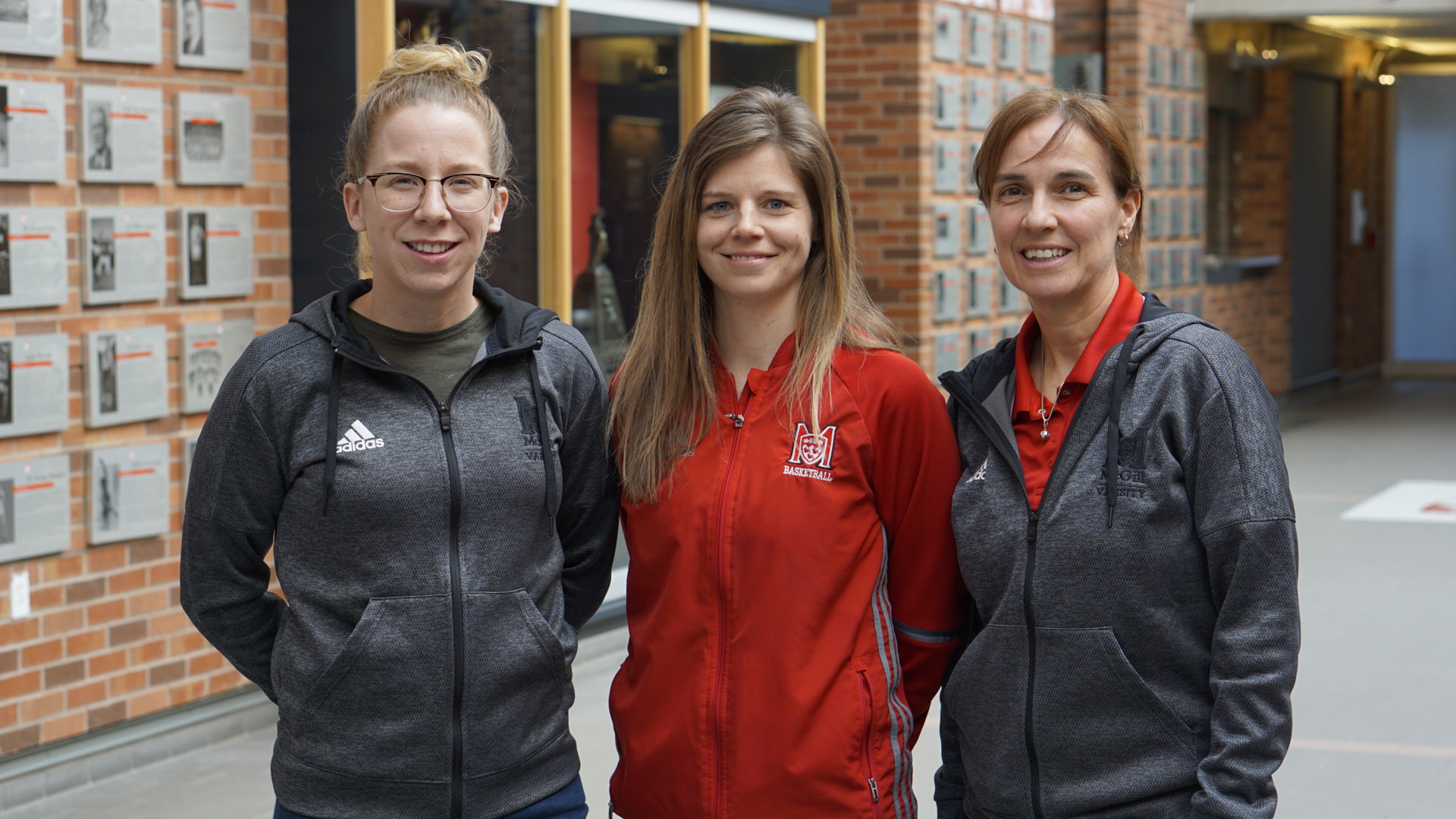
In Sept. 2018, McGill Athletics and Recreation launched the new Women in Sports Initiative thanks to a $3.5 million donation from McGill alumni Sheryl and David Kerr. The initiative aims to promote women in leadership roles within McGill Athletics and help female athletes balance their academic obligations with their athletic time commitment. Hiring two women in full-time associate coach positions has been a key part of this initiative: Rikki Bowles joined the Martlet basketball team coaching staff, while Kelsey Wilson moved from a part-time position to a full-time one with the women’s soccer team.

These additions to the teams’ full-time staff have already made a significant impact on coaches and players alike.

“It’s important to have that possibility of having a female role model,” Wilson said in an interview with The McGill Tribune. “As a player, I didn’t necessarily have that when I was growing up. I think it’s important for young players, especially, to see that if they are interested in coaching, that it is a possibility, that you can continue on and develop and actually find full-time positions.”

Both Bowles and Wilson played for the Martlets during their undergraduate degrees at McGill. Fourth-year Martlet soccer winger Tia Lore agreed that it is comforting and inspiring to have someone who understands the players’ situation.

“It’s huge when you’re playing on a team, and you might be new to the team, or you feel like you’re not doing great, but you gain this confidence [from knowing that] she’s been through this, so she knows the struggles,” Lore said. “Seeing female coaches and having female coaches is super empowering. Having a coach empower you, not just as an athlete, but as a female athlete, is huge.”

In the future, Martlet volleyball will also benefit from the Kerr donation. The team is planning to expand their coaching staff. Meanwhile, the women’s hockey program has already been receiving support through the Kerr Martlet Hockey Coach Endowment. This endowment has funded the salaries for full-time Martlet hockey coaches since 2007. The team went on to win its first three national titles in the four years immediately following, demonstrating the immediate impact that additional full-time coaches can make.

The purpose of the Women in Sports Initiative is to support not only Martlet athletes, but also female coaches.

“Hiring two new people is already huge,” Sylvie Béliveau, senior advisor to the McGill varsity program, said. “It changes the lives of those two women. They can now bond with and better service their student-athletes.”

With these new positions, the women’s soccer and basketball teams now have more full-time coaching staff than their male counterparts. In almost every other sporting environment, including coaching, competing, and sports journalism, women are underrepresented. This move will give female athletes and coaches additional, valuable opportunities to pursue careers in sports.

“I don’t think we really knew what we could have [regarding having female coaches to learn from and look up to],” Lore said. “We weren’t [thinking that] we were missing this. It was more [realizing that] we should have had this before.”

The new hires from the Women in Sports Initiative are certainly making a positive impact. However, the move to provide extra support for female coaches and athletes was a slow one. A 2013 study found that only 22 per cent of head coaches and 17 per cent of assistant coaches in Canadian intercollegiate athletics were female. In the six years since the study was published, McGill’s female coaching statistics have been below national averages. While McGill was providing the same number of coaches to its men’s and women’s teams, the gender imbalance represents a failure to provide sufficient opportunities for female coaches until now.

The Kerr donation is a one-time donation, which means that the money will eventually run out. It is therefore necessary for McGill Athletics to implement a plan that reallocates funds so that they can continue to pay the program’s coaches. The initiative is still in its infancy, but its longevity appears to be a priority for now.

“Our goal is sustainability,” Béliveau said. “We’re thinking long term. It’s going to be a robust program, built on solid ground [….] It’s a 10 to 12 year program, but, past that, we want it to continue.”

The press release from McGill Athletics announcing the donation stated that the initiative would also fund additional resources for female varsity athletes in balancing the academic demands of McGill with their sports.

“The next step is [asking] how we can service them better,” Béliveau said. “We want to ask them [about what they need]. We’re looking at building a community of practice, for example.”

Managing the pressure of being a student-athlete is no easy feat, especially given McGill’s recent defunding of mental health services such as the Eating Disorder Program. Relying on private donorship to fund support programs for students, including student-athletes, gives the university administration an excuse not to provide crucial funding itself. Furthermore, donations often target a particular subset of students and do not effectively reach the entire McGill student population.

Expanding opportunities for female coaches in collegiate athletics is important, but such measures do not equally affect all women. Racial and socio-economic factors significantly impact the accessibility of these opportunities. Without a commitment to opening sporting environments to all backgrounds, starting at the youth and development levels, coaching opportunities will remain attainable only to those who can afford to play sports throughout their youth and collegiate careers. Within Canada, and greater North America as a whole, many racialized communities continue to fall into lower income brackets, which makes sports less accessible due to the time and cost involved. Additionally, transgender athletes continue to be excluded from some sporting environments, making it more difficult—and in some cases, dangerous—to participate. These accessibility issues at lower levels of competition need to be addressed before true diversity and representation at the top levels of professional coaching can be achieved, and McGill Athletics should consider this when developing future programs for women in sports.

The Athletics office should also be weary of making claims about striving for equality while the men’s varsity teams are still named after a racial slur. Keeping the name creates an environment in which Indigenous athletes can feel isolated. McGill can take a step toward truly levelling the playing field by changing the name so that all athletes feel safe and welcome in varsity sports programs.

As for the initiative’s immediate impact, other universities in Canada have reached out to McGill Athletics looking to share ideas as they implement their own programs that build gender parity in athletics.

“I’ve connected with other universities [that] are doing similar programs like [the University of] Guelph, [the University of British Columbia], and […] Dalhousie [University],” Béliveau said. “Those are only examples. If there’s anyone out there who is doing similar things, we want to look at their good practices and see how we can implement [them] here. We don’t need to reinvent everything […], we’re looking to adapt it to suit the women who are in a position to [benefit].”

Women in sports are consistently underrepresented and underserved at higher levels of competition, and, while the Women in Sports Initiative is moving in the right direction, it is not enough to level the playing field for everyone.

News, The Tribune Explains

Tribune Explains: Crunch Time – Final Exams

As the warming weather begins to melt the snow, McGill students can look forward to the summer, but, first, final exams stand as an arduous hurdle in the way of the well-deserved break. While students fill up the campus libraries to study, McGill’s Exam Office in the Enrolment Services is working just as hard to ensure that 64,000 exams are prepared in time for their scheduled date. The McGill Tribune looked into the process of scheduling final exams and what it takes to prepare for a chaotic exam period.

How are final exams organized at McGill?

Approximately two to three weeks before the beginning of each semester, the Exam Office contacts every professor registered to teach a course to determine if their course will include a final exam. Soon after the add/drop deadline, the Exam Office publishes a tentative exam schedule, followed by a final schedule about five weeks after the start of the semester. In the meantime, work is done to assign exam rooms, arrange furniture and supplies, hire invigilators, and schedule exam printing. Course instructors are responsible for organizing non-paper exams, such as lab exams, with their respective departments.

How are final exams scheduled?

According to Stanley Whyte, Chief Invigilator,  a software called Infosilem looks at the exam load for each student and schedules final exams with the least conflicts possible.

“Our scheduling software uses an algorithm that takes into account the enrolment for each course and then attempts to create the best possible schedule for the majority of students by spreading out those courses that have students in common,” Whyte said.

Infosilem is also used to by Enrolment Services to generate McGill’s course schedule.

What happens if I have a conflict?

McGill acknowledges both academic and religious conflicts under conditions outlined on the exam website. Students are responsible for filling out the Exam Conflict Form to be approved by the Exam Office before the exam date. Students who do not have a conflict but require special accommodations, such as McGill athletes who need to play an away game, will need to submit a request for approval to their faculty’s student affairs office.

What if I have a disability?

Students who are registered with the Office for Students with Disabilities (OSD) are accommodated for any disability-related barriers that may hinder their performance on an exam. These students are eligible to fill out an exam sign-up form and get approval for accommodations, such as writing their exam in a different room.

How are invigilators hired?

Most invigilators are graduate students and external candidates, with undergraduate students being ineligible. Hired invigilators must attend a mandatory training session that explains their duties and expectations, as well as how to address any complications that arise during exams. Invigilators are unionized through the Association of Graduate Students Employed at McGill (AGSEM) and hired under the conditions of the Collective Agreement certified in April 2010.

Can I feign illness during an exam to get out of it?

According to Stanley Whyte, Chief Invigilator, there is no guarantee that a student who falls ill while writing an exam will be permitted to write the deferred one in August.

“Each case of a student falling ill during their exam is different and the circumstances of the situation are reviewed before a decision is made,” Whyte said.

Student Life

Trivial pursuit

On Oct. 6, 2014, Mariusz Galczynski, at the time a PhD candidate in the Faculty of Education, watched the taping of an episode of Jeopardy!. He had passed the many required tests in order to be on the show, and it was almost his turn to compete.

“Anyone who knows me […] knows that I love the Spice Girls and Celine Dion,” Galczynski said in an interview with The McGill Tribune. “[In the game before mine], there was a Celine Dion question and then Final Jeopardy. The answer was the Spice Girls, and no one knew of the contestants. So, right away, I was like ‘Agh, my god, I wish I was playing that game.’”

Jeopardy! records a week’s worth of episodes in one day of taping, and Galczynski was up next on the Tuesday episode. He won $20,350 in his initial appearance before losing the following ‘day’ in an episode taped 15 minutes after the first one ended.

When his winning episode aired on Nov. 25, Galczynski hosted a viewing party at Thomson House, where he and his friends used to participate in trivia nights.

“I invited all my friends that could make it, and it was great,” Galczynski said. “We watched the episode live. I knew the result, but they didn’t, and, when you watch the episode, it was a really close game and also pretty exciting [….] Obviously, they’re rooting for you to win, so it was awesome to deliver that at the end of the episode.”

Throughout Montreal, trivia-junkies host events at pubs, basements, and student unions. Venues around campus host themed nights with The Office, Game of Thrones, or even Shrek-specific trivia. For more general-knowledge-based questions, chemistry professor David Harpp has hosted his Centraide Trivia Nights at the Faculty Club for the past nine years.

“My daughter teaches at a university in the [United States], and I was visiting her about 12 years ago, and she said, ‘Do you want to go to a trivia night?’,” Harpp said in an interview with the Tribune.

Harpp’s trivia nights attract the McGill community, Montreal residents, and even a regular visitor from the University of Waterloo. As quizmaster, he runs seven rounds of 10 questions on a Powerpoint slide show. Harpp explained that, in preparation for competitions, he thoroughly researches his questions.

“If I think of [a potential question], like ‘that’s an interesting thought,’ I’ll just research it and make sure that it’s at least ‘Wikipedia right,’” Harpp said.

At Harpp’s trivia nights, around 30 teams of four or five discuss the questions at their tables and submit their answers on scorecards marked by undergraduate students.

“[It] gets very noisy [and] very competitive,” Harpp said. “[There’s] high-fiving, and [then also] a little bit of gentle cursing when they get something wrong or are talked out of a right answer at the table.”

A similar spirited atmosphere is present at the McGill Trivia Club’s events. The club meets twice a week in library group study rooms to practice for Quiz Bowl competitions with other schools across Canada, the U.S. and the U.K. Club president Akhil Garg has been participating in trivia competitions for nine years. He enjoys trivia competitions as a way to absorb new information.

“It’s all about learning new things,” Garg said. “I specialize in science and social science. As a medical student, I’m mostly studying biology, so trivia lets me study [all of the other sciences]. It’s a way to really expand my knowledge base.”

Overall, participants’ appreciation of learning promotes healthy competition. Garg compared this relationship to his favourite piece of trivia.

“There’s this thing called Bergman’s rule, which is that species in higher latitudes tend to be larger,” Garg said. “We at McGill Trivia always like to joke that we’re bigger than the clubs we compete against.”

A friendly atmosphere goes a long way in the trivia world even though competitions can get tough. Harpp agrees: Trivia remains competitive, even at home.

“My wife plays [at my trivia nights] with a team,” Harpp said. “She doesn’t get any inside answers. If I’m playing a piece of music, she’ll say ‘Who’s that?’ and I’ll say ‘That’s for you to find out.’”

Science & Technology

‘I feel you’

Empathy is often talked about in popular culture, particularly within the realms of politics, advertising, and psychology. Articles from ‘Why Empathy May Be Your Most Important Business Skill’ to ‘How to Avoid the Empathy Trap’ are popping up all over the internet. Generally, popular culture labels empathy as a positive, sociable trait.

Despite its universality, though, it seems that there is very little consensus on what empathy actually means. The common confusion is a result of the term’s complexity and wide scope.

“The problem is that empathy is one word that we use for a whole bunch of different things,” Jeffrey Mogil, a professor in McGill’s Department of Psychology, said. “You can functionally define it, but, then, it’s hard to categorize what it is. Is it a cognitive ability, is it an emotional ability, is it something else entirely? [….] That’s why it’s so interesting, right? Precisely because it’s so mysterious and hard to pin down.”

The general consensus is that empathy refers to the understanding and experiencing of another’s emotions. Though both of these endeavours are intertwined in the general definition of empathy, scientists consider each as their own distinct cognitive processes.

Consistent evidence has emerged for two broad forms of empathy at least partially separable at the neural and cognitive levels,” David Vachon, an assistant professor in McGill’s Department of Psychology, wrote in an email to The McGill Tribune. “Cognitive empathy [is] the ability to detect or understand emotions, [while] affective empathy, [is] the tendency to feel the emotions of others.”

Feeling others

One way that scientists have understood the different types of empathy is by studying people with external behavioural disorders, such as narcissistic personality disorder and psychopathy. While psychologists often broadly characterize these disorders by a decreased amount of empathy, it is important to note that empathy does not decrease across the board.

“People with externalizing [behavioural] disorders are not any different in their cognitive empathy, but tend to have lower affective empathy,” Vachon wrote. “They can tell what you are feeling, but they care less.”

Meanwhile, people on the autism spectrum may have the opposite condition. They can have high, sometimes overpowering, affective empathy, and are able to experience the emotions of others. Conversely, though, they generally have lower levels of cognitive empathy, meaning they can have more trouble understanding how other people are feeling in the first place.

Both popular culture and science often link low levels of empathy to violent tendencies. However, unlike certain forms of psychopathy, autism spectrum disorder (ASD) is rarely associated with violent crimes. Based on a meta-analysis, Vachon pointed out that the current model of empathy actually has very little predictive power when it comes to aggression. To address the unpredictability, Vachon and his colleagues posited a third sub-scale of empathy, known as affective dissonance, or ‘anti-empathy.’ This scale measures cognitive and affective empathy in addition to the emotional ‘resonance’ of subjects.

“Empathy can be extended beyond resonant responses (e.g. empathy, sympathy, compassion) to include a lack of response (e.g. callous, unemotional, indifferent) and dissonant responses (e.g. sadism, scorn, schadenfreude),” Vachon wrote.

There is a distinct difference between someone who feels neutral when viewing a sad person and someone who is elated by another’s sadness. The ACME scale Vachon and his colleagues developed includes this important distinction in its measurement, and is a promising predictor of aggression.

Feeling stress

Stress, another key factor in aggression, also plays a vital role in the process of empathy. In 2015, Mogil and his team published a study that found a strong relationship between empathy and stress.

Mogil, a pain researcher, initially came across the link while experimenting on mice. He noticed that a mouse’s pain response would be more dramatic when a mouse that they knew was present in the same room. He explained this as a sign of an empathetic ‘emotional contagion’ between the two mice.

“Emotional contagion is when the emotional state of one animal affects the emotional state of another animal,” Mogil said.

Mogil decided to try this same experiment on humans and found similar results: A person with their hand immersed in ice water experienced more perceived pain when in the presence of a person they knew, as opposed to a stranger. Moreover, the most interesting thing the study found was how to foster emotional contagion.

Mogil’s experiment had three conditions. He divided participants into a control group where two subjects immediately went in, a treatment group where the subjects took a stress-blocking drug, and another treatment group where the two strangers played the music video game Rock Band together for 15 minutes before participating in the experiment.

There was little difference between those that took the stress-blocking drug and those that played Rock Band; both exhibited significantly-higher emotional contagion than the control group that immediately walked in with the stranger. This suggests that the bond of familiarity is more important than the particular activity.

“Once the strangers got into the room to have their pain tested to see if they had emotional contagion, they weren’t strangers anymore, [since] they had just been doing something together for 15 minutes,” Mogil said.

Mogil’s study further showed that the instinctive stress response triggered when encountering a new person blocked emotional contagion, and that this immediately prevents the formation of empathic connections with strangers.

Feeling good

Despite the widespread perception of empathy as morally-sound, there are situations in which it can be a hindrance. Empathy deficits can be favorable in high-stress fields that require quick and unemotional decision-making, such as in surgery or stockbroking.

In fact, empathy’s weaknesses form the entire basis of //Against Empathy//, a book written by Paul Bloom, a psychology professor at Yale University. In a 2017 interview with Vox, Bloom explained some of the key misconceptions about the term, most notably the prevalence of empathic bias.

“I’m [more] likely to feel empathy toward you [the interviewer], a handsome white guy, [than] somebody who is repulsive or frightening,” Bloom said. “I actually feel a lot less empathy for people who aren’t in my culture, who don’t share my skin color, who don’t share my language [.…] Empathy is as biased as can be.”

Bloom cited empathy as a factor influencing individual donations to charities in developing countries. While unconditional donations from sympathetic foreigners can provide short-term benefits they can bankrupt local businesses in the long-term.

“It might feel good, but empathy often leads us to make stupid and unethical decisions,” Bloom said.

McGill, News

Quebec Order of Dentists finds former McGill professor guilty of sexual misconduct

CW: SEXUAL VIOLENCE

Nareg Apelian, a former assistant professor in McGill’s Faculty of Dentistry, has yet to receive a date for his disciplinary hearing, where the Quebec Order of Dentists (QOD) will decide on the consequences for his sexual misconduct. Back in February, the Order found him guilty of groping a student during an off-campus dentist appointment in 2016. The dentistry student, whose identity is protected, made an appointment with Apelian to adjust her mouthguard. Apelian requested to see her at his off-campus clinic, where he groped her in a locked room.

Immediately after the appointment, the student filed a complaint with the Montreal police and McGill. Apelian maintains his innocence, arguing that he required the student to come to his off-campus clinic for accommodations because the necessary equipment was unavailable at McGill. If he is not able to overturn the QOD’s guilty verdict, he may face a suspension of less than five years.

The QOD found Apelian to have violated section 59.1 of the Order of Dentists’ Professional Code, which regulates appropriate workplace conduct.

“The fact of a professional taking advantage of his professional relationship with a person to whom he is providing services, during that relationship, to have sexual relations with that person or to make improper gestures or remarks of a sexual nature, constitutes an act derogatory to the dignity of his profession,” the Code reads.

The police investigation, initiated in response to the complaint, was concluded in May 2017 after the Service de Police de la Ville de Montréal (SPVM) missed the deadline to pursue any charges against Apelian. The SPVM declined to comment on the investigation.

Apelian was placed on administrative leave from McGill in Dec. 2016 following the incident, although the university’s investigations failed to implicate him. He returned to work after the university concluded its investigation in January 2017. After the QOD’s guilty verdict, McGill cut all ties with the assistant professor at the end of February 2019. Associate Provost (Equity and Academic Policies) Angela Campbell attributed McGill’s failure to remove Apelian from the University as a result of the different tools at the QoD’s disposal.  

“An external authority like an administrative tribunal leads a quasi-judicial process and, consequently, has access to ‘tools’ or measures that are not available to the University,” Campbell wrote in an email to The McGill Tribune. “For example, it can issue subpoenas to compel anyone to testify and/or to provide documents and information. The tribunal’s process is based on examination and cross-examination of witnesses and the parties themselves, which provides a better opportunity to test the evidence and the credibility of witnesses. These powers are provided by law. The University does not have these powers. “

Soon after McGill concluded the investigation, the student stated in an interview with CBC that the administration had actively worked to discredit her during her testimony. She stated that she felt as though members of the administration had colluded before meeting with her, enabling them to undermine her testimony throughout the investigation. The Tribune also uncovered a series of emails between members of the administration who had contacted the student’s professors regarding her class attendance without her consent.

The Dean of the Faculty of Dentistry Elham Emami wrote to the Tribune expressing her commitment to the safety of dentistry students.

“This has been a difficult issue for our Faculty, and one that we have taken very seriously,” Emami wrote in an email. “As Dean, I’m committed to ensuring and maintaining a safe and secure learning environment for our students.”

Read the latest issue

Read the latest issue