

Latest News

McGill, News

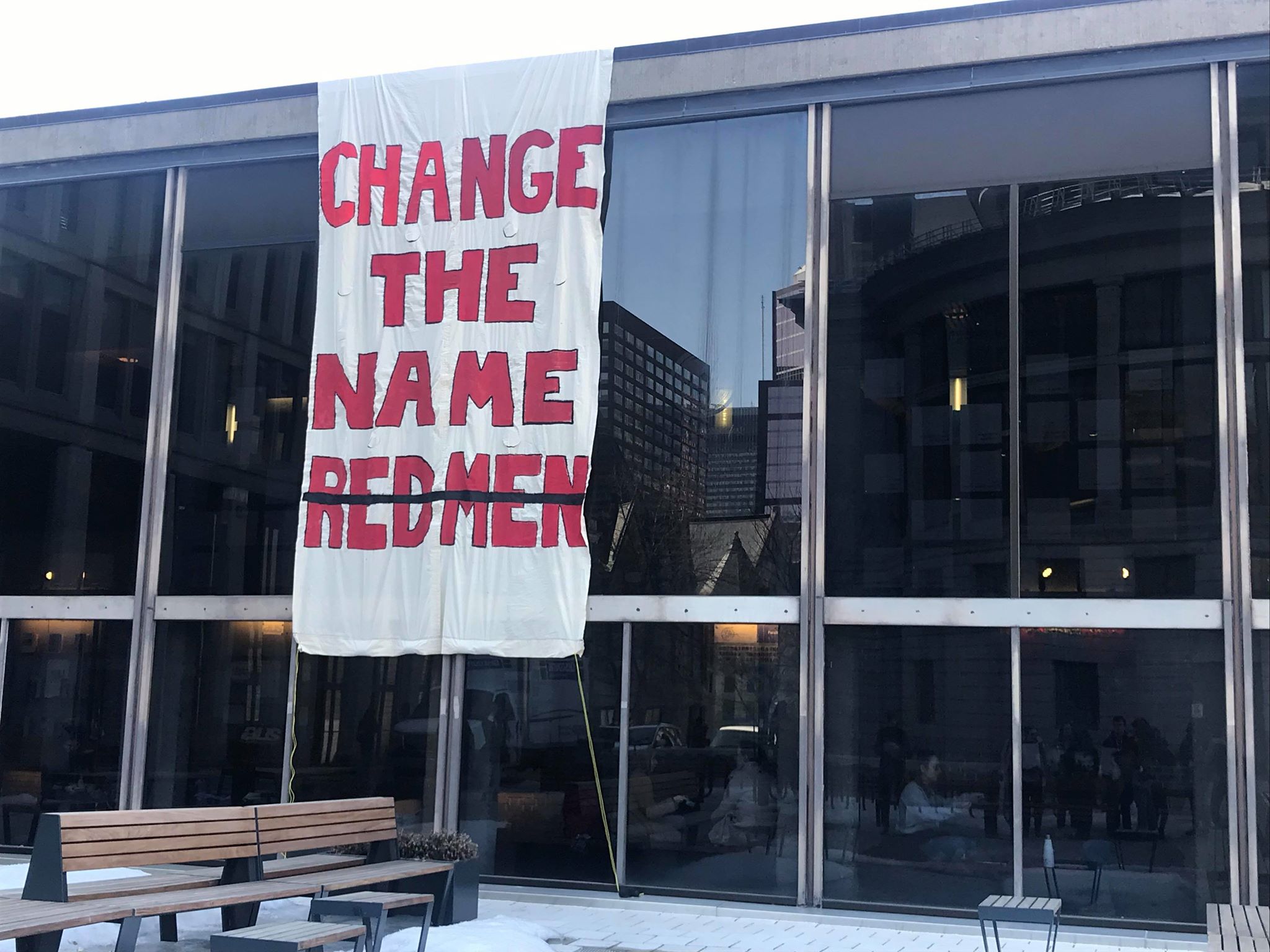
Student activists hang ‘Change the Name’ banner from the roof of Leacock

A group of approximately thirty McGill students gathered on the Leacock Pavillion on March 27 to watch an unknown individual unfurl a banner from the roof with the words ‘Change the Name.’ The banner hung for about 20 minutes, after which two members of McGill Security Services personnel removed it.

Students hung the banner weeks before Principal and Vice-Chancellor Suzanne Fortier is expected to make a decision as to whether to change the McGill men’s varsity team name. Fortier decided to delay her decision until April following a report from the Working Group on Principles on Renaming and Commemoration, which sought to provide steps for engaging in the renaming process.

Campus security cited the danger the banner might pose to those standing nearby as their reason for taking it down.

“Security Services personnel removed the banner from the Leacock Building on March 27 as a matter of standard practice; we did not receive a request to do so,” Associate Director of Campus Public Safety (Security Services) Christopher Carson wrote in an email to The McGill Tribune. “Whenever our agents become aware of a banner hung from a campus building, gate, tree etc., they remove it. Banners can be a public safety issue. Sandbags used to hold banners in place, for example, can endanger the people below. The message displayed on a banner is not a factor in such decisions.”

Co-Chair of the Indigenous Students Alliance (ISA) Vanessa Racine described Security’s removal of the banner as hypocritical due to their failure to take precautions while taking it down.

“What surprised me the most was how dangerously they took it down and seeing one of the pieces of the banner break on the floor as they carelessly dropped it,” Racine wrote in an email to the Tribune. “It was funny, really, to see security take it down in a somewhat unsafe manner.”

Racine also felt that, by removing the banner so quickly, security failed to show solidarity with Indigenous students.  

“Change the Name is a movement brought forth by Indigenous students, and taking down the banner so quickly kind of shows silencing of not just Indigenous voices, but also student voices,” Racine wrote. “I don’t believe that security thought that they were going up to the roof so they could silence voices, but they should have thought of those implications before taking it down so quickly. I don’t think it would have been a problem if it was up for a little longer.”

In addition to the banner drop, Indigenous student activists and their allies have enacted a number of other campaigns to pressure the administration to change the name, such as the ‘Vote No’ to Athletics Facility Improvement Fee. The fee failed with 58 per cent of voters voting no. SSMU Indigenous Affairs Commissioner and the founder of the ‘Change the Name’ campaign Tomas Jirousek spoke to the importance of continuing to challenge the administration with respect to important issues like this one.

“The Principal will be releasing her decision sometime in the coming weeks, and [the banner] certainly brings it back to the forefront in the minds of a lot of students,” Jirousek said. “It also shows that students are still paying attention to the issue. It’s not as if Indigenous students and our allies are meekly waiting for the decision, but we continue to engage with the discussion and continue to critically engage with the administration.”

Co-Chair of the ISA Ella Martindale remains hopeful that the administration will ensure that Fortier takes Indigenous voices into consideration when she makes her final decision.

“At this point I’m optimistic,” Martindale said. “I like to think the best of people, and [now that] she’s had 3 months of her own time to think about this decision, do her research, and think about Indigenous folks, [she will] comes to the right conclusion, which is to change the name.”


Montreal, News

Climate March organizers reflect on the future of climate activism

In an attempt to utilize the momentum generated by the worldwide march for climate justice on March 15, the organizer of the Montreal contingent, La Planète s’invite à l’Université (LPSU), will hold two more marches in April and September. Additionally, LPSU representatives met with Quebec Minister of Environment Benoit Charette on March 22 to discuss climate change policy.  

“Essentially, the meeting today was a lot of empty promises as usual,” SSMU Sustainability Commissioner Alison Gu said. “We expected everything that they said, but they also told us that they were going to approve the Gazoduq pipeline […] which is going to transport liquified natural gas (LNG). The fact is that if we set up more infrastructure to be burning fossil fuels, which is what natural gas is, it’s purported to be [a] cleaner alternative to coal or oil. But, at the end of the day, a lot of the processes that you have to extract and transport LNG are the same or worse than current oil processes.”

Montreal’s protest was one of the largest of the 2,000 marches that took place across the world that day, with 1500 McGill students in attendance. Organizers at McGill began preparing for the demonstration three-and-a-half weeks beforehand. According to Christina Lau, who handled communications for the march, the demonstration was successful due to the dedication of its participants despite a tight time constraint.

“I definitely think [the march’s success was] because everyone in our group was so passionate and so hardworking,” Lau said. “Each of us was going to three or four meetings a week […] for hours to make sure everything was exactly how we wanted it to turn out. Montreal had the biggest march in North America, and I feel like that really speaks to how far we’re willing to go to get [action on climate change], and I think that, especially with the next few [marches] coming up, we will be able to prove to McGill how much students want to protect our planet and [see] concrete action.”

Juan Pablo Arellano, U2 Science, who acted as a point of communication between McGill security, the SPVM, and McGill’s climate demonstration, hopes that the results of the upcoming federal election in October will reflect the momentum of the protests.

“I want to do the best that we can to elect representatives that are aligned with our views and who are pro-climate mitigation, pro-sustainability, and anti-climate change,” Arellano said. “[I want to elect] someone who will try to shift policy to make Quebec more sustainable, more self-reliant, and less fossil-fuel dependent. ”

The impact of climate change on Indigenous communities was an important theme at the demonstration. Alex Allard-Gray, a McGill alumnus and member of the Listuguj Mi’gmaq First Nation, elaborated on how the government can mitigate the impact on Indigenous communities.

“I think the [government needs to make] policies that protect the environment and protect Indigenous lands from being the site of environmental abuse,” Gray in an interview with The McGill Tribune. “Our culture has already been assaulted in so many ways, as we can see in Canadian history, and this is just another way in which we are having our culture progressively taken away from us. We have to fight harder and harder to achieve what we [want].”

Joke, Laughing Matters

Title Club gives students titles of their choosing

The new Title Club joins 501 other student clubs registered with the Students’ Society of McGill University (SSMU). Students who attend one of their Executive Networking General Seminar meetings, which occur for 30 minutes on a daily basis, have the opportunity to come up with new titles to “DIY their own position.”

“We offer a tailored extracurricular experience that no other student club can provide,” Guiding Founder and Secretary General of Internal and External Managers Max Fischer said. “We believe in our members’ communication skills, leadership abilities, and results-driven, customer-centric synergy.”

When pressed on how the Title Club provides communication and leadership opportunities, members referred to the club’s 5,000 Facebook likes.

“Every member contributes to our readability by ‘liking’ posts, they are all our social media influencers and brand ambassadors,” Social Media Senior Strategist Victor Verbaler said. “We contribute as much to the average McGill student’s daily life as Building 21.”

The Title Club has faced organizational difficulties with new departments, but its members are confident they can still use the club to their advantage.

“I was only able to secure my internship because I had experience managing others,” Tommy Triharde, one of the club’s 30 vice-presidents, said. “I don’t get why people don’t spend five minutes of their day yelling out ideas and taking credit for them more often.”

Joke, Laughing Matters

Plumber’s Faucet alleges Suzanne Fortier is five owls in a trench coat

An article in The Plumber’s Faucet recently confirmed what McGill’s student body has long suspected: Principal and Vice-Chancellor Suzanne Fortier is not, in fact, a middle-aged woman with a passion for crystallography, but five owls stacked talon-to-beak in a medium-sized trench coat.

The allegations, brought forth in an article titled “10 Untold Truths about McGill University” by Steve Greenwood, a PhD student in the Arts Faculty, have ruffled feathers on campus. The piece not only alleges that the woman students affectionately call ‘Big Suze’ is actually a remarkably well-coordinated parliament of owls, but that these birds have turned the men’s varsity team mascot into a Horcrux.

Greenwood says he first became suspicious of Fortier when he overheard a faint hooting coming from her direction.

“When I discovered that she had 5 Horcruxes, I was suspicious,” Greenwood wrote in a message to The McGill Tribune. “A person really only needs one Horcrux.”

This fact led Greenwood to the conclusion that has rocked the McGill community: Fortier does not have one for herself, but rather each owl has its own Horcrux hidden somewhere on campus.

For those still unconvinced that Fortier is birds, observations of her behaviour back up this hypothesis. Eastern screech owls, Fortier’s suspected breed, are nocturnal and hide away in holes burrowed into the trunks of trees during the day, explaining why Fortier is only rarely sighted around campus.

Greenwood believes that her mannerisms are textbook owl behaviour.

“Fortier eats a higher-than-normal amount of worms and is always saying things like, ‘I’m actually five owls,’” Greenwood wrote.

One undergraduate student, who wished to remain anonymous for fear of repercussions in the way of Alfred Hitchcock’s The Birds, stated that one evening, after returning from a particularly successful BdA outing, he and a few friends witnessed proof of Fortier’s true identity.

“It was messed up,” the student said. “Her head turned, like, all the way around, and she was looking at me with these crazy yellow eyes. I don’t know a ton about science [because] I’m an English major, but I do know that was no lady. It was just a bunch of owls.”

The news has led some to question whether five birds are enough to run one of the largest universities in Canada.

“Maybe it would be useful to bring in a sixth owl to help her out a bit,” Greenwood said.

Joke, Laughing Matters

I went to every single Montreal emergency room and this is a definitive list of them, ranked

According to the Health Ministry of Quebec, emergency room wait times in Montreal have increased from a median of 4.4 to 4.5 hours over the last year. With little hope that this number will decrease significantly over the next few years, The McGill Tribune has compiled a definitive list of the best and worst emergency rooms based on the following criteria: comfort of waiting area seats, availability of free snacks, free wifi, and waiting room aesthetics. Maximizing comfort and distractions from a horrible fall makes the excruciatingly long wait easier to bear. For the study, I visited each of the below emergency rooms and sat there for 48 hours.

Jewish General Hospital – ⅘

With high gray ceilings and only a 15-minute drive from McGill’s downtown campus, the Jewish General Hospital is a great option for your Blues-Pub-blackout-related needs. The cool atmosphere and somewhat comfy chairs distract you from your throbbing headache so successfully that you’ll forget why you’re even there in the first place!

St. Mary’s Hospital Centre – ⅖

St. Mary’s barely makes the cuttheir waiting room is always cramped, does not have great refreshments, and has horrible carpeting. The subpar aesthetic makes for a strikingly painful wait when compounded with the pain of a protruding femur. It definitely doesn’t help that you’re sitting shoulder to shoulder with other patients.

Montreal’s Children Hospital – ⅘  

Although the Children’s Hospital was the most colourful of the bunch, the emergency room nurses didn’t appreciate a full-grown manchild walking in and demanding cherry cough syrup to treat their mono. The festive seating and plush toys really made the rejection a lot easier, though.

CHUM – ⅖

CHUM puts the CHUM in Chum bucket, due to its very long wait times and disappointing vending machine options. The nurses constantly deflected my concerns with a heavy Québécois accent, making it the most authentic Montreal emergency room experience. As the last emergency room I visited, they did not seem to care at all about the blood clot I had developed sitting on waiting room chairs for the last week.

Joke, Laughing Matters

Montreal Curling Club announces new sponsorship deal with Swiffer™

On March 25, Canada’s most decorated curling club, The Montreal Curling Club, announced their new sponsorship deal with the iconic household brand Swiffer™. Club President Joey Moore and Swiffer™ CFO Howard Tallman signed a five-year contract worth $1,000 at the club’s office in Côte-des-Neiges.

“We here at Swiffer™ are just so proud to support a long-standing tradition of excellence in Canadian curling at the Montreal Curling Club,” Swiffer™ marketing representative Cindy Schmidt said at a press conference that only reporters from CBC Radio 4 attended. “We hope we can provide the tools necessary for the athletes here at the Montreal Curling Club to reach their highest potential.”

Moore echoed Schmidt’s enthusiasm.

“This is huge for us here at Montreal Curling Club,” Moore said. “We’ve never had a sponsor who has been so dedicated to providing us with quality equipment so that we can be the best athletes possible. ”

The Canadian National Curling Championships are scheduled for Feb. 23 and 24, 2020 in Flin Flon, Manitoba. The Montreal Curling Club will be looking for a podium sweep in all events.

Several veterans will return to the sheet this year for the Montreal Curling Club at the national championships. Most notably, Michael Spiel, who looks like he definitely spends his summers fishing in Muskoka, is slated to compete. Spiel is a celebrated skip for Team Canada at the past three Winter Olympic Games in Vancouver, Sochi, and Pyeongchang.

“I’ve been in the game a long time, you know,” Spiel said in an interview with the Waterloo Reporter. “This will probably be my last national championships, so I just really want to go out with a bang. I just want to make my wife, Karen, and my kids, Davey and Georgie, proud.”

According to a report released by Swiffer™ corporate headquarters this week, the brand estimates no boost in sales from this partnership. Tallman is simply a huge curling fan, and it has been a lifelong dream of his to meet an Olympic curling champion like Spiel.

“I’m honestly freaking out a little right now,” Tallman said afterwards at  press conference.“This was major, I’m not gonna lie to you. I’m just worried that I was so starstruck when I met him that I looked kind of dumb.”

With the partnership, the Montreal Curling Club hopes to reignite a culture for curling in Canada. The esteemed Canadian curling program has yet to recover from international humiliation at the 2018 Pyeongchang Winter Olympics: A loss at the hands of the American team in the men’s curling event.

“We have an opportunity here to keep getting better so that, with the help of Swiffer™, we can become the best athletes in North America and crush the souls of the Americans at the next world championships,” Spiel said. “I just can’t wait to be really gracious in victory.”

Joke, Laughing Matters

Student eats magical samosa of truth, devastates journalistic career

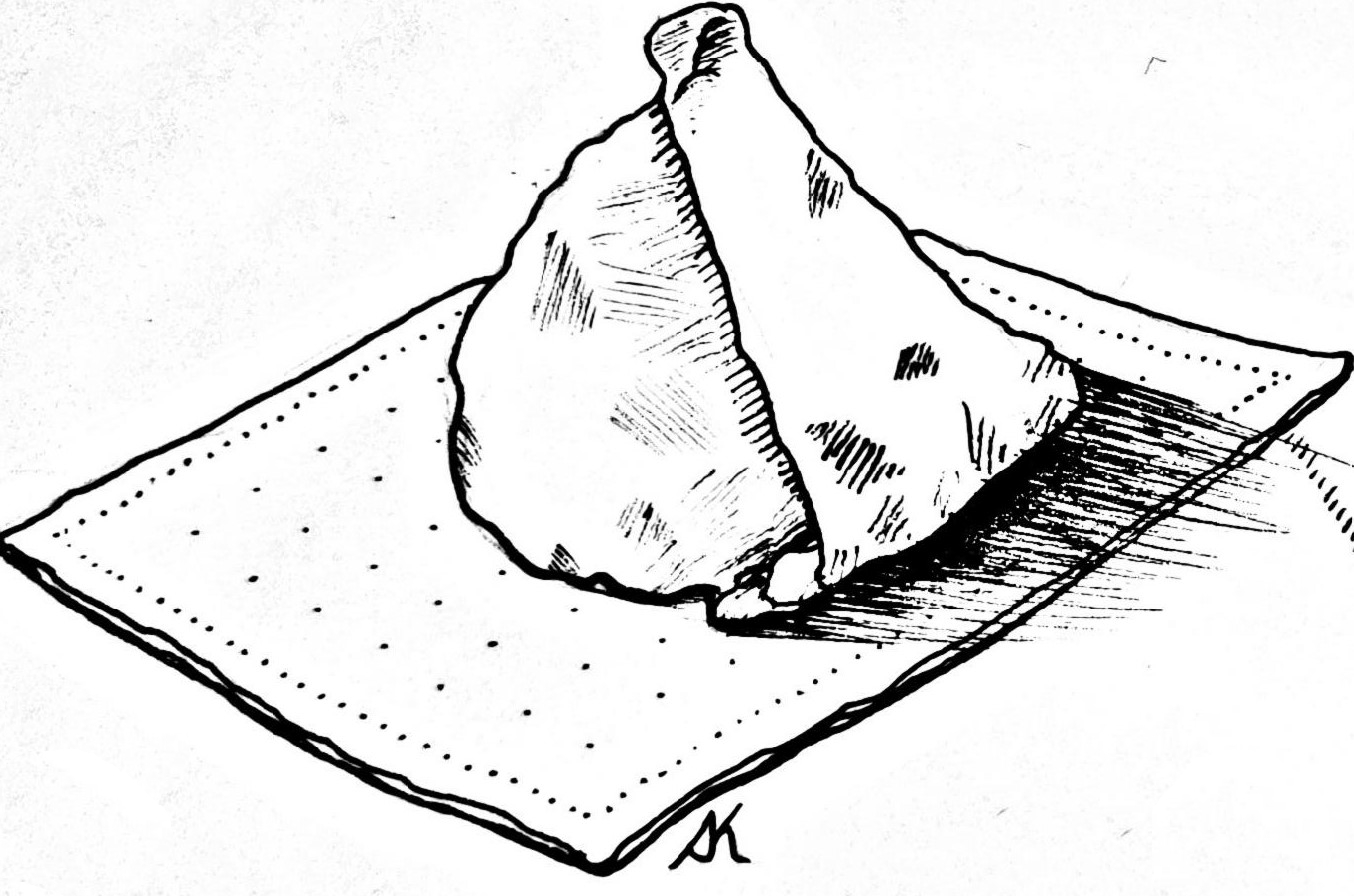
Mark Corey, U1 Political Science, claims to have ingested a magical samosa, rendering him incapable of telling and writing anything but the truth. According to Corey, the otherworldly nature of this samosa revealed itself in the form of severe stomach pains and acute gastrointestinal distress.

“It was as if my body wanted to reject the divinity of the samosa,” Corey said.

The student hobbled to the McGill Student Health Service Clinic in a futile attempt to obtain treatment, foolishly disregarding its 1.4 star rating on Google Maps. In an unsurprising  twist, no nurses were available to treat his ailment.

“I vomited into a wastebasket in the Brown building, not just due to my strict diet of cheap Lebanese food and canned chili, but because my body wanted to reject The Truth,”

After his harrowing experience, Corey said that his understanding of the complete objective truth crystalized.

“Suddenly a lot of the journalistic pieces I had been writing made zero sense whatsoever,” he said, still shivering from the aftershocks of his life-altering experience. “It was liberating, but debilitating.”

As an editor for the McGill Weekly-Almost-Monthly (MWAM for short), Corey found that he could no longer write without getting his articles rejected by the paper.

“My problems began when I wrote an article on American politics. It was rejected. Perhaps my prose had not met the stringent standards of MWAM?”

Disheartened, Corey attempted to write another article, entitled “Israel-Palestine: It’s Complicated.” MWAM promptly rejected the piece for not meeting their standards of objectivity and for promoting division.

Since then, Corey has been unable to fulfill his duties as editor at the paper. He was let go last week, effectively ending his short-lived journalistic career. Corey’s magic samosa snack had stolen his knack.

“My journalistic career was ruined because of one lousy, good for nothing magical samosa. Now I can only write for the Tribune!”

Laughing Matters, Off the Board, Opinion

QUIZ: Do you have imposter syndrome or are you an imposter?

In recent months, “imposter syndrome” has made headlines as the newest millennial affliction: The term has been featured in Time, Forbes, an Alexandria Ocasio-Cortez interview, and even The McGill Tribune. Despite extensive news coverage, it can be difficult to decipher whether a lack of self-confidence is part of a wider psychological pandemic, or simply well-deserved doubt. To help those struggling, The McGill Tribune presents the definitive guide for distinguishing between having imposter syndrome and being an imposter.

  1. You’re preparing your resume for an interview. As you review your credentials, you are struck with panic because:

a.). There’s no way you have enough extra-curricular experience to work as an unpaid intern at a digital media agency.

b.) The company hires a lot of recent graduates, and someone might be able to verify that you were not, in fact, a McGill student between 2014 and 2018.  


  1. Congratulations! You got your dream job as a “Social Media and Content Vision Intern.” You pick up the phone and:

a.) Call your mom! She still wishes you had picked a different major and also applied to law school, but is proud nonetheless.

b.) Speak to a Bell customer service representative because you need to change your number. You previously used 514-938-9999 to answer as “Professor Anita Roth,” your “advisor” last summer, so you need a new line.


  1. It was a long week at work. While cleaning up your apartment, you notice the trash is overflowing with:

a.) Empty coffee cups, tissues, 5-hour Energy® Shots, and KD instant cups.

b.) Hair: Medium ash blonde, rich mahogany, jet black, even a Dollar Store neon wig.


  1. You’re out on a boat on the coast of San Remo with your similarly hot, blonde, and blue-blooded friend. When he rejects your advances, you:

a.) Are disappointed, but never thought that you had a chance with Jude Law anyway. This only confirms your deepest insecurities.

b.) Notice an oar sitting on the side of the boat, and, overcome with rage, beat Jude Law to death. A talented impressionist with a gift for forgery, you proceed to steal his identity and live lavishly travelling across Europe, no matter how hard Gwyneth Paltrow and Philip Seymour Hoffman try to stop you. You are Matt Damon, after all.


Mostly A’s: Congrats! You have imposter syndrome, and while this might be psychologically and interpersonally inhibiting, all of your behaviour is legal in the Province of Quebec. Cheer up, any Digital Media Company / Start-up / Content Creation Platform would be lucky to have you.

Mostly B’s: Forget imposter “syndrome,” you are the real deal. Perhaps if you adopt a baritone and stop conditioning your hair, HBO will one day make a documentary about you, too.

Joke, Laughing Matters

SSMU World Order

Just two months after McGill unveiled plans for the new Rossy Student Wellness Hub, advertising it as a one-stop shop for all McGill healthcare services, SSMU announced plans for a competing wellness hub. McGill will now have two one-stop shops for all students’ physical and mental health needs.

“The administration aren’t students, they don’t know what we need,” an embarrassed SSMU representative, who requested anonymity in case a future employer Googled them, said. “So instead of working with them and their $14 million budget, we decided to take matters into our own hands and put students first.”

The SSMU representative was ‘really excited’ for plans to expand student drinking options.

“Initially we were planning to renovate Gerts into a sort of SuWu-style café/bar. A SSMUWu, if you will,” the SSMU representative said, chuckling at their own joke. “But then we decided it would be easier if we just bought SuWu instead. Our budget is overseen by a U2 Economics student [….] He really believes that this is the best use of student money.”

SSMU plans to continue investing the gargantuan amount of money in other real estate projects.

“We’re thinking about buying up Café Campus next,” the SSMU representative said. “We know how integral Tuesday night drinking is to the McGill experience.”

The Master Plan also acknowledges SSMU’s concern for public relations. The SSMU representative said that they were one erroneous transcription of minutes away from students burning flags and breaking down their office doors. No student could be found to comment who knew where the new SSMU office was.

“Initially, we just wanted to use student money to hire a PR rep,” the SSMU representative said. “You know, a person that we could pay to make our failures look less awful to our constituents. But then we thought, ‘why not take this further?’ We could train an army of people to cover up our mistakes. This is a democracy, after all.”

When asked why SSMU had decided to open their own School of Public Relations with students’ money, the SSMU representative mumbled something about transparency. Or accountability.

SSMU’s School of Public Relations will be located in the SSMU building and is slated to open when the building is asbestos-free. Current estimates put this date at Apr. 1, 2080.

Joke, Laughing Matters

Friend’s boyfriend’s Mile End band actually sort of good

Despite all evidence pointing to the contrary, friend from residence, Sarah Jensen’s boyfriend’s Mile End band played a gig on March 28 that didn’t totally suck. While they seemed like any other tiny-hat toting group of boys, Plunger actually played a pretty solid set; several audience members described it as “a little long winded, but honestly, alright.” The audience itself was mostly a crowd of turtlenecked twentysomethings with a diverse range of Anglo-Saxon roots. One song in particular, “Hal(lelujah)ucinations” a nine-minute ballad about a mystery girl the lead singer had met at TRH-Bar was a crowd favourite, although the lyrics were sometimes inaudible over the sound of shuffling Blundstones.

Plunger’s  three person lineup consists of Nick Hewlett, the loud dude with bad takes from POLI 325, on bass; Josh Byman, who you met in the distant past of Sangria Wednesday at Gerts when you both tried to put ‘Drift Away’ into the jukebox, on drums; and Jensen’s boyfriend, Xander Dave, singing and playing his uncle’s electric guitar.

In an interview with The McGill Tribune Xander explained the origin of “Hal(lelujah)ucinations” and described his artistic process.

“Well I don’t know, it was just sort of an uphill battle, you know?” Xander said.  “Like, even if I hadn’t wanted to end up there I just kinda had to [….] I don’t know, it was just something I’d never experienced before and like, those things just leave an imprint on you.”

Another crowd-pleasing hit was “Puddle-Jump,” a track which Nick described as “like a Peach Pit–Steely Dan fusion with some Tank and the Bangas.” The duration of the five minute song saw Xander and Josh shouting “Hop” repeatedly over Nick’s bassline.

Plunger is not on any music streaming services, but they are playing a gig at Sala Rosa on June 3— so, in Xander’s own words: “Come through. It’ll be chill, or whatever.”

Read the latest issue

Read the latest issue