Latest News

Out on the Town, Student Life

Spooky season socials: Where to go this Halloweekend

The leaves everywhere are exploding into technicolour, the wind is urging you to pull your coat just a little closer and—let’s be real, it’s spooky season. 

As October comes to a close, one of the greatest weekends of the year’s social calendar approaches: Halloweekend. How many costumes do you need? What parties should you attend? How on earth will one have the energy to party for three days straight before heading into that final midterm? These are all questions that plague students nationwide. But fear not, the Tribune is here with the answer to, possibly, the most important one: What should I do this Halloweekend?

Connect with your community

What’s especially isolating about Halloween is the overrepresentation of white voices, scary stories, and presences in the holiday at large. The following clubs and services, working to combat these problems outside of the context of Halloween year round, can offer you the treat of community.

The Hong Kong Student Network and the McGill Korean Educational and Cultural Association, for example, are pairing up to host their “Boos and Booze” event at Muzique on Oct. 30.

On Oct. 25, Girls for Ghana will host a trivia night and social to support girls’ education and sustainable leadership in partnership with the Create Change foundation.

If you love the outdoors and have more than a pumpkin-spiced dash of competitive spirit, check out the Black Student Network’s (BSN) scavenger hunt. On Oct. 27, clues will be placed all over campus and players will have the chance to figure out the puzzle for a chance to win tickets to amusement park La Ronde’s annual Fright Night.

If you think treasure-hunting should be left to Luffy and his crew, perhaps a little scary movie night is more your speed. On Halloween, Oct. 31, the BSN will be hosting a scary movie night in collaboration with the Black Student Finance Society. The movie promises to be freaky and fantastical—plus, it’s produced by a Black director. 

MASS’s Scary Stories Night

Maybe this round of midterms was a rough ride and you’re looking to kick up your feet and relax this Halloweekend. Hosted in the McGill African Students’ Society (MASS) office, the club will be having an African horror stories night. You can listen in to ghastly stories and then vote for the story you thought was scariest, with prizes available to the winners. This event promises to be cozy, cute, and just the right amount of freaky. 

MASS’s VP Social, Fabie Mbodji, invites you to “come get cozy and scared with MASS!” 

Clubbing Ideas

For anyone who might happen to find themselves on St. Laurent around the scariest weekend of the year, the clubs there will have plenty of options for you.

For the creative party-goers who love to pull out all the stops with a costume, Café Campus is hosting a Tim Burton Creepy Halloween party on Oct. 28 and 29. If the Corpse Bride, Edward Scissorhands or the Mad Hatter are calling your name this Halloween, then this is a party you shouldn’t miss.

For those who have been pushed to the edge of their seats—or thrones—watching HBO’s House of the Dragon, Muzique has the perfect party for you. The dance club is hosting a Muzique x Game of Thrones x House of Dragon-themed party. This is sure to be a memorable bash, so head over on Oct. 27…before winter comes.

For those who want to stretch their Halloweekend into more of a Hallow-I’ll-be-partying-this-whole-week, Bar Blue Dog is having a Midterm Mix party on Oct. 26. While not specifically Halloween-themed, this party is a great way to celebrate the end of this crazy exam season.

Finally, stop by Jet Nightclub on Oct. 28, 29 and 31, or Ecole Privée on Oct. 29 for more Halloween bashes.

Get out there this Halloweekend and do the scariest thing of all—socialize. With these great events, it’s sure to be a wild time.

Research Briefs, Science & Technology

Modelling sea level increases based on planetary warming scenarios

In the past few decades, human-driven  global warming has left many questioning the future of the Earth’s oceanic dynamics and the implications of altering them. The Antarctic ice sheet (AIS), the largest body of ice on the planet, is retreating at an accelerated rate due to increased greenhouse gas emissions causing sea levels to rise. The Western Antarctic ice sheet is of particular concern to scientists as it contributes 25 per cent of total yearly global ice sheet melt.

Ice sheets are formed by snow and oceanic water freezing. They are embedded in bedrock but also have parts that float on the ocean’s surface, known as ice shelves. Ice shelves play an important role in maintaining the stability of ice sheets, and act as buttresses by slowing down ice flow. Thinning, or loss of ice shelves due to warm oceanic currents and atmospheric temperatures, causes marine ice sheet instability—when ice thickness drops below certain values and structural failures occur, leading to breakage or calving of the ice. 

The loss of buttressing ice shelves is a concern for many researchers, as it can lead to ice sheet loss and a subsequent rise in sea levels.

The 2016 Paris Agreement aimed to limit global warming by the end of this century to a maximum increase of 1.5℃ to 2℃ above pre-industrial levels. Natalya Gomez, an associate professor at McGill’s Department of Earth and Planetary Sciences, recently co-authored a research article in Nature which modelled possible responses of the Antarctic ice sheet to 1.5, 2, and 3 degree rises in global temperatures. 

Computer models were made using geological records depicting previous Antarctic ice sheet behaviours and their contributions to sea levels. A wide range of parameters, such as hydrofracturing—the disintegration of the bedrock supporting the ice sheet—were integrated into the simulations. Uncertainty within the parameters was accounted for using geological observations and statistical methods.

“There’s a wide range of projections of what the ice sheets may do in the future. We have captured the worst case scenarios,” Gomez said in an interview with The McGill Tribune. “Our model includes processes such as marine cliff instability and ice shelf hydrofracturing [….] Previous works have introduced these effects which allow us to consider a more realistic forcing of the ice shelf.”

Gomez’s team found that in the 1.5℃ and 2℃ warming scenarios, models predicted a similar rate of Antarctic ice loss at the end of this century as today, with a median contribution to sea levels of eight and nine centimetres respectively by 2100. The 3℃ simulations, however, predicted accelerated rates of Antarctic ice loss due to thinning and hydrofracturing of ice shelves. In more extreme simulations, ice instabilities became omnipresent across Antarctica, with a median contribution of 34 centimetres to sea levels by 2100. By 2300, average global sea levels in the 3℃ warming simulations are expected to reach 9.6 metres via Antarctic ice contributions, which is 10 times more than the 1.5℃ warming scenario. 

Although imagining the flooding of our home planet is not a comforting thought, climate technologies and renewable energy sources are becoming more prevalent, showing promise for the future. 

“We have the technology and solutions already there,”

– Natalya Gomez

Additionally, more sustainable policies should be adopted, such as green taxes for environmentally harmful activities, increased investments in renewable energy sources, and protection of natural ecosystems.

In light of these findings, governments worldwide must closely adhere to the Paris Agreement since the consequences of exceeding the limits set by the treaty do not paint a bright future for our planet, and all life that inhabits it.

News, PGSS

PGSS discusses McGill’s lack of accommodations and pay for invigilators

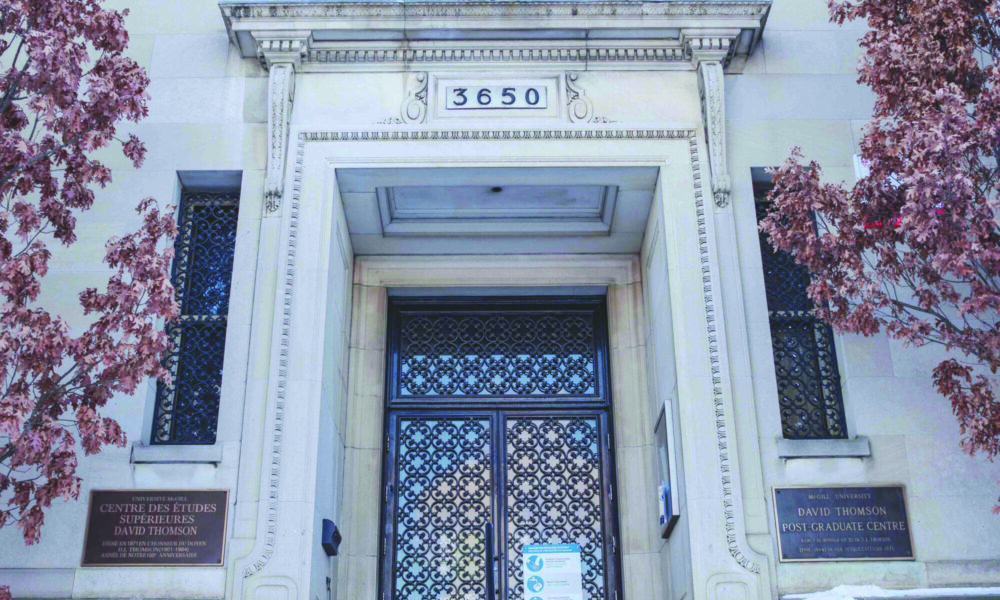
The Post-Graduate Students’ Society (PGSS) held their second Council meeting of the 2022-23 academic year on Oct. 19 to amend their budget, update students on sustainability projects and invigilators’ rights, and discuss concerns surrounding accessibility and accommodations for graduate students. There was also a town hall portion of the evening attended by McGill’s Dean of Students Robin Beech.

During the town hall segment, Rine Vieth, a PhD candidate in Anthropology, pointed to their  personal experience accessing accommodations from  Student Accessibility and Achievement (SAA)—formerly the Office for Students with Disabilities (OSD)—as a graduate student. Vieth asked Beech about removing some of the SAA’s registration criteria.

“McGill does not need to medicalize accommodations. While the McGill line is that this is required or otherwise needed by law, that’s not really the case,” Vieth said. “McGill absolutely could make it a policy to accept accommodations without a particular doctor’s form.” 

In response, Beech stated that there is ongoing discussion between him and Fabrice Labeau, Deputy Provost (Student Life and Learning), about extending the range of accommodations for students. Although they are not sure how, the McGill administration hopes to implement a “no questions asked” three-day accommodation for academic evaluations weighted at under 30 per cent once a semester.  

Hayley Krieger, a master’s student at the Max Bell School of Public Policy, added to Vieth’s point about the need for greater accessibility accommodations. After contracting COVID-19 during the second week of classes, Krieger asked to attend classes over Zoom. She was told her program was not hybrid and that she could not join the class synchronously.

“Classes are recorded, but it feels wrong to put the burden on students who have to stay home and make up a week of lectures,” Krieger said. “The university should have policies advocating accommodations for students that get COVID-19 instead of leaving it up to individual programs and professors to decide.”

While explaining the administration’s lack of uniformly applicable policy, Beech asserted that attending through Zoom is not equivalent to being in class and, thus, is not an appropriate accommodation.

Following the town hall, the Association of Graduate Students Employed at McGill (AGSEM) took the floor to update students on their contract negotiations with McGill regarding invigilators’ wages. The union maintains that the wage should be set to $18 per hour, and is waiting for McGill to return with a satisfactory counter-proposal before signing a new collective agreement.

Kiersten van Vliet, mobilizing officer for the Invigilator Bargaining Committee of the AGSEM, noted that McGill invigilators are paid less than any others in Quebec, and significantly lower than those in other provinces. Van Vliet also said that AGSEM believes McGill is exploiting the position of international students who cannot legally be employed outside the University, and hopes to stop this with firm contract negotiations.

“Many, if not most, of the invigilators at McGill are international students, and these students often have visa requirements that restrict their ability to work off campus,” van Vliet said. “They also have to pay international student fees. This is one of the reasons why the union has been firm with our demand.”  

To conclude the meeting, the Council approved motions to amend the PGSS budget, ratify interim conditional appointments, and condemn the New Vic project.

Moment of the Meeting:

The first 45 minutes of the meeting were subject to constant interruptions and disregard for procedural formats. In attempting to improperly add a motion to the agenda, one individual cut off fellow committee members and attempted to overrule the speaker’s decision to deny the motion’s addition.

Soundbite:

“I was told that there are no supports for students not taking coursework,” Vieth said. “[I am] a little taken aback by [the SAA] seeming to imply thesis-writing is not academic.”

— Rine Vieth, a PhD candidate in Anthropology, discussing the need to expand SAA accommodations for graduate students

Features

Spent out and stretched to the limit

Inflation in Canada is at an all-time high: Recent data released shows that the consumer price index (CPI), which represents changes in prices, is up 6.9 per cent year-over-year in September. This month, Montreal’s city-wide average rent rose by $44 to $1,541 for an unfurnished one-bedroom unit. University students come from a variety of financial backgrounds—some are supported by their parents, others work to cover their living expenses, or rely on financial aid. Burdened with the combined expenses of tuition, course books, housing, social outings, and food, many students are feeling the intense pressures of rising costs. 

Have you noticed any changes in your life this past year due to inflation?

Russell, U2 Management: “During the summer, I didn’t have an internship but I still had to support myself as my parents don’t financially support me, so I found a part-time job. I have to go out to a lot of social events with one of my clubs, and I have to spend money. It’s a part of my life that I have to balance, because I want to keep my social life going, but I also don’t want to spend as much so that’s why I took the part-time job [….] I used to work a lot more last year. I took five classes and was part of one club. But this year, since I joined more clubs, I kind of had to cut down my hours.”

Lou, U3 Education: “I’m disabled, so I have lots of fixed weekly spendings that I have to pay up-front and are usually only partially covered by my insurance. I have been on a waiting list to get a psychometric testing assessment for a very long time, and when they gave me a quote a year and a half ago, the total was $1,200. 

“When I finally got off the waitlist a few weeks ago, they told me that it is $1,500 now. That’s crazy. I’ve been saving for this. I’ve managed to get them to allow me to pay just the original quote, but the increase is still huge: My insurance covers $700 of that category of tests a year, and that amount hasn’t changed for three years. It seems like the coverage is the exact same price when clearly professionals are increasing their prices.”

Bérénice, U4 Arts: “I find that when hanging out, whatever you do, you’re going to have to spend money. I’m trying to have more potlucks, and when dining out as a group somewhere, we take opportunities for buffets because that saves a lot of money. When you have different friends and you want to go out, you don’t have to spend money all the time, of course, but it’s nice to have a coffee, it’s nice to have lunch, just to share a moment like that. But it’s becoming more and more expensive [….] I asked [a friend] to hang out, and she asked me if we can just bring our own packed lunches, as she spent money during the break, and I’m like, yeah sure, let’s not spend another $20 on a meal.

“I’ve noticed an increase in public transportation prices: The one-way tickets are more expensive. The thing is with inflation, products increase by maybe one or two dollars, or even a few cents, but when they are accumulated, you can’t buy as much anymore, or you require more funding [….] I live in the Plateau, in a very small, but cozy, place with three people. But it’s not expensive, my rent is below $600, and everyone pays less than $600. But I’ve been in that apartment for two years now, and for two years, [our landlord] has increased the price per year to accommodate with inflation.” 

Michael, U2 Engineering: “Fortunately, I’m privileged enough to have my parents give me a monthly allowance. However, that amount has not changed for a bit now, so with the same amount of money I’m buying less stuff now. I used to be able to save a bit every month, but it’s a bit harder now because things cost more, so I can’t really keep up with my old spending habits. Inflation has also made WileyPLUS [an online learning program that integrates digital textbooks with other student resources] super expensive. I haven’t bought that yet and that decision has made my grades in one class suffer a little bit. I would never pirate textbooks, I’d never save money on that.”

How has your financial situation shaped how you are planning and thinking about your future?

Manon, U2 Arts: “Though I was not planning in the first place to stay here, [inflation] really made me realize that I don’t want to live in Canada. I think that in Canada, when inflation rises, the [government] doesn’t really help nor subsidize essential goods. I feel like in Europe, inflation is more managed, though that’s just my consumer point of view [….] When I compare my grocery expenses to my friends in Europe, it’s completely different. 

“Rent-wise, I came to McGill because I was told that ‘oh, Montréal is a very cheap place to live’, which I could argue with: Everyone says that, but they say that only because in Canada, it’s the cheapest place to live. But a lot of people pay almost $1,000 a month, which is huge [….] So now, with food prices rising, all my friends are trying to find the cheapest places to get groceries, which kind of sounds crazy, because it’s a problem we didn’t know we would have to deal with when we moved to Montréal.”

Anjali, U3 Arts: “The thought of the future is really terrifying, especially being an Arts student—not that our employment opportunities are less, just that they are less concrete and solid than those of ‘pragmatic’ majors in faculties like Science. At this point, despite loving my hometown of Toronto, the likelihood that I’ll actually be able to afford housing there is slim [….] Ideally, I would save money by staying at home in Toronto, except prices in Toronto are insane. So maybe I would choose a different program in a smaller city just to save that amount. I wouldn’t be in an environment that I love, but I’d financially be more secure. I think generally for young Canadians, we’re all panicking a little bit about housing being completely unaffordable, and it’s not a good situation to be stepping into as we come out of young adulthood.”

Lucille, U2 Arts: “I am pretty sure that I’ll have to reduce my options when choosing where I’ll go for my master’s degree, as I probably won’t be able to afford to go to a private university (with no financial aid from the institution). As an international student, inflation has not affected my decision to remain in Montreal. I honestly love this city too much to even think about leaving before the end of my degree.”

Bérénice: “The Euro lost its value, so that kind of means that it costs more to come here than it used to in the past. So that’s a little annoying, I’m not going to lie. When you consider your cost of transportation and the living expenses before this conversion rate, it was more accessible because the Euro was stronger, but it’s not the case any more.”

What do you think about the student culture at McGill surrounding money?

Michael: “Everyone likes to act like they’re broke; people like to compare how little money they have. Comparing brokeness is not a great thing to do, it’s annoying and it really undermines the struggle of people who do need to work in order to pay their bills [….] It’s just not a very healthy habit overall for a community like this.”

Manon: “When you talk about money with certain people, they like to talk about it and they’re not ashamed to talk about it. But you can kind of see who doesn’t want to talk about it because they’re struggling, and it kind of creates an [imbalance], which is unfair [….] I feel like there’s a huge gap between people who have a lot of money and people who are on scholarships who are more careful about their money, or people who are here as international students and pay more, so they are more careful about their expenses.” 

Anjali: “It’s more subconscious than anything: We don’t recognize where people’s limitations exist, because if you are someone with wealth, you don’t have those limitations. A lot of students at McGill are very privileged and come from socioeconomic backgrounds that are maybe between upper-middle to upper class. There’s not much representation of lower socioeconomic income students, so there’s kind of an assumption that you can afford everything, and that there’s not a consequence to spending money.

“I also think that there is a self-consciousness about not spending, though there shouldn’t be, because we’re all students and supposedly working on smaller budgets, but there totally is. There’s also a lot of posturing about [offering] financial support if you need it, such as through a reimbursement on your membership fees for a club. But at the end of the day, it does feel very [much like] posturing. And it’s not there as a real option.”

What is your call to action for McGill, if you have one, for students impacted by inflation?

Manon: “McGill should definitely help people who are on scholarships, like those who have a hard time paying for groceries and essentials. I know a lot of people have a very tight budget, and at the end of the month, they barely eat anything and only snack, which is really unhealthy and also affects your academic work. I think food is the main thing: Products from McGill are quite expensive, so I think subsidizing them or having cheaper options would be nice. Or, offering meal deals in the cafeteria—I know RVC does the $8 breakfast days, which they could also do for lunch and dinner so that more students could benefit from them.”

Anjali: “It’s hard to say, but I feel like the best resources would be more spaces available to prepare food that is brought from home, or providing lockers for students free of charge, so they can maybe keep snacks on campus and [don’t] have to buy something every time they come to school. Also, if you hold a position of power in student clubs, pay attention to accessibility, especially financial accessibility for your club members.”

Russell: “I would say to release more on-campus jobs and to promote them more. I found my job at the McGill gym by actively looking for it. If I was not actively seeking it,  I wouldn’t have found that opportunity. It’s just hard to find.”

Lou: “[McGill could] make health[care] more accessible, and stop telling us to go private and pay upfront, then get reimbursed, because that is just so unrealistic. I’m sure some students can afford it like I can, but it takes a lot of planning and budgeting. One of my roommates once at the pharmacy couldn’t figure out her insurance, and had to pay around $600 out of pocket, and that’s a crazy amount when you are a student. What are you supposed to do if you don’t have a credit card, or when you don’t have parents who can help out? You can’t skip your meds. It would also be great if they could offer more services at the Wellness Hub, because what else are you supposed to do as an international student if you can’t pay the fees up front at the clinic?”

It’s important that we continue to make visible how inflation unevenly affects us as students. Though talking about the issue might not prompt large-scale action from the federal government, it can urge McGill to implement changes on campus that consider the financial barriers behind academic success and overall student wellbeing. 

Album Reviews, Arts & Entertainment

The 1975’s new album is a triumph of genre-mixing tracks

The 1975’s Being Funny in a Foreign Language is an eclectic new album that encapsulates the band’s shift into genre-mixing assortments. Filled with lively synth sounds—courtesy of star producer Jack Antonoff’s production—unlike The 1975’s previous work, the album abandons their alt-rock origins in favour of jazzier, pop notes. 

“The 1975” introduces the album: The eponymous track that appears on every album, but with different formulations on each to show the band’s musical progression. This version is quicker-paced, more beat-driven, and much longer than on previous albums, and features the entire band rather than isolated vocals.

Frontman Matty Healy’s quirky and thought-provoking lyrics are, as always, the highlight of the entry. With lyrics like ‘I like my men like I like my coffee / full of soy milk and so sweet it won’t offend anybody’ in “Part of the Band”, The 1975 retain their culturally relevant lyrics, while poking fun at their younger, socially conscious demographic. 

The 1975’s success has come largely from their bold lyrical prowess, but also from their collective chemistry, which has only improved in recent years. “Looking For Somebody (To Love)” is one of the album’s highlights, with its upbeat 80s rhythm forming a stark contrast to its dark lyrics. This juxtaposition is not only striking, but is quintessentially Matty Healy. One also can’t forget “About You” – the most enjoyable song of the album––featuring guitarist Adam Hann’s longtime partner Carly Holt. The tempo and lyrics are reminiscent of earlier The 1975 songs, such as “Inside Your Mind” (2018) and “Medicine” (2014). 

Some fans consider this album weaker than their earlier work due to its lack of catchy alternative ballads, which were largely the reason the band amassed such popularity. The album, however, is a tribute to the band’s personal rapport, as well as their appreciation towards their fans who have supported them through their musical evolution. The album is a must-listen for longtime fans, as well as new listeners looking to understand The 1975’s ever-changing discography.

Rating: 4/5 stars

Being Funny In a Foreign Language is now streaming on all streaming platforms.

McGill, Montreal, News

Archeological work at the New Vic site dominates McGill Senate meeting

During the university’s second Senate meeting of the academic year on Oct. 19, senators discussed the Kanien’kehá:ka Kahnistensera’s (Mohawk Mothers) legal dispute with McGill over the New Vic Project and the university’s COVID-19 protocols. The meeting began with memorial tributes for professors who had passed away this year, followed by opening remarks from interim principal and vice-chancellor Christopher Manfredi. 

After Manfredi’s opening remarks, those gathered launched into a discussion session about McGill’s controversial archeological work on the New Vic site. 

Senator David Vaillancourt questioned why McGill’s archeological approach deviates from the Canadian Archeological Association’s (CAA) framework for investigating sites of potential unmarked graves, a concern the Kahnistensera have also raised. Deputy Provost (Student Life and Learning) Fabrice Labeau responded, justifying the archeological approach by claiming that the area under investigation may have Indigenous artifacts from pre-colonial times, but almost certainly does not have unmarked graves. 

“We are really looking at a place that is in front of the Hersey Pavilion, that is very far away from the Allen Memorial Hospital,” Labeau said. “The likelihood of unmarked graves in that area is very, very low [….] We also want to mention that the way the archeological search will be carried out later in other areas is not predetermined.”

Dicki Chhoyang, McGill’s Director of Stakeholder Relations, stressed that Quebec, not McGill, is responsible for the site and that McGill’s efforts to investigate the Mohawk Mothers’ claims are simply out of care for the Indigenous community.(The Mothers have repeatedly stated that their treatment from McGill has been hostile.)

“We spoke to the elected council of Kahnawake, communicated with Kanesatake, Akwesasne, Hurons-Wendat, Anishinabeg, the Assembly of First Nations,” Chhoyang said. “Then we reached out to all the elders, we explained to them, ‘we’re not officially responsible, but our community is very concerned, so in due diligence as a responsibility to them, we are reaching out to you. How would you like us to handle this?’”

Senator Margaret Levey countered Labeau and Chhoyang by pointing out the benefits for the university of complying with the CAA’s guidelines and collaborating with the Kahnistensera.

“Isn’t the advantage clear that it would be good publicity, that it would be a good step toward reconciliation?” Levey said.

Senators then briefly discussed COVID-19 policies. Senator Miranda Hickman expressed a desire for greater information and guidance from the university surrounding the pandemic, particularly in light of the dissolution of the Ad Hoc Advisory Committee on COVID Academic Planning and Policies

“It is often hard to keep tabs on what’s happening around COVID-related issues […] and especially hard to tune into collective wisdom and best practices, as we all have to make ad hoc decisions in response to what is happening,” Hickman said. 

Associate Provost (Equity and Academic Policies) Angela Campbell responded that the committee on COVID-19-related issues was always meant to be temporary and that no revival of the committee is being considered at this time.

Campbell later presented the new Regulations on Academic Staff Grievances and Disciplinary Procedures, which she had outlined at the Sept. 21 Senate meeting. The Senate approved these regulations.

Moment of the meeting:

During his opening remarks, Manfredi affirmed the University’s commitment to working with the re-elected Coalition Avenir Québec (CAQ) government, and specifically the Minister of Education, to advance joint goals.

Soundbite:

“McGill here has an opportunity to model a form of collaboration and peacemaking in the process of developing the New Vic [….] It seems collaborating with the Mothers would be far less expensive, time-consuming than a court case, and it’s difficult to understand why McGill is so certain that no remains will be found, why they would not choose to hear the Mothers.” 

— Senator Ipek Türeli, Faculty of Engineering, on the New Vic project

McGill, News, The Tribune Explains

Tribune Explains: Teaching positions at McGill

McGill instructors can hold a variety of titles—Faculty Lecturer, Assistant Professor, and Associate Professor are just a few of the many positions that exist. There are tenure and tenure-track staff, contract academic staff, visiting academic staff, and Teaching Assistants (TAs) at the university. The McGill Tribune breaks down the different standings and what they mean.

What are tenure and tenure-track academic staff positions?

Academic tenure is a title that comes with prestige and job security. While tenured professors have already received this designation, tenure-track professors are seen as on the route to securing it. Within the tenure-track, one can be an Assistant Professor, an Associate Professor, or a Full Professor, and individuals move through the ranks in this order. Full Professors who hold their position for over five years, and who the university sees as having carried out their responsibilities, are afforded the additional honorific title of Emeritus. 

Staff must be considered for tenure by the sixth, fifth, and fourth year after appointment to these positions, respectively. Individuals may also apply for early consideration. Each department sets its own specific tenure requirements by which candidates are evaluated. Tenured and tenure-track employees are expected to teach and conduct research, along with performing other duties for the university, as outlined by their department chair.

What are contract academic staff positions?

Contract academic staff (CAS) are not eligible for tenure and can be either full- or part-time, on definite or indefinite term appointments, and ranked or unranked. 

Ranked positions include Faculty Lecturer, Senior Faculty Lecturer, Assistant Professor, Associate Professor, and Full Professor—instructors move up the ladder in that order. Ranked CAS are expected to have the same baseline qualifications as those in tenure and tenure-track positions, and must apply to be considered for promotion. 

Unranked CAS positions include Academic Associate or Senior Academic Associate, Adjunct Professor, Affiliate Member, Associate Member, and Professor of Practice. Notably, some unranked positions such as Course Lecturer and Instructor fall under the umbrella of the McGill Course Lecturers and Instructors Union (MCLIU), meaning they are governed by the union’s collective agreement rather than McGill’s Regulations Relating to the Employment of Contract Academic Staff.

Who are visiting staff?

Visiting academics are invited through an official letter from the Dean and are given a finite term at McGill, usually a maximum of one year. According to the Regulations Relating to Visiting Academic Appointments, both Visiting Professors and Visiting Scholars may sometimes engage in teaching activities. 

Who are Teaching Assistants?

TAs—current graduate students who aid a primary instructor by helping teach and grade—are yet another form of instructors. They are also contracted employees who are members of the Association of Graduate Students Employed at McGill (AGSEM).

What unions and associations exist?

Some of the teaching staff at McGill are unionized, while others are not. The MCLIU covers Course Lecturers and Instructors, along with some of the CAS; it does not cover tenure or tenure-track academic staff, visiting academic staff, or any ranked CAS. AGSEM covers TAs at the university. All other instructors fall under the umbrella of the McGill Association of University Teachers (MAUT), which is not a union. 

MCLIU and AGSEM each emphasized the importance and positive impacts of their collective agreement negotiations with McGill in statements to the Tribune, while still pointing to a need for further progress. Both mentioned that inflation is driving up the cost of living, which they believe must be reflected in their members’ salaries. Raad Jassim, MCLIU President, confirmed that the union is working toward achieving the same pay for McGill Course Lecturers as those at other institutions receive.

“We are trying to get to that level of fairness, of compensation and reflected benefits with it,” Jassim said. “We have been in the unfortunate current situation, inflation has hit us badly and we need to know that this will also be considered going forward.”

Laughing Matters, Letters to the Editor, Opinion

Letter to the Editor: Responding to The T on Campus

I’ve decided to go on holiday to the Opinion section this week. I would have preferred Barbados or Mexico, but alas, no flights. Normally I write restaurant reviews in the Student Life section, which is awfully fun. But this week, I’m reviewing your hot takes on campus. 

Let’s not overthink this. For a take to be hot, it just needs to be controversial. Plain and simple, at least when you first hear it. Extra points if you make me laugh and minus points if you try too hard. Trying too hard is inherently unfunny, plus no one likes a try-hard. I’ll also comment on how accurate it is as well. The sweet spot, and I’m doubtful we will find this in the first go, is a take which makes you go something like: “Have you gone mental…wait a minute, that’s brilliant.” So, without further ado, what’s the T?

“No amount of finance bro money can save you from the amount of therapy you will need.” 

Very funny. I’m glad you got that off your chest. Is this a hot take? Or did you just get your heart broken by a finance bro? The funny thing about finance bros at McGill is they’re not even proper finance bros yet—they’re wannabe finance bros, still under parental supervision with their pacifiers in, which is even funnier. They want to be taken seriously, like they’re important and busy, but really they can’t even get their balance sheets balancing properly yet. 

It’s probably unfair to assume every wannabe finance bro will end up like Christian Bale in American Psycho. And finance bros do get the brunt of the jokes, so this take is not particularly hot, nor funny. 

Now here’s a question: Who do you dislike more between finance bros and frat boys? Easy— frat boys, every day of the week. Frat boys are the backwash of the McGill community. Sorry finance bros, I know you love a case comp. 

Hotness-barometer: 1/5

Accuracy: 2.5/5

“We should be able to smoke in front of McLennan.”

So, bear in mind most people who loiter outside McLennan have probably been struck with this inspiration at least once—it’s probably a stretch to say this is a hot take. And, frankly, no, you shouldn’t. If everyone was allowed to smoke outside McLennan, it’d be a puffing orgy! 

Hotness-barometer: 2/5 

Accuracy: 2/5

“Wearing a backpack is so embarrassing, please invest in a different bag”

Oh, you definitely carry a tote bag. And let me guess, you thrifted it. I guess this take is beginning to turn up the heat, I’ll give you that. I wear a backpack, or a rucksack as I like to call it. And what can I say: They’re so wonderfully ergonomic and easy to carry. What’s so embarrassing about that? Okay, maybe I do sound like a loser when I say it like that. There is, however, one small problem with your take: Only sorority girls and finance bros believe in it. And having an opinion that aligns with them? Now that’s embarrassing. 

Hotness-barometer: 4/5

Accuracy: 2/5

“You can definitely trust the person next to you to look after your stuff.”

If this is sarcastic then this is utterly brilliant. What’s that? You’re being serious? Really? Oh no. Well, this is barely a take then. It’s McGill after all, everyone’s squeaky clean here. That being said, I bloody well hope this take is true because I’ve left my stuff to grab a Kit Kat. 

Do watch out though if you’re next to someone with a Concordia laptop sticker. Before you know it, you’ll be in a bidding war for your own laptop on Ebay.

Off the Board, Opinion

Reclaiming the value in being “undecided”

If you ask any of my friends at McGill, they would tell you that I have switched around my majors and minors eight times since the beginning of my degree. I started as an Environment & Development and International Development Studies (IDS) double major with a History minor. Throughout my three semesters at McGill, I have made countless changes to my second major—changing IDS to History, then Economics, then Geography, and even considering Statistics. It was not over yet—my next decision was to drop the second major entirely in favour of a minor in Management—and flip-flop the domain of my Environment major between Environment & Development and Economics & the Earth’s Environment. My minor underwent similar changes before I decided on Economics. 

It was a long and gruelling journey until I finally felt confident in settling on a major in Economics & the Earth’s Environment with minors in Management and Economics. I questioned myself so many times, aimlessly browsing websites about career prospects, and eventually taking a bunch of classes that, while interesting, now count for none of my requirements and are further extending my degree. Looking back, I wish that I had allowed myself a little more flexibility in deciding on a degree plan.

There is a lot of anxiety surrounding the big question: What’s your major? And when will I decide on the perfect one? Picking the “wrong” major can make people feel unprepared for their future, making them miserable throughout undergrad as they are stuck in classes that they do not enjoy or find useful. As a result, students often feel extreme pressure to get it right on the first try, fearing the consequences of idling too long. 

Upon starting university, many people plan their degree around their career aspirations. But how many 17 and 18-year-olds fresh out of high school truly know what kind of career they want to pursue in the ‘real world’? Though there are some students who find their ideal path early on, many students do not have the same luck. High schoolers are just not as exposed to all of the career possibilities and life experiences that college students are, especially if their high school has a weak advising program. Furthermore, many students—like myself—attended high schools where class structures took a ‘Common Core’ form, where there are relatively few options for students to dive deeper into specialized topics to see how much they enjoy them. Beyond the broad knowledge acquired from ‘general-education’ style classes, many high-school students are not exposed to diverse areas of study. For example, somebody who enjoyed general chemistry in high school will not necessarily enjoy pursuing a chemistry major when classes get more difficult and in-depth, especially if they later find that it does not align with their career goals.

Most universities offer their students the option of starting their degrees as undecided, but only 20 to 50 per cent of students make the decision to do so. Many students pick a major upon entering undergrad, taking the risk that they will be one of the 50 to 70 per cent of students studied who change their major at least once. Rather than picking a major and struggling to complete its requirements while attempting to figure out what interests them, students might benefit from going in undecided, taking specialized classes in fields that pique their interest, and then picking a major once they have a more informed picture of what each field of study has to offer.

Stressing about taking classes for the programs I picked early on made it all the more difficult to gauge my enjoyment in a class or interest in a subject. Had I gone into university with an undeclared major—or at least without a concrete decision—it would have been easier for me to discover what I had a passion for and what I wanted to pursue further. Now, I rest easy knowing that I have settled on a degree plan that I am content with… or have I?

Basketball, Sports

Three NBA players to fill the shoes of Lebron James and Kevin Durant this 2022-2023 season

Oct. 18 represented not only the start of the 2022-2023 NBA season, but a new era of basketball. The 2021-2022 season saw 22-year-old point guard and shooting guard Luka Doncic lead the Dallas Mavericks to the Conference Finals, only to lose to the unmatched depth of the Golden State Warriors. Just a round later, fans were treated to veteran-like poise from Boston Celtics forward-guard Jayson Tatum, who confidently led his team to victory in a historically competitive Eastern Conference. The prowess of these young players is beginning to overshadow the legacies of greats like Kevin Durant and Lebron James. Despite their notoriety and reign of dominance, it is time for new stars to shine. The McGill Tribune presents our picks for three potential players to fill the shoes of Durant and James this upcoming season.

Luka Doncic: 

The Slovenian sniper has the deep arsenal and pure dominance it takes to be the next man up. At 23 years old, Luka Doncic became the youngest Mavericks player to reach 5,000 points and is the only NBA player in history to record 30 points, 12 rebounds, and 15 assists in under 30 minutes. With a remarkable 27-point first half in game six of last year’s Western Conference Semi-Final, Doncic gave his team the opportunity they needed for a game seven win against the defending Western champs, the Phoenix Suns. 

Despite all signs pointing to a promising career, the absence of Jalen Brunson, who equalized the Mavericks’ offence with an average 21.6 points per game in the playoffs, could be a barrier to the Mavs’ development of a consistent rhythm. This year will be a true test of whether or not Doncic has the leadership qualities to lead a middling Mavs offence on a deep playoff run. 

Ja Morant: 

‘Ja’-dropping highlights, dynamism, and an unstoppable combination of energy and youth—these are the qualities that best describe Ja Morant. Last season, the young point guard earned his first All-Star and All-NBA selection. Morant was able to prove his clear prowess with the impressive feat of joining Kobe Bryant and Lebron James as one of the only players to record multiple 45-point games before the age of 23. But Morant’s success did not end with the regular season as he carried the Memphis Grizzlies to their first series win in eight years.  

Morant’s most encouraging honour last year was his Most Improved Player award. Morant upgraded his field goal percentage from 44.9 to 49.3, along with his points per game from 19.1 to 27.4 in 2020-21. If Morant can continue to refine his game, a run for the title could be in order for the Grizzlies.

Jayson Tatum: 

Tatum has developed into one of the game’s most dangerous and prolific shot creators. The Duke Blue Devils alumnus made the greatest statement of his young career with a trip to the 2022 NBA finals. Tatum was the definition of a torch carrier for last season’s Celtics team, proven by his All-NBA honours and ranking as sixth in an extremely competitive MVP race. With the acquisition of Malcolm Brogdon, the Celtics are in a prime position to make another run at the title, as Brogdon’s shooting and playmaking should provide the much-needed offensive aid for Tatum. 

Tatum’s got the skill, size, and ability it takes to ascend in the modern NBA. Perhaps his only potential setback is his performance in clutch scenarios—Tatum was held to only 13 points in 40 minutes during game six of last year’s NBA Finals. If Tatum wants to rise to greatness, he’s going to need to do better than 21.5 points per game in the NBA finals and learn to embrace the spotlight.

Read the latest issue

Read the latest issue