Latest News

Hockey, Sports

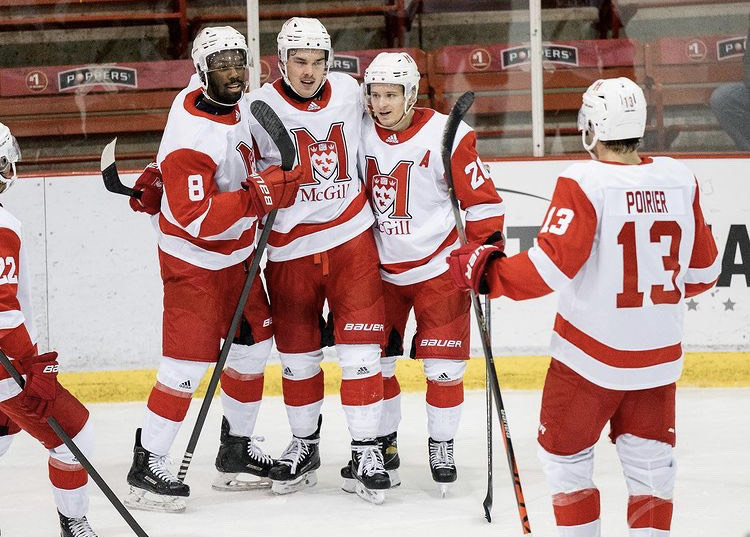
McGill men’s hockey outplayed in loss to UQTR

The McGill men’s hockey team (1–⁠3) continued their OUA season on Nov. 14 against the Université de Québec à Trois-Rivières (3–⁠1), dropping a 4-1 affair. 

The UQTR Patriotes entered McConnell Arena on a two-game win streak, and continued their hot start to the season on Saturday night against the McGill Redbirds.

McGill was able to seize momentum early, drawing a slashing penalty on UQTR forward Vincent Milot-Ouellet just a few minutes into the first frame. However, the powerplay unit was unable to convert the timely opportunity. Unfortunately, this has been a recurring pattern for the Redbirds early in the season, as McGill has only scored on one out of 15 powerplays this year, ranking close to last in the OUA.

Just minutes after the unsuccessful power play, McGill took a penalty of their own. The Redbirds’ penalty kill unit held strong again, stopping the UQTR man advantage. McGill’s unit is the best in the OUA currently, having successfully shut out 18 of the last 19 opponent power plays. 

Despite this, the Patriotes would begin the scoring late in the first period, as UQTR forward Simon Lafrance buried a shot past Redbird netminder Emanuel Vella to take a 1-0 lead. 

This late-period momentum bolstered the Patriotes going into the second period, as just five minutes into the frame, UQTR defenceman Justin Bergeron capitalized on a McGill turnover, scoring a tap-in and doubling the Patriotes’ lead.

Defenceman Jacob Golden, a rookie from Toronto who most recently played for the OHL’s London Knights, believed the team played well during the crucial few minutes before the two UQTR goals but was unable to convert chances compared to UQTR.

“They got a good break on the first goal as we had a bit of breakdown that they capitalized on,” Golden said. “They are a good team so you don’t want to be giving them a lead. Even when we were down 2-0 we had sustained pressure in their zone, but we could just not find the back of the net.”

Late in the period, McGill had an opportunity to cut the lead in half following a UQTR penalty. On the ensuing power play, the Redbirds created multiple scoring chances, notably a shot from the high slot that looked like it went in, but did not cross the goalline according to the referee. 

Despite not scoring on the man advantage, the momentum seemed to have finally swung in the home team’s favour. Any comeback attempt was quickly squashed by a Redbird penalty with just five seconds left in the second, sending UQTR to the power play again to start the third period.

Although the final frame did not present a miraculous comeback from the Redbirds, the home crowd had something to cheer for. With six minutes left and UQTR up 3-0, McGill rookie Eric Uba scored amongst a scrum in front of the net, putting the lone McGill goal of the night on the board. 

The Redbirds started the season strong with a  3-2 win against Concordia, but have dropped their last three contests to OUA opponents Ottawa, Carleton, and UQTR. The team has two important home-and-away matchups against Concordia and Ottawa at the end of November.

Looking ahead to the upcoming stretch, Golden highlighted the group’s perseverance and the return of some key players, including Redbirds captain Samuel Tremblay.

The next few games are really important,” Golden said. “We are definitely looking to get back in the win column next weekend. I think if we maintain our compete level and clean up some small details of our game, we will have success. Getting back some key players from injury, such as our captain, Sam, will definitely help.” 

McGill hosts rival Concordia this Friday, Nov. 19, meeting for the first time since a thrilling shootout finish at Concordia in the OUA season opener.

Moment of the Game:

First-year defenceman Gabriel Villeneuve blocked two shots on a McGill penalty kill to keep the Redbirds in the game.

Quotable:

“The last few games we have been a little snake bitten. I think despite the result, our team will use the positive aspects of the performance to build off for the upcoming weekend” – Second-year defenceman Jacob Golden 

Stat Corner:

The Redbirds killed all four UQTR power plays, increasing their OUA leading penalty kill efficiency to 94.7 per cent. 

Editorial, Opinion

SSMU’s private failings should be public

On Nov. 8, The McGill Daily published an article detailing their efforts to investigate Students’ Society of McGill University (SSMU) president Darshan Daryanani’s ongoing absence. After reaching out to several councillors and staff as part of their investigation, Daily journalists received a hostile email from vice-president (VP) Internal Sarah Paulin, asking them to cease contacting SSMU employees because they have “no implications on campus.” Soon after this interaction, the Daily obtained a copy of an email Paulin had sent to all casual and permanent SSMU employees, which read, “You cannot and must not speak to campus media.” At the next SSMU Legislative Council, Paulin apologized and clarified the existing policies that govern SSMU employee media relations. Articles 24 and 25 of the SSMU Casual Staff Employee Manual state that regular and casual staff members are responsible for maintaining confidentiality and must direct all media inquiries to the general manager and the president—both of whom have been absent from their positions this year. This vague policy puts employees at risk, leaving them with less autonomy and few channels to seek accountability. 

The employee manual may be binding, but its content—specifically article 25—is unclear, and has not been strictly enforced up until now. In the past, SSMU employees, including casual staff, regularly spoke to media about the important work they were doing in their portfolios. Granted, such a policy is necessary to some extent: Some of the union’s affairs warrant confidentiality and since SSMU employees are not elected, they do not necessarily represent the union’s views. However, employees should have the prerogative to discuss their portfolios, which directly impact the student body. 

SSMU employees may not represent the student body in the same way executives do, but their work and well-being matters. Many SSMU employees contribute to important projects in portfolios such as  Black Affairs, Indigenous Affairs, and mental health. Some also work for SSMU-owned businesses like Gerts Bar and Café.  Suggesting SSMU employees have no implications on campus diminishes their efforts.

The consequences of the media blanket ban are ever the more severe when it comes to workplace issues, such as sexual harassment or inappropriate behaviour. But going to the media to discuss internal issues is rarely an employee’s first resort. SSMU employees could find themselves in a toxic work dynamic where a supervisor—the person they are supposed to turn to report workplace harassment, for example—is their abuser. This stipulation is far too broad, especially without a whistleblower policy. Even if no problems are occurring, having such a policy in place facilitates a healthy workplace. 

SSMU’s silencing of their employees’ interactions with campus media removes an important channel of accountability. The student body needs to blow the whistle on SSMU becoming an increasingly private organization. If SSMU wants to commit to transparent reform, they must amend the confidentiality policy to be more explicit in scope, and recognize that their employees’ expertise is valuable to the student body.

Off the Board, Opinion

Maybe I was always playing myself

In elementary school, I spent most of my Saturdays attending Young People’s Concerts at the New York Philharmonic. My memories of those days are scattered and somewhat fleeting—I was far more enthralled by post-concert trips for hotdogs at Grey’s Papaya and Revson Fountain’s extravagant water jets than the actual performances. Many memories from those trips were even tainted with disdain because, in order to attend, my brother and I had to miss countless birthday parties.  

As a kid, I always kicked my brother in the shin when he called me a “fake fan” of classical music. I tolerated the genre, but I was unwilling to sit calmly through the entirety of the concerts—listening was something I insisted on doing in my own way. So although it would be wrong to say that I was passionate about classical music, it still became an unmistakably important aspect of my upbringing.

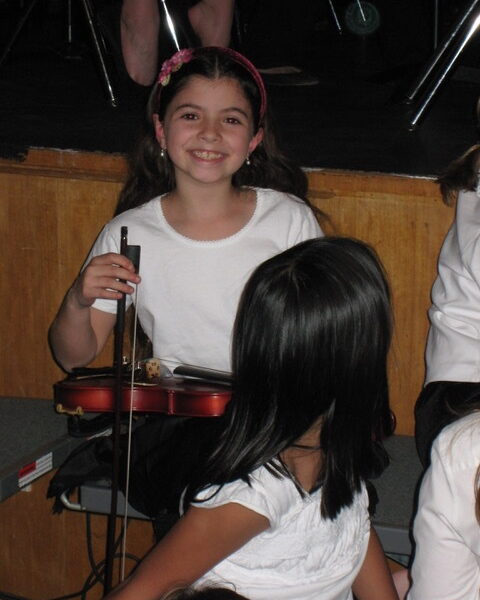
I started playing the violin in school in the third grade, and I kept up with it all through high school. The struggles of learning a string instrument were not necessarily unique to me, but I had a particularly difficult time emotionally dedicating myself to the process. I hated practicing requirements with a burning passion—practicing made sense for more difficult pieces, but I resented being forced to play pieces to a numb redundancy just because of a course requirement. 

In middle school, any genuine enthusiasm I had for playing the violin slowly dropped under the pressures of class. I came to associate the actual experience of playing with stress and frustration. It got so bad that I resorted to listening to music instead of working on homework during work periods—it allowed me to start the latter at home and delay having to practice my violin. When playing with the district high school orchestra, I once tripped and dropped my music binder and violin, nearly breaking both and thoroughly embarrassing myself in front of a very tall and very cute high school senior. Such moments of pubescent awkwardness overshadowed any other feelings I had about my instrument.

This internal struggle only got harder by the time I was playing in my high school’s orchestra. The course acted as the ultimate reprieve from the stress of my other classes, but also created additional burdens: The decreasing quality of our performances and the exasperation of my music teacher brought a new sense of anxiety and shame to the experience. I was often excited by the more contemporary arrangements we would play, but this would lead to awful feeling associations because of different butcherings of the songs in rehearsal. Most times, it felt like school orchestras and classical music were things I survived rather than things I loved.

I have not picked up a violin since my senior year of high school. Like many other aspects of my hometown, I intended to leave them behind when I went off to university. My attempts to repress the memories, however, were not as successful as I hoped. I could not escape the stressful memories of my orchestral past, but upon reflection my feelings regarding them grew far more complex.

Hearing certain clips of music often reminds me of times when I played them in school. But thinking of them now fills me with jaded nostalgia—there’s no internal re-writing of the past, as it still does remind me of my misery. Somehow, I have come to look back on that misery fondly, and I look forward to the times that music can transport me back to a different time in my life. Maybe it is morbid, maybe it is some form of self-inflicted schadenfreude, but much like the hot dogs of my childhood, it is not going anywhere.

News, SSMU

Gerts Café celebrates opening with complimentary double shots of espresso

Gerts Café, the daytime operation of Gerts Campus Bar, officially opened its doors to the McGill community on Nov. 8. The official launch comes after the cafe had to postpone its opening due to equipment shipping delays. 

Tre Mansdoerfer, BEng’19, originally proposed a cafe model for Gerts during his term as Students’ Society of McGill University (SSMU) president in 2018-2019, and continued working on the proposal with Jemark Earle, 2020-2021 SSMU president, to eventually pass the motion on Dec. 3, 2020.   

“A student union building should be a building where every room has some sort of utility, both during the day and at night,” Mansdoerfer said in an interview with  The McGill Tribune. “Gerts bar is the biggest […] selling point of the building, [so] it should [function] starting at 10 a.m.”

U1 Arts student Ella Brown, who enjoyed a free espresso courtesy of the cafe’s launch event, was impressed with the quality of the coffee.She looks forward to having Gerts Café as an alternative to libraries for studying. 

“It seems nicer to study at Gerts Café than working at McLennan or the other libraries,” Brown said. “It has an ambiance that is different from ordinary coffee shops, and the coffee was definitely better at Gerts than at the other cafes around campus that I have tried.”

Kittel Coffee, a Montreal-based specialty coffee roastery, has partnered with Gerts Café as their exclusive supplier. For Nadine Pelaez, the manager of Gerts Café and Bar, a local coffee roastery was key when choosing a supplier, coming second only to quality. Another reason Pelaez chose Kittel was because of its focus on sustainability and transparency. 

“[The] transparency report on their website is a big part of the appeal,” Pelaez said in an interview with The McGill Tribune. “The fact that they had [one] and it was public on their website, and also what was in it […], was part of why I ended up choosing Kittel.”

Mario Bouthat, a sales representative at Kittel and barista-trainer at Gerts, also emphasized the importance of sustainability for Kittel.  

“We negotiate the prices directly with the farmers, [and, with our packaging], we try to minimize the impact on the environment,” Bouthat said. “When you are at least making [the process] as best as you can, you are honoring the usage of resources [and] the countries of origin.”

Marco Pizarro, U2 Arts, echoed Brown’s enthusiasm about having a cafe on campus, but hopes that Gerts Cafe extends its hours to past 12 p.m. 

“During the winter […] it would be better to have coffee and other hot drinks at Gerts in the afternoon,” Pizarro said. “Especially for people who don’t drink alcohol, it would be a shame not to have non-alcoholic options and [to not be able to] enjoy Gerts later in the day.” 

Pelaez assured that there will eventually be some overlap in the hours Gerts’ Café and Bar are open. On Nov. 17, Gerts Café announced it would extend its hours to open at 8 a.m. and close at 3 p.m.

“Right now, my starting line is at six baristas,” Pelaez said. “[But] slowly, as I hire more people, I can expand the [cafe’s] hours.” 

On Nov. 11, SSMU announced in an email that Gerts Student Bar and Cafe would be temporarily closed on Nov. 11 and 12 due to a positive case of COVID-19. SSMU and the Gerts management team informed students that the formal contact tracing process had been initiated to alert those present at both Gerts Bar or Gerts Café on Nov. 8 of the exposure. 

News, SSMU

All items in SSMU Fall 2021 referendum pass after initial technical difficulties

McGill students were invited to vote in the Students’ Society of McGill University (SSMU) Fall 2021 referendum between Nov. 9 to Nov. 15. Voting was initially slated to start Nov. 8 and end Nov. 12, but after technical problems and content errors on certain questions, the original ballot was cancelled and the voting period re-opened with a new ballot on Nov. 9. Referendum results were published just after 5 p.m. Nov. 15 after the polls closed—all eight questions passed.

The SSMU runs a referendum once per semester; the fall referendum takes place early November and the winter one, early March. This semester’s vote was mostly made up of fee referenda—questions involving the addition, removal, preservation, or increase of student fees for certain clubs. The ballot also included a constitutional amendment and a new policy proposal—The McGill Student Union Democratization Initiative (MSUDI). 

MSUDI aims to make the various student unions at McGill more democratic. It proposes to do so by creating small general assemblies for the different student unions that would facilitate a form of non-hierarchical direct democracy—including eliminating elected representatives from student unions. MSUDI also proposes that delegates be elected from the smaller assemblies to represent various student interests at the larger union meetings. 

In an interview with The McGill Tribune, Bryan Buraga, U4 Arts & Science, explained that the passing of the MSUDI will provide funding for the initiative in its pursuit of democratizing student and faculty unions on campus like the Arts Undergraduate Society and the Science Undergraduate Society.

“Our student body has spoken,” Buraga said “Things need to change in our student unions […] We are looking forward to working with our fellow students to build solidarity between one another and put the power of student unions back into [student] hands.”

Campus radio station CKUT and the McGill branch of the Quebec Public Interest Research Group (QPIRG) both ran existence referenda. The referenda will determine whether those organizations will be able to continue operating because if the ballot question for their respective fees failed, they would no longer be able to deliver services in the same capacity.

The referendum passed increases to the Nightline Service fee, the Safety Network fee, and approved the creation of a Queer Equity Support fee and the opt-outable MUSTBUS fee—a bus service that would provide more affordable transport to major cities like Boston, Toronto, and Ottawa. The referendum also passed a constitutional amendment to add a seat to the SSMU Legislative Council for an Outaouais campus representative. 

Specific fees often fund more than one student organization. For example, the SSMU Referral Services fee will go toward both Eating Disorder Resources Support Centre (EDRSC) and Queer McGill (QM). 

“QM is beyond pleased with the referendum results, both the increase of the Referral Services fee and the creation of the Queer Equity Support fee,” wrote Brooklyn Frizzle, U3 Medicine and Health Sciences and administrative coordinator of Queer McGill. “These new and increased fees will truly go a long way in supporting an empowered Queer community at McGill.”

For organizations like CKUT on the other hand, a “no” vote would have resulted in CKUT significantly reducing their operations—and likely losing their frequency modulation license (FM).

“Our FM license is dependent on us being a campus community radio station,” said Tia Kattler, U3 Arts and engagement coordinator at CKUT in an interview with the Tribune before referendum results were published. “[Student fees] provide such a significant portion of our spending, we would likely have to cut down on staff as well, and it could very well mean the end of CKUT as it’s known.”

Emma Gurney, U2 Management and QPIRG board member, also worried that losing their funding would take away services the group provides to the McGill community. She was relieved after having read the referendum results. 

“We are responsible and accountable to a larger community,” Gurney said. “I am happy that QPIRG gets to continue existing.”

A previous version of this article incorrectly stated that Queer McGill was running an existence referendum. In fact, they were not. The Referral Services fee change would potentially impact funding, not Queer McGill’s existence. The Tribune regrets this error.

Commentary, Opinion

Restrictions for the unvaccinated are not oppressive

As of Nov. 14, 76.46 per cent of Quebec’s population is fully vaccinated. Even before the first day of vaccine administration in Canada mid-December 2020, COVID-19 vaccines have been shrouded in doubt and conspiracy. Anti-vaccination (anti-vaxx) protests have plagued the streets of Montreal almost every weekend for a year, spurred by reasons ranging from protesting vaccine mandates to fighting the implementation of vaccine passports. Recently, protestors worldwide have adopted a new strategy––making claims that being unvaccinated is akin to oppression experienced by racial and religious minorities. Individuals who participate in this rhetoric must understand that their decision to remain unvaccinated, no matter the reason behind it, cannot be analogized to the experiences of those whose fundamental and unchangeable positionalities result in experiences of oppression.  

One of the most popular arguments against Quebec’s vaccine passport is that it inhibits unvaccinated people from partaking in everyday activities based solely on their decision to remain unvaccinated. This is viewed by some as oppressive––so much so that it has even been compared to living under the Soviet Union, Communist East Germany, or apartheid South Africa. Needless to say, this is not the case. These measures are in place to prioritize public safety; to protect those most vulnerable to COVID-19 as well as those unable to get vaccinated, like children under 12. The prioritization of communal health over individual, unfounded skepticism is not a marker of an oppressive state but instead integral to a fair society. It shows that the state is willing to take the necessary steps to get through this pandemic. 

Above all, it is both offensive and completely ignorant to claim experiences that result from choosing to remain unvaccinated are similar to those of racialized and religious minorities.  Anti-vaxxers seem to be grasping at straws in an effort to victimize themselves. It is only those who have been privileged their entire lives who would place their mistrust of science above the lives of those around them. Some anti-vaxxers have been seen sporting Stars of David, attempting to equate their experience of being unvaccinated to the oppression that Jewish people faced during the Holocaust. This behaviour is horrifying and unacceptable—if being told to get a life-saving vaccine is the most traumatic thing someone has faced, that is an extremely privileged spot to be in. If this is a method of gaining empathy from marginalized communities, it is an uninformed and ineffective one. 

Claims of unfair treatment for being barred from entering restaurants also blatantly disregards the racism that is embedded in anti-vaxx movements. The first protests against vaccinations arose because inoculations were originally part of non-western cultures across China, the Middle East, and North Africa. When an enslaved African man, Onesimus, taught a minister the method, it was met with public outcry—fueled by racist tropes—that the practice must be dangerous. Now, anti-vaxx movements target minority communities who already have justified mistrust of healthcare systems in order to spread misinformation. For example, Children’s Health Defense, an anti-vaccine organization, created a film against the COVID-19 vaccine that was aimed squarely at Black communities, drawing direct links between the vaccine and real healthcare atrocities, such as the eugenics movement. This pointed misinformation only exacerbates the fact that minority communities are already disproportionately affected by COVID-19.

Preying on minority communities and trying to take advantage of the systemic abuses they have faced in medical spaces is representative of the shameless nature of anti-vaxx movements. Tactics like comparisons to genocides and experiences of religious and racial oppression are a corruption of those real experiences. So while choosing to forgo the COVID-19 vaccine is a personal choice, it does not reign over public safety. Despite the controversy it may cause, public health is more important than one person’s selfish refusal to care for others.

Sports

From the gym to the studio: Athletes who gave music a go

Whether it be a washed-up child actor or a TikTok star on the come-up, many celebrities try to break into the music industry at some point in their career. Given the historical connection between music and the world of sports, it is unsurprising that several star athletes are also taking their talents to the studio. The following are the Tribune’s picks for the best and worst athletes-turned-musicians. 

(sportskeeda.com)

Dwayne “The Rock” Johnson on Tech N9ne’s Faceoff

As the highest-paid male actor for three years running, Dwayne “The Rock” Johnson has ascended far beyond his relatively humble roots in WWE wrestling. While his talents on the big screen are undeniable, his recent foray into the music industry on Tech N9ne’s “Face Off” has some raising their eyebrows, and many others rejoicing on TikTok. His feature in “You’re Welcome” from Moana was heartfelt and catchy, but the Rock’s most recent verse is so over the top in its embodiment of “hustle culture” that it’s been satirized en masse. While this video says a lot about Johnson as a person and businessman, the most obvious takeaway is his position as the most marketable man on the planet. His blatant shill of “Mana” or Teramana—his own tequila brand—is just a sign of things to come. With talk of a 2024 presidential campaign, it’s hard to imagine the new heights Johnson could achieve. In the meantime, we’ll stay hungry, waiting to devour more of Johnson’s music.

(USA Today)

Caroline Wozniacki — Bestie, why? 

In 2012, the Danish tennis player Caroline Wozniacki was just coming off the peak of her professional career, having been seeded number one in the world for the majority of 2010 and 2011. This was also the year she recorded and released “Oxygen, a song for a charity effort that can only be described as an assault on the ears. The video, which I implore readers to watch, features a stock-still Wozniacki lip syncing in a studio, an incomprehensible romantic plotline, and of course, tons of tennis balls—all delivered in eye-searing 240-pixel quality. The song makes a swing at Britney, but lands on robotic. (If it weren’t already bad enough, the bridge gives us the cringeworthy line, “Boy, you’re my matchpoint”.) Courtside, Wozniacki went on to participate in 55 finals, winning 30 singles titles in the process. She will certainly be remembered for her fantastic tennis-playing, and luckily, not for her foray into music. 

(Puck Junk)

Guy Lafleur’s disco career

The beloved Canadiens hockey player is acclaimed as being the Habs’ top scorer of all time with 518 goals and 728 assists, and for being the first player in NHL history to score 50 goals in six consecutive seasons. He is, however, less known for his 1970s disco album, released as an LP with selections in both English and French to please his loyal Quebecois fans. The record was aptly named Lafleur! and was sold along with an instructional booklet that detailed hockey basics, like how to skate, score, and check. Every song, English or French, relates to the game of hockey in some way, and is a certified disco banger. Though he never followed this album up, Lafleur is one of the few entries on this list that excelled both on the rink and in the studio. And with restrictions on dancing in clubs and bars easing this week in Quebec, there has never been a better time to harken back to the good old days, when the disco was hot and the Canadiens were actually good. 

Yannick Noah, French superstar

Yannick Noah is famous throughout France for his incredible tennis career, winning at Roland Garros in 1983 and becoming the French tennis captain in 1991, which led him to win the Davis Cup in 1996 and 1997. However, the tennis player is just as well known for his successful music career. Unlike the others on this list, his music is nationally appreciated for its positive and uplifting messages: His 2006 hit single “Aux arbres citoyens” is about environmentalism, and some of his music royalties go towards related charities such as “Les enfants de la terre” or “Fête le mur”. His 11 albums are a reflection of his French and Cameroonian heritage, which he says has inspired his music. Noah is one of the few artists who has successfully managed to transition from a sports career to a music career, and the Tribune recommends “Destination Ailleurs” to anyone looking for a fun, catchy song to practice their French.

(LA Times)

Kobe Bryant with K.O.B.E

Just like his teammate Shaquille O’Neal—albeit with less success—the Lakers star gave rap a try during his career, signing a record deal with Sony in 1999. Before making his debut as a solo artist, Bryant was featured on a variety of singles, and even collaborated with Destiny’s Child on their hit song “Say My Name”. However, Kobe Bryant’s debut album never saw the light of day after the release of his first single “K.O.B.E”, featuring model Tyra Banks. The song sounds exactly like what one would imagine a Tyra Banks feature to be. She sings the chorus, chanting about how much she loves Bryant: “K-O-B-E / I L-O-V-E you.” Bryant raps to a funky beat that nonetheless does not match the overall tone of the song. For Bryant’s fans, however, the song is full of nostalgia: During the filming of the music video, Kobe Bryant met his future wife, Vanessa Bryant. The song encapsulates the spirit and drive of early 2000s Kobe, who managed to capture the hearts of millions of fans all over the world.

Art, Arts & Entertainment

MAI’s new exhibit ‘Making Revolution’ dissects the anatomy of revolutions

On Nov. 11, the vernissage for Making Revolution: Collective Histories, Desired Futures, curated by Farah Atoui and Viviane Saglier, took place at the Montréal Arts, Interculturels (MAI). This thought-provoking and heartfelt display of short films showcases works from a selection of artists, exploring revolutions and conflicts in Egypt, Lebanon, Palestine, and Iran. 

Raed and Rania Rafei’s film Prologue sets the stage for Making Revolution, documenting the protest of young political activists at the American University of Beirut (AUB) just before Lebanon’s civil war in 1974. Concerned that their Arab heritage was not being recognized and opposing a 10 per cent increase in tuition, the students organized a protest that lasted 41 days until it was dispersed by police. Raed & Rania Rafei’s 49-minute documentary investigates revolutionary student mobilization, depicting the rise and driving forces of change through the perspective of young activists. 

Prayer of Fear is a short video created by Mosireen, a volunteer media activist group that was initially founded to share videos about the 2011 Egyptian revolution. The film features a reading of Mahmoud Ezzat’s poem “Salat al khuf” (“The Prayer of Fear”). Ezzat’s words were inspired by the deaths of hundreds of peaceful protesters at the Rabaa massacre in 2013. Mosireen’s film reveals the severity of devastation experienced during the tragedy—an experience the group described as “truly paralyzing. The worst massacre in modern history […] committed in broad daylight, in Cairo, live on television.” 

At those terrifying frontiers where the existence and disappearance of people fade into each other is a multimedia piece created by film-makers Basel Abbas & Ruanne Abou-Rahme. Inspired by Edward Said’s After the Last Sky, the pair reconstructed Said’s words into a new script—the reworked text reflects on the conflict caused by the complexity of socially constructed nationality and citizenship in Gaza. The artists use moving pictures, written text, and music to convey imagery of the “March of Return” in the Gaza strip. 

Mohammad Shawky Hassan, a video artist and filmmaker who works in both Berlin and Cairo, created And on a Different Note, a production that combines video footage from New York and Cairo. This motion picture reveals human efforts of escapism, to find peace in the privacy of the home, despite the clamorous commotion of the outside world. As Hassan describes, “time and place stand on parallel lines, refuting the coordinates of existence.” And on a Different Note was selected by the Museum of Modern Art in New York City to be displayed in 2016 as a component of a permanent collection.  

Notes on Seeing Double by Sanaz Sohrabi coalesces a photo of a crowd gathering to see Ayatollah Khomeini’s return to Tehran in 1979 after years of exile with a picture of Rembrandt Harmenszoon van Rijn’s painting The Anatomy Lessons of Dr. Nicolaes Tulp from 1632. Sobhari’s film flips through photographs of cut-out images that depict crowds of Khomeini’s supporters, which she holds in front of Rembrandt’s painting. In so doing, she shifts the viewer’s attention from Khomeini to a cadaver in the Amsterdam anatomical theatre, juxtaposition historical images with modern ones. Centred on the Persian expression “temsaal,” meaning to describe or to shape, the exhibit moulds the original photos of Khomeini’s return into an image of crowds welcoming the death of revolutionary ideals, or, perhaps the demise of this free state.

Making Revolutions continues until December 11, 2021, at the Montréal, Arts Interculturels (3680, rue Jeanne-Mance, suite 103 Montréal). Book in advance. Free admission.

Arts & Entertainment, Pop Rhetoric

Astroworld tragedy renews debate on the safety of mosh pits

The Travis Scott Astroworld Festival tragedy, which left 10 concertgoers dead and hundreds injured, has renewed discussions on the question of violence at music events, leaving many wondering if such a tragedy would have occurred without the influence of mosh pit culture.  

Moshing involves pushing and slamming—or sometimes just vigorously dancing with—fellow concertgoers in a space near the stage called the “pit.” Emerging in the late 1980s from the American hardcore punk scene, moshing has since transcended music genres. May it be at a rock or a hip hop concert, a pit of people moving as a large sweaty mass can often be spotted against the stage. 

Criticism of moshing has been around for decades. Mosh pits are often considered hazardous, both to the concertgoers who can get injured and to the concert producers who can get sued for permitting them. In 2014, the punk-rock festival Warped Tour banned moshing from their events, with a banner that read, “You Mosh, You Crowd Surf, You Get Hurt, We Get Sued, No More Warped Tour.” After two concert deaths due to moshing—one in 1996 in Dublin and one in 2007 in Vancouver—Billy Corgan, the lead singer of American rock band The Smashing Pumpkins, outright banned moshing and any other violence at his shows. 

Many fans of moshing, however, disagree with the idea that the practice is too dangerous. For many, the experience of communally moving against a sway of fellow fans is a cathartic experience, where the adrenaline of a high-stress situation mixes with the oxytocin of close human contact.

“Mosh pits are some of the places I’ve felt the most alive,” said Montreal-born concertgoer Fanny Blanchet in an interview with The McGill Tribune. “There’s really nothing like being in a crowd of bodies moving together and against each other.”

In Montrealer Zacharie Masseau’s experience, there is a certain etiquette for mosh pit participants that prioritizes the safety of those both in and out of the pit. 

“With moshing, there are some kind of unwritten rules,” said Masseau in an interview with the Tribune. “Like if you see someone that doesn’t seem too down for it, you can help them out of the pit. And there are certain responsibilities too, that come with where you are in the pit. The people who stand in between the pit and the crowd have the moral obligation to make sure no one outside the pit gets hurt.”

For Masseau, both the audience and the performers must take on the responsibility of making sure the pit remains safe, as the audience are the ones physically creating the flow and dynamic of the pit, and the performers have the authority to step in if they notice something wrong in their audience. 

“Once, in a NOBRO concert in Montreal, someone fell down in the mosh pit and everyone stopped moving until the person was safe,” Masseau said. “The mosh pit went from raging to communal aid in a matter of seconds.”

While moshing culture can be risky for concertgoers, there are a host of other factors that can create unsafe concert environments, from a lack of safety measures and restrictions in concert venues to a lack of diligence from artists and producers. Performers who encourage violence in the audience from the security of their stage must understand the risk they are putting their fans in. At its core, the essence of moshing is not violence, but a sense of community and belonging.

Travis Scott has a history of encouraging rowdiness in his audience rather than pacifying it, and clearly failed to act in the best interest of those who attended his concert. Mosh pits, as a sort of extreme sport for concertgoers, are definitely not for everyone, and  fans must always understand the physical risks of moshing before joining the pit. But when done responsibly, they can be a truly joyful experience. Rather than leading to further bans on same moshing, the rapper’s fatal failure should act as a lesson for future performers. 

Student Life

Demystifying professor office hours

Attending office hours can be daunting, especially if you are a first-year student. Not knowing what to expect or what to ask, students are often intimidated by the idea of talking to a professor on their own. 

Olivier Bergeron-Boutin, a political Science course lecturer, remembers feeling intimidated by professors when he was a student at McGill.

“Professors seemed from another world,” Bergeron-Boutin said in an interview with The McGill Tribune. “They were so knowledgeable that they seemed unapproachable. I felt out of place.”

Despite their seemingly intimidating nature, office hours exist to allow students to meet with the professors and talk about any doubts or concerns that they may have regarding the course material, and are there for students to use to their advantage. Derek Nystrom, a professor in the English department, recognizes the fear of appearing unknowledgeable to a professor even in his daughter, who is in CEGEP. 

“She said that she was scared to talk to a professor about managing the material for fear of getting it wrong and feeling stupid,” Nystrom said. “I have encouraged her to attend office hours since it is a great way to get to know professors and for them to get to know you.” 

These weekly opportunities to meet with professors provide a space for students to develop and deepen their ideas. Athena Paramithiotis, U2 Arts, has made attending office hours a part of her routine. 

“My advice is to go to office hours as soon as you have questions about the class content. I find them to be really helpful,” Paramithiotis explained. “You can talk about the course content, clarify some things, or discuss it in greater depth. You can also ask for advice with an assignment or to go over your past tests and look over the mistakes.”

Most students might assume that office hours are limited to discussing material related to the course. Yet that is not the case. Conversations can range from exploring an idea mentioned during the lectures more deeply, to the professor’s research projects, to a half-formed thought e that may not make sense in your head. Both Professor Nystrom and Bergeron-Boutin said that some of the best conversations with students have been improvised.

Besides enabling students to better understand course material, attending office hours allows students to get to know professors on an individual basis. In classes with hundreds of people, it can be difficult to stand out—especially when many courses are still conducted online.  

“This ends up being important later if a student decides to ask for a letter of recommendation,” Nystrom said. “It is easier for a professor to remember you if you attended office hours than if you just sat with 200 other students in a class taking notes.”

Since students lead the conversation, it’s helpful to prepare topics of discussion or questions. For those who are still wary of entering into that one-on-one meeting, Nystrom advises students to send an email in advance describing the specific topic they wish to discuss. 

“[Emailing in advance] allows the professor to have an idea of what you will bring up and thus have the conversation flow,” Nystrom said.

At the end of the day, professors are just people who are there to help and guide you through your studies—they are not going to scrutinize your misconceptions and think less of you because you don’t remember the complexities of a political theory or haven’t mastered organic chemistry. No professor expects you to come into office hours with a solid knowledge of the material covered in lectures––that’s why there are office hours. The purpose of your time as an undergrad is to learn and to make mistakes. So leave your premonitions at home and walk into your professor’s office hours with your head held high.  

Read the latest issue

Read the latest issue