

Latest News

Commentary, Opinion

Campus conversations: Recovery

Making peace with grey

Ella Fitzhugh, News Editor 

**Content warning: Mentions of mental illness, eating disorders**

I’ve never been secretive about my love for psychotherapy. Admittedly, I have weeks where I dread the session—fears about my perceived lack of progress in treatment flood my mind. Other times, however, I desperately await my hour-long, uninhibited ramble. Even after several years in therapy, I am still unlearning the fallacy that progress with mental health is linear.

Clearly, the pandemic has exacerbated mental illnesses, especially among university students. Indeed, the remote landscape hit me hard. A sneaky eating disorder crept up, devoured me, and kept me suffering in isolated silence. Those who have endured the painstaking, yet beautiful wonders of eating disorder treatment, will know that the word “recovery” is tossed around so much that you start to forget it can be used in other contexts too. Throughout my outpatient treatment, I longed for a perfect recovery from mental illness, which I envisioned as beautiful rolling hills where no struggle could ever reach me again. But therapists are not just supportive, they are also there to feed you life’s truths: Recovery is nonlinear. A healthy mind does not entirely evade every semblance of sadness nor eating disordered-thinking; instead, a healthy mind learns which internal voices to amplify. Through treatment, I have learned to distinguish my “healthy” voice, which knows the truths about recovery, from my “eating disordered” voice, which sees recovery as a far away utopia, the one I think I can reach by simply checking the boxes in a methodical step-by-step process. 

I think we can all benefit from knowing that a healthy, recovered mind is not a perfect one. To me, recovery means accepting ambiguity. There will always be a negative internal narrative dwelling in a corner of your mind, I realized I was capable of turning down the volume to make space for my louder, and more honest, voice. Therapists are always telling me to simply observe the world around me, and I urge you to do so as well. Know that things are not black-and-white, and see that, although the thoughts of hopelessness appear loud now, recovery has been a voice within you all along. It just starts with listening. 

COVID-19 recovery requires proper institutional support 

Kennedy McKee-Braide, Managing Editor 

As early as a few weeks into the pandemic back in 2020, commentators began to talk about how this universally traumatic experience may bring positive change and progress to the post-COVID-19 world. Some pointed to the natural world, noticing that nature seemed to be healing with fewer people out and about to damage the planet. Others hoped the pandemic would lead to lasting political changes, from a permanent universal basic income (UBI) to better support for unhoused people. 

Of course, the pandemic is not yet over––new variants, ongoing vaccine inequity, and vaccine hesitancy suggest it may be quite some time before the world makes it out the other side. But nearly two years and several waves later, it is worth asking ourselves—and our governments—whether we have really learned anything from this seemingly never-ending nightmare. 

One thing the pandemic has made clear is the power of mutual aid and solidarity. Across North America, activists and community members have come together to support those experiencing financial hardship as a result of the pandemic. One Montreal-based Facebook group, Montréal – Tio’tia:ke – Entraide – Mutual Aid, was first launched in March 2020. With over 16,500 members still going strong today, the group is just one example of the fact that mutual aid will remain a major part of many’s lives. 

Where communities have grown stronger and even more supportive than before, most governments have failed to show meaningful political will to account for the many cracks in the system that the pandemic both revealed and exacerbated. For example, despite moving quickly to roll out the Canada Emergency Response Benefit (CERB), a needed financial support program offering lump sum payment for those living in Canada experiencing financial hardship, the Canadian Revenue Agency clawed back money from ordinary working-class people who made mistakes on their applications due to vague instructions. Additionally, despite the fact that the Liberal Party of Canada adopted UBI as a policy objective in their platform, the federal government has shown little intention to pursue the plan in the near future. The pandemic plunged unhoused people into further precarity—now subject to increased police hostility and inadequate shelter in this time of crisis—and Valerie Plante’s administration did not learn from the experience. Take, for example, their decision to cease funding for the Raphaël André memorial tent after December. 

The burden of post-COVID recovery must not be placed squarely on the shoulders of average citizens. Going forward, governments have a responsibility to respond to citizen pressure and calls for more comprehensive social support, for the good of us all. 

COVID-19 state of mind

Madison Edward-Wright, News Editor

Mental health was something I struggled with before the COVID-19 pandemic. My depression and anxiety would play tricks on my mind, convincing me that social isolation would spare me from the judgement of others and that obsessive exercising would rid me of all my pent-up stress. I was lucky, however, to be surrounded by friends and family who supported me. The daily routine of waking up and going to school was an escape that gave me a reason to get out of bed and made me feel like the work I did throughout the day had purpose. 

After putting in the work with my therapist and leaning on the people around me, I was able to pull myself out of my funk and live like the young, dumb, goofy adult that I learned I am. While the hangovers hurt my head, the time spent with friends did wonders for my mental well-being. When the pandemic hit, however, I was sent right back to the place I was in three years ago. I know I was not the only one to experience this. Many of my friends, work colleagues, and fellow students I met on Zoom told me they were struggling to stay motivated to accomplish simple, daily tasks that we used to do without a second thought. 

Many of us struggled with the long stretches of isolation last year––what was once self-induced became forced. I retreated into my room where I let my loneliness engulf me. I will not lie, it was a tough time. What helped me through the past 20 months of the pandemic, though, was knowing that while I might have been alone physically, mentally, I knew so many people were going through the same thing. 

The return to in-person life has been a much needed reprieve from the dreariness of COVID-19. Walking alongside the hundreds of students on campus, running into old friends, meeting new ones, and participating in student life has helped me get back to a healthy mental space. I laugh and smile a lot more in class than I did when attending online school, because interacting with other students, face to face, who are my age, reminds me how much fun life can be. While my mental health has not fully recovered from COVID-19, I feel like I am on the right path; reconnecting with the world has made all the difference.

Science & Technology

Household energy efficiency segregated along racial lines in the U.S., study finds

As the climate crisis worsens, reducing carbon emissions has become one of the most pressing priorities to mitigate its effects. In the United States in 2020, the residential sector was responsible for approximately 20 per cent of total carbon emissions from energy consumption. Targeted housing policies that increase residential energy efficiency, such as retrofitting, are therefore an important step to reduce overall carbon emissions.  

Researchers had already observed a positive association between income levels and carbon emissions. However, no study had looked at the relationship between race and carbon emissions in residential energy consumption. To address this knowledge gap, Benjamin Goldstein, an assistant professor in McGill’s Department of Bioresource Engineering, published a study along with Tony Reames and Joshua Newell of the University of Michigan that examined whether energy efficiency leads to low-carbon households in the U.S., and if these carbon emissions vary by race and ethnicity. 

Goldstein and his colleagues collected data on housing property attributes such as heating systems and floor area from CoreLogic, a privately owned database that contains property information from across the U.S. They also obtained data on energy use by source from the 2015 U.S. Residential Energy Consumption Survey (RECS), and estimated carbon emissions according to the carbon intensities of different fuel types. They classified each zip code area by the majority race of the residents in that area, and estimated the energy use and carbon emissions of these areas using regression models. 

The study found a significant negative association between energy use intensity and housing quality. Poor housing quality, which on average disproportionately affects predominantly Black neighbourhoods due to historically racist policies like redlining, was associated with higher energy use. 

It also found a significant positive association between per capita carbon emissions and per capita floor area. On average, the floor area per capita is 41 per cent lower in majority Latinx and 23 per cent lower in majority Black neighbourhoods than majority white neighbourhoods. Although Black neighbourhoods have more energy inefficient homes than white neighbourhoods, they emit less carbon on average. 

Goldstein explained that racist policies like redlining account for part of this discrepancy. Introduced in the 1930s, the Federal Housing Administration’s redlining policy marked Black, immigrant, and other racialized neighbourhoods as undesirable, making it difficult or nearly impossible for those communities to access mortgage loans for home investments. The effects of this decades-long policy that stretched into the mid-20th century are still reverberating across America.

“​​The poor energy efficiency [the study identified] in these African-American neighbourhoods can be traced back to the legacy of this discriminatory housing policy,” Goldstein said in an interview with The McGill Tribune.  

Due to the historical barriers impeding Black homeownership, renting is more common among Black neighbourhoods. The study found a significant association between rental status and energy use intensity. Due in part to the little motivation for landlords to install retrofits, neighbourhoods with higher rental rates have more energy inefficient homes, exacerbating the racial wealth gap and raising electricity bills. 

The floor area per capita in formerly redlined neighbourhoods is also 19 per cent less than in non-redlined neighbourhoods, outweighing the effect of poor energy efficiency on overall energy consumption.

“Affluent neighbourhoods have much higher emissions. This is driven primarily by household size,” Goldstein said. “The square footage of the homes, no matter how efficient your home is, will outpace those savings in energy and still make you a monster emitter.” 

Looking to the future, Goldstein wants to recreate the study in a Canadian context, but acknowledges that the methodology would likely have to be drastically different due to a lack of data availability. Canada does not have an equivalent of the American residential energy use survey that was used as a data source for this study, nor is real-estate information as easily accessible.

“I would love to do it in Canada, [but] we simply do not have the data,” Goldstein said. “I would like to challenge our government to actually collect useful data for researchers to use.”

Arts & Entertainment, Comedy

Comedy group enchants full house at Moyse Hall

The McGill comedy troupe Bring Your Own Juice performed to a full house on the evenings of Dec. 1–3. The student-written show, divided into over a dozen one-shot narratives, featured all 10 members of the group. It was produced by Anika Hundal, U4 arts, alongside head writer Luc Langille, U3 Arts, and social media coordinator Maya Dagher, U3 Science.

With a run time of a little under two hours, the cast delivered 17 delightfully facetious sketches about the ridiculous moments that occur in media and in real life. The ensemble adjusted costumes and props in the short moments between scenes, constantly re-emerging as entirely new characters. The merry-go-round of roles and locations crossed genre boundaries, dipping its toes into film noir, family dramas, and even commercials. Each scene was unpredictable, with some interwoven narratives in the second act. 

The Bring Your Own Juice crew deployed several enthralling theatrical tools to nail their punchlines. In the second sketch, the character played by actor Jonah Border, U3 Arts, denies his sexual interest in rats while caressing a photo of one on the notice board. The character’s career as a rat exterminator makes his preference all the better. Daniel Korsunsky, U4 Arts and Science, plays a doctor who travels into the Alice-in-wonderland-esque realm of his patients’ rectum—a world where, interestingly enough, he discovers gerbils and a dying prostate. 

Another highlight was the show’s experimentation with sound as a device for humour. One sketch assigns an inner voice, coming from an offstage source, to a toothbrush that is being used and abused by actor Emilia Fowler. Later, two children, played by actors Christal Ouyang, U3 Arts, and Korsunsky, hear an increasingly sensual, chaotic, and eventually outright absurd mix of sounds coming from the offstage living room where their parents are engaging in, presumably, R-rated activities. 

All of the actors are incredibly dynamic in their movements. This effect is best exemplified in the hilarious gag of a choreographed bank robbery dance scene, which brought roars of laughter from the audience. Witnessing the robbery unfold on stage while the characters danced through their emotions of fright and distress was comically startling.

The grand finale was a tale of knightly adventure, delivered in Shakespearean-like phrases with modern lingo tossed in. Actors Mason Persaud and Charles Sterling Atkinson, U1 and U3 Arts respectively, play soldiers in search of attractive women who eventually turn to each other for love; a wholesome conclusion that was the epitome of an already joyful performance.

Arts & Entertainment, Film and TV

‘The French Dispatch’ is a shallow, inconsequential vanity project

A new Wes Anderson film is an event in and of itself. How could it not be? In the last decade, the American filmmaker has become an international sensation, having produced iconic films like the delightful Moonlight Kingdom (2012), and the Oscar-winning The Grand Budapest Hotel (2014). Love him or hate him, it’s clear from the countless, insufferable film class projects you may have had to endure that trademark features of the Wes Anderson cinematic style—recurring casts, symmetrical camera work, meticulously curated soundtracks—have left a deep imprint in our cultural consciousness. Although The French Dispatch loyally upholds the director’s famed aesthetics, it attempts little else, making for a bland and unsubstantial film despite its rich subject matter.

In this latest project, Anderson sets his movie in the fictional confines of mid-century Ennui-sur-Blasé—the small, quirky French town of any film-bro’s dreams. The French Dispatch cinematically reenacts the titular publication’s final issue in a series of somewhat-connected vignettes, told from the perspectives of the journalist behind each feature.

Because of the film’s portmanteau structure, watching The French Dispatch inevitably feels like watching three or four Anderson films in quick succession, making for a very uneven viewing experience. Other than the film’s exasperating pacing, it raises some additional questions: Why must every Anderson female love interest be foreign—and preferably French? Why is the agonizingly kitschy middle portion of the film—where a student protest is reduced to a silly game of chess—in the movie at all? 

As a general rule, Anderson’s films don’t care for politics or messages. He is much more concerned with aesthetics, hijinks, and wit—which is fair, but can sometimes feel jarring, depending on the film. He has an annoying tendency to tease at the idea of profundity in his stories without properly exploring their more nuanced themes and subject matters. In the case of The French Dispatch, the figure of the journalist is reduced to yet another object under Anderson’s romanticizing gaze. In the end credits, he gives special mention to the literary greats who inspired him, like Mavis Gallant and James Baldwin. But if this film is indeed intended to be “a love letter to journalists,” wouldn’t he have given more gravitas to the serious socio-political events and issues which real-life mid-century era journalists reckoned with in their writings, rather than ignoring them or trivializing them to the point of absurdity? The answer is no—naturally, none of this truly concerns Anderson.

What the director wants is for you to indulge him while he geeks out for an hour and a half, as the caricatures of his heroes act out trifling pastiches on top of his elaborate set pieces, and for you to be oh-so endeared. 

One of the only instances where the film feels a bit more substantial is in its last and most poignant segment. Critic Roebuck Wright (Jeffrey Wright) is assigned to write about a dinner prepared by legendary officer chef Nescaffier (Steve Park) and instead becomes embroiled in a high-stakes kidnapping plot. The two have a conversation about the alienation they feel as a result of their mutually marginalized identities within French society; Wright is a Black, gay journalist, and Nescaffier is a police officer of East Asian descent. Other than a few short scenes such as this one, the film is allergic to emotional sincerity of any kind. A mantra repeated by multiple characters throughout the film is “No crying.”

The self-conscientious artifice of Anderson’s films is part of what makes them so endearing to audiences, but in The French Dispatch, one comes to realize that this only serves to distract from the film’s fundamentally hollow core. Despite its visual beauty, Anderson’s latest effort ultimately feels regressive and dull. At this point in his career, blessed with star-studded casts and free to do whatever he wants, the director seems almost adverse to evolving artistically. As an old saying goes, a little bit of Wes Anderson goes a long way. Perhaps The French Dispatch is a true show of the limits of his auteurial abilities—or maybe I’m just finally growing out of my Wes Anderson phase.

Editorial, Opinion

Students’ Society of McGill University Executive Midterm Reviews 2021-2022

Darshan Daryanani, president 

Darshan Daryanani’s time as president is difficult to evaluate due to his absence from every SSMU Legislative Council meeting of the Fall 2021 term and from all Board of Directors meetings since Oct. 7. Daryanani did continue to play minor roles on other committees, including McGill’s Centraide Campaign committee, but his attendance at these committees does not excuse his absence from SSMU. Before his absence, Daryanani claims to have accomplished several things, including supporting advocacy for the Every Child Matters march, reopening of the SSMU University Centre, and advocating for student interests at McGill’s Board of Governors and Senate. Many of these accomplishments, however, can be attributed to the work of other executives and activists. Moreover, Daryanani has been absent from every Senate meeting since the Sept. 22 meeting. Students have been left in the dark about Daryanani’s absence, and his leave has meant that the five other executives have been burdened with taking on the extra work under his portfolio.

Claire Downie, vice-president University Affairs 

Claire Downie’s priority throughout her campaign last spring was pushing the McGill administration to ensure safety and accessibility in its return to campus. In line with that goal, Downie organized a protest on campus on the first day of classes, alongside VP External Sacha Delouvrier. While symbolically powerful, the demonstration drew in very few students and came across as somewhat poorly executed. However, she did help secure better academic accommodations for students through her work with the Senate Ad-Hoc committee for COVID-19 Academic Planning. Given the potential risk that the Omicron variant poses, she plans to remain vigilant over the coming months in ensuring the university is held accountable. Beyond COVID-19 concerns, Downie has worked to expand SSMU’s menstrual product service by allowing students to anonymously request packages of pads and tampons, and has also collaborated with students protesting Bill 2 and Bill 21. Despite a successful first half of her ongoing term, Downie should devote more time to collaborating with portfolios like Black Affairs and Indigenous Affairs going forward. 

Sarah Paulin, vice-president Internal

Sarah Paulin’s term has been a mixed bag. To her credit, Paulin has done an admirable job reforming many of SSMU’s committees; in particular, she has changed the mandate of the Francophone Affairs Committee to focus more on advocacy, rather than just event planning. She also successfully pulled off the Halloween Bar Crawl during COVID-19, implementing appropriate safety measures. However, Paulin has made several crucial mistakes that have undermined her credibility. In particular, her vague, lackluster email in response to The McGill Daily’s Sept. 22 “Sexism and Silence in SSMU” article was a disappointment. She also wrote unprofessional emails to journalists at the Daily, telling them to desist from contacting employees. Overall, Paulin’s poorly communicated effort to enforce SSMU’s confidentiality policy has drawn concern from both SSMU employees and campus media. Going forward, she would benefit from consulting more closely with the staff under her portfolio if she wants to fulfill her campaign promise of making SSMU a more transparent organization.

Karla Heisele Cubilla, vice-president Student Life 

With this semester’s return to campus, the Student Life portfolio was set to see a revival. However, Karla Heisele Cubilla navigated her first term somewhat unsuccessfully. Unfortunately, Heisele Cubilla’s Fall 2021 Virtual Activities Night was not well executed. Hosted on the virtual platform Gather.town, the event crashed shortly after launching. Though Heisele Cubilla successfully pulled off the Activities Night “after hours” party at Muzique, the failure of the previous event left many student clubs and organizations with a sour taste in their mouth. Heisele Cubilla’s decision to host a second hybrid Activities Night was welcomed, though the virtual component still experienced technical difficulties for the first 45 minutes. Although she demonstrated great enthusiasm toward in-person events, she prioritized them to the detriment of the two other major pillars of the Student Life mandate: Mental health and family care. Heisele Cubilla did complete a handful of projects this term, such as creating Microsoft Teams portals for student engagement, facilitating workshops, and conducting an analysis on the current mental health framework, but her progress on some of the more substantive action items remains unclear.

Sacha Delouvrier, vice-president External 

Sacha Delouvrier ran his campaign on three main points: Governance and political affairs, advocacy, and community engagement. As mentioned earlier, Delouvrier’s execution of the Protest for a Safe and Accessible McGill Campus in conjunction with Downie was unengaging. Delouvrier’s efforts in advocacy and community engagement have centred on the Royal Victoria Hospital site, where he oversaw the creation of a public consultation memoir and participated in a public hearing supporting the non-privatization of the location. Ultimately, much of Delouvrier’s student-facing work has been limited to very specific projects, and he has not been particularly successful in engaging students or building community networks. Delouvrier should consider taking a more balanced and transparent approach when it comes to campus engagement to achieve more for the McGill community.

Éric Sader, vice-president Finance 

The finance portfolio is arguably concerned mostly with administrative day-to-day tasks, though previous finance executives took on additional initiatives. As it is, Éric Sader seems to be on top of his duties and has made an effort at increasing transparency in his portfolio. Much of his platform revolved around his fee consolidation plan, a project spearheaded by his predecessor, which is now beginning consultations. One notable highlight was Sader’s decision to transfer the Awards of Distinction into more profitable investments, which will at least double the bursaries offered this year. However, it does not appear that he has followed through on his campaign promise to translate financial statements and budgets into French. Sader’s performance is most lacking when it comes to clubs. His communication with clubs and organizations has been subpar at best, even when they faced delays obtaining access to their bank accounts. In addition, he has yet to give most clubs their allotted credit cards. In the coming months, he should remember that transparency is not only about making financial documents accessible, but about being accessible to students. 

A previous version of this article stated that Daryanani helped re-open Gerts Campus Bar. In reality, he played a negligible role. The Tribune regrets this error.

Science & Technology

CRISPR-Cas9, the unwitting revolutionary

Bacteria get a bad rap, and often deservedly so: Different strains cause a range of infections and diseases, including pneumonia, strep throat, and tuberculosis. However, any well-researched health food advocate can list the many benefits of the bacteria present in yogurt, and your local pub would be doomed without the strains integral to crafting their signature brews. What might be even more surprising is that a recent, revolutionary gene-editing technology, once exclusively the subject of science fiction, is based on the bacterial genome.

Bacteria and archaea, the original hosts of the CRISPR-Cas9 system, use this DNA-protein system to defend themselves from viruses. CRISPRs are DNA sequences that repeat in the genome of a bacterium, interspersed with fragments of genetic code from past viral invaders. When a virus enters a bacterial cell, the remnants of that same virus held in the bacteria’s DNA help identify and eliminate the virus. Once a virus is identified by a bacterium, Cas9 proteins try to figure out whether the new viral intruder matches any of the genetic information contained in the CRISPRs’ sequences of their DNA. If the virus matches the stored genetic information, the Cas9 protein will cleave it into pieces. 

In 2011, researchers, including Nobel laureates Jennifer Doudna and Emmanuelle Charpentier, discovered that Cas9 proteins can be used to cut genomes that do not contain viral information, inspiring a plethora of research projects that have widened the scope of biotechnological possibility.

One such project is spearheaded by Daniel Sapozhnikov, a PhD candidate in the Department of Pharmacology and Therapeutics at McGill, and Moshe Szyf, a professor in the same department. The project aims to develop a way to remove methyl groups—one carbon atom bonded to three hydrogens—from genes. Many diseases and disorders are dependent on whether specific genes are expressed, or “turned on.” Since varying amounts of methylation are associated with whether or not a gene is active, then being able to remove methyl groups could have important consequences for gene manipulation in scientific studies.

“Since the 1980s, it’s been shown that […] genes with less [methylation] tend to be expressed [more] and genes with more tend to be expressed [less],” Sapozhnikov said in an interview with The McGill Tribune. “That’s basically the same conclusion that we have been stuck with in 2020. Without the ability to manipulate the DNA methylation levels at specific genes, there is really not much causational evidence for how DNA methylation and gene expression interact.”

In order to better understand the relationship between methylation and gene expression, Sapozhnikov and Szyf developed a technique to demethylate select regions of a cell’s DNA.

CRISPR-Cas9 plays an integral role in the demethylation technique developed by Sapozhnikov and Szyf. By using guide RNA and Cas9 to block the methylation of genes, the effect of DNA demethylation can be evaluated in different cases. The specific system of CRISPR-Cas9 the team used is known as dCas9, which is CRISPR-Cas9 with a modified protein that prevents the cutting of DNA—a potentially lethal consequence—while retaining the important function of gene targeting. Once the dCas9 protein reaches the desired target of a genome, it binds to the site, preventing methylation of whatever it is attached to by physically blocking the process.

Although other teams have developed techniques for demethylation, Sapozhnikov believes that their method is the most exact.

“There have been other tools that have been made that do similar things, but we argue that our tool is better from a causational perspective because […] it has fewer other activities,” Sapozhnikov said.

The technique developed by Sapozhnikov and Szyf only works to remove methyl groups. Understanding the correlation between demethylation and gene expression could help the development of therapies to treat the numerous problems that arise from the improper functioning of gene expression. 

CRISPR-Cas9 is still a very new technology, and it can often have unforeseen consequences in the cells it is used on—not to mention the ethical concerns raised by editing someone’s DNA, which is a topic of heavy debate and even outrage amongst the scientific community. Despite the many unanswered questions, CRISPR-Cas9 represents an incredible step toward revolutionary gene therapy, and with research like that of Sapozhnikov and Szyf, important new uses will continue to be explored.

Emerging Trends, Student Life

Making way for handmade gifts

When I was in high school, I used to start making my Christmas gifts in the summer. I’d knit stuffed animals, ornaments, socks, mittens, and anything in between. They were a vivid collection of knit items that didn’t always look like the pattern pictures in the books. But that was part of their charm.

I was deeply invested in the gifts during the weeks leading up to Christmas—I would bring my knitting with me to all my classes. The metallic reverberation of knitting needles dropping on the floor would send all eyes in my direction, my teachers scowling at me, or laughing if they were a little more sympathetic. Making handmade gifts is a ritual that has always been a part of the holidays for me.

This season was no exception; as we reach the conclusion of another turbulent year, handmade gifts offer a creative outlet for academic-weary students to extend a thoughtful gesture to a friend or loved one. The McGill Tribune sat down with a few students to hear about their craft. 

Sydney Saleh, U4 Arts, created a collection of quirky objects for her roommates last year.

“I found fuzzy gloves at the dollar store and I made them into little creatures,” Saleh explained. “I pushed the thumb in so it only had four fingers in the bottom, and then I stuffed it with stuffing from an old pillow. [They] definitely looked so asymmetrical, but that was kind of the point.”

In addition to being inherently unique, handmade gifts are also often a cheaper alternative to store-bought presents. 

“We usually have a Christmas get together where we all exchange gifts and I was very broke,” Saleh said. “I didn’t have a lot of money to go and buy them everything that I would have wanted to, so I [decided to] make things from scratch that will have some kind of unknown value.”

Rather than attempting to disguise the fact that the gifts weren’t store-bought, Saleh decided to take advantage of their unique handmade nature.

“I wrote little individualized notes for each of my friends and I put them inside [the gifts] in case they ever came undone,” Saleh said.

I couldn’t help but think of my many stuffed animals that had fallen apart—this just became part of the endearment of Saleh’s gifts.

While Saleh gave her friends their gifts in person last year, Christal OuYang, U3 Arts, who stayed with her parents in Vancouver, shipped off her handmade presents across the country, and even across the world.

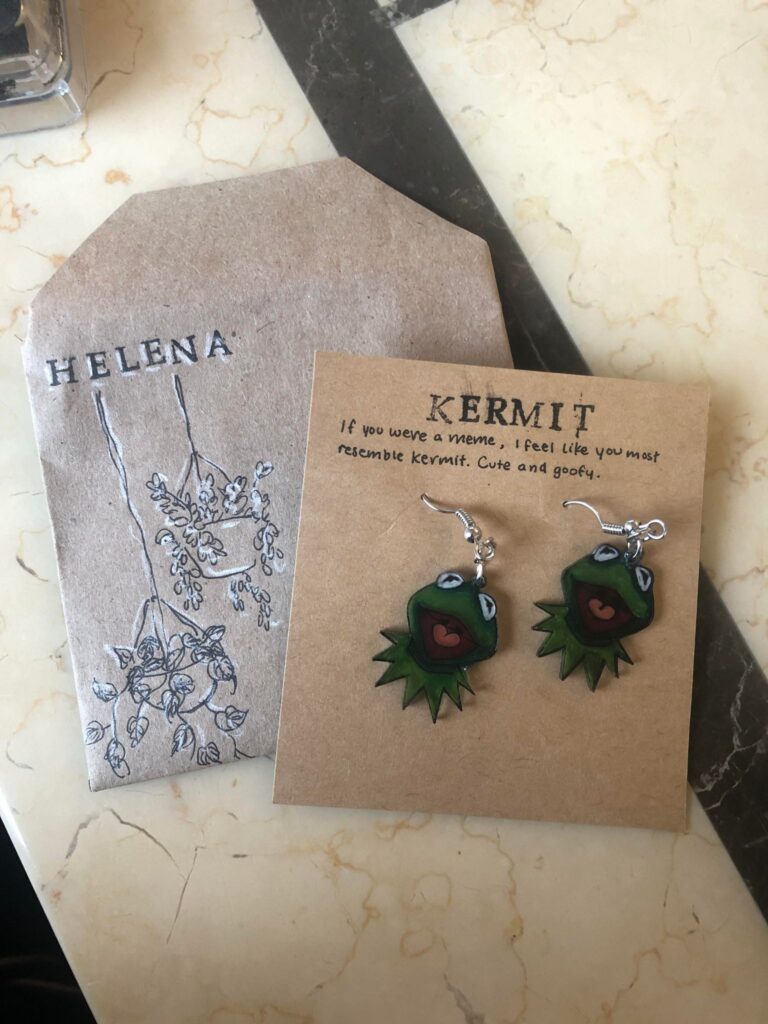
OuYang made crocheted scrunchies, painted cards, and whimsical earrings. She and her girlfriend also sent each other packages during their long-distance relationship.

“For Christmas, I embroidered a hoodie for her with one of her favourite kinds of instant ramen,” Ouyang told the Tribune.

Christal OuYang / The McGill Tribune

Like Saleh, OuYang agrees that the unique nature of the handmade gift sets it apart from store-bought alternatives. 

“I think it’s so much more personalized,” OuYang said. “I feel like when you buy a gift it can easily become one of those things where it just sits around.” 

For many others, like OuYang, the pursuit of crafts spiked last year during the pandemic.

“During COVID, I had a lot more time because I didn’t have a social life,” OuYang joked. “When I scroll past all the pictures of people [on my phone] and I get to the COVID-era, it’s just photos of things.”

As I talked with Saleh and OuYang, I was reminded of how deeply therapeutic it is to make gifts for others. Once exams are over, it’s relieving to become invested in a ritual, tactile activity—an activity so different from the endless essays and exams that dominate finals season.

“It is very fun as a stress reliever,” OuYang said. “There’s also a goal that I’m reaching and it’s not just benefiting me, but making other people happy.”

Editorial, Opinion

Post-Graduate Students’ Society of McGill University Executive Midterm Reviews 2021-2022

Kristi Kouchakji, Secretary-General

Kristi Kouchakji inherited a fraught portfolio––the Secretary-General position was vacant for a period of transition for the better part of last academic year, leaving Kouchakji with lots to catch up on. One of her objectives was to change the workplace culture within the Society by hiring more contractors, encouraging a healthy work-life balance for executives and commissioners, and asking executives to track their hours worked in order to evaluate whether the workload is sustainable. While ongoing, this project appears to be successful thus far. This term, she has also been supporting the BIPOC Grad Network Coordinator and working to increase Society engagement. Recently, she released the PGSS statement on academic freedom––though the full extent of her current undertakings are too lengthy to discuss in full here. Overall, Kouchakji shows a clear desire to reinvigorate her portfolio, and her work so far has been very promising.

Babatunde Alli, External Affairs Officer

Babatunde Alli, who also served in his position last year, aimed to establish stronger ties with other student associations in Montreal and across Canada. This year’s initiatives included communicating closely with the Quebec Student Union (QSU)—attending the QSU caucus and organized one-on-one meetings with the QSU officers to discuss PGSS interests. Alli also worked with other Montreal student associations to reaffirm and add to the demands of the Coalition régionale étudiante de Montréal (CREM) municipal election platform. The platform calls for affordable non-profit student housing, reduced BIXI fares for students, and more. Although PGSS joined CREM in 2017, there has yet to be any progress with Montreal fulfilling their demands. He plans to continue following up with the municipal council to push those demands forward. Alli has also been working to start a federal coalition of Canadian graduate student associations, with their first drafted Memorandum of Understanding being considered at the PGSS executive level.

Adel Ahmadihosseini, Internal Affairs Officer

In his first term as Internal Affairs Officer, Adel Ahmadihosseini’s main goal was to make the transition from virtual to in-person events safe, accessible, and inclusive. PGSS Orientation week offered students a mix of information and social events, and throughout the semester, Ahmadihosseini has successfully coordinated multiple events with hybrid formats, most of which saw high attendance numbers. He has facilitated several initiatives including weekly international language café meetings, various day-trips to national parks, and academic-related workshops. While Ahmadihosseini has delivered many successful social events, he can improve on facilitating events that address pertinent issues graduate students face, such as mental health. Ahmadihosseini is currently working on Winter orientation, Thomson Cup, and events that build community among the different post-graduate departmental student associations.

Dakota Rogers, Member Services Officer

Dakota Rogers was responsible for ensuring the successful rollout of the projects such as Keep.meSAFE, a mental health service at McGill accessible to all students, established as a collaboration between the student societies, and Dialogue, a virtual healthcare platform introduced to address the challenges of accessing health care in Montreal and Canada. The Legal Protection Plan was also put into action to facilitate easier access to lawyers and legal advice for PGSS members. Rogers has also been involved in a handful of other initiatives, including establishing a SSMU daycare fee, ensuring the needs of students are being met after recent changes to the PGSS Health and Dental Insurance Plan, reopening Thomson House according to COVID-19 protocols, and continuing the ongoing Thomson House wheelchair accessibility renovations that are now in McGill’s renovation queue. This year, Rogers successfully achieved his goal of ensuring the rollout of the projects he was involved in and made significant progress on other important initiatives.

Sophie Osiecki, Financial Affairs Officer

Sophie Osiecki’s main focus this semester has been supporting the PGSS needs-based bursary. In collaboration with the Member Services Officer, Osiecki also put a stop to the fee collection for the legal support fund—a fund which has been collecting $1 per student per term—but that according to Osiecki, is rarely if ever used. The fee will stop being collected as of September 2022. Although the question of how to redistribute the fund’s accrued $125,000 is ultimately up to the vote of the PGSS Council, Osiecki hopes to push for part of it to be injected into the needs-based bursary endowment. Osiecki will also spearhead the Seeds of Change initiative next term, a fundraising event that supports the bursary fund. Another project that Osiecki hopes to wrap up before March is passing a motion through the council that would put part of Travel Awards money toward carbon offsets. Sophie Osiecki has made good progress as the Financial Affairs Officer this year, and hopefully all of her projects slated for next semester come to fruition.

Hossein Poorhemati, University Affairs Officer

The role of the University Affairs (UA) Officer is to represent the interests of graduate students to the McGill administration. This semester, Hossein Poorhemati prioritized a smooth transition back to in-person learning by keeping an open line of communication with graduate students through weekly Zoom office hours and regular meetings with the administration. Another aspect of the UA portfolio is recruitment within PGSS, which Poorhemati has helped improve this semester by ensuring adequate volunteer recruitment and holding monthly meetings to keep track of unfilled positions. Additionally, Poorhemati has had a strong commitment to equity initiatives, notably advocating for international students facing financial barriers to research. He also hopes to develop an Equity, Diversity, and Inclusion 101 course that would be mandatory for all students and staff. Poorhemati chaired the PGSS Library Improvement Fund Committee and helped develop a list of recommendations to address the needs of graduate students. Next semester, Poorhemati hopes to continue increasing student involvement in PGSS and to work on improving the work-life balance for his constituents.

A previous version of this article incorrectly spelt Babatunde Alli’s name as “Babatunde Ali.” The Tribune regrets this error.

Off the Board, Opinion

When Christmas isn’t how it used to be

Upon entering my go-to cafe last week, I was hit with a wave of nostalgia. Christmas music was playing and a familiar thought crept back into my mind: Christmas has not felt like Christmas to me for a while now. When familiar tunes about reindeers and Santa Claus chime from every corner, along with the incessant flashing of red, white, and green lights, I cannot help but feel nostalgic. Before I can push the thought away, I am always left wondering why the so-called Christmas “magic” is lost on me. What was it that made Christmas “feel like Christmas” in the first place?

Before the age of nine, my Christmas had religious affiliations. My parents always explained that it was Jesus’ birthday and somehow that meant we gave gifts to each other. The religious customs never stuck with me and although I observed them out of respect, they were no longer part of my Christmas experience as I grew older. What my adolescent self did latch onto was the loud, wild affair of family and relatives piling into our house to eat, drink, play games, and throw money at each other.

After I turned nine, my family moved away and though our Christmas gatherings were smaller, they were no less enjoyable. I attributed a lot of my excitement to the build-up to Christmas. There was something about scrolling through TV channels and only seeing Home Alone or Christmas specials that just made the time of year so comfortable and thrilling. Unlike Halloween, where you would not want to be any of the characters stuck in their timeline of horror, the holiday films were full of joy. I would have loved to be Danny Devito attempting to deck my house in lights so that it can be seen from space.

Now, in my 20s, I do not have the same kind of enthralled attachment to Christmas. I do not feel the same sense of anticipation. Honestly, I struggle to find what Christmas means to me now; I do not go to church, I do not have the same family traditions, and this year I will not even make it home for Christmas. I would not exactly say I have “outgrown” it––I simply do not enjoy it the way my nine-year-old self did. Maybe I never will again. But this does not have to be a bad thing, and I feel comforted that after many conversations with my friends, I know I am not the only one feeling this way.

It goes without saying, Christmas is a largely observed holiday and is practiced differently by many different people. I see it as a clear marker of time passing—like a second birthday. As we get older, we become more nostalgic each passing year and for some of us, this is amplified during the holiday season. Nostalgia is odd in the way that it can either be good or bad. Great memories make you thankful that you had them, but there is also sadness in knowing you will not have them again. The feelings that you had in that moment can never be recreated in the exact same way, and although it can be bittersweet, nostalgia is something that will always come and go—it cannot be avoided. As long as time keeps moving forward, Christmas will always come around to remind me of a time I cannot go back to.

So, even if I cannot replicate the Christmas celebrations of my childhood, nostalgia ensures that my experiences were fulfilling enough that I both remember and miss them. I do not exactly aspire to “make something out of Christmas again.” Simply knowing that I did love it at a time in my life is enough for me.

Read the latest issue

Read the latest issue