
Latest News

McGill, News, SSMU

Barrage of emails from Elections SSMU confuses voters

The Students’ Society of McGill University (SSMU) Fall 2021 Referendum’s results were released on Nov. 15 following a string of technical errors and discrepancies in communication that resulted in widespread confusion. Initially, the voting period was scheduled to start on Nov. 8 and end on Nov. 12. However, a day after the polls were opened, SSMU notified students by email that the original ballot had been replaced with a new ballot, which would be open until Nov. 15 at 17:00.

In an interview with The McGill Tribune, Éric Sader, SSMU’s vice-president (VP) Finance, explained that the initial ballots lacked information about budgetary details for each motion. 

“The motions were amended during the Legislative Council to each include the budgets, […] but there was a miscommunication on who was responsible to make sure those budgets were a part of the questions,” Sader said. “We didn’t want people to have voted […] without seeing the budgets, so we had to rerun the referendum.”

Despite the opening of a new ballot, the Fall 2021 Referendum saw a higher voter turnout than the 2020-2021 year. 19.5 per cent of electors cast a ballot this fall, marking a 3.6 per cent increase from the previous Winter 2021 Referendum

Citing the increase in voter turnout, as well as the increased margins by which the motions passed, Sader believes that the rerun had minimal impact on the outcome of the referendum. 

“[The error] was caught relatively early, and generally people who vote in SSMU referendums early are people [who] are very motivated to vote,” Sader said. “My hope is [that] those people were able to vote in the new ballot immediately. I am quite confident that [the results] reflected the desires of the student body.” 

In addition to the initial technical problems, a Nov. 15 email from Elections SSMU stated that voting would be open until Nov. 17, even though polls closed on Nov. 15, inciting further confusion among some voters. 

Sarah Paulin, SSMU’s VP Internal Affairs, clarified that the email was only sent out to undergraduate students in the Faculty of Arts and directed voters to the Arts Undergraduate Society (AUS)’s departmental referendum, which had been mistakenly labeled as the Fall 2021 referendum.

“[The discrepancies in the emails] is a problem, but I do not think it is a problem of that big of a magnitude because there was no [narrow margin of victory] in any of the referendum questions,” Paulin said in an interview with the Tribune. “We will be talking to the AUS, but apart from that we will be keeping the results as it is.”

Sam Lowery, U3 Management, expressed frustration and a lack of trust in SSMU, describing its agenda as irrelevant to the average student. 

“I struggle to take SSMU seriously, because to me it’s a bunch of kids who are set on going into government and want to play politician in university,” Lowery said in an interview with the Tribune. “I don’t feel like what SSMU does or how any of the referenda turn out affect my day-to-day life, and honestly I don’t want SSMU to affect my day-to-day life. Good on them for getting the voter turnout to increase, but at the same time I think [the low turnout] is still definitely reflective of a general apathy towards whatever it is [that] [SSMU] is doing.”

Sader acknowledged that the lack of interest from students is a significant issue that SSMU aims to address in order for the society to make decisions with the confidence of its membership. 

“There have been a lot of good initiatives from the [Chief of Electoral Office] to try to improve participation [by] making sure that the questions are easily accessible, easily understandable,” Sader said. “At the same time, we need to be realistic in the sense that a lot of students don’t care about [elections and referenda] and that’s fine [because it’s] a student’s right not to care.”

McGill, News

McGill Artificial Intelligence Society’s panel discusses ethics and regulation of artificial intelligence

The McGill Artificial Intelligence Society (MAIS) held its first in-person event of the school year, a panel titled “Ethics in AI,” on Nov. 17. The audience was at full capacity, drawing in a crowd of approximately 35 people from the McGill community to the Trottier lecture hall.

The panel featured three professionals who engage with issues surrounding AI ethics in their respective disciplines: Masa Sweidan, McGill alumna and business development manager at the Montreal AI Ethics institute (MAIEI); Ignacio Cofone, assistant professor of privacy law, AI law, and business associations at McGill; and Mark Likhten, legal innovation lead at Cyberjustice Lab at L’Universite de Montreal (UdeM).

Kaustav Das Sharma, U4 Engineering and team lead of the McGill AI Podcast, moderated the event. The panellists acknowledged that AI is often misrepresented in media and popular culture, and agreed that  it is important for the public to gain a more holistic understanding of AI and the ethical barriers that emerge with its advancement. 

“What is important is to […] be clear about what AI is,” Likhten said. “It is a very powerful tool, but it’s still a tool which needs […] human intervention.”

Cofone considered more precise issues, namely bias, transparency, and privacy within AI, as the issues that should garner more public attention. These three issues are at the core of his research in AI regulation.

“One important aspect to be aware of […] is AI bias,” Cofone said. “AI decision-making affects everyone, everyday [….] Transparency [in AI] is important particularly with decision-making processes such as calculating credit scores to see if you would get a house [or] calculating your risk score to see if you go to jail [….] Privacy is important because most AI is trained with [sensitive] information about us.”

There was also discussion regarding how public institutions can work to push inclusivity and diversity to the forefront of AI research and development. Sweidan stated that diversifying AI education is a crucial first step.

“Having education that includes women, BIPOC, and LGBTQ [communities] is extremely important,” Sweidan said. “Having people with different backgrounds, looking at it from the philosophy standpoint, [from computer science], from law, I think that is what leads to a more holistic education, and I think that is an extremely important first step.”

Panellists also discussed the potential of AI systems to inflict harm, and the importance of adequate personal data protection regulation. Ending on a positive note, Das Sharma asked panellists what makes them excited for a future blossoming with cutting-edge AI development. Sweidan said that she is excited by the possibilities for AI creativity, while Likhten cited the applications of AI in justice.

“I am actually very optimistic for the future,” said Likhten. “[Cyberjustice Lab] works a lot with tools [using] AI to improve access to justice, and the possibilities that we see in that field are endless [….] We talk a lot about people getting stripped of their personal data […], and the bad sides of AI, but there are lots, and lots of […] good things that you can do with AI that remain within the boundaries of ethical principles.”

Commentary, Opinion

‘Post a picture of your pet’: Imagining an online future for activism

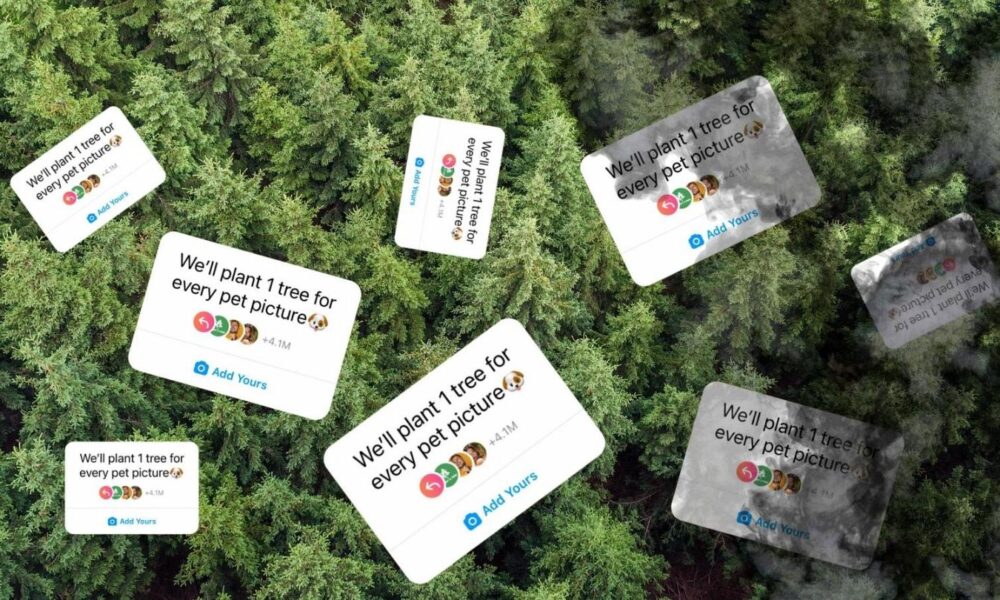
Last month, many found their Instagram story feeds flooded with Plant a Tree Co.’s viral “Post a picture of your pet and we’ll plant a tree” sticker. The trend comes after the platform added the new “Add Yours” sticker feature, which allows users to attach their own pictures to a public prompt on their stories. Days later, Plant a Tree Co.’s prompt had over four million uploads and showed no signs of slowing. Following the growing reach of the post, many Instagram users began to question the viability of the account’s tree-planting promises. Plant a Tree Co. clearly backpedaled because they deleted the original post just after 10 minutes of putting it online. But because of the new sticker feature, the post kept circulating, effectively granting it a life of its own. Plant a Tree Co. will not be planting four, five, or six million trees. They have, however, redirected their goals and started a fundraiser instead. 

While it was a mistake on the part of Plant a Tree Co. to make a promise that they knew could spin so far out of their control, the post’s quick virality indicates the complicated relationship between activism and social media. While it has the potential to be a tool for change, social media amplifies the performative aspect of activism––of which “Post a picture of your pet and we’ll plant a tree” is the perfect example. When activism is performative, it is usually a means to virtue-signal or show support for a cause without meaningful engagement. Treating activism as a fad without focussed intent and motivation will always be ineffective.

This trend, also known as “slacktivism,” does highlight how activists can benefit from social media: A single post can reach millions of people in a matter of minutes. This rapid spread of information renders participation in social movements more visible and accessible to a wider audience. Despite worries about the rise of slacktivism, collective action facilitated through online platforms has undeniably led to real change. Online campaigns like #MeToo gained the traction they did almost entirely because of social media. When much of our lives transitioned online during the pandemic, Black Lives Matter (BLM) activism shifted to social media as well, albeit with varying degrees of success. Performativity is even more striking when comparing the traction BLM gained in 2020 versus in 2014—when people were less present online. Without the internet, notifying people of protest locations, mutual aid needs, and community dangers was completely different. For one, mobilizing people through traditional channels, like physical posters or word of mouth, is far less effective because the internet has profoundly changed how we form communities and movements. Whereas potential protestors might have learned of a demonstration at a Sunday service, they are now more likely to find it on their feed online. 

However, despite the potential for mass mobilization and visibility that online platforms enable, it is crucial to question whether they can sustain  movements, and to what extent this visibility risks distorting a movement’s message. It would be naive to disregard the fact that most of the power of social media comes from posts being looked at and reacted to by others. When you mix the performative aspect of social media with white privilege, the revenue opportunities of platforms like Instagram, and easily digestible infographics, you are bound to produce a diluted movement. The type of mobilization encouraged by posts like “Post a picture of your pet” is low effort, and consequently, low benefit. It takes nothing to post a picture of your dog. It also gets you nothing, or nothing more than nicely curated feed. 

Undergraduate students, made up mostly of avid social media users, need to find the balance between convenience and complacency. The reason why a lot of social media activism is ineffective is not because movements are poorly organized or because Instagram distorts messages; it is ineffective because it is performative. Online activism can host the nuanced and complex conversations that social issues require, but in order for that to happen users need to be more intentional in how they participate in social movements. There is revolutionary potential in the internet, and it doesn’t need to mimic life offline to thrive. It just needs to be authentic.

Science & Technology

Biology symposium investigates modes of language learning

How language plays a role in the evolution of human societies remains a fascinating question for language researchers, given the diversity of language learning techniques and abilities. Some McGill researchers, however, are one step closer to finding the answer. On Nov. 15, a symposium on the “Cultural Evolution of Communication” discussed how society plays a role in the formation and learning of language and, conversely, how language plays a role in constructing societies. The event, hosted by Jon Sakata, a professor in McGill’s Department of Biology, presented the research of Pauline Palma, a PhD candidate in experimental psychology, and Logan James, a McGill alumnus who completed a PhD in 2019 with the Department of Biology. 

Pauline Palma: How bilingualism affects the progression of language 

Many have wondered what the advantages of being bilingual are and how bilingual societies differ from monolingual ones at the cognitive level. In her latest research, Palma addressed this question, looking specifically into whether prior linguistic knowledge in individuals can affect language evolution.

In order to test for the ability to learn a language, Palma recruited young adults who identified English as their first language and French as their second. In a training phase, she used two types of word sets as stimuli—a “French-like” word set containing made-up words resembling French words, and an “English-like’ word set containing made-up words resembling English words. 

Each set contained 12 words. However, during the training phase,  Palma only presented nine words to participants, who were then shown all 12 words at the test phase. This technique measured if the participants were able to use what they had learned in the training phase and apply it in the test phase—in other words, the researchers wanted to test whether the bilingual participants were able to learn this “new” language, and whether this had implications for the way they learn language compared to monolingual speakers. 

Palma’s results showed that the learnability of one’s native language, whether that be English or French, increased over time. As well, the structure of a language increases for the English-like languages when learned first, whereas the French-like languages developed structure in both conditions. Palma explained that her results demonstrate a phenomenon in bilinguals called an asymmetric switch cost. 

“An asymmetric switch cost is when switching to your dominant language becomes more difficult because of intuition, which was seen at the societal level,” Palma said. 

Moving forward, Palma hopes to explore whether these results are reproducible and whether individuals’ differences in their modes of language acquisition can alter these results. 

Logan James: The biology of birdsongs

James, who is currently conducting field work in Panama, presented his research on the biology behind the formation of birdsong. In his studies, James used zebra finches as a model to test how environmental factors can have an impact on the sequencing and timing of their songs, and whether or not there are biological biases behind certain song patterns. 

 “So the question we have is, how do [zebra finches] select which pattern to produce and what timing to produce?” James said. “In general, they’re going to be learning this from their fathers.” 

One experiment that he performed was playing back a random birdsong sequence during song learning and observing its impact on zebra finch song production later on. The results showed that even with a randomized input, the birds produce a song that was similar to the formal birdsong of the zebra finch due to certain biological biases. James compares this to how humans process sound.

“There is a similar [process taking place] in humans, where we as humans use these internal filters to produce particular sequences and timings,” James said. 

Commentary, Opinion

Physical books are worth their cost

The holiday season is approaching, and as many people start the scramble to find gifts for loved ones, friends, or coworkers, a harsh discovery awaits them. Tried and true, books have remained one of the best gifts to give on any occasion, the perfect balance between thoughtful and casual. However, the tumultuous pandemic economy has caused paper, ink, and printing presses to be in high demand, leading to an increase in book prices. The days when a hardcover novel did not cost an arm and a leg are long over, with the average adult fiction book priced at around $34.00 CAD. The rising price of books is just one of the negative effects of current inflation trends threatening the extinction of libraries and smaller book businesses. Everyone must do their part by buying books from local bookstores, and remembering to plan ahead to avoid resorting to large corporate sellers like Amazon. 

Though the pandemic has led to a recent spike in demand for books, it is getting progressively more expensive to produce them. The price of wood pulp rose approximately 71 per cent this year after an environmental initiative in China led to the shutdown of many pulp and paper mills. The large price change has made book prices skyrocket and production timelines slow. Further, the supply chain has taken a hit due to the pandemic, and lengthy shipping delays are predicted for this upcoming holiday season. This seeming book shortage will certainly put a hamper on many people’s plans to shop last minute, as there will be fewer books stocked on the shelves, and delayed projected delivery times—some stretching well into the new year. 

With the many roadblocks to obtaining physical copies of books this year, the growing market for online literature like e-books, Kindles, Kobos has skyrocketed. Online literature tends to be cheaper—no manufacturing, distribution or shipping costs—so with book prices increasing this year, more cost-conscious consumers might pursue those options in lieu of purchasing a physical copy. Also more environmentally friendly, investing in a Kindle or another digital library, saves paper. While there are benefits to making the switch to online, physical books are still overall the better choice. 

McGill, too, has hopped on this online literature bandwagon. Many English courses have started to offer their texts in PDF form, selecting readings available from online resource platforms or offering online course packs so students do not have to purchase an entire short story collection. McGill courses in general have also adapted to online life: The majority of assignments can be submitted online, reducing the need for physical copies of papers—and even some exams are now delivered online. Though, with the hybrid learning scheme, many students find themselves struggling to adapt to fully remote learning. If physical copies of textbooks and novels are slowly phased out, it is almost certain that students’ productivity will suffer, with  reading on paper being important for neurological comprehension. Reducing screen time by doing readings and note-taking offline helps both concentration and retention, and reduces eye strain.

This phenomenon also has consequences for libraries. They, too, risk being rendered useless. This is especially dismaying, as libraries are one of the only public places people can visit without having to pay. Small businesses are also affected, with non-chain bookstores relying heavily on an in-person customer base. While larger names like Indigo and Barnes & Noble may be able to stay afloat in this transitioning market, smaller names like Montreal’s S.W. Welch Bookseller might not. 

However, it would be unlikely that such a change in the literary market would happen before it could be prevented. Yet, to keep the magical world of printed literature alive, everyone must do their part: Keep buying books—especially from small businesses—and get any holiday shopping done sooner rather than later to ensure there are no empty presents under the tree. 

McGill, News

Sustainability initiative ‘impact200’ project winners to be announced next month

Launched in August 2020 as part of McGill’s bicentennial celebrations, impact200 is a challenge that invites teams of students to submit proposals for projects to enhance sustainability on campus, in Montreal, and around the world. The challenge was organized by the Bicentennial Office in collaboration with the McGill Dobson Centre for Entrepreneurship, the McGill Office of Sustainability (MOOS), the McGill Sustainability Systems Initiative (MSSI), and representatives of the Faculty of Agricultural and Environmental Sciences. On Dec. 2, the winners of the challenge will be announced, with prizes ranging from $2,000 to $10,000. Once completed, the finalist teams will be offered the opportunity to refine their project through a training program provided by the Dobson Centre and to ultimately bring it into action if it places in the top three spots.

Each project aims to address one or more of the United Nations Sustainable Development Goals, such as food security, eradication of poverty, and climate action. From the 44 initial proposals, 10 finalists were selected to develop the feasibility of their concept over the summer and then deliver a final presentation of their project in November. The university’s flagship Sustainability Projects Fund (SPF) gave each finalist $5,000 to cover the project’s development expenses and connected each project with mentors for support.

Frédérique Mazerolle, McGill media relations officer, said that the university was pleased to foster sustainable solutions for local and global challenges being innovated at McGill. 

“Sustainability is an institutional priority at McGill, as evidenced by the ambitious goals we have set out for ourselves in the Climate & Sustainability Strategy 2020-2025,” Mazerolle wrote. “It is our responsibility as members of the global community that we do what we can to achieve these goals to reduce our impact on climate change and contribute positively to the sustainability of the planet.”

Simon Cleghorn, U1 Engineering and co-founder of the team 200 Urban Garden—one of the 10 finalists—explained that their project aims to make cities more sustainable by converting underutilized parcels of land into vibrant community green spaces. 

“The initiative gave us a rare opportunity as students to create and pursue a sustainable innovation with external funding,” Cleghorn wrote to the Tribune. “As six environmentalists, this was extremely exciting for us. Impact200 allowed us the opportunity to engage with other like-minded students with similar goals pertaining to sustainability.”

Two other finalists, McGill Mycelium Project and FoodMap, attempt to promote sustainability by responding to food insecurity. Another, SOlar-A,  designed water filtration backpacks to ensure areas with low resources have access to clean water through solar and biomechanical energy. McGill Engineers in Action plans to design a footbridge for rural communities in Bolivia or Eswatini, to then have a group of students work alongside these communities to develop it. The other finalists were teams Algo, CoolHealth, MentalLingual, MiniWaste, and unEarth.  

Joining forces in September 2020, Cleghorn and his team decided to participate in impact200 with the goal of implementing sustainable gardens on McGill’s downtown campus. 

“We began planning our proof-of-concept Wong Garden and formulating the vision of ‘200 Urban Garden’ at weekly meetings all throughout the 2020-2021 academic year,” Cleghorn said. “This past summer we successfully constructed the Wong Garden, which includes various forms of green technology and a wide range of produce.”

Gérald Cadet, director of bicentennial planning at the Office of the Principal & Vice-Chancellor, explained that the winning projects would be chosen based on the quality of each team’s final pitches, the applicability of each project to the SDG goals, and the project’s ability to create transformative and beneficial futures. “The judges considered many criteria, among which [was] the potential to become Bright Spots, that is, projects that transform some piece of the world for the better, clarity of the proposal, etc.,” Cadet wrote to the Tribune. “The challenge is likely to be a one-time; however, through one of the components of the Dobson Cup, students can propose sustainability-focused projects.”

Science & Technology

Computational witness stand: A new way to prevent credit card fraud

In 2018 alone, reported fraud cases increased by 18.4 percent from the previous year and over 20 billion dollars were lost. Although not the only source of card fraud, one major concern is the security of Automated Teller Machines (ATMs). With the spread of ATMs throughout the world, personal banking security has become an increasingly prevalent issue. From hijacking ATM terminals using “skimmers,” a device that collects messages sent on the ATMs data lines, to installing cameras to record individuals inputting their PINs, there are numerous ways for scammers to steal sensitive information from under your nose. 

To prevent fraud, Claude Crépeau, a professor in McGill’s School of Computer Science, along with researchers from other institutions, is looking to find methods for beefing up modern bank security systems. 

Once your bank PIN falls into the wrong hands, the process of resetting it can be a hassle. All the while, your account can be accessed and funds can be taken out. This is where Crépeau’s work comes into play. Using a type of cryptographic method known as zero-knowledge proofs, combined with Einstein’s theory of relativity—which stipulates that matter, and in turn, electronic information, cannot travel faster than the speed of light—the team has developed a new method of combating card fraud. 

To understand zero-knowledge proofs, imagine that person A has two identical containers. One contains a coin and the other contains a die. Person B wants to prove to person A that they can identify which container has the coin and which one has the die, even after they are mixed up. In order to do so, person A will mix up the containers and person B will guess which one has each object. If person B does this correctly several times, person A will accept that person B knows which container has the coin. However, person A will still be unaware of how person B knows this. 

Although not yet present in ATMs, bank machines could use zero-knowledge proofs in order to verify a cardholder’s identity; the cardholder proves their identity with their PIN, and the ATM machine verifies it without accessing the encrypted information. However, even this method of verification would not be foolproof. Therefore, the difficulty of cracking zero-knowledge proofs often rests upon how difficult it is to solve these equations. Some zero-knowledge proofs have already been cracked, while others may only be solved once quantum computing becomes more advanced. This raises the issue of never knowing the level of security of the proof used by banks until it is too late.

Einstein’s theory of relativity is the second piece of the research puzzle. A fraudulent ATM could record the answers given and attempt to solve the equation used to encode them, thereby cracking the zero-knowledge proof. The team decided to use multiple devices mimicking ATMs, set up approximately 60 metres from one another. A cardholder inserted their bank card into each one, and then the machines performed zero-knowledge proofs in order to prove the cardholder’s identity. For this process to work, the devices were not allowed to communicate with each other. Otherwise, fraudulent devices could potentially share information to help each other crack the code. However, if they aren’t able to collaborate, then it is similar to an investigator interviewing two witnesses separately—if their testimonials do not match up, then their story is impossible to corroborate, and the devices will be proven fraudulent.

If the devices are prevented from communicating, any potential hijacker would be forced to solve not one, but two, highly complicated equations in order to work back to the zero-knowledge proof. Since that information cannot travel faster than light, the transfer of useful information between devices will be limited, preventing access to the encrypted information.

“What we have demonstrated makes it tremendously closer to being practical in the sense that it has never been demonstrated before,” Crépeau said. “We strongly believe that with […] more important investment [in] equipment of a higher quality […] we can bring [the distance between ATMs] down to a couple metres or maybe even a single metre.”

Combining zero-knowledge proofs with Einstein’s theory of relativity could allow for a more secure method of validating one’s own identity that won’t be threatened by the advancement of quantum computing.

Although still just a proof of concept, the team’s research has the potential to dramatically improve currently vulnerable banking security. The research into the dynamic between information, light, and zero-knowledge proofs could have important implications for the future of personal banking security. 

Sports

Exposing the history of streaking in sports

Streaking, despite its taboo status, is a popular idea in our collective cultural memory. It’s a common high school and college movie trope to force the loser of a bet to “streak across the quad” or “do a naked lap.” This idea, however, didn’t come from nowhere: The art of stripping down to nothing and dashing as fast as you can has been around for decades.

The true origin of streaking in sports is hotly contested—a cursory glance at online sources will uncover nothing but conflicting accounts. The Guardian cites Michael O’Brien’s sprint across England v. France rugby match at Twickenham for a meagre payout of 10 pounds as the first of several streaking incidents that would plague sports in the years to come. Others, however, cite the University of Georgia as the patient zero of the streaking fad, with several streaking incidents, including a 1,500-person naked dash through campus in the spring of 1974, with some students even parachuting in the nude from above.

Some have even stipulated that streaking’s roots trace back to the 18th century, with reports of Founding Father John Adams’ son running amok across the Harvard Campus without his clothes on.

No matter where streaking claims its roots, it’s undeniable that a golden age of streaking emerged in the ‘70s. Streaking swept college campuses across both the North American and international stage, with sports fans taking to the field in the buff like never before. Streakers would sometimes interrupt gameplay several times a match, and players often felt a need to retaliate. This was the case in a 1977 match between New Zealand and Australia which featured three streakers, the third of whom was promptly spanked with a cricket bat by Australian cricketer Greg Chappell.

Streaking incidents like this haven’t died down—in fact, they’ve only grown more popular. Mark Roberts embodies this reality perfectly: As the self-proclaimed “world’s most prolific streaker,” Roberts has streaked at over five hundred events and has even been paid to streak at high profile events like Super Bowl XXXVIII, where he was ultimately bowled over by Patriots’ linebacker Matt Chatham.

Streaking is a logistical feat. Not only do you need to purchase front row seats to an event, but once you arrive, you need to figure out how to derobe quickly and get on the field before security notices you. After that, you need to run as fast as you can to avoid both security and players with the goal of staying on the field as long as possible—and getting away unscathed. Despite these challenges, people continue to seek out streaking in great numbers, leaving many asking, “Why?”

Are streakers seeking out fame? Are they adrenaline junkies? Or are they just sexual thrill-seekers? While it’s hard to attribute any single motivation to the whole of streaking subculture, Mark Roberts provided some insight in a 2015 interview with The Guardian, explaining that streaking was addictive from the very start.

 “It was just infectious. It was the adrenaline I got from that first day. I went crazy [….] I quickly realized that people really enjoyed watching me do this—this crazy mad streaking.”

The rush acquired from pulling off a stunt like this is certainly motivation for some to streak, the cost of interrupting a game and exposing yourself to thousands of spectators is clearly not deterrent enough.

While it’s hard to say why streaking has gripped sports the way it has, it’s probably here to stay—as long as it’s possible to get past security.

Creative

A Sound Walk Around McGill Campus

Multimedia Editor Farah Elmajdoub takes you on a sound walk throughout McGill campus starting from the Roddick Gates. As you tune in to this podcast, keep your awareness alert to what may unfold during your walk.

Read the latest issue

Read the latest issue