
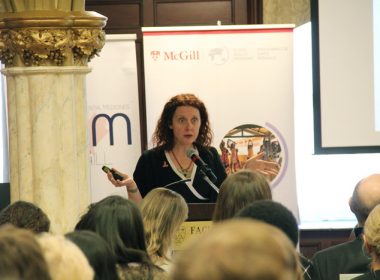
The diagnosis and treatment of tuberculosis (TB) remain the top two leading public health challenges of the 21st century. First identified in 1882, mycobacterium tuberculosis is by far the world’s most successful pathogen: One-third of the world's population is infected, with 10.4 million new infections and 1.8 million deaths in 2015. In recognition[Read More…]
Articles by Andy Wang

McGill researchers develop new model for Zika virus experiments
The spread of new and emerging viruses poses a constant threat to public health and presents a concern to developing and developed countries alike. Population growth, climate change, and the increasing ease and speed of travel have exacerbated the transmission of these viruses. Overpopulation results in the construction of homes[Read More…]

McGill graduate spearheads PornHub’s new sex ed initiative
Pornhub, the largest online provider of pornography, launched a new initiative website on Feb. 1. Called the Sexual Wellness Center, it is the first sexual education website undertaken by a pornographic website. “At the Pornhub Sexual Wellness Center, we are fully dedicated to your health and education, and to create[Read More…]

McGill researchers advocate for delayed school start times for adolescents
With the onslaught of midterms on the horizon, sleep will likely be pushed down the list of students’ priorities. According to a report card issued by ParticipACTION, a Canadian non-profit organization focused on improving public health, 26 per cent of adolescents are either mildly or moderately sleep deprived. In addition[Read More…]

Edward Snowden discusses how technological advances have changed the way governments spy
Edward Snowden, former contractor for the U.S. National Security Agency (NSA), spoke remotely via Google Hangouts at McGill University on Wednesday, Nov. 2. Snowden’s notoriety has not waned since his leak of some 10,000 classified NSA files in 2013. Snowden began with a few words about surveillance issues in Montreal.[Read More…]

Reaching the limits of the human lifespan
The longest any human being has ever lived was 122 years. Jeanne Calment of France, who rode a bicycle until age 100, passed away in 1997. Since then, no one has been recorded to live past 120 years. A paper published in the Oct. 2016 issue of Nature claims to have[Read More…]

Origins of the Canadian accent: Canadian English and factors that contribute to linguistic change
Despite many linguistic similarities with our southern neighbour, the Canadian accent—or accents—can be as distinctive as our love of hockey, maple syrup, and good manners. The origins of Canadian English can be traced back to the American Revolution in the late 18th century when roughly 45,000 Loyalists—American colonists still faithful[Read More…]

Art meets science: McGill researchers program drone to paint
A group of McGill researchers have developed a technique to create large-scale drawings with a small drone called Crazyflie. The Computer Animation and Interaction Capture Lab, led by Computer Science Associate Professor Paul Kry, published their results in the most recent issue of Expressive. Their research outlines a breakthrough method[Read More…]
Islamic art inspires metamaterial
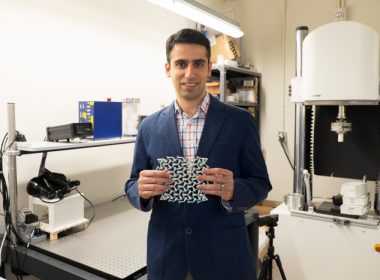
On March 21, McGill University’s Facebook page shared a video that demonstrated a unique type of material called an auxetic, expanding while being stretched. The metamaterial, designed Dr. Ahmad Rafsanjani, a member of the Pasini lab in McGill University’s Faculty of Engineering, is unique because when it is stretched, it[Read More…]

McGill University Procurement Service to seek alternate antibody supplier
Antibodies, also known as immunoglobulins, are proteins that can bind to foreign molecules in the body. Discovered in the early 20th century, the incredible specificity with which they can bind to proteins became an irreplaceable tool in the repertoire of molecular biology. Because of this, scientists have been able to[Read More…]

Taking the next step in developmental biology: Embryonic editing
In April of 2015, researchers in China from Sun Yat-sen University published the results of the world’s first experiment on human embryo editing. The goal of the experiment was to edit a gene containing mutations for a blood disorder called β-thalassemia. The gene is responsible for coding a subunit of[Read More…]

Sounds are better indicators of emotions than words
Researchers have discovered two separate pathways for how emotions conveyed through speech are processed in the brain. Led by Dr. Marc Pell, associate dean and director of McGill University’s School of Communication Sciences and Disorders, the work is the first of its kind to directly compare speech embedded emotions with[Read More…]

All for one and one for all
The origin of life on Earth remains a heavily researched topic in evolutionary biology. Among the myriad of questions yet to be answered is how simple, single-celled organisms evolved to be complex and multicellular. While the mechanism for this phenomenon has been elucidated in plants and fungi, little is known[Read More…]
Disclosing medical information in the work place
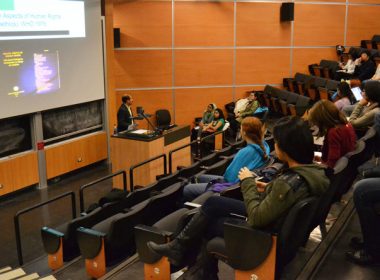
On Nov. 19, the Comparative Health Systems Program (CHSP), a non-profit organization within McGill, hosted a lecture on medical information privacy and its implications in the workplace. The evening’s lecture began with an image of the World Health Organization’s (WHO) 1976 year-end report. Among the many issues the WHO addressed,[Read More…]

Going back to the elements
On Nov. 4, as part of Redpath Museum’s Mini-Science series, McGill Assistant Professor Audrey Moores from the Department of Chemistry discussed her research on nanoparticles in the context of green chemistry. Moores began by posing a fundamental question to the audience: “What is sustainability?” From a pure materials science perspective,[Read More…]
The human connection: A path to paediatric surgery
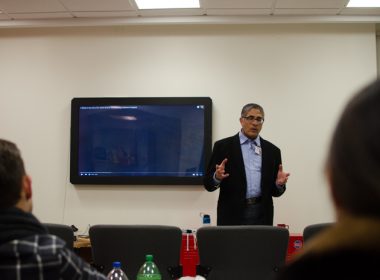
On Tuesday, the common lounge in McGill’s Lady Meredith Annex fell silent as Dr. Sherif Emil, director of paediatric general surgery at the Montreal Children’s Hospital took the stage. No stranger to Montreal—Emil completed both his medical degree and paediatric specialization at McGill—his talk had been highly anticipated by current[Read More…]

Learn to Code: An evening hosted by HackMcGill
On Sept. 30, HackMcGill hosted its second Learn to Code event at the Lorne Trottier Building. Created for McGill students unfamiliar with the programming world, Learn to Code offers newcomers help from those with experience. Following a brief introduction about the types of programming languages and a list of the[Read More…]

Can you change your mind?
Creating Frankenstein’s monster—taking bits and pieces from different people to make a whole—is an idea conceived by fiction, not real-life; however, Dr. Sergio Canavero, Italian neurosurgeon, plans to undertake what he describes as the first human head transplantation with spinal linkage. This venture, named The Head Anastomosis Venture[Read More…]

Fighting Ebola: Prevention, progress, perspectives
In an effort to raise awareness about the impact Ebolavirus disease (EVD) has had on thousands, McGill Students Fight Ebola hosted a conference last Wednesday, Feb. 18, featuring a panel of Ebola experts. The aim was to inform those interested in the problems and perspectives of non-governmental organizations (NGOs) during[Read More…]

Bilinguals get a boost
A recent study conducted at Anglia Ruskin University in the U.K. has once again demonstrated the benefits of bilingualism. Bilingual children of various languages (Polish, Russian, French, and Italian) with English as their primary language, were able to maintain better focus on a task in a noisy environment. When the[Read More…]

Demystifying vampires
When the word vampire is mentioned, it’s easy to imagine a musky room, candle light, and perhaps, romance. Dracula, a novel written by Bram Stoker, and its multiple contemporary renditions were, at least in Western literature, the first brazen attempt at coupling vampires and humans. Of course, the association of[Read More…]

Money talks, researchers listen
If art is the exploration of questions, science is the pursuit of answers.

Research Briefs
Fear not: The Dreadnoughtus The dreadnought was a type of battleship developed in the 20th century that was known for its size and speed.

Breaking the ice on ALS
When internet trends hit, it doesn’t take long until everyone and their grandmothers are taking part.