A student rally in support of Palestine resulted in tense interactions between protestors and Concordia University security on Sept. 12. The rally was organized in conjunction between chapters of Students for Palestine’s Honour and Resistance (SPHR) at McGill and Concordia—formerly known as Solidarity for Palestinian Human Rights—and Palestinian Youth Movement (PYM) Montreal. It began in front of the Arts Building at McGill and proceeded to various buildings at Concordia where it was met by tens of security officers.
At 1 p.m., nearly 100 protestors met and engaged in call-and-response chants to condemn Israel’s siege on Gaza and McGill’s response to student mobilization in recent months. Some slogans explicitly called out McGill President Deep Saini with protestors chanting, “Deep Saini, pick a side: justice or genocide.”
“We are here to remind Saini, [McGill Deputy Provost Fabrice] Labeau, and [McGill Interim Deputy Provost Angela] Campbell that there will be no business or classes as usual during a genocide,” Alex told the crowd. “The student movement has emerged out of this summer, stronger, more united, and more resilient. So to our administration, we tell you, remember, the power is with us […] and until we achieve full liberation and victory, long live the student intifada.”
Around 1:40 p.m., the group began making their way to Concordia’s Engineering, Computer Science and Visual Arts Integrated Complex. There, tensions between protestors and Concordia University security guards bubbled as protestors continued chanting against the blockaded doors.
After about 15 minutes, as the group moved to the Henry F. Hall Building, a group of security guards ran past to intercept them. Protestors began to run to get ahead of the security officers. Inside the building, chants of “cops off campus” echoed through the lobby as protestors tried to get past the security officer who blocked the escalators. Some protestors climbed over the escalator railing, forcing the guard to give in and ushering a wave of protestors to the second floor.
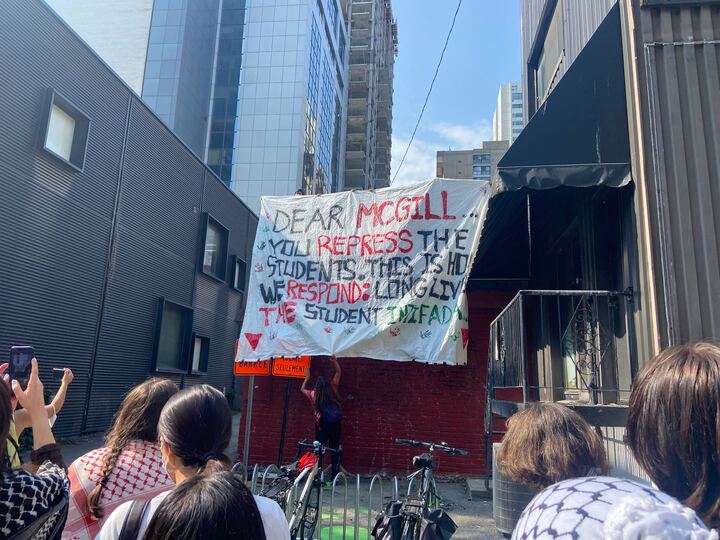
Protestors remained in the building for about 10 minutes, before going back outside to unveil a large banner which read “Dear McGill, you repress the students. This is how we respond: long live the student intifada.” Around 2:45 p.m., organizers dispersed the rally.
(Shani Laskin / The Tribune)
In a statement to The Tribune, Independent Jewish Voices McGill (IJV) condemned the continuous on-site police presence at pro-Palestine protests.
“Last Thursday, members of Concordia security called the police immediately on discovery of a picket that was disrupting class, and worked in tandem with the SPVM upon their arrival,” IJV wrote. “This continues a pattern of collaboration and militarization on our campuses that deeply endangers the student body. Universities like McGill and Concordia have claimed to care about creating ‘safe’ spaces for students, while simultaneously inviting police brutality onto campus.”
After McGill ordered the dismantling of the Palestine Solidarity Encampment in July, Saini wrote that the Board of Governors (BoG) Committee on Sustainability and Social Responsibility (CSSR) would “explore the question of divestment from direct investments in companies that derive a dominant portion of their direct revenues from the production of military weapons, regardless of the countries in which they operate.” To this end, McGill Secretary-General Edyta Rogowska sent an email on Sept. 11 with a webform for students and staff to offer their opinions on the question of divestment. The CSSR is expected to present their findings to the BoG in December 2024.
“McGill is moving forward on a range of measures that reflect our community’s challenges over the last year,” McGill’s Media Relations Office wrote to The Tribune. “All submissions will be read and carefully considered by the Board of Governors’ Committee on Sustainability and Social Responsibility and treated in the strictest confidence.”
For some organizers on campus, this step is too little, too late.
“The email that was sent out […] is redundant after a year of students making their demands heard clearly,” Alex said in an interview with The Tribune. “Our demand for divestment is simple and achievable through already established processes. McGill could divest tomorrow if they chose to.”
*Alex’s name has been changed to preserve their anonymity.
As the climate crisis steadily worsens in Canada, so do the livelihoods and environments of Indigenous peoples who bear the disproportionate brunt of its effects. Climate change is eroding both access to resources and foundations of Indigenous tradition, ritual, and history. These impacts on Indigenous communities are not incidental. They stem directly from systemic eco-racism, perpetuated by blatant disregard for Indigenous ownership of land and self-determination, as well as Canada’s prioritization of fossil fuel companies, infrastructure projects, and large public institutions such as McGill.
McGill prides itself on its cutting-edge sustainability models and practices, such as its carbon offset program, green roof agriculture, and an online sustainability module. The latest and most ostentatious claim to sustainability is McGill’s New Vic Project—an $870 million CAD renovation of the Royal Victoria Hospital (RVH) to extend McGill’s STEM and research facilities. McGill claims that this new infrastructure will be a hub for sustainability systems.
There is clear irony in a so-called “sustainability” project being built on stolen Indigenous land; these two realities cannot coexist. The RVH is built not only on unceded traditional Kanien’kehá:ka (Mohawk) territory, but was also the site of violent, unethical psychiatric experiments conducted on Indigenous peoples as part of the MKULTRA project through McGill’s Allan Memorial Institute. The Mohawk Mothers are still in the midst of a legal battle with McGill to stop construction on the RVH site due to the possibility of unmarked graves on the land. However, despite its violent past and blatant disregard for the Indigenous history of the land, McGill stated just two weeks ago that the New Vic Project will move forward.
Performative activism on the part of both McGill and Canada propagates the invisibility of the Indigenous lived experience of eco-racism. These perfunctory gestures are a convenient substitute for the complete paradigm shift required to move in the direction of eco-justice. In its Frequently Asked Questions page for the New Vic Project, McGill states that it is working towards “Indigenous physical representation” in the building’s design, mentioning the Mohawk Mothers’ legal battle without addressing the necessity for rethinking the project altogether.
The New Vic Project is just one of innumerable instances of eco-racism against Indigenous communities which are rendered invisible by Canadian institutions. The Aamjiwnaang First Nation people spoke out in April about the carcinogenic benzene poisoning on their land from the INEOS Styrolution chemical plant in Sarnia, Ontario. The company called the omissions a “concern,” but have no concrete plans to terminate or rectify their operations. Such acts of environmental racism treat Indigenous spaces as worthless and a waste of lucrative land, thus devaluing Indigenous culture itself.
Eco-racism against Indigenous communities in Canada exposes the true extent of the climate crisis, which manifests as cultural and psychological crises in addition to purely environmental ones for the groups who are most affected. The dispossession of land, inability to honour ancestral history, and restrictions from essential natural resources are factors of the environmental crisis felt exclusively by Indigenous communities. However, the colonial attitude that deems Indigenous land and life as expendable also systematically excludes the acute environmental crises experienced by Indigenous peoples from the concept of the “climate emergency.”
Both McGill and Canada boast progressive efforts towards sustainability. However, no system of “sustainability” is—per McGill’s statement—“benefitting all of humanity” if it ignores the foundational ties that Indigenous peoples have to their land and resources, much of which is unceded and occupied by others. The history of eco-violence and racism against Indigenous peoples at the hands of both McGill and Canada are insurmountable, and thus there are innumerable steps to be taken towards eco-justice. The federal government must aid in relocating Indigenous people who have experienced adverse effects from infrastructure, chemical poisoning, and other pollutants on their land. All projects and initiatives must be conducted hand-in-hand with Indigenous peoples and in line with their priorities. Indigenous sovereignty must be acknowledged and codified. There must be a pervasive awareness that these eco-violences are not just events in a racist, colonial past, but palpable and ongoing today.
Across Canada, 1.6 million children face mental health issues in an ongoing crisis which is exacerbated by a shortage of mental healthcare professionals. Given the potential benefits of artificial intelligence (AI) in diagnosing, preventing, and treating mental illnesses, some people are turning to AI for solutions. But should the future of mental healthcare go digital?
According to Rahimi, investigating how AI affects adolescent mental health is an important but under-researched topic.
“I believe adolescent mental health is a very important issue that’s not properly studied, specifically when it comes to the intersection of adolescent mental health and the use of advanced technologies like [AI],” Rahimi explained in an interview with The Tribune. “There are different areas that we can look into [regarding AI] in terms of prevention, […] in terms of identification, or high-risk populations.”
Before beginning their research process, Rahimi inquired with the Jewish General Hospital about implementing AI in mental healthcare. She wanted to determine if AI could improve treatment plans for adolescents by addressing the challenges clinicians face when treating them.
“We discussed a lot about the no-shows of adolescents, difficulty of building trust [with patients] to share [medical] information, helping young adults [stick with] their treatment, as […] there is low adherence to these medications sometimes,” Rahimi explained.
Yet despite AI’s promises of a novel solution, PCPs are largely uncertain about the idea.
“I think it’s important to recognize that in healthcare, things tend to be very much oriented to evidence-based practices and evidence-based outcomes,” Yaffe said in an interview with The Tribune. “There is still a lot of concern about the ability of AI to deliver the goods in a way that is acceptable to doctors, patients, society, and our regulatory bodies.”
He punctuated his point by stating that there is no research that identifies “the single best” AI that can diagnose a patient.
“Remember that mental health is an extremely broad area for diagnosis, and we’re dealing with depression, anxiety, psychosis, drug abuse, suicidality, and the list goes on,” Yaffe said.
Rahimi also stated that current data laws limit AI capabilities in healthcare. However, she is hopeful for a paradigm shift as public education about AI potential increases.
“I’ve been presenting [AI in healthcare] in different seminars and webinars in terms of its potential, and in a majority of my presentations, I get at least one question in terms of how dangerous these devices are, if there are going to be killer robots in the future,” Rahimi said. “I think there is a lot of need for increasing awareness among the population […] so they can have a better understanding of what AI is.”
There are also restrictions found at the clinical level, as Yaffe explained that Canadian medical colleges, like the Collège des médecins du Québec, set standards of care by looking at physician practices to assess their validity.
“[Medical colleges] look at what outcomes the physicians get from whatever it is that they’re doing. They seek feedback from society at large about acceptability.” Yaffe said. “I think that one has to ask, before saying ‘Let’s put this into action,’ ‘What are the concerns?’”
By holding healthcare to high standards, physicians can maintain public trust in their work. While AI shows promise, both Rahimi and Yaffe conclude that more research and education must be done before it can be accepted by not only the public but also medical regulatory bodies.
“Our research was an attempt to learn more about what Montreal [PCPs] understood about the potential use of AI in the assessment of adolescents’ mental health care,” Yaffe explained. “Varied expressions of both enthusiasm and caution suggest these physicians will approach AI with the same responsibility they employ with constantly evolving technologies and treatments.”
With the countless deadlines and exams progressively piling on your responsibilities, it can be difficult to maintain a healthy mind and body. These tricks and habits can help you balance your time and take on this new semester with confidence.
Taking care of your body
For your own success and comfort, it is crucial to maintain a healthy routine. It’s easy to lose track of eating, exercising, and sleeping during the semester, but trying to persevere through your studies while being malnourished, dehydrated, and sleep-deprived can make it even harder to succeed in your studies.
It can be hard to stay on top of grocery shopping and cooking when the semester gets busy, but eating well brings up your energy levels and helps you feel your best. While access to healthy food is a luxury for many, the IRCGM offers services to find food banks close to you and groups like Food not Bombs offer balanced meals for anyone who needs them. On campus, Midnight Kitchen provides weekly vegan and nut-free meals to students in need each week. Also take a moment to check out The Cheap Sheet, a booklet created yearly by McGill Student Services, which lists affordable, reduced-price, and sometimes free options for goods like groceries, textbooks, and clothes.
Keeping an eye on high-sugar drinks and caffeine intake is also important for your body’s well-being. These drinks are dehydrating and a large consumption can eventually create health issues such as diabetes, heart disease, and more. Opting for hydrating beverages with vitamins and electrolytes will give you more energy and help you carry yourself through the day.
Giving your body rest by sleeping six to nine hours a night enhances your energy, mood, concentration, and your long-term memory. Taking a power nap of 20 to 30 minutes per day can also help you recover your energy during the day without the grogginess that can come with a longer midday nap.
Managing your mental health
With summer giving way to the long Canadian winter, it can be hard to keep up your energy levels and positivity. To help maintain your spirits during the cold winter months, try to spend your personal time engaged in activities you enjoy. If you’re looking for new ways to get out of your home, McGill has countless social clubs and Montréal offers plenty of fun activities that can boost your serotonin. That said, accepting the low-motivation and low-energy days as well as acknowledging that your body and mind deserve care is a step that must not be overlooked.
For students with mental illnesses or declining mental health, seeking support through therapy and healthy coping mechanisms is critical. The McGill Student Wellness Hub offers one-on-one appointments or online counsellors.
Keeping track of your commitments
As lectures, labs, and assignments start to pile up, it’s easy to get lost in a sea of deadlines. Monitoring your responsibilities with a calendar and using a reminders app can help you be more productive and up-to-date. To-do lists can also help, although it’s worth spending some time to determine what method of keeping track of tasks best suits your personality and needs.
Setting yourself attainable and realistic goals will help you maintain consistency in your projects and create a routine you can keep up with. It’s also important to keep an eye on what activities are making it more difficult to meet your goals. For instance, social media can suck up hours of your time without you realizing it: Tracking your screen time can help you learn how much time you’re spending on these platforms and how it’s impacting your life. Multitasking is a better option—like using your screen time or putting your music on blast while working out.
The Association of McGill Professors of Law (AMPL) has been periodically on strike since April 24, 2024. The union, which represents tenured and tenure-track professors at the Faculty of Law, received its certification in November 2022, after a year-long legal battle with McGill at Quebec’s Tribunal administratif du travail (TAT). After more than a year at the bargaining table, McGill and AMPL have yet to arrive at a collective agreement (CA) and the university continues to challenge the union’s certification with an appeal case at the TAT.
On Sept. 12, AMPL announced that it had suspended its strike to extend “an olive branch” to the university and would return to work on the condition that McGill drop its judicial review of AMPL’s certification by Sunday, Sept. 15. Since the university has decided to maintain its case against the union, AMPL has resumed its strike, effective Sept. 16.
In August, the university filed a request for arbitration, which Minister of Labour Jean Boulet granted, appointing Maître Jean Allard. After the appointment of an arbitrator, each side must choose an assessor—an advisor who works with the arbitrator—and have a pre-meeting with Allard. If the arbitrator concludes that there is no possibility of a resolution, then Allard would order interest arbitration—a formal court process at which point any ongoing strike must end. However, the union believes that McGill’s request for arbitration is driven by an intent to de-accredit the union.
“The wheels of justice turn very slowly,” AMPL Vice President Kirsten Anker said in an interview with The Tribune. “If McGill was hoping to use arbitration as a shortcut to ending the strike without making any concessions to us, that plan is not going to happen […], which, of course, means that the semester will be at risk by that stage.”
According to Anker, when the university failed to attend a scheduled negotiation meeting during the summer, AMPL offered to forego a strike and accept arbitration on the CA’s monetary issues if McGill ended its judicial review case. AMPL believes the university’s ongoing challenge to its certification is an attempt to drain the union’s funds and morale rather than overturning the TAT’s decision, given they find McGill’s chances of winning the appeal to be low.
“There are different ways to win in a legal battle and this is what we think the judicial review campaign is about, to either win outright on the law or continue with appeals and challenges […] that would exhaust us,” Anker said.
“We accept arbitration on all monetary matters so [they] are off the table if you accept our existence. Accept our existence, stop this proceeding before the courts and let’s put into a collective agreement all the non-monetary matters we’ve agreed upon,” Janda said in his speech. “This isn’t about money, folks [….] This is about governance. This is about trying to make the university again a collegial institution.”
The union says “the humanitarian suspension” of its strike, which they announced the day after the rally, arose as a goodwill gesture that the union is open to returning to work and as an attempt to draw attention to its offer.
“We reissued the offer on the understanding that if it’s not accepted by noon on Sunday, then we’ll go back on strike,” Anker said. “So it’s partly […] adjusted towards the administration. It’s also adjusted towards students because in particular, there are some time-sensitive processes [such as] getting forms in for graduate students, contracts for research assistants and setting them up with work.”
Shortly after the clock struck noon, on Sunday, Sept.15, AMPL announced through their social media channels that its strike’s hiatus had expired, given the university had disregarded the union’s offer.
“The things that we cared about were refused,” Anker said. “So they did not agree to abandon their judicial review. The only thing that they did offer was to have an expedited […] schedule with the arbitrator.”
In an earlier statement to The Tribune on Sept.13, the McGill Media Relations Office (MRO) expressed content with AMPL’s decision to suspend its strike and said the university is eager to discuss the union’s concerns in the presence of the arbitrator. However, in response to The Tribune’s request for an explanation on why the university had yet to drop its judicial review case against AMPL, the MRO restated the university’s ongoing stance that a single-faculty union is too small of a bargaining unit.
“McGill counts more than 1,700 professors whose appointment, tenure, salary, sabbatical leaves, and retirement are subject to the same regulations. If subsets as small as 42 or so professors, as in AMPL’s case, unionize and negotiate collective agreements, we could see over a dozen new unions join McGill’s current 16,” the MRO wrote in an email.
“Labour relations at McGill would become unmanageably complex, cumbersome, and costly. […] Challenging the description of AMPL’s bargaining unit is not about opposing the unionization of professors. It is about protecting the future of McGill as an equitable and unionized employer,” the MRO continued.
The MRO also stressed McGill’s efforts to mitigate the strike’s effects on the student body and named some of its measures to ensure law students can complete their fall semesters.
“The Dean of Law […] has been holding weekly Zoom sessions so that he and the Associate Dean (Academic) can take live questions from students and receive their concerns,” the MRO wrote. “Public information and measures we’ve taken are also posted on a dedicated webpage. Other measures taken included working with the Registrar’s office on ways to extend the add/drop period, allowing for late payment of fees without penalty, and providing optional sessions offered by the Dean and alumni.”
Anker told The Tribune that Provost and Executive Vice-President (Academic), Christopher Manfredi is now the negotiation lead on McGill’s end. To Anker, this is a hopeful sign that a resolution may be on the horizon.
She also reiterated that in any strike or labour dispute, third parties are the most affected.
“Strikes are inconvenient,” Anker said. “That is the only power lever that unions have against their employers, and there are always third parties who are affected. And we feel that, and we know that it’s just [about] the minimization.”
Anker touched on the community’s concerns that the union’s strike has had impacts on incoming and returning law students. She stressed that AMPL’s negotiations with McGill will pave the way for other faculty unions..
“Students don’t necessarily understand the full picture of this yet, if they’re just focusing on the narrow […] legal arguments,” Anker said. “You can lose a litigation, but win in a broader strategic sense, and getting parties to spend money and time and energy on something is part of the strategy.”
“If [students think] that it’s going to stop at the lower level court, perhaps they’ve misunderstood what the project is here, because it’s not going to stop there on the McGill side. [….] And if, by any chance, we fall on a judge who doesn’t understand labour law, or [one who] sympathizes with McGill, then that’s the end of our union movement,” Anker continued. “Framing [the strike] as […] inconveniencing students […] as if it’s some minor thing […] misrepresents what’s at stake here.”
A previous version of this article mis-attributed a quote about the union’s reissued offer to McGill to AMPL Secretary Richard Janda. In fact, the speaker was AMPL Vice President Kirsten Anker. The Tribune regrets this error.
Perfectionism in students has become an epidemic. In today’s high-pressure society, younger generations are increasingly striving for unattainable standards, often at the expense of their mental health. Anxiety and depression are rising among students, especially in competitive academic environments like McGill University.
David Dunkley, Associate Professor in McGill’s Department of Psychiatry and Department of Psychology and Senior Researcher at the Lady Davis Institute, recently published a paper in the American Psychological Association that sheds light on how targeted interventions may provide a lifeline for perfectionistic students.
At the core of this study is the Perfectionism Coping Processes Model (PCPM), developed by Dunkley and his team to help participants better understand their daily emotional experiences. The novel intervention is the explanatory feedback intervention (EFI), which is a therapy session in which students receive personalized feedback based on their daily emotional experience. This intervention aims to support students with higher self-critical perfectionism.
The goal is to increase self-awareness surrounding daily mood fluctuations and provide students with the best targets to handle high-stress situations. The structured feedback process helps individuals identify emotional patterns that lead to distress, empowering them to shift from avoidance strategies to more constructive coping mechanisms.
Empowerment was one of the study’s key outcomes, with participants reporting feeling more informed, optimistic, and in control. Beyond feeling empowered, the intervention additionally improved participants’ coping skills. Specifically, it increased coping self-efficacy and encouraged problem-focused coping by actively addressing problems rather than avoiding them. A significant reduction in depressive and anxious symptoms was also observed, particularly because the intervention helped participants engage with their mental health more proactively.
“[EFI] is an individualized intervention,” Dunkley said in an interview with The Tribune. “Often, interventions are one-size-fits-all. Self-help books [are] just giving people modules, things to work on, lots of which doesn’t apply to them.”
The study highlights how tailored interventions, like the EFI, offer a more effective solution for perfectionistic individuals who might not benefit from generic approaches.
“Streamlining interventions is critical, [as] perfectionistic people have negative help-seeking attitudes and don’t tolerate interventions they don’t need,” Dunkley said.
The power of this research lies in its advocacy for individuals to become their own agents in addressing their mental health support.
“Let’s try to see how the person can help themselves, because they need to do that anyway,” Dunkley emphasized.
This approach differs from more traditional treatments like medication, by focusing on teaching patients how to navigate their daily lives and improve their mood gradually.
In addition, the study has significant clinical implications. EFI provides students with individualized feedback, helping them gain a deeper understanding of themselves, demystifying their mental health needs.
As one of the study’s key strengths, EFI “fast-tracks” treatment. Therapists often need several sessions to begin understanding a patient’s needs, especially if that patient is introverted. With the EFI, therapists can cover in one session what would normally be covered in multiple.
“If [the patient] already has something that shows them what they need to work on and explains it in a way that’s more constructive and destigmatizing, then hopefully they will be more open to and better informed to seek treatment,” Dunkley said.
Looking ahead, Dunkley and his team hope this type of intervention will become available to McGill students through the Student Wellness Hub.
Dunkley is launching a follow-up study in September, incorporating a new model, the Perfectionism and Emotion Regulation Processes Model (PERPM) with the PCPM framework, focusing on emotional regulation in perfectionism.
Ultimately, this study shows how a single-session intervention like EFI can significantly impact students struggling with perfectionism. This intervention is broadly applicable and has the potential to benefit anyone facing similar challenges.
By helping individuals understand their mental health in a personalized and empowering way, this research opens the door to more effective, streamlined mental health treatments that could transform how we approach perfectionism and other mental health challenges students face.
Dear readers, writers, and the dreamers among you,
Why do we make art? This question crossed my mind the other day as I wandered through an art gallery in my hometown. I stared at abstract doodles framed neatly on the walls, each one whispering in an enigmatic language only the artist seemed to understand. I leaned in closer, noticing the distinct strokes of paint, each bristle defining a line of thought, a feeling. Suddenly, it all seemed to make sense—or so I told myself, as though the work was revealing a story meant just for me.
How does a person keep creating art for an entire lifetime? The critiques, the competition, the vulnerability of exposing your soul to the world. You must find a delicate balance between fully embracing the creative process and maintaining a sense of perspective—engaging deeply with your work while managing the emotional intensity it brings. And yet, that’s the beautiful paradox of creation. The thrill of creating is in the act itself, not the outcome. It’s in the comfort it brings, the freedom it offers, like waking up and falling deeper into a dream at the same time. The more you create, the more alive you truly feel.
As a writer, I often ask myself these questions, especially during moments of self-doubt or writer’s block. For me, the passion and persistence for the craft have always been a part of who I am. Why let anything remain dull when you can reshape it through imagination into something worth writing about?
Sarah Wolfson, author and course lecturer at the McGill Writing Centre, shares this sentiment, saying, “I write because my brain is captivated by the world in ways that come through me as language.” For Wolfson, writing is not just an artistic endeavour, but an interpretive lens through which an artist sees their life.
I’ve always felt that I use writing and my imagination to explore my own longings, and to offer readers a glimpse of their desires mirrored in the stories I tell. As a child, I wished for whimsical adventures, fairytale moments, and coming-of-age fantasies. Sunset road trips with your best friends, arms surfing freely out the window, conversations drowning out the radio’s melodies. I dreamt of secret hideaways, treehouses to escape from weekend chores. I wanted the thrill of first love, where every glance between a pair of hopeful eyes felt electric, sending sparks flying into the air. These ideas made my heart ache with a sweet kind of longing, the magic I hoped to find just around the corner. Many of these whimsical memories came to life beneath pen and paper, despite being silly little moments that never happened at all.
However, as I’ve gotten older, it’s become harder to tap into the boundless imagination I once had, making it more difficult to craft truly creative stories. I have spent painful hours trying to shape memories and moments into something real. I gaze at the empty page placed down before me, ignoring the mountains of crumpled white sheets and remnants of failed attempts—broken pencils, smeared lead, and eraser bits strewn across the desk. Frustration seeps through my skin, my hands gripping the pen tightly, my fingers burdened by the weight of self-doubt. The sweat pooling on my brow feels as futile as the blank page staring back at me.
Gazing at the wall before me, I window shop for new lives, imagining a version of myself that writes with ease and grace. I yearn for perfection, comparing my work to others, hoping it will transform into something great.
This kind of tension and pressure is terrible for a writer—it tamps down your curiosity, and locks away the whimsy and fun of the creative process. To recapture my childlike love for stories, I had to change my approach, and recognize that writing isn’t about waiting for some divine inspiration to strike; it’s about embracing the messy, joyful, and often unpredictable journey of turning ideas into stories.
To explain how my life is shaped by writing, I want to outline my creative process in three steps, showing how ideas take shape from initial inspiration to drafting and refining the piece. By illustrating these stages, I hope to convey what being a writer means to me: Crafting something real out of imagined moments and finding inspiration in the mundane. While the artistic process differs for everyone, the happiness and fulfilment that come from creating art are universal. Living as an artist transforms everyday events into something extraordinary.
Finding your inspiration
Inspiration is the spark that sets the story ablaze. But where does this elusive muse come from?
Reflecting on her own creative process, Rachel Barker, U2 Arts, shared, “Often I am inspired by an existing piece of literature or art that strikes a chord with me and propels me to write about something. For example, I watched a Fran Lebowitz interview where she spoke on how people love musicians because they give us the ability to express the inexpressible. I found this beautiful and true, and it inspired me to write about the power of music as it relates to memory.”
Understanding the true nature of inspiration reveals its profound impact on our creative journey. The world around us is a constant source of wonder. Let curiosity be your guide and write about the things that interest you the most. For me, inspiration finds its way into my mind at the most seemingly insignificant moments.
Schooom! As the train doors swiftly shut themselves behind me, I found myself upon the moving platform, accompanied by the familiar melody of chiming bells marking my journey to the next destination.
To my surprise, the station thrummed with an unexpected liveliness for an autumnal Sunday morning. Amidst the commuters, a tapestry of purpose: The workers embarking on weekend office endeavours and the waiters rushing to make it in time for their midday shifts. An abundance of committed churchgoers sit adorned in their finest attire, long coats and fitted slacks for the gentlemen and pantyhose and dainty dress shoes for the women. The churchgoers scatter among the hustlers, the waiters, the readers of the newspaper, and the headphone boppers who likely missed their stop because their music was playing so loud they simply forgot where they were going. It seems as though there are two types of people who ride the train: Those who are always in a rush to get to their final destination, and those who do not have a care in the world.
Often, I find comfort in the quiet contemplation of my surroundings during these commutes. As I observed the flow of commuters around, I couldn’t help but wonder where they were all going. Children clung to their parents’ arms while others swung carelessly around the underground playground of the subway car. It was as if the subway car itself was a microcosm of human desire—each person with their own unspoken stories, their eyes scanning the crowd, perhaps searching for a sense of recognition or belonging.
I reached for a crumpled up receipt in my bag, quickly scribbling down notes on the scene: the frantic shuffle, the fleeting glances, the silent quest for visibility. I wanted to return to these observations later, hoping to weave them into a narrative that captured the experience of our shared commute.
Below, I noted that I needed to get eggs at the store, and some milk too. With the practical thought lingering in my mind, it was time to get off at my stop.
The Writer’s Toolbox
In Stephen King’s On Writing, he advises authors to “Write with the door closed, rewrite with the door open.”
Barker echoed this sentiment, explaining, “Write without judgement, and write a lot! Do not attach your identity to what arises on the page—instead consider writing as a process with ups and downs, and ride out the downs.”
So I closed my door. Once the teapot, a porcelain relic, finally finished steeping, I carefully poured its contents into my favourite chipped mug, its edge worn smooth from years of use. My room, softly lit by an amber glow, cast gentle shadows over the rows of leather-bound books stacked neatly on my towering bookshelf. I settled into the high-backed chair at my desk, a piece that anchored the room with its worn surface and intricate wooden carvings. The window to my left framed the quiet street where ivy crept along stone-clad walls, the air still filled with the scent of fresh paper and sweet lemon tea.
Here, the first step in my creative process could begin. At this stage, it’s just you and the story. Write freely, without worrying about anyone else’s opinions. Start with an outline or write down whatever comes to mind. The first draft is your playground, a space where you can explore ideas, experiment with characters, and let the plot evolve naturally.
Lydia Lepki, U2 Arts, shares her approach to sparking creativity: “I like to jot down some thoughts first, preferably on paper. Sometimes it just starts with a word and the rest falls into place after that.” And, when feeling stuck, she shares that it’s good to take a break.
“Going on a walk will do wonders. Bonus points if a sunset or sunrise is involved,” Lepki explained.
After countless hours of writing, the sun surrendered to the horizon, and the blank page was now littered with tangled commas and scratched-out adverbs. I rubbed my aching temples as they begged for a much-needed break. I grabbed my shoes and stepped outside, deciding to let the park be my escape. The sky, a portrait of soft pinks and golds, laid a dreamlike cast over the blossoming trees. As I lay in the uncut grass, I found myself watching the clouds take on new shapes. I invited the cloud people, enchanted creatures, and little fairies I dreamt up to join me. They gathered around my mind’s eye, eager to read my story, their tiny wings fluttering as they whispered newfound ideas and sprinkled their magic over the words that had felt so stuck before. There was something in the stillness of the moment, in the way the sky turned to dusk, that made me believe they would guide the story exactly where it needed to go.
Opening my front door, I let the story breathe and invite others in, allowing feedback and revisions. This is where the story becomes more than just yours—it becomes a shared experience.
Embracing the Writing Process
At the heart of all this introspection and crafting, I’ve realized that writing is daunting and delightful, and sometimes both at once. You start with the spark of an idea, fumble through drafts, question every sentence, but somehow—through the chaos of it all—you create something new. You breathe life into words, new words that you dreamed up on a once-blank piece of paper.
It’s easy to get wrapped up in trying to write the “perfect” piece, overthinking every word choice or doubting your creative worth. I often seek validation from peers and readers, but I’ve had to realize that perfection isn’t the goal to strive for. It’s about exploration, growth, and allowing yourself the freedom to make mistakes. This is where the real beauty of the creative process lies. Even if the final piece isn’t flawless, the act of creation lets you reinterpret your life to make the mundane magical. You must unclench your tired hands and go outside, look around, return to observing instead of being preoccupied by the final product.
Whether you’re writing, painting, or composing, reframing ordinary moments as extraordinary transforms your perception, like seeing your life through a more vibrant lens. Creativity offers a new way of looking at the world—one where even the smallest details hold meaning, and the quietest moments carry an untold story.
I stare once more at the page before me. This time, though, something feels different. The weight of self-doubt lingers, but it softens with the understanding that perfection isn’t what I need. The crumpled sheets, the broken pencils—they are all part of the process. And no matter what I write next, I continue to create anyway, trusting that somewhere in the mess, a story is waiting to unfold.
As Wolfson said, “A writer is someone who moves through the world alert to its textures and stories. So cultivate the practices of observing and thinking like a writer.”
Writing is not just about the finished piece; it’s about the journey, the act of discovering the extraordinary in the ordinary. It may seem complex at times, but the beauty of language reveals itself when you are truly immersed in the craft. After all, every unfinished sentence, every imperfect draft, is simply part of the dance between imagination and reality. And in that dance, there is always room for wonder.
As the planet warms, natural dynamics are in constant flux, adjusting to the new environmental pressures imposed by climate change. From the depths of the oceans to the highest mountain peaks, the shift in species’ habitat ranges driven by changing temperatures and other climate factors is dramatically altering ecosystems across the globe. The movement of species impacts not just survival; it affects profound changes in biodiversity, ecosystems, and human livelihood.
Jake Lawlor, a PhD candidate in biology at McGill, explores the effects of these changes in a recently published paper in Nature Reviews Earth and Environment. He highlights that a species’ range is the geographical area where it naturally exists, thrives, and reproduces. As climate change alters temperatures, precipitation patterns, and ecosystems, species shift their ranges to find suitable habitats.
However, climate change does not affect all species in the same ways or to the same degree.
“Some things that we think might affect species range shifts are what we call species traits; characteristics of the species and how they live and how they move that might allow them to keep up with temperature or not,” Lawlor said in an interview with The Tribune.
Many species shift at different speeds due to various factors like dispersal ability, competition for land, and resource availability. For instance, wind-dispersed plants can rapidly move to new areas, while marine invertebrates with limited mobility struggle to keep up with changing temperatures. Additionally, species interactions complicate these movements. Butterflies migrating up mountains may find their progress halted if their host plants cannot move upward quickly enough.
“There’s some non-temperature factors, precipitation patterns, or humidity, or the number of hours of daylight as you go up latitude, that set limits on species,” Lawlor explained. “The hard thing about this is there’s a lot of variables that probably matter, and it’s kind of hard picking apart in specific cases, why a species isn’t shifting when we think it should.”
The impacts of these range shifts are significant and multifaceted. On the one hand, they can help maintain biodiversity by allowing species to find new habitats. On the other hand, they have the potential to destabilize existing natural and human systems.
For example, species suited to warmer conditions will replace cold-adapted species, a phenomenon known as thermophilization. This disruption can upset ecological balances as seen with the expansion of the barren-forming urchin in Australia, which has devastated kelp forests, shifting mangrove species and altering coastal ecosystems.
Lawlor also highlighted the effects range shifts have on human environments, altering human relationships with species.
“Most of the relationships that humans have with species in general, whether it’s harvest species, medicinal species, resource species or economic species, […] were built under the assumption that species are going to stay where they are,” Lawlor explained.
For example, fishers along the Atlantic coast of the US and Canada are facing the need to travel farther to catch the same species they once collected closer to shore. This shift requires adjustments in fishing practices, gear, and markets to account for the changing distribution of target species.
Similarly, conservation strategies such as national parks and marine protected areas, originally designed to protect species within fixed boundaries, may become less effective as species move beyond these areas. Consequently, conservation plans need to be flexible to continue supporting biodiversity effectively.
Lawlor emphasized the importance of observing and adapting to these changes.
“I think we should look around and observe the species that are with us here now,” Lawlor said. “For example, even the trees up and down the streets of Montréal have thermal tolerance ranges as well. So as the Earth keeps warming, all the species around us are going to change, and all the ways that we interact with our environments are going to change too.”
The COVID-19 pandemic has transformed the economy, society, and healthcare system. While this crisis has presented the healthcare delivery system with unprecedented challenges, it has catalyzed the rapid adoption of telemedicine—remote clinical services.
Telemedicine allows patients to chat with healthcare professionals about their physical and mental health or receive a diagnosis via video or phone consultations. Although it has the potential to improve healthcare access and quality, its use may present unique challenges for older adults.
In a recently published paper, Dr. Vladimir Khanassov, assistant professor in McGill’s Department of Family Medicine and Director of the Care of the Elderly Training Program, and his team investigated potential advantages and barriers to telemedicine use in primary care for older adults. They also proposed recommendations to improve older adults’ experiences with telemedicine.
“Unlike younger generations, it is often difficult for older adults to use technology, so my objective was to identify the barriers for the elderly patients to access telemedicine for issues that would sometimes require hours of wait in the emergency room, but when they have access to telemedicine, their problems should be solved in five to ten minutes,” Khanassov said in an interview with The Tribune.
Khanassov’s team found that most older adults preferred phone calls over video sessions for ease of use. Nonetheless, telephone consultations have several disadvantages.
Telephone consultations are restricted to verbal communication, meaning the physicians cannot observe the patient’s body language, facial expressions, and environment. This lack of visual contact can cause essential details to be overlooked and potentially result in diagnostic errors.
However, telemedicine has certain limitations regardless of whether it is conducted over the phone or video.
“For example, it is difficult to treat abdominal pain in telemedicine because you have to touch the belly,” Khanassov said.
The study also highlighted miscommunication-related concerns due to language or hearing barriers.
“Language barrier is a significant challenge to telephone consultations because healthcare professionals cannot explain everything over the phone,” Khanassov said. “Elderly patients often have hearing problems, which make telephone consultations difficult. When they cannot fully understand questions, they cannot see the body language of the healthcare professional or make any visual contact.”
Furthermore, telephone consultations may be inconvenient for older adults with limited literacy or cognitive impairment, as they may struggle to effectively express their medical condition over the phone.
Older adults also often encounter technical challenges associated with video consultations, such as internet connection problems, difficulties in handling video devices, and video quality issues.
“When you do a video call, there is usually a privacy statement that patients need to accept. The elderly patients sometimes do not see the button that they have to click to accept, so they cannot access video consultations, and that would create an obstacle,” Khanassov said.
Despite these disadvantages, patients interviewed in the study expressed several advantages associated with telemedicine, including maintaining continuity of care, saving time, reducing exposure to potential high-risk environments, and improving the patient-physician relationship.
Not only does telemedicine benefit older patients, but it also helps improve the work efficiency of healthcare professionals.
“For nurses, telemedicine helps them to complete tasks more quickly. For example, they can assess the blood pressure over the phone because patients will take the blood pressure, write it down, and report it to the nurses who will then assess the numbers. This process would be more time-consuming if the consultation was in-person,” Khanassov said.
Khanassov also emphasized the importance of supporting older adults in navigating telemedicine platforms and highlighted future directions for telemedicine research.
“This study allows us to see that elderly patients appreciate telemedicine and would like to have access to telemedicine, so we just need to adjust the technology for them,” Khanassov said. “Based on the study, we most likely need to do more randomized, controlled trials to look at the difference in clinical outcomes of certain conditions for telemedicine versus in-person visits, such as the number of emergency visits and admissions.”
Memes make the world go round. Well, not exactly, but they certainly helped me get through my summer internship. Between the stress of research projects and meetings, I found respite in scrolling through my Instagram Explore page and grinning at jokes that the pilgrims would have found incomprehensible (if not explicitly blasphemous).
During one of these breaks, I stumbled upon a post from @OfficialMcGillMemes that had gone viral. Without getting into the nitty-gritty, the meme used a format from the animated film Inside Outthat likened developing class consciousness in response to seeing the McGill senior administration’s ballooning paycheques to the characters discovering a new emotion. I stopped to read the post. I chuckled. I heaved a frustrated sigh at the situation. Then I moved on, not thinking twice about the meme or its McGill-related subject matter.
It’s safe to say that much of the McGill student body is familiar with memes about the university—how else would we preserve crucial institutional memory if not through videos of Flood Girl, photos of the Lettuce Club, or screenshots of our esteemed administration’s online blunders? But this particular post seemed to have popped the McGill bubble and spread to far-reaching corners of the internet; rather than garnering the account’s average of 300 or so likes, or even their previous personal best of nearly 1,400, this post boasts over 15,000 likes as of this article’s publication.
Using humour to cope with difficult situations is nothing new, particularly for Gen Z. As the first generation to grow up with phones at our fingertips, many of us are accustomed to getting some or even all of our news from social media platforms. When you consider that we are bearing witness to countless atrocities and abuses of power through our phones in real-time, every day, it seems like the only option is to resort to humour or risk losing all hope.
Still, seeing how the niche account’s Pixar-inspired meme had gone semi-viral gave me pause. Why did this post in particular resonate with people? Not everyone who liked the post currently goes to or has ever attended McGill, but surely many have. If even a third of those people were students who organized a protest or circulated a petition against McGill’s decision to raise senior administrators’ salaries while neglectingAGSEM members’ right to a living wage, the potential for shifting the status quo would be enormous.
Social media has given us the freedom to engage by reposting an aesthetic infographic or commenting under a topical meme, then letting these movements go out of sight, out of mind when we put our phones down. The actions suggested above are undeniably more strenuous and emotionally-taxing pursuits than engaging in online activism, but they are well worth it. The remedy for despair is direct action and community-building, not memes.
It should be stated that this is as much a critique of my own hypocrisy for engaging with more political memes than tangible activism as anyone else’s. If I had gone to half as many rallies as I had scrolled through satirical Onion articles about the ongoing siege on Gaza or chuckled at a post calling out McGill’s overreliance on the police, I probably wouldn’t be writing this. However, as I was reminded by a chant at a recent student rally, “We keep us safe.” The only way we effect change is by showing up for each other offline and fighting for it.
Silly as it may sound, coming across this post was the reminder I needed that sitting on the sidelines never leads to progress. Attend a rally. Sign a petition. Stand up against injustice in the ways you know how. Memes can be an effective way to start a conversation, but they can’t be the end of the discussion. Sure, you can argue that it isn’t that serious. But unless our memes are accompanied by concrete action, the joke will still be on us, whether we’re in on it or not.