


Latest News

Science & Technology

Empowering women in engineering: Stories for women, by women

In the evolving landscape of science and technology, women in engineering are driving innovation and shaping the future of the field. Despite progress in gender equality in STEM, women continue to face unique challenges, such as overcoming stereotypes about gender roles and underrepresentation in certain fields. 

To gain insight into the experiences of women, I conducted interviews with female engineering students at McGill, exploring their journeys, the challenges they have faced, and the figures who have inspired them. 

Pursuing a Passion For Engineering 

Each student’s journey into engineering was driven by a different passion or interest. 

Yara, U2 Engineering, appreciated the versatility of her degree. 

“I like the broadness of the degree, and I can go into any industry after,” Yara explained in an interview with The Tribune

For Julia, U1 Engineering, the support she recieved from her sister was crucial. 

“My sister is a big inspiration for me. She is three years older and she always told me it would be hard but it would be worth it in the end, and you will be accomplished in your life,” Julia said in an interview with The Tribune.

A second-year master’s student studying Architecture was drawn to the field by her desire to address environmental concerns. 

“What encouraged me to pursue this field [was] the environmental challenges in the field and what we could do to help with those. It gave me a purpose of being there and fighting the climate crisis,” this student shared in an interview with The Tribune.

Challenges Faced by Women in the Field 

The students acknowledged the challenges they face in engineering as women. Andra, U2 Engineering, pointed out the lack of female representation in her program. 

“I noticed that a lot of professors in my program are mostly men, and there is very little female representation,” Andra said in an interview with The Tribune

While representation remains a concern, the students also shared more personal, everyday forms of bias. 

“Sometimes I find myself being underestimated or questioned by other men in my program,” Julia explained. 

These experiences highlight the subtle yet impactful ways in which societal gender dynamics can play out in academic settings. 

Finding Support and Community 

The significance of building a supportive and positive community was a common theme among the students. Yara noted the importance of connecting with women in the field. 

“I usually feel more comfortable talking to the other girls in my classes, we try to help each other out because we all know it can be tough to be a woman in engineering,” Yara said. 

Interestingly, the master’s student shared that she did not feel outnumbered in her architecture classes, which contrasts with her experiences in other engineering fields. 

“In architecture, there are actually a lot of girls, so I did not feel outnumbered in my classes,” she said. Her experience highlights the variation in gender balance across different engineering disciplines. 

Role Models and Inspirations 

Role models play a significant role in motivating and guiding these students through a male-dominated field. 

“Professor Tufenkji has done a lot of work for empowering women in engineering, which I thought was amazing,” Andra said. 

The master’s student shared that she also found inspiration in her professors. “Naomi Keena is doing research on the circular economy and building life cycles. I had her in my first year of my graduate program and she was great.” 

Advice for Aspiring Women Engineers 

The students offered valuable advice for other women considering a career in engineering. “Don’t be intimidated and just do it! It is going to be okay,” Julia added. 

Adrea highlighted the importance of time management in pursuing an engineering career. Meanwhile, the master’s student focused on perseverance. 

“My advice would be to believe in yourself and believe in your dreams. I think we can achieve anything we want to achieve,” she said. 

Lastly, Yara emphasized the importance of finding community. 

“You will find a lot of girls just like you and make friends to get through it together,” she explained.

The stories shared by female students at McGill demonstrate that, although challenges exist, so do opportunities for growth, learning, and leadership. By sharing their experiences, the women contribute to a community of support and inspiration, shaping a more inclusive and innovative future in engineering.


Science & Technology

Redefining care: A new approach to decision-making for individuals with dementia

While dementia is commonly most associated with memory loss, research has also linked it to impaired judgment, increased difficulty navigating one’s surroundings, and even failure to pick up on sarcasm. Understandably, the condition can impact a person’s autonomy and independence, but in what circumstances can we attest that a person is no longer capable of making decisions involving them due to their compromised well-being? 

The United Nations Convention on the Rights of Persons with Disabilities (CRPD), adopted in 2006, established the right of disabled people to receive support in exercising their autonomy. In Canada, several provinces have criticized the existing legal framework for the elderly as being in conflict with the CRPD, prompting nationwide legislative changes aimed at clarifying both a person’s capabilities and the role of those assisting them in decision-making. 

However, there is a lack of research on how best to support people with dementia in decision-making as their condition progresses. Tamara Sussman, professor and PhD Program Director at the McGill School of Social Work, submitted a protocol for a scoping review to document the current knowledge on supported decision-making for people with dementia, aiming to inform future research and practice. 

Supported decision-making is based on an individual’s right to autonomy. It involves a process where people with decisional limitations—such as dementia—receive assistance or input from families, friends, and legally appointed decision-makers, with the goal of enabling them to participate as fully as possible in decisions affecting them.

“We have this [misconception] that any of us is really autonomous,” Sussman said in an interview with The Tribune. “When you make a decision, you probably still consult a few people that are important to you. So we all make supported decisions, in a way.” 

The quick decision-making required in the fast-paced healthcare environment often leads the healthcare providers to bypass patients with dementia in favour of someone who can make medical decisions on their behalf. 

To address this exclusion, clinicians use the concept of the ‘triadic conversation,’ in which consultations about a patient’s treatment involve the person with dementia, their supporter, and the healthcare provider. However, achieving this three-way communication may be more difficult than Sussman anticipated.  

After completing a preliminary review of the literature, Sussman was surprised to find that families typically want to include their family member with dementia, but feel pressured by healthcare providers to make quick decisions, leading to the exclusion of the person with dementia. 

“Families aren’t being offered the time that they need to help consult with their family member. I thought that families also kind of start to exclude [their family member with dementia] early on, but it seems that exclusion is being perpetuated by [healthcare providers],” Sussman said.

Sussman concluded that, while it is clear both families and people with dementia need a more holistic approach to patient care, the primary challenge arises from the largely reductionist nature of the current healthcare system. 

“Implementing [supported decision-making] in a clinical setting won’t happen unless we accept that caring for someone is more than a 15-minute consult with your family physician,” Sussman said. 

Integrating this initiative into long-term treatment for dementia is part of a broader effort to shift from a biomedically-oriented healthcare system to one that is more person-centred and compassionate. 

However, this transformation is not the job of a single doctor or policymaker. It begins with each individual, early on in life, whenever assumptions about a person’s capabilities are made without considering them beyond the context of age or disability-related stigma. 

“We all have to get on the bandwagon in our different ways [to recognize] how we’re perpetuating exclusion. In the end, we’re making people sicker instead of better by not viewing them through a holistic lens,” Sussman emphasized.

Ultimately, fostering an environment where supported decision-making is the norm, rather than the exception, requires a collective effort to ensure that the dignity and autonomy of individuals with dementia are preserved throughout their care journey.

Commentary, Opinion

Feeling lonely? Montreal researchers recommend sex robots as an antidote

One of my all-time favourite films, Her, follows Theodore (Joaquin Phoenix), a lonely divorcée who finds himself falling deeply in love with the virtual assistant on his phone. When it premiered in 2013, it seemed like an outlandish sci-fi fantasy; who would want to date a computer program? Yet, here we are—and our reality is even scarier than the movies.

On Aug. 24-25, researchers at the University of Quebec à Montreal (UQÀM) hosted a conference titled “Love and Sex with Robots.” The conference was led by researchers from across the province to explore the use of “erobotics”—erotic-robotics—spanning from “intimacy dollsto artificial intelligence (AI) chatbots that can simulate a human partner. 

Creators of the event claim that the use of technology to replicate romantic and sexual relationships is inevitable and, therefore, merits exploration. It’s hard to argue that any topic is unworthy of research, but there is reason for concern about the direction in which this research is heading. 

Not long ago, a relationship as detached from reality as one with a doll would have been a red flag for many mental health professionals; when did disengaging from reality and retreating into a fantasy world become a recommended practice?  It raises troubling questions.  Why are people turning to technology to fulfill their most basic human need: Connection? Is it because they find it easier to interact with a machine with no human needs, boundaries, or capacity for disagreement? Are we becoming so accustomed to relationships that exist on our terms alone—relationships we can control, pause, or shut down—that we are losing the skills to navigate fundamental human interactions?

Rather than funding and pushing forward innovations that use technology to simulate intimacy, we should focus on the fundamental issue at hand: The loneliness epidemic that has only been worsened by our reliance on virtual interactions. Prescribing technology as an antidote to a problem that is, in large part, caused by technology, is absurd. Research shows that as people feel more connected online, they can begin to neglect the real relationships that they have all around them and, slowly but surely, feel less confident socializing in person. Then, when it is time to turn off the screens, they find themselves lonelier than before. 

Proponents of “erobotics” suggest it could help individuals become more comfortable with their sexuality or serve as a tool for sex education. Still, this view misses a critical point: Technology designed to fulfill personal desires creates a controlled environment that cannot replicate the complexity of genuine relationships. Human relationships are inherently messy. They require vulnerability, reciprocity, and an acceptance of imperfection—all things that technology, no matter how advanced, cannot simulate.

To its credit, the conference did tackle some ethical implications of erobotics. However, this only further demonstrates how easily this technology can take a dark turn. Consider deepfakes—AI that can alter images and audio to create convincing but fake representations of real people. Sometimes, it can be amusing—such as videos of politicians saying silly things—but more often, it’s downright horrifying—like blackmail and revenge pornography.  

The horror goes beyond screens, as dolls like Frigid Farrah enter the market, designed with “resistance settings” that allow users to simulate rape; other dolls are even designed to resemble children. At best, this technology pushes people further into self-isolation and loneliness; at worst, it enables terrifying, violent behaviour. Technology has made it increasingly easy to retreat into self-isolation. Rather than attempting to fill the emotional gaps in our lives with new technology that only further enforces isolation, the countless hours (and dollars) put toward “erobotics” research would be far more effective if it were aimed at enforcing what will truly fix the problem: Love, community, and the irreplaceable value of human relationships. Spoiler alert: By the end of Her, Theodore realizes that AI can never replace real human connection. The hope is that we all come to that same conclusion, too—sooner rather than later.

Off the Board, Opinion

With great power comes great responsibility 

As students have the privilege of returning to campuses across Canada, I can’t help but think of Medo Halimy. The 19-year-old documented his daily life through the siege on Gaza, bringing awareness to the genocide of Palestinians and sharing moments of Palestinian resilience and joy. On Aug. 27, Israeli airstrikes killed multiple people in Khan Younis, including Halimy. Today, Halimy’s beautiful message continues to echo through global Boycott, Divestment, and Sanctions (BDS) movements: “They’re taking away life, but I’m bringing it to Earth.”

Halimy is one of over 40,000 Palestinians that the Israeli Defence Forces (IDF) have killed in the past 11 months. However, the violence against Palestinians exists beyond the confines of Gaza. Globally, institutions including McGill University have the blood of Palestinians on their hands. Our university is complicit in the colonial Israeli state’s systematic ethnic cleansing of Palestinians. 

Corporate universities—motivated by donor funding, their international status, and underappreciated student and faculty labour—refuse to adequately acknowledge and rectify their ties to colonialism. As an institution founded on imperialism that continues to reap the benefits of transatlantic slavery and a centuries-long genocide of Indigenous peoples, McGill’s management of the 75 day-long Palestine Solidarity Encampment was dismally predictable. The administration’s brutal dismantlement—with aid from private security firm Sirco, the Service de Police de la Ville de Montréal, and Sûreté du Québec—as well as its months-long mistreatment of Palestinian support groups on campus, has sent a clear message: McGill does not care about Palestinian life. 

McGill refuses to cut ties with the Israeli state so as to “not interfere with the academic freedom of individual members of the university community to engage or partner with an institution simply because of where it is located.” Yet, the administration did not think twice about condemning Russia and cutting ties with Russian academic institutions after the Kremlin’s horrific invasion of Ukraine. In fact, McGill promptly shared that the war was a reminder of “the fragility of life as we witness lives disrupted, refugees fleeing their homes, and atrocities visited upon civilians and their communities.” 

In Gaza, the IDF has killed an innumerable number of civilians. Israeli forces have deliberately halted critical aid to Gaza, including oxygen tanks, generators, refrigerators, and vital medical equipment. Starvation and famine have run rampant across the strip. Israeli forces have displaced almost 2 million Palestinians from their homes, violently forcing them out of land that is Indigenous to them. Media coming out of Gaza documents the disgustingly brutal reality of IDF soldiers’ violent methods—methods which colonial powers have used throughout history to oppress marginalized groups—including sexual abuse of Palestinians, daily murders of hundreds of children, systemic killings of journalists and medics, and destruction of entire systems infrastructure, to name a few. So, McGill, is this not evidence of the supposed “atrocities visited upon civilians and their communities” that you claim to stand against? Or will you continue to hide behind the facade that these are the unfortunate consequences of war?

With great power comes great responsibility. McGill, a globally recognized and renowned institution,  has proven time and time again it is unafraid to use violence against its students when the university’s authority is challenged. However, responsibility does not halt at the level of our university’s leaders. Student movements have historically had monumental impacts. At McGill, student-led protests compelled the university to divest from South African apartheid in 1985 and more recently resulted in McGill’s divestment from fossil fuel

Incoming and returning students alike, it is your responsibility to educate yourself on the genocide of Palestinians. Claiming you do not know enough about the occupation of Gaza is simply not an excuse not to take an active stance against the military state of Israel. Palestinians should not have to publicly document their own deaths for the world to acknowledge their humanity. Recognize that the violence in Gaza is a genocide and learn that it did not begin in October 2023. As students, we must never simply accept McGill’s shameless complicity in an active genocide. 

For Medo Halimy. For Hind Rajab. For Mohamed Abd Rabbo.  For the martyrs across Palestine. The resistance will persist.

Martlets, Soccer, Sports

Martlets soccer defeats UdeM Carabins in season home opener

Martlets soccer victoriously kicked off its season, defeating the Université de Montréal (UdeM) Carabins with a tight scoreline of 1-0. The players battled it out in the Percival Molson Memorial Stadium to energetic cheering from the nearly 800-person crowd.

McGill dominated the beginning of the first 45 minutes, controlling the ball well and consistently bringing it into UdeM’s box. During this time, midfielder Chloe Renaud registered several good shots, shooting some wide and others into the hands of UdeM goalkeeper Andréanne Dubeau

Midway through the half, UdeM started to pick up the pace, maintaining better possession of the ball and putting pressure on McGill’s net—but with no result, as McGill goalkeeper Sophie Guilmette maintained tight control of her box. The score remained 0-0 for all of the first half, despite a brilliant chance in the 43rd minute in which Renaud received the ball and chipped it over the head of UdeM’s keeper, who was way off her line; the ball was bouncing in the direction of the net until UdeM defender Santy Malanda managed to catch up to it and make a goal-line clearance. 

McGill registered a few good chances in the first five minutes of the second half. Then, in the 53rd minute, a dangerous shot from UdeM resulted in a masterful save by Guilmette, leading the crowd to erupt into cheers of “Let’s go Martlets” and “UdeM fatigué!”

The score remained level until the 78th minute when forward Arianne Lavoie received a fantastic cross across the face of the net and fired the ball on target; her shot was just saved by Dubeau, but set Renaud up perfectly to hit the rebound into an open net, putting McGill ahead with what ended up being the game’s only goal.

The game went steadily back-and-forth throughout the rest of the half, as McGill worked to stay attacking while also defending their one-goal lead. The crowd’s energy remained high, as they continued to chant and used rubber noise-makers to demonstrate their support for the Martlets. Going into stoppage time, they urged the referee to “Blow the whistle!” Despite having lost their previous preseason game, McGill opened their regular season with a win.

“Winning the first game at home against UdeM, which is a really good team, just scoring that goal, it meant everything to start the season on a really good note,” Renaud said. 

The team has been training together since Aug. 5, and the home opener featured two rookies: Forward Vanessa Kumar started, and forward Estella Irvine subbed in. In her interview with The Tribune, Renaud pointed to the team-building they have been able to cultivate throughout their preseason.

“We’ve had a month to prepare, and throughout all this month we put all the energy together and created that chemistry and I think that today it showed,” Renaud said.

Head coach, Jose-Luis Valdes, told The Tribune that he hopes the team can keep up the spirit they showed in their home opener for the rest of their season.

“The girls did really well,” Valdes said. “[I am] quite happy with how they played and how they went about it. Montreal is a really good opponent, but we managed, we controlled when we had to control, and when it got stressful, the girls still were able to keep their composure and play well.”

“Hopefully in the next games, even if it’s not Montreal and it’s another opponent in the league, we still need to play with that same sort of energy and desire every single minute.” 

Moment of the game:

The last play of the match was a UdeM shot that resulted in a shining save from Guilmette. Following the whistle, all of the McGill players rushed to her, carrying the excitement of starting their regular season off with a win.

Quotable:

“The people coming in have a great vibe. They’re getting along well, and we have a lot of leaders on the team, so it makes it easier to get a lot of people to help.”— Fourth-year captain and midfielder, Mara Bouchard

Stat corner:

Both McGill and UdeM registered 10 shots, but six of McGill’s shots were on goal, compared to only two of UdeM’s.

Album Reviews, Arts & Entertainment, Books, Film and TV, Music

What we liked this summer break

We Are Who We Are (TV miniseries)

By Jordana Curnoe, Contributor

The HBO miniseries We Are Who We Are, directed by Luca Guadagnino, follows a headstrong army brat from New York City named Fraser (Jack Dylan Grazer) who moves to a fictional American military base in Chioggia, Italy. There, he befriends a group of other army brats including Caitlin/Harper (Jordan Kristine Seamón). As they grow closer, Caitlin begins to question her gender identity and feels that she cannot exist inside her old world the way she is expected to. The series consists of visually captivating shots of curiously beautiful Italian scenery and awkward but fitting close-up shots of people’s faces. Although few questions are fully answered, the story demonstrates the importance—and cost—of being unashamedly yourself. Each of the characters tries to accept that they cannot change themselves or what they’ve experienced; they simply are who they are.

Interview with the Vampire – Season 2 (TV show)

By Siena Torres, Contributor

The AMC television adaptation of Anne Rice’s novel Interview with the Vampire is the queer vampire show we all needed. Set in the dual timeline of present-day Dubai and 19th-century New Orleans, the story of Louis (Jacob Anderson) and his complex relationship with his creator and lover, Lestat (Sam Reid), unfolds through flashbacks as he narrates it to a reporter. Through stellar performances ranging from comedic to deadly, this show does not hold back with gore, nudity, or the darkest parts of its “failmarriage.” The second season premiered this summer, raising the stakes as the consequences get deadlier when Parisian vampires and engrossing theatrics merge. The third season has been teased with Lestat as a Chappell Roan-inspired rockstar vampire (yes, you read that correctly), so no need to fret— your new favourite show will be back in no time.

Gayotic with MUNA – Season 3 (podcast)

By Dana Prather, Arts & Entertainment Editor

Gayotic with MUNA is back, and it’s here to save the (podcasting) world. Hosted by indie pop band MUNA’s Katie Gavin, Josette Maskin, and Naomi McPherson, the podcast is a freeform gabfest covering everything from the artists’ personal lives and artistic processes to their political takes and favourite memes. Thanks to the band’s (and by extension, the podcast’s) growing popularity, the show’s third season offers new video episodes alongside the tried-and-true audio-only format. The result? A front-row seat to all the unbridled chaos and unabashedly queer content the show’s name would suggest. While the podcast certainly benefits from its wide range of special guest appearances—fan-favourite drag queen Trixie Mattel, singer-songwriter and guitarist extraordinaire Towa Bird, and Oscar-winning producer FINNEAS are just a few of the stars that have graced the studio this season alone—Gayotic is at its best when it returns to its roots: Solo episodes featuring the trio’s constant chatter and jokes that will make you feel like you’re yapping along with your best friends. 

Dìdi (弟弟) (film)

By Amelia McCluskey, Contributor

Sean Wang’s debut feature Dìdi (弟弟) depicts coming of age in 2008 with nostalgic delight. Attempting to pass the time before the first day of high school, thirteen-year-old Chris (Izaac Wang) watches kissing tutorials on YouTube, practices kickflips in the garage, and swipes Paramore t-shirts from his older sister’s closet. While the film is funny and whimsical—full of talking fish, reanimated squirrels, and some of the most realistic middle-schooler dialogue I’ve ever heard—Chris struggles with a sense of profound loneliness. Dìdi (弟弟) earns its comparisons to films like Lady Bird and Eighth Grade with its deeply heart-wrenching moments as Chris desperately tries to fit in. After changing his ringtone to impress his crush and berating his mom in front of his friends, he only finds himself further ostracized by his peers. Through its unexpected combination of drama and humour, Dìdi (弟弟) provides a fresh perspective on familiar themes, producing a story that feels universal, yet wholly unique. 

The Road to the City (novella)

By Kellie Elrick, Arts & Entertainment Editor

Delia is seventeen and ashamed. She has lofty dreams of life as a housewife in the city. She hates her family’s rotting red house in the village, solacing herself with walks along the road by the river into the city, where there are orchestras and women who want to be seen. Her distant cousin Nini walks with her; he is in love with her. Natalia Ginzburg’s The Road to the City was published in Italian in 1942 under the pseudonym “Alessandra Tornimparte”—Ginzburg was Jewish, and Mussolini’s racial laws forbade her from publishing. Her prose is cold, but it plunges into the deep, bubbling underbelly of disgust and desire: Delia looks at her greying mother and thinks, “If I had met her in the city I should have been ashamed.” Delia is poor, then pregnant, then married, then rich. One day, it appears that she is living as she wished—with a maid and a big house in the city and a velvet blanket—but Nini is gone, and the house, and the days, seem to empty out into the past.

brat (album)

By Charlotte Hayes, Staff Writer

To be ‘brat’ is to embrace your flaws, mess, and ego—at least according to British singer-songwriter and DJ Charli XCX. Her summer release brat is an intensely energetic yet emotionally vulnerable electronic dance-pop album which embodies the essence of breaking down and then getting back up to party again; revelling in the emotional complexity that comes with growing up, while never letting it get in the way of having a good time. Blunt, honest, and volatile, brat is the album to tease the party animal out of your sad-indie-bedroom pop-loving soul. Even though the album is well worth highlighting on its own artistic merits, it exists within a larger cultural context of trends this summer. While we were all in the throes of having our own ‘brat girl summer,’ another unlikely figure joined the brat-iverse: Kamala Harris. Following Joe Biden’s termination of his presidential campaign and subsequent endorsement of Harris, Charli posted a tweet that irrevocably linked her album with the upcoming U.S. election. Somehow, this club-track-packed album has gone from songs about partying every single day of the year, to unpacking generational trauma, and now… to becoming invested in the political future of your country? The campaign’s decision to lean into the support from the British pop star is one that has great potential to bring in a new generation of voters by using a vocabulary that they find more engaging or approachable. However, they could run the risk of leaning too far into the joke at the expense of the promotion of any substantive policy.

McGill, News

McGill begins fall term without Faculty of Law

McGill began the fall semester on Aug. 28 with its Law professors on strike. The Association of McGill Professors of Law (AMPL) first called the strike in April amidst a stalemate in their collective agreement (CA) negotiations with McGill. AMPL then decided to pause their strike in June when McGill agreed to new bargaining sessions in order to preserve strike funds and grade outstanding coursework. However, with the fall semester looming, the union resumed their strike on Aug. 26 to pressure McGill to cease challenging their status as a union before the courts and to return to the bargaining table before moving forward with arbitration

The decision to recommence their strike comes after months of fruitless negotiations. Although the parties have settled many aspects of the CA, AMPL asserts that McGill has been unwilling to give up its authority to unilaterally change the terms of the contract after it has been signed. According to the union, this has been the main sticking point in negotiations. 

In a public message to students, AMPL explained their decision to resume the strike.

“As the first faculty union in the history of McGill, we know that any negotiated change that constrains the administration’s discretion paves the way for improvements in working conditions not just for us, but for the entire campus. We now use the one method at our disposal—the right to strike—to change the dynamics of the bargaining process,” AMPL wrote.

Two bargaining sessions were scheduled to take place over the summer, the first on June 7, and the second on Aug. 19. However, after failing to make progress at the June 7 negotiations, McGill asked Minister of Labour Jean Boulet to submit the issue to an arbitrator, which would allow a neutral third party to resolve the agreement. On July 19, Boulet granted the university’s request, appointing Maître Allard. 

“McGill looks forward to working with Maître Allard to resolve outstanding issues with AMPL and focusing on minimizing any impacts of the dispute on students,” the MRO wrote in a statement to The Tribune

However, AMPL asked the Superior Court of Quebec to suspend Boulet’s decision, arguing that McGill’s pursuit of arbitration aimed to delay the CA’s resolution until a hearing in December where McGill will lobby for AMPL’s decertification.  According to AMPL, a delay could have especially high stakes given that McGill has legally challenged AMPL’s right to strike and exist as a union since the Law professors first applied for certification in November 2021. 

“If their suit is successful, it will gravely impede the ongoing efforts of professors in other faculties—Arts and Education—to certify their associations,” AMPL wrote in their public message to students. “[McGill] wants to drag out reaching a collective agreement with us to try to kill our union through its decertification proceedings.”

Despite AMPL’s concerns, the Superior Court of Quebec ultimately rejected their request to suspend the Ministry’s decision on Aug. 16.

Kirsten Anker, Vice-President of AMPL, urged McGill to cease challenging their union certification so both parties can willingly move to arbitration. She also questioned McGill’s reluctance to drop the lawsuit against the union. 

“The question I’m asked all the time is: ‘What does the university hope to get out of this?’ And I can’t answer that question because […] we have the right to unionize. Apart from burning McGill’s good will with the public and burning our reputation, and disrupting an incredible amount of learning by students, I can’t see what purpose is served,” Anker said in an interview with The Tribune.

In a written statement to The Tribune, the McGill Media Relations Office (MRO) explained the university informed AMPL on Aug. 18 that they would not be attending the Aug. 19 bargaining session because they did not believe further conciliation meetings would yield any progress. However, Anker told The Tribune that AMPL believed both parties would move forward with the meetings, noting that one of the reasons the Superior Court of Quebec rejected the union’s request to suspend arbitration was that further negotiation sessions were scheduled to take place. 

AMPL aims to place conditions on the arbitration process. First, they hope to submit the monetary aspects of the contract to arbitration and finish negotiating the non-monetary issues, which are largely resolved. Further, AMPL has agreed to end its strike if McGill stops litigating against them. 

AMPL also claims that the university has been obstructing union activities by communicating with members of the union directly instead of contacting AMPL representatives in an effort to undermine the union’s credibility. On Aug. 26, the same day the strike began, AMPL filed a complaint with the Tribunal administratif du travail (TAT),  noting that Robert Leckey, Dean of the Faculty of Law, had sent several emails to Law professors on behalf of Provost Christopher Manfredi and Vice-President (Administration and Finance) Fabrice Labeau, including one that questioned the union’s approach to negotiations. One such communication was sent shortly before AMPL’s union meeting, where they would vote on a strike mandate. 

McGill was informed of the complaint on the day it was filed and was summoned to the court on Aug. 30. The night before the hearing, the university’s lawyers notified the court that McGill would not be able to attend and requested that the hearing be rescheduled. The court rejected McGill’s request that the hearing be suspended, noting that they did not give sufficient notice or provide an adequate excuse for their absence, but agreed to consider the evidence McGill’s attorney had transmitted. The TAT ultimately decided to issue a safeguard order, instructing McGill to “cease all forms of obstruction and to refrain from interfering in union affairs in any way whatsoever.”

The tension between AMPL and McGill has had tangible impacts on students. Jonah Kidd, 3L, told The Tribune that the strike could cause issues for international students with student visas, as well as graduating students and students enrolled in the one-year-long Master of Laws program. He also noted that the strike has serious financial implications for students paying tuition despite most or all of their courses being cancelled. Despite Kidd’s concerns, he stated his support for the strike and questioned the validity of McGill’s argument in their lawsuit against AMPL. 

“While there’s definitely a short-term impact on students, there’s also a long-term impact, not only on professors, but on the students they teach if there’s no proper bargain made between AMPL and McGill,” Kidd said.

Other unions on campus have also expressed solidarity with the Law professors. The Association of Graduate Students Employed at McGill (AGSEM), the union which represents teaching assistants and invigilators, condemned McGill’s attempts to decertify AMPL and their pursuit of arbitration.

“McGill’s reasoning that too much time has elapsed between AMPL’s unionization and the creation of a collective agreement is unfair, as the delays have been largely due to McGill’s unwillingness to negotiate,” AGSEM wrote. “Further, McGill’s request for arbitration is completely inappropriate, seeing as how they have not put sufficient effort into bargaining themselves.” 

AGSEM related that they had a similar experience negotiating with McGill when they bargained for their own CA earlier this year. They felt that the university did not take negotiations sincerely and claimed that McGill falsely interpreted the Labour Code to encourage lecturers, instructors, and faculty members to perform scab work while the TAs were on strike in April.

“We take issue with the employer’s callous interpretation of the Labour Code to gain advantage over its employees when this document is designed to allow fairness in a fundamentally unbalanced relationship between employee and employer,” AGSEM wrote. “As usual, we implore the employer to spend less time stalling and litigating and more time negotiating.”

Arts & Entertainment, Pop Rhetoric

Trigger warnings: Are modern audiences too soft?

Language is one of the most illusory human creations. We trust that words will remain objective and unchanging. Thus, we are often ignorant of the ways they can distort before our eyes. In a momentary sleight of hand, a word’s meaning can slip away, adopted anew by generation after generation. We use words primarily within context, with definitions existing in the periphery. As such, the meaning of a word can quickly become obscured. Examine the following definitions: 

trigᐧger warnᐧing (Noun: trigger warning; plural noun: trigger warnings): a statement at the start of a piece of writing, video, etc., alerting the reader or viewer to the fact that it contains potentially distressing material (often used to introduce a description of such content) 

trigᐧger warnᐧing (Noun: trigger warning; plural noun: trigger warnings): a chronically online and misused phrase, often serving as false consideration before presenting derogatory statements or as a form of defence for one presenting a controversial opinion 

The first definition, taken from the Oxford Dictionary, provides the intended conceptualization of the word. The second aligns more with its practical misuses. “Trigger warning,” or “content warning,” has become a buzz-phrase that is excessively misused in several ways—to precede a reprehensible statement in a futile attempt to justify it; to defend oneself from being cancelled for expressing an opinion that deviates from the majority; or even simply to appear more considerate of others, seeking praise online. These misuses unwittingly undermine the purpose of a trigger warning: To situate and inform an individual to mitigate unnecessary psychological harm. 

Despite the term’s blatant unnecessary amplification in social media, trigger warnings are lacking in the entertainment industry. Earlier this year, English actor and film producer Ralph Fiennes presented a brash outlook on trigger warnings, stating that theatres ought to scrap trigger warnings so that audiences might engage more immersively with productions. He maintained that trigger warnings would prevent an audience from being shocked and disturbed by violent or sexual themes. He asserted that the modern audience has gone “soft.” However, the accuracy of this statement is irrelevant; whether or not audiences have become too sensitive, the purpose of the entertainment industry is to entertain. It is not the artists’ job nor their place to “toughen up” audiences. 

Fiennes’ idea that information has to be withheld to avoid marring the impact of a film is contradicted by every mainstream marketing strategy. Entertainment looks different for any individual, so the entertainment industry provides its audience with information prior to a viewing so they can determine what would best suit them—trailers, plot summaries, or maybe avoiding a viewing altogether. This secures a more attentive audience than attempting to generalize across individuals. Take the horror film IT; what if it was marketed as an animated princess film? Would it be a sensation? Or would it precipitate an influx of child trauma? If two-to-three-minute trailers are released for every film, it is difficult to believe a two-sentence trigger warning would be what dismantles the multi-billion dollar industry. 

Consider the recent film adaptation of Colleen Hoover’s novel It Ends with Us starring Blake Lively and Justin Baldoni. The film is marketed as a floral romance despite its portrayal of domestic abuse—and provides no trigger warning. Although the intended message of the story appears to advocate for ending the cycle of abuse, it is easily masked by the perfume of roses. With its misleading marketing, one could easily walk into the theatre prepared for a heartwarming two hours only to emerge feeling deceived. Some might argue that this is an exaggeration. However, one in three women and one in four men in the US alone have experienced some form of domestic abuse. While the word “trauma” has been diluted from overuse (and sometimes, misuse), it is critical not to undermine the genuine pain and experiences of survivors. Millions of people’s shared trauma warrants a couple of sentences from a multi-billion dollar corporation. Regardless of whether or not you have experienced domestic violence firsthand, no one deserves to be made ignorant of something that may likely cause psychological damage. 

If you or someone you know is going through a traumatic experience, including domestic violence, please refer to the resources below.

SOS violence conjugale 24/7: 1-800-363-9010

Kids Help Phone: 1-800-668-6868

Commentary, Opinion

American students should be grateful for McGill’s rigid grading policies

In the past decade, there has been a massive uptick in average university grade point averages (GPAs) in the United States (most notably) but also in countries such as  the United Kingdom. This data became especially alarming after university reports identified top U.S. universities such as Yale and Harvard as major culprits. At Yale, the average undergraduate GPA rose from a 3.60 in 2014 to a 3.70 in 2023, and the distribution of As and A-s rose more than 11 per cent. At Harvard, the percentage of A-range grades rose 19 per cent between 2010 and 2020.  

While GPAs at US universities have risen rapidly, those at McGill have not. Based on a compilation of McGill crowdsourced data, the average grade in PSYC100—a requirement for Psychology, McGill’s largest major concentration program—was B+ (3.3) in 2014. In 2022, that average had not changed; in COMP202—a requirement for the Computer Science major, one of the top five largest at McGill—the 2013 class average was an A- (3.7) while the 2023 class average was a B+ (3.3).  

The surge of American grade-inflation data and discussion in the media in just the past year has fueled animosity in McGill’s American students towards its less lenient—or, as one American student wrote in a College Confidential online forum, “sadomasochistic”—grading policy. The growing GPA disparity between Canadian and US universities has left McGill’s American students questioning their post-graduate viability in the American job market, overrun by our American-educated peers who, with equal effort, boast higher GPAs. 

However, fundamental to the oversaturation of A-level students is a devaluation of the American A, and a subsequent uncertainty regarding students’ true aptitude. When the GPA of a stand-out student differs by half a point from that of a student who barely attends class, an employer or admission office will logically consider the two equally-qualified, or equally unemployable. It is debatable which is worse.  

Meanwhile, the guarantee of an easier A is a threat to the work ethic and grit of a university student, as well as the student’s necessary excavation of their own intrinsic motivations. Where an A feels ever within reach, there is less, if any, urgency to do more—to talk one-on-one with professors, to restart a paper when the argument proves itself misguided, to move away from a subject to one more interesting.  

It is no fault of the university student that the drive for good grades often overshadows commitment to learning itself, as graded performance is held on a high pedestal from an early age. But to dangle the gold-plated 4.0 in such easy reach melts American college graduates into one homogenous, unmotivated puddle. 

That said, the McGill student still faces the reality that their GPA is likely to be lower than the (still increasing since 1990) American standard. To that, I see a clear rebuttal in both the short and long term.  

Short-term, McGill students are working through school with both a stronger work ethic, and a built-in conviction that there is more to learn and ever-more room to improve–a universal truth from myself to Einstein. This is an invaluable asset that plays the key secondary role of pulling a student into uncomfortable or unpredictable territory where they can explore what they find individually interesting. It is in these positions that the best thinking happens.  

In the longer term, while an American student might enter the vast real world and find themselves lost when success is no longer given so readily in letter grades, a McGill student will have already come to terms with failure and with deserved success. They will have embraced the world that waits to be explored outside of a four-point scale: hands-on experience, travel, personal creative endeavors, and more.They will, in short, be prepared for success, however they choose to define it.  

There is a groundedness inherent to McGill’s unapologetic grading that is the single most valuable gift to receive from a college education. Americans may bask in their fleeting 4.0s, but when such statistics are so easily won, the student loses in the end. American students at McGill dodged a bullet.

McGill, News

McGill restricted access to campus after dismantling the Palestine Solidarity Encampment, some say it was unwarranted

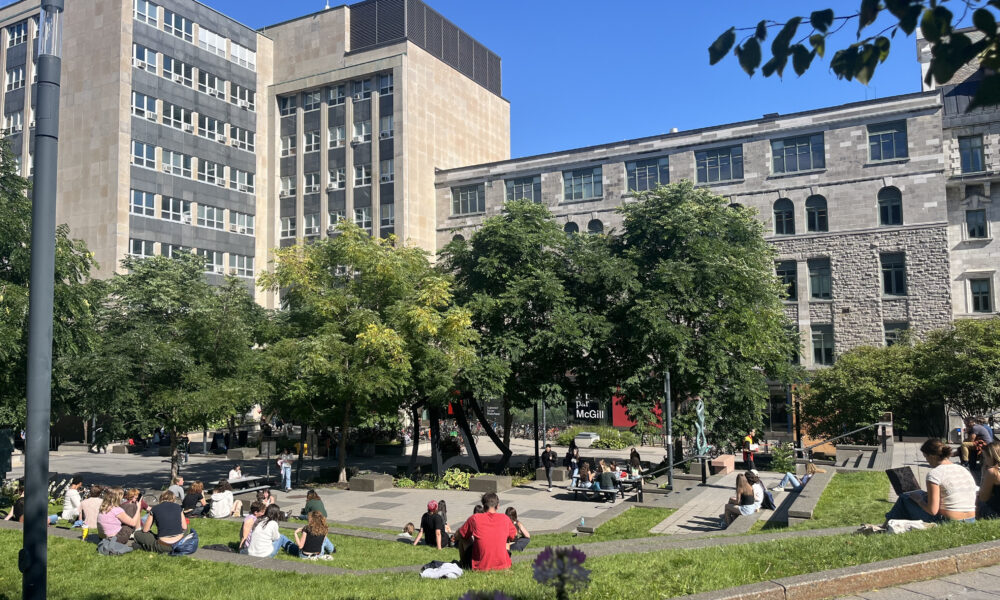
McGill closed its downtown campus to public use as the Service de police de la Ville de Montréal (SPVM) officers and private security firm, SIRCO, dismantled the 75-day Palestine solidarity encampment in the early hours of July 10. Beginning the same day, all buildings were closed to students, courses were moved online, the campus was blocked off to the general public, and the McGill University Emergency Operations Centre urged staff and students in an email communication to avoid campus. Regular campus use as a public park and studying space was effectively suspended. 

Partial restrictions were in place in the downtown campus through Aug. 5. Between July 10 and July 15, 18 buildings were closed entirely. Any research or courses in those buildings were moved online and all staff were required to work remotely, if able. On July 16, key card access was restored to these buildings for essential faculty and two entry points to lower campus were opened between 8 a.m. and 5:30 p.m.. Individuals were required to show their McGill ID before entering lower campus.  

The Roddick Gates were finally opened on July 22 and building access was restored to full public hours on Aug. 5, meaning that McGill ID was no longer necessary to enter lower campus.

As of Aug. 26, the Emergency Management page dedicated to the status of the gradual reopening process reads that those faculty, students, and staff who need to conduct university business on campus outside of opening hours “may do so, but must carry their McGill ID card and may be asked to present it.”

President Deep Saini wrote an email to the McGill community on July 18 explaining the administration’s intentions behind the closures. 

“Our phased reopening aims to reduce, where possible, the risk of occupations or vandalism […] incidents that were not legitimate forms of expression or assembly,” Saini wrote. “As we look ahead, we are called to reestablish a climate where each of us feels welcomed, celebrated, recognized, uplifted, and capable of sharing our views without fear of retribution, regardless of who we are or what perspectives we hold.”

The McGill Media Relations Office echoed Saini’s statement and further emphasized the closures as a means of avoiding further occupation of campus. 

“This approach also provided the time and space needed to stabilize the campus and provide all members of the community who have been working tirelessly for weeks the time and space needed to regroup, restore the campus’ physical state and operations, and to plan for the Fall term,” the Office wrote in an email to The Tribune.

However, some McGill community members—including those active in organizing for Palestine—have criticized McGill’s recent closures of campus. One professor involved in profs4palestine who wished to remain anonymous due to privacy concerns expressed disappointment in an email to The Tribune.

“It upset me—as did most everything else about the way the Administration reacted to the encampment,” they wrote. 

In an interview with The Tribune, Sonia Nouri, U3 Arts, explained her confusion and difficulties moving around campus during the closures. 

“When I finally went on [campus] it was really jarring how hostile the environment felt,” Nouri said. “It is really difficult to get around campus without having a confrontation with some kind of security or seeing someone else have a confrontation with some kind of security.” 

Passang Regyal, a Masters student in the Faculty of Arts and Science cited few disruptions to her daily routine but she was not happy with the closures and did not look on them as an appropriate means of quelling campus tensions. Both students made claims that the presence of private security and police was unnerving and threatening.

“I don’t think there was any adequate explanation provided by the university for the extent of the closures, especially when it comes at the cost of public use of the outdoor spaces and the solidarity and activism of the McGill community that the encampment represented,” Regyal said.

Read the latest issue

Read the latest issue