Latest News

McGill, News

Divest McGill celebrates BoG’s divestment from CU200 after over a decade of activism

On Feb. 8, students, faculty, and alumni joined Divest McGill in the Arts Building to celebrate the McGill Board of Governors’ (BoG) decision to divest from all direct holdings in Carbon Underground 200 (CU 200) fossil fuel companies by 2025. Divest McGill deliberately held the celebration in the Arts Building, where the organization had held an 11-day occupation just two years earlier, to call attention to the years of student activism that led to the BoG’s decision.

Lola Milder, U3 Arts, and member of Divest McGill, addressed the attendees in a speech. She highlighted that the decision came after a presentation the organization made to the BoG last fall, where Board members agreed to vote on divestment in December 2023. Following the vote, the BoG decided to adopt eight socially responsible investing (SRI) measures, including divestment from direct holdings in the CU200. 

At the celebration, attendees enjoyed food provided by Midnight Kitchen while sharing stories about their involvement in Divest McGill over the years. David Summerhays, a former Divest McGill member, spoke about his experience campaigning for divestment when he founded the organization in 2012 in an interview with The Tribune.

“I don’t know if I can communicate to you how small we felt when we started. Nobody knew who we were,” Summerhays said. “[When] we knocked on a door, we never knew what they were going to say. [But] the answer kept being, ‘we support you.’”

Harlan Hutt, U2 Arts and President of the Association of McGill University Support Employees (AMUSE), spoke about his experience protesting with Divest McGill against the Royal Bank of Canada (RBC) in 2021 and how it impacted him as a union leader. 

“The protest at RBC […] served as my introduction to student activism at McGill. I was able to connect with so many activists through this one protest, including people I still talk to, and who help inform my decisions as a union leader,” Hutt said. 

Frédérique Mazerolle, a McGill media relations officer, provided The Tribune with a statement by email, stressing that the administration is open to discourse with student groups.

“Through the years, the University has had discussions with members of student clubs such as ESG McGill and the student-run club Divest McGill to discuss our strategy,” Mazerolle wrote. 

Nonetheless, she maintained that the decision to divest was driven by the BoG.

“The decision by McGill’s Board of Directors to divest from carbon-intensive investment […] is a culmination of a carefully considered strategy implemented over the past few years, driven by McGill’s commitment to sustainability and aligning our investments with our values and community concerns,” Mazerolle wrote.

After more than a decade of organizing, many Divest McGill speakers questioned why McGill did not promise to divest before Dec. 2023. Summerhays said that the BoG’s decision reflects years of “snowballing” student activism. 

Milder thinks that although student activism played a role in the decision, the changing political climate was also influential. 

“I believe that if it was profitable for them socially and economically, [McGill] would still be invested. And so I think student organizing is part of what has changed that socio-political context and made [investments in fossil fuels] less feasible,” Milder said. 

Milder also outlined some of Divest McGill’s concerns with the BoG’s SRI initiatives, noting that McGill has yet to commit to divestment from indirect holdings in fossil fuels. Further, she expressed some ambivalence towards the BoG’s commitment to allocate 10 per cent of the McGill Investment Pool (MIP) to investments aligned with the United Nations Sustainable Development Goals, which include broad objectives such as “end[ing] poverty in all its forms everywhere.” 

“It is strategically vague, and students and faculty and other community members need to stay on McGill’s back to find out what those sustainable development investment goals are,” Milder said. 

Others, including Tamara Ghandour, U2 Science, stated that it is not enough to only divest from fossil fuels and called on McGill to divest from Israeli companies complicit in the war in Gaza. 

“So many issues are intersectional. Palestine is also an environmental issue. Environmental issues are also about violence and militarization and racism,” Ghandour told The Tribune. “There’s still so much divestment to be had.”

Milder echoed Ghandour’s sentiment about standing in solidarity with other student activist groups. 

“As we get to feel a little bit of relief at the beginning of victory, we can also give support to our allies [….] This is a moment for expansion for climate justice organizing at McGill.”

Features

Ethically sharing Indigenous stories: More than principles, it’s our journalistic responsibility

For the past year and a half, I have reported on the ongoing dispute between the Kanien’kehá:ka Kahnistensera (Mohawk Mothers) and McGill, regarding the university’s New Vic Project site, where concerns have been raised about potential unmarked graves. Beyond simply covering their tireless efforts, I’ve been granted the surreal opportunity to delve into a case embroiled in an information and public relations campaign by McGill. As a non-Indigenous person reporting on Indigenous stories, I grapple with the responsibility that accompanies this role and how mainstream media continues to fall short. 

The Case: From Legal Action to Public Relations  

This case has received extensive coverage from various news outlets throughout the litigation surrounding the New Vic Project site—whether it’s from Indigenous sources such as //Aboriginal Peoples Television Network// and //The Eastern Door//, student journalists, or Canadian mainstream media. 

 As the case has progressed, McGill faces increasing demands to justify its actions, which appeared inconsistent with its commitment to reconciliation and its use of student tuition to fund litigation. Representatives in the McGill Senate brought forward questions from students, compelling the university to provide answers. In response to criticism surrounding this case, McGill engaged in a public relations campaign. This included roundtable discussions with student media outlets and McGill Provost and Executive Vice-President (Academic), Christopher Manfredi, sending 11 emails since July 2023 to all students and faculty to communicate updates. On Dec. 20, 2023, Manfredi emailed students informing them of McGill’s decision to appeal Justice Gregory Moore’s Nov. 20 decision to reinstate the court-appointed archaeological panel and to clarify “salient facts.” 

In recent communications, McGill administrators have redirected the conversations from the case itself to the narrative surrounding it. Manfredi even expressed concern over the misrepresentation of the New Vic Project.“For the past nearly two years, the [Project] has been frequently mischaracterized in the media and in various information campaigns. Much of what has been written and said about the [New Vic Project] is incomplete or misleading. The moment is opportune to clarify critical details,” Manfredi wrote. 

However, Indigenous students, such as Leah Louttit-Bunker, U3 Arts, believe McGill has “been falsely implying that there are no unmarked graves” on the site at all through these emails. Additionally, according to Louttit-Bunker, McGill has failed to provide the Mohawk Mothers with the same level of transparent communication.

“McGill has easily communicated email updates to all members frequently, but has been failing to communicate transparently with the Mohawk Mothers,” Louttit-Bunker wrote to //The Tribune//. “It is disrespectful to Indigenous sovereignty and counteracts the land acknowledgements the institution gives. I think that the lack of communication and cooperation with the Mohawk Mothers shows a big ethical concern surrounding reporting on Indigenous issues.”

The Mohawk Mothers: The Burden of Misrepresentation

As the public relations campaign progresses, reporting on the case has varied greatly among different media outlets, imposing a significant burden on the Mohawk Mothers to ensure that their views and experiences are accurately represented.

Furthermore, the Mohawk Mothers have felt the weight of misinformation and mischaracterization. In an interview with //The Tribune//, Mohawk Mother Kwetiio expressed that she feels that a burden is placed on her when speaking to reporters about the case, as every word she says has to be well thought out before it is said. Sometimes, her words will be entirely omitted, as news outlets are unable to “fact-check” the Indigenous protocols and references that she makes. 

“In the media, in all actuality, it is up to us to choose wisely what we’re going to say, so that it cannot get manipulated,” she said.

Larger media outlets tend to report on the case based on information provided in press briefings after the hearings. On the other hand, reporters from smaller outlets have closely followed the story, attended every case management hearing, and developed personal connections with the Mohawk Mothers. 

Reilley Bishop-Stall, assistant professor of Canadian Art and Visual Culture at McGill, shared in a written statement to //The Tribune// that she feels that the coverage she has seen on the Mothers has been restricted, without significance given to the extent of history at stake. 

“Reporting on this situation has, in my mind, been limited and, particularly in Montreal, should be getting more attention than it is,” Bishop-Stall wrote. “There is so much more information available and such a rich history of the site that more of the public needs to be made aware of.”

When providing case updates, big media outlets have failed to regard the information that the Mothers and assisted researchers have compiled and made openly available online that shares the incomprehensible abuse that took place at the former Allan Memorial Institute. The Institute was a research and psychiatric centre that allegedly performed psychological experimentation on unconsenting patients between 1943 and 1964. Karonhia’nó:ron, BA ’23, told //The Tribune// that it is very clear to him which outlets actively follow and engage in the story. 

“It’s really interesting seeing the ways that different publications have reported on the Kahnistensera’s court case and the archaeological work happening at the New Vic. It didn’t take me long to recognize which journalists were consistently showing up to the site or the courtroom to document what’s going [on],” Karonhia’nó:ron wrote.

Canadian Mainstream Media 

Along with failing to wholly and extensively report on the Mohawk Mothers, major Canadian media outlets have also shown their shortcomings when it comes to reporting on Indigenous stories. Their lack of consultation with diverse Indigenous voices has stained coverage, resulting in overgeneralizing portrayals of Indigenous peoples as one homogenous group, rather than individuals. 

“I noticed that the media in general, I would say the bigger media outlets, don’t like to, first of all, make Indigenous people seem personable. It seems like they would rather just be a group of like the last four natives left on Earth,” Kwetiio explained. “I noticed that we’re never looked at like we are people. There’s no intimacy whatsoever on it, and the matter is very intimate.” 

Indigenous reporting is riddled with a lack of proper investigative and empathetic journalism. As Kwetiio says, Indigenous people are “portrayed as something of the past.” Furthermore, the tendency of major outlets to only publish Indigenous stories that focus on Indigenous pain and suffering, without any care given to Indigenous life and joy, actually causes further harm to Indigenous people. Karonhia’nó:ron shared that he has been taking a break from consuming media concerning Indigenous issues as it began to weigh down on him. 

“I won’t lie, I’ve been taking a break from my media consumption for the past couple of months—especially as it concerns Indigenous issues. Of course, I follow the stories concerning the Kahnistensera and my community—but in general, I’ve been scared to seek out any kind of news,” Karonhia’nó:ron wrote. “I’m scared I’ll see reporting on the Winnipeg landfill or ground searches at residential schools. Being exposed to those kinds of stories regularly really affected my mental health in the past.”

Moreover, highlighting the theme of reconciliation in every story is counterproductive. This approach reinforces settler-colonial objectives that allow institutions to falsely project validation, suggesting that they are fulfilling their anti-oppression mission, while their actions contradict that discourse.

Indigenous Papers and Student Reporting

These continuous failures from larger media outlets have illustrated the dire need for alternative media sources. //The Eastern Door//, a newspaper based out of Kahnawake, focuses on Indigenous people and their stories beyond community grief by providing a platform for Indigenous tradition and family stories. In 2022, they started an initiative dubbed //Sharing Our Stories// to allow Kanien’kehá:ka (Mohawk) elders to recount their anecdotes, aiming to preserve Kanien’kehá:ka histories and culture. The stories—published in both Mohawk and English—are used as a teaching tool for Mohawk heritage and language. 

In May 2023, //Sharing Our Stories// began operating as a non-profit entity, separate from //The Eastern Door//. Steve Bonspiel, an editor and publisher for //The Eastern Door//, explained the process behind finding stories in an interview with //The Tribune//. He emphasized how after sitting down with an Elder, listening to them share their story, and writing up the piece, it’s critical to ensure that the Elder is comfortable with the written story. 

“They have to see it and agree with what’s on the paper and sign off on it. Sometimes they’re not as comfortable, sometimes they want to hold off on certain stories, and then, of course, you have to get images to go with it, old photos and whatever else. So, altogether, it’s a big process,” Bonspiel explained. 

Additionally, smaller papers such as //The Eastern Door// often have much more personal connections to the tight-knit communities that they report on. As Bonspiel shared, journalists report on the people that they see around their community, whether it be at the grocery store or the bank. That personal touch allows reporters to carry empathy and care into their reporting. 

Bonspiel also shared that he felt student journalists are in a unique position when it comes to reporting on sensitive stories, as they’re often motivated by a stronger desire to grasp the topics they cover. However, like other non-Indigenous Canadian journalists, they can still face the challenge of not understanding firsthand the Indigenous issues that they cover. 

“Even if you’re a student journalist and try to find as much as possible, not necessarily inherently, not only understanding issues, because that’s a hard thing to do sometimes, but it’s also living the issues,” Bonspiel said. “Living the issues is the hard thing because I can’t impart that on you, that we live with all of these colonial institutions around us, who stole our land, never gave us money, who continue not to give us money, and continue to stonewall things like searching for graves.” 

Improving Practices of Reporting on Indigeneity 

With false depictions, overgeneralizations, a lack of Indigenous individuality, and institutional deceptions, Canadian reporting of Indigenous stories has not met baseline journalistic standards. So, the big question is: How does one go about reporting on Indigenous stories, especially if the reporter is not Indigenous themselves? 

Journalists should start with being well-versed and knowledgeable about the story they’re approaching. That can happen through research, asking for guidance from experts in Indigenous reporting, setting up interviews, and looking beyond mere press releases from the institutions—such as the Royal Canadian Mounted Police and the Office of the Correctional Investigator, Independent Ombuds and Oversight of Federal Corrections in Canada—that actively work against Indigenous people’s interests. 

“I always say you don’t have to know 500 years of history, but you better make damn sure that you know what you’re talking about, whatever the story is,” Bonspiel said. 

Next, journalists must practice empathy, and they must try to grasp and follow Indigenous storytelling. 

“Storytelling really varies from family to family and community to community. Personally, storytelling has been a really important aspect in teaching me things I wouldn’t normally learn in most standard classrooms. There is emotion, lived experience, and gratitude when hearing a story; stories are lessons that never leave you. My dad used to say that I’d learn more during a day spent with him than a day at school,” Louttit-Bunker said. 

Moreover, journalists should have a keen attraction to the truth. As Karonhia’nó:ron explains, the Mohawk word for “news” is “iorì:wase,” which he interprets to mean “the truth going around.” Various media outlets promote different truths, presenting varying lines of evidence, which makes it difficult for readers to navigate the truth. Whether or not the truth serves as a satisfying punch-line for readers, sources and outlets must maintain their duty to report honestly. Additionally, Kwetiio hopes that reporters exercise a level of integrity to fact-check what they’re told, even from an Indigenous person, to ensure that they do not falsely depict an Indigenous community. 

“When I understand that someone non-Indigenous is reporting, I would hope that a certain essence is understood that yes, we’re native and we’re talking […] but it also needs to be investigated what we’re saying before it is printed because that influence is very strong,” Kwetiio said. “We’re in a time when many [Indigenous] people are searching for what their own ways are, and this can be a big influence on them. If they heard that another Indigenous person said something, and it’s put out there, they’re taking it at its word that journalistic integrity is used.”

Producing a factual news piece involves talking to a variety of sources. This is especially important when reporting on Indigenous stories, especially when the media frames one Indigenous person’s perspective as being the sole perspective of all Indigenous people across Canada. 

“This tokenization is very harmful and creates a very black-and-white portrait of Indigenous politics and identities. Even though what I’m saying here is what I hold to be true, I can’t say the same of every Mohawk person, or every Indigenous student at McGill. We’re complex, we disagree—just like everyone else,” Karonhia’nó:ron wrote. 

Most importantly, look at Indigenous stories from a lens beyond suffering. While stories about Indigenous grief deserve to be platformed, Indigenous people, especially Indigenous youth, deserve to share stories that go beyond their suffering and instead centre on themes of inspiration and happiness. 

“If all you grow up hearing is stories about trauma, violence and death, it makes you wonder what your future is going to look like, or if you’ll even have one,” Karonhia’nó:ron explained. 

Kwetiio added to this sentiment, stating that her history goes beyond residential schools. This lens should extend beyond media, and instead, should institutionally expand the Canadian curriculum. Kwetiio has been working alongside various women’s societies across Turtle Island that seek to expand the Canadian education system’s mandate on Indigenous history, with the atrocities of residential schools to be introduced into the curriculum. However, Kwetiio felt that her history was devised from her day-to-day experiences as well. 

“I don’t want residential schools to be my sole history and culture that they learned. I want the land and the people, that these other economic and corporate systems live on, to have to learn what our ways are first. That should be what children are learning,” she said. 

Reporters must learn to report on Indigenous stories with empathy and journalistic standards that involve diverse consultations, fact-checking, and expansive views of what constitutes an Indigenous story. Indigenous reporters must be encouraged, supported, and celebrated. Indigenous stories must be heard, pitched, and platformed.

Reporters must not continue to burden the very communities they purport to uplift. 

Soccer, Sports

Why my heart is behind South Africa’s ‘Bafana Bafana’ in this Africa Cup of Nations

Saturday’s quarterfinal victory over Cape Verde was not the first time that South Africa upended expectations in this Africa Cup of Nations. This was not even their first shock of this tournament; earlier they defeated World Cup semi-finalists Morocco en route to the upcoming semifinal against Nigeria on Feb. 7. The “Bafana Bafana,” nicknamed after a popular Zulu saying meaning “the lads,” are defying expectations and making a name for themselves along the way. 

But, these mesmerizing performances are not what makes them truly unique. The South African national team, along with already-eliminated Namibia, is among the few teams whose players are all born in the country they represent. Furthermore, the majority of the squad plays in the South African Premier Division. While African teams such as Morocco and Algeria have found success by embracing their diasporas, there are concerns that relying on foreign-born players is “fast-tracking” success and undermining efforts to grow the African game on the continent.  

Africa has been touted as an “under-valued” market, where European clubs can find stars at a fraction of the cost due to the strong footballing cultures and lack of formal professional infrastructures compared to the European and South American football landscapes—the historical sources of talent in world football. However, the growing presence of European club scouts on the continent does not signal the growth of the game: After all, the careers of George Weah, Jay-Jay Okocha, and Didier Drogba show that Africa has always had incredible footballing talent.

For African countries to achieve success on the international stage, the game needs to grow in Africa. There is a need for new solutions to propel this growth. Instead, the expansion of the European player markets into Africa reflects a hunger to commodify young talent as soon as possible and extract them from their domestic leagues—if they ever had a chance to play in these leagues at all. These opportunities are often life-changing for the players and their families. But the increased centralization of global football on Europe remains detrimental to the development of the African football landscape as a whole.

Every country that has won one or more (men’s) World Cups have been supported by a healthy, established domestic league. Players grow familiar with each other in their own distinct footballing cultures. It is not a coincidence that it has become increasingly difficult for South American countries to compete over the last 20 years (until 2022), despite producing arguably the best players of any continent. Over this time, the European leagues have become even more powerful and flooded with cash, and these same neocolonial dynamics reproduce themselves there. Even Lionel Messi famously joined Barcelona at just 13

These dynamics are especially troubling when we consider the long history of European extraction from countries in the Global South. Why wouldn’t these patterns replicate themselves in football? Those who have power have not changed all that much since the wave of African independence

The dream for a global landscape where football development is evenly distributed is both compelling and vitally important. Naturally, some leagues will be stronger than others—greatness attracts greatness. However, for African countries to achieve success, their domestic leagues must be worth staying in beyond the age of 18. In South Africa, salaries, player conditions, and football infrastructure are robust enough that players do not need to leave for better compensation in Europe. As billions of fans can attest, the football does not need to be the same quality as the Premier League to be worth watching. 

Nine starters from the team that defeated Cape Verde in penalties play in the South African Premier Division, with eight playing for top-of-the-table Mamelodi Sundowns. The squad exhibits the kind of chemistry expected from players who compete with each other on a daily basis. 

Nigeria has a compelling squad, with riveting stars who play for elite teams in Europe such as Victor Osimhen and Ademola Lookman. Despite this, on Wednesday, my heart and support will be behind South Africa, a team that models the potential of African football propelled by internal growth and investment, rather than centred on the needs of Europe’s “Super Leagues.”

Editorial, Opinion

Abortion access and trans rights are non-negotiables

After decades of financial struggles, Clinic 554, the last private practice to provide surgical abortions in Fredericton, New Brunswick, permanently closed on Jan. 31. With the province refusing to allow Medicare to cover the cost of private clinic procedures, Clinic 554 worked on a pay-what-you-can model that eventually led to its end.

Clinic 554’s services addressed the devastating gap between Canada’s legal provisions for abortion and the reality of limited access for people who need them. Though abortions are legal in Canada, accessibility remains an obstacle for many, especially people outside of urban centres. With the overcrowding crisis in hospitals, our underfunded health care system creates long wait times for anyone who needs an abortion.

Abortion pills such as Mifegymiso, touted as a solution to the problem of limited access to surgical abortions, are expensive and subject to shortages, leading to long wait times that rival those for surgeries. The obstacles to receive an abortion continue to compound as Canadian politicians carve out reproductive and medical justice.

The most significant accessibility barriers emerge from systemic mistreatment and inequity across imposed divisions of race, gender, and class. Anti-abortion movements have long targeted all women’s reproductive rights, but abortions have still always been most available to wealthy, white, cis women who the health care system prioritizes. The Canadian medical system reproduces settler-colonial abuse and medical malpractice toward Indigenous peoples and continually underfunds community-based health organizations. Canadians should not have to leave their town or province to receive an abortion, especially not Indigenous and two-spirit people on whose lands these clinics operate. Similarly, due to the long and continuous history of medical racism toward Black people and people of colour, many communities rightly distrust medical institutions built to exclude them.

Clinic 554’s closure and the erosion of reproductive rights throughout North America indicate the rise of intimate policing of women’s, trans people’s, and nonbinary people’s bodies. The Conservative party leads national polls and, though nominally pro-choice, leader Pierre Poilievre fails to politically align himself with publicly pro-choice party members. The current threats to abortion access in Canada—and the increased threat of a Conservative government—demand a reckoning with how the state denies bodily autonomy to marginalized people in Canada through its laws and institutions.

On Jan. 31–– the last day that the clinic could stay open––Alberta premier Danielle Smith announced new policies preventing trans minors from transitioning and requiring parents to opt their children into education about gender, sex, and sexuality. The Conservative premier spread misinformation about minors transitioning in the name of “protecting” the province’s children. Smith failed to acknowledge that children with transphobic or homophobic parents will be even less safe with legislation in place that harms them. This regressive movement spreads fear about gender, endangers 2SLGBTQIA+ children, and works in tandem with anti-abortion measures to control who gets full citizenship rights in Canada.

Anti-choice activists and legislators failing to provide adequate access to abortions decreases the potential for safe ones. “Pro-life” policies consistently go hand in hand with the limiting of social services for children in marginalized communities and at-risk women, trans people, and queer people. At the institutional level, McGill and other medical schools all but omit abortion education and training from their curriculum. Students—and Canadian citizens generally—must fight to improve abortion education and services to preserve an essential medical service. Canada’s first abortion clinic, the Morgentaler Clinic, opened in Montreal fifty-five years ago—the struggle for reproductive rights must continue in this city. This work begins by recognizing that abortions and bodily autonomy are fundamental human rights. When students have open and vocal conversations about abortion access, birth control, and trans rights and health care, this pushes pro-choice and open-minded legislators to invest in these services. Students have a responsibility not just to pressure McGill to provide better services to students and better training to doctors, but also to advocate for the current services that on-campus organizations such as the Peer Support Centre, Union for Gender Empowerment, the Trans Patient Union at McGill and the Subcommittee on Queer Equity make possible. We must demand continued support for these essential services in the face of efforts to uproot them.

Know Your Athlete, Sports

Know Your Athlete: Charlene Robitaille

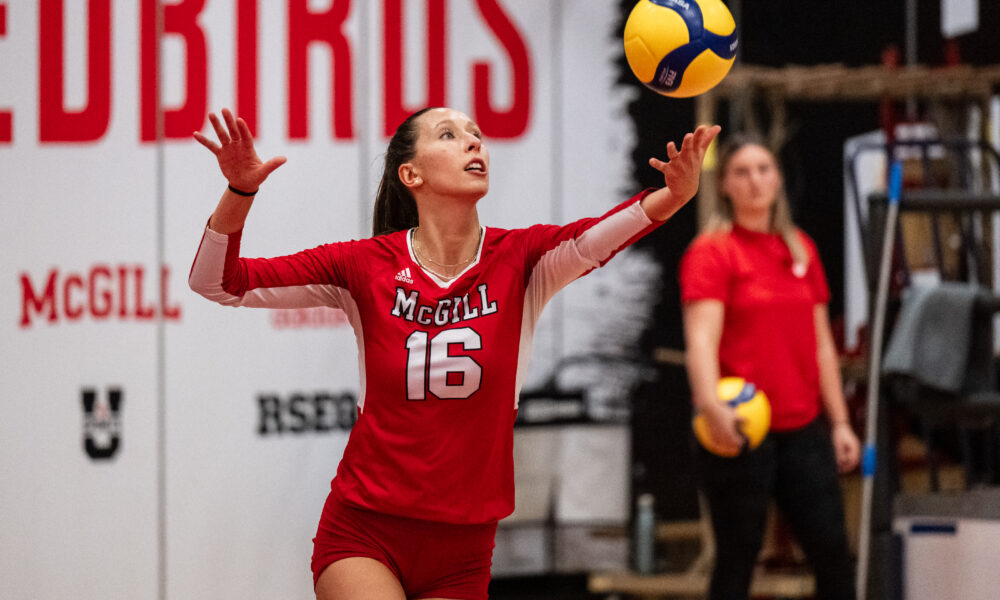
Charlene Robitaille is renowned for her volleyball prowess. Martlet fans are familiar with her skill on the court as well as her history of awards from the Réseau du sport étudiant du Québec (RSEQ), which includes best middle blocker two years in a row and most valuable player. But despite her volleyball success, Robitaille’s athletic career did not begin on the court. It began on the soccer field when she was just five years old.

Robitaille tried volleyball in her first year of high school after a friend on the team suggested she switch sports. Her career took off after a coach saw her potential in secondary four. This led her to change schools so that she could be trained by an experienced coach on a competitive team. From there, she committed to CEGEP Édouard-Montpetit where she led her team to a fifth place finish in the Canadian championship and carried them to victory at the 2014 Jeux du Québec

The transition to university volleyball went hand in hand with a welcome shift in coaching style.  While just a rookie at McGill, she felt extremely lucky that the graduation of two middle blockers allowed her to secure a place on the court. Robitaille felt supported by a coach who trusted her and was confident in her team’s ability to succeed. 

Amid MVP awards and All-Star team nominations, Robitaille found an unexpected takeaway in her personal growth. 

“You’re not always going to agree with your teammates, and you have to deal with that,” Robitaille explained to The Tribune. “It’s relationships that you have to deal with to continue even if you’re exhausted. You need to go to practice and do your best.”

Robitaille feels the lessons she’s learned in volleyball are preparing her for the rest of her life. 

“I think that [volleyball makes you think] outside of yourself. What are your openings, what are your options? Everything like leadership, self-growth, not panicking in rough moments—it’s organization.” 

Robitaille says developing her game day mindset has taken a lot of work. Her anxiety began as a rookie before the pandemic and continued to manifest after.

“I’m the kind of perfectionist that doesn’t want to make any mistakes,” Robitaille said.  “Volleyball is a sport of mistake[s]. If there’s no mistakes from any person, there’s no points. I hate making mistakes in general. I had to learn to accept them, because they will happen for sure,” she explained. 

One of her biggest challenges presented itself the year after the COVID-19 restrictions loosened in 2021-22. Robitaille described moments where mental health struggles took over, causing her to question whether she wanted to continue playing.

“Sometimes I was literally like, can I just quit? Why do I stress like that? Why put that stress on myself? It’s not fun,” Robitaille reflected. “On a game day, I couldn’t do anything else. I was not able to concentrate on work, on anything [….] I was so disconnected.”

She began journaling, meditating, and listening to podcasts to alleviate the pressure she put on herself. Robitaille also credits her coach, Rachèle Béliveau, as a major part of her support system. 

Robitaille recalled a moment two weeks ago where she was unfocused during an important match. 

“If [this had happened] two years ago, I would have told myself, ‘Okay, that’s not my day and that’s it,’” Robitaille explained. “But I was able to refocus and play my best. I was really, really proud of myself.”

As she heads into the final three games of the Martlets’ season before playoffs, Robitaille focuses on her appreciation of the game.

“I really want to enjoy it. I know I have the skills, I know I can bump, I know I can hit, so now it’s just about having fun.” 

Regarding achieving her goal of enjoying herself, she believes it is a process, as every game demands different things. When points flow easily, Robitaille thoroughly enjoys herself, but when a tough game occurs it requires a reminder for her to be kinder to herself.  
The Martlets will play next on Feb. 9 against the UQTR Rouge et Or (2–15).

Arts & Entertainment, Books

Childhood through the ages

Aesop’s Fables (1571) is the oldest book in McGill’s Rare Children’s Book Collection. Written in Latin, with interpretive notes in Greek, it’s now housed in a collection of children’s literature—despite predating the Victorian conception of childhood itself.

But this story also begins later, in the 1930s, with Sheila R. Bourke. As a child, Bourke had polio, which kept her bedridden for three years. She spent her days with children’s books, and she fell in love. 

Bourke—who celebrated her 97th birthday last year—went on to graduate from McGill with a BA in 1949. She maintained her love of children’s books and went on to collect thousands of them. In 2011, she donated 2300 works to McGill’s Rare Books and Special Collections (ROAAr).

On the shelves of the fourth floor of McLennan, a world at once lost and intimately familiar materializes: A world where Kate Greenaway’s garden is always in full bloom and lavender is always blue; but also the bloody world of Bluebeard and the sea where The Little Mermaid dissolves into foam. 

Bourke’s collection ranges from miniature books, the size of a palm, to majestic volumes, hundreds of pages thick—in English, German, French. Included in the collection are the secret world of fairies, the Firebird, foolish foxes, Cinderella, Schippeitaro, Snegurochka; authors from Aesop to Pullman; and illustrators and engravers from Edmund Dulac to Edmund Evans. 

Some titles have stood the test of time—Puss in Boots, The Three Little Pigs. Others, such as Valentine and Orson—a publishing plum of the 19th century—were not so lucky.

Children’s literature, often underestimated and challenged, occupies a strange place in literary history. Deceptively playful, it reflects changing social conventions, global politics, the imagined “other,” what childhood is supposed to look like, and what happens when children grow out of it. 

A 1916 Edmund Dulac work entitled Fairy Tales of the Allied Nations features a compilation of tales from countries that emerged victorious from the First World War. It’s written in English. The Great War also changed how children’s books were produced: Prior to the war, many children’s books had been printed in Germany.

“​​[Germany was] really key in the development of colour [Chromolithography] […] If something is beautifully colour printed, odds are, before the First World War, it was printed in Germany,” Jacquelyn Sundberg, an Outreach Librarian with ROAAr, told The Tribune. “They were leaders in the field up until politics cut off trade relations between Germany and the rest of Europe. And then everybody else had to start printing their own things.”

Contemporary debates surrounding banned books have generated frenzy both online and offline. But these debates return to the same question that children’s literature has been grappling with from the beginning—who is children’s literature for, and what is its purpose?

“I don’t think that denying access to a book is going to stop its ideas from spreading,” Sundberg said. “Because for every book, there’s a person who needs to read it, either to be exposed to an opinion that’s not their own, and to learn from it, or possibly to have their opinion shifted by it.”

Books contain ideas. Within their pages and illustration, between the words, in the ridges of engravings. But they also reflect ideas back. Reading children’s literature—and indeed literature more broadly—allows us to know ourselves and our societies better in the figures and ideas we see living inside the work. 

The preservation of children’s literature is intimately intertwined with the despondent truth that for much of human history, children died as children—many still do today. The stories in the Sheila R. Bourke Collection have survived centuries of oral storytelling, moved across various kinds of borders, and undergone translations into and out of numerous languages. 

It can also be said that these books survived because Sheila R. Bourke survived polio. Many works of children’s literature have been lost. But the stories we have—physically, or in memory—allow us to glimpse back into not only a beautiful, messy historical past—but also our own personal ones. 

An exhibition of the Sheila R. Bourke Collection is viewable online. Individual works from the Collection can also be viewed in person by request through Worldcat.

Out on the Town, Student Life

Igloofest: A must-do for every Montrealer

A brooding night sky hangs above you, and a couple of stars wink lazily in the frigid Montreal air. In the momentary silence, we all hold our breath—nearly ten thousand of us, from university students to parents, travellers to locals. I can imagine the quiet lap of the icy water against the pier beyond the stage. We wait, our excitement tangible and our presence heating the air around us by at least ten degrees, until all of a sudden a synthetic bass beat electrifies the crowd. Immediately, people start to move, jumping to the beat, waving their arms with the strobe lights, letting the erratic sounds and timbre take control. 

Since 2007, electronic dance music (EDM) has energized Montreal’s Old Port in the dead of winter, persuading thousands of people to leave their cozy beds and brave the city’s negative temperatures for several hours. 

Max Gross, U1 Science, described the festival’s unique ambiance in an interview with The Tribune.

“The atmosphere is really unlike anything there, however, and Igloofest is chilly in line but sweaty as hell when inside the main stage area,” Gross explained. “I went more for the crazy atmosphere than the music and I think a lot of people can relate to that.” 

With two stages—one massive and the other more cozy—several interactive tents, and food and beverage vendors, the festival has more than enough to keep anyone entertained for the night. 

Depending on your desires, there are many ways to approach a night at Igloofest. If you are coming from afar or have a distaste for lines, I suggest going early. Getting to the festival around 7:30 p.m. will have you inside the gates in about 15 minutes when everything is only just starting to fill up. Take your time to visit the beverage stands, where you can get a multitude of drinks that come with a festive reusable cup. Maybe mosey around to the sponsor tents and follow a live choreographer to gain the upper hand on all the dancing that’s bound to come, or grab some free samples (this year it was Cadbury chocolate, yum!). 

If you start to get hungry, visit one of the food trucks that promise to supply a variety of spins on poutine. I suggest hurrying to the enclosed room beyond the second stage to keep your food warm and let your fingers defrost before the night’s finale. Being early also gives you the advantage of casually picking your spot for the concert and finding fun neighbours in the crowd. 

But if you’re not interested in spending that many hours outside, pregame at home with friends before heading to the festival, and save some money by eating beforehand. After all, as Gross put it,“The pre is always more fun than the post.”

For Karthikeya Gautam, B.A ‘23, Igloofest’s negative temperatures push the boundaries of outdoor music festivals.

“We have a general perception about the winter—once Christmas is done, that’s it,” Gautam said.  “No enjoyment for the next four months. But Igloofest challenges that very idea, that it doesn’t matter if the sun is setting at 4 p.m. every day: You can still get together with a bunch of people, head outside, and dance to your hearts content.”

Spanning four weekends, Igloofest showcases countless incredible artists—I can personally vouch for Diplo and Armin Van Buuren, who gave unforgettable performances. 

Another lover of Armin Van Buuren’s performance, Léna Ginesta, U2 Arts, confirmed the festival’s allure in an interview with The Tribune

“Igloofest was definitely one of the craziest things that I have experienced in Montreal. It is a must-do for anyone who’s in the city while it’s taking place,” she said.

Whether you’re an EDM fan or not, bundle up and get yourself down to Old Port. The atmosphere, musicians, and the beauty of falling snow glowing in neon light promise a surely magical night. After all, can you really say you had the Montreal experience without going to the world’s coldest music festival?

Arts & Entertainment, Books, Film and TV

‘American Fiction’: A movie about movies about books

Spoilers for American Fiction

“Nuance doesn’t put asses in theater seats.”

At least, that’s what fictional movie director Wiley Valdespino (Adam Brody) says in the final scene of Cord Jefferson’s American Fiction. In the Cineplex that I trekked out to on a Tuesday after class, the audience let out a collective laugh. I looked around suspiciously. Then why are there so many asses in these seats?

There is no denying that American Fiction is a nuanced movie filled with meta-cinematic moments and witty dialogue. But when protagonist Thelonious “Monk” Ellison (Jeffrey Wright) adapts his life into a screenplay, Wiley points out that a story with an ambiguous ending won’t work for a movie. As they cycle through potential endings for the film—letting them play out on screen—the film self-consciously sheds light on the difficulties of adaptation. 

American Fiction is, itself, a literary adaptation of Percival Everett’s 2001 novel Erasure. When I first read Erasure, I hadn’t met anyone outside of my English class who had even heard of it, but somehow I found myself attending a packed screening of American Fiction almost a month after the film’s theatrical premiere. How has the process of adaptation given this story new meaning?

Erasure is a book about books. It follows Monk, a professor and writer who is repeatedly told his work isn’t “Black enough.” In response, Monk writes a satirical, intentionally offensive novel called “My Pafology,” giving his publishers what they seem to want. He publishes it under a pseudonym, only to find that the novel becomes an unironic bestseller. Erasure identifies the limited literary space that publishers give to Black authors, where depictions of poverty and dysfunction are lauded over the multiplicity of Black experiences. 

Erasure is sprawling and multifaceted, with digressions that encourage close reading. By contrast, American Fiction strips away the more ambiguous details, instead emphasizing the plot-driven family drama and comedic moments. The novel chooses to print Monk’s book in its entirety, filling 60 pages with over-exaggerated dialect, blatantly offensive stereotypes, and violence. This works as part of the novel’s complex patchwork-like structure, allowing readers to experience exactly the kind of exploitative book Erasure is critiquing. By contrast, inserting such a huge tonal shift into American Fiction would complicate its genre-signaling. Instead, Monk’s novel is depicted in a single short scene, where his characters materialize in front of him as he writes in his office. As Monk dictates their dialogue, American Fiction manages to convey the voice of the novel without engrossing viewers in gratuitous violence or compromising the film’s comedic tone.

The focus of Erasure’s critique is the literary field. Released in the early 2000s, it scrutinizes the critical acclaim of books such as Sapphire’s Push, a novel that excessively depicts Black trauma. While Erasure assumes that its readers are more familiar with the literary landscape, American Fiction can’t assume the same from its audience of moviegoers. Because of this, the film includes a final scene that poses a new critique. The white director of Monk’s screenplay rejects all of the film’s potential endings only to finally show enthusiasm when Monk suggests a violent conclusion involving police brutality. As he leaves the film lot, Monk shares a nod with a young actor dressed in the costume of an Antebellum-era enslaved person. Here, American Fiction shows how depictions of Black pain continue to retain cultural capital in the mainstream context. By broadening the scope of its commentary to form a meta-critique about movies, American Fiction manages to convey the essence of Erasure while expanding its reach to a wider audience.

Commentary, Opinion

Is a student strike effective? It’s complicated

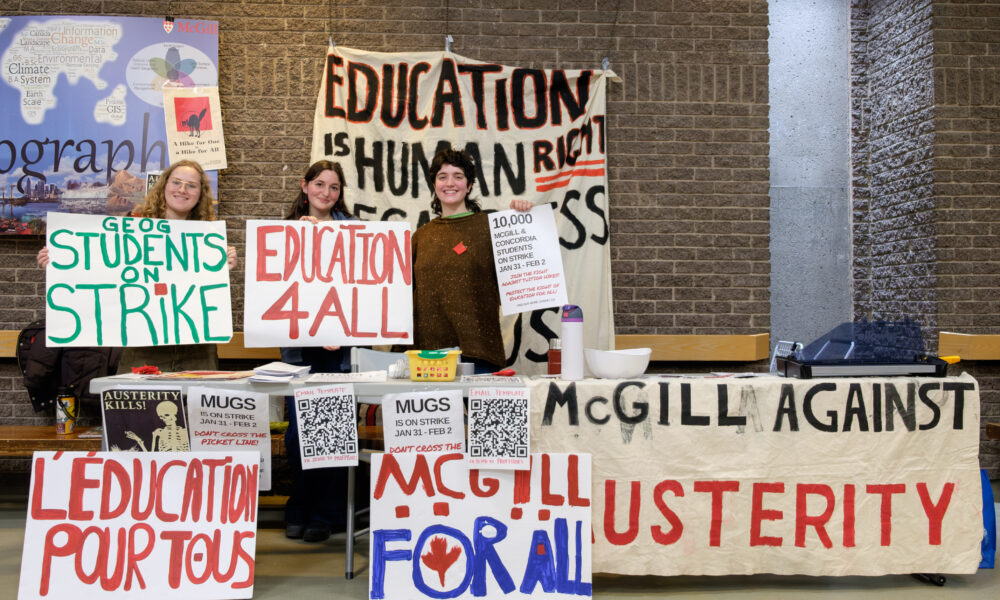
On Jan. 25, the McGill Religious Studies Student Association (RSUS), the Student Association of Sustainability, Science and Society (SASSS), and McGill Undergraduate Geography Society (MUGS) announced that their members would be on strike from Jan. 31 to Feb. 1. The strikes joined Concordia students in responding to the Coalition Avenir Quebec’s (CAQ) tuition increase for out-of-province and international students at Quebec anglophone universities. The hikes triggered dismay throughout the McGill community as a whole, and for good reason––the hikes threaten our right to an affordable education. As such, any effort to reverse them should be applauded. Despite RSUS and MUGS’s admirable sentiment, history warns that without proper organization their efforts could be in vain. To succeed, student strikes have to understand and react to their material conditions. Student strikes demand effective coordination—to truly propel change, students must break into the public sphere and seize collective consciousness. 

Strikes have long been the tool used by unionized workers to make their voices heard; they voice their grievances with employers by refusing to work. For workers, striking is effective because it results in work stopping or slowing and their employer losing out on potential profit. Strikes work because they hit employers where it hurts—collective action leaves those in power with no choice but to listen. Last December, over half a million public-sector workers went on strike in Quebec in response to austerity measures from the CAQ. Workers in Quebec formed the Front Commun, an amalgamation of employees that collectively ratcheted up pressure on the government. The labour disruption’s climax was the seven-day strike in mid-December. As a result, workers were able to stave off the conservative CAQ cuts

Quebec has a strong history of students striking to protect their rights. Since the Quiet Revolution of 1968, students have never been afraid to express their discontent with government bureaucracy. Tradition can be a rallying cry, but it does not do enough to spur change in today’s circumstances. While current movements carry the sentiments of the past, their tactics are misaligned. 

  In 2012, hundreds of thousands of Quebec university students went on strike in what is now known as the “Maple Spring.” The movement rallied against Liberal Premier Jean Charest’s tuition increases for in-province students, eventually forcing the province to rescind the tuition hike and taking Charest’s government down with it. 

How did the Maple Spring achieve this success? By connecting with the public. The 2012 strikes expanded beyond university campuses, both literally and figuratively. Students blocked the Champlain Bridge, causing gridlock in Montreal, and picketed in front of government offices. Organizers formed alliances with some of the largest unions in Canada, who lent support in the streets and financially. By the end of the strike in fall 2012, people of all stripes supported the plight of the students. The 2012 student strikes were effective precisely because they were able to rally support and solidarity outside of campus. 

Workers’ movements force the government’s hand by halting the economy; students alone unfortunately have not pulled the same weight. Linking the students and workers together in struggle, however, has the potential to secure gains for both parties. Greater numbers means greater pressure on the government. Public sector workers prove to be a powerful force time and time again—banding students and workers together would create a formidable force.

 A student-worker alliance would further unions’ collective and broad reach. Take Stanley Grizzle, a leader of Toronto’s Division of the Brotherhood of Sleeping Car Porters elected in 1946. Railway porters in Canada were predominantly Black men who faced intense discrimination and exploitation. Grizzle used his unionized position to successfully advocate for fair treatment for all porters. Integrating students into the labour movement would only further its intersectional scope. 

The McGill and Concordia student strikes mark a solid start of a larger movement. Grassroots initiatives can spark political change, but limiting themselves to a small segment of the population restricts their influence. Social movements must rally broad-based support to make a sizable impact. The right to an affordable education resonates universally; to protect student rights, organizers have to treat it as a cause that matters to all. If strikes remain confined to university campuses they will remain a university issue, giving the CAQ no impetus to hear student interests.

Emerging Trends, Student Life

Are we well-informed at McGill?

In recent years, traditional media has continued its harrowing downward trajectory while audiences turn towards social media for news. On a campus like McGill’s, that emphasizes critical thinking and research skills, do students’ news-consumption habits reflect the digital age of 2024?

Data from Statistics Canada in November 2023 revealed that around 85 per cent of Canadians aged 15 to 34 get their news from social media or the internet. Bill C-18, the Canada Online News Act, which came into effect in December, requires tech companies to pay Canadian media for their content. Meta responded by blocking Canadian media links on Instagram and Facebook.

Where are we getting our news?

Nick Belev, U2 Science, answered this question candidly. 

“At least once a day I’ll see something news-related, usually it’s from a newsletter my mom made me sign up for, or from reels [and] TikTok and I’ll spend about 10 minutes reading it,” he said.

Belev is not alone. In fact, all of the students interviewed said that they receive news through social media, whether indirectly or directly. 

Aliya Frendo, U3 Arts, often relies on TikTok for news. She believes TikTok news, when approached mindfully, offers informative and unique perspectives and also serves as an entry point to other media platforms for more in-depth reading.

“Oftentimes, I’ll come across news clips on TikTok and that will prompt me to leave the app and look them up,” Frendo said. 

Other students, such as Anwyn Woodyatt, U3 Science, have different feelings towards social media as a news source but admit its pervasiveness in daily news consumption is a force to be reckoned with. 

“Indirectly, I end up getting most of my daily news from social media, which isn’t the most reliable source,” she admitted. 

Similarly to Frendo, however, Woodyatt says that she will look for sources beyond social media if the news she receives there is overwhelming or seems to be untrue. 

University’s Uniqueness

Despite the centrality of social media, McGill students interviewed hinted at one specific factor affecting news consumption on a university campus, their area of study. 

Toby Li, U4 Engineering, gets her news mostly from social media and conversations with friends. She feels like her friends in different faculties are definitely better-informed than she is.

“It varies between faculties like there are certain faculties [..]where you have to keep up with the news, like if you’re in research or something,” Li said. “For me in civil engineering, it’s always been the same, like there’s not much new.”

Woodyatt agreed, citing conversations with more politically aware students as a preliminary source of current events. 

“I feel like it’s pretty hard to not be aware of current events when you’re on a campus with people who study these things and are generally pretty up-to-date on these things,” Woodyatt explained. 

How do students feel about their habits?

Habits can change over time; sometimes, seemingly small changes can have a big impact. 

“These days, I’ll be honest, I’m pretty undisciplined about getting the news,” Belev admitted, comparing back to the days when he had to keep updated on current events for his high school political science course.

Becoming a university student has also had an impact on how Li gets her news. 

“Way back, when I was young and newspapers were a thing, I’d read the newspaper because it was delivered to our house,” Li said.  Her newspaper-reading habits stopped when she started University, and the paper was not delivered to her door daily.

While students such as Li and Belev admit that they wish they were more “disciplined” in their news consumption habits, those who are more up-to-date, like Frendo, sometimes struggle with the burden of the current media landscape, finding it tiring at times.

“I’ve fallen out of love with The Globe and Mail and CBC,” Frendo said. “For example, with the situation in Palestine right now, I just don’t find that I have any major news outlet that covers it in a way that doesn’t make me frustrated.”

Students can access various news outlets through McGill, see the McGill Library for more details.

Read the latest issue

Read the latest issue