On Nov. 16, Formula 1 (F1) made its first stop in Sin City since 1982. As the third and final American race of the calendar, the Formula 1 Heineken Silver Las Vegas Grand Prix (LVGP) is the penultimate race of the F1 season, one week before the Abu Dhabi GP kicks off almost 13,200 kilometres away. The decision to have back-to-back races located so far apart raises concerns about the environmental impact of the F1 season. However, the Fédération Internationale de l’Automobile’s (FIA) questionable environmental ethics were nowhere near the greatest concern of the disastrous weekend that was the Las Vegas Grand Prix.
Despite ticket prices dropping by up to 62 per cent before the event, the LVGP was one of the most economically successful F1 races in history, with an estimated $1.2 billion in economic impact for the city of Las Vegas. The race brought 315,000 fans, with non-refundable tickets and hotel deposits, and their expenses ensured the race’s financial success.
The LVGP faced significant technical issues from the get-go. In an attempt to cater to the European audience’s time zones, the race was set at night, not accounting for the extremely cold temperatures of the desert. On race day, the weather forecast predicted a minimum of seven degrees Celsius, prompting Pirelli, the official tire supplier of the FIA, to raise concerns about the drivers’ safety.
Mario Isola, the head of Pirelli, explained that cold reduces tire grip, increasing the chances of losing control of the car. This requires constant control of pace since the slightest slump in rhythm could put lives at risk simply from the tires cooling down. The only feasible solution was to change tires more frequently, as they are kept in heated blankets, going against Pirelli’s climate change action goal to limit the number of tires used. As the FIA decided to go forward with the race, McLaren driver Lando Norris’ accident came close to proving Firelli’s concerns. While officially the incident was caused by a bump on the track, the lack of grip on the tires heavily contributed to Norris losing control of his car and ultimately crashing into the barrier.
Despite starting on time, the LVGP came to a halt less than ten minutes after the Free Practice 1 (FP1) race began. One of the manhole covers was not properly bolted down, causing it to fly up, destroying the bottom of Carlos Sainz’s car––including his power unit––and sending sparks flying. The damages forced Ferrari to replace the car’s energy store––a set of batteries converting energy accumulated into electrical energy––despite each team only being allowed to replace them once per season. Ferrari requested an exemption from the regulations, citing external circumstances outside the team’s control, which the stewards denied, resulting in a ten-place grid penalty for Sainz.
This situation made fans wonder how such an incident was possible. FIA rules require that the initial inspection of tracks happens one day prior to the cars getting on them, yet the inspection only occurred at 3:30 a.m. (PST) on Thursday for the Strip Circuit. Moreover, recent changes in the Sporting Code loosened the level of exigence that the regulatory institution should have, granting the FIA the discretion to declare the circuit’s safety.
The subsequent inspection and repair of the track caused the FP2 to be pushed back to 2:30 a.m. PST on Friday. After the announcement of the delay, ticket-holders who had been waiting on the strip were forced to leave the venue. Many fans were single-day ticket holders for Thursday and their only solace was a $200 voucher to the official shop. On Nov. 18, Dimopoulos Law Firmfiled a class-action lawsuit regarding the compensation of fans. As talks of expanding the calendar resurface annually, the safety of the drivers and the audience must remain of utmost importance. After the extreme heat of the Qatar Grand Prix, the LVGP seemed to be the nail in the coffin for fans and drivers alike, encouraging them to ask for better conditions. Despite the remainder of the weekend carrying on relatively smoothly and Max Verstappen whisking away with another win, the FIA must unequivocally prioritize safety over superficial glamour and marketing ploys.
In an appearance on the broadcast of a game between the New York Knicks and the Boston Celtics on Nov. 13, National Basketball Association (NBA) Commissioner Adam Silver was asked about the league’s plans for expansion. Silver mentioned the possibility of the league one day further expanding internationally, potentially adding teams in cities such as Montreal, Vancouver, and Mexico City. While this is welcome news for basketball fans in Montreal and Quebec at large, NBA expansion to any of the aforementioned cities is far from imminent.
The NBA’s timeline for expansion is made clear by the commissioner’s previous statements. With the league’s current media rights deal expiring at the end of the 2024-25 season, the league must first focus its efforts on negotiating a new TV rights package––an essential part of the league’s revenue stream. Once this issue is settled, the league has expressed interest in adding two more teams, bringing their total to 32. All indications suggest that the NBA will first expand to Las Vegas and Seattle. This has not been kept secret: Michael Fortier, the leading public figure in Montreal’s prospective ownership group, conceded as much earlier this year. From there, it is unclear how quickly the NBA will want to expand to 34 or 36 teams. Adding too many expansion teams in rapid succession may have adverse consequences on talent dilution, with spots on NBA rosters being awarded to players who would not have made the cut in a league with fewer teams.
The commissioner’s comments on the matter do not represent a binding commitment from the league to Montreal, Vancouver, or Mexico City. In fact, Silver’s comments are likely to drive up the bidding price for potential suitors. When the league formally begins its expansion process, having many markets vying for a small number of openings drives up the buy-in price. Interested markets can also serve as leverage for clubs in public financing negotiations. If one of the league’s existing teams is in need of a new arena and local government officials are unable or unwilling to pony up public funds, other markets can be seen as relocation threats. This has been the case in Major League Baseball, with negotiations for public funding of a new facility in Oakland failing to bear fruit, recently leading to a unanimous ownership vote approving the team’s relocation to Las Vegas.
Non-coincidentally, the three markets mentioned by the commissioner recently hosted contests as part of the league’s Canada Series and Global Games. The success of these recent events gave Silver the opportunity to talk up the league’s popularity on a global scale. In October, the Bell Centre hosted a preseason game between the Detroit Pistons and the Oklahoma City Thunder, featuring Canadians Shai Gilgeous-Alexander and Luguentz Dort, the latter of whom grew up in Montréal-Nord. The event was a success for the NBA, with a sold-out crowd of local hoops fans in attendance helping to cement Montreal’s status as a city that is ready and able to support an NBA team.
Montreal has the makings of a city that can support an NBA team. It is one of the biggest markets in the United States and Canada that does not currently have an NBA franchise. It is home to a suitable arena in the downtown core. There has also been publicly stated interest from a group of local business people in bringing an expansion team to Montreal. And yet, several hurdles must first be cleared before any significant progress is made in bringing a team to Montreal.
While hoops fans in Montreal may hope to one day have an NBA team to call their own, it likely will not happen for quite some time. However, if and when that time comes, one can only hope it will lead to seeing a bit less Toronto Raptors apparel being worn on the streets of Montreal.
Bar le 21 buzzed with activity as McGill students, all swathed in eye-catching attire, swarmed the venue on Nov. 16.
The bar’s rustic wooden beams and soft lighting illuminated the throngs of students sporting original outfits—some of which they crafted themselves. Attendees pored over the new release of this semester’s edition of Pamplemousse—Circle of Fashion’s (COF’s) 78-page magazine brimming with eye-catching photos, diverse interviews, and personal articles exploring the intersection between fashion and identity.
As McGill’s main fashion and design club, COF aims to provide a space for the university’s designers, models, photographers, writers, and graphic designers to express their originality and showcase their work. Manon Fillon-Ashida, U3 Arts, founded the club in September 2022, after she realized that there was a lack of creative outlets on campus for fashion enthusiasts of all types.
“When I came here, I didn’t really like what I was studying. I think it was partially because I didn’t have [a] creative space. I express fashion creativity through sewing, and I didn’t have that, so that’s why I wanted to create a space where people could do what they wanted,” Fillon-Ashida said in an interview with The Tribune.
Fillon-Ashida emphasized the club’s accessibility. She credited its success to its openness to various forms of creativity, which she contrasted to her experience in other fashion clubs at the university.
“When I started at McGill, I joined a bunch of fashion-related clubs, and they were so restrictive,” she shared. “I remember that I contributed to one club and wrote an article, and they told me that they couldn’t publish it because they were more focused on ‘high-end fashion.’ What’s the purpose of a club if you can’t contribute to it?”
Indeed, most contributions—unless COF is required to comply with certain constraints—are welcomed and eventually accepted, whether they’re related to writing, photography, modeling, or designing.
“COF allows students to do whatever they want; we’re never going to turn someone down unless their work is super controversial,” Fillon-Ashida added.
(Ilia Shareghi/Circle of Fashion McGill) Students celebrate the magazine’s launch with drinks from Bar le 21.
Pamplemousse’s second issue: All About Students
The club’s fashion magazine—Pamplemousse—is a semester-long project that gives student graphic designers, photographers, writers, and editors the opportunity to collaborate and showcase their passions.
Since its creation, each edition of the magazine has focused on a different theme. Its first volume, published in Spring 2023, revolved around local Montreal and McGill-owned businesses—ranging from shops to vintage stores. This semester’s edition, which Thursday night’s celebration was centred around, focuses on the intersection between students’ upbringing and their personal sense of self-expression.
“This issue explores fashion from a deeper perspective,” Anastasia Van Ryswyk, COF’s VP Magazine and U2 Arts said. “Interviews focused on how your city, or where you’re from, influences you as a person. It influences what you wear. In that sense, anything and everything can be fashion.”
As VP Magazine, Van Ryswyk oversaw the magazine’s production. She discussed its creative process, starting with the recruitment of artists, creators, and writers to fill the magazine’s pages.
“Planning is the longest and most challenging part,” she explained. “For a while, I was just communicating with people and getting updates on their project status, which is a lot of back and forth with everyone.”
COF sat down with 16 McGill students to gain insight into how their personal upbringings were related to their fashion-related aspirations. These interviews are featured on pages nine to 24 of the magazine.
Van Ryswyk then organized the magazine’s photoshoots, editorials, and student interviews alongside COF’s VP Photography, Melody Bucchino, U4 Science. Bucchino shot several of the magazine’s photoshoots, including the cover. In an interview with The Tribune, she described the experience as “incredible.”
“This edition’s theme, ‘All About Students,’ allowed me to meet such an amazing and diverse group of students. I think that I’ve grown a lot as a photographer as a result,” Bucchino shared. “The magazine did a really awesome job in showcasing the creativity and diversity of fashion amongst McGill students.”
Once interviews, photoshoots, and articles were finished, Van Ryswyk worked on the layout, along with the help of five graphic editors. She then revised the final draft of the magazine to make sure everything—from format to budgeting—aligned with the club’s initial vision to uplift students and create quality content.
(Ilia Shareghi/Circle of Fashion McGill) COF’s VP Magazine, Anastasia Van Ryswyk, with a copy of Pamplemousse.
COF’s second edition has greatly evolved from its first; from editing to writing and the organization of the magazine, as COF’s VP Magazine explained.
“Last semester, I had about 10-15 writers, five editors, and a few photographers,” Van Ryswyk revealed. “We did interviews using Google Forms, and that was hard to organize. So this year I wanted to focus more on [expanding] the magazine.”
She went on to explain that she’s hoping to give more freedom to writers in future editions, so that more people could contribute. She also recognized the lack of variety of the fine art forms involved in this edition of Pamplemousse and said she strives to draw more artists to the club for future editions.
When asked about COF’s ideas for future magazines, Van Ryswyk revealed her hopes for a theme involving both sports and fashion.
“For the next magazine, we’re hoping to discuss something along the lines of sports and fashion,” she teased. “I really want to talk about leisure throughout history and on campus and
understand that through writing and imagery. I’d also like to learn more about the role of varsity sports in identity—how you present yourself. There are a lot of different ways we can approach that—but that’s still a work in progress,” she explained.
Since its beginning last year, COF’s audience has grown exponentially. The club has racked up thousands of followers between its Instagram and TikTok accounts. Between the months of September to December, the club has hosted sold-out runaways, pop-up events, and workshops, which continue to encourage artistry in all its forms and bridge the gap between McGill and the larger Montreal community.
Copies of Pamplemousse will be available in print for $12 at SSMU’s winter market on Nov. 30 and Dec. 1.
Naomi Gupta is a magazine and blog editor for Circle of Fashion McGill.
Content Warning: Mentions of death, violence, genocide, domestic abuse, and rape
On Nov. 25, thousands of people from all across Canada marched in Ottawa to stand with Palestine and demand that the Canadian federal government call for an immediate ceasefire in Gaza. The event was organized by the Palestinian Youth Movement (PYM), the Association of Palestinian Arab Canadians, Labour 4 Palestine, and the International League of Peoples’ Struggle Canada. Groups including Solidarity for Palestinian Human Rights (SPHR) McGill and PYM Montrealmobilized dozens of buses for hundreds of Montrealers to travel to Ottawa. Thousands gathered in the field in front of Parliament Hill at 1 p.m., listening to speeches and chants from various organizers and guest speakers, and then marched around downtown Ottawa beginning at 3:30 p.m.
(Mason Bramadat/The Tribune)
According to Al Jazeera, following the Oct. 7 Hamas attack on Israel that killed 1,200 people and resulted in roughly 240 others being taken hostage, Israel has targeted medical infrastructure, destroyed and damaged over 278,000 residential buildings, and cut off access to water and electricity in Gaza. Over 14,854 Palestinians have been killed, of which more than 6,150 are children, as of Nov. 27. On Nov. 22, Israel and Hamas agreed to a four-day pause in fighting and the release of a number of hostages. The temporary truce, which came into effect on Nov. 24 at 7 a.m., also dictates that humanitarian convoys and relief aid be let into Gaza. As of Nov. 27, the deal has been extended by two days, according to Qatar. Israel has released more than 100 imprisoned Palestinian and Hamas has released 58 Israeli hostages as of Nov. 27, according to The Washington Post.
Speakers on Parliament Hill demanded that Prime Minister Justin Trudeau condemn the Israeli government’s actions and call for a permanent end to the war instead of a pause. Previously, Trudeau has attested to Israel’s “right to self-defence.” In an interview with The Tribune, PYM member and media spokesperson Yara Shoufani called for the Canadian government to demand an end to the violence in Gaza and the release of thousands of Palestinian prisoners.
“Gaza has been under blockade for over 17 years, whereby Israel controls Gaza’s access to air, land, and sea, effectively making an open-air prison. We’re here to demand that the siege be lifted and demand an end to Canada’s complicity in Israel’s genocide,” Shoufani said. “Currently, there are [around 10,000] Palestinians who are held hostage in Israeli prisons. Some of them are children, some of them are under administrative detention [….] So, we’re calling for the liberation of all our prisoners and the liberation of Palestine.”
(Mason Bramadat/The Tribune)
Sophie Arseneault, BA’ 23 and another march attendee, emphasized the need for institutions to also abide by the demands posed to the government in an interview with The Tribune.
“I find that academic institutions such as McGill have a really big responsibility given the platform that they have, but also in terms of the weight that they hold in research and in academic publications to call for a government to again be held responsible in its responsibility to uphold international humanitarian law,” Arseneault said.
In an interview with The Tribune, Alex*, a member of SPHR McGill who attended the march, pointed out the importance of representing the student front in the movement for Palestinian liberation in Ottawa and called out McGill for its Israeli investments. One of McGill’s investments includes $515, 381 into Lockheed Martin—the world’s largest arms producer, which provides the Israeli military with air and ground weapons. McGill additionally invests $500,000 into Airbus—an aerospace corporation that has partnered with Israeli Aerospace Industries to develop surveillance drones used in Gaza.
“The goal of a mass rally like this is to show the strength we have in numbers, and to demonstrate the sort of popular power of the movement,” Alex said. “It’s deeply important that McGill is able to follow in a call for a ceasefire and publicly condemn the genocide in Palestine. But also, as we put pressure on the Canadian government, we also have to recognize that McGill as an institution is complicit in Zionism for its investments in weapons manufacturers and exchange programs to Israel.”
In a message to the McGill community on Nov. 2, Principal and Vice-Chancellor Deep Saini wrote that a university “should remain impartial with respect to political questions” and should focus on upholding institutional values. McGill’s Director of Institutional Relations, Michel Proulx, echoed this sentiment in a written statement to The Tribune, stating that McGill’s scope is limited to what happens at the university.
“Weighing in on geopolitical crises around the world lies beyond a university’s mandate and role. Our academic mission is most faithfully served when institutional views are limited to what happens here on our campuses, so that all students, faculty, and staff feel included as members of our community, regardless of their identities and personal beliefs,” Proulx wrote.
Proulx additionally explained that McGill became a signatory of the United Nations Principles for Responsible Investment (UN PRI) in July 2022, which is a global network for investors who adhere to environmental, social, and governance (ESG) considerations in their investments. Fund managers select investments on behalf of McGill in accordance with UN PRI principles.
“99 [per cent] of McGill’s Investment Portfolio assets are managed by those who follow an ESG Policy or are signatories of the UNPRI. Only 70 [per cent] of assets were managed according to these principles in 2016. When selecting investment management firms, the [Office of Investments] sees ESG integration as critical,” Proulx wrote. “McGill does not invest in individual stocks or companies. McGill selects fund managers based on key criteria, which include risk, rate of return and adherence to ESG principles, among other considerations and remains active in evaluating fund managers’ performance and investment processes.”
At around 3:30 p.m., the crowd dispersed to Wellington Street—the road in front of Parliament Hill—to begin marching east toward Dalhousie Street. Accompanied by drummers, organizers of the event chanted “Free, Free, Palestine,” “So-So-So-Solidarité, avec, avec, avec la Palestine,” and various other refrains into megaphones.
(Mason Bramadat/The Tribune)
In an interview with The Tribune, Ruby Belson, a Jewish attendee who travelled from Montreal, explained that their attendance was motivated by personally experiencing forms of oppression in the past, alluding to their sign which read “Rape Survivors for Palestine.” Belson emphasized the necessity to separate Judaism from the actions of the Israeli state.
“I’m a survivor of domestic abuse, and I’m a survivor of rape. I see what’s going on in Palestine, I see the oppression and I relate on a minute scale as an individual who has experienced oppression,” Belson said. “I just can’t believe that my people […] are using our faith to commit genocide [….] I don’t want my religion to fall into the pits of Zionism.”
Tracy Teif, a Jewish mother among the protestors, expressed the sorrow that she has felt over Israel’s actions. She echoed the need for distinction between Judaism and Israel in an interview with The Tribune.
“I don’t know how we walk back from what we’ve done. I’m Jewish, and I’m a Jewish mother,” Teif said. “The more we stand up and say no to genocide, the more people will understand that Israel is not Judaism.”
(Mason Bramadat/The Tribune)
Some supporters rushed to the roofs of nearby public buildings, waving Palestinian flags, lighting flares, and chanting from the rooftops. Upon reaching the intersection of Dalhousie Street and York Street, the march turned left on York, heading toward Sussex Street. Marchers approached the Ottawa sign situated on York, which was adorned with children’s coffins covered in Palestinian flags, kids’ toys, and small bags tied up to illustrate a child’s body.
(Mason Bramadat/The Tribune)
Marchers then turned toward Sussex, heading back to Parliament Hill. Once again, supporters flooded the field in front of Parliament Hill. Speakers gave their closing remarks, thanking attendees for travelling from across Canada to be present for the event. They encouraged everyone to mobilize strikes on Nov. 29 in schools, unions, and businesses, in support of Palestine. The event officially ended at around 5:15 p.m., at which point a few hundred people remained gathered in front of the Office of the Prime Minister and Privy Council.
*Alex’s name has been changed to preserve their confidentiality.
Bus tickets for The Tribune to travel to Ottawa were discounted by PYM. This did not impact the writing or editing of the piece.
This piece was updated at 11 p.m. on Nov. 28 to include an additional comment from McGill.
Several regions of your brain, such as Wernicke’s area and the left temporal region, are currently hard at work as you read this Tribune article. With its approximately 86 billion neurons, the adult human brain fascinates not only neuroscientists, but all sorts of individuals, including students, artists, and writers. This fascination comes with a huge array of widely-disseminated myths. So grab a cup of tea or coffee and settle in as you learn some of the science behind two exciting neuroscience myths.
Do we really only use 10 per cent of our brain capacity?
If you have ever watched Limitless, please disregard the drug dealer Vernon’s statement that “we can only access 20 per cent of our brain.” Many neuroimaging studies attest that we do not only use 10 or 20 per cent of our brain. Functional magnetic resonance imaging (fMRI), for example, has shown the dynamic interplay of neural activity that beautifully interweaves brain areas that are both near and remote anatomically. Every daily task that we accomplish—from sensory processing to more complex cognitive functions—requires numerous specific brain regions.
In fact, simply by listening to music, you already engage at least four different brain areas: The nucleus accumbens, amygdala, and the cerebellum for emotional processing, as well as the temporal lobe, which itself contains many subregions responsible for our auditory functions. According to the book This Is Your Brain on Music: The Science of a Human Obsession by McGill neuroscientist Daniel Levitin, musical rhythm and pitch changes solicit motor movement areas of the brain—for example, when hearing a melody. It also engages language areas when lyrics are present, and since repetition is a major aspect of music, our brains rely on memory systems when listening to our favourite songs on repeat. Depending on the task you are carrying out, almost your entire brain works tirelessly by engaging several brain regions.
Do we only use our left hemisphere when we do multiplications?
For all the lucky McGill students who have had to learn about multiple integrals and Taylor series in MATH 222, you were not only using your left hemisphere while you were solving those math problems. In reality, whenever we use logic and analytical thinking, we employ various brain areas, such as the frontal and parietal lobes of both the left and right hemispheres. Our brain’s anatomy also allows for the interhemispheric transfer of information thanks to the corpus callosum.
Now for all the Arts students who need to come up with eloquent, creative ideas in their political science and international development classes, it is not just your right hemisphere that does the work. According to a Scientific Americanarticle, creativity is a “whole brain process” that encompasses both the left and right hemispheres, so neither one gets jealous for being less active. When you are at the McLennan library trying to finish that 15-page essay at 2:00 a.m., your brain is trying to fire on all cylinders and turns on both the left superior frontal gyrus (SFL) and the right cerebellum, along with plenty of other areas.
We use our whole brain, and logic and creativity reside in both of our hemispheres Your Wernicke’s area and left temporal region will soon take a break after reading this article, but you now know that whatever activity you do next, you will be using more than just 10 per cent of your brain. No matter what you do afterward, whether you will apply more logic or creativity, both your left and right hemispheres will help you accomplish your task.
On Nov. 20, Justice Gregory Moore ruled to reinstate the court-mandated expert archaeological panel that oversees the ongoing investigation into McGill’s New Vic Project site, where the Kanien’kehá:ka Kahnistensera’s (Mohawk Mothers) suspect that there may be unmarked Indigenous graves. The decision comes after the Mohawk Mothers’ last appearance in court on Oct. 27, during which they asked Justice Moore for a safeguard order to “ensure compliance with” the settlement agreement between all parties—including McGill, the Société québécoise des infrastructures (SQI), the Royal Victoria Hospital (RVH), the City of Montreal, and the Attorney General of Canada.
The panel—composed of three archaeologists whom the Mohawk Mothers, McGill, and the SQI jointly appointed—is responsible for assessing the site and recommending specific archaeological techniques to identify whether there are unmarked graves on the site. This process is known as “mapping.”
On April 6, 2023, when the settlement agreement was signed, all parties agreed to be bound by the recommendations of the panel regarding techniques and service providers, as stated in Article 13 of the agreement. On Aug. 3, however, the defendants unilaterally disbanded the panel, declaring the mandate of the panel to be fulfilled despite the Mothers’ and Office of the Independent Special Interlocutor’s belief that mapping is an ongoing process with no end date, a position they voiced in the last court hearing. Nonetheless, excavation and construction on the New Vic site have continued without the archaeological experts.
In an interview with The Tribune, Mohawk Mother Kwetiio explained that the reinstatement of the panel indicates Justice Moore’s approval of the Mothers’ interpretation of the agreement, and allows for the investigation to proceed in alignment with the Mothers’ wishes.
“This means this investigation will actually come back to best practices now. That’s what it means for us,” Kwetiio said. “For us, that’s a big victory, because that was the whole intention from the beginning.”
In an interview with The Tribune, anthropologist and associate of the Mothers Philippe Blouin expressed that the panel’s reinstatement will also allow for the Mothers and the court-appointed cultural monitors to be appropriately informed of updates in the investigation. Both parties are present during excavation on the site to oversee the investigation and ensure all techniques follow Indigenous protocols.
“Every time, these last months, when there’s work, [the Mothers] will be told [on Friday afternoon] there’s work [on the next Monday],” Blouin said. “We’re always running after basic information of what the plans are exactly [….] So that’ll have to change too because the panel will have to be involved in every step.”
In a written statement to The Tribune, the SQI explained that as the ruling does not halt work, excavation will continue on the site without interruption. McGill media relations officer Frédérique Mazerolle echoed this sentiment in a written statement to The Tribune, asserting that McGill will investigate the ramifications of Justice Moore’s decision in the upcoming days.
“We will study the decision and its implications more fully in the days to come. In the meantime, as per the court’s decision, the work at the site may continue. We will provide an update in due course,” Mazerolle wrote.
Blouin explained that the Mohawk Mothers believe that work should be halted until the panel returns to work, and challenged McGill’s decision to continue work in the interim.
“The only part of the judgment McGill mentioned [in its email to all students] is that work is not stopping,” Blouin said. “Yes, the judge didn’t issue an injunction that stops all the work, but it’s just common sense that we have to do this very fast. There’s a court order to bring [the panel] back. It has to be done immediately.”
Kwetiio believes that the steps that McGill takes amid this ruling will be critical in illustrating how the investigation will proceed.
“Whatever the response is from the university to this judgement is going to show the direction they’re going to take,” Kwetiio said. “Hopefully, it is in a spirit of reconciliation. I’m still remaining optimistic that people can, or organizations can, do the right thing.”
The next court date is on Dec. 1. The parties are expected to discuss the issue of archives and records related to the investigation.
Riding the momentum of a three-game win streak, the Redbirds (9–5–1) faced off against the Concordia Stingers (9–6) on Nov. 23, in a highly anticipated showdown between Montreal rivals. The spotlight fell on goaltender Alexis Shank, who put on a remarkable show with 22 saves in the first period alone, setting the stage for winger Charles-Antoine Dumont to score the decisive goal late in the second period. Shank’s heroics continued throughout, ultimately making 44 saves in total—a new McGill record—and securing a 1-0 victory for the Redbirds.
The Redbirds then set off filled with confidence to Thunder Bay, ON, to face the Lakehead Thunderwolves (8–7–1) on Nov. 25. In the penalty filled affair, McGill tallied up a total of 62-penalty minutes with Scott Walford taking 10-minute misconduct and Zach Gallant taking a game misconduct early in the third period. Eric Uba netted McGill’s first goal to tie the game 1-1 after Lakehead struck first. After conceding two unanswered Thunderwolves goals, McGill’s Mikisiw Awashish scored his second of the season to bring the score to 3-2. However, a slew of penalties that followed allowed Lakehead to score one last goal before the period closed, eventually culminating in a costly 5-3 loss for the Redbirds that caused them to fall from third to fourth in the Ontario University Athletics East Division.
The Redbirds will next play against the Queen’s Gaels (11–4) on Dec. 1
Redbirds Basketball
With three straight losses to start the season, the Redbirds (1–5) looked to start fresh against the Bishop’s Gaiters (4–1) on Nov. 23. A tight first quarter left McGill trailing 30-29; however, the game quickly got out of hand with the Gaiters scoring 28 points to McGill’s 10 in the second quarter. After heading into the second half down 58-39, things went from bad to worse for the Redbirds as the Gaiters outscored them 15-14 and 38-8 in the third and fourth quarters, respectively. McGill ultimately fell 111-61, their worst loss of the season.
On Nov. 25, with little to lose, the Redbirds took the court again against the undefeated UQÀM Citadins (4–1). With Sean Herscovitch’s 23 points leading the way, McGill stunned the RSEQ division leaders. The Redbirds got out to an early lead, finishing the first quarter 22-10. The second quarter saw UQÀM cut their deficit down, ending the first half 36-30. McGill regained their footing in the third quarter, scoring 19 points to UQÀM’s 15; however, the final frame saw the Citadins threaten, with 19 points to McGill’s 11. The Redbirds ultimately snuck away with a 66-64 victory for their first win of the season.
The Redbirds will play their next game on Jan. 11, 2024 against the Concordia Stingers (3–1)
Martlets Basketball
On the heels of back-to-back losses, the Martlets (3–3) looked to take home a win against the Bishop’s Gaiters (2–3) on Nov. 23. Despite McGill taking home a 57-53 win in their first matchup of the season, the Gaiters were simply too much for the Martlets, burying 80 points––the most against the Martlets this season. The Martlets were down 22-9 after the first quarter, but were able to outscore the Gaiters 21-18 in the second. Down 40-30 at the half, the game quickly got out of reach from the Martlets with Bishop’s outscoring them 14-12 and 26-9, in the third and fourth quarters, respectively.
Much like the Redbirds, the Martlets found their rhythm against the UQÀM Citadins (0–5) on Nov. 25 in a 61-52 victory. The win ended a three-game losing streak for McGill and brought their season record to an even 3–3. After taking an 11-10 lead out of the opening quarter, the Martlets extended the margin to 28-22 entering the second half. McGill maintained a steady pace throughout, holding a five-point lead after the third quarter and outscoring the Citadins 19-15 in the final frame. Lily Rose Chatila led the Martlets with 12 points in the game. The Martlets play their next regular season game against the Concordia Stingers (3–2) on Jan. 11, 2023
It’s a Friday—already the weekend for Desautels students—and you need to vent and gather reassurance that other students are having a worse finals season than you. You don’t exit your bedroom and talk to your roommates. Instead, you turn to r/mcgill, McGill’s online campus. The subreddit boasts over 57,000 members and countless more casual scrollers. Here are some of the most notable posts from November, notorious for the joy and hope they bring students as we approach finals.
As fellow university students, we too would rather ask pest-related questions on a public forum than call an inspector, landlord, or worse, parents. Mice disappearing into wall crevices is a popular occurrence in the Milton Parc and Plateau neighbourhoods—one of us even left behind their own complimentary mouse pet in a move last May. Comments on this post range in their helpfulness. From advice on what traps to buy from Canadian Tire (not sponsored) to Speedy Gonzales quotes, you can rest assured that every question is a gamble on whether advice will garner a chuckle, or actually be useful.
Why are people having a sing-along in the library – u/lolakitty199
r/mcgill, if anything, is a great place to rant. This is not the first time we’ve heard of shenanigans in the library, and we’re sure it won’t be the last. Unless these people were part of the a cappella group that was visiting classrooms last week (and they nicely asked professors to sing), there is no reason we should be decking the halls in this place of study. Maybe the real reason McLennan is being renovated is to cleanse it of this energy.
Most of us have been here. Whether it was a test harder than expected, a time where you didn’t understand the instructions, or simply a bad day, we’ve all been disappointed with a grade. Luckily, terminally online McGillians were there to help out this user with kind words and advice. Students suggested talking to a teaching assistant (TA), peer editing, and not being so hard on oneself. It’s nice to know that despite all the jokes, we’re all just stressed-out university students trying to get our silly little piece of paper.
THE FINAL EXAM SCHEDULE DID ME DIRTY – u/lolitart17
This one hits home. Whether it is three exams scheduled on the first day, or none until the very last and all your friends have gone home, the final exam schedule will always find its way to make you cry. Don’t listen to the haters who mention the complex logistics of scheduling almost 30,000 undergraduate students without conflicts—this one is about you and no one else, lolitart17! Feel free to use the final exam schedule as an excuse for your grades this semester, we will allow it.
Functioning WiFi? No, sorry, that would be way too much to ask. What are you going to demand next? Affordable food options? McGill students have some kind of nerve.
Oh god, here it comes: the age-old question of “Am I doing enough”? You ask yourself first as a first year but, trust me, chances are you will not find an answer until you walk across that stage in your pretty gown. However, it seems like trying to keep up with a 3.7+ GPA while getting internships and leading student clubs could quickly lead you to burnout. Our advice? University is a four-year-long journey, so take it one step at a time, and you might just end up achieving way more than you expect!
Finally, we’re asking the real questions. We had personally never thought about this, but now that you mention it, thousands of questions are running through our heads: What about the goats? Or the otters? Where have they gone, for God’s sake?! Among the answers given by users in this thread, we believe the most convincing is indeed the language laws. Think about it: Geese are unable to speak French. Their anglicizing effect on the province must have prompted the Quebec government to let the geese go.
On Nov. 23, McGill’s Faculty of Medicine and Health Sciences hosted an event titled “How do we handle disinformation agents in public health? Understanding the challenges and tackling mis and disinformation in public health.” The faculty invited public health experts from universities across Canada to discuss the rise in health misinformation as well as strategies to address challenges associated with science communication and public health messaging. Some of the topics they explored included COVID-19 vaccines, systemic marginalization and epistemic trespassing.
Timothy Caulfield, a professor in the Faculty of Law and the School of Public Health at the University of Alberta and Canada Research Chair in Health Law and Policy, began by highlighting popular myths about COVID-19 vaccines. These myths ranged from the vaccines’ supposed magnetic effects to infusing vaccines in salad dressings and detoxing vaccines with snake venom kits, bleach, or cupping.
“The public has been subjected to misinformation even though it is absurd. This absurdity has spilled over into how people think about vaccines and, more broadly, public health,” Caulfield said. “This spillover effect is impacting the uptake of vaccines around the world. Although the reduced vaccine uptake is caused by a multitude of factors, it is almost entirely the result of misinformation.”
In addition to an increase in vaccination hesitancy, the spread of health-related misinformation has other negative consequences, including mental health problems and hateful rhetoric.
“The current head of the [U.S. Food and Drug Administration] believes that the decrease in life expectancy of around 25 years in the United States is a direct result of the spread of misinformation,” Caulfield noted.
Social media stands out among other sources of misinformation like websites, social groups, and podcasts because of how widely and aggressively its algorithms can push fake news. Caulfield pointed out that about 20 per cent of the content that the algorithms push out contains some degree of misinformation; this figure is closer to 50 per cent for content related to COVID-19 vaccines. Celebrities wield significant influence on the spread of misleading information with 20 per cent of all misinformation stemming from a celebrity.
Annick Gauthier, a virologist and physician in McGill’s Department of Family Medicine, followed by discussing the role of youth education in combating inaccurate information.
“I’ve always believed that educating youth is the best way of educating everyone. If we teach the children critical thinking skills, such as where you get your information from and how you judge the information, that actually spreads into the families,” Gauthier explained.
Ananya Banerjee, an assistant professor in McGill’s School of Population and Global Health, brought another perspective on ways to address the spread of false information. She shared her first-hand experience working with trusted community leaders in systemically-marginalized communities, such as Parc Extension, who have historical mistrust in medicine and science.
The vaccination rate in Parc Extension was falling behind when COVID-19 vaccines first rolled out. However, it rapidly caught up and exceeded the overall rate in Greater Montreal due to the powerful role community leaders played in conveying public health messages.
“We need to invest more in trusted community leaders and make them health ambassadors to help overcome misinformation,” Banerjee suggested.
Following this, Madhukar Pai, Canada Research Chair in Epidemiology and Global Health at McGill, pinpointed a key cause of misinformation: Epistemic trespassing—when people step into domains where they lack expertise.
“When you jump into an area that is not yours, you can do serious harm,” Pai said. “I really want scientists, doctors, and other health professionals to become a lot more critical in how we think about [vaccines] and not jump into epistemic trespassing.”
Overall, this event encouraged the audience to reflect on their own encounters with health misinformation, especially during the COVID-19 pandemic, and pointed to concrete actions that both academics and the wider public can take to promote a healthier information landscape.
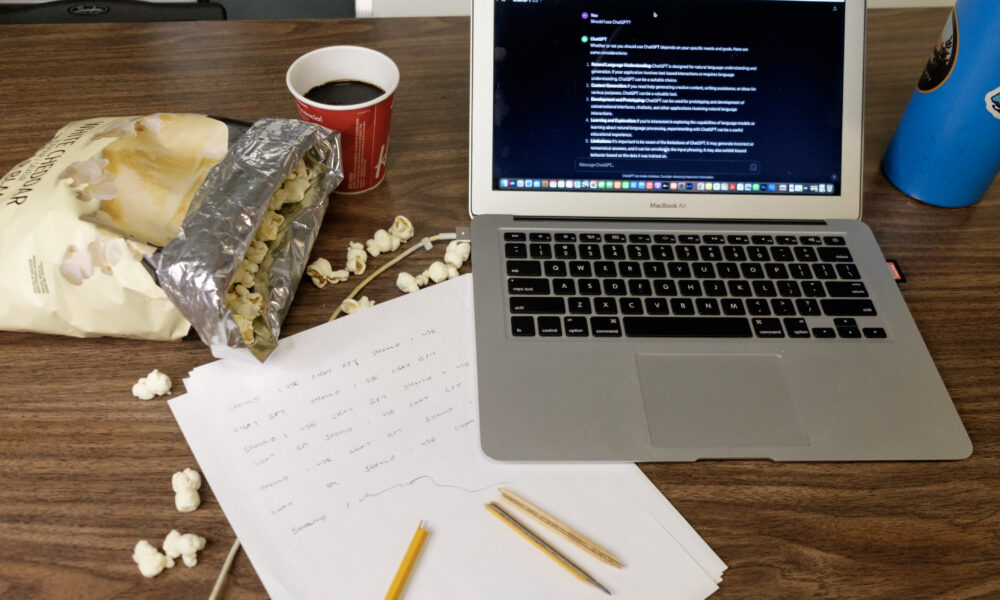
AI writing tools have caused an unforeseen plot twist in the evolving narrative of writing, ushering human writers into a thrilling new chapter of creativity. Yet, this new frontier calls for a thoughtful approach, and writers must explore AI’s possibilities with caution and consideration. Once upon a time, there was a sense of certainty that everything we read was written by another person. The fact that the first two unedited sentences of this article were generated by OpenAI’s ChatGPT shows that this is no longer the case.
In this week’s ‘McGill and AI’ series installment, The Tribune interviewed Lucia Linaje-Ferrel of the McSway Poetry Collective and Vishwa Srinivasan of The Bull & Bear to gain insights into AI’s growing influence in the university and industry writing spheres.
Srinivasan, U2 Desautels, is the Business and Economy Editor for The Bull & Bear. He has observed a growing familiarity and interest in AI on campus and among student journalists.
“I think pretty much everyone I know uses some form of generative AI tools, most commonly, of course, ChatGPT,” he noted.
Linaje-Ferrel, U3 Arts and Co-President of McSway, conversely, has noticed a more cautious approach within creative writing circles.
“I feel like there’s some tentative exploration. As long as it’s just play, people are willing to do it,” Linaje-Ferrel said. “But, I definitely don’t get a sense of people throwing themselves at AI.”
With an estimated one in three students having used ChatGPT to write an assignment, AI has drastically changed how students learn. In a lecture at Cambridge, OpenAI CEO and Co-founder Sam Altman insightfully compared restrictive policies on AI usage to the initial classroom bans on Google and Wikipedia. Although archaic notions by today’s standards, the same arguments are resurfacing in conversations around AI tools.
“Cracking down on AI seems a little misguided,” Srinivasan explained. “Generally, people our age, at least among the student community, have a good understanding of what AI is good for, and what AI is not very good for.”
Linaje-Ferrel similarly highlighted the challenges of managing AI use on campus.
“Just today, I had a class where the professor told us that we were not allowed to use AI in our essays. The fact is that these policies trying to regulate AI are all so new. It’s at a very early stage where it’s difficult to know what’s gonna happen next.”
Outside of academia, there is growing concern over the potential of AI to displace writers across industries.
“Some Bloomberg reporters, for example, those that report on acquisitions or stock trends, can be replaced,” Srinivasan said. “That’s one of those tasks that can be automated. People that write user manuals, they might have their jobs taken away.”
Linaje-Ferrel has also observed AI’s growing presence in creative publishing spaces.
“I do get the sense that some writing is kind of up for grabs. It’s a question of whether or not people who sell products really put [AI-written content] up for sale,” Linaje-Ferrel said. “[For example], you can clearly tell that some publishers switched from using a human translator to AI.”
Reid Hoffman, LinkedIn’s CEO, recently released Impromptu, a book entirely written by ChatGPT. Its mostly positive reception showcases AI’s impressive and rapidly improving abilities.
“We might see a lot of AI-generated books on the shelves, even if they don’t have good writing, which is kind of weird to think about,” Linaje-Ferrel added. “When we see AI, as creative people, we see it as a challenge to the human element of creativity, and also to career opportunities.”
Integrating AI into writing is not just about adapting a new tool; it is about redefining the partnership between creativity and technology—where AI becomes an ally in the pursuit of storytelling and truth. In this unfolding tale of technological evolution, educators and young writers are well-positioned to author the future, dictating our relationship with AI in the chapters to come.