


Latest News

McGill, Montreal, News, Private

McGill announces pause to $50 million French learning program

On Oct. 19, McGill announced a pause in the rollout of its five-year, $50 million Rayonnement du français initiative, intended to increase access to French-learning resources in order to improve students’ and staff’s knowledge of the language.

In an email to the McGill community on Oct. 25, Principal and Vice-Chancellor Deep Saini explained that on Oct. 6, the Quebec government had alerted the university that “changes that could affect [its] financial situation were coming,” compelling McGill to pause the rollout of its French-learning initiative. 

On Oct. 13, the Coalition Avenir Québec (CAQ) unveiled plans to increase tuition rates starting in September 2024. New out-of-province Canadian students’ fees will nearly double—from the current $8,992 to roughly $17,000—and international students will pay a minimum tuition fee of $20,000. With the new policy, the government will receive this minimum tuition fee, and English universities will receive the rest of the fee. Controversially, the extra money levied will be redistributed to francophone secondary and higher education institutions throughout Quebec.

In an email sent to the McGill community on Nov. 2, Principal Saini explained that the fee increase would result in a fall in the number of out-of-province students. McGill estimates that in a best-case scenario, increased recruiting from Quebec and other countries abroad would fill 80 per cent of the places taken by Canadian students; in a worst-case scenario, 20 per cent. The reduction in the student population from out-of-province Canadian students will lead to a decrease in enrollment revenue between $17.6 million and $69.8 million, depending on which scenario McGill is met with. This would force McGill to enact measures ensuring financial stability—such as cutting 650-700 jobs.

The CAQ has stated various reasons for this significant increase in tuition fees for out-of-province students. Quebec’s Minister of Higher Education Pascale Déry stated that the government wants this policy to create greater equilibrium in funding between the province’s francophone and anglophone universities. The majority of the $407 million generated by out-of-province students currently goes to the province’s English-speaking universities. Quebec’s Minister of the French Language, Jean-François Roberge, however, stated that the policy is aimed at preserving the French language in Quebec.

Daniel Béland, Director of the McGill Institute for the Study of Canada, pointed out that this announcement came after their recent loss of a by-election in Quebec City to the rival nationalist party, the Parti Québécois (PQ). According to him, the CAQ sought to regain some political ground by announcing an allegedly Francophone-protecting policy.

“The PQ […] pushes really hard on education and the protection of French language and [the] CAQ is reacting to […] [that] recent victory in this Quebec City riding […] by saying we protect French and French Universities,” Béland said.

Althea Thompson, a second-year History Ph.D. student at Concordia who was among those protesting against the tuition hikes on Oct. 30, told The Tribune in an interview that she was supportive of McGill’s pausing of the Rayonnement du français initiative.

“I think that’s a really great way to fight back because, if you are going to cut the funding to the university, then why would they promote the government’s [policy],” Thompson said.

However, some students were more cautious about the impact of pausing the initiative. Constance Dorion, U2 Arts, said that she opposes the suspension of McGill’s French program because Anglophones already find learning the language difficult.

“The McGill French program is so backwards because it is already difficult, and [it is] pricey, sometimes, to learn French […],” Dorion said. “It gives the idea that it is more difficult to [come to McGill, and] it makes it feel very closed […] But I feel like a lot of us actual Quebec people want people to come, but we just want them to learn French.”

On Nov. 6, Principal Saini sent an email to the McGill community, stating that he and Concordia’s and Bishop’s University principals met with Quebec’s Premier, François Legault, and Déry to propose some solutions designed to promote French in Quebec without raising English-speaking universities’ tuition fees. Saini said that the government promised it would follow up on the universities’ proposal in the following days.

McGill, News

Protesters demand university action and ceasefire in Gaza amidst growing global movement for Palestine

Content Warning: Mentions of violence, death, antisemitism, and Islamophobia

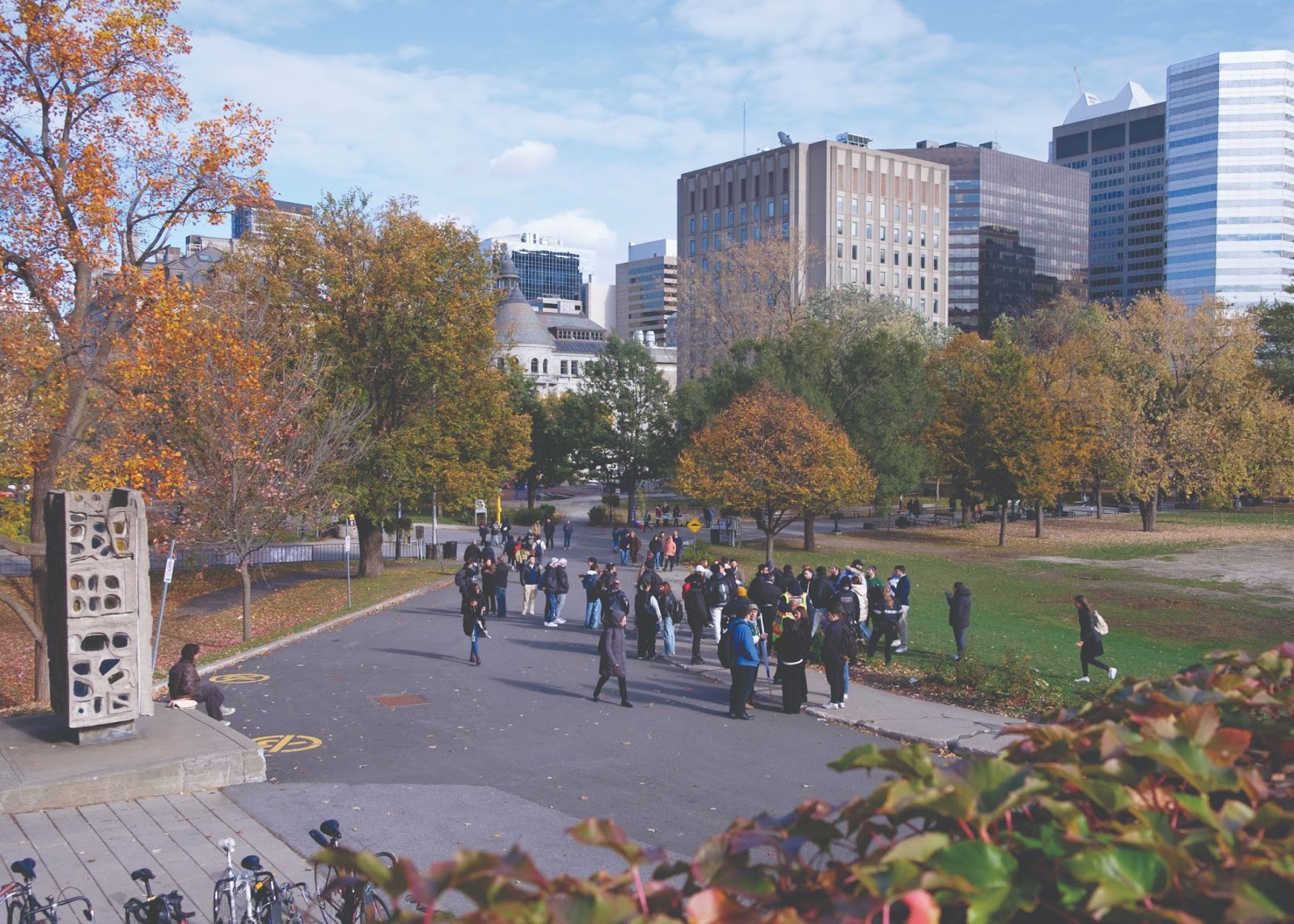
Students flooded out of class at 1:30 p.m. on Oct. 25 to join a growing crowd at the Y-intersection, many donning keffiyehs, waving Palestinian flags, and holding signs in support of the Palestinians in Gaza. The protest eventually moved to the James Administration Building, where members of Students for Palestinian Human Rights (SPHR) McGill blocked the entrance in an attempt to pressure the university to meet their demands.

The protest was part of a wider walkout movement across North America in solidarity with the people of Gaza. In Montreal, SPHR McGill, SPHR Concordia, Solidarité pour les droits humains des Palestiniennes et Palestiniens at Université de Montréal (UdeM) and Université du Québec à Montréal (UQÀM), and Al Raya Dawson partnered to organize and promote the walkout. The organizations listed three demands on their social media platforms: “Divestment from weapons’ manufacturers which arm Israel’s genocide in Gaza,” “an immediate end to Israel’s siege on Gaza and U.S. and Canada funding for Israel,” and “to cease exchange programs with Israeli institutions and cut ties with current and future Zionist donors.”

On Oct. 7, Hamas staged an attack that killed approximately 1,200 Israelis and resulted in more than 200 people being taken hostage, according to Reuters. Israel has retaliated by launching an extensive bombing campaign, and now ground incursions, in Gaza. As of Nov. 2, estimates place the Palestinian death toll since Oct. 7 at over 9,000 and the number of people displaced at over 1.4 million, according to Al Jazeera and the Associated Press.

McGill has sent out a series of university-wide statements following the Oct. 7 attack, including one that specifically mentions SPHR McGill, accusing the group of “celebrating violence” on social media and demanding that the group stop using the McGill name. Other McGill communications have encouraged “looking out for each other in sorrowful times” and referenced the university’s Initiative against Islamophobia and Antisemitism (IAIAS)

Protester Salma El emphasized the importance of everyone—not just people from the Middle East—demonstrating support for the Palestinian cause, and called for an immediate ceasefire.

“I am North African, so we’re kind of brothers with Palestinians,” she said. “To be seeing a genocide happening all over again and no one is talking about it just makes you lose hope in humanity, lose hope in leaders. And I just think that maybe, if anything would have happened to Ukrainians, maybe the world would have reacted another way. Just because it’s Palestinians, no one is saying anything.”

As the crowd grew, SPHR McGill organizers started by leading chants and then delivered a land acknowledgement, drawing a parallel between settler colonialism in Canada and historic Palestine. Chants of “Free, free, free Palestine” and “Viva, viva, Palestina” echoed through the centre of campus as a large Palestinian flag was hung on a rolling whiteboard behind the speakers.

Following the land acknowledgment, an SPHR McGill member reiterated the groups’ demands and voiced support for the Kanien’kehá:ka Kahnistensera (Mohawk Mothers)—a group of Kanien’kehá:ka women resisting McGill’s New Vic project over concerns that there may be Indigenous children buried in unmarked graves on the site.

Professor of Arabic Literature Michelle Hartman and representatives from SPHR McGill, Socialist Fightback, and the Palestinian Youth Movement (PYM) addressed the crowd. Organizers then called for the crowd to travel up from the Y-intersection to the steps of the Arts Building as the chants continued.

Organizers led the crowd in cheering, “Resistance is justified, when people are occupied” and “Palestine is our demand, no peace on stolen land,” followed by chants in Arabic.

The Mohawk Mothers—who held a teach-in on the archaeological work happening on the New Vic site from 12:30 to 2:30 p.m. in the Leacock building—then addressed protesters from the Arts Building steps, reaffirming their solidarity with the Palestinian cause.

After the Mohawk Mothers’ speeches, protest leaders continued their rallying calls before announcing that SPHR McGill members had blocked the entrance to the James Administration building, and the protest would be walking to meet them. Much of the crowd followed suit and relocated to the site of the sit-in.

At the James Administration building—which hosts various key McGill decision and policy makers, including the Office of McGill’s Principal and Vice-Chancellor, Deep Saini—the crowd swarmed to surround the small group that was occupying the area in front of the entrance, blocking office workers from going in or out. One protestor climbed the scaffolding, planting a Palestinian flag above where the student protesters sat. The Tribune talked to an SPHR McGill spokesperson who was part of the sit-in while it was happening.

“The demand is basically to end this bizarre and angry genocidal campaign that’s being imposed on the people of Gaza right now, and also for our universities to divest from arms manufacturing companies, which are actively funding this regime,” the SPHR representative said. “McGill-specific demands were, of course, to revoke the threats that were made about changing SPHR McGill’s name [….] The threat of revoking our name, it came from a place of this university refusing to associate itself with a policy and student movement, but also to pretend that there is no segment of the McGill population which stands up for Palestine.”

In front of the blocked entrance, various professors spoke out in support of the movement, including associate professor of political science William Roberts, associate professor of Indo-Tibetan Buddhism Lara Braitstein, professor of Islamic Studies Rula Abisaab, and Hartman.

“The administration’s response so far has been timid and cowardly. Generally, the McGill administration cares more about the appearance of civility than about the truth and more about the opinion of a few vocal donors and alumni than about the academic freedom of young scholars,” Roberts wrote in an email statement to the The Tribune after the protest. “I don’t expect that to change. Happily, the students don’t need the administration’s approval or assistance.”

A Palestinian student who wished to stay unnamed expressed the importance of those at McGill and in Canada speaking out.

“It’s important to show solidarity. Especially, you know, we have a lot of privilege here, where we have free speech, we should use it,” they said. “I would like to see the university send an email to us condemning what’s happening to Gazans and also divest from all the money they’re pouring into Israel’s pockets.”

The student, like Salma El, expressed disappointment in the lack of support they’ve received from the school, pointing to the difference between how the university responded to the Russian invasion of Ukraine and the current Israeli attacks on Gaza.

“When everything was going on in Ukraine, they sent a very supportive email to Ukrainian students, they announced their support for Ukraine because it was, you know, being occupied, and they were against it,” they said. “So, it’s not that McGill doesn’t want to be political, it can when it wants to.”

In a statement to The Tribune, McGill Media Relations Officer Frédérique Mazerolle expressed that “Members of the McGill community are free to express themselves and to associate within the bounds set by our university’s Statement of Principles Concerning Freedom of Expression and Peaceful Assembly, Charter of Students’ Rights, and Policy on Academic Freedom.”

“Free association and free expression are rights we affirm. But these freedoms are not absolute, and the words we choose, and how we communicate them, matter. We are staunchly committed to building and sustaining a campus community where our diverse identities are honoured and celebrated, where we are safe to express our identities, and where we can all flourish,” Mazerolle went on to write, echoing an Oct. 8 email sent out by Associate Provost (Equity and Academic Policies) Angela Campbell and Deputy Provost (Student Life and Learning) Fabrice Labeau.

The university did not answer questions pertaining to divestment from companies that support the Israeli military or the state of Israel, McGill’s Oct. 10 email demanding that SPHR McGill stop using the McGill name, or differences between how the Russia-Ukraine conflict and Israel-Palestine conflict have been handled.

While there was a large turnout, some students have expressed concerns about the walkout. A portion of the Mohawk Mothers’ speeches, which was posted on Instagram by SPHR McGill and later deleted, gained traction on X, formerly called Twitter, where users felt it appealed to antisemitic tropes that characterized Zionism as monetization, corporatization, and control. 

“The Kahnistensera stand in solidarity with all oppressed groups,” the Mothers wrote in a statement to The Tribune after the walkout. “When seen through the lens of our own struggles for liberation, it is clear to us that the struggle in Palestine is the same as the struggle of all oppressed groups in the world including Jewish people. The common oppressor is European colonialism.”

“It is very detrimental to consider any criticism of Zionism as a criticism of Judaism,” the group added. “Zionism is not Judaism: it is a modern nationalistic ideology weaponizing antisemitism to displace Jewish people and use them to get rid of Palestinians whom they dehumanize.”

Others pointed to language throughout the protest that they felt lauded Hamas’ Oct. 7 attack and criticized a pro-Palestine sign that depicted the Star of David, a symbol of Judaism, instead of utilizing the flag of Israel or words.

“Antisemites often find their way into anti-Zionist spaces. This goes the other way, too, by the way, there’s anti-Palestinian racism and Islamophobia within right-wing Zionist movements. And it’s on those Zionist movements to stamp that out, as well,” a Jewish student who wished to remain anonymous said to The Tribune after the walkout. “Yet, it is so black and white on campus,  that […] there’s seemingly no room for Jewish allies of ending the occupation, Jewish allies of the Palestinian cause—those of us who want to see an end to violence.”

SPHR McGill did not respond to The Tribune’s request for comment before the publication deadline.

The protest continued until around 6 p.m., with the organizers distributing QR-code petitions in support of the people of Gaza.

This piece was updated at 4:35 p.m. on Nov. 2. It was also updated at 11 p.m. on Nov. 13 to fix a capitalization error and to revise the estimated Israeli death toll. On Nov. 10, Israel lowered its estimated death toll following the Oct. 7 attack from 1,400 people to 1,200. 

Features

Where have the queer men gone?

A gay exploration across McGill

In my first month at McGill, I got queerbaited. I started talking to a guy right after moving into residence. As we got closer, he asked with increasing frequency who pinged on my ‘gaydar.’ I had only come out as COVID-19 was declared a pandemic, so meeting other queer men was high up on my 2021 agenda. Naturally, I had a vested interest in seeing where this new connection would lead. 

A week and a half later, he expressed his surprise that I had believed him when he told me that he was into men. After throwing myself a commensurate pity party (a lot of sangria and Phoebe Bridgers), I reset my sights on my objective: To find out where the //actual// queer men of McGill dwell. Three years later, I still haven’t located them. Equally for my sake and for that of anyone else faced with my affliction, I’ve undertaken the task of finding these fabled creatures on campus—if they exist at all.

It’s not as if I don’t know any queer men. The issue is that these connections are rare, and I tend to meet them one at a time. I don’t feel that I have a community, but rather connections with queer men in otherwise disparate spaces. Of course, this is my personal experience, and it might not reflect the general sentiment of queer men at McGill—ironically, I don’t know enough of them to get an appropriate sample. Thus, take my words with a grain of salt.

Finding my communities at McGill is, in many ways, easier for me as a white cis guy. I’m also close with many queer women, trans and non-binary people, and I deeply value those relationships and shared lived queer experiences. However, the absence of people who share both my sexuality and gender—those who can most closely understand my experience of these huge parts of my identity—is something that I feel sharply. 

I’m looking for social settings centred around McGill undergraduates. Additionally, they must be both offline and communal. While online relations and communities are certainly valuable, I am searching for physical spaces where connections are organic, not strictly facilitated. I’m not trying to find one-to-one connections, but spaces where one can enter reliably and inclusively to foster them for social, romantic, or alternative endeavours. 

This definition excludes dating and hookup apps like Tinder and Grindr. I am not necessarily searching for love—I am searching for consistent community. If I have engaged with you on one of these and it hasn’t worked out: It’s not you, it’s the app. 

With these qualifications established, I now set out into //terra incognita//: What queer spaces are available to me at McGill?

Much of my information on McGill queer organizations comes from the online-accessible LGBTQIA2S+ McGill Student, Faculty, and Staff Activism exhibit, curated in 2022 by McGill Institute for Gender, Sexuality and Feminist Studies (IGSF) assistant professor Alex Ketchum and Jacob Williams (BA ‘23). Beyond its usefulness to me, it is an excellent jumping-off point for any interested in McGill’s queer past and present. 

There is, of course, Queer McGill: The university’s student-run queer organization. They operate and promote a variety of services across Montreal for McGill’s 2SLGBTQIA+ population.

“Our communications coordinator, Frida, sends out a weekly newsletter and is also responsible for our social media. They will frequently boost initiatives led by groups with a similar mandate to ours,” Administrative Coordinator Abe Berglas explained in an interview with //The Tribune//. “Our events coordinators, Isabel and Val, are planning a variety of social events so that queer students and community members can congregate. Finally, our resource coordinator Arwyn ensures that our office—room 432 in the SSMU building—is an accessible space for queer folks to exist on campus.”

Editorial, Opinion

Evictions of encampments encroach on equitable housing solutions

As the housing crisis in Montreal persists, neither the city government nor its citizens are addressing the unhoused population with the empathy and urgency they deserve. A coalition of residents from Saint-Henri recently expressed anger over a decision to build a four-storey housing complex for unhoused individuals and a supervised drug use site near an elementary school. This is just the most recent example of a widespread phenomenon of communities opposing the creation of services for the unhoused in the name of “protecting” their neighbourhood. Simultaneously, the city of Montreal has continued forced evictions of encampments around the city, including those living under Route 136 of the Ville-Marie expressway. These evictions put an already vulnerable group at considerably more risk, and do nothing to address the root of the housing issue. 

As the cycle of evictions and displacement in Montreal continues to exacerbate the housing crisis, the number of unhoused people in the province has almost doubled since 2018, with nearly half reported to be living in Montreal. Eviction epitomizes the personal being political, as the state violently inserts itself into people’s homes and privacy to deprive them of the human right of housing. Furthermore, unhoused people face significant barriers when practicing their right to vote and thus lose the ability to have political representation, as it is extremely difficult to register to vote without a stable, permanent address. Being evicted also comes with a host of life-threatening dangers. The street is not a safe place to live and, as winter approaches and the temperature continues to drop, it does not afford any kind of protection from the deadly cold.

The municipal government has evicted people from encampments under the guise of “finding long term housing solutions,” but its actions do not reflect this claim. In breaking up encampments through the police, the Ministère des Transports du Québec (MTQ) is not only destroying people’s only living arrangements, but is also breaking up communities and networks that are integral to unhoused people’s wellbeing. By simultaneously dismantling these encampments and failing to implement any effective affordable housing policies, the MTQ is encroaching on unhoused people’s agency and ability to protect themselves. Since the Ville-Marie encampment was disrupted, only four of its former residents were able to move into government-subsidized housing, while the government refused to provide the rest with anything more than lockers in which to keep their belongings. 

The not-in-my-backyard (NIMBY) attitude held by Montrealers, such as those contesting the construction of the housing complex in Saint-Henri and the shelter in Verdun, further exacerbates the issues unhoused people are facing. Often, NIMBYism deploys language that dehumanizes and demonizes unhoused people, referring to them as ‘dangerous,’ and arguing that children must be protected from them. This outlook indicates an inability to look past one’s personal discomfort to recognize how the creation of shelters and other resources is a step toward fixing the housing crisis and getting unhoused people off the streets. NIMBYism further antagonizes unhoused people, and exacerbates racial and class divisions. In prioritizing neighborhoods over individuals’ well-being, these attitudes solidify the notion that property value is more important than human dignity and life.

Certain communities are disproportionately represented in the unhoused community, including Indigenous peoples, migrants, and people experiencing mental illness. By dispossessing and displacing, evictions perpetuate an ongoing cycle of settler colonial violence on Indigenous peoples. Instead of providing trauma-informed support, the state neglects individuals experiencing mental illness in encampments through the discriminatory structure of their systems and institutions.

McGill is situated in direct proximity to many of Montreal’s unhoused communities, yet students are often dismissive toward unhoused people, avoiding or ignoring them completely. McGill students must act on the houselessness and housing insecurity crisis, treat unhoused people around them with respect, empathy, and dignity, and advocate for equitable housing for all. The city of Montreal needs to cease evictions of encampments, and provide unhoused people with real, tangible alternatives to living on the streets.

Commentary, Opinion

STM constables’ new pepper spray is anti-progress for the Mental Health Crisis

At the start of October, the Société de Transport de Montréal (STM) announced that constables in charge of patrolling the Montreal Metro will now be armed with gel aerosol pepper spray. The STM made this decision in response to a growing number of incidents in the metro system in which constables intervened, often with brute force and the use of batons. The STM describes the pepper spray as a means of “de-escalating” a situation without using the same physical impact of a baton. However, the addition of gel aerosol pepper spray creates room for more frequent, unproductive hostility, and widens the gap of power between constables and Montreal’s vulnerable populations. 

The number of violent incidents and reported safety complaints in the Montreal metro system have increased considerably in recent months. The Service de Police de la Ville de Montréal (SPVM) claimed 54 reported assaults in January of 2023 and 53 in February, while in 2022, the highest reported number of assaults in one month was 44. The incidence rate on the Metro as a whole has also gone up, with about 42,000 reported interventions on the STM in 2022, compared to just over 35,000 in 2021. 

Though there is validity in the intention of reducing the physical harm inflicted during constable interventions in the metro, implementing pepper spray––in addition to the existing batons––attempts to mitigate the houselessness and mental health crisis by attacking people instead of addressing it at the roots. Such development allows for more frequent hostility and intensifies the gap of power, spurring resentment between the constables and the targets of their authority. It also raises questions about the logical consistency of the new policy when STM constables are granted the authority to use this pepper spray, while Canadian civilians are prohibited from arming themselves with it for self-defense, highlighting a disparity in access and usage.

The sparse ten-hour training required in order to carry the pepper spray is time that could go toward training constables in alternate strategies of de-escalation. These approaches would be much more in line with an understanding of the mental health obstacles faced by many of those involved in the interventions. While an immediate solution to crime in the metro is a large ask for the municipal government, initiating a discussion of greater awareness in the constables, who come in close direct contact with incidents of crime, is a good place to start.  

The metro system in Montreal (and beyond) is one of the most immediately accessible shelters for the unhoused community, making the discussion of mental health and houselessness inseparable from the policies of the STM. Such changes must be acknowledged by policy makers as substantial alterations in the daily experiences and overall well-being of individuals who are unhoused, particularly those who are already grappling with mental health challenges. It is imperative to recognize the profound impact that these types of policy changes can have on the lives of unhoused individuals contending with mental health issues. 

Such direct violence toward a vulnerable population solidifies the assumption that addiction, houselessness, and issues of mental health are the fault of the individual, justifying further harm toward them and their situation. Assaulting unhoused individuals with pepper spray as a response to their inability to find shelter is gratuitous and counterproductive; addiction, for instance, is a disease, and houselessness is the result of relentless systemic oppression, not personal failings. Pepper spray does not undo such realities.

Due to their history of abusive power and brute force, especially toward vulnerable and racialized communities, institutions such as the police department or the STM might be quick to disregard such strategies for crime mitigation. While certainly less glamorous and slightly slower-moving than the implementation of pepper spray, an emphasis on peaceful de-escalation instead of violence is progress toward systemic change that has the potential to mitigate the issue of crime as a whole. The physical harm caused by pepper spray paired with the structure of power that enforces it will not.

Opinion

The McGill Book Fair teaches us a lesson in institutional apathy 

Despite being heard by few students during the fall of 2022, a death knell sounded marking the end of the McGill Book Fair. Started in 1972 by the Women’s Associates of McGill and the McGill Women’s Alumnae Association, the Book Fair is yet another victim of the McLennan-Redpath complex renovation. Organizers suggested on a Facebook post that the complex’s closure and a seemingly chronic inability to find volunteers made the event impossible to run. The transformation of the Book Fair from a vibrant community event to university lore demonstrates McGill’s inability to shield its cultural institutions from its relentless attrition. 

Over the past 50 years, the Book Fair has contributed 1,948,000 CAD towards McGill Scholarships and Student Aid, generating three bursaries for undergraduate students. Though there is no doubt those bursaries will have supported many McGillians, to talk about the Book Fair solely as a financial conduit is reductionist. The Fair’s ability to affordably disseminate knowledge, foster community, and give participants a space to be intellectually curious meets and surpasses McGill’s own stated mission, a mission whose nebulous framework commits the university to scholarly excellence but not to community or curiosity. Yet, the Book Fair remains an un-resuscitated champion of McGill’s values. 

The McGill administration is only interested in domains deemed important by Quacquarelli Symonds (QS)–– the company who releases the annual QS World University Rankings. Not every McGill student is willing to volunteer in extracurriculars that are not sexy or employable. If QS made an annual Book Fair a requisite to be a top 50 university, McGill would pour resources into the Book Fair, asserting that the event was “instrumental in delivering on its mission.” If McGill’s Medical or Law school requisitioned volunteering in a Book Fair for admission, to become a volunteer one would have to undertake a competitive entry. The problem is McGill’s neglect for the Book Fair is replicable; this apathy could claim other events. The Book Fair proves that even the most anticipated and successful events can simply cease to exist if they are not cared for. 

Admittedly, I might be romanticizing the McGill Book Fair, but universities are romanticized institutions. With the world’s data readily and instantly available, what can a student gain or learn at McGill that they cannot online? Students may garner a community, exchange ideas, and ultimately, have the university legitimate their knowledge. At least two of those ideas are inherently romantic. If McGill cannot find the impetus to preserve the Book Fair, it not only fails to further the values of its mission, but it also fails to preserve the ideals that uphold the institution for students.  

I mourn that I will never again arrive to class, albeit 10 minutes late, with a box of books in hand, full enough to gravely harm someone if I were to trip or buckle. Nor will I ever again strut campus gleaming with the knowledge that my purchase cost less than a sandwich and banana would at any McGill cafeteria. Worse even is that soon enough, I will be unable to quench the memory of the Book Fair by walking into McLennan Library and endlessly perusing amongst rows of books as a “study break.” 

Though the Book Fair has gone, its end should serve as a reminder to nurture the cultural institutions we participate in. Take the example of Anne Williams and Susan Woodruff, two McGill graduates who attended the university in the 1960s and who were the latest co-directors of the Book Fair. They still post regularly on the Fair’s Facebook group, directing students toward book sales around Montreal or encouraging them to donate to the Fair’s bursaries. In this spirit, beyond demanding that the administration care for the culture that defines this university, students must remember that they are McGill’s vital cultural capital. If others cannot deliver on McGill’s stated mission, the onus falls on us.    

Off the Board, Opinion

Birds: My mortal enemies

I didn’t see a single bird during the U.S. government shutdown between Dec. 22, 2018, and Jan. 25, 2019. While the feathery fiends in British Columbia may have just been taking the month off from antagonizing my fellow high schoolers on the frosty coast of Vancouver Island, I choose to believe the conspiracy theory that all birds are government drones, and were turned off amidst the political instability in my home country. Sure, the theory may be far-fetched, but despite birds’ pea-sized brains, they are smart little gremlins ready to spread evil everywhere they go. 

Every time I look a bird in the eye, I consider what nefarious ploys they are plotting. I’m not kidding. These modern dinosaurs may be small, but they’re crafty. They have access to the sky, the land, the sea, and yet they choose to scavenge for food that humans are actively trying to eat. Some birds understand basic Keynesian economics. Others can literally converse with humans. While the average pigeon you see today might be looking for its next backpack to peck for crumbs, their ancestors were literally war veterans. Now, let loose in an outcry of anarchy, I fear the day the pigeon clusters waiting outside the metro learn how to unionize. 

The fact of the matter is that I find birds terrifying. Whether I’m facing off with a robin trying to steal my almonds, or a crow blocking the stairs to my apartment, I would rather be subjected to a Saw trap than their wicked little beaks. There’s a reason that Darwin’s theory of evolution was based on birds and not sharks. They quickly evolved into a diverse network of beasts, each able to spread evil in a multitude of disturbing ways. Pelicans are essentially giant venus fly traps: They trap prey and swallow them whole. Hawks will pick up fish from the ocean and drop them from large heights. And crows… crows never forget a grudge. 

I think the most terrifying thing is that crows (and their bigger yet thankfully rarer cousins, ravens) can recognize and remember human faces. I remember once chasing a crow away from a lovely, peaceful Seattle picnic I was having with my friends. The crow came back, brought friends, and pelted us with acorns. If I had realized that wanting to eat a sandwich without a bird pecking at my fingers was akin to inciting a clan war with the local kings of the park, I would’ve cut my losses and handed my food over. I still haven’t returned to that spot. I know they’re waiting for me and I refuse to fall back into the same trap.

On the other hand, there are some birds that I understand. I grew up on the West Coast surrounded by armies of Canada’s most ferocious animal: The Canada goose. My upbringing taught me a lot of things—how to duck and cover during an earthquake, the fact that you should never wear crocs while traversing a blackberry bush, and how to swat a goose. As the younger sibling to my older brother, I was the designated fodder for any threat we encountered. As such, I was always the one to face off against the geese. Geese know they’re evil. They own it. And luckily for me, I feel a lot better pushing a hissing, flying rat than another bird species that retains its innocent façade. 

So what’s the moral of this piece? Easy: There is no moral. I am simply here to warn my fellow people of our feathered fiends that we share the sidewalk with. Don’t trust them. Don’t mess with them. I yearn for the days in 2019 when they disappeared from my vicinity. I fantasize of peace. I know it may never happen, but a girl can dream. 

Arts & Entertainment, Comedy, Internet

The older, the wiser: Why X should be reserved for seniors

Most social media apps have age restrictions. For the majority, you have to be at least 13 to create an account. X, formerly known as Twitter, is no exception. Yet, I firmly believe that this age limit is simply unfair. The minimum age to create an account on X should be changed to 75. Though this may seem strange at first, may I present a shining example for why this should be the case: One Joyce Carol Oates.

Joyce Carol Oates is a critically-acclaimed 85-year-old American author who has published over 50 novels, including Blonde and We Were the Mulvaneys, not to mention a litany of short stories and poems. However, the best-written work she has produced undoubtedly exists in the form of her tweets on X. After all, a picture is worth a thousand words, and Oates’ recent posts include profound photos such as “Canal.” Not only this, but the author has deigned to share hidden gems from the art world, including a painting that may have inspired Vermeer’s “Girl with a Pearl Earring.” 

Celebrities of our generation can be rather dismissive of their fans on social media and in real life. Fan pages struggle to get their favourite celebrities to notice them, and the vast majority of love declarations go unacknowledged. On the other hand, fans of Oates have no shortage of responses from the author. She maintains profound conversations with her fellow users. Recently, Oates was quick to comment on the cuteness of a fan’s dog. Additionally, she has engaged in conversations with those who do not seem overly fond of her, such as her multiple political arguments with several opinionated users.

Although Oates’ X account is certainly worth a follow, she is not the only senior whose thoughts are worth sharing. Another member of the older population on the app includes Larry King—famed television and radio host—who strove to spread important information to his dutiful followers prior to his death on Jan. 23rd, 2021. His series of tweets, aptly titled #ItsMy2Cents, offers the star’s many hot takes. For instance, his relatable statement that he “has no desire to eat clams” is nothing short of newsworthy. 

Even if King is no longer with us today, his opinions will live on forever through his tweets. Sure, the app could be used to share the thoughts of the younger generation, but why not give our elders a chance to immortalize their wisdom on the internet? Some may say that seniors have problematic opinions, but no two people are alike, and many individuals from previous generations are worth listening to. After all, thanks to them, we have succeeded in feats such as the moon landing, and life-changing inventions like the lava lamp

In the end, our generation maintains its monopoly over many social media platforms, including TikTok and Snapchat. So why not let the seniors have X? It could very well be their last chance to use their voice, and who wouldn’t want to see another cat photo shared by Joyce Carol Oates? We have no need for another tired retelling of Kylie Jenner having cereal with milk for the first time. Besides, Elon Musk did purchase the platform, and we wouldn’t want to support him long-term—he is known for being a misogynist, and has tweeted a meme comparing Prime Minister Justin Trudeau to Adolf Hitler. Leave it to our elders to express their opinions and, when they pass away, we can let Musk’s success pass on with them. 

Album Reviews, Arts & Entertainment, Music

Something to give the girls

Pop music has hit a lull in the past few months. Beyoncé and Taylor Swift are busy touring, Dua Lipa is missing in action, and Ariana Grande is busy getting raked over the Twitter coals for her new boyfriend. A few select artists have provided tunes throughout the recent slump—credit to Olivia Rodrigo. But none have emerged as swiftly and decisively as Troye Sivan, whose new album Something to Give Each Other has revived our appetites for the popstar. 

His album release began with “Rush,” a lead single titled after everyone’s favourite brand of poppers. With a house beat and a chant-like chorus, the single lives up to its namesake—an addictive opener. The music video features a sweaty Sivan, hedonistic Euro-summer visuals, and decidedly cheeky choreography. Compared with Sivan’s innocent debut, Blue Neighbourhood, and his less precocious 2018 album Bloom, this release was unabashedly more queer, fun, and sexy. 

His second single, “One of Your Girls,” was an instant hit largely owing to Sivan’s bold music video. Featuring former Disney Channel heartthrob Ross Lynch and Sivan himself in incredible drag, the video immediately flooded Twitter feeds and is currently at 8.7 million views. With seductive choreography and Y2K outfits, the visuals draw heavily on early 2000s pop icons like Christina Aguilera and Beyoncé (note the “Single Ladies”-esque black and white scene with the bar). Sivan is taking pop stardom seriously by calling back to its golden age.

The rest of the album is a great mix of slow tunes and uptempo pop. Sivan includes some inventive sampling, such as an electronic hook from Bag Raiders on “Got Me Started” and a clip of Jessica Pratt’s folky warble in “Can’t Go Back, Baby.” Sivan’s increasing comfort with experimentation is paying off—his music has far exceeded its bedroom pop origins.

With a new commitment to choreography and boy toys in tow, Troye Sivan’s new album asserts that he is every bit the pop diva. He has cornered his market with new maturity and confidence, giving people the pop iconography that they want and need. 

Lacrosse, Men's Varsity, Sports

Redbirds lacrosse races to victory against Queen’s University Gaels

On Oct. 29, McGill Redbirds’ lacrosse faced off against the Queen’s University Gaels in a single-elimination playoff game to clinch a spot in  the Canadian University Field Lacrosse Association (CUFLA) playoff tournament, otherwise known as the Baggataway Cup

Motivated and eager to win, the Redbirds opened the scoring mere moments after the opening whistle sounded when captain and attacker Isaiah Cree scored the first goal just 10 seconds into the game. However, the Gaels quickly countered with two back-to-back goals to go up 2-1. The Redbirds struck back thanks to another goal by midfielder Rowan Birrell  giving the Redbirds evening out the score board. Following a few exchanges, Cree had the opportunity to bury his second goal of the afternoon and tie the game.  

The growing goal tally galvanized midfielder Alexander Erbstein, who netted another with under two minutes remaining, and the quarter ended with midfielder Mark Symon’s goal with just 10 seconds left to set the score 5-2.

After a particularly intense first quarter that the Redbirds dominated, the second quarter was quiet until the Gaels shrunk the point gap, scoring with three minutes on the clock. However, midfielder John Miraglia responded with McGill’s sixth goal with just eight seconds left in the half.  

Cree opened the second half of the game with back-to-back goals, giving McGill an 8-2 lead. The Gaels’ frustration erupted into several scuffles. Defender Ryan Badour served his first of four penalties that afternoon for slashing. With two minutes left in the third quarter, defender Kyle Glick suffered an injury following a multi-player collision and had to be escorted off the field. 

This change in pace allowed the Gaels to sneak two goals past Boehm to start the fourth quarter, bringing the score back to 8-4.  After expert passes between midfielders Rowan Birrell and Massimo Thauvette, Birrell buried the ball past the Gael goalkeeper, restoring the five-goal gap.. 

After the Redbirds regained possession, Birrell successfully faked out Queens’ defense and passed the ball. Midfielder Owen Howard successfully picked it up, passing it back to Birrell, who narrowly missed. 

As the game came to a close, the Redbirds continued to apply pressure to Queen’s defense line in an attempt to extend the goal gap. When the referee’s whistle echoed, the score was settled and McGill secured the 9-5 win. 

“I think the big thing today was having our entire lineup really contribute,” assistant coach Maxime Murdoch said in an interview with The Tribune.  “It was really a full team effort. We had a couple of guys that were a little more injured, some starters that we had to take out early. And we had some guys that usually don’t play as much get in there and really play well.” 

The other team, you know, came back really strong at some point,” Murdoch explained. “We kind of just had to, had to do our thing. The biggest thing is really just having all these guys, that usually don’t play, get in there and really contribute to score goals.”

This win allows McGill to compete at the Baggataway Cup at the Trent University Excalibur, last year’s champions, on Nov. 3-5. They will face off against the University of Guelph Gryphons, currently second in the Western division, hoping to advance to the semi-finals. The last time McGill won the Cup was 2015. 

Moment of the Game: After making an incredible save, Boehm pierced through the field to reach the 49-yard line, in front of the Gaels’ goal and passed to a teammate. 

Stats Corner: The game saw seven penalties drawn, including four for McGill’s Badour, and one from Birrell.

Quotable: 

“We win when we move on, we lose once we’re done. So all of them are make-or-break,” Cree said. “I really feel like we can really make a run this year.”

— Senior-year, captain Isaiah Cree reflecting on the significance of this buy-in game for the playoff. 

Read the latest issue

Read the latest issue