Latest News

Commentary, Opinion

How (not) to leave home

A joke of history: North America is the centre of the modern world, so it can never truly feel international. Inane metaphors––melting pot, mosaic, salad bowl––only distract from the inexorable crush of the market and the English language. Even Quebec’s vaguely nationalist slogan, “//Je me souviens//,” today feels without content, as separatist dreams dissipate into a cultural project with little imagination beyond its own borders.

But in the decrepit cradle of empire, something stirs with life. Europe, hoary and fossilized, its immortal meaning shaped by primordial violence. I return to it like a worm to mulch.

I’m going to Berlin. I’ve been “going to Berlin” for several months now; my semester abroad begins in the middle of McGill’s winter semester. My home, classmates, and partner returned to their routine after the Christmas break, but I could not––I am elsewhere, almost. I pass the time watching German television and practicing the language online. //Babylon Berlin// and //Kleo// are both fun watches set during pivotal moments: The fall of Weimar Germany and the Berlin Wall, respectively. Both are crime thrillers, and I wonder sometimes if this will shape my grasp of the language, breathing wit and intrigue into those harsh words.

In my desire to be anywhere but here, I’ve assiduously avoided the Western hemisphere in my studies at McGill. But my German is still shaky, so I’m enrolled in the Free University of Berlin’s only department offering reliable English courses: The John F. Kennedy School of North American Studies. Of course, “North American Studies” refers to the U.S. of A. Should I be offended that Canada has yet to enter history, or comforted? Here I prepare, I read Karl Marx and listen to The Threepenny Opera. In Berlin, I will study Hemingway and the New Deal at a conspicuous remnant of the Cold War. 

Walter Benjamin wrote: “The past can be seized only as an image which flashes up at the instant when it can be recognized and is never seen again.” The philosopher died later that year fleeing the Gestapo. What to make of these flashes of memory? My mother visited Poland as a young woman. She was warned to never, ever mention the trip to her grandparents. They are gone now, along with most of their generation, and their fear and fury hide in the debris. Am I a disloyal son, seeking rebirth on the graves of my ancestors? But I forget: Berlin is a city of memorials and museums, not of graves. Like any good empire, Germany exported its violence.

I leave soon. I am preoccupied with the petty business of preparation, with baggage, clothes, face creams, antidepressants, and the opaque mysticism of McGill’s transfer-credit system. It’s exhausting, of course, but what a miracle of bureaucracy! I travel across the globe and a 20-year-old paper trail follows me, all for the sake of something new. Then I will go through the same steps as I return, and McGill will snatch me back up, richer by 15 credits and half a language.

My partner and I walked through Jeanne Mance in the snow. We had said goodbye before, and have said it many times since, but we did not speak as we walked. Our hoods were up, and the snow swallowed every noise. No cars. No music. The world seemed shapeless and made new. We struggled through it with our heads down and our feet scrabbling for purchase.

A truth hides in the crime thriller: Whatever last episode’s revelation, the mystery only deepens, the cloud of cigarette smoke only grows thicker. No one really gets over anything. There will be no rebirth, no spark of newness buried with the dead, only accretion, only sediment. History collects like dandruff. When the page is saturated with ink, we continue in another colour. I leave Montreal with love and anger packed between my molecules, so I can never really leave Montreal.

Commentary, Opinion

McGill’s academic freedom policy is rude-imentary

Last April, to appease their older rural voters, the Quebec government unveiled a new policy concerning academic freedom in schools and universities: Bill 32. 

Naturally, the policy had little to do with Quebec’s rural population and very much to do with enforcing its definition of academic freedom upon universities, prompting some 130 professors to sign a petition against the bill. 

You see, central to Bill 32 is free speech, it seems, at all costs. 

To comply, McGill has drafted a new academic freedom policy touching on what you should be allowed to say (anything), trigger warnings (not compelled), and the various procedures for academic complaints (a small, secret committee). 

The draft’s biggest problem comes back to the straightforward question: How can you facilitate academic freedom without respect? 

It was the Centre for Human Rights and Legal Pluralism’s welcoming of Professor Robert Wintemute, who opposed a U.K. policy to improve the legal recognition of transgender people that really did it for me, and showed McGill’s true colours. Hiding behind “free speech” is the constant mantra of those who want to guise hate as debate. And for McGill, it’s snorting a line of danger.  

And look, being able to speak freely and question ideas must be the university’s bread and butter. But if that speech incites hate or violence, how can we expect an environment of academic debate to prosper? 

It’s at this point that Interim Principal Christopher Manfredi might throng the university’s policy on equity and inclusivity in my face. Or perhaps he’ll show off the article he wrote in The Montreal Gazette last year about academic freedom and equity going hand in hand, no doubt framed in his office. 

But not so fast, Sir. The notion that universities can defend unchecked speech while advancing equity and inclusion is a thought which didn’t get past one glass of Chardonnay. 

To defend academic freedom, equity and inclusivity guidance must be ingrained within the institution. While it’s a question of enabling freedom of speech, it’s also a question of what type of community McGill seeks to shape. And without guidance on how to create an environment where everyone can freely participate, the policy becomes nothing more than a used tissue. 

Take the recent hosting of Wintemute. He opposed the legal recognition of someone because of their identity—no different from race, sexual orientation, and place of birth. These views, first of all, violate the university’s own equity policy. Second of all, from an academic freedom perspective, it’s ludicrous to expect that those he targets will feel able to contribute to the discussion when he insinuates bigotry.   

And the real kick up the backside with McGill’s draft policy is that instead of providing direction for respect, it does the opposite. 

Point 20 in the draft states how the university will not compel instructors to provide content and trigger warnings. 

This measure, I think, is to align the university with Bill 32’s new policy. But it’s phrased all wrong. Because McGill can comply with the law and still endeavour to ingrain best practices. 

A professor shouldn’t feel like they have the barrel to the head about using content warnings. . But just like you eat with your mouth closed or don’t by way of introduction yell obscenities at strangers, giving a heads-up about a sensitive topic is good manners—and it facilitates an environment where everyone can engage freely, and from which academic freedom can flourish.  

Ingraining respect and fostering an environment of inclusivity is currently omitted from McGill’s draft, and it would be wise to rethink, or at least for the Deans to talk about it over a full bottle of wine, instead of just the glass. 

Academic freedom can only come by creating conditions where all individuals can join the discussion. Because that’s the thing—McGill’s job is not to produce academic content or discussions. It’s to facilitate them. 

Arts & Entertainment, Music

Artist Spotlight: Bibi Club shines in vibrant performance of their debut album

Bibi Club is a growing force amongst Quebec’s burgeoning alternative pop scene—a scene that has seen the likes of Men I Trust and TOPS achieve global acclaim. 

The Montreal dream-pop duo’s debut record, Le soleil et la mer, represents the most fully realized version of their sound, widening their sonic palette from the analog synths and drum machine grooves of their 2019 self-titled EP. 

“It’s not driven by performance abilities. It’s driven by instinct,” said guitarist Nicolas Basque when describing their debut album in an interview with The McGill Tribune. “Labels are tough but at the same time they help you describe what you’re doing [….] I think now indie-pop is anything that’s done in an arts and crafts way musically […] I’m not uncomfortable with that.”

The band’s music cuts through the predictability that often characterizes so-called “dreamy” music. Le soleil et la mer is marked by its dynamism: Basque’s sparkly guitars playfully interact with Adèle Trottier-Rivard’s synth lines and warm, alluring vocals, underpinned by danceable drum loops. In marrying these elements, Bibi Club’s songs resist staticism, rising and falling in swells of shimmer and reverb. Fittingly, Trottier-Rivard and Basque have also been a couple for seven years, balancing their musical lives with raising their children. 

Ahead of their Feb. 9 homecoming gig at Quai Des Brumes, Basque noted how the band enjoys presenting a heavier, more raucous version of their music live. On the night, they eased into proceedings with the track “Le Balcon,” featuring tranquil guitar-picking and wind chimes, before Basque fulfilled his end of the promise and slammed on his effects pedals and drum machines. 

“It’s a bit like listening to the record really loud,” Basque said. “There’s a more, dare I say, punkier energy.”

Meanwhile, Trottier-Rivard stood at the helm of a Prophet 6 synth, surrounded by an array of cymbals and percussion, providing an organic touch to the group’s predominantly electronic setup. The band leaned on material from Le soleil et la mer through their set, with highlights like the unrelenting beats on “La Plage” and the layered vocals and scratchy guitars on the frenetic “Femme-Lady.” The bouncy, glitched-out “Parasite” was particularly well-received by the enthusiastic crowd, morphing from an uptempo bop into a serene half-time groove, over which Basque tastefully soloed on guitar. Ultimately, Bibi Club’s performance style communicates the sense that its members thoroughly enjoy playing as a central facet of their artistry. 

“It’s never heavy in the studio when we work together,” Basque said. “We always try to find a tension between two things […] like being awake and being asleep […] we’re looking for tension but without going into a depressing, darker mode.” 

Much of the band’s playful sound has also been shaped by their schedule as a family, fitting ad-hoc improvisatory home sessions around Trottier-Rivard and Basque’s children. 

“A lot of the sparkle for a song comes from a guitar and vocals jam […] when the kids are in bed,” Basque said. “Then the shape and timbre of the song come to life in the studio.” 

Bibi Club centres community in their musical approach. The band sees the aesthetic aspects of their album art and live performances as opportunities to collaborate with Montreal creatives. They enlisted local artist and painter Mégane Voghell to produce Le soleil et la mer’s cover art, interpolating a childhood image of Trottier-Rivard behind a drum kit into an abstract painting. Such collaborations have become symbiotic, with Voghell even contributing backing vocals on “Le Matin.”

“It brought the record further than what we had done with just the music,” Basque said. “The collective work made it cooler and added depth for me […] even when I play live now, it informs a lot of the process.” 

In the future, Bibi Club plans to keep evolving their craft, and Basque is keen to explore how much minimalism they can incorporate while maintaining a rich sound. With the band returning to the studio this month, Bibi Club’s fans can look forward to hearing the fruits of this sonic experimentation shortly. 

Arts & Entertainment, Books

‘Strange Bewildering Time’ is a time capsule of forgotten history

Forty years ago, author and poet Mark Abley went on a three-month journey that changed his outlook on life. Accompanied by his friend Clare, the two travelled through several countries during the last year of the Hippie trail, at a time when it seemed that travel within Asia was cheap, the sights bountiful, and the hospitality exceptional. He filled three journals during his travels to be used for poetic inspiration; instead, they were left in the depths of his desk drawer. Years later, Abley decided his stories should be shared, and thus he collected and reflected on these stories in his newest work: Strange Bewildering Time.

The travel autobiography tracks Abley and Clare’s wandering journey through Eastern Asia and the Middle East. With no plan except a return ticket to London three months after their arrival, Abley and Clare began their adventure as wide-eyed university students, searching for enlightenment and a good story. In fact, Abley originally planned to transform his journals into a poetry collection. However, the journals became a space for Abley to psychologically ground himself and reflect during the trip. Over three months, the travellers’ journey became an experience that built self-awareness and knowledge of new cultures and strangers’ kindness. 

But as Abley restructured his journals into a travel book 40 years later, he instead discovered his accounts to be somewhat of a time capsule of 1978. The journals housed a naive young man unaware of the cultural, political, and environmental changes bubbling under the surface of his surroundings.

“[At the time], I hadn’t read enough or thought enough about the countries I was travelling through,” Abley told The McGill Tribune. “[O]ne conscious decision I made right from the start of this book was that I would not quote Western writers in the tradition of literary travel writing.”

To rectify this lack of awareness as a white man in a literary tradition filled with voices of the same demographic, Abley sought to incorporate texts and references from the literary canon of the Global South, such as Alboqasem Ferdowsi’s Shahnameh: The Persian Book of King. In doing so, he uses Strange Bewildering Time as a collage for offering lessons and teachings about the cultures he visited so many years ago. His reflective self-awareness reveals his younger self to be ignorant of his privilege as a man, even while travelling with Clare. Abley thus intends to question how locals at the time would’ve viewed him as the ‘scruffy traveller’ he remembers himself as while acknowledging his naive narration in the journals. 

“I feel regret that so many of these countries and places are so much more difficult to travel into and through than they used to be,” Abley said. “But I hoped that nostalgia is not the emotion that comes across. What I more accept is a sense of loss [and] a sense of joy at my own good fortune, at having these experiences and being able to see these places.”

Besides capturing a cultural moment in time, Strange Bewildering Time tracks the environmental changes between 1978 and the present day. Abley ruminates on his bewilderment of the gorgeous landscapes that he and Clare explored mournfully, as the climate crisis has all but eliminated these natural wonders and harmed local communities in its wake. 

“The fact [is] that we crossed rivers and lakes in Iran that don’t exist anymore. The fact [is] that we clambered over a glacier in Kashmir that’s a fragment of its former size,” Abley told the Tribune. “The fact [is] that Kathmandu is suffering from its lack of safe drinking water because they just don’t have the infrastructure in place.”

All in all, Strange Bewildering Time acts as a complex narration of naive youth and learned wisdom through a single journey. Abley masterfully navigates his acknowledgement of his innocent self as a foundation for the book while introducing witty and philosophical remarks that allow the reader to reevaluate the authority of the narrative lens. Abley’s book, therefore, is a remarkable time capsule of culture and circumstance wrapped up in an enticing story about meeting new people on a hippie adventure.

Strange Bewildering Time is available everywhere where books are sold.

Sports

“We need recognition”: McGill Squash wants varsity status after successful season

On Feb. 12, the Ontario University Athletics (OUA) squash championships took place at Queen’s University, bringing an end to the 2022-23 season. But instead of competing for the men’s and women’s titles in Kingston, the McGill Squash Club was running its weekly Sunday practice here in Montreal.

Despite being one of the best teams in the OUA, McGill’s squash team is not allowed to compete in the league’s championship since they are not an official varsity team––a fact which, according to fourth-year co-captain Matt Bicknell, is affecting the team’s competitiveness. 

“When we play in Ontario, we are not allowed to compete in their finals,” Bicknell told The McGill Tribune. “We have to play their C-tier teams which we just obliterate, it’s not even close, so it’s just not worth it to go.”

The Squash Club ceased to be a varsity team after the McGill Athletics system was significantly restructured in the Fall 2010 semester. The change stripped McGill’s intercollegiate clubs of their varsity status, prohibiting them from competing in OUA competitions. Despite competing in the OUA regular season annually (organized by the Ontario Jesters University Squash League), McGill squash has been unable to compete in the OUA championships since 2010. This year, it was an especially bitter pill to swallow for the McGill players considering their success in the regular season, as the women’s and men’s teams placed third and fourth in their respective divisions. 

“We need recognition,” said fourth-year co-captain Anika Kurji. “Both the men’s and women’s teams are doing really well, so it’s frustrating that we are not varsity considering that we are competing with all these varsity teams and beating them.” 

If McGill squash were to be reinstated as a varsity team, they would potentially be eligible for OUA playing privileges as there is an existing by-law that allows non-Ontario schools to compete in certain sports. This currently allows certain McGill teams like the Redbirds’ hockey team to fully compete in the OUA. 

The McGill squash team’s inability to compete is not their only issue, however, as a severe lack of funding poses a serious threat to the team’s future. McGill cut all funding to intercollegiate clubs during the 2010 varsity restructuring, imposing a serious financial burden on the squash team. As a result, the maintenance of McGill’s squash program has become a costly and time-consuming endeavour, as players are responsible for travel expenses and logistics, as well as fundraising. 

“We get absolutely no funding from McGill and no help whatsoever, so it’s me and the other captains that do all of the organizing,” said Kurji. “We book hotels, we book train tickets, rent cars, all that stuff, and we have to do it all ourselves.”

“We are always scrounging for money to travel,” Bicknell added.

In addition to travel expenses, the lack of funding has also prevented McGill’s squash team from hiring a professional coach. Instead, the team’s student captains act as coaches by running practices and training the other players to the best of their abilities. The captains are typically the team’s most experienced players and some have prior coaching experience, but the lack of professional training still puts McGill at a disadvantage. 

“We have people in the top couple spots on the team who have been playing for years and start to go stagnant, so with the extra professional coaching, it would make a really big difference,” said second-year player Simone Visram

The lack of professional coaching has also hindered McGill’s ability to recruit top squash players. In fact, of the players interviewed by the Tribune, all stated that squash played a negligible role in their decision to attend McGill. Due to these disadvantages, the team believes a return to varsity status must come sooner rather than later if they are to compete at the highest level.

“Right now I feel like we are performing at a varsity level, we are beating all the other varsity teams in Canada, other than Western and Toronto,” said Biknell. “But that could all change if we don’t have good leadership or funding in the future.”

Only time will tell whether McGill’s squash club will succeed in their venture, but in the meantime, the team is staying focused and training hard as they look to build on their success next season.

Arts & Entertainment, Theatre

‘The Sorcerer’ bewitches audiences

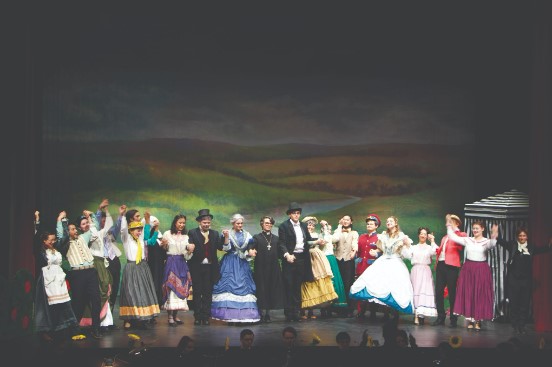
Gilbert and Sullivan’s comic opera, The Sorcerer, debuted in 1877 with a bizarre cast of priests, lovers, and sorcerers. This Victorian-era opera about marriage and love potions was not exactly what one would expect from the occasionally club and drug-obsessed—dare I say depraved—city of Montreal. Suffice it to say, when the McGill Savoy Society announced that they would be putting on The Sorcerer, McGill students paused their rambunctious night lives for an evening of opera.  

In The Sorcerer, the newly-betrothed Alexis (Samuel Valentim-Gervais, U3 Science) enlists the titular sorcerer John Wellington Wells (Aidan McGartland, PhD Music) to brew a love potion for the village so the villagers must share in his lovesickness. Wells agrees, and slips the potion into a pot of tea for a village gathering, wherein the rallying cry is not unlike that of McGill Arts students: To “eat, drink, and be gay!”  But if The Sorcerer can teach McGill students one lesson, it’s this: Always bring your own drinks to parties. 

After the potion takes effect, every villager falls in love with the first person they see. This gambit leads to some fairly unconventional and often hilarious pairings, the funniest being the romantic attraction shared between the young Constance (Alice Wu, U4 Arts) and, my favourite, the hard-of-hearing and certainly geriatric Notary (Melody Grant). In one of the show’s shining moments, the Notary uses an ornate ear trumpet in an attempt to hear Constance.  Despite all its humour, the show ends on an eerie note: To reverse the bizarre effects of the love potion, Wells sacrifices his life.

Even so, the McGill Savoy Society’s production of The Sorcerer was a hilarious and magical night of song and dance.  The cast’s costuming, designed by the show’s director, Natalie Demmon, consisted of intricate Victorian skirts and suits of various pastel hues, and especially mesmerizing cage crinolines and hoop skirts. Unlike the fashion scene in Montreal—pardoning the bright, blue eyeshadow—the costuming made me wonder if the heavy doors to Moyse Hall had opened up a portal to the late-19th-century village of Ploverleigh.  

Natalie Demmon also designed the set: A Monet-like landscape with rolling hills and twisting lakes, then a picnic spot with intricate wooden tables and food platters, and later a potion-making lair complete with a sorcery hut that resembled the cover of an Albert Camus novel.  Throughout the show, characters picked flowers from the set’s hedges to wear in their hair or give to their lover. The lighting, designed by Asa Kohn (first year master’s in math), was powerful enough to change the setting from a relaxing, rolling hillside where lovers profess their feelings for one another to the demonic potion-making chamber of a sorcerer within seconds.

Whether singing within or without the ensemble, each vocalist sounded beautiful. The ornate solos that Aline (Sophie Gaudreau, U3 Arts and Science) sang were particularly noteworthy—especially “Oh, Happy Young Heart.”  I only wished the characters spent more time listening and responding to one another with their songs; their heavy focus on the audience limited genuine conversation between characters. But ultimately, the professional quality of the vocalists more than made up for it.

Despite the orchestra’s small size, their rendering of Arthur Sullivan’s markedly brassy score, evident from the show’s starting “Overture”, was euphonious. “Dear Friends, Take Pity On My Lot” stood out as it alternated between the fast and vivacious tempo of Constance and chorus and the slow waltz of the old Notary who is “67 nearly”—gasp!  The orchestra was an incredibly talented and passionate group of musical artists whom I urge to play with even more confidence during their following musical pursuits—anyone would be lucky to listen.  

Despite debuting nearly 150 years ago,  The Sorcerer still tickles contemporary audiences.  The McGill Savoy Society’s performance of a 19th-century opera about marriage plots and sorcery allowed students to escape the misery of midterms and the monotony of the club scene.  Readers should absolutely attend future performances by this passionate group of technicians, musicians, and artists. Apt. 200 can wait another day.  

The Sorcerer ran from Feb. 10-18 in Moyse Hall.

Basketball, Sports

Martlets’ basketball misses playoffs in crushing defeat to Concordia Stingers

It wasn’t meant to be for the McGill Martlets (3–11) in their must-win showdown against the Concordia Stingers (4–11) on Saturday, Feb. 18. In an emotional farewell to senior players Jessica Salanon and Amélie Rochon in their final home game, the Martlets were unable to contain Stingers star Areej Burgonio, in a 75-58 defeat for the home side. The result means the Martlets fall short of securing the final place in the RSEQ league playoffs.  

In her last game at Love Competition Hall, team captain Salanon told The McGill Tribune it was do-or-die for the team. 

“They came up stronger than us,” Salanon said. “They fought harder. So I guess they deserve the win. It just hurts [….] For us, there’s no chance for playoffs. But hey, basketball is just a game, right?”

After a narrow loss to the Stingers the week before, the Martlets started with intent, capitalizing on early fouls to secure a tight lead in the first quarter. First-year guard Daniella Mbengo led the charge with driving layups as Martlets head coach Rikki Bowles prowled on courtside. Point guard Burgonio, who stands at just five feet tall, kept the Stingers within touching distance, but first-year guard Stephy Tchoukuiegno provided the edge from the far-right corner with an assured three-pointer to close out the quarter with a 17-15 lead.

In the second quarter, the Martlets let their lead slip. Although there were positives from Tchoukuiengo’s sharp shooting, the Martlets were unable to seize on the free throw opportunities and the Stingers pulled away with a 30-26 lead after sinking nine unanswered points. The moment of the quarter came from Burgonio, who closed the half by zipping up the court on the counter-attack in the dying moments of the second, before pausing at the three-point line, shimmying to the left of her marker, pulling back, and sinking the two points.

Launching the second half, third-year guard Emma-Jane Scotten led the Martlets in an attempted comeback, gathering an offensive-rebound and burying her attempts at the free-throw line. Despite this, Concordia maintained their grip on the game. The Martlets fought back in the latter end of the quarter, with Sydney Foran and Salanon both swishing three-pointers. The animated Stingers bench sirened throughout the quarter, while the Martlet crowd cheered and jeered ‘defence’ from courtside, as the Martlets finished the third quarter down 56-40.

The Martlets gritted their teeth in the final quarter, with third-year centre Kristy Awikeh gathering a rebound and calmly finishing the subsequent layup. However, the Martlets’ resolve would not be enough, as the Stingers continued to toy with their defence, sinking the Martlets’ chances of a prized playoff spot. 

Rochon, who’s finishing her fourth year studying medicine, told the Tribune that she will miss the Martlets’ close family spirit. 

“It’s so many things,” Rochon said. “I’ll remember the moments on the court, especially this year, the wins that we got were so special to me [….] There [are] just so many variants outside like just doing groceries or  chilling with the team […] all of it. Even practice. It’s just a great bunch of people and that’s what I’m gonna miss.”

Martlets head coach Rikki Bowles spoke to the Tribune about how Rochon and Salanon, the teams’ graduating seniors, will be an immense loss on and off the court. 

“The thing about Martlets basketball is that it really is a family, so we look forward to seeing them back in the stands and as involved alumni.”

Although this spelled the end of the Martlets’ playoff chances, the Martlets hope to end the season on a high note with their final game of the season next week at UQAM, on Feb 25.  

Moment of the game:

In the game’s final minutes, a ripple of applause waved through the crowd and courtside benches for senior players Amélie Rochon and Jessica Salanon, who both took the court for one final time. 

Quotable: 

“I just appreciate every, every, every single day with [the] team. I’m grateful. And you know, these years, they’ve passed by really quick. And it’s just when you’re at the end that you realize.” —Jessica Salanon on her time playing for the Martlets

Stat Corner: 

The Martlets averaged 52.3 points per game this season, a substantial improvement on last season’s average of 44.4.

McGill, News

Closure of asbestos-ridden Stewart Biology building disrupts teaching and research for weeks

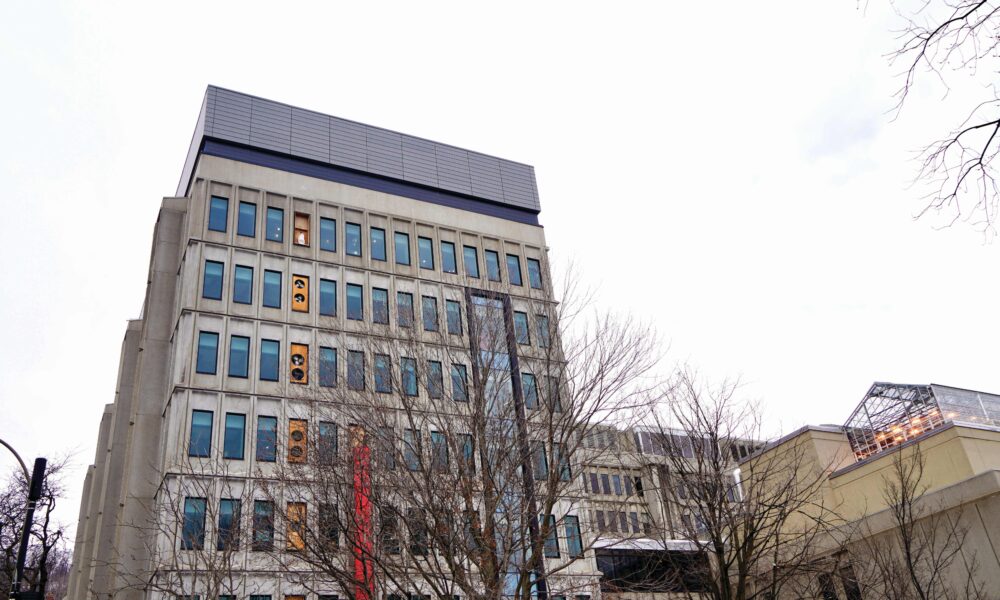
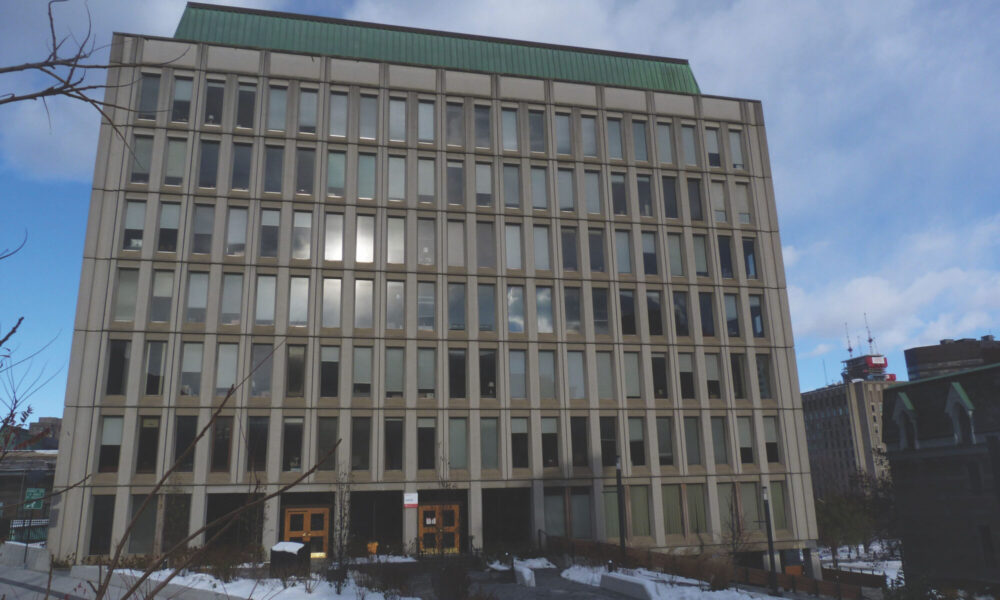
Following the closure of the Stewart Biology Building on Feb. 6 after burst water pipes led to an exposure risk to asbestos, all classes and research in the building have been moved or cancelled. Students and professors have also grown frustrated from a lack of information and logistical challenges caring for lab animals and plants.   

In a statement about the closure to The McGill Tribune, McGill media relations officer Frédérique Mazerolle wrote that extreme temperatures caused the water pipes to burst in the North and South blocks of the building. The West wing was already closed for renovations. Per McGill’s Director (Campus Public Safety) Pierre Barbarie’s update, the water disrupted the asbestos and caused an exposure risk.

Mazerolle said the North block’s affected areas have undergone extensive cleaning and testing according to asbestos safety protocols, with the air tests clean of dangerous inhalable asbestos fibres so far. But testing after the clean-up found that traces of asbestos are still present, so further cleaning will be done in the next week. 

After the additional cleaning, McGill will perform more air tests and, pending clean results, the North block will re-open. Mazerolle noted that once the building opens, McGill will continue monitoring the situation with regular air testing. The South block remains closed for flood repairs.

“We will update the community as to test results and what is being done to fix the issue as soon as information becomes available,” Mazerolle wrote.

When the risk of exposure to asbestos extended the building’s closure on Feb. 8, access to labs became a pressing issue for many researchers. Professor Ehab Abouheif, who heads the Abouheif Lab, which studies ecological evolutionary developmental biology, told the Tribune that his lab was unable to continue research and care for their animals. 

“Our research has stopped cold,” Abouheif wrote in an email. “We also lost some research animals because we could not get in fast enough to feed, although McGill [Environment Health and Safety] was working around the clock to get us in, but nature does not wait.”

Mazerolle informed the Tribune that some “essential personnel for animal care” were allowed “into the building between Feb. 6 and the morning of Feb. 8, provided they were already fit-tested for and had respirator masks and P100 filters.” 

According to assistant professor of biology Fiona Soper, however, McGill staff were barred access on Feb. 6, and no one in her lab was able to access the building to feed their animals until two days later.

“We were not told not to come in until Monday morning at 8 a.m.” Soper wrote in an email to the Tribune. “We didn’t get a great deal more info […] except later on Monday, faculty were asked to supply a list of people who needed emergency access to keep study organisms alive [….] Those people (initially one per lab) could not gain entry until they’d been approved by a committee and fitted for respirators, which began on Wednesday.”

All classes and labs were moved elsewhere, online, or outright cancelled, frustrating the students and professors. Michael Hendricks, an associate professor of biology, is one such member of the McGill community.

“The only directive we were given was ‘move online or cancel class,’” Hendricks wrote to the Tribune. “No centralized attempt to arrange alternative classrooms has been made, which is strange given the fact that we have no idea how long the closure will be, and this affects so many students in so many departments. The uncertainty creates a lot of stress and anxiety around work and safety.”

Soper, who studies plant physiology and ecosystem nutrient cycling, noted that the closure has disrupted the Soper Lab’s time-sensitive research. 

“We have experiments running in the greenhouse and planned lab work that have both been affected [….] The photosynthesis measurements will have to be sacrificed,” Soper wrote. “My PhD student has some time-sensitive root samples (brought back from Costa Rica and irreplaceable) that need to be analyzed ASAP.”

The lab closures have also affected the future plans of some researchers. Maxine Wu, a master’s student who works at the Sarah Woolley lab, which researches songbird behaviour, noted in an email to the Tribune that her work has come to a halt due to the building closure, forcing her to postpone graduation.  

“Much of the research experiments we had planned for the past week and a half have now since been delayed since we [must] be in the lab to do them,” Wu wrote. “My plan was to graduate after this term but due to the closure I now have to extend into the summer term.”

In the two weeks since the building was shut, the university has released six public updates. Yet some, including Samantha Gorle, U3 Science and President of McGill’s Biology Student Union  (MBSU), told the Tribune that despite the university’s updates, there has been very little helpful information provided to students.

“Everyone’s a bit stressed about [the closure],” Gorle said. “Biology students weren’t sent anything additional [than the public updates]. We [MBSU] weren’t communicated with at all [….] I would have appreciated […] when an update came out, being handed it instead of needing to go find it.”

Gorle also told the Tribune that the closure impacted MBSU operations, preventing their team from using their lounge in the building as well as hosting in-person office hours for biology students. 

The closure of the building at short notice also caused delivery issues. According to Hendricks and assistant professor of biology Arnold Ludwig Hayer, the building was unable to accept deliveries, including those of live animals. Instead, couriers were redirected by security to deliver at the McIntyre Medical Building. But Hayer recalled that McIntyre would send deliveries to the unmanned loading dock—where packages cannot be left—so many were returned to the suppliers, including perishable items. 

“I was lucky to run into a motivated FedEx delivery person […] I offered to receive/sign for all FedEx packages with destination Stewart Biology,” Hayer wrote to the //Tribune//. “I have been keeping them in my office in the [Bellini Life Sciences Complex], contacting their recipients, and storing the contents of deliveries at appropriate temperatures when necessary [….] I have not been able to set up a similar arrangement with other courier services besides FedEx, so I am sure a lot of deliveries are still returned.”

The North block is now expected to reopen later this week, with the timeline for South block still unknown. Stewart Biology’s closure comes after three buildings closed last month at McGill’s Macdonald campus also due to an asbestos exposure risk. 

In his initial email, Director (Campus Public Safety) Barbarie explained that the university had known about the asbestos in Stewart Biology for years, as asbestos was used as an insulator in its initial construction.

McGill began renovating the building’s West block in 2017 to remove the asbestos and upgrade the wing to meet modern university standards as part of a project that received $33 million from the Canadian government. The renovation is now in year six. The North and South blocks, which were built at the same time as the West, however, continued to be used as research and teaching spaces. Hendricks says that asbestos is only one part of the building’s issues.

“There are frequent floods on the seventh and eighth floor of Stewart North, and they have never closed the building or tested for asbestos (that I know of) afterward,” Hendricks wrote. “Stewart has been a ticking time bomb for many years. I hope this isn’t a long-term problem…there is no backup plan.” 

McGill’s Annual Safety Report 2021-2022 stated that a plan to update the asbestos administrative policy will be rolled out in 2022-23, with the implementation of the policy being one of the three leadership and policy goals. 

McGill, News

Administration challenged on claims about New Vic at Senate meeting

McGill’s Senate, the university’s second-highest governing body, met for the second time in 2023 on Feb. 15 in the Robert Vogel Council Room of the Leacock Building. The meeting touched on ongoing litigation between McGill and the Kanien’kehá:ka Kahnistensera (Mohawk Mothers). The Mothers and McGill have been in a year-long legal battle over the New Vic Project, which aims to renovate the Royal Victoria Hospital, a site that the Mothers believe contains the unmarked graves of Indigenous children.

Josh Werber, a student representative from the Faculty of Law, challenged the administration’s claim that the chances of finding unmarked graves at the Royal Vic are small, because the site is not a former residential school.

Werber evoked a discrepancy in the administration’s claims, as per volume four of the federal Truth and Reconciliation Commission‘s final report.

“Medical institutions also were the sites of potential acts of violence or of burials, and therefore myself and some of the others wonder why the reliance on that alone […] makes the university think that it doesn’t warrant a deeper investigation,” Werber said.  

The New Vic site, formerly known as Ravenscrag, was home to grisly and unethical experiments on Indigenous peoples from 1957 to 1964 during the MK ULTRA project. Secretly funded by the CIA and led by Dr. Donald Cameron, MK ULTRA subjected unconsenting patients to sensory deprivation, LSD, electroshock therapy, and more with the goal of controlling the human psyche. 

Professor and ombudsperson for students Patricia Hewlin then delivered the Office of the Ombudsperson for Students’ 35th annual report. Hewlin addressed students’ fears of filing complaints against senior or influential members of the university, especially in cases of graduate students experiencing mistreatment from their supervisors.

“In many cases when I have to intervene, I do so anonymously, because they are afraid of raising a concern about their grades, and perhaps there’ll be some type of retaliation [or] they don’t want to have a negative reputation in their programs,” Hewlin said. The Office of the Ombudsperson urged students to come forth with concerns before they “[rise] to the point where the student does not feel they have any recourse or anyone to speak to.”

The meeting then moved on to a new policy revision following changes in Quebec’s Charter Use and Quality of the French Language

Sam Baron, an Arts senator, inquired about the services and programs McGill was considering to support students in achieving competency in French, which is required by the Charter of the French Language in order to obtain the status of permanent resident in Quebec. 

Marie Cousineau, Legal Advisor (Labour and Employment Law), clarified that the Charter of the French Language does not specify that McGill must ensure that students attain a certain level of proficiency in French. Interim Principal and Vice-Chancellor Christopher Manfredi added that such considerations were “beyond the scope of this policy, which is designed to ensure that the university’s operations are consistent with its obligations under law.”

Moment of the meeting:

Interim Principal and Vice-Chancellor Christopher Manfredi began the meeting by announcing that the university flag will be lowered Thursday, March 9, in memory of the late Marcel Desautels, whose “extraordinary generosity” prompted McGill to rename the Management Faculty in his honor.

Soundbite:

“My biggest concern about the way that this project has been approached by the university is

generally the silence surrounding the issue, especially recently it’s been very hard for members of the community to get updates on what exactly is going on right now.”

—Sam Baron on the contentious management of the New Vic project.

Research Briefs, Science & Technology

The inextricable relationship between partner violence and HIV

Four decades into the HIV epidemic, the world is still struggling to keep the disease under control. While countries in the Global North have benefitted from access to life-saving drugs, those in the Global South have had to contend with exorbitant prices, barriers to access, and little help from pharmaceutical companies. 

In 2021, approximately 38.4 million people were living with HIV—54 per cent of them were women and girls. The geographic distribution of HIV cases also disproportionately affects sub-Saharan Africa, where two-thirds of patients with HIV can be found. Young women in the region are twice as likely to contract HIV than young men. 

Despite the plethora of research available to the public and the significant decrease in HIV prevalence, too many people still lack comprehensive sex education and accurate information, thus overlooking feasible precautions, putting off HIV diagnoses, and impeding subsequent treatment.

In a recently published paper in The Lancet HIV, researchers from McGill and other institutions looked into how intimate partner violence (IPV) has affected rates of recent HIV infection and HIV treatment in the past year. They found that to stay on track with the Joint United Nations Programme on HIV/AIDS (UNAIDS) goal of ending HIV as a public health threat by 2030, the inequities women face in education, safety, and health services must be addressed. 

The research team conducted a pooled analysis of nationally representative surveys with data on IPV and HIV across countries in sub-Saharan Africa such as Uganda and South Africa. They looked at data from 57 surveys spanning 20 years and 280,059 women across 30 countries. 

However, identifying the effects of IPV on women’s HIV risks comes with its own inherent implications.

“First, the relationships between IPV and HIV acquisition in women, and women’s engagement in HIV care are extremely multifaceted and complicated,” lead researcher Salome Kuchukhidze, PhD candidate in McGill’s Department of Epidemiology, Biostatistics, and Occupational Health, wrote in an email to The McGill Tribune

“This is why it is difficult to ensure that we account for all the external factors or variables that might influence HIV and IPV individually and thus might muddle the true relationship between the two.” 

Despite the onerous undertaking, Kuchukhidze explained that the team carefully maintained excellent statistical sampling throughout their analysis, which allowed them to identify a clear correlation between IPV, HIV, and a woman’s physical and mental well-being.

The researchers concluded that women are particularly vulnerable to HIV. Adding onto inherent biological risk factors, women experiencing IPV are often in relationships with abusive men who have additional sexual partners without their partner’s knowledge, ultimately increasing their risks of contracting HIV. Kuchukhidze’s team also found that the imbalance of power in cases of IPV is correlated with difficult contraceptive-use negotiation—when women are coerced or bullied into forgoing contraception—which further exposes them to sexually transmitted infections.

“We show that women who had experienced physical or sexual IPV were over three times as likely to acquire HIV recently than those who had not experienced IPV in the past year,” Kuchukhidze wrote. “These women also had worse HIV treatment outcomes.” 

Kuchukhidze believes that more research into the connection between IPV and HIV, among other social and medical variables, is necessary if governments hope to understand the causal relationship between the two.

“Given this link, governmental (or non-governmental) funding for HIV interventions should incorporate aspects of IPV prevention and eradication, as well as additional support for women living with HIV who are experiencing IPV,” Kuchukhidze wrote.

By highlighting this link, Kuchukhidze’s researchers have discovered a path forward: To truly eliminate HIV as a public health threat in sub-Saharan Africa, IPV must be considered as a mitigating factor when providing care to women and girls.

Read the latest issue

Read the latest issue