


Latest News

Out on the Town, Student Life

A holy site steps away from campus

In the late summer of 1912, a highly anticipated visit to the Montreal Baha’i Shrine, formerly the Maxwell home, located at 1548 Avenue des Pins, made anglophone and francophone headlines all across Montreal. Articles titled “Persian Teacher to Preach Peace” and “Apostle of Peace Meet Socialists” could be found across Montreal publications. Over a hundred years later, the Maxwell home stands as the sole shrine of the Baha’i faith outside of the Middle East. And it’s just a 12-minute walk away from McGill’s Law Library. 

I was eager to learn more about the Baha’i faith from my first introduction to its principles. Rather than being practised through a complex set of rites administered by clergy, the religion places human unity at its centre; it is a highly personal practice, a conversation between the soul and God. 

“Central to the faith is the duty of independently investigating the truth,” Shidan Javaheri, a U2 Engineering student at McGill who grew up in a Baha’i family in Lusaka, Zambia, told me. 

He explained that he decided to become Baha’i at age 15, after the teachings of the faith resonated with him. This notion of religious choice at such an early age was almost as shocking to me as a Roman Catholic as was hearing that Baha’is do not practice confession. Indeed, the confession of sin is forbidden and individuals are encouraged to seek repentance directly with God. At this point in our interview, I started to wish I had heard about this religion sooner—it would have saved me years of Catholic guilt. 

The shrine became a holy site of the Baha’i faith after the 1912 visit of Abdu’l Bahá, one of the three central figures of the faith. The home was owned by May and Sutherland Maxwell, one of the earliest Baha’is in Montreal and one of Canada’s most renowned architects, respectively. Montreal was the only Canadian city Abdu’l Bahá visited during his voyages to the West to spread the Baha’i faith, but this alone was not enough to cement the Maxwell home as a shrine. It was only when Abdu’l Bahá’s declared “this is my home” upon first entering the house that the building could assume sacred status as a shrine. Indeed, Baha’is consider the homes of sacred religious figures as shrines. The Maxwell home became symbolic of the religion’s reach into the West. The Maxwell house is the only Baha’i shrine situated outside of the Middle East. 

Maziar Djoneidi, member of the shrine’s Board of Directors, explained that “the shrine is a space for spiritual refreshment, not just for Baha’is but for people of any religion, or no religion at all.”

They are open two days a week for visits, and receive up to 50 people per day in the summer. So as a McGill student, no matter your faith, or lack thereof, you are welcome at the Baha’i shrine of Montreal for a moment of peaceful reflection. 

“It is open to anyone who wants a moment alone with a higher power,” Javaheri told me.

If you don’t want to make the effort to walk up des Pins, you can still learn more about the faith on campus. Although it is not operating through  SSMU as a student club, Baha’i students work with McGill’s Office of Religious and Spiritual Life and recently hosted both a panel on their faith and a visit to the Shrine. 

If you want to visit the shrine, you can book your slot online. You can also contact the shrine at [email protected], and, if you are interested in learning more about the McGill Baha’is’ activities, you can reach out to [email protected].

Artistic Swimming, Sports

When it rains, it pours: The Martlets’ artistic swimming is back

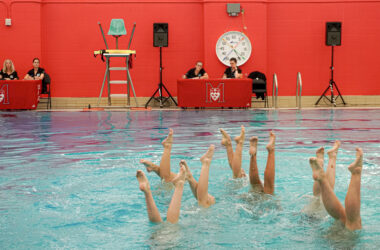
After a two-year hiatus, McGill’s Artistic Swimming Invitational made its long-awaited comeback on Jan. 21. Following back-to-back wins in the 2019 and 2020 editions of the invitational, expectations for the Martlets were higher than ever. 

Events are split into competitor levels ranging from novice (no competition experience at the national or provincial level after the age of 12), competitive (any swimmer who is registered with Canadian University Artistic Swimming League (CUASL)), and experienced (athletes that competed nationally or internationally before joining CUASL, or competed provincially after the age of 12). This year, McGill competed in every event, except for the novice duo, presenting two solos, two teams, and a duo in the experienced category, along with a solo and team in the novice category.

In attendance were five Ontarian universities, as well as four institutions from Quebec as part of the CUASL.

Ten minutes before the start of the competition, the Memorial Gymnasium saw athletes finalizing their preparations, with some reviewing choreographies for the last time, while others touched up their makeup by the side of the pool. The invitational opened with the novice duet events, followed by the experienced duets and trio, where Abbie Carnahan and Catherine McGee presented a graceful choreography to sombre, lyrical music. 

From intense lyrical melodies to upbeat pop songs, from Dua Lipa to Flo Rida and Pitbull, competing teams offered up a wide range of choreographies. However, they all had the same goal in mind: Showcasing their artistry and technical skills to the judges. The requirements between the various events differ slightly across levels and increase in difficulty for the experienced events. 

When the solos came, McGill’s novice soloist Diana Paparelli performed to Madonna’s “Isla Bonita,” delivering a theatrical and technical performance that invigorated those in the stands. Her routine placed her at the top of the soloists and ultimately earned her first place in the event. 

McGill experienced soloist, Clara Thomas, performed a stunning technical choreography and finished in third place on the podium.  

The stands never emptied as family, friends, and curious bystanders rotated in over the course of the afternoon. 

“The energy and cheering was really nice,” first-year swimmer Olivia McLaughlin told The McGill Tribune. “It was definitely very fun to have a home meet for a first competition, it’s a little ounce of security we had, […] you usually don’t have that luxury.” 

The Martlets did not only elicit support from their own stands, but also from the other teams, as those on the poolside yelled and cheered them on. 

“It’s very much a team effort,” McLaughlin told the Tribune. “There’s a certain structure that you kind of follow [….] It makes for a routine that you’re super proud to show off, because you all have your little bits and pieces in there.” 

This year’s artistic swimming team has a young core, with an overwhelming majority of first-years and only a few returning athletes. 

“Most of us never swam together before [….] it can take a while to develop the team dynamic necessary for a good performance, ” explained fourth-year science student April Ozere. “So in this way, we are at a disadvantage to other teams who may have been swimming together for a few years. However, our team dynamics are improving with every practice and I’m confident we will be able to deliver a great performance at Nationals.” 

“We were pretty happy with how we swam, considering the obstacles we had before coming to the competition,” McLaughlin added.

The schedule and competition suits were given to them just days before the event, while their McGill warm-up suits arrived the day of the competition. Since artistic swimming receives little to no funding from McGill, both of their suits were paid for by the athletes themselves, with the help of a fundraiser they organized this past fall. 

The lack of funding from McGill has proven to be a barrier for the team. In 2020, the Martlets had to pay out of pocket for all travel expenses to get to British Columbia to compete in Nationals. 

The McGill artistic swimming team will be hosting a “send-off” water show before Nationals at the end of the semester, after facing CUASL rivals in Ontario for the Eastern Divisionals on March 5-6.

McGill, News

McGill releases updated version of mandatory “It Takes All of Us” program

Content warning: Mentions of sexual violence

McGill launched a new version of its mandatory “It Takes All of Us” program, an online tool meant to educate the McGill community about sexual violence, on Jan. 30. The updated version was created by the Office for Sexual Violence Response, Support and Education (OSVRSE), McGill’s Teaching and Learning Services (TLS), and the Office for Mediation and Reporting (OMR).

The original program, introduced in 2019 and modelled after Concordia University’s version of “It Takes All of Us,” took approximately 45 minutes to complete and contained four modules that used “character-driven scenarios” centred around sexual violence and consent.

Felicia Gisondi founded the student-run non-for-profit Sex and Self to fill the gaps in trauma-informed and intersectional sexual health education. She recounted her experience taking the old “It Takes All of Us” program, which she found perfunctory and performative, to The McGill Tribune.

“I remember it being really easy to skip through,” said Gisondi, who is currently getting a master’s in psychiatry at McGill. “I also feel like it was a very, very easy way to say that your school does sexual health or sexual violence prevention because students are required to do a 45-minute digital training that they could probably do in 10 minutes if you skip through it correctly.”

The new “It Takes All of Us” takes around an hour to complete and is made up of five modules, still featuring “character-driven scenarios.” It is accessible through the MyCourses website and available in both French and English. 

Frédérique Mazerolle, a McGill media relations officer, claims that the university did a “thorough overhaul” of the program, incorporating feedback from students, staff, and at least one postdoctoral researcher who specializes in sexual violence education. 

“The [“It Takes All of Us”] refresh also puts sharper focus on the intersectionality of sexual violence and gender, race[,] and different abilities,” Mazerolle wrote in an email to the Tribune. “Additionally, given the difficult nature of some of the material, the refreshed [“It Takes All of Us”] has added more mindfulness and self-care resources for learners who may feel activated or overwhelmed while doing the program.”

The modules are designed to be completed in multiple sittings, and allow participants to save their progress. The program also has a “take a break” option that will guide users through a breathing exercise. OSVRSE urges any individuals who have or who anticipate having difficulty completing the program to reach out for confidential assistance and accommodations. 

Unlike the old program, there is now only one version for both students and staff. All students and staff who started at McGill before Jan. 31 are required to complete the new “It Takes All of Us” by April 28—even if they had already taken the old version. Students who do not complete the program in time will have a hold placed on their Minerva accounts, making them unable to register for courses. 

Gisondi, whose organization was not consulted during the program refresh, thinks that modules play an important role in sexual violence education, but are insufficient. She urged the university to invest in more counsellors and full-time OSVRSE staff, to recognize the “emotionally laborious” nature of the field, and fix the barriers to accessing care at the Wellness Hub.

I feel like McGill really needs to reinvest in their sexual violence prevention, reinvest in OSVRSE, and make sure that staff are equitably and generously paid for the work that they’re doing,” Gismondi said. “There should not be less than 10 full-time paid staff at OSVRSE at any point in time. McGill has 40,000 students.”

Keith Bellec-Warrick is a longtime member of the Union for Gender Empowerment (UGE) and is the advocacy group’s finance coordinator. Bellec-Warrick, who is currently a graduate student in education, spoke to the Tribune on the day that the new program was released. He believes that the program has strengths, such as the module on consent, but also found the structure confusing at times. He pointed to a lack of continuity between modules, and thought that the section concerning sexual violence against men was not thorough enough.

One of Bellec-Warrick’s main grievances was that the new program frequently references the availability of OSVRSE’s services and fails to suggest alternatives like the Sexual Assault Centre of the McGill Students’ Society (SACOMSS). OSVRSE, although now open after a temporary closure, has very limited appointment availability according to  their online booking tool.

“It just seems so irresponsible to release this program now when they don’t even have a functioning office,” Bellec-Warrick said. “I go on their website, there’s no information, it just shows a blocked out calendar where I can’t book an appointment, there’s no announcement that makes it obvious what the situation is. Imagine that I’m in a vulnerable situation.”

Like Sex and Self, UGE says it was not contacted during the remaking of the program. Bellec-Warrick thinks that this lack of consultation played into mistakes that he found while reviewing the program, such as poor French translations.

“The university doesn’t pursue or value the expertise of students, even though we have a lot to offer—and that’s a problem,” Bellec-Warrick said.

For any member of the McGill community in need of support regarding sexual violence, OSVRSE can be reached at 514-398-3954 or [email protected]; SACOMSS can be reached at [email protected] or over Zoom using the instructions on sacomss.org; the OMR can be reached at [email protected]; and the province-wide Sexual Violence Helpline can be reached at 1-888-933-9007.

Cross-Country / Track, Sports

Sparks fly at McGill’s track and field Team Challenge

On Jan. 27 and 28, the Martlet and Redbird track and field teams held their annual McGill Team Challenge at the Tomlinson Fieldhouse. With 538 athletes representing schools and clubs from across Canada, personal bests were achieved, school records were broken, and fans were more than entertained. 

Day one started off with a bang after Donna Ntambue’s stunning performance in the 60-metre dash. The transfer from Northeastern University won her race with a time of 7.38 seconds, beating McGill track alumna Jorden Savoury—who was competing for the Saint-Laurent Seléct club team—by 0.27 seconds.

“I’m still speechless,” said Ntambue in a post-race interview with The McGill Tribune. “Obviously that was one of my goals, but it’s just nice to see it happen. But I’m just grateful for the opportunity to be back on track. And it’s nice to know that I’m actually getting better. So I’m looking forward to [running] faster [and] just enjoying the ride.”

Ntambue later led the Martlets 4×200-metre relay team to a bronze medal with a McGill record finish. 

The longer-distance events held several highlights as well, including Abby McIntosh and Markus Geiger in the 1000-metre race, and Noah El Rimawi-Fine and Sophie Courville in the 3000-metre race. McIntosh managed to dip under three minutes with her 2:58.49 for seventh place, while Geiger put up an intimidating early season performance with a 2:26.37 for fifth place. In the longest races of the weekend, Courville ran an impressive 10:09.93 and El Rimawi-Fine ran a smashing personal best of 8:33.17. The two runners both scored themselves a spot in seventh place in their respective women’s and men’s races. 

Despite some pre-competition frustrations, El Rimawi-Fine reflected on how the race went surprisingly well, but noted that there are still areas to improve. 

“Honestly, I felt pretty good. I didn’t expect that,” said El Rimawi-Fine. “But I felt like the Queen’s guy was slowing down a little bit and I had a lot of energy, so I kind of wanted to make a move. If I had known I had enough in me, I probably would have kicked a bit sooner [….] So I think if I had done that, it could have been a sub four attempt closer than 4:03. But I’m happy with this.”

However, the 1500-metre isn’t El Rimawi-Fine’s main race—most of his season goals revolve around the 3000-metre race, where he placed fifth this weekend with a time of 8:33.17.

Day two was another intense day of racing. Ricardo Percopo finished eighth in the 300-metre, and Geiger followed up his impressive day one performance with an even more remarkable third place in the 600-metre, running 1:20.59. 

In the men’s 1500-metre, a massive McGill presence made for an exciting spectacle for the home crowd. One of the seven McGill runners in that race was Jérôme Jacques, who slid in under four minutes (3:58.89 to be precise) for 11th place in an inspiring display of grit and bold racing tactics. On the women’s side, Courville followed up her 3000-metre performance from the day before with a 12th place finish of 4:47.27 in the 1500-metre. 

Two of the most exciting races of the weekend came courtesy of Matthew Beaudet in the 1000 and 1500-metre races. Despite being passed by two of his competitors in the last 100 metres, Beaudet still managed to pull off an impressive 2:24.76 for third place in the 1000-metre on day one. 

“My main goal for the weekend was to run a good 1000-metre, and I felt I was in shape to run close to the provincial record of 2:21,” Beaudet told the Tribune. “ I think I was a little too anxious during the race as I took the lead early [at about] 550 [metres] and used too much energy there [….] The time was still good considering the tactical mistakes, and it was nice to compete against strong athletes in Montreal.”

On day two in the 1500, Beaudet ran a very similar race. His blistering pace was too much for everyone else in the field except for Queen’s University’s Jude Wheeler-Dee––the same foe who bested him in the 1000-metre––who managed to hang on once again and out-kicked Beaudet in the last stretch of the race. 

“I was pretty tired doubling in the 1500, but I wanted to run with more confidence this year, so I picked up the pace after 850 metres and led until the last 50 metres where I got passed again,” said Beaudet. “I was hoping to run a few seconds faster in this race, but I was happy with how I executed the race plan and I am looking forward to competing in later meets.”

Off the track, McGill dominated with two golds on the men’s side from Mackenzie Stathis in triple jump and Olivier Gregoire in pole vault. The Martlets came home with one bronze medal from pole vaulter Rosalie Lupien. And for those who throw heavy things, McGill took home two bronzes in shot put from Lina Ikhlef and Ella Villeneuve, while Philippe Haddad finished seventh for the men. As for the hurdles, Vanessa Lu Langley took home a silver medal in the women’s 60-metre race.

The Martlets and Redbirds will compete again on Feb. 4 in Quebec City at the Laval Invitational. 

Moment of the Meet:

Ntambue ran the 60m in 7.38 seconds, dominating her toughest university competitors by over two-tenths of a second and setting a fresh school record.

Quotable:

“I’m no better than I was last season…but I’m also not worse.”

––Lucien Louvet, distance runner

Stat Corner: 

With 45 teams and clubs, including 14 universities, over 500 athletes, and more than 800 entries, the 2023 McGill Team Challenge was slotted as the largest indoor track meet in Canada.

McGill, News, The Tribune Explains

Tribune Explains: McGill Alumni Association and Scarlet Key Society

In a season when many are searching for summer opportunities, taking advantage of the university’s alumni network can be a useful tool. The McGill Alumni Association (MAA) offers various events and opportunities to students and graduates worldwide, including networking services such as McGill Connect, the McGill News Alumni Magazine, and McGill Crowdfunding. The Scarlet Key Society is an exclusive society for both alumni and current students that provides similar networking benefits. The McGill Tribune looked into the employment, mentorship, and learning opportunities that both groups offer.

How do you start networking using the McGill Alumni Association? 

McGill graduates automatically become members of the MAA. Graduates can connect with over 300,000 McGill alumni across the globe by signing into the McGill Alumni directory using their McGill credentials. 

The MAA, in partnership with a virtual networking platform called Ten Thousand Coffees (10KC), designed McGill Connect—an exclusive networking platform that allows McGill alumni, current students, and faculty to link with one another. The platform even allows recruiters to search for new hires within the McGill graduate pool. 

McGill Connect works through a three-pronged system. First, members complete a quick matching quiz to determine the personalized connection suggestions they will receive. Then, they can search the platform based on a number of factors, including location, expertise, and industry. Finally, alumni can connect with their matches through discussion boards, messages, and calls. 

What other services and opportunities does the McGill Alumni Association offer?

Along with McGill Connect, the MAA boasts a range of activities, initiatives, and benefits for its members. Events range from a Roller Skate Party in Switzerland, Winter Pancakes and Maple Syrup Brunch in Paris, to a Student-Alumni Networking Cocktail in Montreal. Events are either free or charge an attendance fee.

The MAA also publishes the McGill News Alumni Magazine, which highlights the achievements of McGill’s graduates and reports on the latest developments at McGill. 

Members of the MAA enjoy benefits such as discounts on insurance rates and credit card services. When members sign up for these perks, McGill’s affinity partners return a percentage of the premiums collected to McGill. Members can also peruse discounted accommodations across the world and pay reduced rates at McGill facilities. 

Along with collecting private donations for the university, the MAA also runs McGill Crowdfunding, a fundraising platform for individuals in the McGill community to raise money in support of educational initiatives and research.

What is the Scarlet Key Society?

The Scarlet Key Society strives to bring together students who have shown outstanding leadership and generosity in the McGill community and provides a space for them to continue their service. According to the group’s Constitution, the Society holds a few events a year and also supports a number of charitable causes.

The Society consists of members of the original Scarlet Key and Red Wing Societies, honourary members appointed by the Scarlet Key executive, and recipients of the Scarlet Key award. This exclusive award is granted to student leaders who show extraordinary leadership and ambition, and go above and beyond in their communities.

Candidates for the award can be self-nominated or nominated by others in the McGill community. All nominations must be done through an online application. Candidates must have completed at least two full-time semesters and be in satisfactory standing or be a McGill alumnus, but grades are not considered beyond this requirement. Candidates must also have taken on a significant project that has had a positive impact. 

The 2022-2023 “pinning” ceremony for chosen Scarlet Key award recipients will take place on March 23.

Commentary, Opinion

The truth behind so-called sustainable vehicles

In December 2022, Federal Environment Minister Steven Guilbeault gave the go-ahead for a new lithium mine in northern Quebec. The James Bay project represents the only lithium mine in North America, and the materials are slated to help meet the surging demand for electric vehicles. Although the shift away from fossil fuels is an important step in fighting climate change, the Cree community of Eeyou Istchee has led the charge to oppose the project. Various other Indigenous communities have similarly raised concerns about the environmental effects of mines and the fact that lithium-powered machinery is not as sustainable as advertised.

When looking to purchase new vehicles, consumers should question the narrative surrounding the sustainability of said products before deciding to pump money into the industry. To truly engage in the fight against the climate crisis, consumers must commit to curtailing patterns of overconsumption, which will decrease demand for materials such as lithium. Beyond consumption patterns, consumers must pressure their governments to not invest in industries that are complicit in environmental destruction and human rights abuses under the guise of sustainable development. 

While Guilbeault stated that the project is not expected to have serious environmental effects and will be built in partnership with local Cree communities, we must consider the Canadian government’s history of broken promises. Despite commitments to allegedly defend Indigenous sovereignty and land, communities such as the Wet’suwet’en continue to protest the construction of pipelines such as Coastal GasLink, whose non-consensual construction ensues despite violent police repression

Lithium mining itself in Quebec has already faced staunch resistance from Indigenous communities. When another Quebec lithium mine was proposed in November 2022, members of the Long Point First Nation opposed it and the exploitation of their land, but the project is set to go ahead. 

Beyond its immediate overstepping of Indigenous sovereignty, lithium mining is linked to grave human rights concerns due to its reliance on cobalt production—a key ingredient in lithium-ion batteries. Seventy per cent of the world’s cobalt is produced in the Democratic Republic of the Congo under inhumane working conditions and using child labour. This type of exploitation is the lived reality of millions of people in the supply chain that the Quebec government is choosing to take part in. 

While electric vehicles, whose production requires lithium, are generally the more environmentally-friendly option, consumers must consider the effects of the emissions linked to lithium production and automobile manufacturing. China’s production of lithium batteries—which constitutes the majority of global production—is fuelled by coal. The production of an electric vehicle’s battery and fuel both produce more emissions and are more resource-intensive than the manufacturing of a standard automobile engine. The improved energy efficiency of electric vehicles, however, makes up for these higher environmental costs. Nonetheless, the demand for lithium-ion battery materials is growing, which will undoubtedly lead to increased global emissions that cancel out the effects of electric cars.

When consumers overlook the big picture of vehicle production, they only further contribute to overconsumption. If the exorbitant demand for private vehicles continues—even if they are electric—the environment will continue to severely degrade. Although electric vehicles and the shift away from fossil fuels are positive steps forward, we must still acknowledge that our unquenchable thirst for the latest and most advanced technology continues to perpetuate the destruction of our environment.

McGill students have embarked on noteworthy initiatives to help build new patterns of sustainability, such as the Sustainability Projects Fund. While initiatives like these are great for students to create more sustainable living and consumption patterns, those residing in Quebec must also fight against government projects that make them complicit in environmental devastation. On the journey to climate justice, one of the first steps must be active lobbying against destructive mining funded by the government.  

Art, Arts & Entertainment

‘Lasting Impressions’ showcases classic paintings in a new dimension

At Espace St. Denis, Lasting Impressions unfolds in an atmospheric movie theatre, complete with a menu of drinks and snacks that contribute to the show’s Parisian atmosphere, as if you are sitting in one of the quaint cafés depicted in the impressionist paintings. Multiple movie screens wrap around the sides of the theatre, creating a truly immersive experience. 

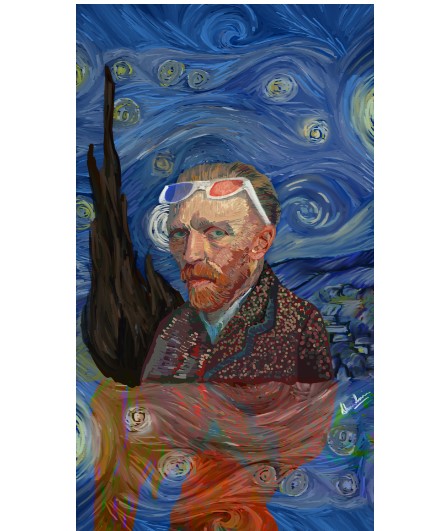
Lasting Impressions offers a dazzling highlight reel of famous impressionists, including Van Gogh, Monet, and Pissarro. This exhibition stands apart from the slew of other impressionist showcases that are popular today by showing 3D renderings of the artworks. While the use of 3D may sound gimmicky, it counteracts the flatness that often plagues digitally rendered and projected art pieces. Using this technique is a clever response to the impressionist style, which relies on dynamic movement and depth to convey emotion. 

The show is divided into two parts. The first, in 2D, explores Paris as the epicentre of the impressionist movement beginning in the late 19th century. As jaunty music and a restaurant ambiance permeate  the background, vintage footage of bustling Parisian streets is projected, interspersed with artist introductions detailing their upbringing and involvement in the Parisian art scene. The showcase also highlights some lesser-known women impressionists, such as Marie Bracquemond, Eva Gonzales, and Berthe Morisot

After a brief intermission, the second section begins with an audio introduction by the great-granddaughter of Pierre-Auguste Renoir, Sophie Renoir. Guests are then prompted to put on their glasses, and the 3D show begins. 

The massive wraparound screens combined with the expertly crafted 3D makes for a mesmerizing experience. The size of the screens allows for an unprecedented view of the immense detail that went into these works. The slideshow lasts 50 minutes, with each painting on display for about half a minute. There are a total of over 100 paintings shown, ranging from famous masterworks to relatively unknown paintings.

Dylan Pierce, who made the 3D effects for the show, is the key to Lasting Impressions’ success. Masterworks, such as Manet’s A Bar at the Folies-Bergère and Degas’ The Rehearsal, float serenely across the screen with amazing depth and movement. Monet’s Water Lilies was especially entrancing; the water in the painting was digitally manipulated to make rippling waves. The 3D elements lend themselves especially well in this scenario, making the water seem transparent and the bottom of the lake far, far away.

Only an experienced producer could match this show’s ambition. Rubin Fogel, a producer responsible for a host of Montreal concerts and shows, helped organize Lasting Impressions. In the introduction to the show, he called it “one of the most exciting projects that I’ve been involved with in the 45 years I’ve been in this business.”

Accompanying musical pieces were carefully chosen to fit perfectly with the art. Selections varied from lively instrumentals to sombre classical pieces to moving vocal performances. For example, the gentle melodies in Debussy’s ”Clair de Lune worked harmoniously with the soft, glimmering view of Van Gogh’s Starry Night to create a transcendent experience at multiple sensory levels. Additionally, Adam Fisher’s tribute to Van Gogh, “Vincent,” was especially impactful when overlaid with some of the visual artist’s other works, such as The Bedroom and The Church at Auvers.

This display does a much better service to its impressionist paintings than other non-physical showcases have. It still, however, possesses some of the unavoidable limitations of digital art. The texture and visibility of the brushstrokes, visual elements that are considered a cornerstone of the impressionist movement, are completely lost. Additionally, the viewer cannot see the light interact with the canvas as it would if they were walking around the real-life painting.

Viewing the paintings in this exhibition is no substitute for viewing them in real life. With that being said, visitors are still bound for a completely unique, ambient, and compelling experience at Lasting Impressions. 

Lasting Impressions is on display at Espace St. Denis until March 12.

Arts & Entertainment, Film and TV

‘Women Talking’ is as vibrant as it is harrowing

After premiering at the Telluride Film Festival in the fall of 2022, Women Talking made its way to theatrical audiences on Jan. 13. Adapted from Miriam Toews’s 2018 novel of the same name, the film was co-written and adapted by Toews and Canadian director Sarah Polley. Women Talking follows eight women in a remote Mennonite community who grapple with their faith in God and their community following a series of violent sexual assaults. The film tracks these women for 48 hours as they decide, through a series of conversations, to fight, forgive, or flee. Despite its grim subject matter, Women Talking doesn’t feel like taking your medicine. With piercing dialogue, a captivating sea of performances, and striking visual composition, Women Talking is as compelling cinematically as it is thematically. 

The film creatively departs from the novel by placing a young girl from the colony (Kate Hallett) as the narrator—in stark contrast to the novel’s male narrator, August. Although August (Ben Whishaw) still appears in the film, Polley and Toews use this minute yet monumental change to centre women’s voices and presences in their story. The central conversation between the eight women is sharp, cutting, and at times, witty. The script pays careful attention to never demonize or look down upon these women for their religious beliefs. It never once passes judgment for their fears of staying or leaving the place they call home, even though it may be a dangerous place. With such powerful dialogue, their words resonate well into the film’s quiet moments. 

The film’s three leads—Ona (Rooney Mara), Salome (Claire Foy), and Mariche (Jessie Buckley)—intently articulate the emotional, physical, and spiritual pains of the women. Each of them symbolizes the three core solutions proposed by the women in the colony—to forgive, fight, or flee—but none ever feel like a caricature or too on the nose. Foy, who comes to represent the desire to fight, delivers an intensely captivating performance, unwavering in vigour and sorrow from start to finish. She says every line of dialogue with the same fierceness as the last—serving as the driving force of division, you simply can’t take your eyes off her. Alongside the rest of the cast, Buckley and Mara’s performances expertly support Foy’s. Mara, in particular, acts as the emotional core of the film as an audience stand-in, incorporating lighter moments of a blossoming romance with the bleak backdrop of the film’s overarching themes. Buckley plays in direct contrast to Foy, acting as a sounding board for her ever-changing perspectives throughout the film. 

The matriarchs of the colony, Greta (Sheila McCarthy) and Agata (Judith Ivey), masterfully bring a sense of structure and order to the sprawling cast. Despite the individual merits of each performance, the cast’s chemistry and support of one another is what makes the entire film something extraordinary.  Their authentic chemistry brings life to the script, brilliantly portraying countless aspects of this community’s collective experience. 

Director Sarah Polley made a striking and bold choice with the film’s visual language by working with a drab, grey colour palette. This could have compromised the cinematography, but Polley elevates the emotional tension with colour to emphasize the desperation the women in this colony feel. Something has drained these women’s lifeblood, metaphorically and visually. With sweeping shots of country fields and sunsets from barn doors tinted with the film’s ominous colour palette, Polley creates a sense of familiarity, discomfort, and hope, all before the first words are spoken. 

Women Talking combines a masterfully written script, astonishing performances, and phenomenal visuals, making the film one of the year’s most important and compelling works. To some, a story of women having conversations in one setting may seem exceptionally suited to a novel. Polley, however, expertly demonstrates how film can not only accommodate, but even elevate the text beyond its original form. 

Women Talking is currently playing in theatres across the country.

Combat Sports, Sports

Boxe Office: A hit among McGill students

Over the past several years, boxing has seen a remarkable resurgence in both viewership and participation. The sport’s popularity has skyrocketed, likely in part due to the rise of “influencer boxing,” where organized fights amongst popular internet figures garner massive attention and millions in pay-per-view sales. 

As boxing gains more and more fans, it is no surprise that young people have begun to seek out amateur boxing for their own enjoyment. Located one street south of McGill’s downtown campus on President Kennedy Avenue, Boxe Office has quickly become a hotspot for downtown residents, particularly McGill students. The gym was founded in July 2021, after the fitness industry endured a harsh year of lockdowns and diminished revenue. The timing, however, didn’t phase gym owner Normand Robert, a seasoned boxing coach and Taekwondo black belt who has been active in the boxing world for over four decades.

Due to the precarious timing of the Boxe Office’s opening, the gym started out with a lower volume of customers than it had hoped for. Despite the initially modest numbers, Robert recalls being optimistic about the gym’s prospects.

“I saw it as an advantage. I said to myself [that] COVID would eventually slow down,” Robert said in an interview with The McGill Tribune. “I’ll use this time to fine-tune the business, work any bugs out, and when people come back to the gym, I’ll be ready.”

Robert credits the gym’s success to his personable one-on-one approach to coaching and his decision to operate out of a small space, with enough room for only six heavy bags. 

Robert believes that in order to get the most out of training, athletes must develop each technical aspect of boxing individually. As such, the gym offers six different types of one-hour classes: soft, flash, core, shadow, focus, or boom.  As most of the gym’s members are new to boxing, Robert takes pride in training his new clients from the very beginning and watching them develop their skills from beginner to expert. 

Many students who came to the gym as beginner-level boxers in the fall were quick to praise the gym, not only for helping them develop a new skill, but also for its impact on their lives. 

“Mr. Robert motivates me to push myself, teaches me the art of boxing, and, most importantly, cultivates my ever-growing passion for the sport,” said Charlie Li, U1 Science. “I’m glad I’ve stepped into this gym. It has changed my life and made boxing an integral part of my life.”

Lauren Kennedy, U1 Music, found that boxing helps her grow her self-esteem. 

“When I leave Boxe Office, I leave as a stronger and more confident person [. . ..] Robert is an extremely encouraging, patient, and talented coach,” she said. “His boxing classes are the favourite part of my day.” 

Robert contends that regardless of skill or experience, his best clients are focused and eager to learn. He noted that many McGill students who come to his gym already embody these traits.

“I get a lot of McGill students,” said Robert. “They’re smart; they want to understand what I teach them and ask a lot of questions. That is something that I love.”

As the Boxe Office experience continues to grow in demand, Robert is starting to consider his plans for the gym’s future. But Robert insists that small class sizes must remain the priority so he can continue to build relationships with clients, both old and new. 

“Community is important,”  Robert said. “Nobody is a stranger here. One of my goals, when I opened, was to make something friendly, and […] build up a community.”

Read the latest issue

Read the latest issue