

Latest News

Arts & Entertainment, Film and TV

‘Partition’ views Palestine from the interwar period to modern-day experiences

McGill’s Department of Anthropology and the Institute for the Study of International Development hosted a screening and Q&A session for Diana Allan’s film Partition on Wednesday, Jan. 14, at McGill’s Critical Media Lab (CML). Allan, a filmmaker and professor of Anthropology at McGill, considers Partition a collaborative work; other members of the lab—Co-Directors Lisa Stevenson and Megan Bradley, as well as Associate Director Julian Flavin—worked on the film with Allan.

When Allan introduced her film, she emphasized how the project would not have been possible without the people she worked with at the CML.

“[This film] is a product of this space and the friendships and collaborations that it has enabled,” Allan said. “If Montreal is the home of [this film], CML is the heart [….] Thank you for the partners in this project.”

Partition explores the impact of British colonialism in Palestine by combining 1900s black-and-white visuals with modern-day audio and stories. The film showcases photos and footage from the time of the British Mandate for Palestine, which spanned from 1917 to the establishment of an Israeli state in 1948. The footage, which was recorded by British soldiers, depicted daily Palestinian life as well as British military activity during the mandate.

The archival footage is taken from the Imperial War Museum Collection in London, accompanied by music and interviews from Allan’s own collection. 

“[The film] was bifocal in the sense that you’re seeing images from 100 years ago and sound from today,” Allan said.

Partition is not Allan’s first attempt to shed light on the ongoing genocide in Palestine through film. She has published a book, “Refugees of the Revolution: Experiences of Palestinian Exile,” which explores the daily struggles of Palestinian refugees in Lebanon. She is also the co-director of the Nakba Archive, an oral history collective recording and commemorating Palestinian refugees in Lebanon who lived through the Nakba.  

Allan focuses on the Palestinian experience, with all language in the film either written or spoken in Palestinian Arabic. Throughout the film, she interviews Palestinians about their lived experiences, as well as their families’ experiences in Palestine. Much of the film revolved around interviews with Sumaya, a former student of Allan’s. Through these interviews, Allan shares modern-day stories of Palestine as well as historical ones through the accounts of Sumaya’s family. 

In the Q&A session, Allan explains how this documentary shares similarities with many of her other films. Like Partition, Allan’s other films focus primarily on the human condition—specifically memory and the emotional impact it can have on the lives of refugees.

“All of my films have been about memory [….] Reference photos and through movement, through space, activates this sort of process of memory, and this form is about the experience of the archive itself,” Allan said.  

Paloma Masel, U2 Arts, said that the film’s focus on memory and human experience drew her to the screening. She emphasized the role of a traditional song Sumaya referred to as “the camel driver’s song.”

“That song being followed by what sounded like the songs of thousands of families […] that might have gone through that sort of trauma really stuck with me,” Masel said. “And I wanted to hear more encapsulation of that […] experience in the final sequence.” 

Before the Q&A began, Lisa Stevenson, co-director of the CML, warned attendees about using colonial images, as they could risk inadvertently uplifting colonial oppressors.

“I think that working with the colonial images is a very faulty endeavour and there’s a danger of you, obviously, questioning forms of colonial violence, that are the context for the making of these images and how you both make these images visible, these histories visible,” Stevenson said.

By using this footage in a film centred on the Palestinian cause, told by Palestinians themselves, Allan repurposes a tool of imperial control as a testimony of resistance against occupation. 

Allan shows aerial and ground surveillance footage, women hiding their faces from British soldiers, and British bombings of Palestine during the British Mandate. Palestinians were encouraged or forced to join the British military, which had placed them under constant watch. 

“You’re aware of the colonial violence. You’re very aware of the colonial gaze,” Allan says. “Images that seem to carry that kind of violence, […] something really malicious, frightening, and fearful. By the end, we transformed it into something else.”


Science & Technology

Take the Tribune’s Science and Technology quiz

In 1989, Alan Emtage, a graduate and system administrator at McGill, created the first Internet search engine, which present-day search engines still rely on. What did he call his search engine?

a) WebCrawler
b) Yahoo
c) Archie
d) ChatGPT

As of Fall 2025, which faculty had the largest number of students enrolled?

a) Arts
b) Medicine and Health Sciences
c) Science
d) Engineering

Two of the three ‘Godfathers’ of Artificial Intelligence are Canadians. Who are they?

a) Yann LeCun and Yoshua Bengio
b) Ray Solomonoff and Arthur Samuel
c) Geoffrey Hinton and Yoshua Bengio
d) Yann LeCun and Alan Turing

Which of these CEGEPs was named after a McGill alumnus?

a) LaSalle College
b) Dawson College
c) Marianopolis College
d) Vanier College

In what year did Carrie Derrick become Canada’s first female professor, having been appointed as a Professor of Morphological Botany at McGill?

a) 1912
b) 1950
c) 1963
d) 1934

McGill was the first Canadian university to award a degree in which discipline?

a) Medicine 
b) Arts
c) Engineering 
d) Religious Studies

The first McGill psychology course was taught in 1850, but psychology did not become its own department at the university until 1922. Under which department did psychology originate?

a) Sociology
b) Philosophy
c) Biology
d) Anthropology

Who was the second Canadian woman to go to space and the first to board the International Space Station, all while holding a degree from McGill?

a) Valentina Tereshkova
b) Katy Perry
c) Roberta Bondar
d) Julie Payette

Answers:
c) Archie
a) Arts
c) Geoffrey Hinton and Yoshua Bengio
b) Dawson College
a) 1912
a) Medicine
b) Philosophy
d) Julie Payette

Arts & Entertainment, Exhibition

Sixty years of song and community celebrated at the Marvin Duchow Music Library

Since its inception 60 years ago, the Marvin Duchow Music Library has seen McGill students through the good, the bad, and the never-ending tears that accompany late-night cramming sessions. Wandering the aisles for the first time, I passed towering shelves lined with scores of music I doubt I will ever learn to decipher. Compared to the hectic atmosphere of rue Sherbrooke below, the library feels like a greenhouse for one of the most instinctive forms of art.

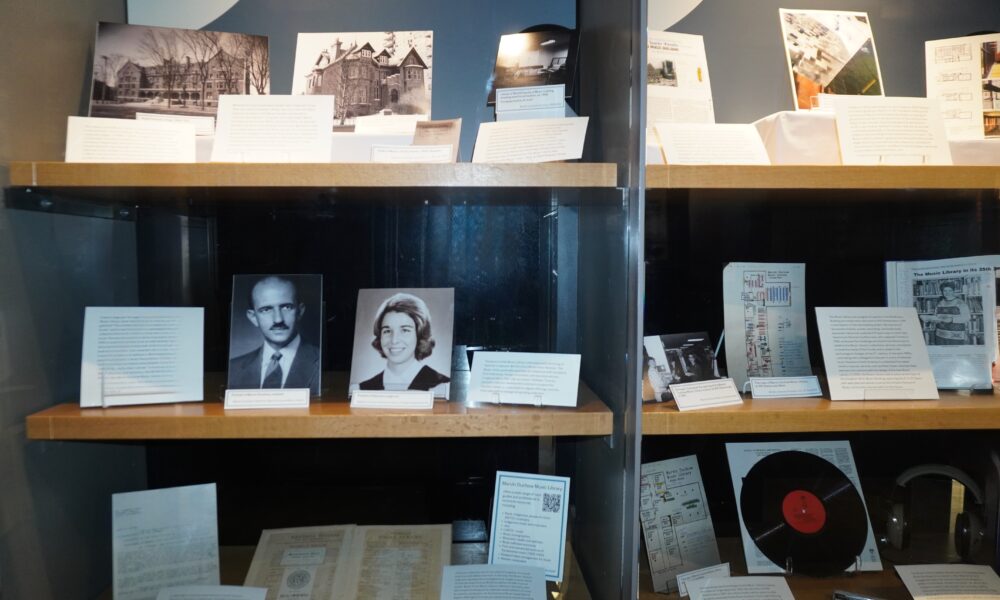
To mark its anniversary, the library is presenting Marvin Duchow Music Library at 60: Interplay of Community, Service, and Discovery, exhibiting artifacts drawn from the library and the university’s archives, with one display near the entrance and another inside. When I first explored the exhibit, a bright red record from 1982, featuring the McGill Symphony Orchestra conducted by Uri Mayer, immediately caught my eye. Like the musicians themselves, the record’s bold colours draw viewers into the intertwined histories of the Schulich School of Music and its ever-evolving library.

Rather than simply documenting the library’s history, the exhibit celebrates the efforts of those who sustained the space as a resource for the music community on campus and beyond. Marvin Duchow, a former Schulich School of Music Dean, understood how integral these two institutions were to each other. In a featured address to the Canadian and American Music Library Associations, he emphasized the reciprocal role music faculties and libraries play in sustaining one another.

Also featured are various administrative and informational artifacts, including a visitors’ log, The McGill Daily’s articles detailing students’ and librarians’ fight for a larger facility, photographs showing the library’s various iterations, and words from the many librarians who have looked after the collection over the decades. An obituary for Marvin Duchow is, of course, featured prominently in the collection—a fitting tribute to the man who dedicated himself to the pursuit of community knowledge.

Through the care taken in curating the exhibit and the honouring of those who fought for the library, the space is not only celebrated as somewhere to study but as a necessary resource for musicians. In a featured statement, former head librarian Cynthia Leive underscored the library’s role as a learning institution on its 25th anniversary.

“Students […] haven’t the years and money necessary to build a personal collection of books and scores,” Leive said. “So they start by coming here [….] They become more interested, more literate, and start studying scores [….] What they will take away with them is a love of music and knowledge, and of learning that will be with them for the rest of their lives. That, in essence, is the spirit of the library.”

The exhibit exemplifies Duchow’s belief that libraries are the heartbeat of an academic community by focusing on both the library’s evolution in the Elizabeth Wirth building and on the strong connection to its faculty. The library is loved through the care that librarians and staff put into keeping it going, day and night, for whatever one might need. The library, as its namesake hoped it would, continues to reflect the changing needs of the musicians it houses. Of course, the one thing that never changes is the music community’s commitment to protecting the space. 

In 1975, a decade after the library’s opening, Librarian Emirata Kathleen Toomey humorously recounted the quirks that come with her job, highlighting the work the exhibit celebrates. Her words, like the exhibit itself, find hope in the library’s future through the foundations of the past, and still resonate on its 60th anniversary.

“A library is not always such a frivolous place,” Toomey said. “There are those who rely on it for their life’s work, and it is of prime importance that it continues to grow—especially in its holdings. If the past ten years are an example of things to come, I can foresee only a bright future ahead.”

News

The Tribune Explains: The No More Loopholes Act

On Sept. 19, Jenny Kwan, current New Democratic Party Member of Parliament (MP) for the Vancouver East Riding, introduced Bill C-233. While Canada has ceased direct military exports to Israel, Canadian arms can reach Israel and other conflict zones unregulated through a U.S. ‘loophole.’ The Tribune explains Kwan’s proposal, which aims to close this gap, and how McGill students can get involved to stop the flow of Canadian-made weapons to Israel.

What does Bill C-233 do?

Bill C-233—more commonly known as the No More Loopholes Act—is a law that intends to amend the Export and Import Permits Act, originally created in 1947. The House of Commons has since amended the act many times, including following the Arms Trade Treaty (ATT), which was adopted by the UN General Assembly in 2013 to regulate the international trade of conventional arms. Canada acceded to the ATT  in 2019. Currently, the Export and Import Permit Act regulates the international trade of arms with international standards, but certain loopholes allow Canada to send military exports to the U.S. without a permit. Bill C-233 intends to amend the act to ensure Canada abides by this international treaty more closely, preventing Canada from sending arms to foreign war zones via the U.S.

How does it work?

Currently, Canada may export military arms to the U.S. without the permits that other countries require. These arms are then integrated into larger weapon systems exported to Israel and other war zones. No human rights risk assessment is conducted under this method, allowing Canada to sidestep regulations intended to prevent human rights violations. Reports find that hundreds of shipments of Canadian explosives and fighter jet components have reached Israel through this technicality over the past two years.

The No More Loopholes Act would end the U.S. exemption from regulations, meaning that if Parliament passes the amendment, the government’s Export Controls Division would have to check all military export permits for any potential association with human rights violations and war crimes. 

How are Canada and McGill complicit in international warfare?

Canada exports around $1 billion CAD in military goods to the U.S. each year. Due to diplomatic agreements between the two countries, these exports are almost entirely unregulated. The components Canada ships to the U.S. are used in many major weapons systems, such as fighter jets, drones, and missiles. From here, these weapons are often shipped to Israel, contributing to the ongoing genocide in Palestine. While direct export to Israel has been well regulated, Canada is nonetheless complicit in genocide through its exports to the U.S.

McGill, too, is implicated in international warfare through its current investments in the defence contractors Lockheed Martin, Thales SA, and Safran, which all have ties to Israel’s military, manufacturing, and surveillance activities. 

What can McGill students do?

In late February,  Parliament will vote on Bill C-233. Students may participate in the campaign by contacting their MP and expressing their support for the amendment. Students may fill out this form to email their MP directly.

Students can also contribute by encouraging their friends and family to get involved. In a movement briefing for the No More Loopholes Campaign, Shatha Mahmoud, organizer at the Palestinian Youth Movement, emphasized the importance of taking action.

“We are now in the final stretch before [Kwan’s] bill comes to a vote in Parliament [….]The government is counting on us to be delayed, to be confused, and we are ensuring we are doing the exact opposite,” Mahmoud said. “Silence is how this violence is normalized.”

News

Recap: AGSEM in the process of bargaining for better invigilator contract

The Association of Graduate Students Employed at McGill (AGSEM) is bargaining for an improved contract for invigilators after the Collective Agreement between the university and the association expired on Dec. 1, 2025. The new contract demands a pay increase from $18 CAD per hour to a comparable wage between Université de Montréal’s $27 CAD per hour and the University of Toronto’s $50 CAD per hour. They are also demanding a minimum number of invigilators hired commensurate with the number of students who need to be invigilated.

Sneha Vaishali, a PhD candidate and doctoral researcher at McGill’s Montreal Neurological Institute-Hospital who is part of AGSEM’s Unit 2 Bargaining Committee, clarified their requests in a written statement to The Tribune, stating that these demands were democratically decided upon at their Unit Assembly.

“We expect a wage of $26 [CAD per hour] going up to $32 [CAD per hour] by 2028,” Vaishali wrote. “We currently have a huge number of no-shows [in shifts], and this is because the wage is not high enough to keep invigilators motivated enough to work.”

As Canada’s leading university, Vaishali believes that McGill can most certainly meet their principal demands along with accessory ones, which may be instated pending final negotiations. These include a mandate to instate retroactive pay for invigilators who worked after the previous Collective Agreement.

Lara Herlah, currently enrolled in McGill’s biological and biomedical engineering Master’s Program, also shared her experiences as an invigilator in an interview with The Tribune. She stated that, while she did not feel overworked in the position, the pay was still inadequate considering the hours.

“It’s [graduate] students that are being hired for these positions, so I do think it would be fair to pay them more because our time is also money,” Herlah explained. “So, what would be a fair wage? Definitely more than $18 [CAD] an hour.”

If a new agreement is signed, it will last for three years before it expires. Vaishali stated that these negotiations typically last a couple of months, but that AGSEM hopes to finish as soon as possible.

“Our first bargaining session will be on [Feb. 9], and we hope to meet McGill where our members are,” Vaishali wrote. “We have been doing open bargaining during negotiations, which means that anyone that’s interested in bargaining or would like to support can join either in person or online.”

Science & Technology

The link between mental health and breathlessness

Have you ever trudged through the snow up rue University, about to write a final exam that will make or break your grade? By the time you reach the top of that hill, you might be feeling more out of breath than usual. 

A recent study involving Dennis Jensen, a clinical exercise and respiratory physiologist at the Research Institute of the McGill University Health Center (RI-MUHC), reveals that anxious and depressive feelings may intensify the sensation of breathlessness during exercise and in daily life. In this case, breathlessness, also referred to as shortness of breath or dyspnea, a feeling of struggling to take in enough air into the lungs, is estimated to affect one in ten adults.

“These are people that, oftentimes because of their health condition, experience breathlessness that can become so difficult and so severe and so unpleasant that they avoid physical activity. In that way, it becomes disabling,” Jensen explained in an interview with The Tribune. “They start to make decisions around not climbing stairs, not going for a walk, not participating in activities of daily life that require physical activity with friends and family [….] The burden of breathlessness or breathing discomfort becomes an impediment to them to lead physically active lifestyles.” 

Jensen and his colleagues analyzed a cohort of 1155 adults between the ages of 40 and 91. They found that increased symptoms of depression correlated with greater breathlessness in daily life. The researchers also identified a strong association between both depression and anxiety and increased breathlessness during exercise, or exertional breathlessness

These relationships remained even after controlling for factors that may otherwise affect one’s degree of breathlessness, including age, sex, body mass index (BMI), smoking status, and the presence of heart and lung conditions such as asthma, cardiovascular disease, and obstructive lung disease. By controlling for these confounding variables, Jensen and his team identified anxiety and depression as independent contributors to breathlessness. 

“We used this large cohort to examine the associations between people’s self-reports of anxiety and depression using a standard scale called the Hospital Anxiety and Depression Scale,” Jensen said.

Participants also self-reported their experience of exertional breathlessness in daily life and completed the Cardiopulmonary Exercise Test (CPET), the gold standard for assessing breathlessness during exercise. Sports scientists commonly use the CPET to measure VO2 max, which describes how efficiently one’s body circulates and uses oxygen. The test typically has participants pedal a cycle ergometer, also known as a stationary bike, and breathe through a mouthpiece, all while the bike’s resistance slowly increases.

“While I think our results are important and an important step forward, we recognize that the analysis was cross-sectional, so we didn’t follow people over time,” Jensen said. “While the exercise test was very standardized, and I would say the gold standard, and while the Hospital Anxiety and Depression Scale is a widely used screening tool for symptoms of anxiety and depression, it wasn’t clinically diagnosed.”

The researchers believe that clinically diagnosed depression or anxiety could potentially show even stronger associations with breathlessness, especially in the unstable, non-laboratory setting of stressful daily life. Thus, this study points to the idea that by treating symptoms of anxiety and depression, we can potentially alleviate daily and exertional breathlessness. 

“Say, for example, […] you’ve taken somebody with a lung disease and you’ve optimized their condition with inhaled steroids and bronchodilators and stuff, but they’re still breathless [….] Maybe you have to dig a little bit deeper and recognize that some of the residual breathlessness might not go away unless you address the comorbid anxiety or depression,” Jensen explained.

Overall, Jensen’s research supports existing observations on the link between anxiety and depression with greater exertional breathlessness in daily life, and it is the first to show that this association is also reflected in greater exertional breathlessness during a standardized CPET.

“Anxiety and depression and breathlessness, you know, all of them have independent effects on quality of life. I think ultimately, we not only want to understand […], but to make people’s lives better through the work that we do,” Jensen said. 

Commentary, Opinion

Safety isn’t one-sided when harm reduction saves lives

McGill University researchers from the Department of Epidemiology, Biostatistics, and Occupational Health recently found that overdose prevention and supervised consumption sites in Toronto were not associated with long-term increases in local crime, with rates remaining stable or even declining over a decade. Yet fear about public safety continues to shape opposition to these initiatives, often projecting discrimination and stigma onto individuals who use drugs. However, people’s perceptions of safety and comfort should not take precedence over protecting human lives, especially when harm reduction has been proven effective to save them.

Fear drives much of the resistance to supervised consumption sites. In neighbourhoods such as Milton-Parc in downtown Montreal, many residents recount uncomfortable or distressing encounters with unhoused individuals—but the discomfort these interactions may bring does not justify eliminating initiatives that have positive impacts on the people they serve.

When access to regulated substances is restricted without adequate investments in harm reduction, drug use does not simply disappear. Instead, it finds another way to survive. This often results in the creation and expansion of unregulated drug markets that offer cheaper, more potent, unpredictable, and consequently toxic substances. This push-pull dynamic reflects what is often described as the iron law of prohibition: When governments and authorities intensify efforts to eliminate drug supply or circulation, markets respond by producing increasingly dangerous substances. Additionally, the criminalization of substance use corners people who use drugs into hidden and unsafe conditions, where they face higher risks of infection, disease, and, above all else, overdose. Ultimately, deprioritizing harm reduction to accommodate public perceptions of safety only creates the very risk it claims to prevent.

Harm reduction is necessary for saving lives. However, framing it as a cure-all solution—or as enabling substance use—is as damaging as rejecting it altogether, as it suggests that lives are only worth saving if individuals are working toward a single, prescribed goal: sobriety. Instead, the objective should be unconditional care that promotes well-being and, most importantly, the autonomy, dignity, and safety of people who use drugs.

Society often frames individuals who use drugs as socially disengaged or incapable of care, but this perspective overlooks the reality of their lived experiences. Many of them actively participate in informal systems of mutual aid as caregivers, advocates, and sources of support for those around them. For instance, at Kensington Market Overdose Prevention Services, a community-led, supervised consumption site (SCS) in Ontario, individuals not only access life-saving care but also contribute to their communities’ well-being. Some go on to become peer educators and staff. Through these roles, they teach safer drug use practices and overdose reversal, and ultimately save lives

Addressing this situation requires not only a shift in perspective but also a great deal of honesty. It means abandoning standardized and linear visions of recovery while also recognizing that fear surrounding SCSs should not dictate decisions that determine who lives and who dies. Effective harm reduction embraces the complexities of human experience and prioritizes care. Listening to people who use drugs, including those who are unhoused, is essential. Their expertise, grounded in lived experience, should guide decisions about which interventions work best for them. In the end, safety cannot be defined solely by the absence of discomfort for the public; it must also include the security, health, and autonomy of those most affected by systemic failures. 

Rejecting harm reduction is not a neutral act; it produces measurable harm and deepens inequality. People who use drugs should not forfeit their right to healthcare, housing, or dignity because of public discomfort or moral judgment. This fight is no longer about drug use. It is about human rights.

Student Life

In search of books

You never know what you will find with a keen eye in a good library. While library databases bring the world of academic publications to your fingertips, there’s something about wandering the stacks, leafing through covers, and stumbling across unexpected gems that the library website’s “Browse the Shelf” function just can’t replicate.

With the majority of books at the McLennan Library having been moved off-site for the sake of the Fiat Lux renovation project—which is now indefinitely suspended—it might be time to start finding alternative places to browse. For those who never checked out books in person but are now finding that empty, bereft stacks deepen the despair of a late-night study session, read on for some suggestions of alternative study spaces.

If you’re in search of good books—or just a better studying backdrop—here are some places to check out. 

Quebec Public Interest Research Group McGill (QPIRG McGill) Alternative Library

QPIRG McGill’s library, located on av. du Parc, just 10 minutes from campus, is a great spot if you are looking for politically engaged books that challenge traditional power structures and go beyond the dominant narratives of your textbooks. They have a great selection of activist non-fiction books, zines, and graphic novels. You can browse their catalogue online or check out their cozy physical library space. 

The Union for Gender Empowerment (UGE) Alternative Library

Conveniently located on the top floor of the SSMU building, the UGE offers a curated selection of books with a focus on queerness, gender, sexuality, and feminist studies. The collection includes fiction, non-fiction, poetry, and zines, and the office contains armchairs and a couch if you want to test-drive your selections before checking out. 

Bibliothèque et Archives nationales du Québec (BAnQ

The BAnQ’s Grande Bibliothèque, located 15 minutes away from campus on rue Berri, is one of the only libraries in Montreal that can rival McLennan-Redpath in size. Although the English selection is a little thin, it’s worth checking out, and you can easily register for a free library card if you go in person. It’s also a great place to work if you’re getting sick of McGill’s study spaces.

If you’re one of the many McGill students currently trying to learn French, the BAnQ can also be an opportunity to find free reading and listening material. If you go in person, check out their large collection of bandes dessinées (graphic novels) on the second floor. After getting your library card, you can also access their online collection of audio and e-books. 

Concordia’s Webster Library

While you can’t check out books as a McGill student, you can always wander into Concordia’s main library during opening hours, browse the shelves, and pretend you’re a student of a university with a functional library space. The collections at Concordia skew newer than those at McGill as well, so there’s always an interesting find waiting for you in the stacks.

Bonus: There is something left in the McLennan Library

While the books have been removed, the second floor’s microfilm collection remains onsite. While the collection can be hard to engage with at first, if you spend some time exploring, you’ll find some unexpected treasures—from 100-year-old New York Times articles to declassified CIA documents from the 1950s. If something catches your eye, there’s a viewing room on the second floor with machines to enlarge the film. 

Student Life

To read or not to read?

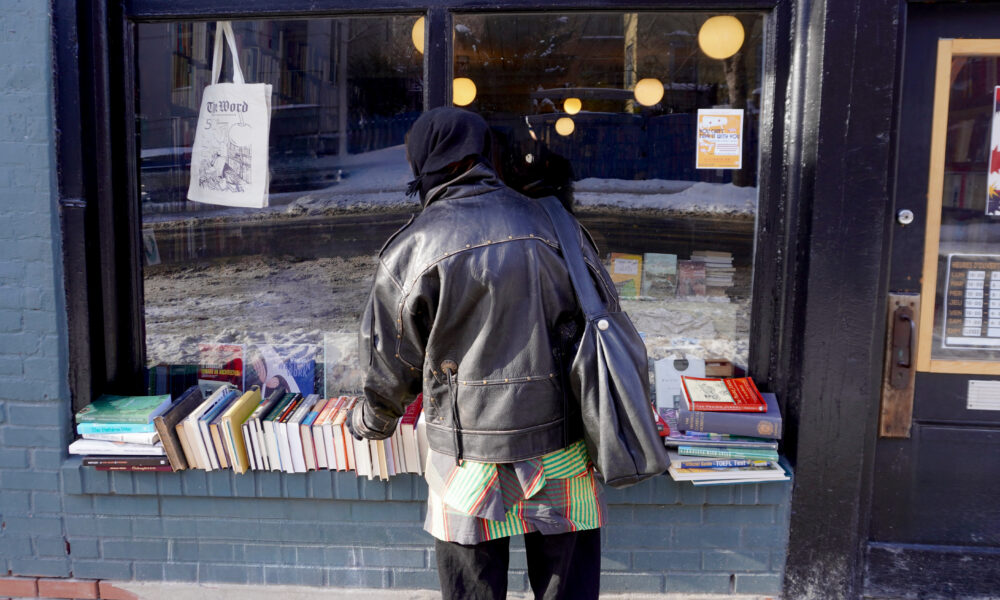
Montreal’s independent bookstores offer readers a hearty supplement for their cultural and intellectual curiosities. Walking into each store feels like meeting a new character, each built from the ground up with unique qualities they hope to share with readers, if you’re willing to get to know them. 

To show you where to start, The Tribune has compiled a guide to some of the best independent bookstores scattered across the city so you know exactly where to find the next comfort read to keep in your rustic messenger bag. 

The Word

The Word, located just a few steps from McGill’s downtown campus on rue Milton, has been selling secondhand books since 1975. The store itself is small but plentiful, with floor-to-ceiling bookshelves stocked with every genre, from classics to music, fiction, and history. Rare first-edition, antiquarian, and collectible tomes sit among copies of Harry Potter and The Hunger Games. The gas stove that rests against the wall of the store is a testament to its timeless nature, despite the ever-changing variety of books available. 

L’euguélionne

L’euguelionne (pronounced: ler-gay-lee-onn, for novice French speakers) is located a bit further from campus on Rue Beaudry in The Village. The store is named for its specialty: French feminist literature; its name is aptly taken from Quebec’s first feminist novel, L’Euguélionne: roman triptyque (1976) by Lucile Durand under the pen name Louky Bersianik. As a non-profit solidarity co-op, its values radiate through its collection of new and used books, zines, and print art. The store’s diversity of media effectively conveys its commitment to anti-racism, anti-colonialism, feminism, and queer-positive principles. 

Librarie MAKTABA 

MAKTABA (meaning ‘bookshop’ in Arabic) awaits you in Montreal’s Old Port, cobbled into the neighbourhood’s stony aesthetic. Inside, a vast red Persian rug adorns the space for comfortable and effective reading. MAKTABA seeks to open visitors’ eyes with its collection of English-language books curated from far corners of the world. If you happen to be looking for an analogue soundtrack to accompany your reading, vinyl records are also sold in-store.

Librairie Gallimard

Looking for a great Francophone establishment? Ouais! Librairie Gallimard is nestled in Montreal’s Plateau-Mont-Royal district with an excellent selection of books en français. Its bright red exterior is hard to miss if you pass by, and the books inside are sure to ensnare you as well. Literary essays, philosophy, history, youth, Quebec history (if you don’t know where you live), and more line the shelves. Be sure to check out their website for literary events like their recent Against excess – Authoritarian excesses in America discussion with Jonathan Durand Folco, Mark Fortier, and Alain Roy.

Librairie Anarchiste L’Insoumise

Do you swing both ways? Librairie Anarchiste L’Insoumise is perfect for bilingual speakers with a propensity toward sudden and vigorous anarchism. Nestled down on boul. Saint-Laurent, be sure to bring cash, not card, because this store’s commitment trickles down to its accepted payment methods. After all, who else will fight against the ever-expanding power of the plastic card owned by the banks and corporations who seek to control you? Be sure to stop at Librairie Anarchiste L’Insoumise for radical and subversive texts rooted in the Libertarian Socialist movement. 

Physical media allows us to be conscious of worlds, languages, and cultures that we would have otherwise never touched.  Without this consistent supply of maps to the foreign from independent bookstores, we run the risk of sleeping through the changes that seek to suffocate us into unconsciousness. 

Art, Arts & Entertainment, Made at McGill

The ‘New at McGill’ exhibit showcases over400 years of history

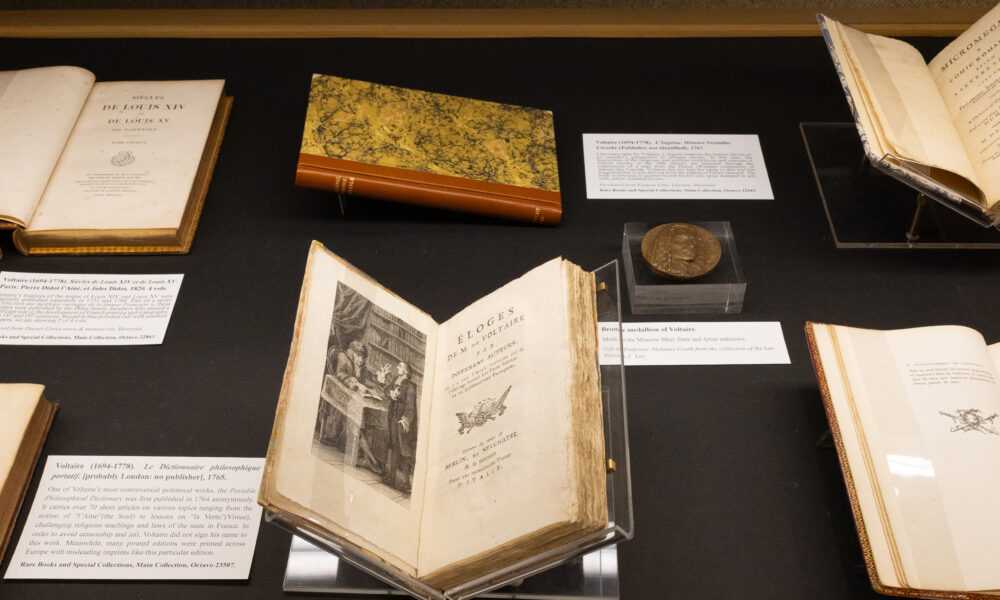
Most students don’t realize that one of McGill’s McLennan Library’s fourth floor’s Reading Room houses extensive historical archives. Its New at McGill exhibit features a wide variety of subjects ranging from Voltaire’s literature and modern architecture plans, to embargoed letters and natural science collections in astronomy and botany. The collection’s diversity is a testimony to the careful work of the Rare Books and Special Collections (RBSC) team. 

When funding is limited, archivists must determine whether an item truly adds value to the collection before acquiring it. This careful selection process makes the exhibit special, with objects from different periods placed side by side. It features modern works, such as a pop-up book made by Collette Fu from her 2008 to 2023 project titled We Are Tiger Dragon People and presentation models of the Mangaf Beach Development Project in Kuwait from 1996. Elsewhere in the exhibit, you can view Icones Historiarum Veteris Testamenti, published in 1547, which is in near-mint condition. 

I initially browsed the exhibit, walking through the Reading Room and reading the captions in the two rows of cases on display. I started with the left case, where Monica Ong’s 2021 Planetaria, a work of visual poetry about astronomy, was juxtaposed with a perpetual calendar from 1810. 

Among the most striking items are letters by Canadian short story writer Mavis Gallant. Canadian filmmaker and journalist William Weintraub, a close friend of Gallant, donated the letters to McGill in 2002 under embargo. The embargo expired in 2025, allowing the shipment to be opened for the first time. Eve Majzels, one of five curators of this exhibit, was given the honour of opening the collection and now manages it. Inside were 118 letters and six postcards from the William Weintraub fonds. These letters offer a peek into the private life of Gallant, an important literary figure of Montreal, with the letters’ topics revolving around Quebec politics, personal matters, and her and Weintraub’s careers. Among these letters, Majzels selected two for display in the exhibit because of the quality of their writing and Gallant’s humour.

The exhibit also nods to the expansion of women’s literacy and education. L’origine des fleurs and Hommage aux dames are two beautiful, handcrafted books on display that were published for a female audience in the 19th century. These books are evidence of women’s increasing access to literature at the time.

For the botanical collection, the curators chose a 1910 book of pressed flowers detailing the locations from which they were picked. The page displayed counts three flowers: Heather, foxglove, and pomegranate, each gathered from different locations in Italy. Another book on exhibit, British Sea-Weeds, published in 1872, introduced women and non-scientists to the study of algae. Lauren Williams, the curator of this case, said during a recorded presentation that botany “was one of the few subjects to be appropriate for women to engage with at the time.” 

When the exhibit closes, archival items will return to archival storage on the fourth floor’s shelves or to their designated collection locations. While they won’t be publicly displayed anymore, individuals can request to see some of the materials on display in McGill’s Archival Collections Catalogue. However, the majority can be found in the McGill Libraries catalogue. Ursula Charmichael, one of two coordinators of New at McGill, emphasized that the team is constantly working to expand their collections to support teaching and research at McGill and across Montreal. The recently unveiled Gallant letters are a prime example of McGill’s role in presenting new discoveries to the global research community. 

New at McGill allows us to recognize collection development as a crucial role of librarians and archivists. If you need a break from studying, consider visiting this exhibit. Not only will you find significant relics of history on display, but you will also see the dedication and teamwork that went into putting the collection together.

New at McGill is open to the public until March. 2nd.

Read the latest issue

Read the latest issue