


Latest News

Editorial, Opinion

Our unconscionable role in the Uyghur genocide

On Oct. 18, the Students’ Society of McGill University (SSMU) hosted a series of events entitled “Support Uyghur Rights” to raise awareness about the Uyghur genocide and to encourage students to take action. The event highlighted McGill’s involvement in the Uyghur genocide through an examination of the university’s unconscionable endowment fund. Currently, McGill holds multi-million dollar investments in several corporations that profit directly from the Uyghur genocide, contributing to a culture of complicity that is typical of a historically colonial and profit-driven institution. The university must divest, provide resources for the McGill community to stay informed on the atrocities committed in East Turkestan, and support student activist efforts.

The Chinese government continues to commit human rights violations and crimes against humanity in East Turkestan, constituting the largest mass incarceration campaign of ethnic and religious minorities since the Holocaust. Twelve million Uyghurs live in East Turkestan, or the Xinjiang Uyghur Autonomous Region, and along with other Turkic peoples native to the region, they have been fighting for independence for almost a century. Since 2017, more than one million people have been detained, and in 2020, researchers documented the existence of 201 reeducation camps and 179 detention centres in East Turkestan. In addition to mass surveillance and indoctrination, Uyghurs and other Turkic peoples have been subjected to torture, brutal and inhumane living conditions, and forced labour. Research has found that over 20 per cent of all cotton in the global clothing market has been tainted by forced Uyghur labour. Countless children have been separated from their families and incarcerated women have been subjected to systematic rape and forced sterilization.

In February 2021, the House of Commons—despite Trudeau and his cabinet abstaining—unanimously adopted a motion recognizing the Chinese government’s genocide against Uyghur, Kazakh, and Kyrgyz ethnic and religious minorities in Xinjiang. Two legislative proposals are presently being considered in Ottawa. Motion M-62, which is set to be debated in parliament on Oct. 26, calls for the Canadian government to expedite the entry of 10,000 Uyghur and Turkic refugees that are in need of protection. Bill S-204 would ban all goods imported from East Turkestan whether or not they have been proven to use forced labour.

These urgent pieces of legislation should spur McGill to evaluate its problematic endowment portfolio and to encourage active advocacy and relief efforts. Earlier this year, an investigation by The McGill Tribune revealed the university’s endowment fund allocates $15 million into corporations tied up in the Uyghur genocide. McGill’s portfolio includes companies such as Tencent (WeChat’s parent company) and Alibaba, that surveil Uyghurs, as well as Puma, Nordstrom, and Kohl’s, companies that allegedly use enslaved Uyghur labour in their supply chains. The least the McGill administration can and should do is divest from companies that are profiting from the genocide in East Turkestan. 

While divesting is an easy yet necessary first step, McGill must also provide educational resources on the genocide and ways to support the Uyghur rights movement. The administration has been silent on the Uyghur genocide, once again choosing indifference for its staff and students who are racialized minorities. So long as it prides itself on being an international institution, McGill must encourage its students to advocate against international human rights abuses, and in turn, students mustto reach out to their Member of Parliament. Furthermore, the university should expand their Students and Scholars at Risk Fund and subsidize the World University Services Canada’s Student Refugee Program at McGill that sponsorship of young refugees.

We must contextualize our demands for divestment and sanctions in terms of global cooperation, decolonization, and workers’ rights movements. We must not overlook the implications of outsourcing on workers’ rights globally. Many of today’s global supply chains resemble imperialist systems that exist to feed the growing appetite of Western economies and exploit low-level workers in the Global South. We must understand that these globalist structures of exploitation are the same ones that contribute to an international attitude of indifference towards forced Uyghur labour. McGill should recognize its role in this global neoliberal and imperialist framework, and take after Pparliament by urgently addressing what is likely the largest ethnic cleansing campaign of the century.

Motion M-62 is being debated in parliament on Oct. 26. You can sign up to attend here.
Sports

Climbing without a hijab: Iranian athlete subject to morality laws abroad 

Content Warning: Gender-based violence, misogyny, suicide

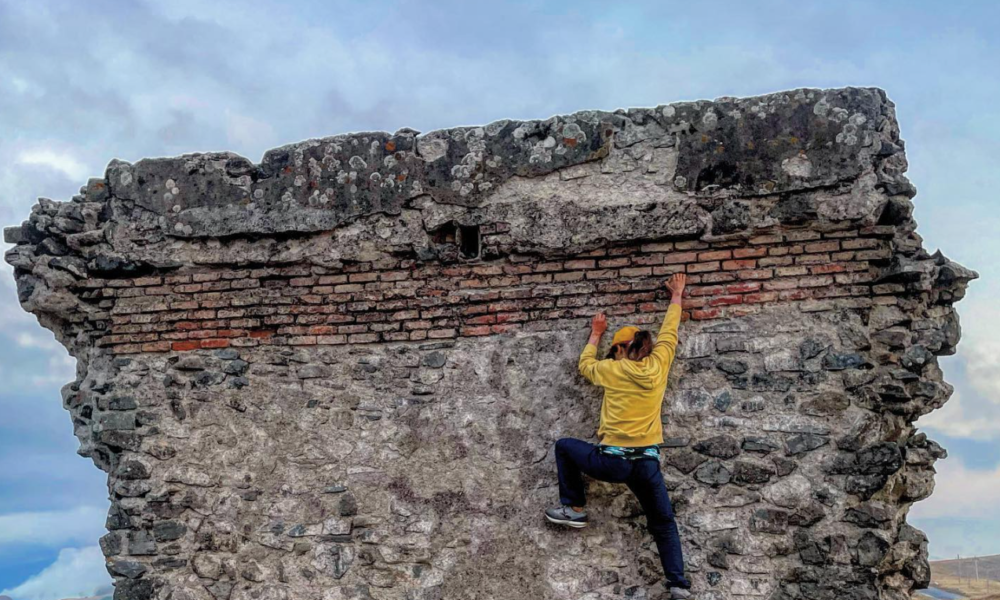
On Oct. 16, Elnaz Rekabi, a 33-year-old Iranian rock climber, competed at the International Federation of Sport Climbing (IFSC) Asian Championship in Seoul. Rekabi—who, just last year, became the first Iranian woman to win a medal at the IFSC World Championship—competed without a hijab, defying the strict dress code restrictions that the Iranian government enforces on women, including its women athletes abroad. 

Rekabi’s climb comes in the wake of the murder of Jina (Mahsa) Amini, a 22-year-old Kurdish woman who was tortured and killed in Tehran by morality police for violating the Islamic state’s mandatory hijab laws. Since Amini’s death, nationwide protests and increased state repression have gripped Iran, leaving many to see Rekabi’s climb as an act of resistance

Shortly after the competition, where she finished fourth, Rekabi disappeared and severe concerns for her safety began to circulate. BBC Persian reported that Rekabi’s passport and mobile phone had been confiscated prior to boarding a plane back to Iran. Early on Oct. 18, an Instagram story was posted from an account said to be run by Rekabi claiming that her hijab “unintentionally had a problem.” It said that she was unexpectedly called on to climb, and that she would be headed back to Iran on her regularly scheduled timeline despite returning a day earlier than anticipated. 

When Iranian athletes go abroad for international competition, the government often forces them to leave collateral in order to guarantee their return to Iran. Before leaving for Seoul, Rekabi handed over a cheque for over $35,000 and granted full power of attorney to Iran’s Mountaineering Federation to sell her family’s property if she did not return. 

Upon her arrival back in Tehran, Rekabi was met by a huge gathering of supporters who united in the hopes of deterring her arrest. In an interview with state television, Rekabi reiterated that her move to compete without a hijab was inadvertent. However, BBC Persian reported that this apology came as Rekabi had been threatened with the seizure of her family property.

Rekabi was then held at the National Olympics Academy of Iran under the watch of plainclothes officers, where she met with Iran’s sports minister. Despite previous statements by Iran’s Olympic chief that no punishment would come to Rekabi, she has since been placed under house arrest with the pretext of a post-competition “resting period.” 

The oppression of female athletes extends across borders. Rekabi’s story bears resemblance to that of Peng Shuai, a Chinese tennis player who was first forcibly disappeared, and then abruptly retired after making sexual assault allegations against a former Chinese vice-premier.

Rekabi is only the second athlete to defy the Iranian government’s compulsory dress code. In April 2019, Sadaf Khadem became the first Iranian woman to win an official boxing match, defeating Anne Chauvin. Khadem elected not to wear hijab during competition and feared that she would face arrest upon returning to Iran. She has since defected to France. 

Iran has a long and troubling history of silencing its outspoken athletes. Navid Afkari, an Iranian wrestler, was executed following his involvement in anti-government protests. Iran’s only female Olympic medalist, taekwondo athlete Kimia Alizadeh, is one of several Iranian women who have chosen to defect from the country altogether. With few exceptions, female sports fans are barred from entering soccer stadiums in Iran. In September 2019, Iranian soccer fan Sahar Khodayari died in protest after setting herself on fire at a courthouse while facing trial for trying to enter a stadium disguised as a man. 

Current players on Iran’s national soccer team chose to cover their country’s emblem as the national anthem played during a match against Senegal following Amini’s murder, and forward Sardar Azmoun expressed support for the ongoing protests. 

The women’s rights movement in Iran and continued fear for Rekabi’s future and safety must serve as reminders that sports and politics will forever be intertwined. The oppression of women athletes embodies the state’s broader attempt to regulate women’s bodies—a prerogative that is not exclusive to non-democratic nations, from the United States’ rush of anti-abortion laws to France’s hijab ban. Women’s lives depend on the freedom to choose what they do with their bodies, in sport and in every aspect of life beyond it.

Campus Spotlight, Student Life

McGill’s Book Fair makes its long-awaited return to Redpath Hall

After a two-year hiatus due to the pandemic, McGill’s beloved Book Fair returned to campus. Tens of thousands of books—divided into 37 categories––were crammed into every corner of Redpath Hall. Between Oct. 18 and 20, students, booksellers, and the general public enjoyed the Fair’s 50th edition. 

The Book Fair is organized by the McGill Alumni Association and has been part of the McGill community since 1971. The organization collects donations and sells them to raise money for McGill scholarships and bursaries, including the Book Fair Bursary in Music and the Jane B. Hood Bursary in English Literature, in addition to the McGill Book Fair for all undergraduate students.

The Book Fair has overcome many hurdles, the latest being the COVID-19 pandemic. Anne Williams, co-coordinator of the Book Fair, reflected upon how the organizers had to adjust to this setback in an interview with The McGill Tribune

“We had to remember [the process of preparing the Book Fair], you know, and reinvent everything,” Williams said. “So, there were a few problems along the way, but it’s working out.” 

Despite hardships over the last two years, the Book Fair has landed back on its feet. In only three short days, the organization raised approximately $50,000 for their bursaries and scholarships. Williams and her fellow co-coordinator, Susan Woodruff, credit this success to the sheer volume of books and high-quality pieces from donors that are often worth hundreds of dollars. 

The Fair sells everything from novels, vinyls, CDs, and DVDs, to sheet music—in both English and French. Books at the Fair are incredibly affordable, rarely stretching over five dollars even for mint-condition pieces—with the exception of rare and collectible books. 

“I don’t see why I would buy a new book for 30 dollars when I can get the same one for like two dollars,” Sophie Brunelle-Newman, U4 Arts, told the Tribune.

On top of their affordability, most books are in pristine condition. The book’s high quality is due to the Book Fair’s months-long effort of collecting donations, sorting, curating, and pricing books in preparation for the October sale.

Many library frequenters may be familiar with the notorious free book piles left outside Redpath Hall throughout the year. Woodruff explains how only the best among these make it to the shelves of the Book Fair, while less immaculate books are given out in free boxes to the students of McGill, or sent off to Renaissance, the Book Fair’s not-for-profit partner. 

Much like the enormous traffic on the fair’s opening day, McGill students’ enthusiasm toward these free piles was a source of astonishment and encouragement for Williams.

 “They always amaze us how the boxes go out and [students] are like vultures on the terrace; all of a sudden [the books] are gone,” Williams said.

Brunelle-Newman agreed that the Book Fair brings something unique to the McGill campus.

“I imagine that a lot of people from the McGill community bring books that they’ve read, and then other people from the McGill community come, and then it’s like a book exchange, like a knowledge exchange,” Brunelle-Newman said. 

The Book Fair is clearly about much more than just selling books; as Brunelle-Newman points out, it is about growing McGill’s public literary culture and increasing accessibility to literature. The average student is unlikely to splurge on a new book, but when they cost three dollars each, students can enjoy books that they may not have otherwise sought out. 

Above all, Woodruff is grateful for the Book Fair’s return following the COVID-19 lockdowns and the positive reception that the fair received. 

“We have quite a big fan base,” Woodruff said. “Everybody at McGill was so excited to find us back.”

Research Briefs, Science & Technology

Modernizing investing: The rise of fintech in business lending

Suppose NeuroConnect, a fictitious company, requested a loan of $300,000 from October, a real financial technology (fintech) lending platform. The loan would be doled out over the course of 36 months to finance the acquisition of lab equipment like an electron microscope and an MRI scanner.  October uses an automatic loan assessment tool to attribute NeuroConnect a credit score of B on a scale of A+ to C- based on the company’s financial history, default probability, and projected profit margin. The annual interest rate, or an investor’s profit gain, is estimated at 6.3 per cent. Now, suppose you want to invest a portion of your savings to make some money. If you were in October’s position, would you consider NeuroConnect worth the risk? 

The scenario above is an example of how fintech platforms, also known as peer-to-peer (P2P) lending businesses, attract multiple individual investors who are willing to invest funds in a given firm. This unconventional way of lending is financing small and medium-sized enterprises (SMEs) that banks are often unable to assist due to strict requirements on lending, such as evidence of valuable assets and a well-established business credit profile that these new companies often cannot fulfill.

Although banks dominate the global lending market, the innovative P2P business model facilitates the financing of SMEs, which has been a traditionally difficult task for banks to accomplish. In an interview with The McGill Tribune, Paul Beaumont, an associate professor at McGill’s Desautels Faculty of Management, discussed fintech’s potential to provide greater access to long-term funding and its unique limitations compared to the customary bank lending model.

“We’ve been lending the same way […] for decades,” Beaumont said. “I think it’s good to have this emergence of new actors in the small business lending markets—actors that are less regulated because [these lending firms] expand the set of products [that other innovative] firms [can now] have access to.”

Compared to banks, which are heavily regulated because they manage the money of millions of clients, fintechs are mainly regulated because of the risk they present for fraud. 

On average, bank interest rates are three per cent lower than those of fintech loans. This significant difference is one of the major challenges fintechs face as they not only have to attract lenders, but also firms that are willing to borrow money at a higher interest rate. Despite this potential roadblock, automation based on artificial intelligence and faster delivery of loan application decisions are selling points that give fintechs a competitive edge over banks. 

In spite of these advantages, fintech is not the primary player in the small business lending market. Beaumont says that the use of algorithms to predict whether a company is worth betting on and its probability of defaulting does not absolve fintech lending from the inherent risk associated with the practice. After all, the fintech market is still very small. 

Beaumont emphasized the importance of small business lending because of SMEs’ vital contributions to both economic and community development. For instance, in 2021, small business employees accounted for a whopping 63.8 per cent of the total Canadian labour force according to Statistics Canada. Medium-sized business employees make up for another 21.1 per cent, while large businesses represent the remaining 15.1 per cent.

Canadian small businesses, therefore, constitute a powerful economic driver that can continue to flourish by receiving funding for their ideas in a more sustainable and accessible fashion than before. 

“Fintech platforms may perhaps not completely change the market, but [they] still bring […] innovation in a market that has not been super innovative,” Beaumont said.

McGill, Montreal, News, SSMU

Students call for greater cross-university collaboration on sexual violence policies

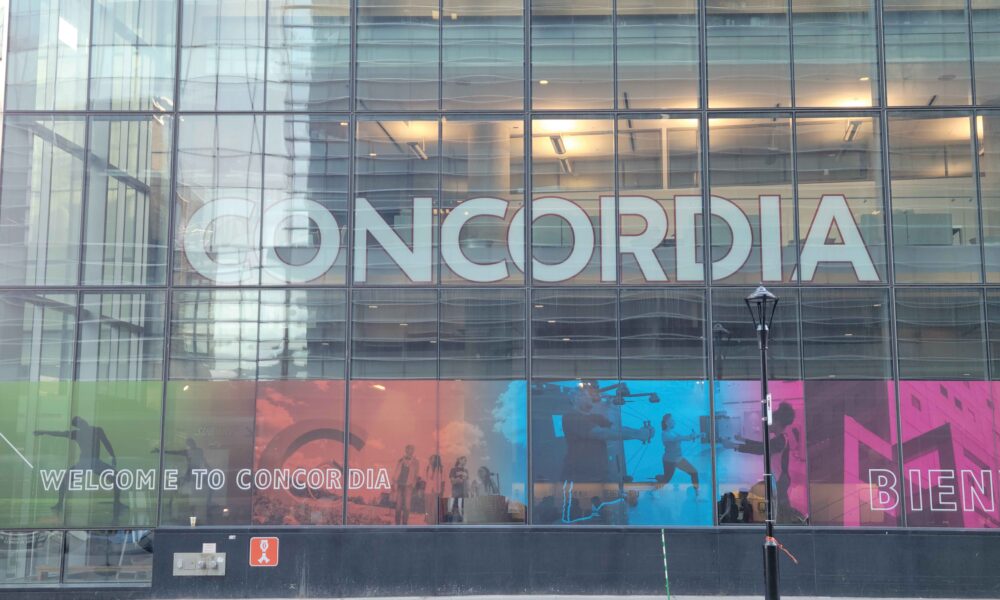
Three Concordia University student organizations announced on Oct. 5 that they would not participate in, nor nominate representatives to, the university’s Standing Committee on Sexual Misconduct and Sexual Violence (SMSV). Their statement of non-participation claimed that the SMSV committee undermined student participation and was “hostile” toward students’ attempts to change Concordia’s policy. The McGill Tribune looked into the role student participation plays in McGill’s Policy against Sexual Violence (PSV) and whether similar criticisms apply to McGill when considering student input during its revision process.

McGill’s PSV is reviewed triennially and was last approved by the Senate and the Board of Governors in September and October of this year respectively. An implementation committee—including four student representatives, one member of the university’s academic staff, and representatives of various campus services, among other campus stakeholders—meets four times annually to oversee the PSV and to issue recommendations for revision. These recommendations are taken to the PSV’s working group, which then revises the PSV. The working group is composed of 19 members, one from each student association and union at McGill, as well as a representative from the Office of Dean of Students, Human Resources, Sexual Violence Centre of the McGill Students’ Society (SACOMSS), and more. 

Although they hold seats on the PSV’s working group, student associations at McGill do not hold seats on the implementation committee. This is because student associations are legally separate entities from McGill and the PSV does not apply to them. As a result, the Students’ Society of McGill University (SSMU) has its own policy: The SSMU Gendered and Sexualized Violence Policy, to combat sexual violence and support survivors. 

In a statement to the Tribune, McGill media relations officer Frédérique Mazerolle emphasized the importance of student voices in the implementation of the PSV. Mazerolle also noted that the recent revisions to the PSV resulted from significant student advocacy. 

“One of the key changes to the PSV is a process that allows survivors of sexual violence who have filed formal reports to access information about the outcome of a disciplinary process where sexual violence was found to have occurred,” Mazerolle wrote. “This policy change was the result of a legislative amendment that stemmed from strong survivor and student advocacy.”

At Concordia, students have led the charge in advocating for better university-level policies. Saskia Kowalchuk, a Teaching and Research Assistants at Concordia (TRAC) Feminist Workplace Committee member, emphasized the importance of student participation in an email to the //Tribune//.

“Students are the experts on our own rights, needs, and experience,”  Kowalchuk wrote. “Concordia University must begin treating us as such, but until they do we cannot continue to participate in their unjust and illegitimate processes at the SMSV.” 

Arts Undergraduate Society (AUS) Senator Sam Baron raised concerns about the McGill PSV’s missing framework for collaboration with student organizations in the policy’s implementation. 

“We were invited to make edits to the [PSV] during the summer, and while they took some of our comments, the university was either not willing or not capable of incorporating feedback and information-sharing mechanisms for our undergraduate societies into the policy,” Baron wrote in an email to the Tribune

Though SSMU has its own policy, SSMU vice-president (VP) University Affairs Kerry Yang believes that there should be more opportunities for collaboration between the university and student representatives for tackling sexual violence on campus. 

“We would like to see much more communication and collaboration on sexual violence from McGill,” Yang wrote in an email to the Tribune. “Although we cannot interact with the policy as SSMU, we would love it if McGill had more open channels of collaboration on this issue.”

Despite these shortcomings, Baron considers the PSV to be a strong, survivor-centric mechanism for combatting sexual violence.

“Regardless of the outcomes, the process is legally sound, provides good opportunities for the support of survivors, and has a lot of flexibility in the measures it can implement upon the completion of a report,” Baron wrote. “If we as students continue holding McGill accountable for when they deviate from their established processes, we can make the [PSV] work for us.”

McGill Recommendations, Student Life

On finding references, letters, and research connections

You’re thinking of going to graduate school or professional school. You’ve lined up the universities where you wish to apply––research-intensive Canadian universities, British universities with specialized masters, our Southern neighbour’s Ivies, and high-performing public institutions all make the list. You stumble not on the personal and research statement, not on the potential standardized test, and not on the resumé. It is the recommendation letter(s) that have yet to be written, faculty members who have yet to be emailed, and you are at a loss for where to begin. 

For those of us who started, finished, and continued our education through the COVID-19 pandemic, with its severe impacts on inequality and mental health, the letters prove to be a challenge that asks us to salvage or even create personal and intimate connections with professors that the public health measures inhibited. But there’s still hope, and possibility, and most importantly, time. To assist students working through applications, The McGill Tribune has compiled a guide to reference letters.

Go through the archives of your education 

If you’re applying to graduate school, you have already taken a few years’ worth of courses. Go through your MyCourses page, back to the years of your youth. What courses stick out? What patterns slowly reveal themselves? Where did you succeed, and how does that tie in to your research interests? For example, you’re working on a portfolio for an MA in English with a specialization in creative writing. The classes where you exhibited innovation and artistry, both in your creative and critical writing, should be your first stop.

You might be trying to head to a specialized graduate program after a degree in one of McGill’s larger undergraduate programs: Engineering, biology, economics, political science, psychology, to name just a few. You are not a number, a black screen in a Zoom meeting, or just a face in a lecture of 600 people. Take it one step at a time, and put it in perspective. Why did your labour economics course make you more interested in a pathway in environmental policy? What about a research course on evolution pushed you toward critical museum studies? Start collecting assignments where you did well. Once again, returning to the past, something central to crafting a personal statement and CV, will prove useful to this process.

Reach out, reach out, reach out 

With a welcome return to the present––seemingly never-ending midterms and your obligations to caring for yourself––start reaching out. You’ve seen the past, and gotten a sense of the professors to contact. If you’ve done research courses, research assistantships, or independent projects, courses, or theses, pat yourself on the back. For those who missed these opportunities––it’s not only difficult overall to break through, but systemic barriers still in place at institutions prevent women, people of colour, queer and trans people, people with disabilities, and lower-income people from entering––look to what’s in your toolkit. Graduate school should not be reserved for the loudest, the richest, the most privileged, or the closest to the professor. 

That course on postcolonial political theory or anthropology of modern Africa or the history of human rights changed the course of your studies in international development, for instance. The professor will have an email listed in that syllabus. Reach out with grace and gratitude, and detail who you are, your interests, and why you wish to ask them. Remember that professors, especially on the tenure-track, untenured, and contract faculty are neither immune to institutional exhaustion, nor to their commitments to the profession, their families, and themselves. Make steps easier for them. Your email should be compelling and respectful, highlighting your performance in their class or asking for a brief meeting or interview.

Keep on keeping on

If your professor(s) agree, remember that letters take care and effort to write. Give your referee time and space to think and craft. If your professor(s) do not agree, remember to reach out to multiple faculty members or check if you’re allowed to use professional references if you do not have connections.

Have courage, remember why you made this choice, and know that there are people who want to help you and who want to make space in institutions for bright and dynamic younger scholars.

Montreal, News

Thousands in Montreal join solidarity rallies for anti-government protests in Iran

Content warning: Mentions of violence and misogyny 

Montrealers gathered in solidarity with Iranians on Oct. 22 to protest Iran’s oppressive regime and detainment and  killing of Jina (Mahsa) Amini at the hands of Iran’s morality police for improperly wearing a hijab. The rally was one in a series of similar events in Montreal and across the globe to support the women-led movement.Recent reports estimate that 244 Iranian protesters have been killed and another 12,500 have been detained since the uprising began.

The march began in the afternoon outside the Berri-UQAM metro station with “Baraye” by Shervin Hajipour blasting from speakers. The song, which has become an anthem for protestors, elicited heavy emotion as many in attendance sang along through tears. As the march continued, Persian, Kurdish, English, and French iterations of the chant “woman, life, freedom,” the slogan of the movement, echoed through the streets of downtown Montreal. Other chants included “silence is violence,” “revolution,” and “down with dictators.” 

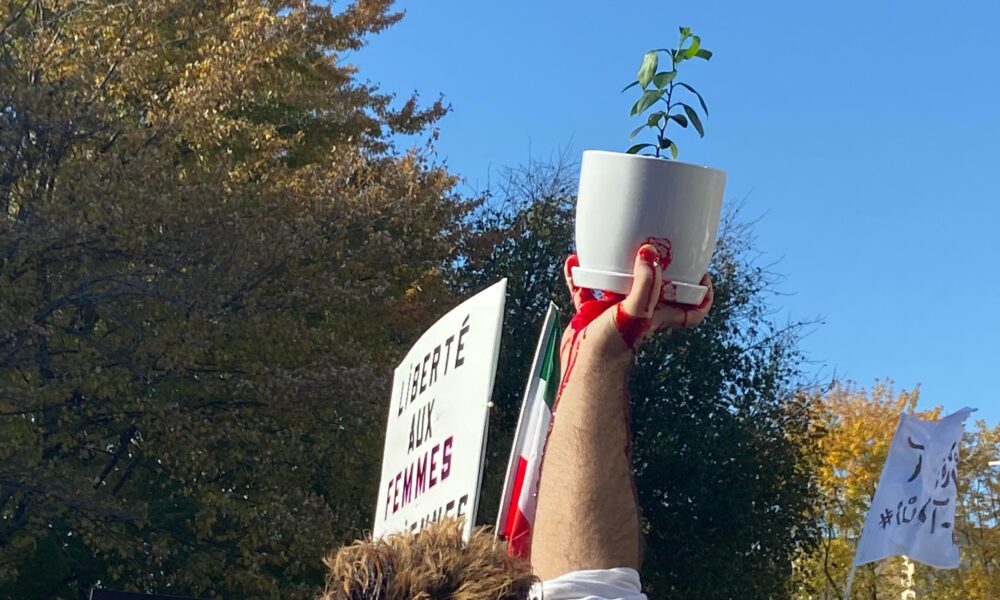
As Reza Azarpoor marched, he held a Persian sweet lemon sapling with fake blood dripping down his hand. In an interview with The McGill Tribune, Azarpoor explained that this representation mourns the youth who have been and are being killed and detained by Iranian authorities, while also celebrating their resilience.

“This is a symbol of the kids, youth, and young people that are dying. But honestly, they’re not dying. Every day, every moment, there is another tree coming out of [Iran], and it’s not gonna stop. This is a revolution, there is no going back.”

Reza Azarpoor

When the march reached Place du Canada, organizers made speeches and announced the demands of ralliers: That Canada sever ties with the Islamic Republic of Iran, sanction and try people connected to the regime in Iran, and designate the Islamic Revolutionary Guard Corps as a terrorist organization. Marchers also asked the Canadian government to address PS752—a Ukrainian International Airline flight which was shot down by the Islamic Revolutionary Guard Corps, killing all 176 people on board including 57 Canadian citizens and permanent residents—with a criminal proceeding. 

One of the organizers of the rally, Darya Almasi, noted that, compared with previous events held in Montreal, there was a larger presence of non-Iranian supporters and attendees overall on Oct. 22.

“The world is ready to hear what people demand in Iran,” Almasi said. “At this point in history, there’s a revolution happening in Iran. It has escalated from a movement or a riot or a protest. It’s a revolution and seeing non-Iranians’ support little by little, it’s growing, it’s ever-expanding, and seeing their support is really heartwarming.”

Another organizer and President of the Iranian Student Association of Concordia University (ISACU), Shayan Asgharian, believes that students, as political entities, ought to get involved.

“Our institutions are political, therefore, it is important for us to have a presence in the political scene,” Asgharian said in an interview with the Tribune. “[At] institutions of higher education, where freedom of expression is a core pillar, we believe it is our duty as students to be the voice of the voiceless.”

Amidst the Iranian regime’s deadly crackdown on protests and imposed internet outages, members of the Iranian diaspora in Montreal and other parts of the world have been using rallies such as the one on Oct. 22 to show their solidarity and support. 

“It’s a big shout-out to Iranian people that we heard you, we are watching you, we are standing behind you, holding your back,” Almasi said. “We are here for you and the world is watching your courage and your bravery. You’re not alone.”McGill announced in a university-wide email on Sept. 22 that the university is offering academic accommodations and priority counselling appointments at the Student Wellness Hub to community members affected by the situation in Iran. The McGill Iranian Student Association (MISA) has also encouraged those who could benefit from support at this time to reach out to Keep.meSafe, a 24/7 mental health service that provides access to licensed counsellors through telephone and mobile chat for free.

News, SSMU

 SSMU event explores McGill’s investment ties to Uyghur genocide

The Students’ Society of McGill University (SSMU) hosted an advocacy event in support of Uyghur rights on Oct. 18. Uyghurs are a Muslim minority group mostly residing in the Xinjiang Uyghur Autonomous Region of China. For years, Uyghurs and other Turkic Muslims have been the victims of human rights violations and forced labour by the Chinese government. 

There are currently an estimated 380 forced labour camps in the Xinjiang region.

The event, led by the Uyghur Rights Advocacy Project (URAP), featured a panel discussion about McGill’s endowment fund―specifically, investments into companies complicit in the Uyghur genocide―as well as Motion M-62 which aims to expedite the entry of 10,000 Uyghurs and other Turkic Muslims into Canada over a two-year period beginning in 2024. 

Miri Teich, Policy and Advocacy Director at URAP, said that a //Tribune// investigation during the Winter 2022 semester—which revealed that McGill has millions of dollars invested in companies complicit in the genocide—inspired URAP’s most recent project. URAP began its advocacy work in May 2020 and since then, have conducted extensive research and data analysis into the university’s portfolio holdings. 

Eli Offman, a volunteer data analyst at URAP, explained in an interview with the //Tribune// that the algorithm he created helps URAP determine which of McGill’s stock holdings are placed in companies implicated in forced labour.

“I take publicly available data and I compare it with the McGill portfolio,” Offman said. “I essentially created a relatively basic search function that [determines if] any of the companies listed in these stock holdings match with any of the companies implicated [in forced Uyghur labour].” 

Teich added that the organization has found many connections between McGill’s stock portfolio and companies using forced labour.

“We found 437 entities [that] matched directly, amounting to $67,630,181 in market value (around four per cent of McGill’s holdings),” Teich wrote in a statement to the Tribune. “This is a low estimate; if you include Chinese companies, the number goes up to 660 companies amounting to $139,770,302 in market value (nine per cent of their holdings).”

According to Teich, most of the worst offenders are China-based companies that supply both raw materials and software to bigger-name brands, many of which are based in North America. Occasionally, these companies supply security and surveillance technology to the Chinese government directly. 

“Some of the biggest offenders are Zijin Mining Group, which digs in Xinjiang using forced labour ($1,036,347.65 invested), Alibaba, which sold cloud computing tech to the Xinjiang government for surveillance ($3,079,684.66 invested) and Tencent Holdings, which helps operate ‘smart prisons’ in Xinjiang ($4,987,171.21 invested),” Teich wrote.

Although the Uyghur genocide is occurring over 9,000 kilometres away, panellists at the endowment fund discussion stressed that many Canadians are personally affected. Sameer Zuberi, Member of Parliament for the Liberal Party of Canada and Chair of the Subcommittee on International Human Rights, encouraged McGill students to take action against the exploitation of the Uyghur people by the Chinese Communist Party.

“Bottom-up activism is critical. There are different ways of having impact, but definitely people on the ground are part of it,” said Zuberi. “Legislatures respond because people want things to happen. There is a lot of power in people gathering together [and] having their voices heard, be it in the form of protest, be it in the form of letter writing, or engaging with one’s elected official.”

On Oct. 26, Zuberi’s motion M-62 will undergo its first hour of debate in the Canadian House of Commons. Zuberi warned, however, that passing the motion is easy compared to implementing it, which will require broader public support.

In a statement to the Tribune, McGill media relations officer Frédérique Mazerolle wrote that McGill is working towards building a more socially conscious investment portfolio, but did not comment on the endowment fund’s ties to the Uyghur genocide. 

“The Board of Governors has approved in June 2020 changes to the Statement of Investment Policy of the Endowment Fund to include [Environmental, Social, and Governance] considerations and a Socially responsible investment concrete action plan.”

Research Briefs, Science & Technology

Modelling sea level increases based on planetary warming scenarios

In the past few decades, human-driven  global warming has left many questioning the future of the Earth’s oceanic dynamics and the implications of altering them. The Antarctic ice sheet (AIS), the largest body of ice on the planet, is retreating at an accelerated rate due to increased greenhouse gas emissions causing sea levels to rise. The Western Antarctic ice sheet is of particular concern to scientists as it contributes 25 per cent of total yearly global ice sheet melt.

Ice sheets are formed by snow and oceanic water freezing. They are embedded in bedrock but also have parts that float on the ocean’s surface, known as ice shelves. Ice shelves play an important role in maintaining the stability of ice sheets, and act as buttresses by slowing down ice flow. Thinning, or loss of ice shelves due to warm oceanic currents and atmospheric temperatures, causes marine ice sheet instability—when ice thickness drops below certain values and structural failures occur, leading to breakage or calving of the ice. 

The loss of buttressing ice shelves is a concern for many researchers, as it can lead to ice sheet loss and a subsequent rise in sea levels.

The 2016 Paris Agreement aimed to limit global warming by the end of this century to a maximum increase of 1.5℃ to 2℃ above pre-industrial levels. Natalya Gomez, an associate professor at McGill’s Department of Earth and Planetary Sciences, recently co-authored a research article in Nature which modelled possible responses of the Antarctic ice sheet to 1.5, 2, and 3 degree rises in global temperatures. 

Computer models were made using geological records depicting previous Antarctic ice sheet behaviours and their contributions to sea levels. A wide range of parameters, such as hydrofracturing—the disintegration of the bedrock supporting the ice sheet—were integrated into the simulations. Uncertainty within the parameters was accounted for using geological observations and statistical methods.

“There’s a wide range of projections of what the ice sheets may do in the future. We have captured the worst case scenarios,” Gomez said in an interview with The McGill Tribune. “Our model includes processes such as marine cliff instability and ice shelf hydrofracturing [….] Previous works have introduced these effects which allow us to consider a more realistic forcing of the ice shelf.”

Gomez’s team found that in the 1.5℃ and 2℃ warming scenarios, models predicted a similar rate of Antarctic ice loss at the end of this century as today, with a median contribution to sea levels of eight and nine centimetres respectively by 2100. The 3℃ simulations, however, predicted accelerated rates of Antarctic ice loss due to thinning and hydrofracturing of ice shelves. In more extreme simulations, ice instabilities became omnipresent across Antarctica, with a median contribution of 34 centimetres to sea levels by 2100. By 2300, average global sea levels in the 3℃ warming simulations are expected to reach 9.6 metres via Antarctic ice contributions, which is 10 times more than the 1.5℃ warming scenario. 

Although imagining the flooding of our home planet is not a comforting thought, climate technologies and renewable energy sources are becoming more prevalent, showing promise for the future. 

“We have the technology and solutions already there,”

– Natalya Gomez

Additionally, more sustainable policies should be adopted, such as green taxes for environmentally harmful activities, increased investments in renewable energy sources, and protection of natural ecosystems.

In light of these findings, governments worldwide must closely adhere to the Paris Agreement since the consequences of exceeding the limits set by the treaty do not paint a bright future for our planet, and all life that inhabits it.

News, PGSS

PGSS discusses McGill’s lack of accommodations and pay for invigilators

The Post-Graduate Students’ Society (PGSS) held their second Council meeting of the 2022-23 academic year on Oct. 19 to amend their budget, update students on sustainability projects and invigilators’ rights, and discuss concerns surrounding accessibility and accommodations for graduate students. There was also a town hall portion of the evening attended by McGill’s Dean of Students Robin Beech.

During the town hall segment, Rine Vieth, a PhD candidate in Anthropology, pointed to their  personal experience accessing accommodations from  Student Accessibility and Achievement (SAA)—formerly the Office for Students with Disabilities (OSD)—as a graduate student. Vieth asked Beech about removing some of the SAA’s registration criteria.

“McGill does not need to medicalize accommodations. While the McGill line is that this is required or otherwise needed by law, that’s not really the case,” Vieth said. “McGill absolutely could make it a policy to accept accommodations without a particular doctor’s form.” 

In response, Beech stated that there is ongoing discussion between him and Fabrice Labeau, Deputy Provost (Student Life and Learning), about extending the range of accommodations for students. Although they are not sure how, the McGill administration hopes to implement a “no questions asked” three-day accommodation for academic evaluations weighted at under 30 per cent once a semester.  

Hayley Krieger, a master’s student at the Max Bell School of Public Policy, added to Vieth’s point about the need for greater accessibility accommodations. After contracting COVID-19 during the second week of classes, Krieger asked to attend classes over Zoom. She was told her program was not hybrid and that she could not join the class synchronously.

“Classes are recorded, but it feels wrong to put the burden on students who have to stay home and make up a week of lectures,” Krieger said. “The university should have policies advocating accommodations for students that get COVID-19 instead of leaving it up to individual programs and professors to decide.”

While explaining the administration’s lack of uniformly applicable policy, Beech asserted that attending through Zoom is not equivalent to being in class and, thus, is not an appropriate accommodation.

Following the town hall, the Association of Graduate Students Employed at McGill (AGSEM) took the floor to update students on their contract negotiations with McGill regarding invigilators’ wages. The union maintains that the wage should be set to $18 per hour, and is waiting for McGill to return with a satisfactory counter-proposal before signing a new collective agreement.

Kiersten van Vliet, mobilizing officer for the Invigilator Bargaining Committee of the AGSEM, noted that McGill invigilators are paid less than any others in Quebec, and significantly lower than those in other provinces. Van Vliet also said that AGSEM believes McGill is exploiting the position of international students who cannot legally be employed outside the University, and hopes to stop this with firm contract negotiations.

“Many, if not most, of the invigilators at McGill are international students, and these students often have visa requirements that restrict their ability to work off campus,” van Vliet said. “They also have to pay international student fees. This is one of the reasons why the union has been firm with our demand.”  

To conclude the meeting, the Council approved motions to amend the PGSS budget, ratify interim conditional appointments, and condemn the New Vic project.

Moment of the Meeting:

The first 45 minutes of the meeting were subject to constant interruptions and disregard for procedural formats. In attempting to improperly add a motion to the agenda, one individual cut off fellow committee members and attempted to overrule the speaker’s decision to deny the motion’s addition.

Soundbite:

“I was told that there are no supports for students not taking coursework,” Vieth said. “[I am] a little taken aback by [the SAA] seeming to imply thesis-writing is not academic.”

— Rine Vieth, a PhD candidate in Anthropology, discussing the need to expand SAA accommodations for graduate students

Read the latest issue

Read the latest issue