


Dylan Hennessy is a part-time busker. Once, when performing at the intersection of Ste. Catherine and Crescent, with about 200 people gathered around him, fireworks started, and he even crowd surfed.
“It was like something out of a movie,” Hennessy told The McGill Tribune.
That same night, someone came and sat in Hennessy’s guitar case, flipped him off, and got booed by the crowd. Hennessy says he occasionally encounters hostility from unhoused people while busking. He began to negotiate with anyone he noticed inhabiting the space surrounding his desired performance spots by asking for permission to use the location or offering to give them a share of his earnings at the end of the night.
“People seem to want to fight me,” Hennessy said. “And that’s no slight against them. It’s like I would imagine that if I was them, I would feel like someone is in my home and they’re disrupting me [….] They would like some fucking peace and quiet probably.”
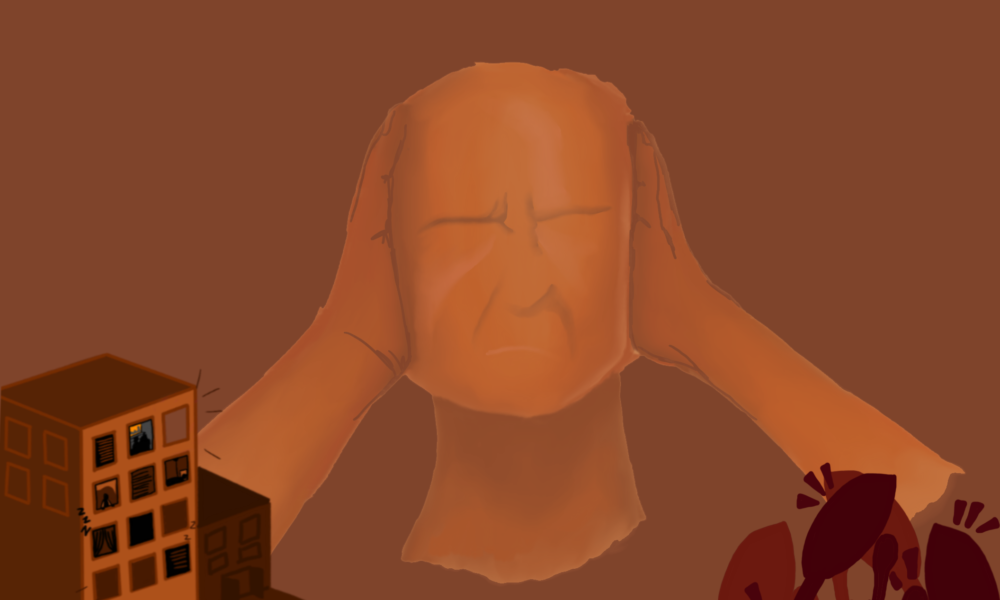
With so many noises colliding in most urban settings, quiet is an overlooked luxury: Sounds of industry and transportation lower the value of real estate, making marginalized groups more likely to live near train tracks, highways, and airports. Unhoused people are frequently targeted by businesses with high-frequency noise devices, while those in prison are punished by federal authorities with either deafening noise or a painful deprivation of it. Long-term exposure to loud noise takes a toll on the body. Studies show that people who live or work in loud environments are particularly susceptible to a host of physical, cognitive, and emotional health problems, including heart disease, high blood pressure, and low birth weight.
Though noise pollution disproportionately affects the disenfranchised, noise ordinances have historically acted as the mouthpiece of a city’s most privileged dwellers. The first comprehensive noise bylaw in North America was passed in the 1930s in New York during the Great Depression, where media and cultural historian Lillian Radovac notes that mayor Fiorello La Guardia saw noise as a “symptom and even a cause of urban disorder.” At a time of economic recession, the anti-noise campaign marshalled the city’s resources to stabilize social stratifications and constrain dissatisfied—and noisy—protesters. Ironically, the raucous din of industrial production and new-age machine inventions at the time was seen by anti-noise advocates as incongruent with a civilized society. The desire for silence came to privilege an upper-class image of intellectual labour, one contained in the carpeted and insulated modern office, floating in a high-rise. Noise was “murdering rational thought”, anti-noise advocate and McGill physics professor H.E. Reilley told Montrealers on the radio in 1931.