

Latest News

Commentary, Opinion

Bill 96 further ingrains systemic racism

In a devastating decision taken by the National Assembly of Quebec on May 24, Bill 96—the newest addition to the province’s array of restrictive language laws—was officially adopted. While the Coalition Avenir Québec (CAQ) advertised the bill as another small step to protect the French language, the reality is that Bill 96 will alienate and discriminate against all those who are not francophone.

As a native English speaker born and raised in Quebec, I am used to being told that I am a second-class citizen because of the language that I speak. The Sûreté du Québec, the police force that is tasked with protecting me, is not required to communicate with me in English, no matter the circumstance. Moreover, I was only permitted to attend an English high school because my parents are anglophones. My children would be forced to attend French schools if I do not request a document from the Quebec government that certifies I graduated from an English high school. By preventing allophone and francophone children from attending English schools, the government is limiting the children’s abilities to learn a language used globally, across all industries. Moreover, existing legislation in Quebec seems to contradict The Convention on the Rights of the Child, which stipulates that children have the right to use their mother tongue and that education should allow children to fully develop as people—which is facilitated when done in a child’s preferred language.  

Bill 96 further delegitimizes my status as a Quebec citizen in the eyes of the government by ingraining my otherness as a non-francophone. I will now have to demonstrate that I am a “historic anglo” in order to receive medical services in English. If I work for a company that has more than 25 employees, I will have to conduct all internal and external business in French. The obstacles that white Quebec anglophones like me will have to face, however, can hardly compare to the repercussions of Bill 96 for Indigenous people and immigrants. 

Because neither group qualifies as historic anglophones, there is nothing guaranteeing the rights of Indigenous people or immigrants to receive healthcare in any language other than French. Unsurprisingly, the Quebec government uses the term “historic” to grant rights to anglophones but ignores the fact that Indigenous people are the historic caretakers of this land. The lack of accommodation for Indigenous people proves both that systemic racism is still rampant in the province and that the government has doubled down on its attempts at assimilation.

Immigrants can receive services in English during their first six months in Quebec, which are allotted to learn French—but once that time has passed, immigrants are expected to navigate services in French with the ease of a native speaker. The communication barriers the government is set on establishing will likely lead to a decrease in the quality of care, an increase in medical malpractice cases due to miscommunication between doctors and patients, or instances where doctors purposely misinform patients. Racialized patients already face neglect due to systemic racism in Quebec’s healthcare system and Bill 96 only increases the likelihood of more widespread discriminatory practices.

The targeted racism of Bill 96 extends throughout the government and into every business and institution, including the most formative—education. The Bill limits the educational opportunities of Indigenous youth by requiring them to follow a French curriculum rather than one determined by their respective communities. According to international and Canadian federal law, Indigenous peoples have the right to self-determination, meaning they have the right to oversee their own political, economic, and cultural development. Bill 96 directly contradicts and disregards this right, while also invoking the notwithstanding clause in the Canadian constitution for protection from federal challenges.

The Quebec government is also restricting the educational opportunities available to immigrant and Indigenous students by placing a cap on the number of non-historic anglophone students that can attend English CEGEPs. The CAQ’s targeting of these students stifles their educational opportunities, which is a clear sign that the party is not invested in the futures of minority groups in the province. 

The passing of Bill 96 disadvantages all non-francophones, but Indigenous people and immigrants are more affected than anglophones. The bill institutionalizes and legitimizes the racist ideal of assimilation of racialized and non-francophone groups in Quebec. It also makes emigration an enticing option for all those the Bill discriminates against, a consequence that falls in line with the Quebec government’s desire to create an entirely francophone population. Ultimately, Bill 96 joins the ranks of Bill 101, Bill 178, and Bill 86 in the Quebec government’s arsenal of laws that perpetuate systemic racism and discrimination against non-francophones throughout the province.

McGill, News

QS 2023 Rankings names McGill top university in Canada

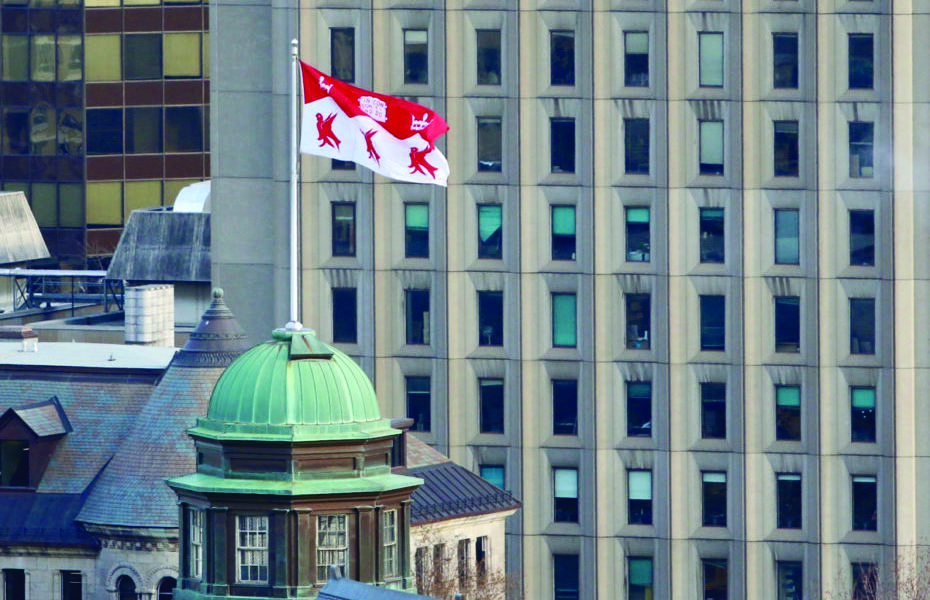
The Quacquarelli Symonds (QS) World University Rankings, published on June 8, listed McGill as the number-one university in Canada and the 31st in the world for the 2022-2023 academic year. In last year’s publication, McGill ranked close behind the University of Toronto (UofT) as the second-best university in Canada. The QS ranking is based on eight factors: Academic reputation, employer reputation, faculty-student ratio, citations per faculty, international faculty ratio, international student ratio, international research network, and employment outcomes.

McGill earned a total of 81.9 out of 100 points—a weighted average of its score in each category. McGill scored approximately 80 points in all categories except for faculty student ratio (68.9) and citations per faculty (59.6).  UofT and the University of British Columbia (UBC) took second and third place. McGill beat out UofT and UBC for the top spot due to their citations per faculty criterion—UofT scored 43.5 and UBC scored 42.1.

In an email to The McGill Tribune, McGill media relations officer Frédérique Mazerolle shared the administration’s pride in the university’s top ranking. She also explained that the university’s global reputation comes from the institute’s commitment to high-quality education.

“Our institution is recognized globally for the excellence of its teaching and research programs,” Mazerolle wrote. “While positive rankings can contribute to a good international profile, McGill’s international reputation is based on much more than that: [A] 200-year-old tradition of excellence in both research and teaching […] and a network of students and alumni who are ultimately our best ambassadors around the globe.”

While students were pleased by McGill’s accomplishment, many were skeptical of the ranking and its evaluation criteria.  In an email to the Tribune, Thibaut Baguette, U2 Engineering, pointed out that the ranking does not consider student well-being. He believes the quality of an institution varies from one person to another depending on student experiences, not just faculty achievements.

“I think [McGill’s ranking] is pretty cool, but apart from bragging rights, it doesn’t mean much,” Baguette wrote. “As with many other things, what’s good for one person isn’t necessarily good for another. What ultimately matters most is transparency and how much the university listens to what their students want.”

For others, including some racialized students, the ranking feels like an affront when compared with the racism they have faced while at McGill. Many students have also voiced frustration toward the administration about their refusal to divest from fossil fuels and their treatment of marginalized students.

Fanta Ly, 4L, has spoken out about her encounters with harassment from faculty and administration, including a call from the administration to her family falsely claiming she had died. Ly expressed that given her experiences, she does not want the ranking to influence other students to attend McGill. 

“[The ranking] means nothing to me and I hope it won’t encourage Black students to attend such a racist institution,” said Ly.

University rankings such as that of QS vary year to year due to changes at individual institutions and in the ranking criteria. In the past three years, McGill’s global QS ranking has fluctuated from 31st to 27th and back to 31st, but it has consistently been in the top 50 schools worldwide for decades. 

In a statement to the Tribune, Emma Gormley, U2 Management, explained that while she believes the ranking system is inherently flawed, she also acknowledges McGill’s rank as a helpful tool for her future goals. 

“Overall, university rankings are really arbitrary and there is a lot of evidence that criticizes their methodology and the privileging of certain faculties or institutions based on subjective reputations,” Gormley wrote. “Despite these flaws, however, rankings are essential for many professions or grad school applications so I cannot ignore McGill’s ranking and reputation.”

News, SSMU

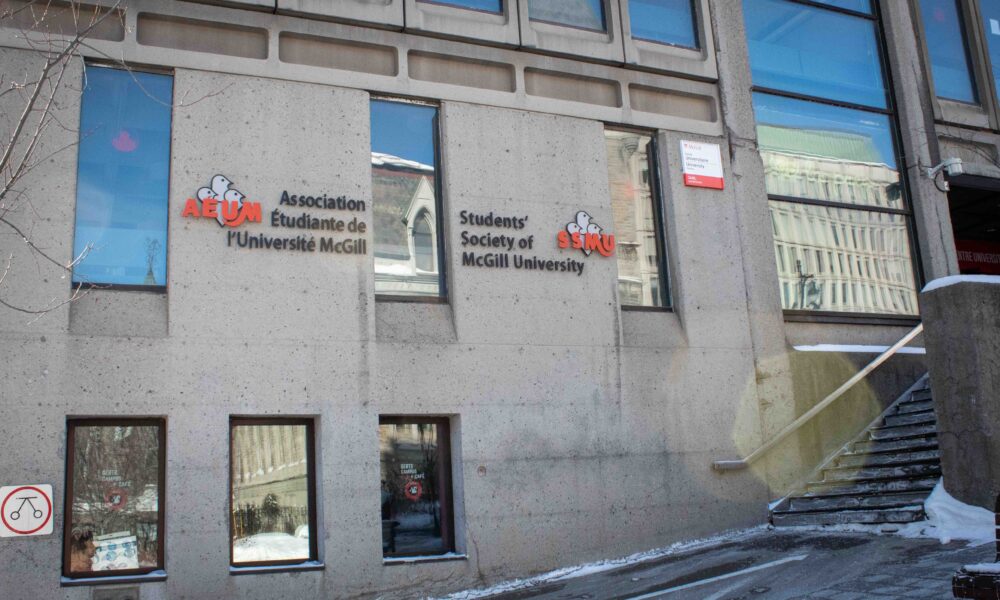
SSMU suspends SPHR McGill over parody post, citing harassment

After publishing a satirical article on social media in protest of the Students’ Society of McGill University’s (SSMU) decision to revoke the Palestine Solidarity Policy, Solidarity for Palestinian Human Rights McGill (SPHR) received a 105-day suspension for harassment. SPHR will not be able to access any resources provided by the SSMU, such as funding opportunities, room booking privileges, or their SSMU bank account, until Aug. 29. Former SSMU vice-president (VP) Student Life Karla Heisele Cubilla notified SPHR of the Board of Directors’ (BoD) decision to suspend the organization on May 16 via email. 

The SPHR article, shared on April 25, was a caricature of SSMU’s April 25 statement announcing that the Society would not adopt the Palestine Solidarity Policy because it was deemed unconstitutional. SPHR’s message mimicked the format of the BoD’s announcement, but satirized SSMU and its decision-making, characterizing the processes as dictatorial.

In an interview with The McGill Tribune, SPHR executive Anya* explained that the statement was devised to raise morale among supporters of the Policy after the Palestine Solidarity Policy was struck down.

“There was a […] feeling of defeat, and, honestly, spirits were down,” Anya* said. “A lot went into this campaign, and a lot of people contributed. The parody was just a lighthearted way to criticize the Board for its decision.”

SSMU found that the post’s language—particularly, references to the BoD as the “Board of Dictators,” with “backbones made of jelly” who “uphold the white supremacist values of McGill’s Board of Governors”—to be in violation of article 3.1.6 of the Internal Regulations of Student Groups. According to article 3.1.6, all clubs’ operations must abide by SSMU and McGill’s rules, regulations, and by-laws. The SSMU claims that the language used by SPHR McGill constitutes harassment as per its Equity Policy and the McGill Policy on Harassment and Discrimination

While SPHR does not have access to room booking or funding opportunities from SSMU during its suspension, Anya* believes SPHR’s operations will not be greatly impacted. 

“We get most of our funding, and most of our resources from QPIRG [the Quebec Public Interest Research Group at McGill],” Anya* said. “With regards to funding, we don’t take funding from SSMU […] usually, just because we don’t want to deal with the receipts and have people’s identities be jeopardized.”

Other student groups have spoken out against SPHR’s suspension. In an email to the Tribune, Sebastian Seyva, a PhD candidate in the Department of Neuroscience and member of Socialist Fightback at Concordia and McGill, emphasized the importance of student union support for student activism. 

“The suspension of SPHR from the McGill SSMU is just the latest in a string of attacks on student activism and the democratic will of the student body on campus,” Seyva wrote. “As students, our primary weapon to fight back against these attacks is our student union, but recent events have revealed how the leadership of the student union (its Board of Directors) is equally complicit in clamping down on any sort of dissent in the student body, and actively preventing the student union from becoming a real avenue of struggle for students looking to fight back.”

SPHR McGill is currently working to appeal its suspension. VP Student Life Hassanatou Koulibaly explained that such a process prompts a review by the Clubs Committee.

“Depending on the nature of the issue, sanctions are determined according to the Internal Regulations of Student Groups and as detailed by Club Processes,” Koulibaly wrote in an email to the Tribune. “When a club receives a sanction, they may wish to appeal the decision through the Sanction Appeal Form which is then submitted to the Clubs and Services Coordinator for review before then being reviewed by the Clubs Committee.”

*Anya’s name has been changed to preserve their anonymity

McGill, Montreal, News

McGill to end two-year mask mandate, case tracking and data collection

As of May 24, 10 days after masking became optional in most indoor settings province-wide, wearing masks indoors at McGill will no longer be mandatory. The news that McGill would be ending its mask mandate came in an email from Associate Provost Christopher Buddle and Deputy Provost Fabrice Labeau on May 2.

The email also reported the dissolution of McGill’s Case Management Group (CMG), and thus the suspension of McGill’s COVID-19 data collection. The university will no longer track cases, measure CO2 levels in classrooms, monitor campus traffic, or record vaccination rates. And as of May 30, administrative and support staff will be required to work in person full time.

Although masking will no longer be compulsory after May 24, the provosts stressed that it is still “strongly encouraged to continue to wear a mask” and that mask dispensers and hand sanitizer stations will remain in place until further notice. However, on the McGill subreddit, students have complained about a lack of masks and empty sanitizers at the Redpath and McLennan Libraries. 

The decision to end mandatory masking has been met with mixed reactions from the McGill community. Some, like Noor Jetha, U1 Engineering, think the university should have waited longer before making such a decision. 

“At first glance, I felt a sense of panic,” Jetha said in an interview with The McGill Tribune. “Now that the mask mandate is being lifted, nobody’s gonna wear a mask at all, and nobody can force people to wear a mask which will make people more exposed and COVID will surge again.”

James Newman, MA’20 and president of the Association of McGill University Support Employees (AMUSE), agrees with Jetha and feels that mask-wearing by students has been lax, even with a mandate. He cited having seen some students who tested positive for COVID-19 not wearing masks when opening their front doors and other students not wearing masks while walking around their residence hallways. 

Some, like Wanjun Chen, U2 Agricultural and Environmental Sciences, are still deciding whether to continue masking after May 24. For Chen, who found masking distracting during classes, the end of the mandate feels relatively safe.

“I feel [hesitant about] whether to lower my mask or keep it on, because the mask didn’t make me feel very comfortable, especially in [lectures] [….] I feel a bit dizzy with a mask because I don’t feel I got enough oxygen,” Chen said. “I think it is safe because all the other provinces in Canada already removed the mask, and they didn’t have very serious consequences, so I think it will be safe.”

In an email to the Tribune, David Juncker, professor and chair of the Department of Biomedical Engineering, explained that he believes the decommissioning of the CMG will leave the university ill-prepared for the Fall 2022 semester. 

“Tracking is a good measure, and so stopping tracking is unfortunate as it will leave us flying blind at a time where cases are still high,” Juncker wrote. “The silver lining is that there is less activity on campus during the summer months, and that people can go outside and windows [can be] opened.”

Christian Tonnesen, U4 Science and vice-president floor fellow, emphasized the risks workers face on campus. Masks represented one of the few protective measures available to them, he says, alongside hand sanitizer stations and plexiglass dividers around campus. 

“I suspect we will definitely see a rise in cases this August, early September, due to the amount of partying, social contact, and perhaps the biggest virulent source, Frosh,” Tonnesen wrote in an email to the Tribune

Rose Chabot, teaching assistant and PhD candidate in the Department of Political Science, worries more about the barriers this could create for the most vulnerable members of the community. 

“I am more worried about immunocompromised students and staff and the risks that attending a mask-free class would represent for them—or the barriers to education, if they decide not to take the risk,” Chabot wrote. “Personally, in a mask-free class I would feel more comfortable teaching with a lot of air circulation (open windows)—and I know this is not possible everywhere on campus.”

In an email to the Tribune, McGill media relations officer Frédérique Mazerolle explained that the COVID-19 situation in May 2022 is radically different from when the pandemic began in March 2020. Hence, McGill feels it is appropriate to follow the government’s lead on this issue and stop requiring masks. 

“If the Quebec government decides to delay its timeline for making masks optional, the university may adapt its approach,” Mazerolle wrote. “McGill will continue to follow other public health measures as required by the government. The health and well-being of our community remain our top priority.”

Arts & Entertainment, Fashion, Pop Rhetoric

The Met Gala 2022: Fundraising event or vanity circus?

The beginning of May marks both the end of McGill’s winter semester and the annual Met Gala, a fundraising benefit for the Metropolitan Museum of Art’s Costume Institute that has become known as ‘fashion’s biggest night.’ When the Costume Institute announced its Gilded Glamour theme this year, many expressed excitement on social media, expecting their favourite celebrities to sport attire from the Gilded Age such as corsets, pearls, and frills. Despite fans’ expectations, many attendees seemed to disregard the theme entirely, a recurrent pattern throughout the last few years. When viewers jump at the chance to criticize celebrities’ adherence to the theme, they are mostly ignoring the more insidious trend at hand—romanticizing the Gilded Age as a theme in itself.

Gilded Glamour is an extension of the Met’s 2021 exhibition on American fashion. The theme evokes the Gilded Age of late nineteenth-century America, a period characterized by opulence, extravagance, and innovation in technology, fashion, and industrialization. By creating a public space for celebrities to exercise their wealth and reputation, this theme contributes to an ever-present culture of celebrity sensationalism. Brand deals, cultural capital, and gossip dominate the event, turning it into a spectacle of affluence and status rather than a celebration of art. The Met Gala originally served as a fundraising event for the Costume Institute and a celebration of their annual fashion exhibition. It wasn’t until Vogue editor-in-chief Diana Vreeland was appointed special consultant for the 1973 Met Gala that celebrity personnel were invited. Since then, the Met Gala has become a significant pop-culture event mostly recognized for its high-profile attendees.

(vogue.com)

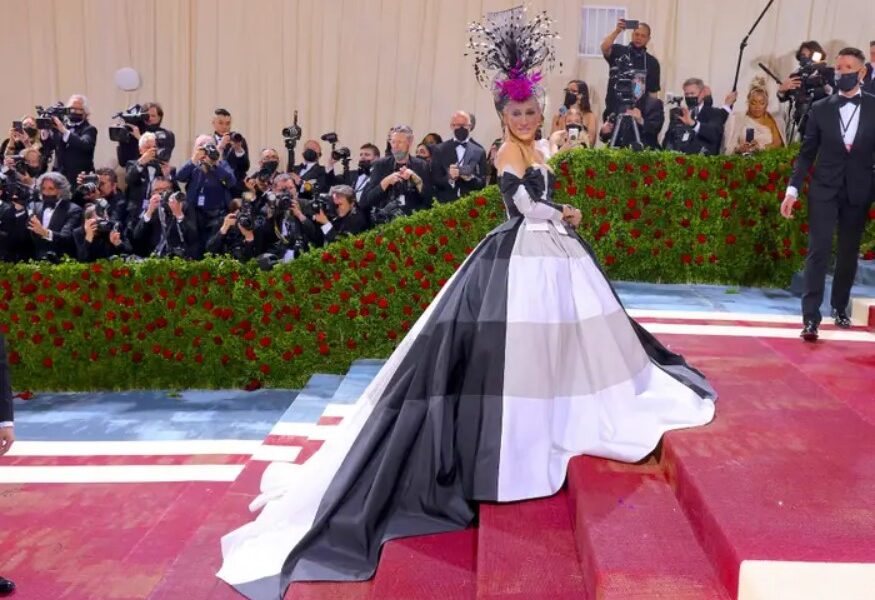
The theme’s glorification of the Gilded Age signifies the vain and aloof attitude that encompasses celebrity culture. The majority of the outfits worn by the wealthy attendees only reflect the wealthy population from that time period. These overt displays of wealth speak to a tendency for celebrities to pick and choose which parts of history they feel are most important to represent. This willful ignorance calls the event’s very integrity into question, as well as how the fashion industry promotes questionable celebrity values. The cruel irony is that the Museum of Modern Art’s Costume Institute has recently spoken about highlighting under-recognized moments in American fashion. However, some celebrities were exceptions to this trend. Take actor Riz Ahmed, who wore a navy jacket and trousers inspired by the uniforms of immigrant labourers in nineteenth-century New York. His look served as an homage to these workers—the ones who made the extravagance of the Gilded Age possible. In choosing to highlight an underrepresented population from the Gilded Age, Ahmed called attention to the economic disparities that defined the period. Sarah Jessica Parker wore a gown modelled after an outfit by Elizabeth Hobbs Keckly, a Black designer from the 19th century and the first Black woman to design garments for White House inhabitants. This look highlighted the dichotomy between the extravagance of the Gilded Age and the many institutional barriers faced by marginalized peoples during the period. Many individuals and organizations, like Black Lives Matter, have challenged the Met Gala from the inside, arguing that the event is a waste of money and that such resources could be spent more responsibly and productively. While this year’s gala is a celebration of American fashion, the event as a whole fails to acknowledge the issues of collective erasure of working-class and racialized people in contemporary American culture. 

The Met Gala has effectively gone from a fundraising benefit to an event dependent on the commodification of celebrity status. This shift is evident throughout news coverage of the 2022 event, which mainly focussed on scandal and outrage over what hollow statements the off-theme outfits make. For example, Kim Kardashian was heavily scrutinized for the harmful ways she lost weight to fit into Marilyn Monroe’s dress for the event, allegedly dropping 16 pounds in three weeks. Celebrities like Kardashian not only failed to adhere to the theme, but also used the event as a medium to perpetuate problematic beauty standards. This emphasizes the idea that the Met Gala has become out of touch with its original intentions of fun, fashion, and fundraising in the past years.

The Met Gala has transformed from a display of high fashion and creativity into an excuse for celebrities to spend exorbitant sums on playing dress-up. Interpretation and adherence to themes have declined over time, as has the quality and appropriateness of the themes themselves. Evidently, the Met Gala’s perception and purpose have shifted as it seeks to act in accordance with the values of contemporary celebrity culture premised on celebrity idolatry and toxic sensationalism.

McGill, News, SSMU

Student activists protest SSMU decision to drop Palestine Solidarity Policy

The Students’ Society of McGill University (SSMU) announced in a statement on April 22 that they would not be adopting the Palestine Solidarity Policy, despite 71.1 per cent of voters endorsing it in the Winter 2022 referendum. The Policy would have mandated the Society to condemn the surveillance of Palestinian and pro-Palestine members of the McGill community, publicly assert its support for the cause of Palestinian liberation biannually, boycott companies complicit in the Israeli occupation of Palestine, and pressure the McGill administration to do the same. 

The decision to drop the Policy came after sustained pressure from the McGill administration. On March 24, McGill’s Deputy Provost Fabrice Labeau sent an email to students that denounced the Policy as divisive and polarizing. Labeau explained that the administration found the Policy to be in violation of the university’s values and SSMU’s constitution. According to Labeau, if the policy was implemented, the university would end its Memorandum of Agreement (MoA) with the Society, which formalizes their relationship. The university gave SSMU 30 days to remedy the alleged violation of its constitution, or 90 days to submit the dispute for arbitration. 

On April 22, when the SSMU concluded its internal investigation of the alleged MoA violation, the SSMU Board of Directors (BoD) announced that it had also found the Policy to be at odds with the SSMU Constitution, the SSMU Equity Policy, a 2016 SSMU Judicial Board ruling, and Quebec law. SSMU has therefore complied with the administration’s demand to revoke the Policy.

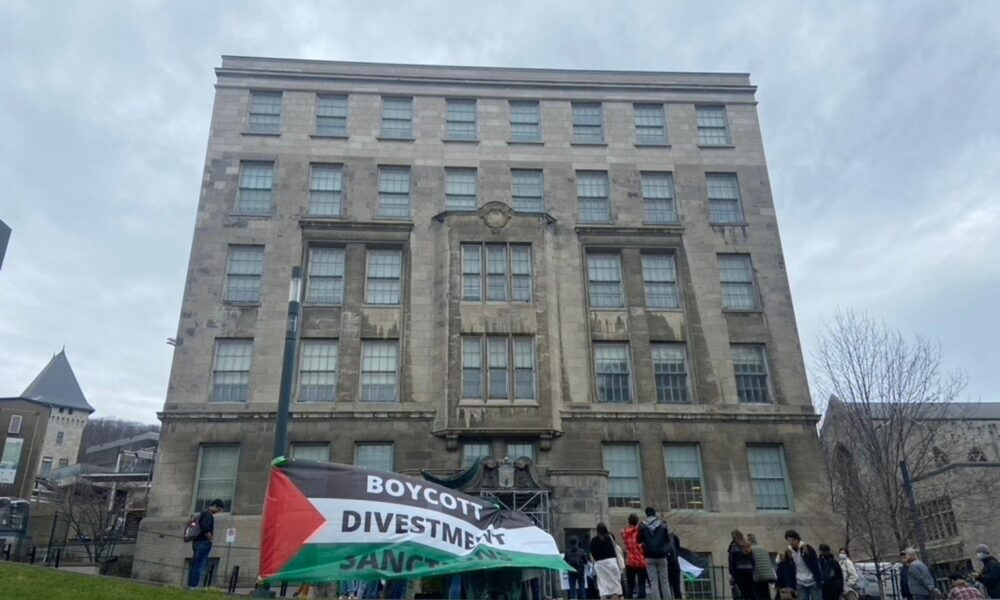
Students for Palestinian Human Rights (SPHR) McGill held a rally on April 25 in front of the James Administration Building to show support for the Policy and to protest SSMU’s decision. Before the rally, Noor,* a member of SPHR, voiced their dismay in an interview with The McGill Tribune

“We do not recognize the SSMU Board of Directors’, or as we like to call them the board of dictators, decision to repeal or overturn this policy because it is a complete attack on student democracy and it completely dismisses the entire referendum vote,” Noor said. “We do not recognize it, and we urge students, as well, not to recognize the board of dictators’ decision [….] We are just really ashamed that the student union chose not to represent us.”

Noor believes that SSMU should have stood its ground when faced with pressure from the administration. They also think the Society timed its announcement to be released during the final exam period when students are preoccupied with  studying—a sentiment shared by others who attended the rally. 

“I think pressure from the admin definitely played a big role. I wouldn’t be surprised if [the] McGill administration was down [SSMU’s] throat,” Noor said. “[The SSMU BoD] could have easily said that it was constitutional, which it is, and went to arbitration, but they chose to overturn a democratically elected policy.”

Sarah Abdelshamy, a former member of SPHR and current organizer with the Palestinian Youth Movement, stated at the April 25 rally that she believes McGill’s intervention in the referendum was motivated by the interests of shareholders as opposed to the well-being of its students. 

“They say that this motion is divisive without acknowledging that our campus has been divided for decades now—precisely because we do not have any motions or mechanisms that protect us,” Abdelshamy said. “For years now, students on campus have been harassed, doxxed, harmed, and targeted, and the administration turns a blind eye to it. The only division that this motion causes is between the university and its donors—the only relationship that the administration is capable of or desires to protect and uphold.”

In an email sent to the McGill community on April 26, Labeau applauded SSMU’s decision. While Labeau condemned the surveillance of pro-Palestinian students on campus and recognized the importance of student activism, he reasserted McGill’s stance against the adoption of the Policy.   

In a speech at the SPHR rally, Islamic studies professor Rula Jurdi Abisaab criticized the administration for its rhetoric surrounding the Palestine Solidarity Policy. 

“As an educator at McGill, I caution against the statements used by the administration, such as ‘a culture of ostracization and disrespect,’ to suppress the results of the democratic elections of McGill students,” Abisaab said. “Such phrases gravely misrepresent the aims of the Palestine Solidarity Policy and promote inadvertently a passive coexistence with injustice.”

Abisaab, also a signatory of the open letter from McGill faculty and staff endorsing the Palestine Solidarity Policy, further reaffirmed her admiration for the students championing the Policy. 

“I support our students’ use of legitimate civil and democratic means to dissociate themselves from ideas and institutions that have promoted racism, dehumanization, and violence,” Abisaab said. “Our undergraduate students are to be praised for embracing democratic ideals of human dignity, freedom, and equality at McGill.”

Former SSMU President Darshan Daryanani, who was recently impeached, also spoke at the rally. He praised the Palestine Solidarity Policy for changing the discourse about Palestine on campus. 

“I publicly defended and endorsed the Palestine Solidarity Policy. Personally, I agree with all the calls to action, and your 71 per cent overwhelming majority vote only made it easier to defend it,” Daryanani said. “Right now, more than ever, I urge you to continue to speak up because your voice matters.” 

The Tribune reached out to the SSMU BoD for a statement on the decision-making processes that led to the nullification of the Palestinian Solidarity Policy. All executives declined to comment.

*Noor’s name has been changed to preserve their anonymity.

News, SSMU

Students vote to remove SSMU President Darshan Daryanani after tumultuous year in office

*Content warning: Gender violence, sexism, harassment

Students’ Society of McGill University (SSMU) President Darshan Daryanani was impeached in a Special General Assembly (GA) on April 11. The three-hour meeting culminated in the approval of a motion to remove Officer Daryanani from his post, which surpassed the required two-thirds majority with 351 votes in favour, 27 opposed, and 22 abstentions. In the following online ballot held from April 14 to 18, the GA’s decision was ratified, with a McGill undergraduate voter turnout of 12.6 per cent.

Allegations of discrimination, the ill-explained five-month absence of Daryanani, and repeated testimonies about a toxic work environment at SSMU fuelled much of the controversy surrounding the Society over the 2021-2022 academic year. Demands for transparency and accountability accumulated over months: Public mentions of impeachment were first made on Nov. 11, 2021, the fifth Legislative Council (LC) from which Daryanani was absent. A motion that would have mandated Daryanani to hand in a letter of resignation passed in LC on Nov. 25, but was ultimately postponed by the Board of Directors (BoD). 

Daryanani’s reinstatement on Feb. 14 dominated the conversation at both the Feb. 17 LC and the Feb. 21 Winter GA. At the annual Winter GA, Councillor Pérez Tiniacos asked the executives if they would resign upon receiving a letter from the LC stating that executives and councillors do not feel safe with the executive’s presence in SSMU. Such a letter would require the support of at least 50 members of the Society. All executives said that they would resign, while Daryanani did not directly address the question in his response. 

“If I [resigned] as soon as I received a suspension letter, I wouldn’t be here today,” Daryanani said at the annual Winter GA. “But like I said, the reasons to suspend me were deemed inadmissible and unfounded.”

In late February, 12 councillors put forth a petition to hold a Special GA that would address the possibility of impeaching Daryanani. The document received over 200 signatures, easily surpassing the mandated 50 required by the SSMU Constitution.

On April 11, hundreds of McGill undergraduates gathered on Zoom to deliberate Daryanani’s removal—an event that quickly devolved into chaos. The volume of last-minute sign-ups delayed the meeting by nearly 45 minutes, but quorum was maintained due to sizable student interest— a first in recent McGill history. 

An hour into the scheduled start, Pérez Tiniacos, who moved the impeachment motion, introduced the grounds of ‘impropriety’ that he and other councillors believe warranted Daryanani’s removal. He emphasized that SSMU representatives no longer saw Daryanani as a leader, but as an obstacle to the Society’s operations. 

“To some, this impeachment may not make a lot of sense, especially seeing how late it is in the school year,” Pérez Tiniacos said. “But let me remind you, it will cut off the President from whatever is left of his $30,000 salary paid by student fees, it will invalidate his title as President, it will provide safety to all the workers, and ease the transition to next year’s Executive Committee. But most importantly, it will show the student population this type of behaviour is not tolerated within the SSMU and that we hold everyone accountable for their actions.”

Daryanani stated that he saw the meeting as an opportunity for him to question the true motives of SSMU members and the BoD in introducing this motion. He then directly addressed those individuals and questioned whether his impeachment was warranted.

“Why did [the BoD] suspend me for nearly five months? Prior to my suspension, why did I not receive any sort of warning, and why did nobody even bother to talk to me?” Daryanani asked. “On what basis have [the councillors] convinced 231 signatories to call for my impeachment? [….] Do [students] think it is reasonable for me to have been unjustly suspended from an elected position for five months, only to be reinstated, and then again removed for no clear reason?”

In the question period that followed Daryanani’s statement, SSMU VP Internal Sarah Paulin invited the movers of the motion to respond. Councillor and seconder Nathaniel Saad expressed concern about whether the President had read the motion, which defined the charges against him as “a failure to observe standards or show due honesty or modesty; improper language, behaviour, or character.”

“[The President’s language attempts] to discredit the Board of Directors by answering criticism with criticism, but never actually presenting a counter argument,” Saad said. “[The basis for impeachment] is clearly in the motion and we’ve been saying it for the last two months.” 

The Special GA also served as an opportunity to discuss the resignation of VP External Sacha Delouvrier, announced at the April 7 LC, which occurred before his impeachment process could begin. The councillors that created the petition for Daryanani had also created one for Delouvrier. According to Pérez Tiniacos, Delouvrier stepped down after receiving the document from councillors. Delouvrier stated publicly at the April 7 LC that his departure was for health reasons.

Member of the gallery Mikael de la Brindille requested examples to support the claims of impropriety against Daryanani, questioning how members were expected to vote on impeachment when requests for evidence were regularly denied on the basis of confidentiality. 

“I totally understand the frustration,” Councillor Mary Zhang said. “However, I would like to reiterate that the topic at hand is extremely sensitive to the people that are concerned [….] We should not have to hear [dehumanizing details] just to make a call [to] action in the right direction.”

Following the request for evidence, Councillor Charlotte Gurung shared her account of the Feb. 21 GA, when interactions with Daryanani left her uncomfortable and anxious because she felt his behaviour was aggressive and his tone threatening. She also implored the audience to consider how having personal, distressing interactions aired to a crowd of 370 could worsen the situation for those involved.

Member Ghida Mawlawi, on the other hand, urged the attendees to consider Daryanani’s viewpoint.

“No one mentioned the fact that an independent investigation […] found those claims were unfounded,” Mawlawi said. “Has anyone considered that Darshan’s tone was angry because he had just been suspended for four months for no reason? I don’t know if you guys are noticing, but it feels like all of you are ganging up on President Daryanani.”

Daryanani also expressed disappointment at the process. According to Daryanani, when he filed a complaint against another executive for racially targeting him, the executive received equity training rather than a suspension and public scrutiny. 

Following its approval at the Special GA, the motion to impeach Daryanani required ratification by undergraduate students before it could officially take effect. At 5:05 p.m. on April 18, Elections SSMU certified that students had approved the motion to remove Daryanani from office and he was impeached, effective immediately. 

“We’re all very happy that the motion was officially ratified,” Pérez Tiniacos told the Tribune. “But more than just a celebration, I think this also has to be a point of reflection on how this environment within the SSMU that was perpetuated was definitely not the first.”

As stipulated in the motion, the president’s portfolio—as well as that of the VP University Affairs and the VP External—has been divided up amongst the remaining executives, who have effectively been working as a three-person team since February. The remaining executives will also undertake the training for incoming executives as a group, and are looking into consulting previous office-holders for help with the transition. 

“Something we’re going to be stressing a lot for next year’s execs is ‘take care of each other,’” Sader said in an interview with the Tribune. “You cannot talk about a lot of things to your partners, your friends, your family. You can only talk about it to each other; you need to be able to rely on each other [….] I’m confident in the next year’s execs that they’ll be able to do an excellent job—they all seem to be kind people, and that’s what’s important. Hopefully, they’ll be able to work together and kind of stick through it together.”

McGill, News, SSMU

Faculty and staff sign open letter endorsing SSMU’s adoption of Palestine Solidarity Policy

An open letter published in The McGill Daily on April 5 endorsed the Students’ Society of McGill University’s (SSMU) adoption of the Palestine Solidarity Policy. The letter, titled “Support SSMU and the Palestine Solidarity Policy,” was signed by 103 McGill faculty and staff members. It came after an email from the McGill administration that publicly denounced the Policy and threatened to terminate its Memorandum of Agreement (MOA) with the SSMU on March 24. In a statement released on April 22, SSMU announced that it would not be ratifying the Policy, as the SSMU Board of Directors determined that it goes against its constitution, Equity Policy, a 2016 Judicial Board ruling, and Quebec law.

In the open letter, professors and staff applauded the work of Solidarity for Palestinian Human Rights McGill (SPHR) in creating the Palestine Solidarity Policy and students for passing it with a 71.1 per cent majority. The letter also stressed the importance of maintaining independent democratic channels, such as SSMU referenda, for students to push for meaningful change on campus. 

Michelle Hartman, professor of Arabic Literature at the Institute of Islamic Studies, told The McGill Tribune in an email that she believes it is important for faculty to support students when the administration attempts to suppress student political activism. 

“The attempt to shut down a student union policy like this by a university administration runs against everything a university is meant to do and stand for,” Hartman wrote. “So many professors that I spoke to were outraged about how the university administration responded in such a threatening and heavy-handed way to a student initiative—especially something that is standing for social justice. I find it egregious that the administration would try to shut down students engaging in activism and solidarity on one of the most pressing and urgent causes of our time.”

Associate professor of political science William Clare Roberts echoed Hartman’s sentiment—he feels the university’s threat to terminate its MOA with SSMU goes against its commitment to collegial governance. Roberts also noted the importance of showing solidarity with Palestinian people. 

“I’m incredibly proud of the students who brought the resolution to the student body, and of the voters for passing it by such a large margin,” Roberts wrote in an email to the Tribune. “Solidarity with the Palestinian people, and efforts to address their displacement and dispossession by Israel’s apartheid policies, are morally and politically righteous. In no other case are invasion, occupation, and oppression so protected from criticism and opposition. No one can deny that Israeli policy is unjust, but the demand to do something about it, to withhold support and cooperation from universities and corporations that collaborate, is always greeted by hysterical reactions.”

In an email statement to the Tribune, SPHR said that support from faculty and staff helped keep the Palestine Solidarity Policy relevant. They also commended students’ efforts to promote social justice and human rights.

“[Support from faculty and staff] shows the administration that we are not alone in our indignation towards their threats,” the group wrote. “It moreover demonstrates to the majority of McGill students, who demonstrated their support for the Palestinian liberation struggle in the Winter referendum, that they are supported by academics and professors.”

In an email to the Tribune, McGill media relations officer Frédérique Mazerolle reiterated the administration’s stance that the Policy is at odds with McGill’s mission of inclusivity.

“Robust debate is key to what we do and who we are as a university,” Mazerolle wrote. “But such debate cannot be carried out at the expense of respect and inclusion. Initiatives that create excessive polarization in our community and encourage a culture of ostracization due to students’ identities, religious or political beliefs, are in contradiction with the university’s values of inclusion, diversity, and respect.”

Arts & Entertainment, Film and TV

‘Human Resources’ may not top ‘Big Mouth,’ but it impresses nonetheless

In the mythical world of Big Mouth’s spinoff series, the department of Human Resources in question may appear like any other: Employees attend boring meetings, unpaid interns pretend to take minutes, gossip is exchanged in the elevator, and love triangles brew between coworkers. But viewers should not let this department’s name obscure its important purpose. In this series, Human Resources has a purpose far greater than filing complaints. Rather, its employees are tasked with the important responsibility of dispensing and controlling the emotions of each human alive on Earth.

The animated Netflix series, which premiered on March 18, follows an array of different creatures, each embodying a different human dimension of human personality as they navigate office life. These creatures include mosquitos for anxiety, glowbugs for love, and rocks for logic. The show centres around the office intern, Lovebug Emmy (Aidy Bryant), after she is abruptly assigned to her first human client, Becca (Ali Wong). As the season progresses, Emmy grows into her role as a lovebug and fosters new relationships with Becca and her other coworkers. The show also features returning creatures from Big Mouth, like raunchy hormone monsters Maury (Nick Kroll) and Connie (Maya Rudolph).

Human Resources diverges from Big Mouth in its decision to focus on the lives of adults instead of adolescents, expanding on the diversity of human experiences that it explores. For example, the series follows Becca as she copes with postpartum depression and feelings of shame for not feeling an immediate connection to her baby. Another particularly touching storyline follows an elderly woman with Alzheimer’s disease, Yara (Nidah Barber), who revisits old memories of her young romances accompanied by her lovebug, Walter (Brandon Kyle Goodman). Through Yara’s story, the series illustrates the complicated and bittersweet nature of experiencing love while coping with dementia. Meanwhile, Yara’s son Amir (Ahmed El-Mawas) cares for her with the help of his logic rock, Pete (Randall Park). At the same time, he tries to avoid the creature representing grief—a seemingly docile sweater—which grows violent each moment it’s ignored. Through focussing attention on the complexity of adult emotions and experiences, the series highlights how the responsibilities associated with maturity can impact mental health. Because they must provide for their family and earn money, humans in Human Resources tend to prioritize certain feelings over others to an extent that the younger characters of Big Mouth do not. By representing love, grief, anxiety, and shame through exuberant creatures, the show lends a lightheartedness to these dark subjects while simultaneously treating characters affected with empathy and understanding. 

One of the most disappointing features of the show is its attempt to incorporate returning cast members Maury and Connie as side characters. Because the focus in Big Mouth is on humans, the hormone monsters are almost always portrayed alongside their restrained clients. This contrast between ordinary human characters and the obscenity of their hormone monsters was a crucial part of Big Mouth’s humour. But in Human Resources, they mainly interact with each other or other hormone monsters. Creators likely chose to include them in the series to please returning fans of Big Mouth, but it has the consequence of diluting the entertainment factor of Maury and Connie. Without their more serious characters to balance their crass humour, their obscenities don’t stand out. Instead, their normally sharp, punchy jokes are wasted on each other and conversations quickly get stale. 

Human Resources likely wasn’t created with the expectation, or intention, of upstaging Big Mouth. It’s difficult to create a new show distinct enough from the original to stand alone while still appealing to returning viewers. Given the creative limitations associated with creating a spinoff series, Human Resources ‘s explorations of new human perspectives, without sacrificing the entertainment audiences expect, is particularly impressive. Talented voice actors, a colourful animation style, and smart writing also endow the show with a humour that balances being lighthearted and sharp. Though it does suffer by isolating Maury and Connie from the other characters, the show’s depth adds to the Big Mouth universe, and the humour with which it approaches sensitive topics make it worth a watch. 

Read the latest issue

Read the latest issue