Latest News

Campus Spotlight, Student Life

A conversation with ‘The McGill Nightly,’ the source of satire for McGillians

The history of student publications at McGill goes back nearly 150 years, with the creation of the McGill University Gazette, the first undergraduate-run monthly publication at McGill, in 1874. The 20th century saw the emergence of a different kind of publication: satire publications. These publications prefigured one that today many students know and love: The McGill Nightly. Unlike fake news, which takes advantage of the reader to peddle falsehoods, satirical news plays with the reader by using humour and irony to poke fun or make social commentary at real-world events and social trends.

The McGill Nightly’s team comprises a small inner circle, including two permanent writers, a website developer, and manager––all of whom remain set on maintaining anonymity.  

Though the Nightly covers a wide range of topics, it initially came into being to poke fun at The McGill Daily––apparent in their name, brand design, articles, and tagline. 

“We call ourselves ‘McGill’s Second Least Trusted News Source’ for a reason,” the team said. “[The McGill Daily has] a $260,000 annual budget to write articles that, at best, the vast majority of the student body doesn’t care about, and at worst disagrees with.” 

The Nightly’s claim is factually incorrect, however: The Daily splits its $260,000 DPS budget with Le Délit.

While a few of their articles directly critique the Daily‘s operations, the Nightly is more often writing about the failures of SSMU, the university administration, McGill’s on-campus services (or lack thereof), and online school, among others.

“Whenever shit hits the fan in a major way, we know we’re in for a fun article,” the team said. “It’s always fun to write about a big current event that everyone knows about. It helps make our articles feel relevant and timely and lets us have our say on all the important goings-on at McGill. Those articles also rack up the most views, which is fun too.”

Whether it is online publications like The Onion or The Beaverton, or shows like Last Week Tonight with John Oliver, the use of humour and wit to mock or break down current events is extremely popular—and it’s something that is not lost on The McGill Nightly team.

“We don’t think there is anything that makes McGill politics easy to understand,” the team said. “But we do find humour to be a great way to comment on these often-complicated issues. [We] use our articles to express the opinions and disappointment that McGill students too often feel in these institutions. Humour is a great way to communicate these feelings in a way that people will want to read.”

The McGill Nightly’s satirical perspective on campus events has become a staple part of students’ communal commiseration over the institution’s absurdities, with their articles consistently receiving thousands of views. 

“Thankfully, we didn’t have any friends at the time to tell us we’re not funny, so three years and 60 articles later, here we are,” the team said. “When they’re good enough, we’re always happy to publish guest submissions.” 

Although they don’t have a big budget, this hasn’t stopped the Nightly from continuing to write.  

“Whatever money we do have comes from merch sales and we put all the profits back into the Nightly [website], usually by giving away laptop stickers on our Instagram.”

A previous version of this article incorrectly stated that The McGill Nightly was McGill’s first own satire publication. In fact, McGill has had multiple satire publications throughout its history and the Nightly was not the first. The Tribune regrets this error.

Art, Arts & Entertainment, Fashion

The McCord Museum’s Artist-in-Residence Niap weaves a story of Inuit women through inventive beadwork

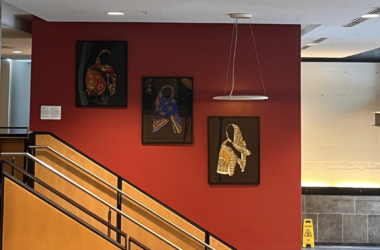
The McCord Museum’s newest Artist-in-Residence, Niap, is a Montreal-based multidisciplinary artist from Kuujjuaq, Nunavik. Her sculptures, textiles, and murals are currently displayed in some of Canada’s largest galleries. On March 25, her new exhibit, Piqutiapiit—meaning “precious belongings” in Inuktitut—premiered at the museum, a display of past and present Inuit beading practices that showcases the creative ingenuity of Inuit women. Niap’s collection is a beautiful tribute to the artist’s Inuit identity told through entrancing craftsmanship. The exhibit features photography, crafting tools, and Inuit clothing, including a new beaded tapestry that took Niap six months to complete. The tapestry was inspired by savviqutik—the beaded decorations on the front of Inuit women’s clothing. These decorations are constructed out of suede, cotton, leather, and Caribou hide, but are embellished with ivory, glass, brass, and turquoise beads, as well as freshwater pearls. Niap admitted that although the beads are widely available in Inuit communities, the Caribou hide was tough to source. Even though a savviqutik is typically stitched over the chest of a coat, Niap said she felt inspired to make it into a mural. 

“There are a lot of things that inspired my work,” Niap said in an interview with The McGill Tribune. Pointing to a tapestry on the wall, she explained, “This piece in particular, was inspired by the chest piece that you’ll see on Inuit traditional clothing. There’s the ulu that inspired the wood piece. There are a lot of things that inspire, but most, the intricate work on Inuit clothing.” An ulu is an Inuit hand-held knife, many of which are displayed in the exhibit.

Upon entering the exhibition, one encounters a series of black-and-white photographs of Inuit women dressed in beautifully intricate beaded parkas lining the walls. These forays into the history of Inuit women’s clothing provide a visual history that sheds light upon Niap’s own creations, such as her own hand-beaded chest piece hanging up on the back wall. During a tour of the exhibit, Niap explained that even to this day, the creation of the garments is an activity reserved for the women and girls of the community. Contrast, yet continuity, between grayscale photos and Niap’s vibrantly coloured creations create a timeline of Inuit women’s clothing that culminates in an explosion of colour, marking Niap’s creations as culturally celebrative pieces that speak to both the past and present of Inuit women’s artistry. 

Indeed, Niap recalled the important role beading played in connecting her to family and, particularly, her female relatives: The artist began beading at a young age, with her grandmother and cousins. The entire exhibit exudes a familial air. For instance, a mother’s coat known as an amauti, retrieved from the McCord Museum’s Indigenous Cultures Collection, sits adjacent to Niap’s own creations. Such coats are typically worn by mothers carrying babies, who ride in a snuggly pouch, or an amaut, below the mother’s hood. One can also find examples of such coats in photographs on the walls, worn by the women of Inuit history.

The exhibit also displays an impressive collection of small tools and crafting artifacts that Inuit women use in the beading and sewing of clothing, including items such as thimbles made of Caribou bone and needle cases made of animal hide. These items are also accompanied by a series of small knives, referred to as women’s knives, and a qulliq, a traditional seal oil lamp. Described by the artist as “precious little things,” such tools complete the narrative of Inuit creativity that Piqutiapiit weaves together: Photographs tell a visual history of Inuit garments, while tools represent each stage of such garments’ production—from the cutting of fabric to the stitching of beads. Along with Niap’s savviqutik, the multiple objects of Piqutiapiit come together into a tapestry-like story not just about Niap as a female Inuk designer, but of generations of Inuit women, using small tools, beads, and most importantly, creative innovation, to keep Inuks not just warm, but stylish. 

“I hope [visitors] take away the pure ingenuity and the pure talent that Inuit women had and continue to have today, and the patience and perseverance it takes to make something like the coats and the clothing and the kayak,” Niap said. “I really hope people realize how much time is spent with such little material, all these handmade items.” 

Piqutiapiit remains open until Aug. 21 at the McCord Museum.

Arts & Entertainment, Comedy

Cara Connors doesn’t want to see your ugly boyfriend on Tinder

On March 20, Diving Bell Social Club hosted LA-based comedian Cara Connors and opener Inés Anaya for one of the last stops on Connors’ North American Straight for Pay tour. The hour-long set hilariously captured elements of modern queer experiences—from exploring one’s identity to navigating dating apps to incessant requests for threesomes with straight couples. 

Connors grew up in Los Angeles and moved to Toronto for graduate school at the University of Toronto, where she discovered the city’s robust comedy scene. When they initially got into comedy, Connors identified as straight and was married to a man. Connors told me how her time living in Toronto played a role in the development of her comedic voice, which developed in tandem with her sexuality and gender identity. 

“I think it’s fair to say that Canada made me gay,” Connors said. “I think that is an objective, accurate statement.”

While Connors has plenty of experience in different areas of comedy––boasting numerous writing credits and performances on projects like E!’s Dating: No Filter and several CBC comedy series––stand-up remains their true love. Straight for Pay initially premiered at the New York Comedy Festival before the pandemic. When restrictions were first relaxed, Connors organized a monthly show in LA alongside other queer comedians and a few token allies. When the time was right, they decided they were ready to take it across the continent. 

“As an extreme girl boss and Taurus, I knew that I needed to go my own way,” Connors said. “So then I was like, okay, I feel ready. I have this hour, I feel like it’s sharp. I feel like people will come and see it. I’ll just put the work into making sure that people come and see it. And now I’m really proud of it.”

As a queer comedian, Connors is very intentional about the venues and audiences she pursues. When planning the tour’s stops, she tried to choose progressive cities with large queer populations, where she knew a queer comedy scene already existed in some capacity. Unlike the average smaller-scale stand up night, the majority of tickets are snapped up before the official sale. 

“It’s like they’re coming to see this show to see me––they’re not just like ‘Oh, I love going to the Guffaw Barn and seeing what ancient dinosaur they can pull out who has some horrific take on the Me Too movement in the same 10 minutes he’s had for the last 10 years,” Connors said. “People are like, let me come and see this weird gay cowboy.”

As a result, Connors’ crowds tend to represent the diversity of queer spaces, reflecting her content’s relatability. Connors enjoys seeing the different groups of people who come to her shows, from hip Gen Z-ers to 75-year-old lesbian therapists, to name a few.

“They’re like, I got my ex-girlfriend’s’ ex-girlfriend to watch my child that I had with a different ex-girlfriend. And we’re in a polyamorous family couples’ share, they’re gonna watch our gender fluid baby so that we can come and see this show. The fucking energy is so sick,” Connors said. “That’s what I want the world to be––I’m like great, can we make this the majority? It’s really a plot for the gay agenda.” 

As for what fans can look forward to in the future, Connors hopes to take Straight for Pay overseas, and eventually develop a new set for other demographics who need some gay comedy in their lives. 

“Maybe I’ll just do a tour on retiree cruises too––I don’t know, maybe I’ll take it on every Disney Cruise and I’ll start there,” Connors said. “I’ll only perform on cruises that exit out of Florida or Texas. Because there’s a lot of things happening there. Obviously, it’s a dystopian nightmare. So yeah, I think I have no choice.”

McGill, News, SSMU

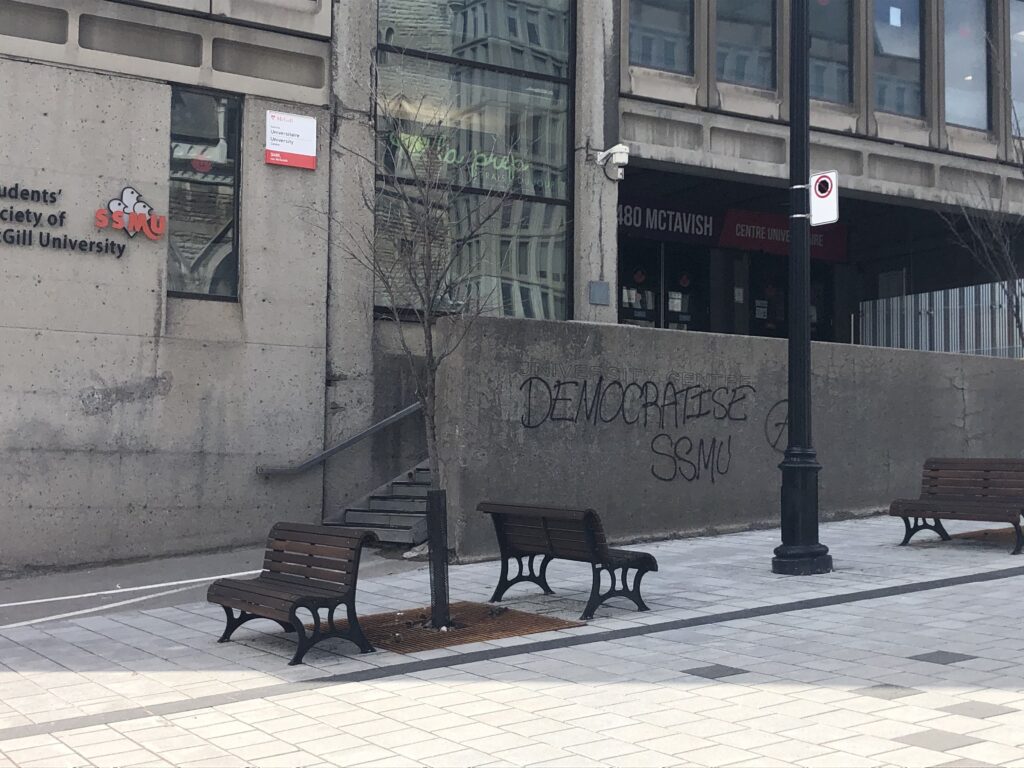
SSMU passes motion condemning McGill’s response to Palestine Solidarity Policy

On March 24, the Students’ Society of McGill University (SSMU) held its third Legislative Council session of the winter semester at 6 p.m. Discussion centred around an email the McGill administration sent just hours earlier through its MRO Communications system. The email, sent to all McGill students and staff, denounced the Palestine Solidarity Policy that students voted in with 71.1 per cent in favour during SSMU’s Winter 2022 referendum. 

Authored by Deputy Provost Fabrice Labeau, the administration’s MRO expressed dismay at the passing of the Palestine Solidarity Policy, calling it “an initiative that can only bring more division to [the McGill] community,” and asserting it was in violation of the SSMU’s constitution. McGill has called on the Society to take “appropriate remedial action,” threatening to end the Memorandum of Agreement (MoA) that governs its relationship with the SSMU if it fails to do so. 

At the onset of the meeting, Arts representative Yara Coussa proposed the possibility of introducing motions to publicly condemn the university’s message and stand in support of the referendum’s result. The Council’s Steering Committee approved the presentation of these motions for later in the meeting.

Multiple constituent questions were brought forth during the question period about how the Society would respond to the MRO and whether it would stand by the result of its referendum. In response to these queries, vice-president (VP) Finance Eric Sader noted that the issue at hand revolved around the constitutionality of the policy, and that the decision would be primarily left to SSMU’s Judicial Board (J-Board), not the Legislative Council. 

“The university should not have a say as to what SSMU does,” Sader said. “They do not have a legal right to do so and they do not have a legal right to determine what is or is not an acceptable stance in that sense. What does exist, however, is the SSMU constitution itself [….] We are not allowed to violate our own constitution. Does McGill have a right to tell us what opinions to hold? No.” 

One of the motions moved by councillor Coussa called on the SSMU to issue a statement standing against McGill’s message and denouncing its decision to publicly intimidate the Society and its democratic process. The motion passed with 11 votes in favour, and four opposed. 

Another motion moved by Coussa called for a joint statement with SSMU and the Solidarity for Palestinian Human Rights McGill (SPHR) to stand by the policy and condemn the administration’s disregard for the safety of Palestinian students. The motion was indefinitely tabled for the purposes of verifying the policy’s legalities with J-Board first, as many councillors raised concerns about potentially exposing SSMU to litigation from McGill.

Cited potential repercussions included the significant cost of a legal feud, as noted by VP Student Life Karla Heisele Cubilla, and the implications of terminating the MoA, which councillor Andres Perez Tiniacos believes would put many SSMU spaces in jeopardy, including the University Centre

“It is important to look at the risk of should termination of the MoA happen by the McGill Administration,” Tiniacos said. “A lot of the current services and a lot of the spaces that SSMU is able to provide to students right now are under the MoA. The University Centre is not one of them, but as we heard previously, the lease of this agreement […] is binding to the MoA as well. So, it could also mean the SSMU losing the University Centre.” 

Soundbite: 

“As a Jewish student, I am absolutely appalled to see the interference in this way and the blatant attempt to undermine student democracy and smear Palestinian human rights. I urge all of the members of SSMU to stand up for the student body here and stand up for Palestinian human rights and against this blatant interference.” 

—Member of the Gallery Geneviève Navin during the question period, condemning the administration’s MRO.

Moment of the Meeting: 

Member of the Gallery Saf Hakawati urged the Legislative Council to take note of the pressing nature of their response, emphasizing that the whole student body was waiting to see how SSMU would react and that the story was garnering attention from both national and international media outlets. 

McGill, News, SSMU

McGill threatens to terminate MoA with SSMU over the approval of Palestine Solidarity Policy

On March 21, the Palestine Solidarity Policy question on the Students’ Society of McGill University (SSMU) Winter 2022 Referendum passed with a 71.1 per cent majority. The following day, however, Deputy Provost Fabrice Labeau informed SSMU that the university found the policy to be in violation of SSMU’s constitution and provided SSMU with a notice of default in accordance with the Memorandum of Agreement (MoA) between SSMU and McGill. Labeau then publicly announced in an MRO email sent to all McGill students and staff on March 24 that the university threatened to terminate its agreement with SSMU if the alleged violation is not remedied. 

The approved Palestine Solidarity Policy mandates that SSMU institutionalize its support for Palestinian and pro-Palestine students by creating a Palestine Solidarity Committee. The policy was subject to much controversy during the Winter 2022 referendum and is now facing more as the university administration weighs in on its legitimacy.

On March 25, approximately 100 members of the McGill community gathered outside the James Administration Building in protest of the university’s disavowal of the Palestine Solidarity Policy. The demonstration featured speeches from several student groups on campus, including Independent Jewish Voices (IJV) and Solidarity for Palestinian Human Rights (SPHR) McGill, as well as SSMU president Darshan Daryanani, former SSMU president Bryan Buraga, and former McGill University Board of Governors (BoG) member Ehab Lotayef. 

Chanting “Free Palestine,” Daryanani began his address to the crowd. He decried McGill’s decision to interfere in the democratic processes of a student association, calling it an overstep on the part of the administration. 

“[As] the Students’ Society of McGill University, we require a certain degree of autonomy to effectively carry out [our] roles and we fear that the statement made by McGill University severely encroaches in this ability,” Daryanani said. “At this time, regardless of the communications sent by the McGill administration, the Palestine Solidarity Policy remains in force. Despite the pressure from the McGill administration, we will not stand down. We will do everything in our power to defend and implement this democratically approved policy.”

Lotayef applauded Daryanani and the students present at the protest for resisting the administration’s demands. In May, 2021, Lotayef stepped down as a member of the BoG after the board refused to table his motion for an equity statement. After the rally, he told  The McGill Tribune that he was “disgusted” by the administration’s continued refusal to acknowledge the crimes committed by the Israeli regime, despite their history of speaking out against other international human rights issues. 

“The student body should be totally independent and putting such a pressure is shameful,” Lotayef said. “When we are seeing the whole world encouraged to speak up in support of Ukraine, [to] deny Palestinians the right to pass a motion that is not attacking anyone, it’s disgusting [….] Those who will be offended by this motion are those who are saying we support apartheid. Apartheid that has been acknowledge by Amnesty and by Human Rights Watch.”

Dana,* a member of SPHR McGill who attended the rally, was outraged that Labeau stated that the Palestine Solidarity Policy would “bring more division” to the McGill community. Dana believes the administration intentionally taints conversations around Palestine with accusations of antisemitism to deter people from the issue. 

“There is a really really big line between antisemitism and anti-Zionism,” Dana said in an interview with the Tribune. “McGill constantly and repetitively blurs that line which is a danger to Jewish students on campus as well as pro-Palestinian students. The administration is scared that because of this policy, the donors and collaborations they have with Israeli or pro-Israel corporations will back out. That’s what we want. We want them to divest from these institutions that are complicit in settler-colonial apartheid.”  

Socialist Fightback Club president Lucas Marques also spoke at the protest. In an interview with the Tribune, he criticized McGill for “blackmailing SSMU” in an attempt to infringe on the democratic rights of the student body.  

“Ultimately, this is a threat to student democracy and our power comes from our ability to withhold ourselves from going to class,” Marques said.” I think SSMU should be unequivocal and call for a strike if that is what is needed.”


*Dana’s name has been changed to preserve their anonymity.

McGill, News

Floor fellows rally as bargaining for collective agreement with McGill continues

On March 24, the Association of McGill University Support Employees (AMUSE) held a rally outside of the James Administration building to bolster support for the floor fellow’s bargaining team. Floor fellows, upper-year students who work in McGill residences, have been on strike since March 18 over failure to reach a collective agreement with the university. The rally eventually relocated to outside University Hall, where the bargaining team met virtually with Susan Campbell, interim senior director for Student Housing and Hospitality Service (SHHS), and other administrators in an attempt to negotiate a new agreement. Among the floor fellows’ top priorities are higher wages, retroactive pay, and an updated meal plan. 

Both students and members of the Association of Graduate Students Employed at McGill (AGSEM) joined the rally in support of floor fellows and AMUSE in their bargaining efforts with McGill. 

“I’m here in solidarity,” said Lucas Marques, member of AGSEM and of McGill’s Socialist Fightback Club, in an interview with The McGill Tribune from inside University Hall. “It’s absolutely unacceptable what McGill has been offering the floor fellows. My dean [David Eidelman] makes almost $900,000 in compensation, Suzanne Fortier makes almost $860,000 in compensation.”

Because no agreement was reached between the bargaining team and the administration at the March 24 meeting, the strike will continue. According to James Newman, MA ‘20 and president of AMUSE, actions are planned for the near future to show that floor fellows are willing to stand their ground until they reach a fair deal with McGill. Overall, he believes the strike has been a powerful mobilizing force that has helped garner support for the floor fellows throughout the McGill community.

“This week has been spectacular,” Newman told the Tribune, referencing the open letter in support of the AMUSE negotiation team addressed to McGill. “We went from about 600 signatures before the strike started […] to over 1,500 [….] We’re mobilized, we’re motivated, but we are also distraught at the situation going on in residence.”

The “situation” Newman was referring to is the recent spike in COVID-19 cases within McGill residences, which he sees as further evidence of the need for better working conditions for floor fellows. According to Newman, COVID-19-positive students have been told to use shared bathrooms and dining halls, and McGill’s testing program for those in residence is being scaled-down to just the Carrefour Sherbrooke site. Newman believes that McGill’s decision to loosen COVID-19 restrictions in residences at this time is dangerous both for students and floor fellows.

“Things are really hunkering down right now as a result of the ongoing case-breaks that are plaguing McGill,” Christian Tonnesen, U4 science and vice-president floor fellow, elaborated. “I know that many floor fellows are concerned about the possibility of working in these conditions [….] As it currently stands, we as employees are being asked to live and work in conditions that place us at increased risk of contracting COVID-19, which seems to be a flagrant disrespect of Quebec labour safety codes.”

At the beginning of their strike on March 18, floor fellows left residences and stayed in hotel rooms until March 21—paid for by the Public Service Alliance of Canada, AMUSE’s parent union. Tonnesen explained that because St. Patrick’s weekend is a particularly busy time for floor fellows, they hoped their action would resonate with McGill. According to Tonnesen, the university did not communicate with students in residence about the fact that floor fellows would be away.

“Per strike rules, the only people that were allowed to work our roles were those above us in the chain of command, meaning that only Residence Life Managers (RLM) could take our spot,” Tonnesen said. “However, I saw no communications from McGill to students about the fact that floor fellows would be on strike, which seems concerning given how active of a weekend St. Patrick’s Day weekend usually is.” 

In an email to the Tribune, McGill media relation officer Frédérique Mazerolle provided an identical statement to a previous request for comment regarding the ongoing bargaining between AMUSE and the McGill administration. 


“Both parties have come to agreement on all non-monetary elements within the collective agreement,” Mazerolle wrote. “It is our hope we will reach a fruitful agreement as quickly as possible.”

McGill, Montreal, News, SSMU

‘Living with Law 21’ panel tells personal narratives of Bill 21’s multifarious impacts

On June 16, 2019, the Coalition Avenir Québec (CAQ) government implemented Bill 21, which banned public sector employees from wearing religious symbols at work. Since then, many McGill students and staff have critiqued the secularism the Act purports to uphold, drawing particular attention to its effect on racial and gender minorities. In their latest efforts to educate and mobilize others against the Act, the McGill Institute of Islamic Studies, the Students’ Society of McGill University (SSMU), McGill Coalition Against Bill 21, and the Muslim Students Association of McGill University (MSA McGill) hosted a joint panel on March 24 titled “Living with Law 21: Second-class citizenship in Quebec today.”

Weeam Ben Rejeb, 1L, one of the event organizers, explained to The McGill Tribune that the McGill Against Law 21 Coalition identified a critical need for public awareness while distributing “No to Law 21” buttons to the McGill community last fall.  

“The majority of people that we spoke with had no idea that this law was in effect or what are the impacts and implications of the law,” Ben Rejeb said. “We wanted to organize this event to give a chance for folks interested in learning more to come and learn from our panellists, and to raise awareness. We wanted to provide a forum for learning and discussion where people can learn and also hear about practical ways that they can help in the fights against the law.”

The panel reflected an array of expertise and experiences, bringing together academic Zeinab Diab, lawyer Faiz Lalani, previous public sector employee Fatemeh Anvari, and community leader Rabbi Lisa Grushcow.

First to speak, Anvari recounted the events of Dec. 2021, when she was removed from her position as a third grade homeroom teacher at Chelsea Elementary School for wearing a hijab. Although she spoke from personal experience, she implored the audience to think of her story in the context of broader society, and consider their own positionality within it. 

“If the experiences I shared of loneliness, pain, fear, sadness, and disappointment do not resonate with you in a similar sense or context, I invite you to look at whether this is due to a privilege,” Anvari said. “Now that this privilege exists for you, what do you choose to do with it? How do you choose to be, and how do you choose to exist, and co-exist?” 

Next to speak was Rabbi Lisa Grushcow, BA ‘96, a senior Rabbi at Temple Emanu-El-Beth Sholom. Rabbi Grushcow acknowledged the importance of sharing experiences such as Anvari’s, echoing her belief that resistance to the law is and should be shaped by stories. 

“It’s about us, as another religious minority, as people who often […] dress in a certain way as part of the practices of our faith,” Grushcow said. “It’s [also] very clearly a case of Islamophobia, of targeting Muslim women in particular.” 

The panel’s two legal experts—Zeinab Diab, a Ph.D. candidate at the University of Montreal, and Faiz Lalani, BA ‘10, BCL/LLB ‘14 and partner at Davies Ward Phillips & Vineberg LLP—spoke about the technical dimensions of Bill 21, describing practical steps one can take to resist the bill.

“If you can, donate to the cause, write to the politicians, and participate in local politics, because that will have a tremendous impact,” Lalani said. 

Rabbi Grushcow added that this panel was preaching to the choir. She urged attendees to open dialogue with people outside of the space in order to continue pushing for change.

“We need to be taking on this bigger societal project of getting in conversations with people with whom we disagree,” Grushcow said. “For us in this room who are advocates of diversity and pluralism, maybe it’s even more incumbent upon us to find ways to start those conversations.” 

Commentary, Opinion

The adoption of the Palestine Solidarity Policy is a historic victory

On March 21, the Palestine Solidarity Policy was overwhelmingly approved by the undergraduate students of McGill University in the Winter 2022 Referendum, garnering a 71 per cent “yes” vote. 

The policy mandates the Students’ Society of McGill University (SSMU) to campaign for McGill University to condemn Canary Mission and other surveillance against Palestinian students, as well as boycott and divest from corporations or institutions complicit in settler-colonial apartheid against Palestinians. Furthermore, the SSMU will form a Palestine Solidarity Committee, which will be tasked with implementing the policy, and whose decisions will be subject to ratification by the student body via future referenda. The committee will also issue at least one public statement each semester, including a statement on Nakba Day, reaffirming the SSMU’s solidarity with Palestinian students and Palestinian liberation.

Just before voting commenced on March 14, the SSMU Judicial Board staged a last-ditch attempt to remove the policy from the referendum. Following our swift denunciation of this brazen violation of the democratic process and public outcry, Elections SSMU restored the policy to the ballot and issued a semi-apologetic statement. At this time, the Judicial Board has still not publicly apologized for its disgraceful undermining of student democracy.

Unfortunately, bodies within the SSMU have frequently engaged in the silencing of Palestinian students. Last year, members of the Board of Directors repeatedly delayed the ratification of the Divest for Human Rights Policy, and later refused to ratify a Nakba Day statement, which had been approved by the SSMU Legislative Council. As for the Judicial Board, its decision to strike down a BDS motion as “unconstitutional” in 2016 struck a devastating blow to free speech and political organizing on campus for many years. The Judicial Board’s more recent attempt to derail the Palestine Solidarity Policy indicates that SSMU officials have not forsaken the temptation to abuse their power.

We fully expected that the administration, in collaboration with off-campus organizations, would do everything in its power to overturn the democratic voice of the students. It therefore came as no surprise when Deputy Provost Fabrice Labeau hurriedly sent out a mass email demanding that the SSMU overturn the Palestine Solidarity Policy and threatening to terminate the Memorandum of Agreement with SSMU. As justification, he claimed that the policy violates the SSMU Constitution, since it “echoes key tenets of the Boycott, Divestment, Sanctions (BDS) movement.” However, the Judicial Board issued three separate rulings in 2021, all of which affirm the constitutionality of political campaigns against corporate or state entities, including BDS-related campaigns. 

None of these undemocratic actions should surprise anyone, given that the McGill administration has always fought tooth and nail against efforts that challenge its complicity in settler-colonial apartheid against Palestinians, just as it continues to stubbornly reject divestment from the fossil fuel industry. Indeed, only after sustained student activism did McGill finally cut its ties with institutions and corporations profiting from the South African apartheid regime in the 1980s. 

In response to Labeau’s cowardly email, SPHR McGill organized a victory rally in front of the James Administration building on Friday, March 25. The presence of over two hundred students, staff, faculty, and community members represented a powerful rejection of the Deputy Provost’s attack on student democracy, as well as a celebration of this unprecedented victory. We now fully expect the SSMU to follow through on its promise to strongly resist the McGill administration’s shameful intimidation, and continue implementing the policy.

We cannot overstate the importance of this historic victory for Palestinian students at McGill University, and for the Palestine solidarity movement across Turtle Island. For two decades, Palestinian students at McGill have worked tirelessly to educate their peers about the complicity of this institution in settler-colonial apartheid. Time and time again, their activism has been met with censorship, blacklisting, and repression from an openly hostile McGill administration. 

During the referendum, our comrades at Divest McGill, the Black Student Network (BSN), CKUT Radio, and other anti-colonial and social justice communities reminded us of the strength of their solidarity by wholeheartedly embracing the Palestine Solidarity Policy. While we champion the cause of Palestinian liberation, we must never forget its place within the broader, global struggle against colonialism, racism, imperialism, militarism, and capitalism. 

On March 21, the students of McGill University showed that no blacklist, no threat from the McGill administration, and no smear campaign is strong enough to defeat the popular power of students, when these students choose to reject their University’s active participation in the settler-colonial oppression of the Palestinian people. 

McGill, News

Divest occupation packs up camp after positive COVID-19 case

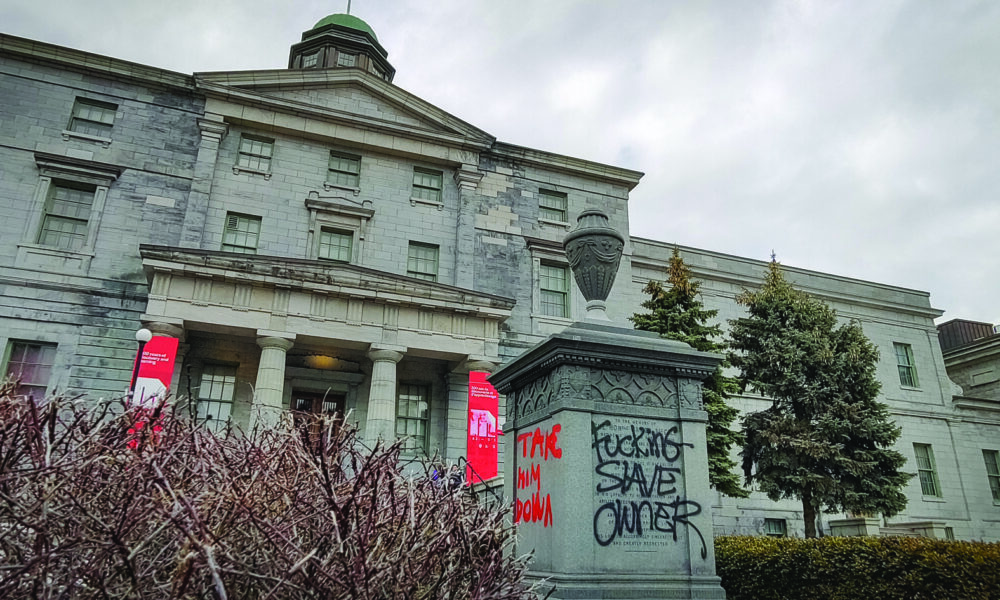
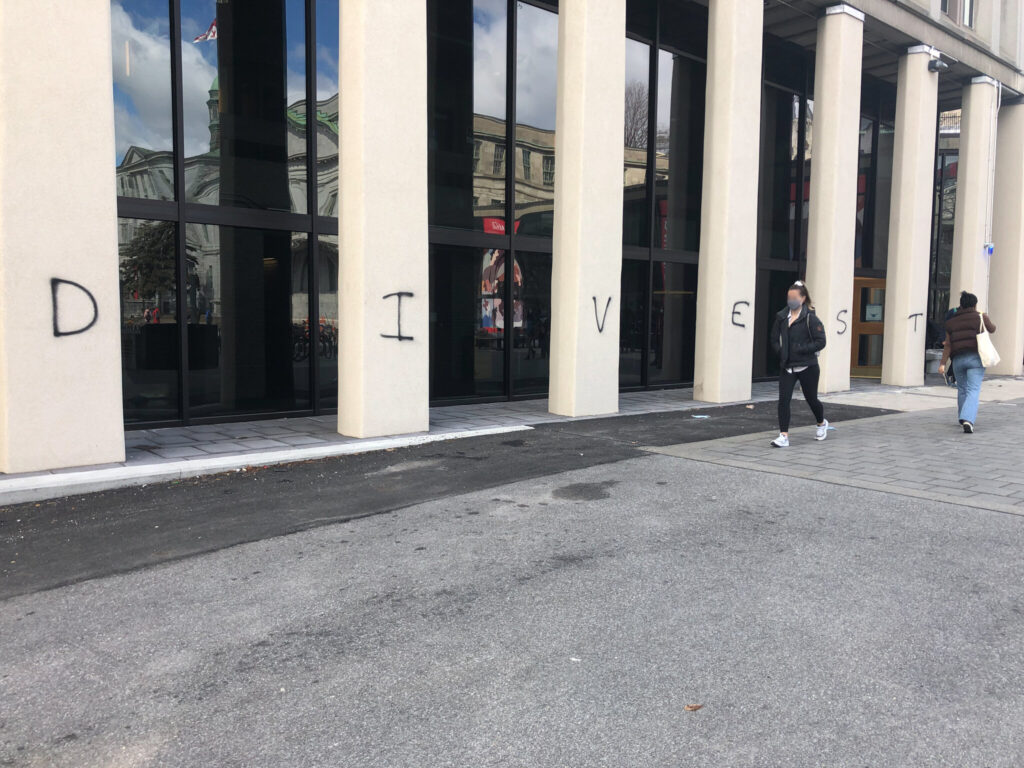
After spending 11 days inside, Divest McGill took their occupation of the McCall MacBain Arts building outdoors on March 17. The student group set up tents to block the Y-intersection, preventing vehicles from using the pathway to get to the Arts building. Divest purposely planned the move outside on a warm day so that the group could interact with the students who gathered on campus to enjoy the weather.

Members of Divest painted banners, set up a station to give free haircuts, and distributed pamphlets to passers-by, including to campus tour groups with prospective students. Francis Dinh, U1 Science, was one of the students who stopped to listen and learn on his way to class. He spoke with the Tribune at the Y-intersection after a few conversations with Divest McGill members handing out pamphlets.

“Divesting from fossil fuels is really important,” Dinh said. “All the big names have already divested, like Harvard. I think that most people don’t care enough about the situation [….] So it is important for people to know as much as possible.”

Alex,* an organizer with Divest, described the long-term goals of the occupation.

“One of the goals of our occupation is to push and fight for university divestment from the fossil fuel industry, specifically the top 200 fossil fuel industry companies and TC Energy, which is currently funding the CGL [Coastal Gas-Link] pipeline in Wet’suwet’en territory,” Alex said. “Additionally, one of our long-term goals is to fight for democratization, and build a foundation for a more democratic university from the ground up.”

Divest’s occupation, Alex elaborated, has been focussed on interacting with the McGill community and demonstrating what community conversations and consultation looks like in real time.

“An occupation is an effective way to start building that foundation for democratic university because we are able to talk to people at all hours of the day, and reach people that otherwise might not be able to attend our events or figure out what’s going on,” Alex said. “The act of […] now moving out of the Arts Building is simply an extension of that effort to build a grassroots democratization and divestment movement. We are going to be able to talk to people that otherwise might not have even known that this occupation has been going on.”

Divest chose not to contact the McGill administration prior to or during the occupation, and the administration had not reached out to the occupiers either. Though administrators did not interact with the activists, McGill media relations officer Frédérique Mazerolle shared a statement to the Tribune about the occupation.

“Over the last couple of years, CAMSR [the Committee to Advise on Matters of Social Responsibility] has sought and welcomed comments from the McGill community—namely representatives of student associations who shared their support for the resolution adopted by Senate, and representatives of Divest McGill who shared their view on the effectiveness of divestment in responding to the threat of climate change—as well as subject matter experts,” Mazerolle wrote. “The University recognizes and supports the rights of its students to peaceful protest on campus.”

The occupation came to an abrupt end on March 18 when a positive COVID-19 case among someone who occupied the autonomous zone—a term Divest used for the space being occupied—led Divest to leave the Arts building in the interest of public safety.

“On Friday, March 18, Divest made the challenging decision to pack up camp and cancel the events we had planned after someone who had slept and spent considerable time in the autonomous zone tested positive for COVID-19,” Divest said in a group statement to the Tribune. “However disappointing, the swiftness of our decision reflects the purpose of this occupation: We sought to enact the structures and relationships we wish for the university at large. Under our vision, public health and well-being are of the highest priority.”

*Alex’s name has been changed to preserve their anonymity. 

Read the latest issue

Read the latest issue