

Latest News

McGill, News, SSMU

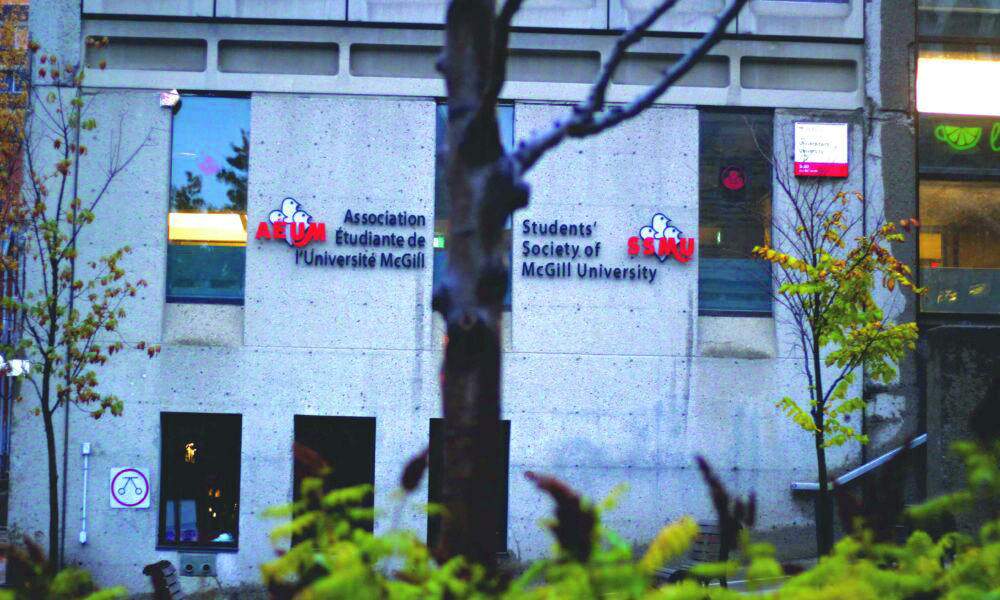
SSMU BoD meeting dominated by discussions about McGill Palestine Solidarity Policy MRO

The Students’ Society of McGill University (SSMU) Board of Directors (BoD) convened on March 31 with all directors present except vice-president (VP) Student Affairs Claire Downie. Downie had submitted her notice of resignation to the SSMU leadership and campus media outlets earlier in the day, explaining that her resignation was due to the SSMU’s harmful work environment

SSMU president Darshan Daryanani presented a working document with a timeline of events, beginning March 21 with the adoption of the Palestine Solidarity Policy and ending with the March 29 meeting between himself, VP finance Eric Sader, VP student life Karla Heisele Cubilla, and Deputy Provost Fabrice Labeau. Daryanani clarified in an email to The McGill Tribune that the discussion with Labeau featured the Palestine Solidarity Policy, the notice of default, the MoA, and the MRO. The SSMU is still in its 30-day grace period regarding the notice of default and in the process of reviewing the remedies requested by McGill before taking any formal steps. 

Daryanani also thanked the Legislative Council for passing a motion regarding McGill’s MRO at its March 24 meeting and announced that the executive committee approved $5,000 on March 28 to retain legal counsel regarding the official notice of default. The SSMU leadership further expressed their intent to uphold student democracy, evidenced by two statements to the McGill community following the March 24 MRO email.

In the question period following Daryanani’s executive committee report and announcement, Director Yara Coussa asked Daryanani if there was a precedent for McGill using MRO communications to publicly pressure SSMU.

“Yes, the MRO has been used as a tool to inform SSMU,” Daryanani said. “[On November 28] 2019, [Labeau] came to Legislative Council and spoke publicly regarding a particular motion, [the Motion Regarding Free Trip Offers to Student Leaders], and once the motion was adopted by the Legislative Council, the deputy provost also sent an email to the student body.”

All of the Legislative Council motions on the agenda were promptly ratified with unanimous approval. The remainder of the Board’s public session was dominated by discussions about Coussa’s motion to publish the Legislative Council-mandated statement by April 5. In a lengthy debate period, directors and members of the gallery alike expressed concerns over the back-and-forth between the university and SSMU escalating into a costly legal feud. The motion was ultimately ratified after the addition of three amendments regarding a legal review of the statement before its publication. 

“As a director, I feel strongly about legal consultation on [SSMU’s statement in response to the MRO],” said Charlotte Gurung, a Council representative to the Board. “I do think the statement is great, but I think that we’re in a precarious situation with McGill, and just because they have made a public statement, and that is potentially a misstep for them, I don’t think we need to be justifying us making a public statement without legal consultation because that could just as well be a misstep for us.”

Moment of the meeting: During the question period, council representative Mary Zhang asked the Board if Downie’s resignation could have been prevented, and how they plan to mitigate the vacancy. Delouvrier responded that he was saddened to hear of Downie’s resignation, and that he would answer objectively by directly quoting Downie’s letter, in which she said the resignation was preventable. 

Soundbite: “I would encourage all directors to vote in favour of this statement pending the approval of legal, because I think that as directors we have a duty to SSMU and SSMU’s mission, and our long-term stability as a Society depends on our ability to carry out our mission. That’s not something we’ll be able to do if we are dependent on the university. It’s our duty as directors to approve this motion in order to send out a message that we are independent from the university, and we have agency, and that we take a stance against this form of pressure.”

—Director Coussa during the debate period on the ratification of the motion regarding the Legislative Council-mandated statement against the MRO.


Science & Technology

Tannic acid might help develop a drug to treat COVID-19

Although most of us would like to forget about the pandemic as Canada eases its restrictions yet again, the threat of COVID-19 overwhelming the health-care system is still present as the country enters a sixth wave. A team of researchers from McGill, Institut national de la recherche scientifique (INRS), Université de Montréal, and Université du Québec à Montréal is still looking for suitable drug candidates to treat severe cases of COVID-19.

In a recent paper published in the International Journal of Molecular Sciences, the team shared their discovery that tannic acid (TA), a naturally occurring polyphenol compound, shows promising results in inhibiting the activity of the SARS-CoV2 virus. The researchers took a multidisciplinary approach to this collaborative project, with each contributor working on different experimental techniques, from molecular modelling simulations to enzyme assays in the lab. 

Currently, the best weapon against the virus is the vaccine, which is a preventative measure. With mutative SARS-CoV2 variants like Omicron emerging with increased infectivity, there is a pressing need to find effective and accessible drug candidates.

Roger Gaudreault, one of the authors on this paper and a researcher at the Université de Montréal, explained why TA is an ideal drug candidate.

“As TA is a natural product obtained from plants, some of which are recognized for their use in food,” Gaudreault said in an interview with The McGill Tribune. “It appears that it will be a drug candidate of great relevance.”

According to Hannah Wiebe, a graduate student in McGill’s Department of Chemistry and one of the authors on the study, developing therapeutic drugs from natural products is actually not uncommon. Nearly 50 per cent of drugs developed in the last four decades are naturally derived.

The spike protein present on the outer membrane of the SARS-CoV2 virus facilitates its entry into human cells. It binds to the surface receptors, called ACE2, which are present on several tissue cells in humans. Both the spike protein and its ACE2 receptor serve as important targets for therapeutic drugs to prevent the entry of the virus into cells, stopping it from propagating throughout the body. Researchers found that, along with TA, two other natural polyphenol compounds called TGG and corilagin showed significant reduction in the binding between the spike protein and ACE2 receptors. Strikingly, TA reduced the binding by 95 per cent, the most effective of them all.

TA was also able to inhibit the enzymatic activity of other proteins involved in establishing an infection, which makes TA a very promising option as a multi-target drug.

Wiebe cautioned that their work is a very preliminary finding, limited to in vitro studies—meaning within an artificial environment—on isolated chemicals and proteins. It can often be hard to predict whether the same effects will be seen in real viruses and cells, or even COVID-19 patients, if the drug makes it to clinical trials.

The current antiviral drugs approved by the U.S. Food and Drug Administration include Remdesivir, Paxlovid and Molnupiravir, which have substantial side effects or very low rates of effectiveness. They are also extremely expensive and thus inaccessible to much of the world population.

Gaudreault emphasized that as with most polyphenols, TA’s efficacy is contingent on its bioavailability, which in turn depends on multiple factors such as the properties of the molecule itself, intestinal microbiota, pH values, and consumption alongside other compounds. He also said that while developing therapeutics, it is also important to consider the inter-variability between individual COVID-19 cases.

The discovery that TA might be able to inhibit the entry and multiplication of SARS-CoV2 in human cells paves the way for development of an efficient and accessible therapeutic drug. The main challenge now is to take this discovery from the lab to preclinical trials, and ultimately, to treat COVID-19 patients. 

Arts & Entertainment, Film and TV

‘Atlanta’ season three is chaotic in the best way

Warning: Spoilers ahead

The third season of Atlanta may very well be its best. Picking up from its season two finale nearly four years ago, Atlanta leaves behind its titular setting for Europe, just as it does with its old rules for fresh fury. Donald Glover, the show’s creator, showrunner, and lead actor, abandons any form of predictable clichés for frenzied, yet thematically consistent vignette-style storytelling. The David Lynch-like traces of horror-slash-surrealism that Atlanta once teased take centre stage, elevating its comedy in ways I didn’t think possible. But at its core, Atlanta remains the same, following the down-on-his-luck Earn (Donald Glover) trying to make something of himself as a music manager for his talented cousin and rising hip-hop star Alfred (Bryan Tyree Henry). Immensely intelligent and perpetually stupid, Earn can never seem to live up to his potential. 

Unlike many of its contemporaries, Atlanta doesn’t try to fart soliloquies; rather, it leaves itself bare and doesn’t take itself too seriously. For example, the season’s pilot opens on a quiet night, where two friends are fishing on an eerie lake. The white friend explains to his Black friend the cursed lake’s history, and how there used to be a town—inhabited solely by Black residents—that was flooded by the government, drowning many. Apparently the town was once so prosperous they were “almost white,” since whiteness was really something to be bought, nothing more than a mirage. With each word growing more ominous, the white man suddenly turns to reveal a pair of empty eye sockets and shrieks as ghosts pull the Black friend into the lake. This type of commentary—laced in mythos and quite funny—is what makes this season so spectacular. 

The season’s pilot is a bottle episode based on the Hart family murders, an enraging case of foster parenting gone wrong. The moments stolen from real life are more terrifying than any of the episode’s supernatural contortions. Episodes two and three return to the previous season’s storyline as Alfred’s European rap tour proves to be a huge success. The familiar cast navigate their way through unfamiliar European countries, which on the surface appear more friendly than the America they’re used to—the key word being ‘appear.’ From commercialized blackface to the wealthy’s fetishization of white saviourism, the ironies, hypocrisies, and absurdities of racism remain, just worn under a different mask.

Glover achieves creative freedoms rarely seen in Hollywood. Atlanta isn’t afraid to offend, tackling Sinterklaas and depression in the same episode that portrays an elderly Tupac Shakur’s assisted suicide—and still managing to make it hilarious. 

There are moments Atlanta sends me into a near-fatal laughing fit, but as I catch my breath I can’t help but question whether it’s intended to be funny. Atlanta blurs the line between comedy and political commentary, but whether this is to make itself more palatable for wider audiences or make the real problems more bearable is unclear. Perhaps Donald Glover isn’t certain himself. Or, perhaps attempting to pry into the show’s intentions is a pointless exercise in conjecture, rather than taking it for what it is. A famous T.S. Elliot quote comes to mind: “I meant what I said. If I could have said it any differently, I would have.” 

Without exposing too much, there is one scene in the first episode I believe best encapsulates both the humour and the poignancy of Atlanta season three: Loquacious, a young Black boy paraded by his insane white foster parents, holds a “Free Hugs” sign at a farmer’s market, before a white man approaches and asks, “Aw. Is Hugs your father?”

Atlanta season three streams on Apple TV+, with new episodes releasing every Thursday.

Student Life

Graduating students look back at their time at McGill–and forward, too

As the Winter semester comes to a close, the class of 2022 is getting ready to graduate. Some will take a gap year to travel or to work, whilst others may be heading to graduate school. The options are endless—but what’s certain is that graduation marks both the end of an era and the start of a new chapter. 

While Alena Russell, U3 Arts, is excited to be graduating and going into the “real world,” she is also anxious. Before heading to graduate school to study art history, Russell will be taking a break from academia. To kick off her gap year, she’s travelling to Greece in May. 

“I am nervous about big changes and goodbyes, but I am really looking forward to my gap year,” Russell said. “I’m hoping to work a little and get some experience, but I am also excited to be able to travel, as I have not travelled much outside of the U.S. I am looking to prioritize life experiences and personal growth this coming year, and take a breather from academia.”

Looking back at her time at McGill, Russell explained that the university has been the backdrop for many of her most valuable moments and relationships. 

“McGill has given me amazing friends and meaningful experiences that have helped me grow into an adult,” Russell said. “I would love to go back and experience that chaotic joy again. Living in dorms, exploring a new city, and figuring out what I wanted to study was so formative and meaningful to me looking back on it now.” 

Students in the Arts program often face internal doubt and external pressure about their futures and the practicality of their degrees—if not graduate school, then what? Despite not knowing exactly what her post-McGill life will look like, Victoria Fortunato, U3 Arts, reflected on how her undergraduate degree helped her develop more than book smarts.

“I feel fairly prepared to enter the real world,” Fortunato said. “It’s something I was always planning for and thinking about throughout university [….] Many McGill classes have helped me understand more about myself and the world, and I find that really necessary for me to feel comfortable with the fact that I’m leaving.”

For some, the transition to life after McGill will be fairly straightforward. Others, however, like Natika Bikraj, U3 Science, have noticed a scarcity in resources for finding a career post-graduation.

“I don’t think McGill prepares us for life after graduation, especially in science. In terms of trying to expose students to different job opportunities, it’s very academia-focussed,” Bikraj explained.

Despite her misgivings, Bikraj says she will always remember the community she found at McGill and the moments she shared with friends.

“My favourite memories at McGill have all been the times I was hanging out with my friends, making cocktails and having board game nights,” Bikraj said.

Ruxi Chirila, U3 Arts, would have been among the graduating cohort this year as well if not for the pandemic. However, like many other students who have spent most of their time at McGill online, Chirila is taking an extra semester. Though she’ll be missing out on the formal hurrahs of the end-of-year spring season, like grad balls and summer grad trips, the extra time brings its own perks. 

“Because my first year went online at the start of the pandemic, being able to take an extra semester has overall helped me feel like my undergraduate degree isn’t being cut too short,” Chirila said. “It’s also provided me the space to take four-course semesters, giving me more time to take on a larger role in my extracurriculars and experience a healthier school-life balance.”

Like Bikraj, Fortunato’s experiences meeting new people at McGill has had a huge impact on her. Her most memorable experience at McGill has been meeting people from around the world who have different perspectives. 

“Coming to McGill has shaped me to be the person I am today. I’ve met so many amazing people thanks to McGill, both students, and professors alike.” Fortunato said. “I’ve had numerous moments in class where I’ve thought, ‘I’m so glad I’m here.’ I’ve been lucky to experience classes and meet people that have changed my life.” 

Ask Ainsley, Student Life

Ask Ainsley: How should I handle rejection?

Dear Ainsley, 

It’s been a rough couple of weeks for me. I’ve sent out over 20 summer job applications, got two interviews, and no offers. I’m entering my final year next year and am worried that I’ll be unprepared to enter the workforce without professional experience. Plus, though I know I shouldn’t compare myself with others, seeing my friends all getting offers and being set for the summer months makes me feel awful about myself. How do I stop feeling this way? 

From, 

SAD (Searching Aimlessly Daily)


Dear SAD, 

I feel you! Rejection, though a universal experience, is never easy. Despite the urge you may have to hop on Indeed.com and immediately start the job search again, we suggest you take an adequate amount of time to feel. Take a few hours, or however much time you need, to spend alone with yourself. It’s important to acknowledge, rather than suppress, any painful emotions so they don’t fester and hinder you from putting yourself out there in the future. At the same time, avoid overanalyzing your every decision throughout the failed hiring process—you won’t arrive at any concrete answers and this kind of circular thinking will only compound negative emotions. 

After the grieving process, remind yourself that these instances of rejection do not define your worth or skill level in any way. The recruiters on the other side of the job board are not omniscient. They’re fallible, messy humans just like you. A one-page cover letter, C.V., and 15-minute interview can’t accurately encapsulate all of your assets and skills, and is an inherently unnatural way of meeting people. Mastering this process, like any other exam or course, is a matter of practice. As students just entering into the workforce, rejections don’t reflect on your inherent abilities, but rather on your familiarity and experience navigating the specific forms of self-presentation that job searches typically require. 

It’s cheesy, but my word of encouragement to you is—don’t give up. Forget obsessing over your past applications, and instead reflect on the areas you can improve on. You may be avoiding your friends who have received acceptances out of anxiety or jealousy—and of course, we know that you’re happy for them, but a tinge of envy is only natural. However, rather than indulging in those negative emotions and cutting off a source of support during a difficult time, take advantage of their wisdom: Ask if they’re willing to read over your future cover letters and host mock interviews with you. Do they have any unique tactics? Especially if these folks are in the same field as you, it’s likely that the jobs they’ve applied for have similar expectations to your own prospects. By seeking to learn from your friends’ successes, it will be easier to see their achievements as logical results rather than a personal affront to your competence. 

Putting yourself out there is an accomplishment in itself—with each interview, you’ll become more prepared for the next one, and each cover letter you compose is a great writing experience. It’s also important to remember that rejection is normal, even necessary. Regardless of you who are, everyone has had the experience of sending out dozens of resumes without receiving a response. Many famous writers, for instance, have been rejected at one point or another—try, like them, to shift your mindset entirely. If you frame your goal around receiving 100 rejections instead of acceptances, your success will be inevitable! It’s a matter of putting yourself out there, even when the going gets tough.

I hope you find this advice helpful as you navigate your job search. Remember, all you need is one yes. 

Sincerely,

Ainsley

Student Life, Word on the Y

Word on the Y: Experiences with burnout

With finals season upon us, McGill students and faculty alike are entering a period of intense academic stress and anxiety. The turmoils of the past months, from online classes to several spikes in COVID-19 cases, have offered no relief. These high-pressure situations are the perfect recipe for burnout and ––the exhaustion that comes from prolonged stress. While these moments can leave you feeling alone, it is important to remember that many other McGill students face similar mental and physical fatigue. Here are some of their experiences with learning to combat burnout. 


“I did not know what burnout was until a few months ago as I was starting my first year as a university student. Back when I burned out in middle and high school, I thought I was simply disinterested or lazy, which just caused the negative cycle of thoughts to continue to persist. I recently booked an appointment with my local wellness advisor and got connected to a counsellor at the Wellness Hub, and though I can’t speak for everyone’s experience, it’s personally been one of the best choices I’ve made this year. They’ve helped me to pay attention to things I didn’t even know were going on in my body, have a way better sense of what is healthy for me, and learn that it’s okay to lighten my load. Even though many unexpected stresses and barriers have hit me this year, I’m happy I have this new knowledge and set of skills to tackle future ones and I feel more hopeful for the future than I have in years.”

—C.S., U0 Science

“Continuous uncertainty surrounding whether I get to have in-person classes has led to burnout for me in my first two years at McGill. What gets me through rough patches is having established habits and routines with regards to my schoolwork that establish a sort of bare minimum, so I at least never fall too far behind. I guess it’s not really a solution for burnout, but it minimizes the damage.”

—Jacob Van Oorschot, U1 Science 

“Burnout has hit me really hard with the McGill workload. Things tend to snowball one way or another. I have found it helpful to turn the snowball around toward productivity by forcing myself to get moving so that I am likely to continue that momentum.” 

—Ophelia Kaya, U2 Arts 

“I struggled with burnout for a few years in high school and into my first year of university. I felt so much pressure to perform well and get good marks. I had taken on too many responsibilities and my expectations for myself were too high. I began to detach and make excuses for why I couldn’t do things. I eventually reached out to a therapist who helped me realize I needed to change my expectations and just do enough, that I couldn’t do everything. I took a step back and focussed more on what I could enjoy in each thing I was doing, rather than what I was achieving in every aspect of my life.”

—C.W., U0 Arts 

“It was like I could not focus on anything. I could not delay gratification and I had a hard time getting easy things done, like cooking and doing laundry. I’m not out of it yet, but I had to take a step back from school and other activities to start my recovery.”

—L.R., U2 Science

Creative, Video

McGill Psycho

260946387 is handsome, well-educated, and intelligent. He is twenty-seven and living his own McGillian dream. He studies by day, achieving a grade point average of 4.0.

Staff Producer Kate Gelinas documents a day in the life of a 4.0 GPA student at McGill University in this parody of Patrick Bateman’s morning routine from “American Psycho”.

Laughing Matters, Opinion

On becoming the It-Girl

With the spring weather suddenly upon us, it is time to look wistfully forward to summer…or more specifically, the summer aesthetic. It doesn’t matter that it is barely spring, or that the spring solstice was only last Sunday—it will never be too early to start working on your bikini body! 

Luckily for you, That Influencer just uploaded their 10-minute summer body workout. Now you can sneakily do crunches beside your bed as the mind-numbing, non-copyrighted music trickles out of your Airpods—MOM GET OUT OF MY ROOM! You’ll have to leap to your feet and run to the door in a shameful attempt to conceal your flimsy athletic aspirations, wondering why parents must always have the worst timing. Returning to the floor, you’ll dutifully recommence your Russian twists and reassure yourself that you’ll see results soon. Maybe you have model genetics too, they’re just recessive. 

Of course, all bodies are bikini bodies…and besides, you’re working out for your mental health, right? But on top of that, this year’s trending pieces actually only look good on a small fraction of the population. That won’t stop you from buying them though, since stores are now more inclusive than ever! Maybe you’ll try asking an employee for fashion advice. She’s ignoring you? Weird. Whatever, Aritzia is overpriced anyways. 

Though you’ve heard mixed reviews, you’ll place an order from SHEIN instead; 10 shirts for less than $100? Steal! But when you check the tracking email, you’ll be horrified. Estimated Delivery: One month! What ever happened to fast fashion? You probably should’ve paid the extra four dollars for express shipping. So because you have no clothes to wear, you’ll head down to Eva B. for some much-needed retail therapy. But don’t worry, you’re shopping sustainably. 

The feminine urge to categorize yourself for others’ consumption is overwhelming, so you’ll definitely open Pinterest, pinning inspiration for the aesthetic that’s All Yours. Remember, the It-Girl is not just an aesthetic, it’s a lifestyle. You must dress like you’re vacationing in Italy, —but make itstill weather appropriate—: Iit is only 10 degrees out. Listen to small indie artists (like Tame Impala or Mac DeMarco) that you discovered before they got popular—but also know all the popular radio ones. Workout—but not too much. Drink green juices and eat your vegetables but also be able to enjoy a burger and fries and party—in a classy way that costs more money than you currently have. 

The stress of preemptively defining your summer vibe swells, and you might decide you need a coffee, your third one of the day, but it’s okay because you’re in your Lorelai Gilmore era. As you walk to Starbucks, you’ll pass a guy who checks you out. You’ll roll your eyes and meet the lens of an imaginary camera: You’re in your Fleabag era.

As you wait for your iced white mocha latte with oat milk to be ready, the BeReal notification will ping. You’ll snap a selfie and upload it. Gotta update your friends on what you’re doing at this exact moment in time. Scrolling through: McLenny, cafe, still in bed, oh—she’s in a lecture right now. You smile at your phone. It’s fun to be so present in your friends’ lives…almost like hanging out with them. 

A text will pop up on your phone, it’s your friend. She says you guys are going out tonight. You’ll ask her the dress code and she’ll respond: Medium whore. You’ll mentally sift through your box of nearly identical tiny black tops and decide on one. Or maybe you’ll wear that one. 

And then you’ll be at the club, dancing and trying to pretend you don’t notice the guy who has been staring at your tits for the last 10 minutes. You’ll raise your phone above the crowd to snap a picture to post on your Instagram story—for how else are people going to know that you’re having more fun than they are?

Laughing Matters, Opinion

The McGill Tribune’s declassified McGill tour guide

Tis’ the season for university campus tours, when dozens of wide-eyed McGill hopefuls explore our beautiful campus, filled with promise for a future at this wondrous institution. Though optimism is great, realism is better. Here’s what your average preppy tour guide and his polyester fanny pack won’t tell you. You’re lucky you’ve got me, I’m not like other tour guides.

To your right entering from Roddick gates is Burnside Hall, the single greatest building at McGill. Burnside can’t decide if it’s a prison compound or an underfunded high school, so you’re sure to get the best of both worlds. And don’t worry too much about the sudden thump noises in the elevators––once you’ve attended your Calc tutorial in the basement, you’ll realize falling down the shaft isn’t much worse. 

On your scenic walk up towards the Arts Building, avoid eye contact with the squirrels and mentally prepare yourself to abandon the glossy image the brochures sold you. Here it is! Note the marble floors, high ceilings, and students camped out in tents occupying the lobby––ah, the charms of a colonial landmark. 

Continue to your left toward the McLennan-Redpath library complex, a dynamic study spot for all your diverse student needs. If you’re looking to watch YouTube at full volume with your friends, morph your spinal cord while trying to plug in your computer, or get absolutely nothing done, Cybertheque is the place to be. If you enjoy loud silence—the kind that pressures you into holding in a cough to the point of a self-induced aneurysm—McLennan’s upper floors will never disappoint. And of course, if you’re fascinated by the “duality” of entirely unspecific things, Emma will be attending her Zoom conference straight dab in the middle of the McLennan stairwell every Wednesday, without fail. Watch your step!

Continue right and you’ll find McTavish, where the Desautels Chad who mansplained the stock exchange to you last Friday is probably taking his Linkedin headshot. Off McTavish you’ll spot the Islamic Studies building, where white people love to congregate for the dark academia aesthetic despite not knowing Persians from Arabs, or the Palestinian from the Sudanese flag. This building is also where McGill takes most of its promotional human rights shots, in the Octagon Room. 

For the classic lecture hall experience, you’ll find Leacock and Adams auditoriums on opposite ends of campus. Nay-sayers will urge you to watch the recording and spare yourself from cramming into a room of hundreds of overheated and likely hungover students. Perhaps you could’ve done without the leg cramps and half-hour of incessant questions from the first-years at the front. But isn’t that what university is all about?

High up Rue University, you will see beloved Trottier to your left. Don’t be fooled by its relatively modern design and good maintenance, for Trottier will find creative ways to elevate your blood pressure. For one, if you manage to squirm into the desk-attached chairs without breaking both your legs, prepare to cease all breathing and movement for the next hour unless you want to curse your class with screeching metal hinges. The last thing you need is a dirty look from the Electrical and Computer Engineering major next to you running 854 programs on his soon-to-explode MacBook Air. 

Finally, a moment of silent admiration for all those that made it to Stewart Bio or McMed for their 8:30 a.m. in the winter. It doesn’t matter that you got a 34 per cent on that midterm, crossing the Peel and Doctor Penfield intersection without sliding to your doom is a true accomplishment worthy of the utmost respect.  

Hopefully, this campus tour has cured any doubts you may have had about McGill from recent news stories denting our ironclad reputation. It really is an excellent option, and McGill is beyond excited to welcome your tuition, and you, of course! Best of luck with your applications.

Read the latest issue

Read the latest issue