


Latest News

Science & Technology, Student Research

Uncovering past climates through paleobotany

Paleontology has long offered scientists insight into the mysteries of prehistory. Through excavations of colossal skeletons, petrified insects, and fossilized plants, researchers can uncover what life looked like long ago. 

Despite the extensive study of animals from the Cretaceous period, which stretched from 145.5 million years ago to the dinosaur extinction 65.5 million years ago, little is known about the climate of this time, especially in regions of eastern Canada. Researchers at the McGill Redpath Museum have taken a different approach to filling in these gaps in knowledge, using paleobotany, the study of fossilized plants. 

“The fossil record is rich in assemblages of fern, angiosperm, and conifer leaves that offer clues about the plant diversity of past ecosystems,” Alexandre Demers-Potvin, a graduate student and 2018 National Geographic Explorer, wrote in an email to The McGill Tribune. “Not only do fossil plants offer a glimpse of the vegetation of past landscapes, but some of them […] can be used to predict the climate of that past landscape.” 

This past summer, Demers-Potvin, the lead author of a recent study on paleoclimate reconstruction, and a team of researchers under the supervision of Professor Hans Larsson, director of the Redpath Museum, headed to Schefferville, a town near the Quebec-Labrador border. Among the researchers were Noemie Sheppard, an undergraduate student in Environment, and Michel Chartier and Mario Cournoyer, co-founders of Montreal’s Musée de paléontologie et de l’evolution (MPE), which also supported the study. They centred their analysis on insect fossils and angiosperm, or flowering plant, specimens from the region, known as the Redmond flora.

Among the ruins of an abandoned mine, the team found remnants of angiosperms preserved in sedimentary rock, which served as their first clue to what environmental conditions were like in the Late Cretaceous. The composition of the rocks and the fossils’ broad leaves suggest that they formed at the bottom of a lake surrounded by a forest.

Demers-Potvin and Larsson discovered that Schefferville experienced an average yearly temperature of 13 to 17 degrees Celsius during the Late Cretaceous. Although this would have been on the cooler side for North America at the time, the creatures there would have enjoyed moderate humidity and hot summers. 

Remarkably, this data was extracted from plant leaves. Since flowering plants of the Cretaceous are anatomically similar to ones today, the researchers can extrapolate climate information from the fossilized plants in the same way that they can deduce this information from modern-day plants. Demers-Potvin and his team derived elements of the bygone environment using a tool called Climate Leaf Analysis Multivariate Program (CLAMP) .

“[CLAMP] rests on the premise that some anatomical traits in leaves are correlated to some climate parameters [such as] temperature [or] precipitation,” Demers-Potvin wrote. 

As a system of data analysis, CLAMP uses a scoring method to track the ways in which modern plants adapt to their environment. Referencing fossil records, it then works backward to associate the same traits in older plants to their potential environmental context. The results can be used to understand the effects that drastic climate change had on species thousands of years ago, and how this translates to potential effects on species in today’s climate crisis.

In addition to sampling with CLAMP, the research team unearthed 15 new plant species that were previously unknown to the region. Surprisingly, the taxonomic record of the Redmond flora had not been measured in any meaningful capacity since the 1960s. 

Beyond the Creataceous explorations led by Demers-Potvin, who aims to continue the team’s research with insect fossils found in Schefferville, Larsson is overseeing multiple evolutionary field projects, ranging from studies of alligators off the coast of Mexico to Dinosaur Provincial Park in Alberta. Larsson thanked the Redpath Museum for allowing researchers to explore diverse interests. 

“None of this would be possible without the Redpath Museum,” Professor Larsson said. “You’re not siloed in here.”
Art, Arts & Entertainment

New gallery ‘No.01’ offers insights through experimental creations

The Visual Arts Visuels’ (VAV) exhibition space at Concordia University may appear modest in its size and spare curation, but the industrial, L-shaped room presents artwork with the same sense of ambition as those found in venues like the MAC and MMFA. It affirms that artistry isn’t found solely in institutions that project an aura of exclusivity. As one of Montreal’s few student-run galleries, the VAV is a valuable outlet for burgeoning voices with new ideas. The VAV features a rolling catalogue of work made mostly by Concordia’s art undergraduates, and on Oct. 17, the venue held a vernissage for its newest gallery, No.01. The venue hosted a large audience, with the accompaniment of DJ Jacqui Beaumont and appearances by some of the featured artists. 

Aptly titled, No. 01 marks the beginning of VAV’s Fall programming. Because the show doesn’t suggest a specific theme, it appeals to the variety of works on display. With an emphasis on experimentation, the gallery features artists who question rigid notions of prescribed mediums and materials while communicating ideas surrounding both public and personal spheres.

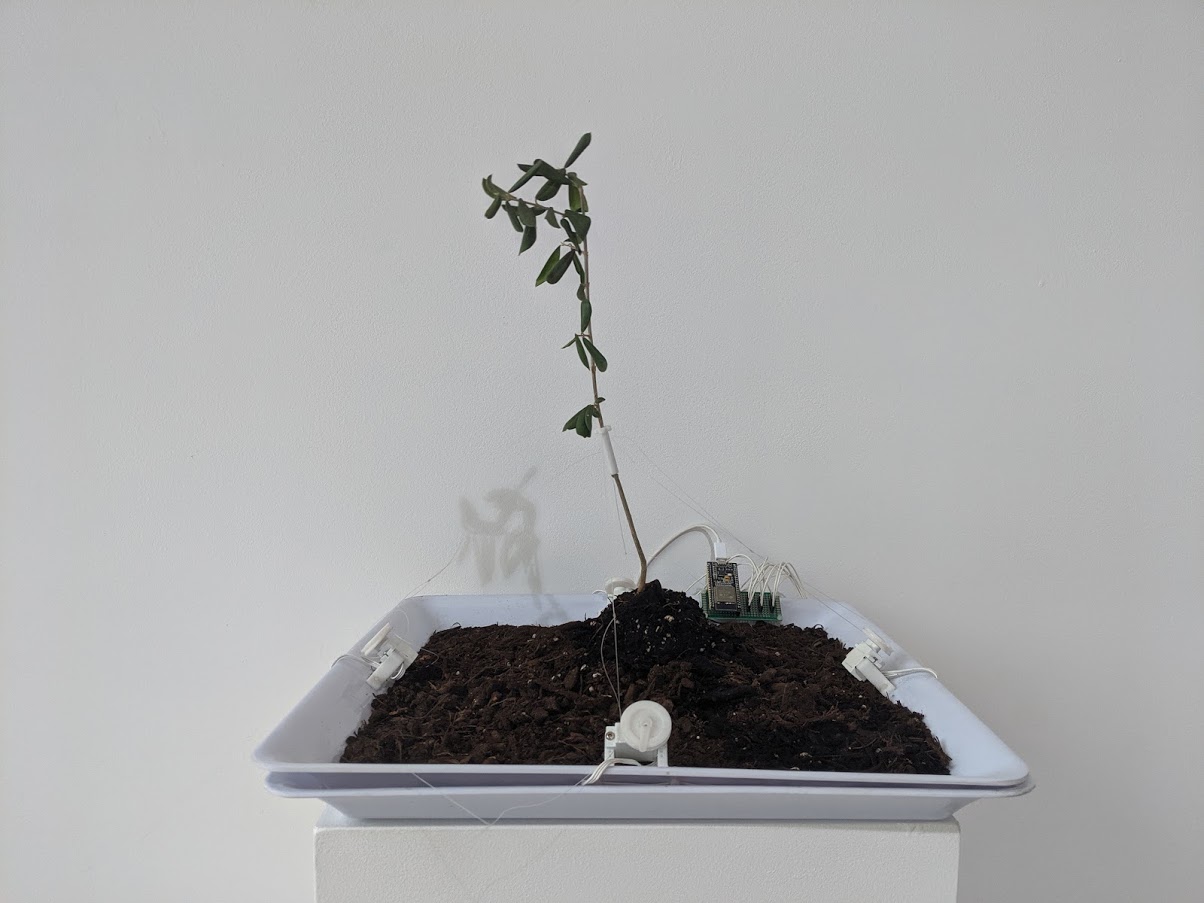
In one corner of the gallery, Philippe Vandal, currently studying intermedia cyber arts at Concordia, presents Thigmo, a dynamic piece that connects a motorized fan with an olive tree. While the fan spins, a set of strings pull at the tree in a cycle of perpetually opposing directions, a process that Vandal describes as the “animation of preconceived stillness.” As he explains in his bio, Vandal’s intent is to frame the process of thigmomorphogenesis—in which plants respond to mechanical sensations, usually natural in origin—in an artificial context. Vandal notes how the systematization of this natural process calls into question the human tendency to overlook our impact on our surroundings  and the consequences that follow our interference. 

Sharing Vandal’s concerns about interactions between synthetic and organic matter, Jules Galbraith, a print media and computational arts student, contextualizes this relationship with our current fears surrounding climate change. Recent findings in the UN Climate Report, which posited a 12-year window to mitigate our effects of environmental abuse, motivated Galbraith to create Accumulations, a set of monochrome scans of the plastic they use everyday. Their work, plastered on a rigid and uneven cast sprawled across the gallery floor, evokes the image of a discarded plastic bag or a pile of garbage. The product appropriates the natural process of fossilization for synthetic matter, and it suggests the unsettling idea that the inventions of our downfall will, in their permanence, outlive us.


Arts & Entertainment, Music

Dream-pop in bloom: In conversation with Sorrey

As the saying goes, slow and steady wins the race. In the case of the dream pop group Sorrey, slow and steady can also produce a great album. On Oct. 18, the Prince Edward Island-based dream-pop band released their full-length debut album, In Full Bloom, their first release since their 2015 EP Thick as Thieves. The melancholic and melody-driven release will be followed by a tour throughout Quebec, Ontario, and the Maritimes.

Emilee Sorrey, the band’s namesake and songwriter, leads the group on vocals and guitar. She was working with Colin Buchanan of Paper Lions in 2015 when they began to collaborate on songs that Sorrey had written previously.

“As that project came to a natural end, we started to work on some of my solo songs,” Sorrey said in an interview with The McGill Tribune. From that point, Sorrey-the-singer slowly transformed into Sorrey-the-band, and they have been releasing singles and playing live sets ever since. 

The band’s sound is dreamy and ethereal, while the lyrics are well-grounded in Sorrey’s personal experiences. On In Full Bloom, many songs deal with relationship troubles and miscommunication, but in a lighthearted, contemplative tone that makes for a pleasant listening experience.

“Songwriting is me working my emotions out through a song,” Sorrey said. “I start writing with a mood in mind, and then the other band members tighten up my ideas until we have a well-balanced song.” 

Patience was key when it came to recording the band’s debut album. All the band members live in the Maritimes; besides influencing their sound, it grounded them in an islander mentality, and within a dedicated community. While they recorded some tracks outside the island, most of the work was done at The Hill Sound Studios in Charlottetown. 

“You might think that [the proximity] would make for a quicker recording process, but we took our time with it,” Sorrey said. “Sometimes it can take years to finish a song.”

As the last song the band recorded, the singer sees title track “Full Bloom” as an encapsulation of the entire process of making the album.

“It’s about waiting for the right moment,” she said. “And when the moment is right, everything is in full bloom.” 

The song’s moderate tempo and easy-breezy melody evokes an image of lounging in the sun on a summer day, with nowhere to go in particular and just enjoying the moment. Sorrey’s relaxed vocals and catchy melodies give the band its dreamlike quality, while the backing instrumentals often feature bright guitar riffs and warm synths. 

The band’s love for live performance reflects the wider Maritime musical community. According to Sorrey, the music scene in P.E.I. is tightly knit and full of energy—an atmosphere that musical groups can thrive in. As all of the band members are either from or currently live on Prince Edward Island, their local music scene provides opportunities for collaboration and musical development within the community.

“Three nights out of the week, you can find a lot of good live music, and not just within our genre,” Sorrey said. “It’s really popping off.”

Despite the comforts of home, going on tour provides a chance to bring their music to new audiences along with a change of scenery.

“No matter how big a crowd is on the island, you’ll know everyone there” Sorrey said. “It’s always exciting to see new faces.”

In Full Bloom is available now on most streaming platforms.

Hockey Season Opener
Hockey, Sports

Martlet hockey falls to Stingers in shootout

Martlet hockey (0–1) hosted the Concordia Stingers (1–0) in their regular season home-opener on Oct. 19. A goal each in the second period was the only scoring in regulation, sending the game to a shootout. Concordia stopped all three of McGill’s attempts, while the Stingers found the back of the net on their third shot to claim the victory. Despite a disappointing loss for McGill, both sides played well, showcasing the best of what their rivalry has to offer. 

“I think [that] both teams are highly motivated, and I think we like playing each other,” Martlet Head Coach Peter Smith said. “I thought it was a real good game today, and I thought our team played real well.” 

Concordia set the pace in the opening minutes of the game. About halfway through the period, the Martlets found their rhythm and started dominating the play, stringing together several quality scoring opportunities. Unfortunately, none of their chances found the net, and the period ended with no score. 

Play evened out again in the second period, with Concordia having the better scoring opportunities of the two sides. Late in the period, however, a delayed penalty call against the Stingers gave McGill a six-on-five, and the Martlets capitalized on the opportunity. Fourth-year centre Jade Downie-Landry scored McGill’s first goal of the regular season, assisted by first-year forward Anna MacCara and third-year forward Stéphanie Desjardins. Downie-Landry was called for a penalty a minute later, and the Stingers responded seconds into their power play to even the score at one apiece. 

In the third period, McGill took a four-minute penalty but played excellent defence, aided by a strong forecheck forcing key turnovers in their offensive zone to run down the clock. Though McGill had most of the chances in the final minutes of the game, fourth-year goaltender Tricia Deguire, who remained as solid as a rock on the penalty kill, came up with a huge stop in a two-on-one with just over a minute of regulation time to play. 

“Your best penalty killer has to be your goaltender, and I thought [Deguire] did a real good job,” Smith said. “That four-minute kill that we had, I thought she was outstanding.” 

With the score tied at 1–1, the game went into overtime. Both teams had a few opportunities to end the match, but neither could seal the deal, and a shootout ensued. With the pressure building, the Martlets leaned on each other to remain calm and focused on the game plan.

“It’s all a game of emotions, so we got our mental coach that comes in [and] tells us to breathe when we are too stressed,” Deguire said. “But sticking together, that’s what helps the most, [keeping] all our cheering up, […] helping each other [….] Pressure-wise, teammates are the most helpful.”

The Stingers came out victorious in the shootout, handing the Martlets their first loss of the season. However, Smith is not worried. 

“It’s just about the little details, and we’re still early in the season, and we still have lots of chances to work out those details,” Smith said. “We’ve got 19 games to go in the regular season. I suspect that most of those 19 games are going to be exactly like the game we had this afternoon, so this game will make us better.” 

The Martlets face off against the Montréal Carabins (1–0) on Oct. 25. 


Moment of the Game:

A shot from the point found its way around the crowd in front of the net to fourth-year centre Jade Downie-Landry for McGill’s first goal of the regular season.    

Quotable:

“We knew it was the home opener so we wanted for sure to perform, and give the crowd a good game. It was also an emotional game against Concordia. We actually wanted to make sure that we could get out there, and play as hard as we could.” – Fourth-year goaltender Tricia Deguire on the significance of the home-opener against Concordia. 

Stat Corner:

Fourth-year goaltender Tricia Deguire made 30 saves throughout the game.

Album Reviews, Arts & Entertainment

‘Pang’ is for crying in the ocean

Caroline Polachek is no novice: The singer-songwriter has produced prolifically over the past two decades as part of indie synthpop duo Chairlift, released an album under the name Ramona Lisa, and even boasts a writing credit on Beyonce’s critically lauded 2013 self-titled release. Pang, her solo debut, is a near-perfect breakup album. Though Polachek recently divorced fellow musician Ian Drennan, Pang is about more than just that relationship. Polachek retreads well worn pop music fodder such as songs about dreams, lost youth, and the ocean.

Pang is produced by Polachek herself, along with PC Music’s Danny L Harle—a harmonious pairing. Harle’s exaggerated pop tendencies joyfully creep in. The glittering synth in the title track, and vocal sampling on “Door” demonstrate his handiwork, but it is Polachek’s talent that dominates the album. It is her heartbreak to swim in, after all. Her vocals ground the album; Polachek has referred to the voice as “the ultimate analog synth,” and she uses her instrument deftly in Pang. “Ocean of Tears” contains perhaps this year’s most heartbreaking chorus, all thanks to Polachek’s shattering vocals. 

Everything on Pang ultimately builds up to “So Hot You’re Hurting My Feelings,” an uptempo, New Wave inspired track with an impossibly catchy hook. It is hard not to get swept away in Polachek’s heartache and infatuation—the dreamy bassline provides a steady launchpad for Polachek’s voice to soar from, aided by dizzying auto-tune.  

“And I’m out at a party, they’re playing our song / I cry on the dance floor, it’s so embarrassing / Don’t send me photos, you’re making it worse / ‘Cause you’re so hot it’s hurting my feelings,” Polachek sings. 

Embarrassment is central to Pang; Polachek chastises herself for loving too much on “Caroline Shut Up,” and frets about her predictable romantic tendencies in “Look At Me Now.” Ultimately, this embarrassment is fitting: Pang’s strength lies in its self-reflexivity and restlessness. After all, no honest break-up album has ever been comfortable or picturesque.   


Arts & Entertainment, Theatre

‘Ti-Jean and His Brothers’ brings Satan to centre stage at TNC

Tuesday Night Café’s (TNC) performance of Ti-Jean and His Brothers, a modern Caribbean folktale written by Derek Walcott and premiered at Morrice Hall on Oct. 16, is enticingly bizarre. The production is the first of the year from the entirely student-run theatre company and features plenty of up-and-coming actors from the McGill community, including actor and director Deneille Guiseppi. 

The play itself is a surreal combination of traditional folk themes set in a more modern colonial context. Ti-Jean and His Brothers takes places some time in the early- to mid-20th century and revolves around the eponymous characters Ti-Jean (Laura Quenneville), Gros-Jean (Deneille Giuseppi), and Mi-Jean (Ryan Chahri) as they clash with the Devil when he shows up on their doorstep. The Devil  wishes to live as a human to experience all the horrible things that he has done to the world. He disguises himself as various characters, such as a white plantation owner and an old man, and torments Ti-Jean and his brothers in sadistic ways from behind a human disguise. 

The overall atmosphere of the play is accentuated by simple, yet effective set design. The set consists of an arch of branches covered in leaves and some contemporary props, like a lantern and some wooden lawn chairs. They create a fantasy-like setting while clearly being a thematic device representing colonial thinking. 

Camille Simon stands out as the boys’ mother, heartbroken as each of her sons leave her in pursuit of a fight against an insurmountable adversary. Her markedly sympathetic disposition brightens this dark play full of tragically flawed characters, and Simon presents this dynamic faithfully. 

Jacob Berk gives a commanding performance as the Devil, channeling his inner-demon to perform the role in the most maniacal, conniving and evil way possible. When he gets angry, the sentiment is palpable. 

Samantha Ling and Rebecca Turner introduce and lead us through the play as narrators. Taking the form of a frog and a firefly, respectively, Ling and Turner add a much needed touch of levity to a relatively serious production, adding to the play’s twisted fairytale-esque production.

Chahri and Quenneville give dedicated performances as the younger two children, Mi-Jean and Ti-Jean. Mi-Jean is intellectual to a fault, lacking in common sense. Ti-Jean, the smallest of his brethren, is the only one clever enough to have a chance at overcoming his great evil through his faith in God. Despite decent performances, the fact that their characters are written as black boys, despite both actors being white inherently challenges the audience. While this casting choice seldom gets in the way of a general understanding of the narrative, it does muddle the colonial undertones. It is unfortunate that these roles were taken up by white actors, when they could have offered valuable representation for Afro-Caribbean performers at McGill.

Guiseppi plays double duty as Gros-Jean and as the play’s director. Her character is the brawny and hot-headed brother, the first of the devil’s victims. Her direction has a clear vision, and though it is a respectable and ambitious one, the play falls short of achieving such heights. Guiseppi attempts to translate an obscure Caribbean folktale to a McGill stage while retaining all of its original integrity and historical value, and despite some talent in the cast, many were not playing roles they appeared entirely comfortable in. Still, her Caribbean roots shine through, and make Ti-Jean and His Brothers a valuable viewing experience. 

Science & Technology

E-cigarettes could be the next big public health epidemic

McGill students are no strangers to plumes of e-cigarette vapour, whether it is in class, at McLennan, or on the sidewalk. Created in 2004, vapes imitate the sensation of smoking and are often marketed as being completely safe. E-cigarettes have surged in popularity in the last few years, due in part to advertising campaigns of companies like Juul that target young people, offering products with fun flavours such as mango and mint.

According to Christopher Labos, a cardiologist and an associate with the McGill Office for Science and Society, regular cigarette-users inhale smoke, while e-cigarettes produce vapour. 

“The difference between regular cigarettes and e-cigarettes is that regular cigarettes are a combustion product,” Labos said in an interview with The McGill Tribune.  “With e-cigarettes, you have liquid nicotine that is usually in an oil solution, and you are producing vapour when it is heated.”

E-cigarettes were originally introduced to help people quit smoking: The first e-cigarette had water vapour but no nicotine and was intended to simply mimic the feeling of a cigarette in your hand. Now, the majority of e-cigarettes have nicotine content ranging from zero to 87 milligrams. For example, one Juul pod contains as much nicotine as a whole pack of cigarettes. 

“Nicotine […] itself does have health effects,” Labos said. “It stimulates the sympathetic nervous system of the body and increases […] heart rate and blood pressure.”

Recently, nicotine and marijuana vapes have garnered attention due to their popularity and potentially fatal consequences. As of Oct. 15, 33 people have died in the US and nearly 1,500 people suffered lung injuries associated with marijuana vaping. A Statistics Canada survey showed that e-cigarettes are more popular among younger people, with 23 per cent of high school students having tried them. Currently, scientists know little of the effects of long-term e-cigarette usage. While nicotine is known to be addictive, not enough time has passed to observe the full effects of regularly inhaling mass amounts of vapour. 

“If you took a bunch of healthy 20-year-olds, and they started smoking today, the likelihood is in five years you would not see any effect to their health yet,” Labos said.

While vaping’s long-term effects are yet to be established, a study found that vapour can irritate and disrupt the protective layers of the lungs in mice. Due to toxins in the vapour, e-cigarettes also pose potential threats to young people’s brain development. Still, companies often claim that they are safe in advertisements targeting young people.

Before the link between cardiovascular diseases and cigarettes was established by researchers, tobacco companies used to market cigarettes as safe and recommended by doctors. The consequences of this advertising are obvious now; whether e-cigarette advertising will cause the same effects in 40 years is debatable. 

Lack of scientific certainty is not a reason to ignore warnings from public health officials and doctors to steer clear from e-cigarettes. Aside from causing a number of deaths and injuries in the US, vaping could potentially affect the lungs and the brain. Further, the nicotine in e-cigarettes puts young people at risk of addiction. Ultimately, the qualified opinion of health professionals is more valuable than that of companies trying to make a profit.

Virtual Assistant Referees
Point-Counterpoint, Soccer, Sports

Point Counterpoint: Virtual Assistant Referees

Video assisted referee (VAR) was introduced to professional soccer in 2017, garnering mixed reactions from fans and players alike since. Some say it makes calls more accurate, while others argue that it disrupts the game.


VAR disrupts the flow of the game 

Jack Armstrong 

Since the introduction of VAR in the German Bundesliga and Italian Serie A at the beginning of the 2017-2018 season, it has negatively changed the sport of soccer. Instead of the once free-flowing game, matches are now filled with stoppages that take away from the spectator’s enjoyment. Last summer’s FIFA Women’s World Cup saw over 800 minutes of VAR-caused stoppages, and because the clock never stops in soccer, both the players and the fans lose valuable game time, even with stoppage time added to the end of each half. 

VAR scrutinizes every small detail, which often leads to decisions based on things that have virtually no impact on the game. For example, a one centimetre offside offense by Heung-min Son in a Tottenham game this year nullified a fantastic strike by Serge Aurier, despite Son not being directly involved in the play that led to the goal. VAR even needed a computer program’s help to make the decision. If the call cannot be decided immediately, then the game should continue, because at that point the stoppage will cause more disruption than the referee’s choice. 

Much of the enjoyment has been sucked out of the game for fans with the overanalysis of minute details. Every time a team scores a goal, supporters are hesitant to celebrate out of fear that the goal will be retroactively overturned. VAR is taking over the headlines for far too many soccer games, and the focus is now more on the officiating than the play. This is not to say that improvements should not be made to the sport; however, VAR poses far too many issues to the game of soccer to be worth the controversy.


Referees can now make the right calls

Ender McDuff

While still imperfect, VAR is a critical step in the right direction for soccer. It helps ensure play is fair and called correctly by giving the in-game referees much-needed technological support, which ensures that games are fair and free from the undue influence of referees’ natural human error. Take for instance what is widely considered the worst missed call in soccer history: The infamous “hand of God goal” by Diego Maradona that decisively put Argentina up one over England in the 1986 World Cup quarter-final. While in real time, the play is challenging to call, the support of VAR would have correctly overturned the unearned goal. 

VAR is also only used in limited instances and is consulted at natural stoppages of play so as to minimize its effect on the flow of the game. It is only used to ensure that goals, penalties, and red cards are correctly assigned. These are all crucial plays to get right in a sport like soccer, where scores are significantly lower than in other sports. As such, every goal is critical meaning it is not worth getting the call wrong in the name of reduced stoppage time.

During the 2019 FIFA Women’s World Cup, however, there were some issues with the implementation of VAR. People felt that the zero-tolerance policy for goalkeepers stepping off the line during penalty kicks was too stringent. But, the International Football Association Board was responsive and quickly addressed the issue. In this way, VAR can continue to be refined until it is truly serving its mandate of “minimal interference for maximum benefit.” Other sports leagues like the NBA have successfully done this with their instant replay centers; there is no reason that soccer cannot also use technology to produce fairer, less subjective games that both players and fans can enjoy. 


Editor’s Pick

While VAR may have potential, its current use is causing more harm than good to the game of soccer. Disruptions to games due to overuse of VAR by on-field referees has made the game more stressful for both fans and players. 

Off the Board, Opinion

Love at first bite

We set the scene on a Sunday afternoon. Dinnertime is approaching and my family has elected to order in. We shuffle through a list of options, and settle on Eastern Twist, a sandwich shop a couple of blocks away that sells barbecue chicken wraps—a form of Americanized roti, an Asian fusion hybrid that we can not live without—and spicy fries. The fries are fine: They are hollow for some reason, but still ridiculously tasty. We call to place an order. We have to pick up from Eastern Twist but they are close enough that someone will walk the dog or hop in the car for a short drive. We forgot that Eastern Twist is closed on Sundays, so we settle for something inferior.

We set the scene on a Thursday evening. Dinner is still undecided and we settle on Eastern Twist once again, since it feels as though it is a no fuss-kind of option. For a family with a lot of diverging tastes, it is remarkably easy to agree on it. We walk the dog, Vader, and pick up our sandwiches and fries and walk home. It is around the corner after all. It takes maybe 10 minutes to eat. 

We set the scene on a game night. The Raptors are playing, and everyone’s eyes are going to be glued to the television. We have to pick dinner. There are maybe nine people coming over; how are we supposed to decide? It feels impossible. Our solution: Eastern Twist.

We set the scene on my train ride home to Toronto in April, at the end of last semester. I’m sitting there looking out of the window. I feel reflective; it feels like one of those movie scenes when the rain comes down hard and your hand is on the glass and some beautiful music is playing. The thing is, it is not raining and my hand is not on the glass: Train window glass is probably really dirty. I am listening to Fleetwood Mac, though, and Fleetwood Mac rules.

“Well, I’ve been afraid of changing,

‘Cause I’ve built my whole life around you

But time makes you bolder, even children get older 

And I’m getting older too

Oh, I’m getting older too.”

I return home to a family dinner, and I got to choose the restaurant. We placed a call to Eastern Twist, prepared to order our barbecue chicken wraps and our spicy fries; the specific craving had hit not long before exam season ended and I was excited to be home. The restaurant didn’t pick up the call, and it was not Sunday. 

We tried several more times over the summer to no avail. We drove by one time late in the evening, and the walls had been papered up. Our beloved Eastern Twist had closed its doors. 

Time to be honest: I fibbed a little bit earlier in the name of narrative flow. I was listening to Fleetwood Mac, but I wasn’t listening to the song “Landslide” off of their namesake album. I was listening to “The Chain” off of their album Rumours. But, “Landslide” works better here anyway, because my family has quite cheesily built its life around Eastern Twist. I used to be a picky eater, in part because I was a child who enjoyed chicken fingers, and in part because of allergies. But as a family, we found a place that all of us liked. We introduced friends to it and they liked it too. I honestly do not know anyone who did not fall in love with Eastern Twist at first bite. 

As I grew up, I was raised alongside chicken wraps and spicy fries—I cannot tell you the number of times my lips lost feeling and I persevered for more. It was truly an addictive food, in the best way.

But, Eastern Twist is gone now. I guess you could say I was afraid of changing, kind of like how Stevie Nicks was. The little sandwich shop on the corner of Bathurst St. and St. Clair Ave. is a sandwich shop that my family built its dinner life around. Time has made me bolder and a more adventurous eater. And anyway, a lot of the restaurants that I like are open on Sundays too.


Commentary, Opinion

Gentrification falls on university administrations too

Urban universities take up a lot of space, and their presence has a profound impact on local neighborhoods’ economies. When universities such as McGill, Concordia, or the University of Montreal (UdeM) expand their properties or develop new ones, property values in the surrounding area tend to increase and developers pressure landowners to sell their properties. This is one example of gentrification, and it is directly abetted by Universities who fail to take preventative measures. 

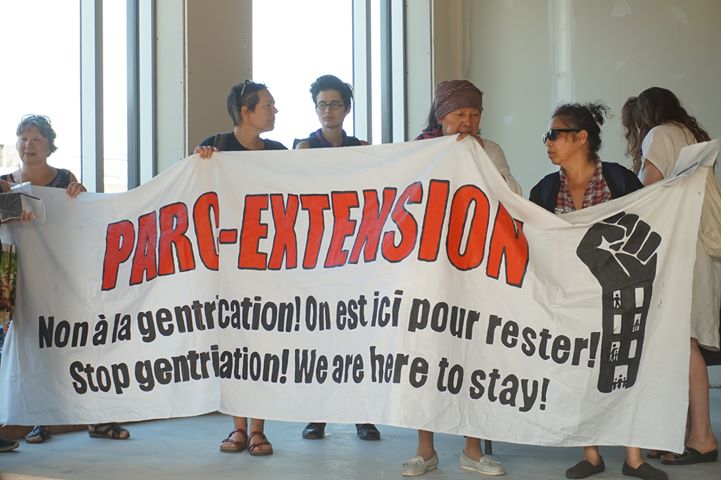
UdeM recently came under fire for gentrifying the Parc-Extension area with its Montreal Innovation Laboratory project (MIL). While the project’s goal of turning Montreal into a hub for the growing AI industry is entirely legitimate, it has had unintended consequences. Vacancy rates in the ParcEx this year hit an unprecedented low, and some residents of the area have cited the recent UdeM development as the cause for rising rents. 

ParcEx is one of the most ethnically-diverse neighbourhoods in all of Canada, and it is also relatively low-income. Working-class families in the neighborhood lack the financial means to retain their properties under the economic pressure created by the development of a UdeM campus in the area. Residents have already been seeing rising rates of evictions. Unless the university takes action now, people remain at risk of losing their homes. UdeM has argued that the project is a ‘lifeline’ for the struggling neighbourhood, and that increasing its attractiveness will improve the quality of life for its residents. However, as evictions have continued and expensive new condos have been established, it has become increasingly evident that the project is inaugurating a dramatic demographic transformation in the community.

Instead of improving the quality of life for the current residents of the area, the project forces them away from Parc-Ex and replaces them with higher-income residents. Individuals who have been forced out face significant obstacles to finding affordable housing again: Montreal is currently experiencing a housing crunch, and housing vacancy rates in Parc-Ex are at an all-time low, leaving evicted residents without many options. The gentrification in Parc-Ex poses an existential threat to a neighbourhood in Montreal. McGill students should be particularly concerned about this issue because they also contribute to gentrification.

While students are a vital economic asset to the city of Montreal, entire districts of the city have turned into de facto residence areas for students. Students have different needs than full-time residents that are satisfied by different enterprises, and they do not use government services that regular residents pay for with tax dollars. Neighborhoods like the Plateau, Saint-Henri, and the Gay Village have become increasingly expensive to live in, as “studentification” has grown. This is cutting some Montreal residents off from potentially affordable housing, creating “student ghettos” that are not well integrated into local communities, and ultimately diminishes the quality of life for non-student residents.

MIL might not even be the most economically viable project for the UdeM according to an article by UdeM Professor Emeritus Jean-Claude Marsan, in à babord! This fact notwithstanding, it would not be difficult for UdeM to curb gentrification resulting from its project anyway. Research has shown that universities can harness their economic power to foster inclusive growth in local communities. The University of Toronto has launched an “Anchor Strategy” for its campus in Scarborough, which, like Parc-Ex, is one of Canada’s most multicultural areas. The strategy is geared to bring more diverse and local enterprises onto its campuses and to increase employment opportunities for nearby residents. Similarly, Drexel University in Philadelphia demonstrated that its Hire Local campaign led to decreased turnover rates among staff.

University administrations have the most control over gentrification, but this does not exonerate students of responsibility. McGill students are a key factor in the issue and are therefore morally responsible for safeguarding the area’s unique atmosphere and accessibility. By spreading awareness on social media platforms, protesting with the residents of Parc-Ex, and petitioning the local government and university administrations, students can take action. University of Montreal’s failure to employ a strategy like UofT’s or Drexel’s is reprehensible, and we must hold McGill to a higher standard.

Read the latest issue

Read the latest issue