Latest News

McGill, News

World Bank President delivers speech ahead of Annual Meetings

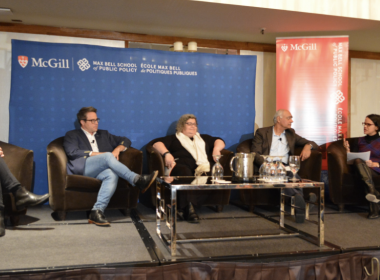
The Faculty of Arts and the Desautels Faculty of Management hosted World Bank Group President David Malpass on Oct. 7 in the Strathcona Music Building. Malpass addressed topics related to the institutions’ policy agenda, which include pro-market liberalization and addressing climate change, setting the tone for the World Bank Group and International Monetary Fund Annual Meetings being held this week in Washington, DC Oct. 14–20.

Malpass was nominated to head the World Bank by US  President Donald Trump after having served as his senior economic advisor during the 2016 election campaign. After his tenureship as the American Under-Secretary of the Treasury for International, Malpass’ nomination was unanimously approved by the Bank’s 25-member executive board this year on Apr. 5. This marked the beginning of his responsibilities as the leader of one of the world’s largest providers of development loans to governments.

Following an introduction by the Dean of the Faculty of Arts Antonia Maioni and McGill Principal and Vice-Chancellor Suzanne Fortier, Malpass spoke about the important role that technology plays in lifting people out of extreme poverty by enabling growth and reducing inequality.

“We’re almost at the point of having secure systems that would allow poor people to electronically receive remittances, foreign aid, and social safety net payments, as well as their earnings, and then be allowed to save and transact freely,” Malpass said. “That [will] be revolutionary, because it [will allow] people the freedom and opportunity they need to improve their living conditions.”

The World Bank estimates that the global labor force will grow to 620 million people from 2020 to 2035, while economic growth worldwide is predicted to taper off.

“With most of the growth in the poorest countries, employment is the best safety net,” Malpass said. “With global growth slowing, it’s paramount that countries carry out well designed structural reforms to ignite domestic growth.”

Malpass also spoke about the challenges posed by climate change, which risk hindering the organisation’s mission of ending poverty and promoting global prosperity.

“In November [2018], the World Bank announced a $200 billion five-year target to help the countries address climate challenges, [stressing the importance of the implementation of both adaptation and mitigation strategies],” Malpass said. “At the recent United Nations General Assembly meetings in New York, I [also] joined Germany in announcing PROGREEN, a fund that will address a range of climate and environmental problems.”

Following Malpass’ speech, Dean of the Desautels Faculty of Management Isabelle Bajeux-Besnainou moderated a short Q&A session between the guest speaker and the students in the audience.

However, the event left some students disappointed by the message that David Malpass delivered. Alexandre Caillon, U3 Arts, was concerned about the implications behind the institution’s focus on using economic indicators for assessing development.

“Without surprise, [Malpass] promoted the role of private actors and alleviating barriers to trade to boost development and tackle social issues, which isn’t necessarily a bad thing,” Caillon said. “I’m just worried about the overly pro-market, pro-US, pro-[trade] liberalization ideology it may hide.” 

Many students were unsatisfied at the end of Malpass’ talk due to his ambiguous responses to their questions. 

“[It] was slightly unsettling to see in person how an important policy and development leader on the international stage could be quite vague in response to pointed questions asked specifically by students,” Shannon Greisman, U2 Arts, said. “A lot of his answers seemed to me a little bit evasive or vague. This is what we’ve come to expect of our political and global leaders [but] it was a new and unsettling experience for me to see it in person.”

McGill, News

Black Student Network aims to pass ‘Black students’ Bill of Rights’

McGill’s Black Student Network (BSN) is working to pass a motion this year through the McGill Senate that would establish several rights that Black students would be entitled to on campus. The BSN aims to shed light on the distinct experiences and barriers that Black students face at McGill. The motion, titled the ‘Black Students’ Bill of Rights,’ hopes to ensure an institutional support framework in which Black students will be able to advocate for their needs on campus.

The Bill, which will be proposed at the last McGill Senate meeting of the Fall 2019 semester, will be composed based on findings from the online consultation form, in addition to data gathered from previous surveys circulated by the BSN. 

An online consultation form for the proposed legislation was created to collect feedback from Black students concerning their experiences at McGill. The poll includes several links on what motivated the idea for the bill, such as the history of James McGill as a slave owner, the growing reparations movement, and the recent establishment of  Georgetown University’s Black Students’ reparation fund, which repays descendants of slaves sold by the school.

Chloe Kemeni, Vice-President of Advocacy for the BSN at McGill conceived the idea for the Bill of Rights. Kemeni explained that, to this date, there have been no institutional systems in place to support Black students.

“I [wanted] some sort of institutional bill in place that [was] similar to a call to action, which [the university would be] forced to confront,” Kemeni said. “The university is [making its] commitment to equity through the Bicentennial, through strategic planning [and] long term planning [….] you have these big five core goals for the university, and one of them is to expand diversity.” 

Kemeni stated that suggestions for the bill will be put forward by Black McGill students at a Town Hall taking place on Oct. 17. While the online form will be instrumental in developing a draft of the document, Kemeni also has several ideas about what resources she would like to see on campus for Black students. Her main concerns are the recruitment of Black counselors, discrimination-free classrooms, as well as sustained funding that will allow [the BSN] to run initiatives benefiting Black students.

“Ideally, the bill would be divided into multiple sections; [….] what Black students are entitled to in academia and in classrooms, [….] what Black students are entitled to when it comes to services, [….] what Black students are entitled to in residence, [and] what Black students are entitled to in the admissions process,” Kemeni said. “So then I see distinct pools based around that.” 

Kemeni expressed concerns about the lack of racialized professors and counselors at McGill.

“What does it look like to recruit more racialized and Black professors? What does it look like to make sure that your services can be able to support Black students? Why is it that [there are] counselors for your international student or Francophone, or  Indigenous or queer [students], but then there’s nothing for [those who are] racialized?” Kemeni said. “So then it once again puts the burden on students to fill the gaps that the university, in my opinion, should be providing”

Christelle Tessono, former President of BSN, agreed that the proposed Bill of Rights would benefit Black students.

“I believe that the Bill of Rights presents itself as a good opportunity to hold the institution accountable to the specific challenges related to anti-Black racism,”  Tessono said. 

VP External Affairs for the Arts Undergraduate Society (AUS) Darshan Daryanani agreed that the implementation of the bill is long overdue. Daryanani expressed that his only concern with the Bill would be ensuring that it wholly captures the gravity of the issues of racism on campus.

“It is good that the [online consultation] form is there because it is getting students to discuss their feelings concerning their experiences [on campus],” Daryanani said. “My hope with a form of this nature [that will provide data for the bill] is that […] it is representative of all the [students’] concerns because something as formal as a bill should not miss out on anything.”

Student Life

Brain games for study breaks

As exams rapidly approach, individuals are often overwhelmed and struggle to keep their focus while studying. Research suggests that brain games can make for a more productive study break as these activities keep the mind active, while offering a comforting way to de-stress. Whether it be a crossword, a jigsaw puzzle, or sudoku, mind games have been known to improve memory, cognitive function, attention span, and other brain functions vital to student success. 

For most students, retaining complex information can be challenging. A study conducted at the University of Exeter and King’s College London found that participants who frequently played crossword and sudoku puzzles demonstrated sharper performances across several tasks. These tasks were specifically designed to assess memory, attention, and reasoning. The study also suggests that playing such games helps keep the brain younger as one ages, reducing the likelihood of later developing advanced stages of dementia or Alzheimer’s disease. 

Additionally, students who often play brain games find that they help with focus, since their mind is working to find a solution in an allotted amount of time. While some like to save these puzzles for a relaxing study break, others choose to start or end their day with a brain game. For Corrina Greenler, U3 Arts, starting her morning with a crossword puzzle helps her productivity throughout the day. 

“I love how doing a crossword is something to keep my mind active but isn’t school work,”  Greenler said. “[It] gets me thinking and motivated [Once I finish one], I’m ready to work on my other tasks.” 

This satisfaction from solving a puzzle is a motivator to challenge oneself with these activities. Many individuals who partake in brain-stimulating games see this form of entertainment as exercise for the brain. A study published in the International Journal of Geritatic Psychiatry suggests that, in seniors, crosswords and other such puzzles strengthen the brain, almost like physical exercise does for the body. 

Focusing on a non-academic task for a set period of time allows students to take a break without letting their minds idle. Meredith Charney, U3 Arts, finds that doing crossword puzzles can help balance everyday stresses.

“I do the crossword almost every day,” Charney said. “I have a lot of anxiety, and when I’m doing a crossword, it diverts that mental energy elsewhere.” 

McGill psychology professor Dr. Richard Koestner connects brain games with the concept of flow as defined by psychologist Mihaly Csikszentmihali. 

“[Flow is] associated with pursuing interesting and challenging activities where there is a specific goal and feedback,” Koestner said. “Games and puzzles […] are designed to produce the conditions that lead to flow.” 

In contrast to watching TV and surfing the internet, which provide minimal structure to divert our attention from our anxieties, brain games allow us to spend more time in flow.

“[Research supports the idea that] increasing the number of flow activities we do each day can greatly enhance our personal well-being,” Koestner said. “I think [brain games] are more likely to produce flow [than these activities, but] we have to keep increasing challenge and skill so that the activity continues to produce flow.” 

Since high stress levels can lead to numerous health concerns, it is important to find enjoyable and productive ways to relax the mind and body. A University of Toronto study suggests that giving the mind a break allows one to return to a task with more energy and a new perspective. The results found that effective relaxation techniques vary from person to person, but for many students, crosswords and other puzzles can be a worthy means both to de-stress and to challenge oneself. Referencing Mihaly Csikszentmihali, Koestner recommends that students challenge themselves through brain games in order to reap the mental benefits.

“[With any flow activity] we [should] set goals, monitor our performance, and [aim to] increase the challenge level so that we stay in the flow channel. Sometimes we have to increase our skills so that we can manage our challenges.”

Science & Technology

The strongest-ever hurricane in the northeast Atlantic

After developing off the coast of West Africa in late September, Hurricane Lorenzo took 11 days to reach the west coast of Ireland and the UK. In addition to record-breaking heavy rainfall, Lorenzo wrought major damage on the British Isles and other places lying along its path, like the Azores. Hurricane Lorenzo is the strongest recorded storm to have made it so far east in the northern Atlantic Ocean.

Kai Melamed-Turkish, a Master’s student in the Department of Atmospheric and Oceanic Sciences at McGill, explained that there are two main criteria for hurricanes to develop.

“One of the major factors that you need for a hurricane to form are warm sea surface temperatures […] of about 27 degrees Celsius,” Melamed-Turkish said in an interview with The McGill Tribune. “You also need relatively weak winds in the upper part of the atmosphere. You don’t want the winds to be too strong, or to be changing direction too much.”

In the case of Hurricane Lorenzo, the warm sea surface at its tropical development location provided it with ample energy for surface water evaporation. Once a hurricane has formed, it can only last if high sea surface temperatures and the jet stream, a concentration of relatively strong high-altitude winds in the atmosphere, carry it through its course. 

“Normally in the Atlantic, we would have a pattern that tends to direct storms further west and at more southerly latitudes until they reach about the Caribbean or North America, and then they would start to make a turn towards the North,” Melamed-Turkish said. “But in the case of Lorenzo, that wasn’t quite the pattern. The wind pattern in the upper atmosphere allowed Lorenzo to make the turn towards the North and further east.”

Melamed-Turkish added that throughout Lorenzo’s northbound path, the sea surface temperatures remained above normal, which allowed the hurricane to build up energy and maintain its strength at latitudes further north than usual.

As the ocean surface in the Northern Hemisphere reached its warmest month in 140 years this past August, more extreme weather events are likely. Kevin Bloxam, a PhD candidate in the Department of Atmospheric and Oceanic Sciences, advised against directly attributing the longevity of Hurricane Lorenzo to climate change, however, drawing an analogy of steroid doping in baseball games.

“It’s hard to actually separate which [home run] was hit because of the [player’s] natural ability from which one was caused by the amplification [of drug use],” Bloxam said.

While scientists cannot say for sure what is to blame for a single extreme weather event such as Hurricane Lorenzo, climate change will certainly increase the frequency of such events. As a recent study in Nature found, higher temperatures in the Arctic can cause variations in the jet stream in certain parts of the world. This weakening of the jet stream produces meteorological extremities such as unusual intrusions of cold air from the Arctic into the middle latitudes, as well as prolonged heat waves and dry conditions. 

With both rising sea levels and increasingly frequent extreme weather events, Melamed-Turkish expressed concern for populations along coasts.

“With a rise in sea level, it makes it easier for these storms to bring water from the ocean into major coastal cities,” Melamed-Turkish said. 

Meanwhile, Bloxam urges both adaptation and mitigation in protecting coastal cities. 

“We have to collectively reduce our carbon emissions and also protect the people who are most vulnerable to climate change at this moment,” Bloxam said.

Out on the Town, Student Life

Pointe-à-Callière: Where history meets modernity

Tourists and locals alike usually flock to Old Montreal for its quintessential cobblestone streets, cafés, and boutiques, but anyone hoping to learn more about the history and architectural origins of Montreal should look no further than Pointe-à-Callière. Montreal’s Archaeology and History Complex sits in the heart of Old Montreal. The museum consists of seven buildings and structures on top of authentic historic sites, all of which tell stories about the origins of Montreal.

What most distinguishes Pointe-à-Callière from other history museums is its modern approach to design. The museum draws upon multimedia and modern technology to engage visitors and bring history to life. With authentic archaeological digs as the foundation for the complex, visitors can walk through these sites or view them from above through transparent glass floors.

Pointe-à-Callière’s permanent exhibitions focus primarily on the history of Montreal. The very first exhibit, “Generations Montreal,” is a fast-paced multimedia show that provides an immersive glimpse into the history and birthplace of Montreal. The show was internationally recognized as an immersive live experience at the 2019 Muse Creative Awards.

Memory Collector” is an underground light installation projected onto the stone walls of North America’s first collector sewer, and was a feat of civil engineering and urban infrastructure when it was first built in Montreal in the 1830s. “Where Montreal Began,” a newer exhibit, is a sleek, interactive design studio built over the very first settlement in Montreal, Fort Ville-Marie. The space is designed to pay tribute to the pioneers of the colony and their desire to establish a new society. Visitors can place their hands on shapes along a wall and see the names of the people who played a role in founding Montreal appear. In another room, a map and guide outlines a brief history of First Nations villages, but Indigenous history and culture is otherwise largely missing from the overall narrative of the museum, as settler-colonial interactions are discussed in mainly Eurocentric terms.

Building Montreal,” another permanent exhibition, highlights key moments in the timeline of Montreal’s history from 1350 to the present. Finally, “Crossroads Montreal,” the last permanent exhibition, begins in the ruins of Ville-Marie’s first Catholic cemetery, dating back to 1643, and continues onward from there. Archaeological traces help to guide the history of the site, beginning with the Indigenous peoples and ending in the 19th century.

In addition to the permanent exhibitions, the museum also presents three to four temporary exhibits every year. Dinner is Served! The Story of French Cuisine” delves into the history of France’s culinary culture, and “Into the Wonder Room” brings together objects from the collections of the Musée des Confluences in Lyon, France, as well as hundreds of items from museum collections across Quebec and Canada and from private collectors.

Starting on Nov. 27, a new exhibit called “The Incas, Treasures of Peru” will be on display, which explores the world of the Inca and Andean culture from prehistory to the contemporary era. In the style of Pointe-à-Callière’s other exhibitions, “Treasures of Peru” is set to include immersive projections, authentic architectural elements, and a model of a contemporary market.

Though the museum primarily lays the foundation for the story of Montreal’s history from a settler-colonialist perspective, the complex nonetheless provides a starting point for visitors to discover the history of the city. Montreal has a rich history, and Pointe-à-Callière has uniquely allowed archaeological traces of Montreal’s birthplace to become accessible to the public. 

Off the Board, Opinion

Mental health requires more than hashtags and hotlines

Content warning: Mentions of self-harm and suicide. 

People are uncomfortable talking about sadness. Discussions of tragic events are often met sympathetically, with ‘I’m sorry,’ if not ignored. Perhaps out of knee-jerk politeness, people are reluctant to exercise empathy. We would much rather turn our backs on the pain of others, or watch from afar and be thankful for our own conditions. Public obsession with celebrity divorces and breakups stems from this reluctance to engage with people in our own lives, and even represents a tendency towards finding entertainment in others struggles. Negativity, including talking about personal struggles or one’s own mental health, comes with the price of social isolation.

Mental health is a topic that people are uncomfortable to talk about; if mental health is talked about, the discussion is centred around the most common mental illnesses: Depression and anxiety disorders. Personality disorders, schizophrenia, and obsessive compulsive disorder, to name a few, go widely undiscussed. Public reluctance to discuss painful topics encourages individuals conceal their struggles and emotional pain. 

The unwillingness to address the darker side of personal struggles is exemplified in social media culture, as mental health is treated as another platform for shallow and ineffectual virtue signalling. Awareness campaigns are co-opted by hashtag activism—lists of hotlines mixed with soccer mom-like platitudes posted to garner retweets. Much is owed to these campaigns, including promising starts to destigmatization, but addressing mental health requires more than just a tweet. Hotlines and mental health organizations are impartial resources, but they require people to have the courage to reach out to get help in the first place. Seeking help requires addressing topics that continue to be ostracized in public discussion, all while confronting the real threat of involuntary loss of agency through hospitalization. One day per year, even one month per year, devoted to mental health is not enough. 

Moreover, large corporations’ attempts to address mental health are tone-deaf at best. On Twitter, people can now report tweets talking about self-harm or suicide to Twitter’s “safety” partner program. This results in an email to the user containing a (notably devoid of Canadian or international resources) list of crisis hotlines. Implementing a reporting system for mental health treats the issue with the same level of scrutiny as punishable actions or crimes. Furthermore, it represents the general public’s aversion to confronting mental health issues as health issues instead of punishable offences: Platforms such as Instagram and Facebook have adopted policies to ban users or hide content that relates to self-harm or suicide altogether.

There is a balance to be struck between recognizing that mental illnesses require professional help and realizing that we all have a part to play in helping others. Destigmatization requires confronting the uncomfortable and looking out for those around you. The burden cannot fall on the mentally-ill to reach out when the path to reaching out is littered with hurdles, when the words “get help” are used interchangeably with negative and positive intentions. Mental illness continues to be used in everyday ableist vernacular as a way to silence individuals, whether it be through describing your annoying neighbour as ‘psychotic’ or attempting to diagnose Donald Trump and describe his actions as a result of poor mental health.

We need to become comfortable with asking if others are okay. Only a few words are needed to check up on others and give them the opportunity to open up and, to show that you care. Placing bans on content and hiding mental illness from our private lives will not get rid of its existence. Facebook and Instagram had good intentions in drafting their policies, recognizing the need for those in distress to express themselves, but it is individuals and communities that must learn to listen to the mentally ill, not large corporations with hashtags and hotlines.

Campus Spotlight, Student Life

Campus Spotlight: McGill Design Collective

Purposeful design determines the user-friendliness of websites, the efficacy of advertisements, and the accessibility of buildingsand McGill is home to many students who are passionate about it. For Carrie Rong, U2 Science, graphic design is both an interest and an outlet for her creative side, which is often otherwise neglected during the school year. A year ago, she began to tinker with graphic design software to create promotional material such as posters and a website for the Physiology Undergraduate League of Students (PULS), where she is currently the Communications Director. Her interest even led to a summer internship in product design. Rong lamented the lack of a community for design-minded individuals like herself at McGill.

“I realized [that] there seemed to be no one to talk to about design with,” Rong said. “I wanted to bring creative people together to show McGill what good design is [and use our foundation of skills to] change the design here.”

Sensing this lack of space for creatives on campus, Rong founded the McGill Design Collective as a home where designers at McGill could congregate. The first goal of the club, which aspires to be “McGill’s premiere creative agency,” is to advise other clubs on good design. Rong wants to work with student groups on campus because she noticed that many groups made posters and websites that were not effective or aesthetically pleasing. She hopes that she and her fellow Design Collective members will soon be able to take requests from both clubs and local startups to create material that incorporates their clients’ requests into while applying smart design principles.

The collective also aims to teach and challenge its member base, which is currently composed of 20 people with experience in various forms of design such as graphic design, web design, and photography. For beginners, the Design Collective will host workshops introducing common design software such as Adobe Illustrator and Figma. For more advanced members, the collective is giving a monthly design challenge to help foster creative growth. With these initiatives, Rong hopes to achieve the slogan of their group: “Let’s Make McGill Beautiful.” 

“A designer’s mindset is to iterate upon things that can be improved,” Rong said. “The Design Collective aims to enable its members to go out [on campus], take projects from clubs, and make them more beautiful.”

For the group, beautifying McGill’s clubs means creating design that has meaning and purpose. An example of purposeful design is choosing colours that express a certain sentiment or characteristic, such as using blue to convey tranquility. Rong envisions that the collective sets a precedent to incorporate good design principles for promotional materials at McGill, such as complementary colours and thoughtful use of negative space. She also hopes to have the collective’ members inspire others to strive for more meaningful use of design. 

With the goal of making McGill a place with more deliberate design, the club is starting this fall with weekly meetings that alternate between workshops and “Design and Donuts,” an event for like-minded creatives to come together and evaluate each others’ design pieces. A permanent meeting place and time has not been set, but students can keep up with this up-and-coming design club on their Facebook page

Out on the Town, Student Life

La Cale: A greener way to stand out

The recent Montreal climate march and ensuing conversations about climate change have prompted many students to reexamine their consumption habits and reduce their waste. Four friends in Rosemont are ushering in this change with their new zero-waste pub, La Cale. Located on Rue Saint-Hubert, the bar prides itself on its strict adherence to environmentally-friendly business practices while still offering patrons a full bar experience. 

Walking into La Cale, the industrial ceilings and dim lighting create a rustic aura. There is still a ‘new bar’ feel, as co-owners Gab and Luca Silver Fox rush about making their homemade sodas and prepping vegetarian poutine. Josh Gendron, who has been with La Cale since the beginning and goes by Gend, described La Cale’s journey from its beginning to opening day. 

“It’s hard to make it a short story, because it was a long process,” Gend said. “Me and some friends […] wanted to open a bar for a while but […] lacked the inspiration to do so. There’s so many [similar] bars out there. So when we came across this book by Bea Johnson about zero-waste lifestyles it just inspired us to [implement] that style of operation into the bar system. It’s a way for us to be different from other people while also making a difference in the bar industry. Most of us nowadays, we like to care about what we eat [and] what we serve.”

Gend does not believe La Cale has faced obstacles so much as challenges. 

“It’s just finding the right suppliers and thinking outside the box,” Gend said. “It’s not an obstacle, it’s just a bit more work [and] a bit more research. [Our juices and sodas are made in-house], which most bars buy premade. We made the bar. The chairs and tables are second-hand furniture from auctions or restaurants that closed. Zero-waste is all about reuse, and we like to give things a second chance.”

Gend continued to support this claim as he talked about the message they would like to send to the Montreal bar community. 

“This is not a difficult thing,” Gend said. “Sometimes, things are more costly or time-consuming, but that’s really what makes your bar stand out more than other places. When you buy a Coke at another bar, it’s always the same Coke [….] I think it’s worth all the effort if you want to be different.”

Gend recommends that business-owners forgo printing the second extra receipt and stock their businesses based on what they can reasonably sell. To consumers, he urges people to stop ordering bottles of water and fill their empty pint glasses instead.

“Say no to straws,” Gend said. “My main advice is just try your best to make the least waste as possible [….] When a business goes zero-waste, the impact is multiplied, [and it pressures] other businesses […] to do the same [to avoid being] seen as the polluting business. You’ll have to make the switch eventually, [so] why not now? You just need to think outside the box, and [with all the literature], it’s getting easier and easier.”

Gend reports an overall positive response to the bar and hopes for further support from the community at its upcoming events, including Thursday comedy nights and a wide array of musical acts. 

With significant strides and major community support, La Cale is setting the stage for some long-awaited and exciting changes to the Montreal bar scene. Gend reported that the pub raised $22,000 through online campaigns, which shows the high demand for waste-conscious businesses in the city. This will likely mark the beginning of more conscious business practices and will urge business owners and consumers alike to start thinking outside the box.

Arts & Entertainment, Music

Mashrou’ Leila echoes voices of Arab resistance at Club Soda

Mashrou’ Leila celebrated their 10th anniversary this year; to commemorate the occasion, the band released The Beirut School, their fourth studio album. The band have begun international superstars, with their tour covering Europe, the Middle East, before making  stop in Montreal at Club Soda on Oct. 9. Singer Hamed Sinno, violinist Haig Papazian, keyboardist and guitarist Firas Abou Fakher, and drummer Carl Gerges brought powerful Arab energy that radiated through the venue. Sinno and Mashou’ Leila have been Arab 2SLGBTQI+ activists and trailblazers, completely flipping the script on the homophobia and heteronormativity that plague much of mainstream Arab pop music. The band, whose name translates to either ‘The Night Project’ or ‘Leila’s Project’, played a set full of warmth and inspiration. 

The night began with a performance from one of Montreal’s own Iraqi-Canadian alternative hip-hop artist Yassin “Narcy” Alsalman. Through his show, Narcy also shed light on current protests in Iraq against corruption, rising unemployment, and poor public services. Besides his career in music, Narcy is also an actor, professor, and multimedia artist, currently teaching one of Canada’s only hip-hop courses at Concordia University.  Narcy’s performance and call to action created an intense and impassioned atmosphere in anticipation for the main act.

Mashrou’ Leila’s Hamed Sinno opened with a spoken word poem, followed by a performance of “Roman,” an ode to rebellion and hope. Sinno’s ardent and energetic call for resistance inspired a fiery energy in the crowd and was a fitting way to inaugurate the concert. 

Another standout of the night was “Jinn,” written after Sinno’s father passed away. In the song, Sinno detailed his struggle to mourn, using drugs and alcohol as a means to cope. Sinno’s soothing but strong voice allowed the audience to feel the pain, but also his resilience. 

Throughout their set, Mashrou’ Leila was accompanied by audiovisuals that enhanced the deep lyrical meaning behind many of their works. During “Radio Romance,” a projection of two male-presenting lovers tried to embrace flooded the screen with the impending night and many protestors blocking their way. 

The band’s set was filled with thoughtful and political calls to action; the dreamy and multidimensional ballad “Tayf,” Sinno explained, is about the Lebanese government’s crackdown on queer clubs and bars in the country. 

The band’s outspoken activism has led to multiple controversies, including the government of Egypt banning Mashrou’ Leila from ever performing in the country again. Sinno explained that the song “Cavalry” highlights those struggles against government oppression and calls to fans to continue supporting resistance. Additionally, the accompanying music video echoes the same sentiments, resembling the protests by Palestinian activist Ahed Tamimi in the year prior. The images portrayed a young girl attempting to fight soldiers who are invading her home, arresting her family, and cutting down their olive trees,

In the encore,  the band closed off the night with “Marrikh.” Sinno explained that the song was about his struggles with mental illness and the stigma that comes with it; therefore, he asked the audience to put down all their phones, and the venue to turn off the lights. “Marrikh” was a powerful, dreamy, and bittersweet end to the night, with audience members closing their eyes and drifting into the finale.

Arts & Entertainment, Film and TV

‘Hron, a Country of Ghosts’ dares to be different

 Hron, A Country of Ghosts, a new independent film from director dani Tardif, is a self-described anarcho-queer sci-fi movie about love and war. The film centres on Dydo Horacki (Noé Larose), a journalist who is assigned to a military camp to cover the expansion efforts of the fictional Borolian Empire, an imperialist regime intent on domination. After writing an article that criticizes the war effort, Dydo is sent by the militia’s commander to accompany some soldiers on a dangerous mission. Realizing too late into the expedition that they were set up, the party is attacked and Dydo is taken by one of many militia groups that reside in the mountains. Herein lies the twist: The “captors” quickly make it clear that they aren’t taking Dydo as a prisoner. They do not seem interested in pointless cruelty. Instead, they give Dydo the option to be left behind, but for lack of a better option, the journalist joins them.

Drawing inspiration from Michel Foucault’s idea of heterotopiasspaces which exist within but apart from the contexts that surround them, and as such reveal hidden values of the cultures they exist inthe bulk of the film’s 60-minute runtime juxtaposes this small group of anarchists with the violent imperialist state. The anarchists, who refer to themselves as the Free Company of Mount Heather, are depicted as warm and authentic. The imperialists are not. It is a clever political twist on the classic sci-fi war epic: Rather than having democratic rebels try to take down an autocratic empire, socialist anarchists attempt the coup. However, this film is more interested in the political battles taking place than the physical ones.

For the rest of the film, we are treated to a look into the life of this free collective. The viewer is invited to imagine a classless, genderless society where decision making is shared. There are many overt critiques of capitalist hierarchies throughout the film, but the subtle digs are the most effective. For example, Dydo reacts with childlike disbelief when they learn that people choose to work freely to benefit their collective. Coming from the empire, Dydo has only understood work as the product of coercion by a superior. Hron, A Country of Ghosts plays as a social critique simply by showing the merits of its subject: The confederation, unlike the Empire, is very, very good. 

Though the film prides itself on tidy politics, core elements of the story that would have strengthened Hron‘s impact are sadly absent. The relationships between characters are what drive the film, but they lack conflict and tangible development. The close bonds that form between Dydo and the militia members develop for no discernible reason beyond narrative convenience, and the viewer has no cause to root for these characters. Many of them are given extended and intimate monologues over the second half of the film, but their emotional impact is limited by the lack of narrative development. The film privileges its political message over traditional storytelling techniques; which is ultimately unfortunate.

The film does a good job with costumes and setting, and manages to create a distinct universe in an impressively short span of time. The ski masks, bandanas, and ragged clothes of the anarchists immediately register as rebellious as well as being of this planet, while the imperialists’ orderly and uptight outfits are classically sci-fi. Attention is drawn to the dress frequently, and watching both kinds on screen at once makes this sci-fi feel timeless and distinct.

The film’s crew introduced the work suggesting that although something is not perfect, that doesn’t mean it is not worth making. There are merits in the film’s production, acting, and designand there is a charm and depth to the rogue politics on display that makes the film work as a conceptual piece examining the effects of politics on interpersonal relationships. 

Whether or not you agree with its message, the film has an unabashedly independent spirit. And it’s a welcome breath of fresh air from whatever has been clogging up your Netflix queue. 

Read the latest issue

Read the latest issue