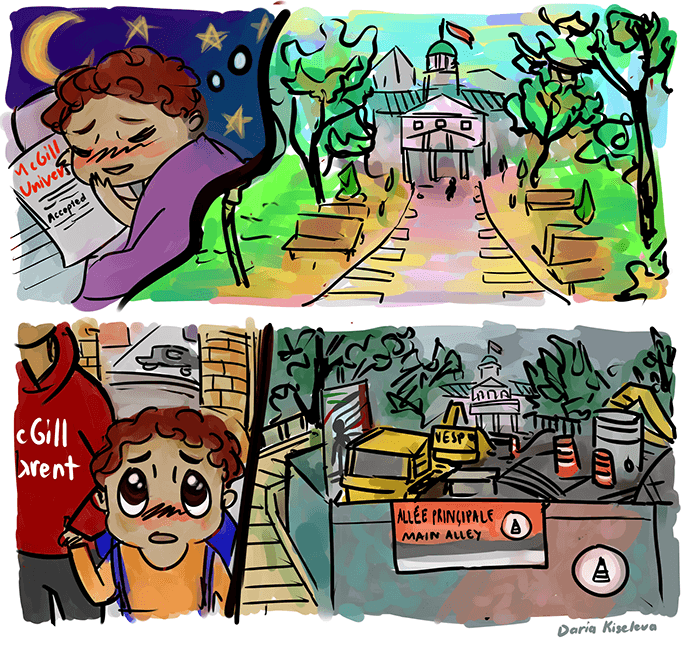
Welcome to McGill (construction)!


While students eagerly await Jane Goodall’s upcoming lecture on Sept. 26, they may be unaware of the history behind the star-studded Beatty Lecture series, named in honour of Sir Edward Beatty. Returning 40 years after her first lecture in 1979, Goodall will be the first repeat speaker in Beatty Lecture history. On the 65th anniversary of the annual event, Goodall’s talk will add to over half a century of seminal lectures by speakers that exemplify their eras.
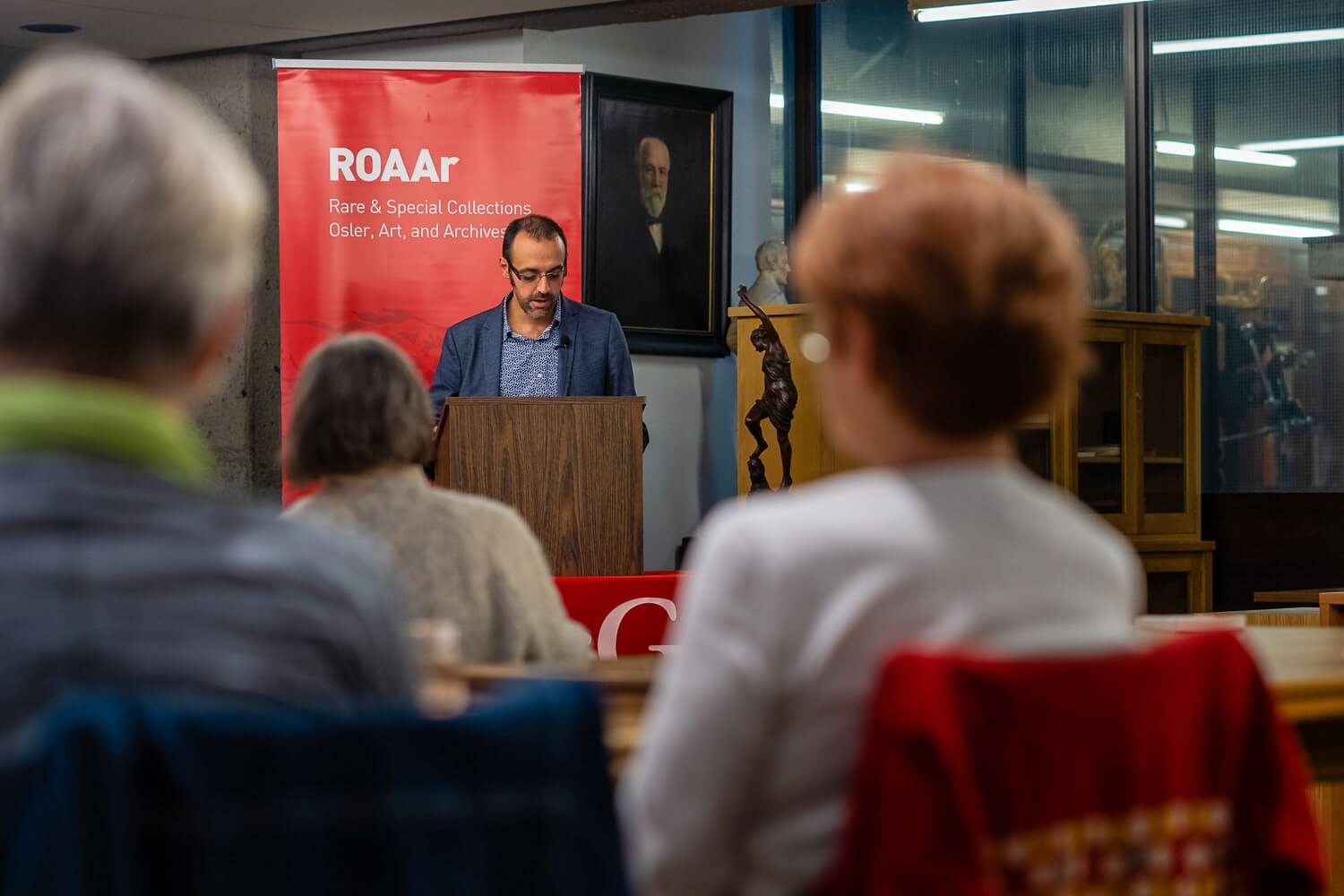
The exhibition “With the World to Choose From: Celebrating 65 Years of the Beatty Lecture” will be on display in the fourth-floor lobby of the McLennan Library building until Oct. 31. The vernissage on Sept. 12 launched both the main exhibit and a smaller collection focused on the life and home of former McGill Chancellor and president of the CPR Sir Edward Beatty.
Curators Frédéric Giuliano and Robin Koning highlighted the Beatty Lecture’s mission to inspire students with 11 quotes from past speakers on the walls surrounding the exhibit. The exhibit draws a timeline from the establishment of the Beatty Lecture fund to promotional material and press from past lectures. In 1952, Dr. Henry A. Beatty donated $100,000 gift to McGill in memory of his brother, Sir Edward Beatty, establishing the Beatty Lecture fund.
Robin Koning, Digital Marketing & Outreach Associate for the Office of the Vice Principal Research and Innovation, which organizes the Beatty Lecture, spoke on its namesake’s legacy.
“Back in the day, the Canadian Pacific Railway was one of the largest corporations on the planet, so [Beatty] had a really big job really young,” Koning said. “He dedicated his life to being McGill’s chancellor and the CPR, and he was knighted in 1935 by King George V.”
The exhibit follows the process to select the first speaker before landing on India’s first post-colonial Vice President and President Sarvepalli Radhakrishnan. Original ideas included author T. S. Eliot and pop culture theory pioneer Russel Nye. Frédéric Giuliano, who also works as an archivist at McGill University Archives, cited a letter from then Dean Thompson to the principal.
“This is where the title of the exhibit came from: ‘With the world to choose from, it becomes difficult to select for the Beatty lectureship,’” Giuliano said.
Selecting the Beatty lecturer has grown into more than just a conversation between senior administrations. Alongside their selection committee, the Beatty Lecture website encourages suggestions from students and faculty alike, reifying the lecture’s multidisciplinary and essentially collective nature.
“[The Lecture] is truly a campus-wide event,” Koning said. “It [tends to appeal] to a wide variety of people. It’s an event for McGill and for Montreal as well. It does stand unique, [being] so broad and [bringing] in such well known, influential names that are really part of the zeitgeist.”
With an extensive pool of preeminent scholars to choose from, the Beatty Lecture has historically highlighted people at the forefront of their fields, creating an archive of the last century’s freshest ideas and intellectual conundrums.
“In the ‘90s, people talked about environmental issues because [these issues] really entered into our popular dialogue,” Koning said. “You have people in the ‘70s [asking] what technology is going to do to us, wondering if we were going to become slaves to [it] since it was the beginning of tech and the first wave of computers. It’s like a timeline of some of the major events that have happened since the ‘50s.”
To access this remarkable timeline, Koning encourages students to explore past lectures on the digital archive on the website.

On Sept. 12 and 13, 15 speakers from various disciplines participated in the McGill Climate Conference, a comprehensive event spanning six panels held at the McGill Faculty Club. Emphasizing equitability and inclusion, the speakers confronted some of the most pressing issues facing Canada in its transition to a green economy, ranging from carbon pricing and the phasing out of fossil fuels, to closing the partisan divide.
Former NDP leader Thomas Mulclair opened the event with a speech on cross-party collaboration.
“Few challenges so clearly expose the frailties of our system of government [as climate change],” Mulcair said.
Mulcair’s speech touched on the Russian Revolution, trailblazing writer Rachel Carson’s work on pesticide usage, and the fight against acid rain in the ‘90s, putting in perspective a history of change and struggle and the advances made possible by political collaboration. Referencing the Trudeau government’s empty promises, Conservative disregard for the climate crisis, and progressive in-fighting between the Greens and the NDP, Mulclair implored Canadian politicians to work together for the sake of the environment.
The keynote address was followed by speakers Olivier Pineau, the chair in Energy Sector Management at HEC Montréal; and Greg Mikkelson, a professor in the McGill School of Environment, each representing different perspectives on the mitigation of Canadian emissions. While Pineau advocated primarily for reducing consumer demand, Mikkelson emphasized curbing oil sand extraction to cut down the industry’s disproportionate share in Canadian per-capita emissions.
Another panel focused on broader policies, including infrastructures and social impacts surrounding carbon pricing, a fee attached to carbon dioxide emissions. One way of doing this is by adding a carbon tax to the sale and use of fossil fuels. The carbon tax is a flagship policy of the Trudeau government and has been a major source of contention for Conservative premiers opposing the tax in Ontario, New Brunswick, Saskatchewan, Alberta, and Manitoba.
Erick Lachapelle, a professor in the Political Science Department at the Université de Montréal, discussed the factors influencing Canadians’ views of carbon taxes. He has found that, though support for carbon taxation is increasing year-to-year, it remains polarized along partisan lines. Those who oppose carbon taxes largely do so due to increased costs for consumers; however, people are also more likely to favour carbon taxation if they know that their taxes are being put to good environmental uses, such as to fund sustainable energy development and lower the cost of green energy.
Lachapelle believes that carbon taxation has been molded into a political weapon and urges parties to find areas of agreement.
Normand Mousseau, a physics professor at the Université de Montréal and the Academic Director of the Trottier Energy Institute, covered the hidden costs and inequalities of the carbon tax, which must be accounted for to build a just green economy. For example, someone might be saddled with higher fuel costs but unable to afford a more fuel-efficient car. In Mousseau’s view, the financial onus should not be placed entirely on individuals to change their behaviour: Institutional transformations are necessary to make it easier for people to adapt. For this, civil participation is key.
“The upcoming election is perhaps the most important in Canadian history,” Mulclair said.
With the Montreal Climate Strike on Sept. 27 and a federal election looming, the ongoing climate crisis has dominated the Canadian consciousness. As an increasing sense of urgency sets in around the country, the McGill Climate Conference and other such forums for discussion and debate of the climate issues that divide the Canadian public are essential for finding lasting solutions.
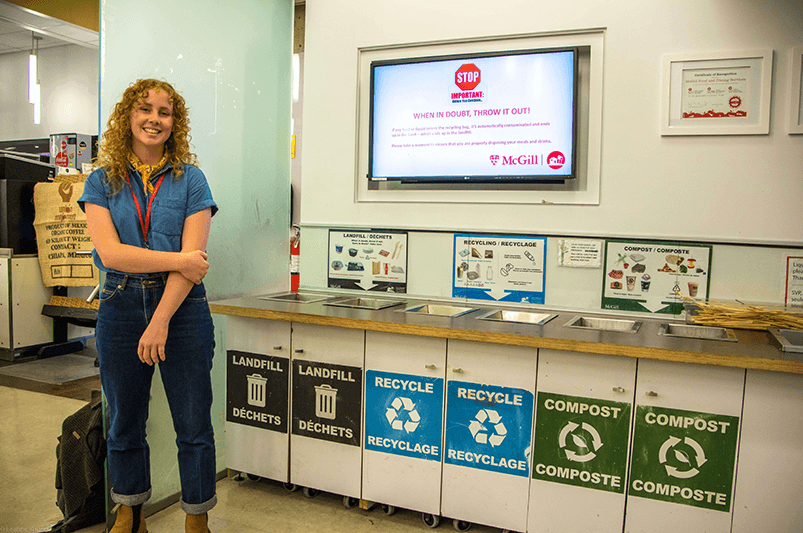
Since 2015, McGill Student Housing and Hospitality has united a team of approximately 30 Waste Educators to engage with students about sustainability and the importance of waste segregation. This team aims to ensure that recyclable or compostable packaging does not end up in landfills. Waste Educators do this by helping first-year students sort their food waste by ecosystem and facilitating casual conversations about sustainable practices. This program takes place at the dining halls in Royal Victoria College, Bishop Mountain Hall, Carrefour Sherbrooke, New Residence Hall, and Douglas Hall three times a day for the first three weeks of the school year.
Sophie Doyon, a U3 Management student studying Managing for Sustainability with a concentration in Social Enterprise, is the sustainability coordinator for McGill Food and Dining Services. Part of her job is to run the waste education program.
“The students are very interested, so they’ll ask a lot of questions and the waste educators are there to intervene if they get confused or want help,” Doyon said. “Their main role is to guide the right waste sorting techniques and teach students who are excited to learn about it.”
Doyon explained that recycling and composting are important for reducing the amount of waste that goes into landfills, which limits greenhouse gas emissions. She also emphasized that although sorting your waste is a great step toward sustainability, the best thing to do is reduce your use of disposable goods.
Energy and enthusiasm from the Waste Educators is crucial for the program’s success. Karan Kumar, a second-year Masters student studying agricultural economics, is one of this year’s Waste Educators. He is passionate about sustainability and believes in the waste education program’s mandate to encourage collaboration.
“It’s a positive campaign that gives hope to the students that, if we take the small steps, we can work towards a sustainable world,” Kumar said. “There’s no blame game. We aren’t creating any hate campaigns over here. We’re just working together.”
The Waste Education program appeals to Kumar because it gives people real, concrete steps to help the environment.
“Everyone can do it,” Kumar said. “It’s not just people working in education. It’s you, me, doctors, engineers, students, anyone who can take the extra effort to segregate their waste, and not only in dining halls, but in their homes.”
Doyon has had many positive experiences interacting with curious first-years and says that McGill students are open and receptive to the initiative.
“Young people […] are great at helping the environment,” Doyon said. “They are really are excited to learn, and the more information we give them, the more skilled they are and the better they do at sorting their waste [….] They’re great at it already, so we’re just there to help out.”
Reactions from first-year students have largely been positive: Hannah Klemets, U0 Science, has found the Waste Educators useful for her and her residence peers who want to clear their cafeteria trays properly.
“I’ve seen multiple people almost throw perfectly fine things to recycle or compost in the garbage, so [the waste educators are] helping McGill be better for the environment for sure,” Klemets said.
The Sustainability and Waste Education campaign wants to instill the idea that students have the power to make a positive environmental impact by actively pursuing sustainability in their own lives. Although the McGill Waste Educators are gone for the rest of the year, McGill Dining Services will be hosting Local Food Day, Meatless Mondays, and Fair Trade Week where Waste Educators can continue the food sustainability conversation with students.
In anticipation of the Sept. 27 climate strike, Climate Justice Action McGill (C-JAM) has filed a petition to the Arts Undergraduate Society (AUS) calling for its members to hold a general strike. Ahead of the AUS’ general assembly (GA) on Sept 25, The McGill Tribune looked into what a strike would look like, and what would need to happen in order for a strike to be called.
What is a student strike?
All students attending a Quebec university are entitled to belonging to a student union, such as the Student’s Society of McGill University (SSMU). These unions are protected under the Act respecting the accreditation and financing of students’ associations, which states that student unions are organisations dedicated to promoting students’ interests within their university. However, students are not employees, and therefore cannot benefit from laws that protect workers’ strikes. For example, employers are forbidden from firing workers on a legal strike; however there exists no specific piece of legislation at the provincial or university level that obligates schools to protect the academic standing of students who strike.
Student strikes still have a history of being a successful bargaining tactic in persuading policy changes. For example, the 2012 Maple Spring protests were a significant factor in persuading the Quebec government to rethink tuition increases. Regardless of whether a student strike is called, Montreal’s global climate march intends to proceed as planned.
What has to happen for a general AUS strike?
The AUS has a policy in its constitution that lays out the necessary steps to call a strike. First, a petition must be presented to the AUS’ legislative council with 200 signatures from AUS members—full or part-time students registered in the Faculty of Arts or the Bachelor’s of Arts and Science program. This step has already been fulfilled by C-JAM’s petition. Now, the AUS’ must call for a GA with five days’ notice. Normal quorum for a GA is 150 members; however, because strike votes have a quorum of 500 members. If the GA does not meet quorum, or the GA meets quorum and students vote against striking, the motion to strike will fail. However, if quorum is reached and students vote to hold a strike, the AUS is bound by the GA to call for a strike for all of its members.
The GA will be held on Sept. 25 at 6:00 pm in Leacock 132. Those who vote at the GA must be AUS members. McGill’s contingent for Sept. 27th’s climate strike will meet on McTavish Street at 11:00 am.
On Sept. 18, McGill held one of three active shooter workshops scheduled for this year. The workshops, which McGill began facilitating five years ago, is designed to inform students and staff about how to stay safe during an active shooter situation. This scenario is defined in McGill’s security protocol as a situation in which an individual attempts to murder or injure others in a confined area.
The workshops cover statistics related to mass shooting incidents, early warning signs exhibited by a potential threat, and what to do in a real active shooter situation. The workshop ended with a viewing of McGill’s Active Shooter Training video, available online. Two Campus Public Safety staff members, Kevin Byers and Jeremme Doucette, facilitated the workshop.
“We really want to sensitize the community to the possible risk,” Byers said. “It’s unfortunate that it’s something happening in society, in the US, mainly. But we also have people [from] around the world who are part of our community, and we want to make sure [that] everybody has the same tools to deal with this unlikely incident.”
Doucette elaborated on the workshops’ aims to provide people with a plan of action when confronted with an active shooter.
“In stressful situations, people refer to what they’ve been taught,” Doucette said. “I compare it to first aid training. You might panic on the way there, panic after the fact, but in the heat of the moment you tend to refer to what you know.”
Audience member Bria Blair, a Student Affairs Coordinator in McGill’s Biochemistry Department, spoke positively of the experience.
“I enjoyed hearing the statistics,” Blair said. “The video was a bit disturbing. Myself, I don’t know how I would react in that situation. It was good to see it, but hard to watch.”
Blair also expressed regret about the low student turnout; only one student, a McGill Tribune writer, attended the workshop.
“It would be nice to see more […] students getting involved,” Blair said. “I don’t feel like enough people really think about the negative things in life. You never know what could happen.”
Byers acknowledged that the topic can be emotionally draining for some.
“As a citizen, as someone who watches TV and reads the newspaper, you see it so often,” Byers said. “If it happens on a weekend, it’s not necessarily a topic of conversation on Monday anymore. We just want to make sure that we don’t get complacent. [Mass shootings] have happened three times in [Montreal].”
In 1989, 25-year-old Marc Lépine murdered 14 women at École Polytechnique. Three years later, an associate professor at Concordia killed four colleagues in another mass shooting incident. The most recent incident occurred in 2006, when a 25-year-old man opened fire at Dawson College, killing one woman and injuring 19 others.
Both Byers and Doucette emphasized that students who prefer not to attend a live workshop could educate themselves in other ways.
“It might [involve] using the resources on our website,” Byers said. “It’s less intense.”
“Unfortunately, given the subject matter, it’s hard for us to make the [presentation] fluffy or fun,” Doucette said. “It’s an active shooter presentation, and it can be a difficult subject for people to talk about.”
Doucette emphasized the importance of finding ways to accommodate people more sensitive to this topic.
“If there’s a student interested, but they’re really not interested in participating in a group because they find it troublesome […] we may have alternative ways of getting that information to you,” Doucette said. “Particularly if you [or your family] have been through that type of situation. We’re really not trying to shock or upset anybody.”

Though it is easy to spend downtime in the McGill bubble, it is always good for students to discover new places in Montreal. Sure, the classic study spots can be soothing, but it is good for the soul to move out of the comfort zone. Case in point: Café Éclair.
This innovative spot, located just north of Fairmount street on Saint-Laurent, is a hybrid between a café and a bookstore. Quite frankly, there is nothing more perfect than sipping on a delicious flat white while perusing a thoughtfully curated book collection.
Café Éclair opened in early July, a joint venture between owners Miranda Ko, Chantale Potié, and Daniel Alvarez. Alvarez and Ko have extensive histories in the coffee and bookstore industries. Alvarez is also the owner of Café Difference, located downtown.
“Most of my [employment] history is with books,” Potié said. “So the inspiration to blend both industries came very naturally.”
The blend is seamless. The decoration is minimalistic, with an impressive attention to detail. From the forest green velvet seating area to the sleek white bookshelves and marble countertop, the café is incredibly stylish. You feel as if you are at a friend’s apartment and a coffee shop at the same time. Furthermore, the staff are all warm and welcoming, further breaking down the barriers between barista and customer. Sitting on a stool at a long counter invokes the feeling of late-night chats at a friend’s home.
“The goal of the space is to have customers feel like they were in somebody’s apartment, […] somebody’s kitchen,” Ko said.
The actual coffee is the major test for students assessing whether the café will meet their needs. The coffee roasters Café Éclair sources produce quality blends: Bows and Arrows from Victoria, British Columbia, and The Barn, roasted in Berlin.
“We chose these suppliers because the coffee is really good but also because their values align with ours and create close relationships with the farmers,” Ko said.
Instead of carrying best-selling novels, Café Éclair offers themed collections of books.
“We come up with a theme and pick a certain number of books around that theme that we think apply,” Potié said.
In their latest collection they are offering about 12 different titles, all around the theme of ‘womb to tomb.’ This theme raises concerns surrounding work, money, and capitalism, and the books touch on those ideas in many different ways. From a book on working honeybees and their importance for our environment; to a children’s book on how a mother’s love is unchanging whether they’re a CEO or a sex worker; this collection is curated to appeal to all audiences. Their collection includes poetry, non-fiction, fiction, children’s books, zines, with a guarantee of both French and English options.
Alvarez, Ko, and Potié have high hopes for Café Éclair. Along with the launch of the café, they started a non-profit foundation as a way to bring the books and the ethics of their place out of the space. Through this philanthropy, they work to benefit their neighborhood and the space they occupy.
“It’s something that’s pretty important for us, not just being a commerce in this neighbourhood but trying to do more,” Potié said.
On Sept. 20, members of the McGill and Montreal community gathered on Lower Field to participate in the 19th Annual Pow Wow hosted by the First Peoples’ House (FPH). The Pow Wow was a day full of traditional dancing, singing, and performances with the purpose of bringing the McGill community together to celebrate First Nations, Inuit, and Métis cultures. The Pow Wow is part of Indigenous Awareness Weeks which was organized by the McGill Indigenous Education Program.
Amber Bedard, the Indigenous Student Advisor for the First Peoples’ House, noted the Pow Wow’s role in providing a unique, celebratory space for Indigenous students at McGill to showcase their culture and pride.
“[The Pow Wow is] a time for the community to come together and celebrate our culture,” Bedard said. “I think it’s really important, especially for Indigenous students on campus, to feel recognized within the institution. Often, there’s not really a space to learn and to feel welcomed in, and the Pow Wow provides that space and welcomes people from all backgrounds to come together.”
The Pow Wow served not only as a celebration of Indigenous cultures, but as an educational opportunity for those who may not have learned about Indigenous history in school.
“What’s really important for the Pow Wow at McGill is to showcase who we are to the community—to students, staff, and faculty, and also to celebrate that we’re still here on Turtle Island,” Allan Vicaire, Director of the FPH, said. “Often times, what happens is [that] through the K-12 history [curriculum], there’s an erasure of Indigenous peoples, and we always want to say that we’re still here, we’re still vibrant, we’re still surviving, [and] we’re still resilient. McGill is an international university, and for newcomers, it’s everyone’s responsibility to learn about the original peoples here.”
Friday’s Pow Wow featured a variety of artisan vendors, Indigenous organizations, and performances throughout the day. Following the opening words and grand entry were a series of intertribal dances and Inuit throat singing. Aneeka Anderson, an Inuk U2 Arts student, and her sister Abigail Carleton performed traditional Inuit throat songs together. Anderson was intially hesitant to perform in front of such a large group but ultimately felt empowered by the experience.
“It took me a while to be in that space where I knew I could do it,” Anderson said. “I think, as Indigenous peoples, a real struggle is ‘are we Indigenous enough?’ But, for me to stand there in my regalia throat singing, having invited lots of people and encouraged them to experience this with me, allows me to feel like they know Inuit are here, and [that] they know [that] Inuit retain culture, have culture, [and] love our culture [….] Sometimes I believe I’m not Inuk enough, but, in this moment, I am.”
The FPH is dedicated to providing cultural, academic, and campus-wide resources to Indigenous students at McGill, and the Pow Wow is just one of many events they hold throughout the year. The FPH also offers weekly cultural events, such as drumming, beadings, and traditional dance sessions. They also offer Finding Your Voice sessions and monthly workshops geared towards academic success. Their next upcoming event is a workshop called “Decolonizing Consent: Reclaiming Land and Body” on Sept. 23, hosted in parternship with the Office for Sexual Violence Response, Support, and Education (OSVRSE). The focus of the event will be decolonizing trauma work and healing practices after assault, and looking at the connection between land and body for Indigenous peoples.
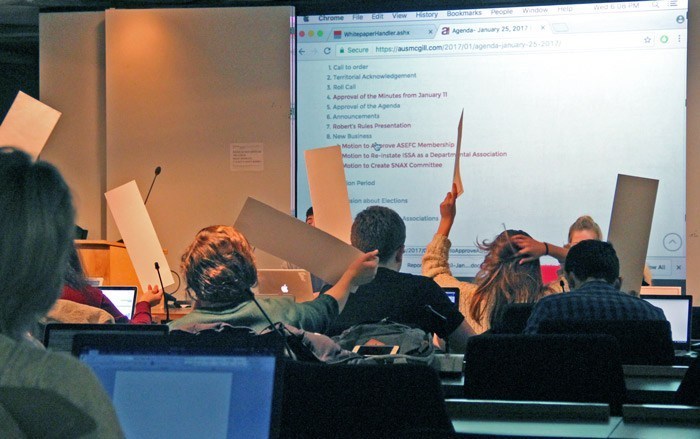
On Sept. 18, the Arts Undergraduate Society (AUS) Legislative Council convened to discuss the McGill Senate’s failure to pass a motion to cancel classes on Sept. 27.
AUS General Assembly is called after to senate ruling on Climate Strike
Student’s Society of McGill University (SSMU) Arts Senator Henrique Mecabó presented the Senate’s report to the council, which included insights into the administration’s view on the choice of individual students to participate in climate activism .
“We had a Senate meeting here this afternoon where the only motion moved was by student senators regarding the Climate Strike […] on Sept. 27,” Mecabó said. “McGill […] will not be requiring classes to be cancelled. The administration believes it is an individual choice that each student join or not join the march, and that students who do want to go to class should not be penalized.”
Without the Senate’s support, any motion to strike on Sept. 27 must be handled at the departmental level. Student societies, such as the AUS, would have to vote to strike independently from McGill’s administration.
AUS President Jamal Tarrabain shared that he had been contacted by Climate Justice Action McGill (C-JAM), a student group that lobbies the McGill administration and Canadian government for climate justice. C-JAM presented Tarrabain with a petition calling for a general assembly to vote for an AUS student strike, which may only be convened if more than 200 signatures from arts students are collected.
As the petition met its quota, the AUS will be holding a general assembly on Wednesday, Sept. 25, at 6:00 pm in Leacock 132. Five hundred AUS members must appear at the general assembly to successfully pass the motion to strike. Tarrabain said that the AUS should demonstrate the importance of climate action by standing in solidarity.
“If AUS can come together as a faculty […] and vote for this motion to strike, I think it would send a powerful message to the administration,” Tarrabain said.
AUS council votes to exempt stipulated campus media organizations from recording ban
Tarrabain moved to exempt certain campus media from the audio and visual recording ban, which was put in place after members of the AUS expressed worry that recording would create a hostile environment for councillors. The ban was initially passed in Feb. 2019, in light of the debates over the summer exchange course POLI 339 in Israel.
Brent Jamsa, Vice President External of the Canadian Studies Association of Undergraduate Students (CSAUS) queried as to whether this amendment infringed on students’ individual rights.
“My concern with [this standing rule] is that Quebec is a one party recording [province],” Jamsa said. “I don’t know if it would particularly apply to [Legislative] council, but you only need one party to consent to a recording. There are other free speech implications on that. Was any sort of outside legal counsel or McGill legal counsel consulted when this amendment was added last year?”
Tarrabain confirmed that legal counsel was not consulted when the amendment was drafted and passed, which complicates this debate with issues of individual rights and freedoms within Quebec. Tarrabain motioned to exempt the following campus media from Article 10 of the AUS Standing Rules: The McGill Tribune, The Daily, Le Délit, and the Bull and Bear. The motion passed successfully.
The Legislative Assembly will reconvene on Oct. 2, 2019.