Latest News

McGill, Montreal, News

Students worldwide march for climate justice

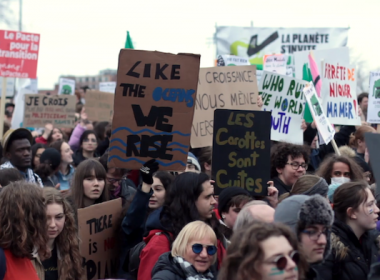
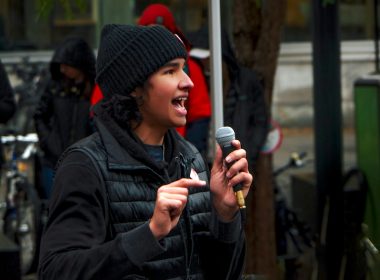
Over 150,000 protesters, including university, CEGEP, and primary school students, joined the Montreal march for climate justice on March 15. The march, organized by the student movement La planète s’invite à l’Université, was one of more than 2,000 of its kind in 125 countries. Around 1,500 McGill students attended the McGill Walkout for Climate Justice demonstration held in front of the Arts Building, later joining a coalition of delegations from other universities and CEGEPs for the main demonstration at Jeanne-Mance Park.

The McGill Walkout’s organizers made three demands of McGill University: That it publicly acknowledge that fossil fuel companies cause grave injurious impacts on humans and the natural environment, that it immediately divest from fossil fuel companies, and that it urge the federal and provincial governments to implement the United Nations Declaration on the Rights of Indigenous Peoples (UNDRIP), which states that Indigenous peoples have the right to conserve and protect the environment. Further, the organizers called on the provincial and federal governments to implement an emergency climate action plan.

Jacqueline Lee-Tam, U1 Environment and Economics and one of the organizers of the McGill walkout, sees no excuse for McGill to postpone divestment.

“[Divestment] is a first step, and it is not radical,” Lee-Tam said. “Entire cities, states, and countries have divested. It is more than possible, and higher returns are being seen in fossil-free investments.”

Lee-Tam believes that declaring a climate emergency is the only way to prevent further irreversible climate destruction and that youth voices are essential to bringing about policy change at the international level.

“What would be radical would be to be complacent on this issue, to not act,” Lee-Tam said. “It’s our future, that’s the whole point of the youth [movement]. We’re taking the power back to have a say in what our future will look like.”

Alex Allard-Gray, member of the Listuguj Mi’gmaq First Nation and outreach administrator for the Indigenous Health Professional Program at McGill, explained that students need to collectively mobilize to amplify their voices.

“Students are very future-minded,” Allard-Gray said. “They’re not only learning about [climate change], but they’re experiencing a lot of these changes first-hand. A lot of us are not in decision-making roles, and it feels out of our hands. That can feel like a very hopeless environment, but, by coming together in these large groups and showing solidarity for [wanting] to change how we are [treating] the environment, it makes our voices heard.”

Allard-Gray pointed out that Indigenous communities often shoulder the most serious consequences of climate destruction.

“There have been constant promises of things to come, and it feels like lip service,” Allard-Gray said. “When [Trudeau’s government is] working with Indigenous peoples, we want to feel included. We want to feel as if we have a say when it comes to what is being done in our territories [….] Governments are going to have to start respecting Indigenous access to land. Consultation should not be a chore.”

Mostafa Henaway, a community worker at the Immigrant Workers’ Centre, explained that climate change disproportionately harms the global south, driving mass displacement and migration.

“This is the natural outcome of a system where profit exceeds everything else,” Henaway said. “[Of a system where] where profit exceeds our democracy, our humanity, Indigenous peoples’ rights […] to self-determine, the right for people to have decent and living jobs, […and] for people to not be displaced on their lands. It’s a crisis for all of us, but we’re going to make it a crisis for them.”

Many elementary and high school students were present at the Montreal March. Zoe Desharbes, a student at Villa-Maria elementary school, explained that it is important for children to make their voices heard because climate change will impact their futures the most.

“We’re here today because [the] climate is changing [and] the planet is dying,” Desharbes said. “It was really nice to see how many people came today. It’s a shame that they didn’t cancel school so that we could all come out.”

Montreal, News

Protesters riot during annual anti-police brutality demonstration

Protestors took to the streets in downtown Montreal on March 15 for the 23rd annual anti-police brutality demonstration. The event was initially peaceful, beginning in the evening with a gathering at Norman Bethune Square. Food Against Fascists provided meals to the crowd and community members took turns delivering speeches highlighting the history of police brutality continuing in Montreal.

Jeremy Thomas, Welding and Fitting student at Laurier Macdonald Vocational Centre, described how intense police surveillance has affected his career. Although he does not believe his situation will change, he came out in support of his fellow residents.

“The police have actually completely destroyed my life,” Thomas said. “I started in Calgary. I was involved with gangs and crime, [and] when that was going on, I had lots of run-ins with the police and justice system. The police became very emotionally attached to me due to the fact that they can’t get me through the justice system. They got me fired from my jobs and constantly bombarded my house with drones, airplanes [and] helicopters.”

From May 2016 to April 2017, the Service de Police de la Ville de Montréal (SPVM) launched a pilot project to evaluate the feasibility of deploying body cameras. 78 patrol members wore the cameras during the project, but the decision to deploy them was rejected by Montreal’s public security committee due to their cost and ineffectiveness. Member of Mouvement Action Justice Robin Edgar claimed that the police’s abusive power extends beyond physical brutality and includes misconduct like false arrests and repression of speech. Edgar believes that body cameras promote better behaviour by police and suggested that officers of the SPVM begin to employ them.

“I think the SPVM has too much influence over politics,” Edgar said. “They have too much power making excuses like, ‘it’s too expensive.’ I do a lot of videoing of police myself and they behave better when they know they are being filmed.”

Event organizer and member of the Industrial Workers of the World Tessa Mascia denounced the SPVM for the shooting of Nicholas Gibbs, an unarmed 23-year-old father from Montreal’s Notre-Dame-de-Grâce neighbourhood, in August 2018. Mascia went on to provide more vivid accusations of how he believes the SPVM have abused their power.

“We have the displeasure today of being surrounded by Montreal’s supposed finest, the SPVM,” Masica said. “Whereas as firefighters have a specific mandate to save people, the state agents of the SPVM do nothing but further tax the already burdened working class with more state fines. They’re the goons of the condo developers when they push out homeless people, and their hands are dirty with the neocolonial genocide of natives in precarious social conditions here on the island [of Montreal] itself.”

Mascia believes that police brutality is a serious problem in Montreal, rife with both physical violence and discriminatory behaviours. She claims that the SPVM targets marginalized groups to reach their ticket quota and she does not believe that policing has any place in today’s society.  

“We need to make policing obsolete, not just by talking about this [issue], but by gathering together and building those better communities [and] those better services,” Mascia said. “There’s absolutely nothing [the police] can do to better train or protect its citizens. The only [solution] is if we as a people dismantle the institution of policing.”

Immediately after the speeches, the group of a few hundred protestors stormed north. They marched down Sherbrooke, setting off fireworks, throwing flares, and chanting ‘No justice, no peace, f*ck the police.” Some individuals began to smash the windows of stores and parked cars, uttering threats and breaking out into fights. The demonstration quickly began to resemble a riot and police were on standby in riot gear.

As a smoke bomb was set off, the SPVM ordered the protestors to disperse due to illegal behaviour that was ‘endangering safety and public order.’ The SPVM has reported on Twitter that two arrests were made for mischief and uttering threats.


A previous version of this article originally stated that the demonstration was hosted by the organization It’s Going Down. In fact, It’s Going Down only publicized the event. The Tribune regrets this error.

Creative

An interview with Leslie Copeland

Leslie Copeland has been First-Year Coordinator at Campus Life and Engagement for more than 20 years. She has seen her role, the school, and the world change around her – but the one thing that has kept her inspired all of these years: the generosity and kindness of McGill’s students.

Video by Beatrice Dimaculangan, Elli Slavitch, and Tristan Surman

Creative

Word on the Y | Where is McGill in the rankings?

The McGill Tribune went to the Y to ask students where they thought McGill fell on the 2018 QS university rankings. Has McGill gone up or down in the rankings? Stick around to find out!

Video by Sofia Mikton, Aidan Martin, Thyaga Dahanayake.

Features

Beyond #ChangetheName

The Government of Canada established Canada’s Truth and Reconciliation Commission (TRC) in 2007 to investigate the history of residential schools. The investigation’s goal was to inform Canadians about the brutal treatment of Indigenous people under the residential school system and to start the process of reconciliation with Indigenous communities. Reconciliation, however, goes beyond the residential school system: indigenous language rightsdisparities and discrimination in the child welfare system, and the coerced sterilization of Indigenous women are just a few examples of persistent injustices that Canadian indigenous people face today.

Off the Board, Opinion

Enough with the unwarranted LinkedIn views

A helicopter pilot once viewed my LinkedIn profile five times in one day before sliding into my DMs. As bizarre as this sounds, I know that I am not alone in experiencing harassment on the platform. Numerous women have come forward about harassment on LinkedIn, and unpleasant experiences sparked the creation of the website CreepedIn, which documents users’ encounters with inappropriate messages. On a forum where professionals want to be recognized for their accomplishments, some individuals are objectified for their appearance instead. Inappropriate LinkedIn profile views affect many users, but they place students in a particularly vulnerable position. Online spaces should not be exempt from zero-tolerance standards for sexist behaviour.

As students prepare to enter the workforce, creating a LinkedIn profile is often the first step in seeking—it generally serves as a first introduction to the opportunities which exist outside of McGill. Although useful, LinkedIn is undeniably strange. It is invariably cluttered with sponsored spam in users’ inbox, and odd lingo such as ‘gurus’, ‘ninjas’, and ‘jedis’. While harassment pervades all social media platforms, LinkedIn differs in that the website sends users a notification when another user views their profile. LinkedIn’s primary efforts to stay engaging and relevant neglects important components of the workplace, like the importance of workplace conduct and resources to help victims of harassment, online and offline.

Profile views are LinkedIn’s currency of clout, boosting users’ egos and keeping them addicted to the site. Often times, the feature is useful, and I find it exciting to see that employers that I look up to are viewing my profile. Most of the time, however, my notifications are populated by user profiles from individuals who work in fields unrelated to my own and whose only unifying trait is that they are middle-aged men. Initially, I had no idea how or why this was happening. However, I realized that I am a young, inexperienced student soon to enter the workforce and that being ‘viewed’ is inherent to LinkedIn and the professional world at large. As students, the early stages of employment are often precarious—especially as we land in ‘probationary’ paid and unpaid internships and entry-level positions. Many of us will face exploitative labor, workplace discrimination and harassment, but still don’t know how to deal with it. This is something we’re introduced to through LinkedIn views and will repeatedly endure in the workforce—universities should prepare us for this as its internship networks and career portals connect us to future employers.

The traditional solution to unwanted social media attention is going into ‘private’ mode: Hiding your profile picture, connections, bio, and everything else related to your profile. But LinkedIn is different because, on this platform, you need to be seen. Obscuring your profile is potentially harmful to your professional future and does nothing to address the root issues of harassment in work-adjacent environments. No one, especially femme-identifying workers and others vulnerable to harassment, should feel the need to hide from professional spaces.

The public nature of LinkedIn gives students an unfortunate, yet realistic introduction to the professional world. Harassment happens in offices, just as it does online. Too many of us have unpleasant and traumatic introductions to a world in which we are being ‘viewed’ inappropriately and it’s essential spaces we interact in foster respect and do not tolerate predatory behaviour. Just as McGill offers Career Development WorkshopsCareer Advising and even LinkedIn Advising, it should also warn of potential dangers in all workplace environments, including cyber spaces. Too many of us have unpleasant and traumatic introductions to a world in which we are inappropriately and unwarrantedly being ‘viewed,’ online and offline. It’s time that we’re viewed for the right reasons.

India
Commentary, Opinion

India-Pakistan tensions: When the international is personal

On Feb. 14, a suicide attack on Central Reserve Police Force (CRPF) in the Pulwama district of Indian-administered Kashmir, a region at the centre of a border dispute between India and Pakistan, pushed the two nuclear powers to the verge of war. The attack, carried out by Jaish-e-Mohammad, a Pakistan-based group, killed at least 40 CRPF personnel. India blames Pakistan for the attack, while Pakistan denies any connection to the militant group and condemned their actions.

The anxiety, grief, and fear provoked by recent events were the same as they were in 2014 when I was in the final year of my GCE O Level examinations, roughly equivalent to Canadian grade 11. A deadly attack on a school in Pakistan resulted in my school shutting down indefinitely as the army launched an operation against militants in the country’s north. When schools did reopen after a few weeks, heightened security measures were in place. I had to leave home early because the queues for security outside our school’s gates were busier than those in some airports. Parents’ goodbyes outside the school in the mornings became even longer. As a Pakistani who experienced the terror of war and saw it inch so close to home, the news of an imminent conflict paralyzed me with fear.

Only this time, some things were different: I am a university student in a foreign country with a circle of friends that includes Indians and Pakistanis alike. When the standoff began, I felt unsure whether we were safe around each other, or if any of my best friends from across the border saw me differently.

Two days after the Pulwama attack, my best friend, who is from India, confessed to having similar concerns. She said that I had sounded short with her on the phone that day and that she hoped it was not because of ‘the India-Pakistan thing.’ My heart sank. Neither of us was overreacting—war does create distance. Some students at McGill had taken to social media to spew hate against ‘the other’; more extreme and jingoistic cases called for war.

But, as tensions between the countries worsened, the opposite shift occurred among my circle of friends. Instead of feeling unsure of how ‘the otherfelt, we huddled around our laptops in the Redpath library at 2 a.m. together, checking the news and worrying that our country would provoke conflict. The following morning, we called each other to check in. We knew that no matter our nationality, we had something more important in common: A love for our homes and for each other. We did not want war, we despised the hysteria, and we hated seeing each other stressed and afraid.

During the past two weeks, despite what I had feared, I have grown closer to many of my Indian friends. They answered my anxious calls with love, and we settled our usual political debates by our mutual wish for peace—despite the hate we saw on our social media and news channels. We all wished for cooler heads to prevail.

The two countries stepped back from the brink of war after Pakistan’s Prime Minister, Imran Khan, offered a round of peace talks when addressing national and international media on Feb. 19. With this hopeful news, my friends and I decided to get together. We had to calm down after a week that reminded us of the gut-wrenching memories of past terrorist attacks, emergency drills, and constant worry for our families back home. My Indian friends and I attending a showing of Bollywood’s newest release, Gully Boy, and shared a meal of biryani to cherish what we had in common and to celebrate the victory of peace over war—not just between countries, but among friends.

Science & Technology

Addressing LGBTQ+ needs in healthcare

At their recent panel on Feb. 25, Healthy McGill and the Nursing Peer Mentorship Program hosted a collaborative forum to address LGBTQ+ needs in healthcare.

“Over 50 per cent of trans people say they are not comfortable going and getting healthcare services and, of people that needed emergency care in Ontario, about 23 per cent opted not to get the care,” Florence Ashley, a transfeminine jurist and bioethicist, said during the discussion.

These statistics are stark evidence of a lack of professionals trained to address the needs of the LGBTQ+ community, which has long struggled to have access to the same basic services as the general, cisgender, heteronormative population, particularly in rural areas. Trans individuals are often forced to travel to large cities to visit one of a select few doctors known among the community for offering adequate services.

Panellists at the forum included Ashley, Kimberly Wong, who works with AIDS Community Care Montreal (ACCM), and Eve Finley, an equity facilitator with the McGill Dean of Students.

“[This session is for] folks who have never heard all the letters to [the LGBTQI2A] acronym and […] folks that may be deeply immersed in trans activism in communities,” Ashley said.

The panel started with an exploration of the meaning of each letter in the LQBTQI2A acronym and the difference between the terms transsexual and transgender. It aimed to educate students, particularly those in nursing, occupational therapy, and dietetics, about appropriate care practices for LGBTQ+ individuals. The forum served primarily as a safe space to ask questions and disenuntangle assumptions about individuals in the community such as the difference between sexuality and gender.

“Sexuality is who you go to bed with, gender is who you go to bed as,” Finley said.

The simple definition cleared up many preconceived ideas at the forum and hinted at a major issue across education systems: The lack of proper, LGBTQ+-inclusive sexual education.

Sex education in Quebec is known to be rudimentary and mainly addresses the needs of its heterosexual population. From teaching students about penetrative sex, contraception methods, and how to put on a condom, sex education in primary and secondary schools is often irrelevant for LGBTQ+ youth. McGill’s programs to train future healthcare professionals are similarly lacking.

During the education session, the panellists divulged helpful tips to put LGBTQ+ patients at ease in a healthcare setting. Sharing one’s pronouns and avoiding the use of gendered titles were just two of the practices.

“As a healthcare provider, you can still support someone and be respectful to them and be inclusive of them even if they are using words to describe themselves that you do not quite understand,” Finley said.

These simple approaches, rooted in respect, empathy, and understanding, were just a few of the recommendations made during the forum.
“‘I would rather die than go to the doctor because I cannot stand being misgendered again,’” Wong said, recalling words from LGBTQ+ individuals she had interacted with.

By educating healthcare professionals on the needs of LGBTQ+ populations, the panellists hope that, one day, such a phrase will no longer be spoken.

Know Your Athlete, Martlets, Sports

Know Your Athlete: Madeleine Whitestone

On Feb. 16, third-year hurdler Madeleine Whitestone secured her season-best time of 9.61 seconds in the 60 metre hurdles at the Raven U-Sport Last Chance Invitational, finishing in fifth place. Whitestone had been struggling with a back injury all season so the strong performance was an encouraging sign of her recovery.

Running has always been a part of Whitestone’s life. She started running triathlons when she was young but also played soccer and field hockey. Eventually, she picked up track, too. During high school, Whitestone ran for the University of Toronto (U of T) Track Club so that she could run year-round rather than just during her school’s short track season.

“I was always a big runner […], so I have pretty much been doing track [and] running for as long as I can remember,” Whitestone said. “I joined the U of T track club. It was really close to my house and had some of the best facilities in the country, so I was really lucky with that.”

Growing up, Whitestone mainly ran long-distance, so when her coach threw her into a hurdles race, she was surprised. However, she performed well and decided to stick with running the 60m hurdles.

“Hurdles, to me, are pretty fun because it makes running a bit more technical, as if it wasn’t technical enough,” Whitestone said. “If you’re doing a longer race like the 400 [metre] hurdles, it’s a lot easier to focus on the hurdling than on the pain.”

Track and field is an exhausting, painful sport. As a result, competitive runners are often self-motivated and independent individuals, so completing workouts are personal challenges and victories. For Whitestone, this is exactly the case.

“A motivator for me is focusing on how accomplished and amazing I will feel after the workout is done,” Whitestone said. “Another huge help in getting through hard days are my teammates. They are always so supportive and encouraging, [and] if someone is really not feeling it [that day], someone else will chime in with a motivating comment and keep us all going.”

Racing is mostly an individual endeavour, though Whitestone and her teammates train alongside each other in practice. However, at the 2019 Provincial Championships, she did get the opportunity to run with her teammates as part of the 4x200m relay team.

“Track, despite it being a team, is an individual sport which can put a lot of pressure on you and [lead to] a somewhat lonely journey,” Whitestone said. “Getting a chance to do a proper team event is really great because we all support each other as teammates, but this gives us a chance to be ‘in it together’ which is pretty fun.”

While many of her teammates have specific routines to prepare themselves before a race, like eating only half of a banana, and exclusively drinking blue Gatorade, Whitestone likes to keep hers simple.

“Pre-race rituals are pretty big on the team,” Whitestone said. “I’m boring and just try to eat a sugary snack about an hour and a half before I race, typically a granola bar or fruit. In terms of music, I know how tacky this is, but I like to listen to Drake because it reminds me of home.”

The Toronto native is currently in her third year of an undergraduate degree in chemical engineering. She hopes to work in the sustainability industry and eventually pursue graduate school after working for a year or two.

“I’d love to get involved in research or work on topics such as the circular economy, where I’d be given a chance to use my degree for good,” Whitestone said.

With the outdoor track and field season approaching, Whitestone is preparing to transition back into longer sprints as well as the 400m hurdles. Having just wrapped up the 2018-19 season, she will condition the way she always has: Performing athletic activities that put less stress on her body, like yoga and swimming, to help her heal after all the strain she accumulates over a season on the track.

McGill, News, SSMU

Progressive groups on campus form alliance

Founded in fall 2018, Solidarity Alliance McGill (SAM) is a new umbrella organization that serves to unite several of McGill’s socially-progressive groups. Student clubs such as Divest McGill, McGill Students for the New Democratic Party (NDP McGill), and Socialist Fightback at McGill and Concordia attended a Feb.11 SAM meeting to finalize the coalition’s constitution. According to the new document, the Alliance will act as a forum for McGill’s left-wing groups to coordinate efforts and is committed to the ‘protection of all those who are unjustly oppressed.’

NDP McGill member Joshua Werber was inspired to help found SAM in Nov. 2018 to foster relationships among parties with similar interests. For Werber, the Alliance represents a way for progressive voices on campus to act in a more concerted manner.

“Whenever there’s a hot issue, the groups will make [an] individual statement,” Werber said. “It becomes very divided. But, if we can all join together to make some sort of united statement on certain salient issues, we can have a much larger impact.”

Maranda Raskin, SAM social media coordinator and member of Independent Jewish Voices (IJV), gave a different reason for SAM’s inception. For her, SAM is also a means for progressives to match political rivals on campus.

“I feel like a lot of conservative groups on campus are, [or] have been in the past, very organized, and this is just a way for us to do that ourselves,” Raskin said.

Raskin believes that SAM will help foster communication between left-leaning groups on campus. She also hopes that the alliance will make it easier for students to get politically involved on campus.

“In the future, we want it to be like a platform for new students who are interested in leftist politics or progressive organizing to come into McGill and have one platform for people to shop around, like a virtual activities fair,” Raskin said.

Members stressed that the non-hierarchical structure of SAM is a crucial part of the organization’s identityno member has a veto.

Students’ Society of McGill University (SSMU) Vice-President (VP) Student Life Cody Esterle confirmed that SAM members have already conveyed their desire to gain club status, which members of SAM hope will guarantee their Alliance’s existence after they graduate.

However, Esterle warned that associating with SSMU is not without its conditions. This comes after the SSMU Judicial Board (J-Board)’s unanimous ruling in May 2016 to prohibit SSMU from politically campaigning against either side of the Israel-Palestine conflict. Specifically, the J-Board found that the Boycott, Divestment, and Sanctions (BDS) campaign, which aims to non-violently pressure Israel into complying with international law, was unconstitutional and violated the SSMU Equity Policy by targeting a country directly. 

“Any group that is associated with SSMU has to adhere to the Judicial Board ruling […] in their official documents,” Esterle said. “All groups would be held to the same standard [whether they are] existing groups or groups seeking [SSMU club] status.”

The J-Board is the dispute resolution body mandated by the SSMU Constitution to adjudicate interpretation of constitutions, namely, the SSMU Constitution but, also, the constitutions of clubs and services under SSMU. Currently, SAM’s constitution supports BDS.

“We’re fully committed to not violating any SSMU legislation or [Judicial Board] ruling,” Werber said. “We respect SSMU and we also are not ashamed of our beliefs, but we’re certainly not going to try to usurp SSMU, and if we’re told there’s an issue we’re going to work in good faith.”

Werber pointed out that several student groups have published pro-BDS material and continue to work with the SSMU. He also noted the Alliance’s stance against anti-semitism which stand independent of its views on BDS.

“Both ‘pro-BDS’ and ‘opposed to anti-semitism’ are independent [principles],” Werber said. “We believe in both because they’re both progressive values. All of our principles are equally important to us. It could happen that some individuals may decide to focus on one of our particular principles, but we’re a very broad coalition and our goal isn’t to be defined by one principle but rather to offer the left on campus a louder and inclusive platform to speak from.”

Read the latest issue

Read the latest issue