Latest News

McGill, News, SSMU

Constitutional challenge contested in judicial hearing

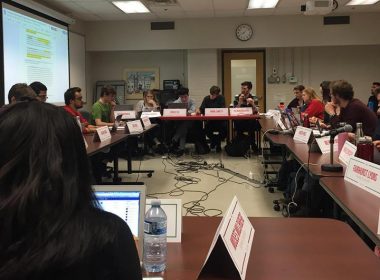
The Student Society of McGill University’s (SSMU) Judicial Board (J-Board) held a hearing on Nov. 20 to determine if the Anti-Violence Fee Levy (AVFL) motion was constitutional. The AVFL passed referendum on Nov. 12 with 79.4 per cent of students in favour of the creation of the new fee, which would fund the implementation of the Gendered and Sexual Violence Policy (GSVP). Arts and Science Senator Bryan Buraga, the SSMU representative who referred the matter to the J-Board’s authority, firmly set the stakes for the hearing in his opening statement.

“[This petition] is a case of sexual violence,” Buraga said.  “This will set a [precedent] for survivors.”

Buraga argued that the AVFL passed with an insufficient number of movers, or individuals supporting the motion. The Internal Regulations of Elections and Referenda (IR-ER) requires referendum questions to have at least four movers before being approved by the SSMU Legislative Council; the AVFL only had three when it passed. Buraga also claimed that the SSMU executives showed poor judgement when they did not immediately allocate funding for the GSVP. He asserted that SSMU has the capital to pay for it given that, following last month’s Children of the Corn Halloween event, SSMU expects to reimburse students $10,000 in Uber fares after they were unable to provide transportation back from Macdonald Campus.

“SSMU has found funding for other ad-hoc expenses,” Buraga said “The VP Internal said that SSMU priotisizes safety over cost, but the executive has demonstrated the opposite.”

Although he was listed as a respondent on Buraga’s petition, SSMU Vice-President (VP) Finance Jun Wang was absent from the hearing. Wang, who is responsible for financing the GSVP, stated that he didn’t believe that his presence at the hearing was warranted.

[My absence] is a statement to be made to the filer of the petition to say how much I don’t believe that this is a matter of constitutionality, but rather [Buraga] is just trying to strike down this fee,” Wang said. “I believe that most people will understand that, with the building closure, the budget is not there and that we’re running at a deficit. If I were to attend the hearing, I would just be repeating that.”

SSMU President Tre Mansdoerfer argued that Buraga has overlooked a contradiction in SSMU policy. The Internal Regulations of Governance (IR-G) state that the Standing Rules determine the number of movers a motion needs to pass: Currently, at least three movers are required. In cases where internal regulations contradict each other, the rules within the IR-G take precedence over the IR-ER.

“Main motions require a minimum of three (3) movers to be presented before Council,” the Standing Rules read.

Buraga replied that there is no contradiction between the IR-ER requiring four movers and the IR-G requiring three. He reasoned that the IR-G only claims that it is necessary to have at least three movers, not that having at least three movers is sufficient, leaving room for additional requirements.

In response to Buraga’s accusation of poor judgement, Loïc Welch, a law student at McGill who represented Mansdoerfer at the hearing, argued that the executive has acted in a manner that assures SSMU student security.

“The President and the executive clearly acted within their standards of care,” Welch said. “They quickly moved the AVFL through SSMU in order to fund the GSVP.”

Buraga, who detailed his own experience with sexual violence in a Letter to the Editor of The McGill Tribune, closed his statement with an impassioned plea to the justices.

“There is an immediate crisis of funding […] and, as a result, I have not been able to get the protection I need,” Buraga said. “No student should have to stand here and go through this.”

Chief Justice Georgina Hartono announced that the J-Board will have two weeks to deliberate.  A written judgement will be submitted to the Board of Directors on Dec. 4, and the Board will either affirm, issue an order for amendment, or deny the judgement.

Creative

SSMU Who? | Episode 1: What is SSMU?

SSMU… Who?

In the first episode of our SSMU Series, Keating Reid investigates what the Students’ Society of McGill University (SSMU) is and does.

Video by Sofia Mikton, Tony Wang, and Bilal Virji

Hosted by Keating Reid

Features

Why we stay silent

I was nine when I first became a victim of sexual violence. I was assaulted again when I was 12, then again when I was 13, and then I stopped counting—so many different people, and so many different faces to remember. Flashbacks are unpredictable. The first snow of the season reminded me of his cold, ashy breath on my neck. I started picking at my nails because of him, and, now, whenever I look at my hands, I think of him. Sometimes, when I’m completing a mundane task like washing my clothes or brushing my teeth, I recall an event that I had almost forgotten about. I see my abusers’ faces in every nightmare, in shadows while I’m trying to sleep.
Off the Board, Opinion

The elephant in the room

Among other deeply instilled habits I’ve developed as a socially-anxious introvert, I make a point of not sharing my political opinions. Somewhere in the midst of the chaotic depression of high school, I found myself a political outsider in my liberal home state of Massachusetts. I was convinced I would certainly become a victim of political violence upon arrival to the so-called leftist hordes of university, a fear ignited by the countless riots in response to conservative speakers at colleges across the country. There’s a misconception in conservative circles that there is no need for safe spaces. However, with the prevalence of violent polarization and the social precedent it sets, everyone needs a sanctuary among the mayhem, conservatives included.

My concerns are perhaps overwrought, but I never got over the lingering fear that the outing of my political beliefs would sever ties with those who love me the most. This fear was only amplified during the 2016 American presidential primaries, when my mother made an uncomfortable habit of pointing out my support for Republican candidate John Kasich to my extended family. This was often met with the well-meaning but overtly-patronizing remark that, surely, I was just mistaken. When my grandfather passed away, I was haunted by the idea that, had I spoken out about my politics when he was alive, he would have had a similar reaction.

Politics has a way of breaking the boundaries of unconditional love. Beyond unfriending Facebook friends with opposing political opinions after elections, the experience of being cut off from one’s family as a result of divergent political views has too often become a reality. As American Thanksgiving looms, so do the articles on how to cope with a loved one being a Trump supporter. As politics are increasingly viewed as synonymous with morality and values, splitting from family members with differing political opinions seems to have materialized as an ethically-viable position. Dehumanizing Republicans has become both morally acceptable and the progressive norm.

The theoretical gap between moral values and stances on government policies is often neglected. Believing in something universal, such as wanting to help others, means different things for different people in the realm of politics. Being for or against gun control does not affect the general stance that mass shootings are abhorrent and unnecessary tragedies. Regardless of political beliefs, most people ultimately want the best for themselves and those they love.

It’s hard for people to separate arguments and ideas from the individuals pronouncing them. People avoid open debates because of their uncomfortable tendency to strain relationships. In the predominantly centre-left university context, this affects who chooses to speak up, and, at a more fundamental level, who feels safe to do so.

After two years at McGill, I have found environments in which open debates are both appreciated and encouraged. Events at McGill such as Freedom Week, run by the Institute for Liberal Studies, supplies a long series of lectures on libertarian topics and is open to undergraduate and graduate students of various political leanings. I’ve also found clubs such as Conservative McGill, as well as friends with similar views. Finding those groups has given me the confidence that I never thought I would have to speak out in class and conferences. For our emotional well-being, we all need a place to feel at home.

McLennan
Commentary, Opinion

Curing the McLennan blues

For many students, midterms, paper writing, and the pressure of the approaching finals season means that they must spend the majority of their waking hours in the infamous McLennan-Redpath Library Complex. McLennan-Redpath is known to evoke strong feelings of anxiety, dread, and stress among its dwellers, due in large part to its drab lighting and brutalist architectural scheme. The libraries’ condition is an issue that Tre Mansdoerfer, president of the Students’ Society of McGill University (SSMU), has raised with administration.

“Everyone, including the librarians, agree that [McLennan] is very outdated and that whoever originally built the building did a poor job of planning it,” Mansdoerfer said. “It’s a really sad place to be in.”

McGill must respond to students’ grievances regarding McLennan-Redpath with the extensive and necessary changes for students to be able to work productively in their library. To this end, McGill proposed the Fiat Lux project in 2014, a library improvement project that aims to address concerns by focusing on acquiring digital materials over print and expanding physical userspace. The plan includes a total overhaul of the library’s outdated construction and footprint. Fiat Lux is a three-phase plan that would begin by moving McLennan/Redpath’s unused books off-site and then completely rebuilding the Redpath Library, before, finally, renovating McLennan to increase much-needed natural light and allow for greater ease of movement.

The McLennan-Redpath complex is the largest library on campus, but students often cannot find space to work in the library, leaving them with few options for quiet study spots on campus. This is detrimental to students’ mental health and, consequently, their schoolwork. Little has been done to improve McLennan since it was built over 50 years ago, and its impracticality has burdened McGill students for just as long. Change is long overdue.

In 2018, McGill announced plans to shift some of its collection around over the summer to create 100 new study spots on the second floor. But, just from looking at the crowds of students in McLennan this midterm season, it’s obvious that more than a few hundred extra seats are necessary. According to the Fiat Lux Master Plan, libraries at a public research university of McGill’s size should be able to accommodate 15–25 per cent of the student population with 30-35 square feet allocated per seat. However, all of McGill’s libraries combined have space for a mere nine per cent of its population. So, it’s only natural that McLennan often feels so cramped and overcrowded that you can practically feel other students’ stress emanating throughout it.

Despite the 30-page master plan published in 2015, the Fiat Lux webpage seems to have been abandoned since then, with little information regarding the timelines of these improvements or whether they will ever come to be. The SSMU Library Improvement Fund website is also outdated and provides little useful information. McGill seems to have begun implementing the first phase of the plan, but this is also unclear: A common theme throughout the McLennan improvement plan. However, according to Mansdoerfer, the university plans to have the project completed some time in the next decade.

Improving McLennan and the rest of McGill’s libraries should be one of the school’s top priorities, although, right now, it clearly is not. Its lack of quiet study spaces or group study areas, sufficient lighting, and general inaccessibility make it much more difficult for McGill students to study. We should not have to worry about these factors on top of our already strenuous workloads.

The SSMU Library Improvement Fund Committee (LIFC) is accepting proposals to improve the downtown McGill libraries. Students will no doubt have a lot to say.

Science & Technology

Tuberculosis: Where are we now?

“We need to science the shit out of tuberculosis,” Madhukar Pai, director of the McGill Global Health Programs, said in front of the United Nations (UN) at their headquarters in New York in September.

The meeting was a historic event; it was the first-ever high-level UN meeting organized to address the ongoing tuberculosis (TB) crisis. Pai’s statement to the General Assembly was an appeal for politicians to increase investment in research and development.

TB continues to be the leading infectious disease killer, claiming the lives of about 1.7 million people in 2016– approximately equal to the entire population of Montreal the same year. An estimated USD$1.3 billion per year supplement to the existing budget is required to fund newer drugs and discontinue the use of antiquated diagnostic tools. Current drugs used to treat MDR-TB, a drug-resistant form of the disease, are highly toxic with side-effects that include deafness. Given the necessary funding, the UN aims to eradicate the disease by 2030.

Although those fighting to eradicate TB pushed country leaders to be present at the meeting in New York and to support the initiative, attendance was underwhelming. None of the G7 heads of state, including Prime Minister Justin Trudeau, were present. The only key political invitee present was South African President Cyril Ramaphosa.

Pai described the turnout as disappointing.

“It is still very hard for TB to be a political priority,” Pai said in an interview with The McGill Tribune.

Between 2014 and 2016, Ebola caused an estimated 11,000 deaths while, in that same period, TB killed more than three million. Pai attributes the lack of concern among politicians to the fact that, unlike other epidemics in the past, TB continues to affect the poorest strata of the world’s population.

“People are quietly dying”, Pai said.“[Politicians] have become desensitized to it.”

In an op-ed for the Huffington Post, Pai stated that, if each country spent 0.1 per cent of its annual gross domestic expenditure on research and development (GERD) on TB, the UN could collectively meet its $1.3 billion USD per year budget. Pai believes that the ongoing TB crisis is a result of an unwillingness on the part of political leaders to allocate funds, rather than a difficult scientific problem to solve. His sentiments allude to the colonial roots of global health, which the numbers suggest are still an influence today.  

“The fact that we have TB up north in our Inuit communities three hundred-fold higher than here tells you that this is not a science issue,” Pai said.

With regard to the future of tuberculosis research, Pai stressed that high-burden TB countries should lead the discourse going forward.

“[The] TB agenda is still being dictated by rich white people from countries with hardly any TB,” Pai said.

Currently, global health initiatives are mostly funded by the United States. According to Pai, this puts global health in a one-sided and precarious position.

“All of global health is under threat under the Trump administration,” Pai said.

Passing the baton to high-burden TB countries that have the money and tools to tackle the problem would be the next advisable step. Pai believes that China and India have the resources and money to take the lead. Furthermore, he thinks it is crucial to involve TB survivors in the conversation to foster a strong civil society movement that will hold politicians accountable for their progress on the issue.

Emerging Trends, Student Life

How students can use ASMR to decompress

Whispering, crumpling, tapping, and buzzing. These are among the most popular autonomous sensory meridian response (ASMR) techniques that millions enjoy over the internet. ASMR allows consumers to experience low levels of euphoria triggered by specific auditory or visual stimuli. Though some people do not experience this phenomenon, it is a growing trend among young adults and students who use it as an easily accessible means of relaxation.   

Individuals who experience ASMR triggers believe that they help to cope with stress, anxiety, and even insomnia. Some describe the feeling as a ‘brain massage’—the equivalent of having someone play with their hair or trace their back. Though research on the effects of ASMR is still unfolding, a recent study at the University of Sheffield found that there are several mental and physical health benefits for those who frequently watch ASMR videos. The study concluded that individuals who experience ASMR tend to have lower heart rates and show significant increases in positive feelings such as relaxation and social connection. Madison Palmer, U1 Arts, explained that, for her, listening to ASMR videos is a form of self care.

“ASMR has a great calming effect,” Palmer said. “If you feel a panic attack coming on or are in the middle of one, it can really help.”

In recent years, ASMR videos have grown in popularity and developed into an art form of their own. ASMR producers, known as ASMRtists, creatively incorporate theatrics and detailed visuals into their video and, sometimes, even tell a story for the duration of the video.

There are currently more than 11 million ASMR videos on YouTube. The most in-demand video to date has over 20 million views. It features an ASMRtist speaking in whispered tones through a 3-D microphone which produces a binaural recording, mimicking how ears hear live sounds. Over the years, many ASMR videos have used this technology in combination with a variety of trigger-inducing techniques like cutting hair, turning pages, and speaking softly.

ASMR videos are ideal for university students since they are a free and calming coping mechanism for academic pressure. In fact, according to Think with Google, individuals between the ages of 18-24 make up more than half of the overall ASMR audience. To Vanessa Barron, U1 Arts, ASMR videos are appealing because they require no thought or brain power to view and are even less strenuous on the mind than music.

“It appeals to our generation because, let’s face it, we’re all stressed,” Barron said. “Hearing and watching something so simple, […] it’s just relaxing.”

Despite its usefulness, ASMR has a polarizing effect among individuals: Some are intrigued, while others struggle to understand the fascination and find the videos’ pseudo-intimacy odd or disturbing. However, no online content is the same. ASMRtists use different approaches and techniques. As a result, artists recommend sampling different content or watching a compilation of triggers. Christopher Cadogan, U2 Arts, agreed that viewers  should explore a variety of ASMR videos and explained that sampling different genres may better help students relieve stress.

“[In general], I struggle to watch ASMR videos,” Cadogan said. “But there’s one in particular that I can watch for hours. […] It’s just about finding what works for you.”

ASMR videos provide a simple and creative way for individuals to de-stress. For overwhelmed university students, the world of ASMR could be key to many students’ mental wellbeing.


Basketball, Martlets, Private, Sports

McGill Martlet basketball stifles Gaiters

On Nov. 15, the McGill Martlets (2-1) made an early-season statement in Love Competition Hall against Bishop’s University (1-1). Their aggressive performance on both ends of the court enabled them to dismantle the Gaiters by a score of 67-44.

In a game during which McGill never trailed, the Martlets smothered Bishop’s on the defensive end: They limited the Gaiters to just 18.8 per cent shooting during the evening. The Martlets also benefitted from the heroics of fourth-year transfer centre Sirah Diarra, who posted a monstrous double-double with 20 points and 23 rebounds.

Scoring was slow to start: The first few minutes of action were a hectic and ultimately fruitless back-and-forth for both teams. McGill struck first on a well-executed out-of-bounds play when second-year guard Charlotte Clayton, who finished with 11 points, knocked down a baseline jumper.

After a subsequent 10-unanswered-point run, the Martlets found themselves up 12-2. However, after several turnovers and fouls, Bishop’s pulled back within four—the closest margin of the night. The period ended with the Martlets back up 10, leading 21-11.

In the second quarter, the Martlets truly took command of the game. McGill benefitted from a string of great defensive plays from Diarra and second-year forward Kamsi Ogbudibe as well as swift offensive execution. The Gaiters managed just seven points all quarter, shooting an anemic 8.7 per cent from the field.

In the third quarter, the Gaiters managed to pull within 14 points of the Martlets. Diarra responded with crucial plays at the rim, and Clayton drilled a deep, buzzer-beating three-pointer, ending the quarter at 48-31 McGill.

By the fourth quarter, every Martlet had gotten involved, either breaking the full-court press for layups, driving hard to the basket to make a play, or knocking down the open jumper. To the delight of the packed house, the Martlet lead ballooned to 24 points at one point before the final buzzer sounded with a final score of 67-44.

Head Coach Ryan Thorne felt that this was one of McGill’s most impressive wins in a long time.

“Usually, we’re very methodical with what we do offensively, and, […] today, we started to change it up to be a little more aggressive,” Thorne said.

Thorne stressed the importance his team put on matchups in their game plan, both in exploiting their interior advantage on offence and in focusing the Martlet defensive effort on Bishop’s two primary threats. Diarra, who attributed her personal success to quick and decisive playmaking, agreed that the team had done well in following through with its game plan.

“This week, we practiced [attacking the basket, moving the ball, and cutting], and today we executed [it] on the court,” Diarra said.

Ogbudibe spoke to the team’s defensive mindset, which allowed the Martlets to dominate Bishop’s throughout the night.

“It was [all about] the details on defence,” Ogbudibe said. “[We] tried to prevent them from rebounding and getting easy put-backs.”

The Martlets will look to build on the win on Nov. 22 when they host cross-town rival Concordia (1-1) for the annual Pots and Pans game.

Moment of the Game

The Martlet offence went cold toward the end of the third period until second-year starting guard Charlotte Clayton hit a pull-up, buzzer-beating three-pointer to end the quarter and put McGill back up by 17 points.

Quotable

“I think this was probably one of the most impressive wins that we’ve had in a long time, just with a bit of a different style to it.” – Head Coach Ryan Thorne on his team’s aggressive offense.

Stat Corner

Sirah Diarra led the way for the Martlets with a dominant performance, as she hauled down 23 of her team’s total 49 rebounds, to go along with her 20 points and four blocks.

Science & Technology

The McGill Department of Physics presents its third annual Hackathon

“I think everyone wins, and that’s not just a fluff sentence,” Nikolas Provatas, professor in the Department of Physics, said at McGill’s Physics Hackathon. “Everyone wins just by being here. If they go back home and they have something positive to say about science, to me, that’s a success.”

From Nov. 3 to 4, 120 eager hackathon participants were assigned to teams of two to five members to  collaborate and solve any physics problem of their choosing.

“The idea is [to] come and hack a solution to a problem you think is interesting [….] At this high level, we try to limit it to some kind of fusion of science, arts, and creativity,” Provatas said. “At the end of the Hackathon, a panel of judges will go around the room, and you have five minutes to sell your hack.”

Participants designed projects able to solve a variety of problems. From finding a way to determine the most fuel-efficient route between two points to modelling Fresnel diffraction and distinguishing patterns created by waves when light is shown through a narrow opening, the projects were diverse. McGill University student Louis Richez, U2 Science, and his team began the hackathon with a preconceived idea: To design a program that is able to process images of handwritten numbers, particularly whether someone has written a three or a seven.

“We are classifying images of hand-drawn digits, particularly digits three and seven,” Richez said. “For each picture of a three or a seven, the neural network will try to identify it as a three or seven [….] The perturbations we are adding are to make the distinctions in the original images more ambiguous, so making threes look more like sevens and sevens more like threes and testing to see whether the network can still distinguish the images.”

Participation was open to high school students through to PhD candidates and most participants hailed from schools in either Quebec or Ontario. The Hackathon encouraged students of any background or specialization to register, offering a chance for younger or non-STEM students to spend a 25-hours learning from their more experienced counterparts.

“Let’s be honest,” Danylo Perkov, a grade 11 student at l’École secondaire Félix-Leclerc, said of the marathon coding event. “In a normal week, with all the activities and the homework, we don’t have much time to just sit and concentrate on a program. It [provides] an opportunity to bring everyone together in one place where we can work together constantly without other [interferences].”

At the end of the competition, judges assessed the final projects not just on technical ability, but also the respective team’s presentation quality and teamwork. The judging process was guided by each team’s individual skill level and experience, providing opportunity for young and inexperienced hackers to compete alongside their more advanced peers. The fair judging method levelling of the playing field allowed for a team of CEGEP students who modelled Fresnel diffraction to finish the competition in first place.

An enthusiastic team of nine organizers spent six months preparing for the event. At the Phi Centre in Montreal’s Old Port, an additional 20 mentors, many of whom were prize-winning participants of years past, joined the team. The hackathon hosted presentations by their partners including Google throughout the event, which also featured introductory workshops on Arduino, Python, and Machine Learning.

Read the latest issue

Read the latest issue