Latest News

Arts & Entertainment, Theatre

Arcadia delves into discussions of science, sexuality, and existentialism

Past and present overlap in playwright Tom Stoppard’s Arcadia, a curious exploration of sex and love, mathematics and nature, and the pursuit of knowledge. Presented by Player’s Theatre and directed by Steven Greenwood (PhD candidate in English), Arcadia portrays the curiosity and determination of young scholars in this brilliant rendition of Stoppard’s 1993 tragicomedy.

Arcadia is set in two distinct time periods: The early 19th century and the present day. However, both eras share the same setting, a long table, the enduring presence of which represents the abstract and intangible nature of time. The table stays immobile throughout the play, and the only clear indication of a change in time period are the characters and the impeccable juxtaposition of their costumes and voices.  

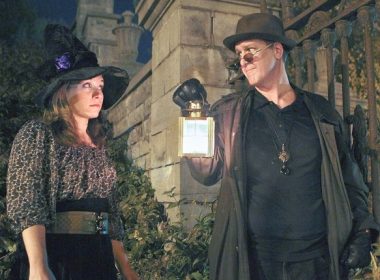
Set in Sidley Park, an English country home, Arcadia’s first timeline revolves around the young and inquisitive spirit of Thomasina Coverly (Liana Brooks, U3 Science), who studies the intersection of physics and sexuality in the early 1800s with her nihilistic tutor Septimus Hodge (Thomas Fix, BA ‘18). Arcadia then flashes forward to the present day, in which academics convene in the same country house to research the home and its garden. The academics include Hannah Jarvis (Tess McNeil, U3 Arts & Science), a practical scholar frustrated by the sexism inherent to academia, and Bernard Nightingale (Huxley Anjilvel, U2 Arts), a charismatic yet stubborn young man who represents the institutional barriers that Jarvis resents.

Greenwood creates smooth and coherent transitions between the past and the present, and although the set remains static, the space is transformed by what transpires within it. The characters from the 19th century exude nobility, their aristocracy depicted by their intricate costumes and verbose dialogue. Lady Croom (Hazel Neil, U1 Arts) and Ezra Chater’s (Lucas Amato, BS ‘18) blustery personalities, both of which comedically captured the sophistication of the represented period, also underscore the signifiers of the time period. The overt gender dynamics also symbolize the past in Arcadia, as exemplified by Septimus Hodge’s condescending tone and authority over Thomasina.  

Young Thomasina and Septimus Hodge partake in hilarious conversations revolving around larger discussions of sex and math that far exceed the maturity levels of the young scholar. Their tutoring sessions quickly devolve into discussions of grandiose themes and questions, and the actors’ chemistry makes for realistic, reflective, and memorable interactions.

The present day trades the luxury of the 19th century costuming by dressing stuffy academics in drab suits and stiff attire. Bernard captures the trope of the tenured professor and the profession’s associated vanity. He personifies institutional misogyny, constantly dismissing Hannah’s research and unfairly giving her book a poor review. Though he is more concerned with undermining his subordinates than with his own research, he continues to receive public praise. McNeil successfully captures her character’s frustrations with Bernard through a fiery determination to uncover the histories of Sidley Park and prove him wrong. In its depictions of both past and present, Arcadia critiques academia’s patriarchal structure.

“I am always drawn to projects that restore lost histories, particularly stories that have been lost due to oppression and marginalization,” Greenwood said.

Stoppard displays a passion for knowledge across multiple disciplines, including poetry, science, math, philosophy, and history. Arcadia embodies the intersection of these disciplines across two different time periods, reflecting the parallels between characters and their intentions in the contrasting temporalities.

Arguably, the irreversibility of time is Arcadia’s most dominant theme. Thomasina’s tutoring sessions on thermodynamics and heat reveal the bitter truth that time only moves forward and that heat can only travel in one direction.

“Newton’s equations go forward and backward,’ Thomasina said. “They do not care which way. But, the heat equation cares very much. It only goes one way.”

Thomasina’s insightful ideas and heartwarming personality, beautifully portrayed by Brooks, leave the audience questioning time and nature long after the end of the play.

McGill, News

Social work students protest against unpaid internships

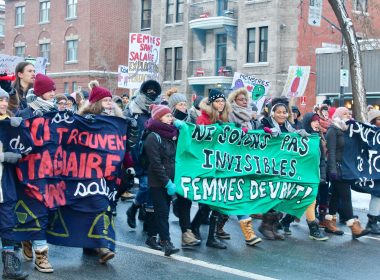
From Nov. 19 to 23, students in McGill’s School of Social Work went on strike against unpaid internships. The strike was organized by the Social Work Students’ Association (SWSA), with participants standing in solidarity with similar efforts by Université de Québec à Montréal (UQAM), Université de Montréal, and 54,000 other social work students, rallying under a larger provincial-level protest led by the Comités unitaires sur le travail étudiant (CUTE).

The School of Social Work faculty voted unanimously on Nov. 14 to support the strike by cancelling classes for the duration of the week. However, an email sent by the School of Social Work Director Nico Trocmé and Dean of Arts Christopher Manfredi reminded faculty of their legal obligation to continue instruction as usual.

“Teaching faculty support the concerns of the students, but we do have a requirement to teach classes, both as part of our legal requirements and with respect to requirement [to provide instruction],” Trocmé said to The McGill Tribune. “Any student who requests class is entitled to have class.”

SWSA strikers joined CUTE strike participants at a demonstration on Nov. 21 on UQAM’s downtown campus, where students from across Montreal gathered to demand compensation for their field placements.

In an interview with the Tribune at the demonstration, Vincent Mousseau, U2 Arts in the School of Social Work and SWSA Internal Affairs coordinator, attested to a right for compensation for mandatory labour.

“We’re here protesting unpaid internships,” Mousseau said. “More specifically, the School of Social Work at McGill does 800 hours of unpaid internships without any remuneration. We think this is unfair.”

At McGill, the Bachelor of Social Work requires that students take, and, thus, pay for, 800 hours of field placement courses that are usually unpaid. Although unpaid internships are illegal in Quebec, the law makes an exception if they are part of a program approved by a university, college, or secondary school board. At McGill, Nursing and Education students are also required to complete unpaid field placements as a part of their degree.  

Matthew Savage, U3 Arts in the School of Social Work and the strike coordinator for SWSA, sees unpaid internships as a problem that all students can unite against.

“I like to know that this isn’t just a Social Work fight,” Savage said. “This is a fight for Nursing and Education, and its about time that they get involved.”

Sandy Esvina, U1 Arts in the School of Social Work, believes that unpaid field placements are more common in female-dominated professions.  She argues that students studying in male-dominated fields, such as engineering, are more likely to receive compensation for program-related work.

“Your grade depends on [unpaid internships], and people take advantage of that,” Esvina said. “Why are [social work students] not paid? This is really a feminist issue [….] We’re in 2018, women should be paid equally to men, and our work is just as valuable.”

Esvina believes that the labour of social workers as a whole, like many care-centred fields, is undervalued in popular opinion.

“I work in youth protection,” Esvina said. “So, when I’m going to go do my [internships], I’m going to be doing very vulnerable work because I’m teaching these kids to [reintegrate into] society [and] how to learn to trust again. I’m going to be helping [those people] and I think my work is valuable enough to be paid for it.”

Quebec Education Minister Jean-François Roberge called the social work protest ‘premature.’ In an interview with the CBC on Nov. 19, Roberge stated that he is in the process of studying and evaluating solutions for the issue of unpaid internships.

Album Reviews, Arts & Entertainment

Album Review: ‘Music Inspired by Illumination and Dr. Seuss’ The Grinch EP’ by Tyler, the Creator

Following the critical and commercial acclaim of 2017’s Flower Boy, Tyler, the Creator—the now reformed enfant-terrible of the softboy hip-hop world—opened up a world of artistic possibilities for himself. Given his disregard for public opinion, it isn’t entirely surprising that his next artistic endeavour would be a new rendition of “You’re a Mean One, Mr. Grinch” for the recent remake of the children’s classic How the Grinch Stole Christmas, and an accompanying EP inspired by the green man himself.  

Vaguely amusing at best, The Grinch EP teeters between irony and sincerity; its inability to commit to either camp is ultimately its greatest shortcoming. As a pseudo-children’s album, its complete lack of lewd language is its most striking feature for frequent listeners of Tyler. In comparison to the vulgarity of past releases, Tyler’s newfound commitment to censorship is a strange move. If the EP had a target audience, it would be twenty-something ex-Odd Future fans who are also new parents. Considering that Tyler once rapped “chilling with the Polar Bear / That used to work for coke, Santa’s sniffin’ coke” on a track aptly titled “Fuck Santa,” hearing the self-proclaimed “Satan’s Son” mumble rap about what type of milk he likes in his hot chocolate is certainly a change of pace. It’s two percent milk for those who are curious.

None of the tracks exceed two and a half minutes, which is ultimately for the best. It’s obvious that Tyler had fun with the EP, even managing to get Santigold and Brockhampton-attaché Ryan Beatty to feature on the festive track “Lights On.” Sonically, The Grinch EP is the younger sibling to Flower Boy, both incorporating similar elements of neo-soul, while also favouring a smoother sound over punchier, jarring rap rants. Still, Tyler maintains the same bravado while rapping about stealing presents from all the Whos down in Whoville on the track “Big Bag” that he displayed when talking about crashing private jets and killing B.o.B. Sadly, The Grinch EP never reaches the level of pure fun and catharsis that it could, and instead will have to spend this holiday dinner relegated to the kids’ table.

S
Editorial, Opinion

The current S/U option is unsatisfactory

As the end of term nears, students start scrambling to calculate the minimum grades they need to achieve on their final exams to pass their courses. Amidst the stress, the Satisfactory/Unsatisfactory (S/U) grading option offers some respite. Vice President (VP) University Affairs (UA) Jacob Shapiro wants to incentivize students to continue studying for their S/U classes, even when they’re guaranteed to pass. Shapiro is advocating for a change to the S/U system that would allow students to convert their ‘S’ grades back to regular letter grades. While Shapiro’s proposal sounds promising, an updated S/U policy alone cannot encourage students to take a variety of courses, and McGill must continue encouraging students to take classes that fall outside of their comfort zones.

Currently, during the add-drop period, students can opt to take elective courses through a model under which final grades are represented by either an ‘S’ if the student passed with a 55 per cent or above or a ‘U’ if the student failed. Neither option is reflected in a student’s GPA.

Shapiro’s proposal would allow students to switch their ‘S’ grade to whatever letter grade they would have received in the course under the normal grading scheme for up to two weeks after the release of their final mark. By suggesting this change, Shapiro hopes to incentivize students to fully engage with their elective courses. Similar options exist at other universities: Both Columbia and Yale have alternative S/U programs that allow students to ‘uncover’ their grade after they’ve received it.

On Nov. 1, the Students’ Society of McGill University (SSMU) Legislative Council voted to formally recognize Shapiro’s mandate to advocate for the proposal. However, Shapiro’s plan has some critics. The president of the Computer Science Undergraduate Society (CSUS) Kyle Rubenok believes it would privilege those who have the money to retake courses until they receive a higher grade. Dubious as this claim is, Shapiro still needs to refine his proposed changes to address other concerns, like devaluation of the ‘S’ mark and grade inflation. Shapiro’s plan risks undermining the purpose of the ‘S’ grade, as students who received high numerical grades will most likely uncover their grade to boost their GPA. This then suggests that students who choose to keep their ‘S’ did not receive a good grade in the first place. Additionally, Shapiro needs to clarify whether uncovering S/U grades would allow students to apply those courses to their major or minor, if they decided they liked the course and want to pursue further study in the field.

Moreover, the S/U policy alone is not enough to encourage students to take courses beyond their major and minor areas of study. McGill’s academic culture is highly competitive, incentivizing students to take easy courses that will boost their GPAs to supplement their resumes for future job searches and graduate school applications. Encouraging students to take electives outside of their programs will make their education more holistic, provide them with interdisciplinary skills, and even introduce students to subjects they didn’t expect to enjoy.

Shapiro’s proposed changes still have a long way to go before implementation. However, this does not mean that McGill cannot continue to prioritize interdisciplinary learning in the meantime. One standout example is the Bachelor of Arts & Science (BA & Sc.), a degree that is offered jointly by the Faculty of Arts and the Faculty of Science. McGill’s B.A.& Sc. program is relatively new, and it can look to McMaster’s BA & Sc., which offers courses unique to the program. McGill can also follow the lead of universities like Brown, New York University, and Northeastern, where students can design their own major program.

However, interdisciplinary programs at McGill, such as Liberal Arts, have limited enrollment; the North American studies program, which combined history, political science, and economics courses, was recently cut. McGill can continue to promote and refine interdisciplinary programs like Liberal Arts to increase student enrollment.

These examples demonstrate only a few of the ways in which McGill could continue to promote interdisciplinary learning. Its graduates will be better equipped for future employment or graduate studies if they are provided with a diverse array of skills. But students won’t branch out unless the accompanying incentives are realigned—and a new S/U option is an adjustment worth considering.

News, PGSS

McGill library misplaces PGSS contract

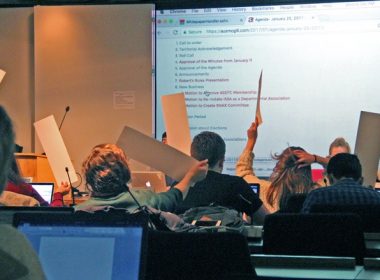
At the Post-Graduate Students’ Society of McGill University (PGSS) meeting on Nov. 21, councillors discussed the McGill-PGSS Library Improvement Fund (LIF) contract and voted to endorse changing the Redmen name. Despite the setback of missing documentation, Sara Allan, PGSS Library Improvement Fund coordinator, presented on the LIF and the Council voted to support it.


Motion for McGill-PGSS Library Improvement Fund Contract

The PGSS Library Improvement Fund (LIF) of $3.00 per student has existed since 2009 to fund projects and proposals that improve the McGill library environment for graduate students.

Although the LIF expired last semester, PGSS currently has a total of $400,000 in funds generated by the fee, held in a bank account managed by the McGill Library services. Allan believes that the LIF should be continued, referencing the results from the recent PGSS graduate library-use survey.

“Over 100 students were surveyed and over half of them use the library weekly or daily,” Allan said. “There are [also] a substantial [number of graduate students who] use the library electronically. That was more than I expected, so that is a really good argument to continue this fund.”

Allan disclosed to the Council that the contract governing the management of the LIF and documentation of past projects, which were entrusted to the McGill Library for safekeeping, are missing.

“The major issue is that we are facing at the moment is [that] our memorandum of agreement is missing,” Allan said. “As of now, we are in the position of wondering what to do. We need to find the memorandum agreement […or], if we cannot find the document, we will write a new contract.”

Allan explained that a referendum to renew the LIF cannot take place until the contract is either found or replaced. She presented some ideas of future projects that the LIF can fund once a new contract is drawn up to prepare for a referendum.

“[Graduates have requested] lockers at individual desks so people can lock their laptops up and go to the bathroom, and a tech lending [system] of chargers, laptops, and other tech devices,” Allan said. “Library planning as of last week said that they were actually willing to support this and do the cataloging and care of these items if we do our half of the work.”

PGSS Secretary-General Helena Zakrzewski urged the adoption of the motion and claimed that a legally binding contract will avert future problems by establishing expectations for both McGill Libraries and PGSS.

“With the creation of a contract, we are able to hold both parties, ourselves included, [accountable],” Zakrzewski said. 

The motion, which called for the development of a new contract before a referendum to renew the fee in the future, passed with a majority voting in favour.


Motion for endorsing ‘Change the Redmen Name’

The name ‘Redmen’, used by men’s varsity teams, has recently drawn attention for its use as a racial slur against indigenous peoples. PGSS Member Services Officer Jeremy Goh and PGSS Equity Commissioner Harmehr Sekhon motioned to sign both an open letter and a petition spearheaded by varsity athlete Tomas Jirousek, calling for the immediate renaming of the men’s varsity teams. During the question period, Patricia Goerner-Potvin, Vice President communication of the Human Genetics Student Society and former athlete on the varsity rowing team, explained the origins of the Redmen name.

“‘Redmen’ originally [started] from the Redcoats and the [Scottish] history of McGill, so that was the main argument for why it was not racist,” Goerner-Potvin said. “In the ‘80s and other times, [however], various different sports teams have turned it into a racial slur by associating [the term] ‘Squaw’ with some of the women’s teams and ‘Mohawk’ to some of the men’s [teams] to reference it as being Redmen from native people.”

The motion passed by an overwhelming majority.

Basketball, Sports

Carmelo Anthony: From star to slouch

The 2018-19 NBA season’s opening weeks have been exhilarating after blockbuster off-season moves and progress from the league’s youngest stars have brought in a wave of new title contenders like the Philadelphia 76ers and the Milwaukee Bucks. But, with the rise of the new guard comes the fall of Carmelo Anthony.

After just 10 games with the Houston Rockets, Carmelo Anthony was benched for illness, and, on Nov. 15, General Manager Daryl Morey revealed that Anthony’s time with Houston was over. Of these 10 games, Anthony started in two, and the Rockets, a hopeful title contender, managed to win just four. His time with Houston was the worst in his career: Averaging a shade under 30 minutes per game, Anthony saw his field goal percentage drop to an all-time-low at 40 per cent. His Player Efficiency Rating dropped to 11.55, making him the 226th most efficient player in the NBA. These statistics are a sharp departure from Anthony’s previous all-star status.

His recent failures in Houston are reflective of a theme that has plagued his career: Selfishness. Most recently, in his time with the Oklahoma City Thunder, Anthony refused to accept a bench role on a winning team. As a result, the Thunder let him go in the offseason, which led to his signing with the Rockets.

Anthony has displayed this attitude even earlier in his career, pushing a trade from Denver to New York that has kept him from making it to the second round of the playoffs ever since. That 2011 trade was a major turning point in Anthony’s career; by forcing this deal instead of signing with the Knicks as a free agent, he ruined his chances of playoff success. The trade lost the Knicks four promising young starters to clear cap space for his three-year, $65M contract extension, dooming them to just three playoff appearances in Anthony’s seven years.

However, there is a larger trend that explains why Anthony is faltering: The NBA is shifting away from the ‘franchise player’ mentality. Over the last decade, superteams, like the 2014 San Antonio Spurs or the current Golden State Warriors, have risen to the top of the standings by placing emphasis on collective teamwork. In the 90s and early 2000s, the NBA saw prominent use of offensive systems, such as the triangle offense, that depended on superstars like Michael Jordan, Shaquille O’Neal, and Kobe Bryant. More recently, however, the league has entered a new age. This era has no room for ball-dominant players like Carmelo Anthony—he has become a relic of times past.

With Anthony’s departure from the Rockets comes speculation about the future. Anthony can retire, or he can learn to take a smaller role on a winning team. The first option isn’t unprecedented—NBA Hall Of Famer Tracy McGrady retired at age 34, and he has advocated for Anthony to do the same. However, since Anthony won’t be in favour of letting his career end on such a sour note, the second option is more likely. In that case, teams like the Denver Nuggets or Los Angeles Lakers will clamour for his services because, despite all of Anthony’s flaws, the NBA still won’t give up on one of its fading superstars.

Basketball, Men's Varsity, Sports

McGill men’s basketball rattled by Stingers

On Nov. 22, the McGill basketball teams hosted their annual Pots and Pans Night. Unfortunately, the raucous crowd went home disappointed, as the McGill men’s basketball team (2-2) could not complete its comeback against the crosstown-rival Concordia Stingers (2-1) and fell by a score of 87-81.

McGill started the first quarter powerfully, and fifth-year point-guard Alex Paquin helped set the tone. He scored McGill’s first seven points and had nine total in the frame. Fifth-year forward Noah Daoust did an excellent job keeping Concordia away from the offensive glass early. On the offensive end, McGill moved the ball efficiently, and threes from third-year forward Edgar Brown and first-year guard Anthony Fisiru helped build a 19-12 lead at the end of the first.

In the second period, both teams’ offences found their grooves. After McGill second-year guard Sam Jenkins converted on a three-point play to stretch the lead to 28-21, Concordia went on a 14-3 run over the next two minutes to take a 35-31 lead. The McGill side, however, battled back to take the halftime lead, 41-40.

Coming out of the gate after halftime, neither team could do anything to stop the other from scoring. It became clear that the first team to find their defence would gain an edge.

“We came out in the second half very slowly,” first-year forward Brennan Laidman said. “We basically just traded baskets the entire time [….] We ended up falling behind and we couldn’t make it all the way back after that.”

At one point, Paquin and Concordia guard Ricardo Monge showed what it meant to trade baskets. First, Paquin converted a rare four-point-play. Then, Monge made a layup through contact and the ensuing free throw. Then, it was Paquin’s turn again: He hit his free throw after being fouled while making a layup to give McGill a 51-48 lead.

The Stingers then started connecting from long-distance more consistently: They went 4-8 from three-point range in the frame and shot 42.3 per cent for the night. As a result, Concordia’s three-point deficit became a 12-point lead by the end of the quarter. The Stingers slowed McGill down and finished the third ahead 70-58.

A quick 6-0 run for McGill to start the fourth quarter cut the Concordia lead in half, but, ultimately, McGill’s lack of execution on the defensive end stopped them from taking home the victory.

“We responded pretty well [at the start of the fourth quarter],” Jenkins said. “Again, we couldn’t get stops. We couldn’t stop the drives, and they were kicking out for easy shots, wide-open.”

With the Concordia lead down to six points and 3:26 remaining in the game, Daoust fouled out. That loss made it more difficult to stop the Concordia offence without a key presence in the post to match up against Stingers centre Olivier Simon, who finished with a game-high 32 points.

The game was not over yet, though: A quick McGill run cut the Stingers lead to three once again. And, with 15 seconds to play, the home team forced a turnover to get one last chance to tie the game. However, Paquin missed his three-point shot, and three Concordia free throws ultimately sealed the Stingers win.

McGill has ten days off to recuperate after the tough loss. They play next on Dec. 1 against the Bishop’s Gaiters (3-1) in Lennoxville, Quebec.

Moment of the Game:

Fifth-year guard Avery Cadogan knocked down a three-point shot to cut the Concordia lead to 72-70, bringing the 546 fans packed into Love Competition Hall to their feet.

Quotable:

“Both coaches went really small. Avery [Cadogan], who’s normally a three [a small forward], was playing centre for us [….] It’s less opportunity for mismatches, it’s harder to get open shots. But on defence, it’s easier for us because we can switch everything, and we can block out.” – McGill guard Sam Jenkins on the last three minutes of the game.

Stat Corner:

McGill’s second and third quarters were poor defensive efforts, as they allowed Concordia to score 58 points combined.

Arts & Entertainment, Film and TV

‘Island of the Hungry Ghosts’ exposes the inhumanity of immigration detention centres

When filmmaker Gabrielle Brady went to Christmas Island, a tiny speck of land in the middle of the Indian Ocean, she was expecting to just relax by the beach. Beyond observing the mass migration of forty million red crabs which scuttle from the depths of the jungle toward the coastline every year to spawn, Brady was not anticipating an eventful trip. Amidst the otherworldly beauty of the island, however, she encountered a dark secret in the middle of its dense, luxuriant jungle: A high-security detention centre for hundreds of migrants seeking asylum in Australia. In Island of the Hungry Ghosts, which won Best Documentary at this year’s Tribeca Film Festival, and was screened Nov. 18 by the Montreal International Documentary Festival (RIDM), Brady weaves together multiple narratives of migration into a single hypnotic portrait of ethical and spiritual conflict.

The film follows Poh Lin Lee, a trauma therapist whose job is to support migrants held at the detention centre as they navigate the immigration process. As they recount why they were forced to flee their homeland, detainees disclose how little their lives have improved since reaching Christmas Island. Relating brutal, zoo-like conditions and forced separations from their families, the migrants must wait indefinitely as their fates lie in the hands of bureaucratic immigration officials indifferent to their cries and concerns. The migrants must cope with both the devastation of leaving their old lives behind and the uncertainty of finding a new one in Australia.

For many detainees, the struggle proves unbearable. In one particularly distressing scene, the camera zooms in on Lee’s tear-soaked face as she learns that some of her patients have harmed themselves, including one man who stitched his lips shut to protest his mistreatment in the detention centre. This incident reportedly inspired 20 other inmates to do the same.

Lee offers suggestions to the authorities on how to better accommodate the refugees, but her advice goes unheeded. When her patients fail to show up to appointments, she inquires about the status of their immigration; however, because of confidentiality laws, she does not receive any tangible answers from authorities. Lee’s sense of despair mounts as she tries to help people who are powerless themselves, their spirit breaking down as months turn into years.

According to local legend, the souls of certain people who perished on Christmas Island are caught in limbo. The miners who once worked in the island’s phosphate mines and died without receiving proper burials are among the spirits doomed to wander the jungle for eternity. The island’s inmates, most of whom are of Chinese, Australian, Malay, English and Indian descent, carry out “hungry ghost” rituals to appease the wandering spirits and help them enter the next realm.

By juxtaposing these narratives with the yearly exodus of the red crabs inching their way across the jungle, Island of the Hungry Ghosts poetically exposes the irony and absurdity of current xenophobic attitudes toward migration and refugees. Park rangers and residents go to great lengths to help crustaceans safely make their way to the ocean and carefully assist ‘hungry ghosts’ in their voyages to the beyond, but fail to provide care to the flesh-and-blood human beings in need.

Complemented by an eerie score and a lush, languid cinematography that captures Christmas Island’s beauty, Brady’s film successfully connects viewers with individuals whose humanity has been violated. Prompting timely discussions about immigration and human rights abuses, Island of the Hungry Ghosts’ haunting beauty and troubling relevance linger.

Science & Technology

Electric impulses help paraplegic patients walk again

Three paraplegic patients with chronic spinal cord injuries are now able to walk again thanks to new Swiss neurotechnology and a multidisciplinary team that includes two McGill graduates.

The STIMO (STImulation Movement Overground) study published in Nature this month, proposed a new technology to accelerate recovery from spinal cord injuries. This new ‘spatiotemporal’ method is a form of electrical epidural stimulation (EES) which stimulates the area of the spinal cord that transmits sensory information. What makes it unique is that, unlike the continuous EES methods used in previous studies, its electrical impulses are separated by intervals.

“The novelty about this [study] is that we use an individual, electrical system to stimulate the dorsal root ganglion [which is located at the spinal cord] to stimulate a group of muscles in the leg,” Molywan Vat, co-author of the study and McGill MSN ‘13, said.

The STIMO study was conducted at Lausanne University Hospital. As a clinical trial coordinator, Vat has been responsible for organizing and screening patients for the past two years. So far, he has selected three male patients to participate in the study, ranging in age from 28 to 48 years old. All were chronically paraplegic, meaning their legs and lower body were partially or completely paralyzed and had been so for over four years.

The procedure involves implanting an electrode chip into the spinal cord. The chip’s electrical impulses, which can be voice-controlled during rehabilitation, can then target motor neurons that pass information from the spinal cord to muscles associated with walking activity. Patients used the chip in physiotherapy which resulted in immediate voluntary control of walking. Over the course of a few months, all three patients were able to walk or cycle outside with the help of a body weight system or walker.

Before EES, activity-based physiotherapy was used to rehabilitate paraplegic patients, through reorganizing neuronal pathways and speeding up recovery. Activity-based programs rely on assisted exercises that, when repeated, activate muscles and re-establish nerve patterns. But, these methods alone are often unsuccessful for patients who are unable to move voluntarily.

Valentin Radevich, McGill MSc ‘17, joined the STIMO project two months ago and worked as one of the four physiotherapists actively rehabilitating the patients.

“You want to push the patient to be as good as they can be, but there are always limits,” Radevich said. “With the STIMO project, you’re stimulating the spinal cord, so you have a little bit more sensation, a little bit more strength. In simple words, you’re reconnecting a few fibres that were broken.”

Engineers, neuroscientists, radiologists, nurses, and physiotherapists were all on the team, fostering a diversity of ideas and opportunities for collaboration. For Vat, the size of the project presented a challenge in the form of coordinating many different schedules and filling out large amounts of paperwork, all while ensuring patient safety throughout the clinical trial. He found his experience working on the project to be very rewarding.

The STIMO project targeted patients who have been affected by paraplegia for a long time, but the next step is to develop a device for patients who have recently experienced spinal cord injuries. The researchers also hope to apply this study to the wider population of paraplegics, which would involve developing a more adaptable device.

With the possibility of extending the project to more patients, the future of spinal cord injury rehabilitation seems bright. But, for now, Vat and Radevich are focused on the present and on the recovery of each individual patient in the program.

Chill Thrills, Student Life

The Battle of Waterloo, but with, like, snow

As the clock struck 2 p.m. on Nov. 23, two teams—one representing Great Britain and the other France—battled in a historically-inspired snowball fight on McGill’s Lower Field to commemorate the 203.5-year anniversary of the Battle of Waterloo. The event recreated the classic story of English heroism and French defeat, reenacted with students’ preferred weaponry: Snow. At a university with significant anglophone and francophone populations, the historical battle seemed all too appropriate.

Colin Jacobs, U2 Arts, started organizing the event a week prior to the showdown, advertising the snowball fight on Facebook as “The Battle of Waterloo but with, like, snow.” Jacobs explained that he wanted to stage a snowball fight and give it an amusing title to attract people to the seemingly-absurd event.

“I wanted to throw a snowball fight,” Jacobs said. “I figured that the Battle of Waterloo was easy enough to divide up by sides, so it would be fun.”

Jacobs denies a direct connection to the historical event, but stated rather that it was chosen as a theme for the afternoon. His purpose for organizing the event was to provide a ridiculous premise to get people together and have fun.

Participants from Great Britain and France were given the first choice to fight for their countries of origin. In keeping with the event’s farcical tone, those remaining were allocated to teams based on their star signs.

Initially, Jacobs did not know if anyone would turn up to the event. Although over 400 people expressed interest on the event’s Facebook page, he doubted there would be a significant showing. Despite these fears, 20 supporters showed up to the snowball battle.

For a while, the teams were locked in a stalemate, but after 20 minutes of on-and-off fighting, the British team overwhelmed the French. Perhaps, the historical Battle of Waterloo presaged this victory in which the British vanquished Napoleon’s army.

“It was all because of my brilliant strategizing, or so I’d like to think,” Larissa Godin, U1 Science and British soldier, said.

In the final moments of the snowball fight, the British side overran the French and defeated their leader, Jacobs, by dividing and conquering. When surrounded by the British side, Jacobs retaliated by tackling the French team. Jacobs, who the British team cast as the de-facto Napoleon-figure during the confrontation, argued that it was the cold that brought the battle to an end.

“I figure everyone stopped when it got too cold to continue fighting,” Jacobs said.

Finn McCleary, U1 Arts, also on the British side, recounted the combat.

“It was quite the battle,” McCleary said. “At first we outnumbered the French twofold. But, their reinforcements came. However, we were strategic and knew if we took down Napoleon [Jacobs], the French would fall. So, we took down Napoleon, literally.”

It was a bleak grey day with a chill in the air. The terrain was treacherous with the snow on the ground, making it difficult for the teams to advance. On the French side was Christiane-Marie Cantwell, U1 Arts, who felt that the weather was not optimal. By the conclusion of the event, participants were tired and weary.

“The snow was not ideal, but we made do,” Cantwell said. “We fought long and hard until the […] end.”

Read the latest issue

Read the latest issue