


Latest News

McGill, News

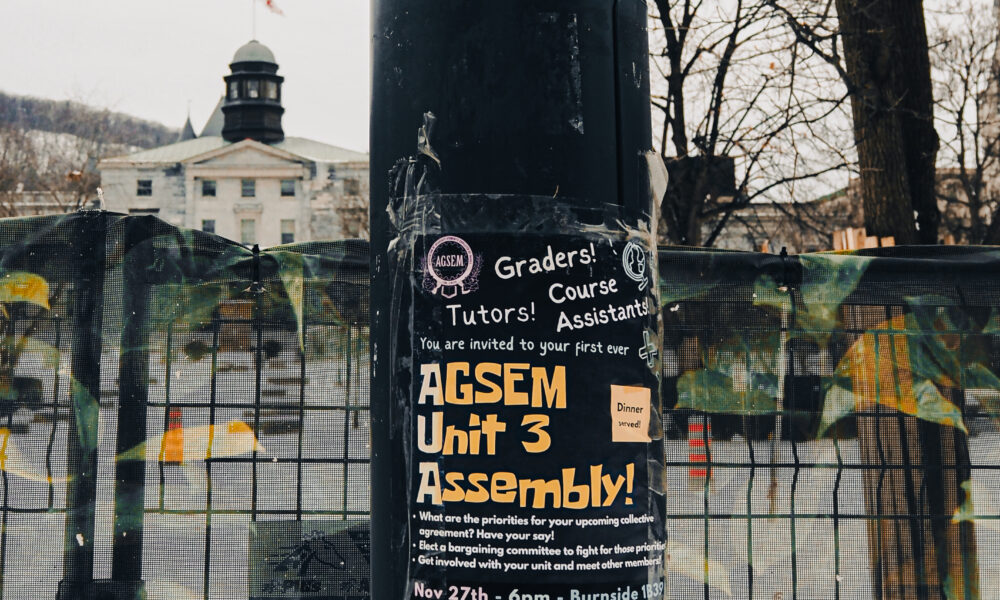
AGSEM experiences negotiation delay for Unit 3 union members

On Nov. 27, the Association of Graduate Students Employed at McGill (AGSEM) elected a bargaining committee to negotiate on behalf of Unit 3, representing over 250 members. Unit 3 is composed of “course-based academic casuals,” which include graders, course assistants, and graduate teaching fellows. Unit 3 is separate from AGSEM’s Units 1 and 2, which represent teaching assistants (TAs) and invigilators, respectively.

Despite Unit 3’s fairly recent formation, they have already elected bargaining committees to negotiate working conditions. AGSEM’s priorities for Unit 3 include pay equity with TAs, protections against harassment and discrimination, and clearer workload definitions. All members are also able to voice their own experiences during negotiations as part of Unit 3’s open bargaining agreement.

Donnie Morard, a PhD candidate in History and Classical Studies and member of the Unit 3 Bargaining Committee, elaborated on the negotiation process in an interview with The Tribune

“Unit 1 TAs went into bargaining last year, so we pushed really hard to make sure these other groups of workers would be protected under a union,” Morard said. “One of the key issues is McGill creates these positions of graders who oftentimes have very similar jobs or tasks as TAs.”

Morard explained that this lack of distinction between a TA’s and a grader’s duties can create inequities. Although some TAs may head tutorials, run office hours, and officiate labs, the responsibilities of many TAs can also be limited to only grading assignments—much like Unit 3 workers.

“Some TA-ships are simply just grading. It’s the exact same job, [a grader] is just as qualified, but it’s more than a $10 [CAD] difference [in pay], along with less protections in terms of hiring and workloads,” Morard said. “We want to close that gap.”

Megan Millet, U3 Arts and a member of the Unit 3 Bargaining Support Committee, noted that this disparity between jobs falling under Unit 3 and those under other Unit divisions varies by department and faculty, making it difficult to ensure consistent protection for AGSEM members.

“What we’ve noticed in Unit 3 is that [McGill] has like 50 different titles for job postings to make sure it is difficult to make sure who falls under Unit 3,” Millet said in an interview with The Tribune. “We’re trying to consolidate this to make sure everyone can be represented, and so that McGill can’t just create new positions whenever they want.”

While McGill is aware of Unit 3’s demands, they have not yet met with AGSEM to discuss them. However, Morard argues that McGill can negotiate the non-monetary aspects as soon as possible.

“There’s a lot of non-monetary aspects to our collective agreement as well, such as hiring practices or topics dealing with harassment and discrimination.” Morard stated. “One of the things we’ve proposed is to hold off on the monetary demands, and we can essentially submit on the non-monetary proposal and start working on this to get the ball rolling.”

However, seeing as the semester has only just begun, Morard expressed some understanding for McGill’s slow deliberation process. In the meantime, AGSEM continues to assess their priorities for future negotiations.

“As of now, we are gathering data by calling up students and Unit 3 members from other departments and faculties for their experience,” Millet explained. “We’re always looking for more people to help join us to make sure we can represent everyone properly.”

In an email to The Tribune, the McGill Media Relations Office (MRO) declined to share the details of their negotiations with AGSEM.

“McGill works with well over a dozen unions, doing our utmost to undertake all negotiations in a timely manner,” the MRO wrote. “That said, we do not comment publicly on details of talks with them.”

Despite these delays, Morard remains optimistic about the future of labour relations at McGill.

“[Unions] create solidarity among different groups of workers on campus and, even though I think the administration doesn’t necessarily like this change, we see McGill union culture becoming stronger,” Morard stated. “I think [unionizing] is not something we can do at the bargaining table, but instead something that we could just do.”

Science & Technology

Fresh produce: The hidden face of food poisoning

Over four million Canadians contract food poisoning every year, making it a relatively common—although intensely unpleasant—ailment. The most commonly identified culprits are undercooked red meat, poultry products, and seafood. However, fresh produce is another source that often gets overlooked. As the general public increasingly recognizes fruits and vegetables as integral parts of a healthy diet, our overall consumption of fresh produce is rising, resulting in increased bacterial outbreaks in the produce supply chain. 

In a recent paper, Pierre-Luc Longchamps, a PhD student at McGill’s Department of Food Science and Agricultural Chemistry, and his colleagues studied how bacterial contamination of fresh produce at each step of the supply chain, along with bacterial dormancy, allows bacteria to entrench itself into our produce. 

Typically, bacteria that cause food poisoning, such as  E. Coli, Salmonella, and Listeria, are not naturally present in fresh fruits and vegetables. Instead, contamination occurs through contact with wildlife before harvesting, through human handling, and from unsafe food storage conditions during processing. This can happen at various stages of production, from contaminated surface water runoff on agricultural land or manure from livestock coming in contact with produce, to the final stages of production if produce is packed in a contaminated environment. 

“A major source [of infection] is from a handler, so anyone who’s picking, cleaning, cutting, or processing the produce. If they themselves are sick, they can often spread it to the food,” Longchamps said in an interview with The Tribune

While people usually cook animal products such as meat and poultry before consumption, they often consume fresh produce raw, making contaminated produce more likely to impact us since cooking serves as an intermediate step to kill bacteria. Bacteria in fresh produce can also evade detection by entering a dormant phase—an adaptive state that makes them harder to measure. 

Bacterial dormancy describes a period where bacteria stop growing and replicating in response to a stressor, allowing them to survive in harsh conditions. This is problematic, since current detection methods involve culturing bacteria on selective growth media.

“[Depending on their dormancy state], bacteria have an intact cell membrane and still [perform cellular] respiration, but if you put them on normal growth media, like a petri dish, they won’t grow [….] However, when ingested, we know that bacteria can revert back to their normal growing states and still cause infections,” Longchamps added. 

Notably, bacteria culturing often uses selective growth media, a controlled environment that only allows a specific bacterial strain to grow. This often prevents dormant bacteria from growing even in their own selective environment due to their dormant state, making detection even more difficult. 

PCR testing, a method used to detect COVID-19 infections during the pandemic, is becoming a credible alternative to current culture testing for bacteria detection in fresh produce. This method could help detect the presence of bacteria even when they are dormant. However, it requires expensive equipment and highly trained laboratory professionals, and is prone to false positives—a test result which incorrectly indicates the presence of a condition. 

In the past few decades, reports of bacterial outbreaks in fresh produce have been on the rise, which is likely because of increased testing and the prevalence of prepackaged mixed salads. 

“For a long time, it was thought that vegetables were relatively safe, and people were more concerned with meats, but as we became better at keeping our meat clean, there’s a lot more [testing] being done on vegetables [….] The rise in popularity of pre-bagged salads [also explains the rise in outbreaks] since you end up with vegetables being mixed together, and if a single vegetable is contaminated, then you end up contaminating everything else,” Longchamps explained. While governments are implementing more preventive measures to prevent bacterial outbreaks and scientists are studying novel detection methods, consumers can also take a few measures: Actively checking produce recalls and thoroughly rinsing fruits and vegetables with running water.

McGill, News, PGSS, SSMU

McGill governance meeting highlights: Week of Jan. 13-17

The McGill Senate,  Post-Graduate Students’ Society (PGSS) Council, and Legislative Council of the Students’ Society of McGill University (SSMU) each held their first meetings of the semester during the week of Jan. 13-17. Senators explored the potential impacts of Bill 74 and Bill 83, and concerns regarding McGill’s new policy for booking rooms on campus. Meanwhile, PGSS councillors discussed the union’s new online health provider and a letter from the Graduate Law Students’ Association (GLSA) condemning  McGill’s ban of event bookings on campus in December. Finally, the Legislative Council’s agenda included the low voter turnout of a recent SSMU by-election and proposed changes to SSMU’s internal regulations. 

McGill Senate Jan. 15 meeting

The meeting commenced with messages from the Chair and McGill President, Vice-Chancellor Deep Saini. He expressed worry about Quebec’s passing of Bill 74, which gives the government the ability to cap the amount of international students in universities. Saini noted that the passage of this bill “poses risks to Quebec’s future, threatens the ability to attract top international talent, and could harm Quebec’s innovation and research centers.”

Saini then mentioned the potential ripple effects of Bill 83 passing, which forces all students who go to medical school in Quebec to work in the province’s public health sector for at least five years or else pay a hefty fine. Saini worried that students will refrain from attending medical school in Quebec because of this new provision, which could affect the enrollment of students at McGill. 

The meeting continued to the question-answer segment. Discussion first turned to administrative support for departments, which is divided into Academic Excellence Centres (AECs). Senator Terry Hébert raised concerns about the effectiveness of AECs when much of the work that should be allocated to these centres still falls on the shoulders of the department heads. 

Provost and Executive Vice-President (Academic) Christopher Manfredi responded, elaborating that some responsibilities should be allocated to department heads rather than the AECs since there are particularities within each department. Still, Hébert noted that the weaknesses of the implementation of AECs outweigh the strengths. 

Arts Senator Vivian Wright then spoke on the impacts of the swift changes in room booking protocol. The new booking protocol implemented on Jan. 1 requires one to fill out a form of 26 questions in order to book a room, when previously a simple sentence or two sufficed. Additionally, under this protocol, room bookings require more advanced notice of 10 days, when before only five days were required. 

“I’m concerned that these issues will lead to a lack of trust from the student body,” Wright said. 

Interim Deputy Provost (Student Life & Learning) Angela Campbell explained that these new provisions were implemented for the sake of the administrative staff. Campbell noted that there are only two big changes to policy: The introduction of the form and increased notice. These features allegedly streamline the process for the ease and efficiency of administrative staff dealing with room bookings. 

PGSS Jan. 15 Council meeting

PGSS Councillors gathered in the Thomson House Ballroom for the body’s first meeting of the semester. 

To start the meeting off, the PGSS executives made announcements to the group which included an update on PGSS’s program to offset carbon emissions from travel that students must make for conferences, the extension of the deadline for the Health & Wellness survey, the fundraising for the Needs-Based Bursary, and programming for Academic Bullying Awareness Week which will take place the last week of January.

Next, the Council went over reports from various executives, PGSS commissioners, and PGSS committees. Only two reports—one from the Equity and Diversity Commissioner and another from the Innovation Committee—were shared directly in the meeting as they had been added to the agenda at the start of it, meaning that councillors had not had access to them prior to the meeting.

The meeting then turned to two discussion items. The first was in regard to PGSS’s decision to switch online healthcare providers from Dialogue to Maple. Member Services Officer Ambre Lambert explained that while the two platforms are comparable in services, Maple is cheaper per student.

GLSA Vice-President External Ajey Sangai raised the second discussion item as a last-minute addition to the agenda. Sangai explained that at the GLSA’s General Assembly in December, the group drafted a letter condemning McGill’s decision to ban speaker events on campus until the start of the winter term. In the letter, students argued that the action impeded students’ freedom of assembly and speech and they urged the university to better communicate the reasoning behind the ban. Students also wrote that the ban follows a pattern of poor communication on the part of the university, pointing to McGill’s emails surrounding the injunction against protests on campus around Oct. 7 this year as another example. 

After a brief discussion on this subject, the Council voted on motions brought to the group prior to the meeting. Out of 12 motions, only four saw discussions on whether they ought to pass. In the end, every motion passed. 

After nearly two and a half hours, the meeting adjourned at 8:53 p.m. 

SSMU Jan. 16 Legislative Council meeting

The first SSMU Legislative Council meeting of 2025 began with 18 out of 34 voting members present on Jan. 16.  

Chief Electoral Officer Emma Chen began by addressing the low voter turnout in the past semester’s elections. Chen claimed that students did not believe ballot items impacted their lives, which led to disinterest in election outcomes and a subsequent lack of participation. To avoid nullified results due to a failure to meet quorum—as was seen in the by-election for the Vice-President (VP) Student Life and VP Sustainability and Operations roles on Nov. 29—Chen proposed SSMU becomes more proactive on social media to better inform the student body of their vote’s impact and importance. 

The council then discussed five proposed motions. First, VP University Affairs Abe Berglas  moved the Motion Regarding the Internal Regulations (IRs) of Representation and Advocacy. The motion stands to revise and shorten the current IRs applied to committees on campus to give faculties more control over how and who is elected as a senator. When electing students to the McGill Senate, a group of councillors representing several committees across campus, University Affairs would take into account a candidate’s lived experience and identity. This would give preference to both students and senators most impacted by a committee’s scope when appointing positions of authority within the group. 

Arts Councillor Ben Weissman questioned the rationale behind the removal of sections of the current IRs, and asked how the university would determine the extent to which a student is impacted by a committee’s subject matter. Berglas responded that only committees which serve a specific motion or demographic on campus would be subject to this motion. 

“The Academic [Policy] Committee, we’re all impacted by that,” Berglas said. “But there’s some that are pretty specific […] there’s a Subcommittee on Queer People, there’s a subcommittee on Black people; being part of those communities it makes sense would give you a leg up.”

VP External Affairs Hugo-Victor Solomon supported the motion, proposing a friendly amendment which added the caveat “if applicable” to exclude committees for which this regulation would be irrelevant. 

When put to vote, the motion passed with 10 in favour, three against, and five abstaining. 

President Dymetri Taylor put forward four other motions which were unanimously approved without debate: The Motion Regarding Interim Club Status for the Green Olive Chinese Christian Club, the Motion Regarding Constitution Changes for the McGill Students Chinese Music Society, the Motion Regarding an Interim Provision to the Internal Regulations of Student Groups, and the Motion Regarding Interim Provision for IRs of Elections and Referenda

McGill, News, The Tribune Explains

The Tribune Explains: McGill’s Canada Award

In October 2023, the Quebec provincial government announced its plan to increase tuition at English universities for out-of-province Canadian students.

While the government’s original plans were to nearly double tuition rates, in December 2023, Higher Education Minister Pascale Déry settled on hiking tuition rates by about 30 per cent. In an effort to sustain out-of-province undergraduate applications, McGill launched the Canada Award, while Concordia University launched the Canada Scholars Award—both of which subsidize part of the increased tuition for most out-of-province students.

According to McGill’s Fall 2024 Admissions Profile, 22 per cent of the university’s incoming undergraduate class is from Canada beyond Quebec. For these out-of-province students, The Tribune unpacks the Canada Award.

What is the total monetary value of the Canada Award?

The Canada Award is valued at $3,000 CAD annually, with $1,500 CAD disbursed to recipients each semester. The Award offers up to $12,000 CAD over the course of eight semesters, translating to four years of full-time study. 

The award is classified as taxable income, which means recipients must report the return on their T4A tax slips. McGill issues these students a T4A tax slip each February for the award granted in the prior year term.

Why did McGill launch the Canada Award?

In a 2023 CBC interview with journalist Mark Kelley, McGill Vice-President (Administration and Finance) Fabrice Labeau mentioned that the Quebec government’s intention to raise tuition rates would “price [McGill] out of the market and close access to […] degrees and to the McGill experience.”  The Canada Award was thus created to maintain the university’s competitiveness.

“So what we’re trying to do here is [to send] a message to our students and our prospective students […] saying, you’re welcome here at McGill,” Labeau said to CBC. “We’re going to help you overcome these new barriers that have been put up by the government.”

In another statement, McGill President and Vice-Chancellor Deep Saini said that the university’s success is founded in the talent of a diverse student body, and the Canada Award aims to support students who otherwise would not be able to come to McGill.

Who is eligible for the Canada Award?

Currently, the Canada Award is offered to out-of-province, full-time undergraduate students admitted to McGill in Fall 2024 or Winter 2025, in the Faculties or Schools of Agricultural and Environmental Science, Architecture, Arts, Arts & Science, Education, Music, Nursing, and Science.

Additionally, students who have undergone an interfaculty transfer in Fall 2024 or Winter 2025 from an ineligible faculty to an eligible faculty can also receive the Canada Award.

To qualify for full-time status, students must be registered and billed for 12 or more credits per semester. If students receiving the award withdraw from a course with a refund and fall under 12 credits, the award will be revoked. However, if students withdraw from a course after the refund deadline, they can keep the award.

Students in part-time studies due to a disability can also claim the Canada Award, so long as their disability is recognized by Student Accessibility and Achievement.

For students entering McGill in the Fall 2025 and Winter 2026 semesters, the Canada Award will still be offered, albeit with added restrictions: Canada Award recipients will also have to be in receipt of a one-time or renewable Entrance Scholarship or Bursary.

Students who deferred their admission to the Fall 2025 semester or beyond will only receive the Canada Award if they meet the Fall 2025 eligibility criteria.

How is the Canada Award issued? Does it interact with other scholarships or bursaries?

The Canada Award requires no application. It is automatically deducted from tuition rates on e-Bills for eligible students. During the add-drop period, if a student fluctuates between full-time and part-time status, the Award will simultaneously be added and dropped on their student fees account menu.

McGill scholarships and bursaries are distributed regardless of whether a student is a recipient of the Canada Award. 

For more information on the Canada Award, visit McGill’s Scholarships and Student Aid website.

McGill, News, SSMU

SSMU transfers VP Student Life responsibilities to Director of Clubs and Services

The Students’ Society of McGill University (SSMU) recently shifted the duties of Vice-President (VP) Student Life to a different position: Director of Clubs and Services. Hamza Abu Alkhair, the recently appointed Director, is a U2 Electrical Engineering student. He started as the Director on Nov. 15 and completed onboarding for his new responsibilities on Jan. 19. He is currently the SSMU Services Representative and is also an active member of the SSMU Legislative Council, through which he has experience working in the VP Student Life portfolio. 

The VP Student Life position has remained vacant following Chloé Muñoz’s resignation from the role on Oct. 29. SSMU held a by-election to fill the role in late November, but the results were nullified as the election failed to meet quorum. SSMU did not hold an election to appoint Abu Alkhair to the position of Director of Clubs and Services. He will remain responsible for the VP Student Life duties until a newly elected VP takes over on May 31. 

SSMU President Dymetri Taylor told The Tribune that the student union made this change to the Director of Clubs and Services position because there are currently two executive vacancies and the VP Student Life position entails an extensive workload. Instead of having the other SSMU executives continue to assume the role’s responsibilities, SSMU distributed them to Abu Alkhair. In addition, Abu Alkhair will sit on the SSMU executive board, but will not receive a vote. 

“It was akin to the responsibilities of a Fire Chief being given to the Deputy Fire Chief,” wrote Taylor. 

Taylor added that this redelegation of responsibilities will allow the rest of the SSMU executives to focus their complete attention on the core requirements of their own roles, rather than having to juggle extra tasks. Additionally, Taylor explained that the creation of the Director role will give clubs and services the attention and focus they deserve. 

Abu Alkhair told The Tribune that he was selected for the transfer of responsibilities because he was already taking on some of the VP Student Life responsibilities, and that he can now help lighten the workload for all SSMU executives since he will oversee club applications and manage services they were previously responsible for due to the vacancy. 

“As the previous president of [Arab Student Network] ASN I found that we had a lot of challenges that SSMU could help out with especially when it came to managing funds, room bookings, and Activities Night,” Abu Alkhair wrote. “My goal is to be more involved with clubs and help as much as I can. We are in this together.”

Abu Alkhair’s plans for his new responsibilities include reevaluating SSMU’s clubs and services review process to improve efficiency, increasing acceptance speed for new club applications, and adding more resources for clubs on the SSMU website

Former VP Student Life candidate Alice Postovskiy wrote to The Tribune that she was disheartened by this development, given her campaign for VP Student Life in November and prior experience as a club and service executive. 

“Students should demand change!” Postovskiy wrote. “We deserve a student union accountable to its members. We deserve a SSMU without nullified elections, unclear rules, and an unelected Board.”

Postovskiy also noted that SSMU has not set a similar precedent in past by-elections that also failed to meet quorum. 

“I would have hoped that the SSMU consulted with its student groups [….] As always, the lack of communication is uninspiring,” Postovskiy wrote.

Arts & Entertainment, Film and TV

Nosferatu reawakened: A symphony of horror!

‘Twas a dark and stormy night, when the screen flickered bright. Not a creature was stirring, not even a bite. The Christmas bells jingled, but something wasn’t right. Shadows were creeping, the moon hid from sight. Nosferatu emerged, a creature of night. We finally found out who was flickering the lights. As we gathered around for a tale of pure fright, it quickly became clear that fear had taken flight.

Seeing Nosferatu’s opening on Christmas Day was like receiving a funeral arrangement for Valentine’s Day—a flowery ode to the sacred and the beautifully profane. Like a guardian angel announcing its presence, Nosferatu reminds us: Do not be afraid of the dark! At the heart of the film lies the forbidden gothic romance of Ellen Hutter (Lily-Rose Depp) and Count Orlok, also known as “Nosferatu” (Bill Skarsgård). Driven by an ancient hunger, the two become entangled in a hunter-prey dynamic that blurs the boundary between obsession and temptation.

Fully embracing the inky space of historical horror, Robert Eggers delivers signature authenticity through meticulous period-accurate sets, costumes, and dialogue. It’s apparent that Eggers is no stranger to the dark, and with his acclaimed work on The VVitch and The Lighthouse, Nosferatu serves as a natural successor in his repertoire—perhaps his most impressive work to date. Through its dramatic tricks of light and dark, the film pays tribute to gothic horror style, referencing the German Expressionism movement that defined the 1922 original. Just as vampires can only enter a home when invited, Nosferatu extends a chilling invitation to its audience to “succumb to the darkness” with a series of promotional coffin-shaped popcorn tins and rat plushies in its plague-themed marketing campaign.

Lily-Rose Depp delivers a standout performance as Ellen Hutter. She performs long-take convulsion scenes, prescription breakdowns, and the unique psyche of a woman who grieves the living. In a role where the stakes could not be higher, Depp conjures a desperate lover, convincing housewife, and sympathetic patient in the demanding role of Ellen.

A new addition to the world of Nosferatu, Willem Dafoe plays Professor Albin Erbehart von Franz—an occult scientist introduced in the 2024 rendition. The character seemingly takes inspiration from Dr. Caligari of the Cabinet of Dr. Caligari, a hallmark of German Expressionism often double-featured with Nosferatu in screenings. Through this character, the film suggests that increasing reliance on science has made man less tolerant of mysteries beyond our understanding. He declares: “We are not so enlightened as we are blinded by the gaseous light of science. I have wrestled with the Devil as Jacob has wrestled the angel.” von Franz reminds us that life changes amidst technological advancement; though cities may grow, graveyards will always remain. 

Nosferatu subverts the conventions set by its contemporaries, existing as a countercultural response to the pop culture interpretation of the vampire myth. While drawing inspiration from Bram Stoker’s Dracula, Nosferatu diverges radically, embracing an unsettling intimacy with repulsion. While vampires traditionally intertwine repression and sexuality, Nosferatu presents himself as a hideous manifestation of unbound evil and ailment, even when presenting themes of temptation. His name derives from the Greek “nosophoros, meaning “plague carrier,” reinforcing the idea of vampirism as an otherworldly disease. While Dracula manipulates with charisma and seduction, Nosferatu hypnotizes with pure psychological force. His love is an affliction that corrupts contagiously and is characterized by a brutality that makes Dracula pale in comparison

We skeptical lovers often convince ourselves that evil things have an inherent allure or hidden beauty. But Nosferatu rejects this notion. Unapologetically grotesque, he taps into modern anxieties beyond reason to engage with the primal disgust within us and challenge our beliefs about morality. Orlok has very little to redeem himself with—he’s not complex, not an antihero. He is neither sympathetic nor vengeful—he is unknowable at best. Remaining remarkably faithful to the 1922 original, this adaptation takes a stab at the silent horror classic, bringing it to life and delivering a holiday gift like no other—proving love, in its darkest form, never truly dies.

Science & Technology

Searching for life beyond Earth

What does it mean to be alive? Could life exist elsewhere in the universe, and if so, how would we recognize it? 

On Jan. 14, 2025, Dr. Michael L. Wong, Postdoctoral Fellow at Carnegie Science’s Earth & Planets Laboratory, addressed these mysteries during a seminar at the Trottier Space Institute (TSI) at McGill. Wong’s talk, titled Pondering Our Place in the Universe, showcased his interdisciplinary approach, blending planetary science, data science, and philosophy. 

Wong began his presentation by framing the core questions of astrobiology: How does life emerge? And what makes a planet habitable? These questions, he argued, demand a multidimensional approach to better understand life’s inherent complexity. 

Earth’s distinct atmosphere

One of the key focuses of Wong’s research is atmospheric chemistry. Earth’s atmospheric network is distinct from those of other planets. This could be because Earth’s atmosphere reflects a combination of its biosphere and technosphere—the part of the environment made up or modified by humans. Together, these two unique features form a technobiosphere

“Earth’s atmospheric network is the most non-random network we’ve observed,” Wong noted. 

This means that although everything in the universe is formed randomly, our atmosphere has the most non-random biochemistry that would be conducive to harbouring life. 

This begs the question: Does life reorganize matter in a universal manner? And if so, it raises intriguing possibilities for identifying biosignatures—chemical traces of life—in the atmospheres of exoplanets.

How do we detect life? 

The next part of Wong’s talk focused on methods to detect life beyond Earth. One method is the use of Pyrolysis Gas Chromatography-Mass Spectrometry (Pyrolysis GCMS), which uses heat to separate the chemical components of a sample to then analyze it. This approach, Wong explained, offers several advantages: Minimal sample preparation, versatility in extreme environments, and low energy requirements. 

“If there is life on an alien world, it will not exhibit the exact same biochemistry as Earth,” Wong emphasized. 

By training machine learning algorithms on a diverse range of biotic and abiotic samples, Wong’s team achieved an impressive 90 per cent accuracy rate in determining whether a sample contained evidence of life. However, challenges remain, particularly when identifying fossilized life or life concealed within mixtures of abiotic components

Ethics of the Cosmos

Wong advocates for the development of astrobioethics, an ethical framework to guide humanity’s exploration of outer space. With private companies, such as SpaceX, accelerating the path to space travel, Wong urged the audience to consider what constitutes moral value in the cosmos. 

“We have an obligation to respect that which is morally valuable,” Wong explained. “The big question is, what actually constitutes moral value in outer space?” 

Should intrinsic value be assigned only to living entities, or do non-living structures with innate complexity deserve moral consideration? These questions are crucial to answer as humans prepare to venture into extraterrestrial environments. 

Looking to the Future

From missions like NASA’s Europa Clipper and Dragonfly to the potential for sample-return missions from Mars and Enceladus, Wong highlighted the exciting opportunities that lie ahead. 

“These missions could revolutionize our understanding of life in the universe,” he said.

Moving forward, Wong hopes to partner with space agencies to continue searching for signs of life in the cosmos. He also aims to bring more attention to the field of astrobioethics to fuel moral discussions on space exploration and interaction with the universe. 

Wong’s seminar offered a thought-provoking mix of innovative science and deep philosophical reflection. By pushing the boundaries of planetary science and ethics, he is paving the way for humanity’s search for life beyond Earth. 

“Astrobiology doesn’t just answer questions about life elsewhere,” Wong concluded. “It helps us better understand what it means to be alive here.”

Arts & Entertainment, Film and TV

‘Squid Game’ wins again

If offered bread or a lottery ticket, which would you choose? Now imagine this question is posed only to students who are hundreds of thousands of dollars in debt. Which would they choose?

Released on Dec. 26, Squid Game Season 2 follows Seong Gi-hun (Lee Jung-Jae) as he attempts to dismantle the Squid Game, a competition in which players must compete in childhood games for a prize of 35.6 billion ₩ (over $45 million CAD). Winners take home the money while losers die, and each player’s death increases the prize money for the remaining players. Contestants are cherry-picked for having hefty debts; most are motivated to play to escape a life of poverty, pay off medical expenses, or recover from an unlucky gamble. In his efforts to undermine the games, Seong becomes trapped in them instead. Losing contact with his militant team on the outside, he must confront the game’s organizer, the Front Man (Lee Byung-hun), on his own.

The first season premiered to unprecedented acclaim, and so far, Season 2 has been nominated for a Golden Globe and reached 152.5 million views on Netflix. Along with near-universal praise, the success of the first Squid Game  led to a reality television spin-off and the second earned a Google Doodle. The cinematography is breathtaking; one could get lost analyzing the lighting, colour, and contrast used in a single frame. Lee’s performance of Seong is particularly captivating as he embraces his character’s duality: Vengeful and strategic, yet frustrated and desperate. In Season 1, Seong is motivated by self-preservation, a few friends, and fortune; in Season 2, Lee expertly captures the transition to a character who is now fighting for all of the players’ survival.

This season’s antagonist is no longer fellow competitors, but the Squid Game itself and those in charge of the operation. It mimics the plots of films like the Matrix and Hunger Games: Catching Fire, where in the midst of violent conflict, both the audience and underdog characters have to “remember who the real enemy is.”  Squid Game Season 2 excels in highlighting the humanity of individual players, ensuring the audience never forgets that the players are not the criminals—the games are the true perpetrators. Squid Game Season 2’s antagonist inversion not only creates plenty of action-packed and gory scenes, but it also reveals an obvious commentary about the exploitation of desperation among impoverished and indebted people in society. Characters that would have been received as villains in the first season, like the pink-suited soldiers hired to oversee and kill players, are made tragic and even sympathetic as their despair is equally as preyed upon as the heroes.

However, while side character spotlights and side plots allowed the audience to focus on the players’ humanity rather than just that of the main characters, the expanding side characters failed to create a clear fan favourite. Viewers can empathize with every side character subject to the cruelty of the game, but each side character doesn’t have enough screen time to make their deaths nearly as emotionally devastating as in the first season.

A striking feature of this season is the increased representation of marginalized people within Korean society, featuring side characters such as a North Korean defector, individuals experiencing drug addiction, and a transgender woman, Cho Hyun-ju (Park Sung-hoon).  Cho entered the games to acquire money for gender-affirming care, and is unfailingly heroic and caring. Though Cho represents a big step for the representation of 2SLGBTQIA+ characters in Korean media, the character would have been more accurately portrayed by a transgender actress.

Squid Game Season 2 is a masterclass in suspenseful pacing, creative cinematography, and mesmerizing performance, prompting the audience to empathize with those whom society leaves behind.
Squid Game Season 2 is now available on Netflix.

Commentary, Opinion

Those who decry McGill’s work-hard-play-hard culture have it wrong

Four days of activities, DJs, and early rises is a serious undertaking at the end of your summer holidays. Some outsiders raise eyebrows when told that’s how McGill readies students for university life—and yet it sets the tone perfectly for our degree. What better way to work out how many nights you can handle on the trot and still function the next day? Who better to introduce you to student life than upper-year students who’ve been in your shoes? Of course, Frosh wasn’t perfect for everyone, but those who declare that it inculcates a toxic culture of peer pressure and alcohol couldn’t be more wrong. 

Frosh has changed with the times and does a great job of ensuring that the almost 5000 students who partake in the orientation week can move at their own pace. As a first-year, I did Frosh sober (loved it), and became a Frosh leader this year. About half of my froshies hardly touched a drink all week, enjoying the opportunities to dip their toes in Montreal nightlife, make friends over a game of beach volleyball, and explore the city. 

This contrasts with a crew of Québecois first-years I bumped into at the Mont-Royal viewpoint on a morning run back in October. They told me they were doing “scunts”—a portmanteau of “scavenger hunts”—to earn points for their team in one of McGill’s activity weeks. These students had read ahead in their classes so they could spend their day running up mountains, taking shots, and all sorts of other chaos. They told me that so far, it had been the best fun they’d ever had. 

One might wonder how it can possibly be in the interest of those students to miss two lectures to spend a day doing silly drunken challenges. However silly as they might seem, these activities play an important role in establishing community, making friends, and having a good time. A McGill degree isn’t easy, but that doesn’t mean students should chain themselves to the library year-round. 

Beyond the classic “you’re only young once” argument—though it is true that you’re not going to be able to squeeze out a 2000-word essay the day after getting home at 3 a.m. forever—life doesn’t get any less busy. Being able to balance academic deadlines with whatever else you enjoy is a vital skill, whether that means getting involved in Intramurals, acting in a play, or running a club—whatever piques your interest. What’s important is making time to do anything other than your essays—if not for the sake of your mental health, then at least for the sake of having something to talk about besides that professor.

A student bar like Bar des Arts (BDA) might not immediately appeal to everyone, but the excitement on the faces in its line reveals that it’s doing a hell of a good job providing respite for stressed McGill students. Frosh and scunts may look like academic self-sabotage, but the 4.0 GPA of the sorority girl who goes out every night (as per the transcript posted on her Instagram for 150 scunt points) evidences the patently obvious truth that McGill students are capable of scheduling their work and their play. 

Some will take it too far and drop a few marks, as has been the case since the dawn of time, but that’s a lesson we all must learn. University is more than simply ensuring you nail your calculus test or can perfectly outline the realist perspective on nuclear proliferation. It’s about learning self-discipline, giving yourself the broad base of experiences you need to tackle an evolving world, and working out who you are. At the end of the day, university is where you make the most of your newfound freedom. Which will you regret more at 30: Dropping down to an A- on POLI 244 because you failed to squeeze in those last couple of readings between a soccer game and a power hour, or having never made the memories at all?

Arts & Entertainment

Arts & Entertainment recommends

The Eternal Memory (dir. Maite Alberdi) – Shani Laskin, Managing Editor

From Chilean director-producer Maite Alberdi, The Eternal Memory follows life partners Paulina Urrutia and Augusto Góngora as they navigate the latter’s Alzheimer’s diagnosis. The film intertwines the couple’s day-to-day routines with home videos and archived footage of Góngora’s career as a broadcast journalist during the repressive Pinochet regime in Chile. 

In the documentary, Urrutia—an actress, union leader, and politician—reckons with caring for her partner as his mobility and cognitive function increasingly deteriorate while acknowledging the reality that he is slowly forgetting who she is. Through this film, these two beloved figures of Chilean public life literally open the door to their most intimate moments, baring themselves to the world. Urrutia’s commitment to her husband and to ensuring that his legacy lives on is an act of tremendous selflessness. Clips of Urrutia leading Góngora on walks juxtaposed with moments of desperation when he fears his beloved books will be taken away from him emphasize the joy, peacefulness, and immense heartache in the act of loving through the loss of memory. 

In addition to the remarkable love between the Urrutia and Góngora, what sets the documentary apart is the throughline of memory not just as a personal endeavour but as a political tool. Góngora’s career was defined by a commitment to truth-telling despite the threat of imprisonment, torture, and even death. Through his work and activism, Góngora stressed the importance of documentary to fuel action and reconstruction. In a way, The Eternal Memory can be viewed as his final attempt to do exactly that.

The Vegetarian (Han Kang) – Kellie Elrick, Arts & Entertainment Editor

Content warning: Eating disorders, self-harm, sexual violence.

When the novel begins, Yeong-hye is having violent dreams—murder, barn floors soaked with blood, frothing mouths, cuts, faces. She stops eating meat, and eventually stops eating altogether. She gives up sex. She dreams of transforming into a plant.

The Vegetarian is written in three parts, each with one voice: Yeong-hye’s husband, her brother-in-law, and her sister. The novel begins in the first person and eventually moves into the third, becoming estranged from itself as Yeong-hye becomes estranged from her own body. She desires to escape the body in order to rid herself of the thing that eats, hurts, the thing men look at, and violate.

Yeong-hye stands on her hands, imagining them as roots in the earth, wills flowers to bloom between her legs, bares her body to the sun, wanting to leave the woman behind and become the tree. The story is a much older one: In an ancient myth, Apollo, god of the Sun, music, poetry, and—most relevant to Kang’s story—healing and illness, falls in love with the nymph Daphne. She tries to flee, but Apollo chases after her. Daphne, terrified, cries out to her father, a river god, who transforms her into a laurel tree. 

But in Kang’s story, there’s no god to save Yeong-hye.

Swan Song (dir. Chelsea McMullan) – Charlotte Hayes, Arts & Entertainment Editor

“Ballet is punk rock as fuck,” says newly promoted corps de ballet member Shaelynn Estrada in the closing moments of Swan Song—and after watching Chelsea McMullan’s docu-series, it’s easy to see why. The series offers an intimate look at the National Ballet of Canada as they take on the ambitious task of mounting an all-new version of the beloved Swan Lake, complete with fresh choreography by their long-time artistic director, Karen Kain.

Over its four-episode run, the series follows Estrada alongside fellow cast members Jurgita Dronina and Siphesihle November as each navigates pivotal “breakthrough” moments in their careers during rehearsals. Swan Song brilliantly showcases the extraordinary mental fortitude demanded of professional ballet dancers, matching their physical endurance and artistic talent. From grappling with mental health challenges to the struggles of immigration and adjusting to life in a new country, the series thoughtfully explores how ballet intersects—both positively and negatively—with the dancers’ personal milestones.
From casting to opening night, Swan Song delivers a comprehensive and unfiltered portrayal of what it truly means to give everything to your art. Blending the intrigue of a gossip-fuelled reality show with the stakes of a high-stakes sporting event, it immerses the audience in the joy and drama that drive one of the world’s most celebrated ballet companies.

Read the latest issue

Read the latest issue