Latest News

Features

Looking back, moving forward

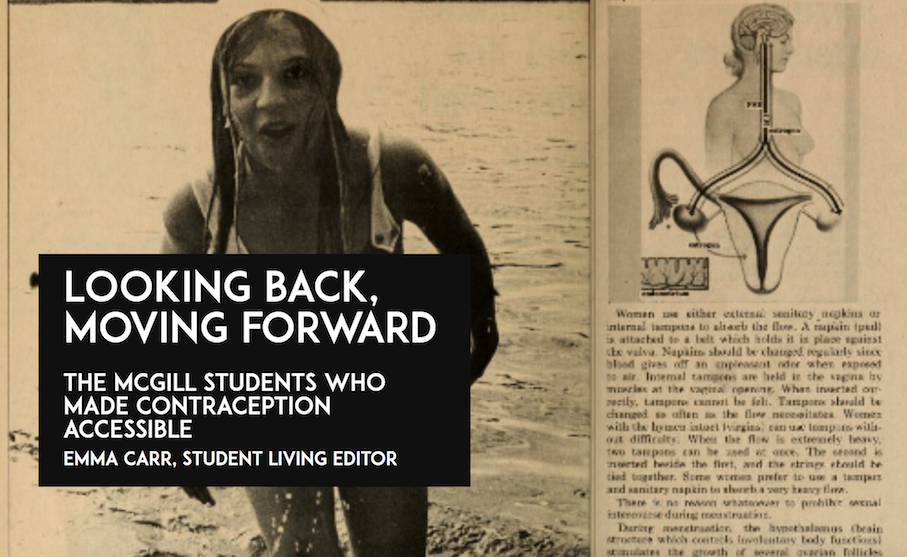
“The McGill Students’ Council affirms the principle that the student, like any other citizen, has the right to information and counselling about birth control, as well as to any contraceptive device he may require,” a 1967 McGill Students’ Council decision reads.

With this decision, the McGill Students’ Council, the precursor to the Students’ Society of McGill University (SSMU), acknowledged that access to contraception was a legal right—nearly two years before the government of Canada reached the same conclusion. These students’ decision represented not only a remarkable act of civil disobedience but also set a precedent for making contraception more accessible within the university’s gates.

Bell
Commentary, Opinion

Let’s talk about Bell Let’s Talk

On Jan. 30, Canadian social media will be flooded with posts about mental health, spurred by Bell’s annual “Let’s Talk” awareness campaign. Since 2011, Bell has raised over nine million dollars for mental health initiatives, which has helped approximately 2 million volunteers to receive mental health crisis training. Their largest social initiative, Bell Let’s Talk Day, has been a wild success; in the past eight years, their hashtag #BellLetsTalk has been used over 800 million times. Let’s Talk has even provided funding to our own university’s mental health programs. Bell has single-handedly created the largest mental health initiative in Canadian history, but, in doing so, they have trivialized the challenges that people with mental illness face.

Bell Let’s Talk relies on a convenient fiction: That ‘reducing the stigma’ around mental illness is the best way to combat the mental health crisis in Canada. As a result, Let’s Talk and other anti-stigma initiatives have turned mental illness into a one-dimensional issue with a simple solution: Awareness. Unfortunately, being ‘aware’ of this issue isn’t going to stop the discrimination that people with mental illness face.

There is a difference between stigma and discrimination, and, although it’s subtle, it has profound implications on how a community decides to combat social issues like mental illness. The Canadian Mental Health Association provides a clear definition that distinguishes the two: A stigma is a negative stereotype, while discrimination is unfair treatment due to a person’s identity, which includes mental illness. To improve the overall quality of life of people with mental illness, we as a community need to combat both stigma and discrimination. Unfortunately, social initiatives that rely on ‘raising awareness,’ like Bell Let’s Talk, underscore the former while neglecting the latter.

Bell’s ‘anti-stigma’ approach has had a positive impact on Canadian society: 89 per cent of respondents to a survey have reported becoming ‘more aware’ of mental illness since 2011. This is beneficial, since, according to the Centre of Addiction and Mental Health, Canada’s current medical infrastructure is not prepared to handle the worsening mental health crisis. For example, over 75 per cent of children with mental health disorders do not have access to specialized care. Canadians have to be aware of these issues in order to address them; but, awareness is no substitute for failing social and medical infrastructure.

While Bell Let’s Talk Day is helpful in raising funds for mental health initiatives, it isn’t going to dismantle the prejudice that those with mental illness face. Instead of simply having a one-day conversation, the community needs to demand that the mental health crisis receives constant attention from our leaders and, in the case of McGill students, their administration. For example, McGill’s administration has slashed funding for its own mental health programs, making services like psychotherapy all but inaccessible to students. Moreover, they have failed to deliver a proper sexual violence policy, despite the fact that sexual assault has been shown to contribute to mental illness. In the face of provincial budget cuts to university funding, McGill’s administrative team reallocated over $2.5 million in fees paid to student services–which are supposed to fund student wellness programs–into the salaries of faculty and senior staff in the 2015–2016 academic year.

This Wednesday, students who believe that they deserve more from their institution should demand more from their administration; actions as simple as sending their faculty’s dean an email stressing the importance of adequate mental health support has the potential to make our lives happier and healthier.

Off the Board, Opinion

“But, you don’t seem autistic!”

Last October, my best friend, who has autism, told me that he thought I might be on the spectrum. I was skeptical: I’m not into trains, I take turns in a conversation, and I’m good at giving relationship advice; I’m not autistic. Still, his comment prompted me to do some research.

First, it’s important to dispel some myths about autism. Like other neurobehavioral conditions, autism exists on a spectrum, meaning symptoms vary dramatically in presentation and prevalence between individuals—Rain Man is the exception, not the rule. Autism is not a developmental disorder: Most people can learn techniques to alleviate their symptoms, but it isn’t something you grow out of, ever. People with autism are not psychopaths; they feel empathy, but have impaired emotional cognition, meaning that what comes across as a lack of caring is probably just a lack of understanding. Lastly, women with autism do exist, though they often go unnoticed by healthcare professionals because of the differences in the way that their symptoms manifest.

This unique presentation is the reason I was diagnosed so late. After an eating disorder, a misfired ADHD diagnosis, a period of selective mutism, two years of crippling social anxiety, and a long and frustrating experience with the mental health system, I was diagnosed with high-functioning autism at age 21. For reference, the average age for diagnosis in North America is four-and-a-half. I decided to seek out assessment after reading dozens of articles written by women presenting symptoms that matched my own experiences who didn’t receive their diagnoses until their twenties, thirties, or even later in life. Had I not gone to a psychologist and specifically requested testing for autism, I’m not certain I would have been diagnosed.

The way autism manifests in women looks nothing like stereotypical male autism. Men on the spectrum tend to have technical interests, such as trains or maps, however, women are more likely to fixate on socially-acceptable and traditionally-feminine interests like fashion or pop culture. Girls and boys learn to socialize differently from a young age, and, because there is so often more social pressure on women, girls are better at learning conversational rules such as appropriate eye contact. This means that autistic women, particularly high-functioning women, learn from a young age to ‘camouflage.’

Camouflaging is a constant and elaborate effort to mask autism symptoms in order to fit in in social situations. This can range from practicing conversation topics before social events to copying peers or TV characters for instructions on how to behave in social situations to repressing ‘stimming’—repetitive behaviours such as pacing, hand flapping, and leg tapping. Last month I had an interview for a job with my dream company: Before the interview, I wrote out and memorized answers to potential questions so that I wouldn’t lose track of what I was saying while I was focusing on not fidgeting and making appropriate amounts of eye contact. People on the spectrum do these things to connect with friends, avoid being shunned or disciplined, or simply to seem ‘normal.’ Constantly camouflaging is exhausting, and is linked to depression, identity loss, and disordered eating.

Women are four times less likely to be diagnosed with autism than men. While camouflaging contributes to this discrepancy, it also results from the measures used to assess autism, which were designed using predominantly-male studies. Autism in women is often misdiagnosed as borderline personality disorder or ADHD, or hidden behind depression and social anxiety. Without early identification and treatment, women with autism are also at increased risk for eating disorders and sexual abuse.

With updated diagnostic criteria, rates of diagnosis are increasing in North America. A 2017 study proposed a working definition for camouflaging, but a quantifiable way to score individuals on camouflaging for diagnostic purposes still does not exist. While funding for research that focuses on female and non-binary individuals is increasing, the field has a long way to go to ensure that autism is both identifiable and treatable in all genders, particularly in higher-functioning individuals.

A diagnosis doesn’t change anything about me. A diagnosis is a tool used by healthcare professionals to treat a condition; I’m not attached to this label, nor am I upset by it. Knowing that I am on the spectrum means that I can better understand how to take care of myself, and that I can begin to confront difficulties I have in social situations in a productive way.

I still freak out in grocery stores due to sensory overload, so I wear noise-cancelling headphones. I find large groups draining, so I take breaks in social situations. I suck at pop culture, but I don’t really feel a pressure to keep up anymore. Now, I understand that I just need to address my needs instead of fighting them.

Commentary, Off the Board, Opinion

Reflecting on the Quebec mosque shooting two years later

I remember crying when I first heard about the Quebec City Mosque shooting. I saw the faces of my father, my uncles, and my friends in the faces of the victims. I remember asking how this could have happened in a country that claims to value immigrants and diversity. I was stressed about college applications, since most of my options were in Canada, McGill being my first choice. My father, an Egyptian Muslim, tried to console me, telling me that a few bad apples shouldn’t ruin the bunch, and that, ultimately, I would be safer and happier in Canada than I would be back home. I believed him.

I believed him all through my first semester. I believed him until I was walking home one night from a restaurant on St. Catherine street, when a man began to follow me home, yelling “Go back home, terrorist!” I started seeing posters around Milton-Parc by Generation Identity, a white-supremacist group that is known to recruit on university campuses, displaying Islamophobic and anti-immigrant rhetoric. As an Egyptian-Canadian Muslim, I think that we must own up to and address our Islamophobia.

Hate crimes against racialized people and religious minorities, especially Muslims, is on the rise. Islamophobia is more prevalent in Quebec than in any other province. There are between 20 and 25 documented hate groups in Quebec: Besides Generation Identity, La Meute, an anti-Muslim Quebec nationalist group, has over 17,000 members on Facebook alone as of press time. Groups like these are founded on the same principles that Alexandre Bissonnette held when he murdered six Muslims and injured 19 others two years ago. And, these are the same principles that will lead to more discrimination, violence, and suffering if Quebec does not act against white-supremacist groups.

Not all Islamophobia comes from hate groups. Government institutions are just as responsible for propagating hate, including provincial laws like Bill 62, Quebec’s ‘religious neutrality’ law, which bans face-coverings for those obtaining or providing public services.

The victory of the Coalition Avenir Québec (CAQ) in the recent provincial election has only augmented my fears. The CAQ was elected on a platform that specifically targets immigrants and Muslims, proposing expulsion for immigrants who fail a “Quebec values” test and a hijab ban for public servants while on the job. Governments who spew hateful rhetoric will only validate the views of white supremacists like Bissonette. Premier François Legault must make an active effort to preserve the safety and freedom of Muslim Quebecers.

Islamophobia, like other kinds of discrimination, is an intersectional issue. Most Muslims, myself included, are racialized, meaning that we face racism as well. In the case of Muslim women, sexism comes into play, too. We need to address all forms of systemic discrimination in Canada in order to improve the lives of Muslims, racialized people, women, and sometimes, all of the above.

There is no one way to tackle hate. For McGill students specifically, it’s important that we continue to mobilize against systemic discrimination, white-supremacy, and hate. Groups like the Muslim Students’ Association, the Black Students’ Network, and other associations do indispensable work in the interim for racialized and Muslim students. On Jan. 29, take a moment to honour those killed and injured. It is a hard day for many Muslims; provide support for your peers who need it.

Football, Know Your Athlete, Sports

Know Your Athlete: Daniel Adesegun

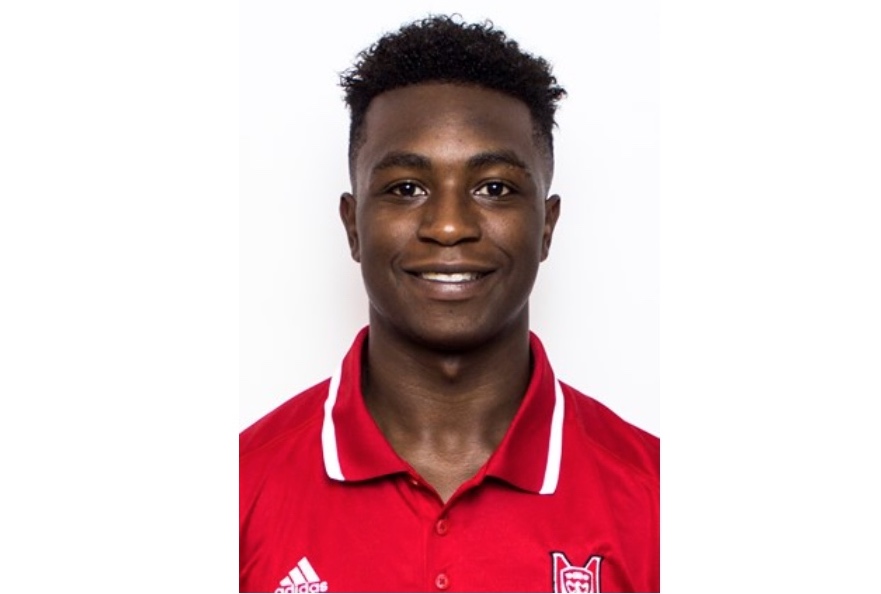
After suffering two injuries in his first university season at the University of Calgary, third-year transfer running back Daniel Adesegun was unsure if he would ever play football again. But, now that he has completed two standout seasons at McGill, it is clear that Adesegun successfully kicked off a new chapter in his athletic and academic career.

Hailing from Corbyn, Texas, Adesegun’s love for football grew out of watching games on TV at the young age of six. He enjoyed watching running backs and big, bruising hits, and, decided that he was going to play football.

“My entire focus was football,” Adesegun said in an interview with The McGill Tribune. “I didn’t care about school. I just played football.”

Adesegun continued to play after his family moved to Calgary, Alberta when he was 12 years old. When the time came, he signed with the local University of Calgary to begin his collegiate career. The Dinos appealed to him as a perennial championship contender with quality player development.

Adesegun noted a drastic transition from the low-contact-level game of his early years in football to the high-intensity play he experienced in his first collegiate season.

“It’s totally different,” Adesegun said. “It changes how you play. I don’t want to say there is more fear, but there’s certainly a different dynamic. [The game becomes] more structured, more strategic.”

Unfortunately, Adesegun suffered a broken wrist early in his first season at the University of Calgary, and, when he returned, he badly sprained his ankle. The consecutive injuries made him reconsider whether he wanted to keep playing football.

“I think it’s about love,” Adesegun said. “To play football, especially at this level, you have to really love what you are doing [by putting] your body and […] your mind [at] that kind of risk.”

After consulting with a close friend, Adesegun ultimately decided that his passion for the sport outweighed the risks involved. Consequently, he began the search for his next destination, a school where he could both play football and pursue his academic passions.

After looking into several schools, Adesegun landed at McGill. At first, he struggled to adjust to life both academically and socially. However, a supportive team environment helped Adesegun adapt to his new city.

“Everyone’s there for you and supporting you, so that was great,” Adesegun said. “[My first season] wasn’t the best season, record-wise [for McGill], but I think that getting back into it was really great for […] the way I felt about myself.”

While McGill finished just 1-8, Adesegun enjoyed a successful individual season, walking away with the RSEQ Offensive Rookie of the Year award.

In the 2018 season, the McGill football team continued to struggle to win games, leaving Adesegun disappointed. He was encouraged, however, by how the team came together toward the end of the season. Moving forward, Adesegun’s goals for the team are simple.

“Compete,” Adesegun said. “Compete in the playoffs [… and] compete hard.”

Adesegun is an integral part of the team. The running back prefers to lead by example, and his statistics make that clear. He led McGill in rushing yards and tied for the team-best mark in touchdowns this past season.

“You want to do the best you can individually to support the team,” Adesegun said. “If I’m not performing up to par, […] then we aren’t going to reach our potential.”

To get ready for games, Adesegun makes sure to get lots of rest. He spends time visualizing the game and listening to soft music.

“I like to come out before warm-up and do my own warm-up,” Adesegun said. “I like to get out there, lay down, and […] just be there with the field and get peaceful.”

Adesegun acknowledges that this routine is different from the typical, higher-energy warm-up of some of his teammates. However, his way is one that has successfully created a dynamic, accomplished competitor, who—despite any injury—will not be going anywhere anytime soon.

 

Football, Sports

Super Bowl LIII preview

On Feb. 3 in Atlanta, Georgia, the New England Patriots and the Los Angeles Rams will face off in Super Bowl LIII. Seventeen years removed from a Patriots victory in the teams’ last Super Bowl clash, much has changed for the two franchises. The Rams moved back from St. Louis and have made the playoffs only four times since 2002; meanwhile, the Patriots have won four more Super Bowl titles, cementing themselves as one of the greatest sports dynasties of all time.

The two teams’ roads to the Super Bowl are similar: Both won their respective divisions to secure a bye in the first round of the playoffs. The Patriots, 11-5 in the regular season, bested the Los Angeles Chargers in the divisional round and then the Kansas City Chiefs in the conference championship. On the other hand, the Rams went 13-3 in the regular season. They beat the Dallas Cowboys in the divisional round and the New Orleans Saints in the conference championship due, in part, to a controversial pass interference non-call late in the game.

In terms of yards per game, the teams are evenly matched on both sides of the ball. Los Angeles is led by quarterback Jared Goff and top receiver Robert Woods, whose connections led the Rams to gain 421.1 yards per game, almost 30 more than the Patriots in the regular season. The Rams also scored 32.9 points a game, nearly six more than the Patriots’ 27.2. On defense, both sides gave up roughly the same number of yards per game, but New England held their opponents to 20.3 points per game compared to the Rams’ 24 points against per game, seventh and 20th in the league, respectively.

One matchup to watch out for throughout the game will take place between the Rams’ defensive line, led by Aaron Donald, against Patriots quarterback Tom Brady. Donald, the 2017-18 NFL Defensive Player of the Year, put up another strong campaign this season, leading the league with 20.5 sacks. On the other side of the ball, Tom Brady is known for his lightning-quick release, giving pass rushers minimal time to sack or pressure him. If Brady can find his favourite weapons—primarily Julian Edelman, Rob Gronkowski, and James White—quickly, then Donald’s impact will be limited. If not, Brady will be in for a tough fight.

The Rams have the advantage in the running game with star running back Todd Gurley on their side. Gurley has been in the NFL’s top three in rushing yards for the past two seasons, though his recent play is cause for concern. He suffered a slight knee injury in Week 15, which led him to miss the last two weeks of the regular season. Despite returning to rush for over 100 yards in the divisional round, he was limited to just four carries for 10 yards in the conference championship. Rams Head Coach Sean McVay has since said that Gurley played less due to poor performance, but the fear of a nagging injury still remains.

As for the Patriots, running back Sony Michel has rushed for over 100 yards in each playoff game: If he can maintain his strong performance, what once seemed like a clear advantage for L.A. is suddenly far from certain.

Ultimately, Donald and the Rams offense will push the Rams over the Patriots in an exciting affair. Both teams have earned their spots in the NFL’s biggest game of the year and will surely deliver a thrilling contest for fans of football and Maroon 5 alike.

Martlets, Sports, Volleyball

Martlet volleyball storms past Sherbrooke in straight sets

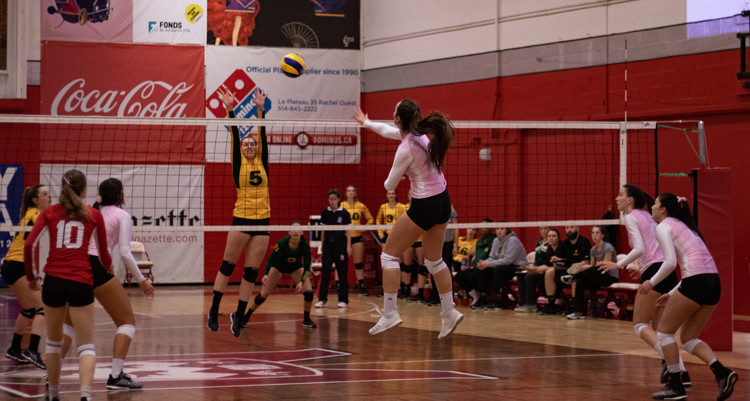
On Jan. 25 at Love Competition Hall, the McGill Martlets (15-12-3) took down a sturdy Sherbrooke Vert et Or (14-5-9) defense in three hotly contested sets. The Martlets treated the 170 fans in attendance for the Martlets’ annual Dig for the Cure game—a fundraiser to support the Quebec Breast Cancer Foundation—to some spectacular plays as they inched closer to cementing a top postseason position.

The start to the first set was intense as both teams tried to assert their presence early. Third-year power-hitter Claire Vercheval kicked off a strong three-point run with a perfectly-placed ace, and the Martlets took control of the set. Sherbrooke fought back late but could not stop McGill, and the first set ended 25-20 in favour of the Martlets.

The beginning of the second set saw much of the same from McGill. A block from Vercheval set the tone for the strong Martlet start and incited a rousing cheer from the crowd. The pressure only grew after an error from the Sherbrooke libero led to a seven-point difference in favour of McGill, 8-1.

Despite a breathtaking one-handed dig from Martlet power-hitter Emilie Matte de Grasse, Sherbrooke finally killed the run. There was some controversy over the play, however, as the umpire seemingly missed a double hit by a Sherbrooke player for the point, leading to some rumbling among the Martlet fans. The opponents used the confusion as fuel, fighting back to take the lead 17-16.

The two teams traded leads several more times as the tension reached its peak. But, with the set then tied at 23, McGill held strong and staved off the Vert et Or for two consecutive points to take the second set, 25-23.  

Martlet Head Coach Rachèle Béliveau urged her team to focus after the tight second set.

“She told us we had to execute […] our game plan,” fourth-year middle blocker Mila Krunic said. “Whenever we get a kill, we get very excited. It gives us momentum. She wanted us to keep the momentum.”

Heading into the third set, an aggressive exchange for the first point set the tone for what would be the closest set of the game. A timely, textbook dig by Martlet libero Lea-Marie Duguay and another hammered hit from Vercheval highlighted the Martlets’ efforts midway through the set.

McGill finally built some momentum, courtesy of a bold kill from second-year setter Andreanne Tremblay and the opponents unfortunately hitting the ceiling, giving the Martlets a 20-17 lead. However, an inspired Sherbrooke side pushed the game to its limit by evening out the score at 24. In response, Béliveau brought fourth-year right-side hitter Clare Nishikawa onto the court late in the game. With some key blocks from Nishikawa, the Martlets took control and completed the three-set victory.

With the win, the Martlets maintain a four-point advantage over the second-place Montreal Carabins, with a game in hand. Béliveau, however, is wary of complacency.

“In the past, we had a good season, and we would not qualify for the playoffs because [we] missed one game,” Béliveau said. “It’s so tight. We have to take every opportunity [… and] be prepared for the challenge.”

The Martlets defeated the last-place Ottawa Gee Gees (1-13) in four sets on Jan. 27. They will face their closest competitors, the Université de Montréal Carabins (11-4), on Feb. 3.

Moment of the Game

Fourth-year power-hitter Claire Vercheval got the loudest cheer of the game when she capped off the second-set with a thunderous strike.

Quotable

“We came out strong and […] ready. We came out knowing the game plan […] and did it. We were confident in our display.” – Middle blocker Mila Krunic on why McGill was the better of the two teams.

Stat Corner

Martlet power-hitter Claire Vercheval put up a game-high 22.5 points.


Science & Technology

Elementary, my dear Watson

Everything is made of something. Books are made of pages, which are made of paper, which is made of wood. All of these items are made up of molecular complexes that break down into tiny atoms. What differentiates these atoms from one another is the number of subatomic particles, protons and neutrons, that compose them. This is what makes elements distinct from one another.

For a long time, people didn’t know what anything was made of. This ignorance persisted until the protoscience of alchemy birthed chemistry almost four hundred years ago. Early chemists initially found elements haphazardly, labelling and mislabelling them as they went, until the invention of the periodic table of elements.

“Truth be told, chemical knowledge at the time was pretty chaotic,” Joe Schwarcz, director of the McGill Office for Science and Society, wrote in an email to The McGill Tribune. “Students basically memorized what happened when chemicals were combined. They learned, for example, that when a piece of sodium was dropped into water, it ignited [while] a piece of aluminum did not. Nobody really knew why.

The organization of elements continued to be mired in confusion until Dmitri Mendeleev, a Siberian-born chemistry professor at the Main Pedagogical Institute in St. Petersburg, Russia, began recording the atomic weights, names, and properties of known elements on cards. By 1868, he had created the first prototype of the periodic table, placing the elements in horizontal rows in order of atomic weight and grouping elements of similar properties into columns.

“Then came Mendeleev’s boldest stroke,” Schwarcz wrote. “He predicted from ‘holes’ in his periodic table that undiscovered elements must exist.”

Every element has a different, exciting tale of discovery. Initially, elements were found by exploring nature, delving into caves or the ocean to find substances no human had yet laid eyes upon and then manually analyzing their properties back at the lab. Today, scientists have found all the natural elements and so have moved on to investigating elements that can only be created artificially.

Scott Bohle, a chemistry professor at McGill and the Canadian Research Chair in Bioinorganic Chemistry, elaborated on the process of modern elemental discovery.

“We’ve discovered all the stable [elements], or we think we’ve discovered [them],” Bohle said. “But, now it’s much more controversial […] because you have to demonstrate that you have […] a new element.”

Bohle explained that nature fabricates many elements in nuclear explosions via calcium fusion, a process in which a calcium atom collides with a larger atom to create a new, larger molecule, usually verified via mass spectrometry.

Unfortunately, the larger molecules get, the less stable their configurations are: Some of the largest on the periodic table exist for mere thousandths of a second before they begin to decay, giving off protons and neutrons and, therefore, changing their elemental composition.

To mark the enormous scientific impact of Mendeleev’s creation, UNESCO named 2019 the International Year of the Periodic Table to celebrate its 150th anniversary. Despite being over a century old, modern scientists still refer back to it.

“I used to be able to write out the basic table in about 75 seconds, but now I am out of practice,” David Harpp, professor in the Department of Chemistry, said. “It is easy to do with an hour’s effort and helpful for students, I believe, for defining the relationships. They ‘own’ the table instead of having to look it up.”

Singing the table appears to be another popular way to learn it, with a number of different tunes published online, including celebrity appearances from Sheldon Cooper and even Laura Pavelka, a faculty lecturer in McGill’s Department of Chemistry.

“Our inorganic chemistry course instructor insisted that we memorize the first row of the transition metals, which I am terrible at […], so I made a little tune to sing the list of 10 elements,” Pavelka wrote in an email to the Tribune. “Joke’s on me, because I still remember them in order!”

No matter the field, the periodic table of elements has revolutionized the way that scientists think about and organize the elements that make up our world.

Arts & Entertainment, Theatre

‘Spring Awakening’: A change of scene and season

The Arts Undergraduate Theatre Society’s (AUTS) production of Duncan Sheik and Steven Sater’s 2006 musical, Spring Awakening premiered on Jan. 24 at Moyse Hall. Directed by Kyra Church (Concordia BA) and adapted from the 1891 Frank Wedekind play of the same name, Spring Awakening is a coming-of-age tale that follows the lives of young teenagers in late 19th-century Germany as they uncover realities about themselves, their peers and the world around them.

The musical begins as one of the central characters, Wendla (Leah DeBorba U0 Arts) asks her mother the age-old question: “Where do babies come from?” Fearful of divulging too much too soon to her young daughter, Wendla’s mother (Julia Kennific) refuses to answer, intent on keeping Wendla’s innocence intact. Curiosity gets the better of Wendla, however, and what follows is a familiar and heartbreaking account of the trials of adolescence.

The characters in Spring Awakening are all navigating puberty and its accompanying anxieties in an era when traditional values discourage them from exploring their curiosities and desires freely and safely. Wendla isn’t the only one searching for answers; her peers, too, are all puzzled by new experiences and feelings. When Wendla and her friends meet Melchoir (Natan Saviv U0), a well-read and mature classmate, they gain the courage to explore their feelings and learn more about themselves.

Discovery, coming of age, and sexuality are all central themes of Spring Awakening. Notable performances by DeBorba and Eric Wakim (Concordia BFA) as lovable but nervous Moritz highlight these ideas and anchor the ensemble. Their stunning vocals convey pure emotion, which makes for captivating musical numbers, specifically in “Touch Me.” The brilliant instrumentation, conducted by musical director Ben Barton Creelman (M1 Music) adds depth to the songs and heightens the emotions of the characters while complementing the cast’s outstanding vocals.

Wendla’s close friend Marta (Devin Sunar U2 Arts) gives a heartbreaking performance that balances precocity with  innocent youthfulness. During “The Dark I Know Well,” Marta reveals to her friends that she has dealt with abuse for years. She is then accompanied by a close friend, Ilse (Meera Raman), who shares that she has endured similar experiences. This number stands out, offering a particularly poignant portrayal of the effects of trauma.   

The simple stage design allows for the actors to make full use of their space, best demonstrated in the various dance sequences. Although the staging is effective, the young girls’ costumes—reflecting different styles and time-periods—are somewhat distracting considering that the rest of the costuming is indicative of the late 19th century time frame.

Jeffrey D’Ambrosio’s (U1 Arts) stunning light direction brings the show to life, particularly in the penultimate scene as the cast joins in unison to sing “Song of Purple Summer.” As the front lights turn off, only the silhouettes of the cast remain backlit with a violet light that creates a mystical atmosphere.

Although Spring Awakening is set over a century ago, the characters’ stories of sexual assault and abuse feel strikingly contemporary. The musical cements itself as an impactful piece of theatre by portraying an important story that continues to be relevant to this day.  

Spring Awakening runs Jan. 31 and Feb. 1-2 at 7:30 p.m. at Moyse Hall (853 Sherbrooke St W). Tickets are $15 for students and $20 for the general public and can be purchased online at autstheatre.ca or at the door.

News, SSMU

SSMU hears $19 million student housing pitch

The Students’ Society of McGill University (SSMU) held their first Legislative Council of 2019 on Jan. 24. As this is the final semester in SSMU executives’ terms, some pushed major legislation to the forefront.

SSMU invites UTILE to research affordable housing options for students

General Coordinator of L’Unité de travail pour l’implantation de logement étudiant (UTILE) Laurent Levesque introduced an affordable student housing project to the council. UTILE is a non-profit organization in Quebec that promotes and develops affordable student housing in cooperation with student unions. Although SSMU does not sit on UTILE’s board of student directors, it has collaborated with the organization since 2014.

Levesque summarized UTILE’s 60-page proposition on how SSMU could create new affordable housing.

“The first [option] looked into was Royal Victoria Hospital,” Levesque said. “We researched residential conversion […involving buying] existing housing, [lowering] rents, and [offering] it to students. We [also] looked into two different construction scenarios: A medium-rise which is four to six stories or a high-rise which means eight or more stories.”

UTILE explored each option based on criteria such as environmental impact, risk, and quality of life for tenants. Each proposal carried some complications, but Levesque noted that a medium-sized construction project would be ideal.

“The average rent per room in this recommended scenario would be $650 [amenities included],” Levesque said. “About 58 per cent of students pay more than that.”

The suggested 150-unit building is estimated to cost $19 million to construct. Fortunately for SSMU, part of UTILE’s mission is to connect student unions with investors to fund construction. Levesque estimated that SSMU would only need to pay $1.6 million out of pocket, and could use government and private investments to make up the difference.

SSMU President Tre Mansdoerfer and Vice-President (VP) University Affairs Jacob Shapiro expressed a strong interest in the project and planned for time to be allocated outside of Council for discussion and questions.

Solidarity with Unis’tot’en Camp in Wet’suwet’en

In 2010, Unis’tot’en members built a cabin directly on the path of a proposed Coastal GasLink pipeline that would cut through their territory in northern British Columbia. They argued that their hereditary chiefs retain ownership of the land and did not consent to construction. More recently, the government deployed Royal Canadian Mounted Police Force (RCMP) tactical officers on Jan. 7 to breach the Unis’tot’en Camp.

In conjunction with SSMU Indigenous Affairs Commissioner Tomas Jirousek, Council members submitted a motion declaring SSMU’s solidarity with the Unis’tot’en. Senate Caucus Representative Bryan Buraga was primarily responsible for the motion.

“This motion would [urge] SSMU to pledge their support for the Unis’tot’en as well as communicate this position to [the] local [Member of Parliament] and Minister of Justice,” Buraga said.

SSMU’s motion originally mentioned their opposition to the Coastal GasLink pipeline. However, several Council members raised concerns with this statement.

“The truth is that a lot of McGill students will be employed [in the gas and oil market], especially engineers,” Club Councillor Victoria Flaherty said. “If we move the amendment [to remove opposition], it would be more representative [of] the McGill population.”

In response, the original statement was amended to remove direct opposition to the pipeline. Buraga argued that this did not constitute a major change, as the motion still called for the signing of a pledge opposed to the pipeline.

“We denounce attempts by Coastal GasLink Pipeline, federal and provincial government, or RCMP to interfere in the rights of the Unis’tot’en,” the third clause of the pledge reads.

Jacob Shapiro objected to what he believes is a contradictory stance on the matter.

“It is lacking [in] transparency [on the part of SSMU] to take away an action that we’re clearly doing,” Shapiro said. “We will still be in opposition to the pipeline [due to the citation], we just won’t say we are in opposition.”

The motion ultimately passed without explicit opposition to the pipeline itself but in favour of the show of solidarity.

SSMU will hold its next council meeting on Feb. 7.

Read the latest issue

Read the latest issue