

Latest News

Soccer, Sports

Glaring double standards as Israel continues Nations League campaign

Israel’s participation in major sporting events, like the Union of European Football Associations (UEFA) Nations League soccer tournament or the Olympic Games, has raised controversy among fans and activists alike. The double standard of sports governing bodies allowing Israel to compete has been particularly noticeable in the wake of FIFA and UEFA extending Russia’s international soccer suspension on Nov. 18. Russia was originally suspended just four days after its invasion of Ukraine in 2022 for violating international law. However, Israel continues to participate in the UEFA Nations League, despite ongoing violations of international law through its continuous human rights abuses in Palestine

FIFA justifies its ban against Russia as part of its human rights policy, where it claims to stand by its commitment to take any measures necessary to avoid contributing to human rights abuses. FIFA banned South Africa from the World Cup from 1961 to 1992 because of the oppressive apartheid regime. Yet, this standard does not seem to apply to Israel. Article 76 (3) of FIFA’s statutes states that “member associations and their clubs may not play on the territory of another member association without the latter’s approval.” Despite this, the Israel Football Association (IFA) has at least eight clubs that play on occupied Palestinian territory in the West Bank. 

FIFA has been aware of this breach since 2013, but Israel has faced no repercussions. The Palestinian national football team, on the other hand, faces a deteriorating security situation as a result of Israel’s occupation. Israeli forces have killed around 350 professional Palestinian athletes since Oct. 7, 2023, and Israel’s bombing campaigns have destroyed almost all the sporting facilities available in Gaza and the West Bank. The Human Rights Watch and the Palestinian Football Association argue that, by allowing Israel to compete, FIFA and UEFA are supporting and legitimizing the occupation. 

While not a European country, Israel has been a part of UEFA since 1994. Originally, the IFA was a founding member of the Asian Football Confederation (AFC) in 1954. However, some AFC members, such as Kuwait and all of the Arab League nations, boycotted matches against Israel due to the occupation and treatment of Palestinians. Eventually, the AFC expelled Israel in a motion led by Kuwait in 1974. UEFA invited Israel to participate in European competitions starting in 1992 and permanently accepted it in 1994, despite Israel’s geographic location.

There was similar controversy over Israel’s ability to participate in the Paris Olympic Games this summer, while Russian athletes had to compete as Individual Neutral Athletes (AIN). At least 30 of the 88 Israeli Olympians publicly supported Israel’s actions. Palestine’s Olympic Committee called this out, pointing to the contradictory attitude the athletics community appears to have toward the treatment of Russian and Israeli athletes

During the opening ceremonies, spectators booed the Israeli national anthem, but France maintained its commitment to protecting Israeli athletes. Russia, on the other hand, was banned on the grounds of violating the ancient Greek tradition of Olympic Truce. Palestine’s Olympic Committee accused Israel of violating that same truce by continuing its violence in Gaza. Some athletes also disagreed with Israel’s presence, such as Tajikistan’s judoka Nurali Emomali, who refused to shake hands with his Israeli opponent.  

In July 2024, the International Court of Justice (ICJ) found Israel guilty of a long list of human rights abuses and violations of international law. The ICJ deemed the Israeli occupation illegal and set out the standards of reparations that Israeli authorities owed Palestinian civilians. Similarly, on Nov. 21, 2024, the International Criminal Court issued a warrant for the arrest of Israeli Prime Minister Benjamin Netanyahu for the war crimes Israel has committed since Oct. 7, 2023. The warrant also included Israel’s Defence Minister, Yoav Gallant and a senior Hamas official, Mohammed Deif (although Israel states he was killed in a targeted July airstrike).

How can Israel, a country convicted of so many violations of international law, human rights, and sporting regulations still be allowed to compete? FIFA and UEFA seem to apply scrutiny over human rights selectively. As people continue to demonstrate against Israel’s participation, it seems unlikely that the country will face any restrictions on its ability to compete in the future. If FIFA and UEFA want to promote unity, diplomacy, and peace through sport, they must apply pressure to all countries committing human rights violations.    

McGill, Montreal, News

Tens of thousands of students walk out in support of Palestine across Montreal

On Nov. 21, over 80,000 Cégep, college, and university students across Montreal walked out of their classrooms to call out their institutions’s complicity in the ongoing genocide in Palestine. At McGill, students walked out of classes at 1 p.m., organized by Students for Palestine’s Honour and Resistance (SPHR) at McGill in collaboration with Law Students For Palestine at McGill, Divest McGill, Independent Jewish Voices (IJV) McGill, Profs4Palestine, and the Association of Graduate Students Employed at McGill. Protestors gathered outside of the University Centre before heading to Concordia University. There, groups from McGill, Concordia, and other adjacent Montreal institutions and communities filed into the Henry F. Hall Building, going from one floor to the next. Afterward, the protest once again filled the streets of downtown Montreal before dispersing at around 3:45 p.m. 

The protest began in front of the University Centre, which houses the offices of the Students’ Society of McGill University (SSMU). In a statement to The Tribune, a representative from SPHR at McGill who wished to remain anonymous explained that along with walking out of campuses in support of Palestine, the McGill contingent was also walking out for what they believed to be inaction from SSMU. 

SPHR submitted a motion through SSMU channels for the entire body to join departmental strikes across McGill in support of Palestine, which would have brought together roughly 24,000 students. The SSMU-wide Strike General Assembly (GA) would have required a 500-person quorum. While 12 GAs were hosted across various departments in the days leading up to Nov. 21, the facilitation of a SSMU-wide strike GA was denied.

“They deflected to obscure legal ‘constraints’ which they had extrapolated so ridiculously and conveniently as to not allow the SSMU to make any public statement in relation to Palestine. After confronting them for over two weeks, we learned that this pretense was clearly a ridiculous and misconstrued interpretation of their legal limitations regarding the injunction,” the SPHR representative wrote.

In a statement to The Tribune, SSMU President Dymetri Taylor shared that the SSMU Steering Committee denied SPHR’s first motion for a strike GA because it had actionables taken verbatim from the Policy Against Genocide in Palestine (PAGIP), which a present court injunction has forbidden SSMU from enacting in any part. 

“We communicated as much that, due to the ongoing case and injunction against the SSMU, we cannot do anything that the Courts would perceive as us enacting the [PAGIP]. If we did, we would be in contempt of the Court, leading to further sanctions against the SSMU, potential fines, or worse,” Taylor wrote. 

Taylor also shared that SPHR then worked on another draft of the strike motion, which called for a strike general assembly and a referendum to vote on the strike scheduled for Nov. 28-29. 

“This time, it was not as clear as to whether or not we would be in violation of the injunction, thus, we sent it to our Legal Counsel. Another issue before that, however, is the fact that more than 50% of the students who signed the petition were from a single Faculty, which is not permissible under our internal regulations,” Taylor wrote. “We have been waiting for a legal opinion since November 14th, and they take time to procure.” 

However, the SPHR representative expressed frustration toward SSMU for its “colossal failures” in representing the student body over the past year. 

“We see a clear pattern of this within the SSMU where last year they failed to contest the injunction on the historic PAGIP. This year, when we’ve seen them revoke SPHR’s status [as a] club […], fail to adequately address the current condition on campus, and fail to adequately take a stand in solidarity with the student body as they’ve been disciplined, arrested and criminalized,” they wrote. “And now finally, we see their inaction in the face of this strike [….] We have honestly let the SSMU get away with not being a representative force for way too long.”

A representative from IJV McGill who wished to remain anonymous encouraged students to join in on the national protest for Palestine. 
“It’s been over a year of genocide. It’s been over 76 years of occupation. There are chances for you to get involved. There [is] rally after rally. Make your voice heard,” they said in an interview with The Tribune. “I understand that it’s scary on campus right now with our administration placing literal surveillance on us. But you have a voice, and you can use that.”

Local Stories, Student Life

My mom ran for Congress. This is what I learned

For the last four years, my mom has been running for Congress in Tucson, Arizona. She started her political journey in the state legislature when I was 11. When she first ran for Congress, she lost by such a narrow margin that many asked her to run again; so she did. Her race this time was one of the closest and most high-profile in the country, as it could have been one of the four seats needed by Democrats to gain a majority in the House of Representatives.

I came to McGill a year and a half ago, far from where American politics run both my parents’ lives. While most people know about the presidential elections, few know the nitty-gritty of the campaigns behind them.

My biggest takeaways from watching a congressional campaign behind the scenes are how gruelling the work is, how constrained candidates are in what they can say or do to appeal to voters, please their own party, and prevent an avalanche of spending against them, and most importantly, how almost everything in American politics is about money—a whopping $36 million USD was spent in my mom’s race by both sides. 

Every time I accompanied my mom to an event, people were excited to meet the candidate’s daughter. They recognized me from her TV ads, asking “Aren’t you proud of your mom? Isn’t she cool? Are you going to run for office like her?” 

But I just see her as my mom. At home, she is loving, caring, and quirky. She doesn’t understand technology or pop culture, she hates scary movies, laughs easily, sings or hums when she walks around the house, and loves to accumulate a ridiculous number of houseplants. She’s smart, and very opinionated, having worked as an environmental lawyer before politics. 

But this isn’t who she is during the campaign. Her fiery candidate persona is like a superhero alter ego, albeit one constrained by her consultants and the “D-triple-C” (Democratic Congressional Campaign Committee). They told her reproductive rights were her strongest issue—crucial because abortion care in Arizona is abysmal—despite water and climate issues being her professional strength. In the state legislature, she championed bipartisan progressive criminal justice reform, which she was discouraged from mentioning in the campaign because her opponent was accusing her of wanting to defund the police. I noticed she was also overly cautious when speaking on controversial topics, like Israel’s siege on Gaza. This was a point of contention in our household: I wanted her to speak out more strongly against it.

The conservative district also played a role. She was asked in an interview once, “Is there a crisis on the border?” She answered “No,” and followed it with a thorough answer about the need for more officers to process asylum-seeking migrants, and the need to secure the border from drug and human trafficking. But her opponent clipped her saying “No,” and ran it in a TV ad, making his whole campaign against her about that one word. The political system is so inflated with money—which mostly goes to TV hit ads—that it pushes candidates to be centrist and robotic. 

I flew home to Arizona for her (and the presidential) election night. Initially, energy was high, but as the night wore on, the ambiance took a plunge. First North Carolina went for Trump, and then the rest of the swing states, one by one. We were all in shock, but my mom’s race took a week to finish being counted. She was ahead on election night, but little by little, her opponent surpassed her, winning the election in the Trump wave that swept the nation. 

It’s incredibly disappointing. Her campaign was exciting and important, and she could have done so much as a congresswoman. Looking back, I feel she was squeezed into a mold that the party had for her, one which flattened her into something much less nuanced and certainly less interesting than she is.

Montreal, News

Trans Day of Remembrance protest honours the past and looks toward the future

Over a hundred people gathered on the evening of Nov. 20 to mark Transgender Day of Remembrance, an annual observance that serves to honour and remember transgender people who have lost their lives due to transphobia and discrimination. The event, organized by a group of Montreal activists, began with a vigil and series of speeches at Dorchester Square, followed by a march that weaved through downtown Montreal and the Village and ended in front of the Radio Canada headquarters on Avenue Papineau. 

“Trans Day of Remembrance is an especially important event for the trans community because it faces a higher mortality rate – simply put, trans people tend to often have community members to grieve, and it is deeply meaningful to do it as a community,” Quebec Public Interest Research Group (QPIRG) wrote in an email to The Tribune.

Following the election of Donald Trump, whose campaign focused heavily on anti-trans policies and transphobic rhetoric, anxiety about increasing American and Canadian legislation against trans rights was palpable. 

“It’s devastating news for trans people who live in the US,” added Celeste Trianon, a jurist and activist for trans rights in Montreal, in an interview with The Tribune. “Trump has fully gone down the rabbit hole of attacking trans people as much as he can, especially trans women.”

The organizers also recognized the ties between trans rights activism and Palestinian human rights. 

“We, as queer and trans people, have been able to work within the pro-Palestinian movement to fight for liberation and an end to genocide,” a representative from the Divest for Palestine Collective said, addressing the crowd. “Not only that, but also to knit a larger web of solidarity between our struggles, which all converge together.” 

While many of the speeches reiterated the need for continued solidarity and activism, they also emphasized Trans Day of Remembrance as an opportunity to make space for mourning, rest, and community support. 

“I’m thankful for each and every one of you who’s here today to remember and honour the siblings who have lost due to transphobia,” said Montreal-based activist Alice Winterland, addressing the crowd. “Let us mourn those we’ve lost today. Let us celebrate their lives, and finally, let us find solidarity amongst each other and other queer people in the community.”

Recognizing the difficulty of a day for mourning, several volunteers were designated as active listeners for anyone who needed to discuss feelings brought up by the day or the event. They additionally provided free food, encouraged attendees to wear masks, and supplied wheelchairs for those who needed them during the march. 

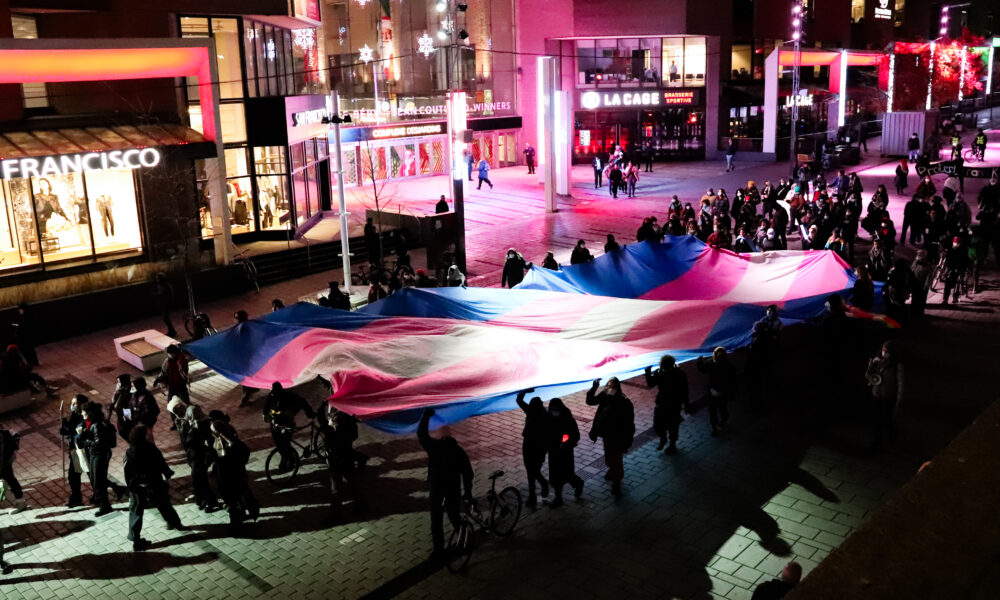
After the speeches and food, protestors unfolded a large trans flag, which spread from one side of the street to the other. They marched along Sainte Catherine Street through downtown Montreal. As the protest moved through the Gay Village, people spilled out of clubs and restaurants to join in with the chanting, joining in for refrains like “We’re here, we’re queer! We’re fabulous, don’t fuck with us!” and “Fight for Black trans women!”

Finally, the protestors arrived at the Radio-Canada headquarters on Avenue Papineau, where they called on the organization to increase their support for trans-Canadians and report more actively on trans issues, with chants like “Every time the media lies, another trans kid dies!” Celeste noted that there were no mainstream media organizations covering the protest. 

“It shows how trans rights are represented in the media as an issue that is not worthy of reporting, that trans lives are not worth reporting on,” she told The Tribune

A representative from the Union for Gender Empowerment also spoke about the importance of events like this to break the silence surrounding the mistreatment of trans individuals. 

“The amount of violence that occurs in our lives, whether it’s social violence, whether it’s what sociologists call deaths of despair, whether it’s interpersonal violence, […] all of these things occur very quietly, to the ears of the outside world,” they shared in a voice memo to The Tribune. “Trans Day of Remembrance is about claiming that, it’s about saying these things actually do occur. They’re occurring to us. And they deserve to be remembered, right here, right now.”

Ask Ainsley, McGill Recommendations, Student Life

Winter in Montréaland

As we approach the frigid winter months, students from warmer climates who are spending their first winter in Canada may be wondering how to best prepare themselves. 

Gearing oneself up for winter can be anxiety-inducing for many, from the high prices of apparel like winter coats to confusing labeling practices. Figuring out what is necessary is a personal journey, as everyone’s body reacts to the cold differently. Here are the five categories you should focus on to stay warm and cozy in spite of Montreal’s winter.

Head

Overlooking keeping your head warm is a common mistake. A solid piece of headwear can be the difference between a bearable and terrible hike to McMed. Hats, scarves, and balaclavas are good choices depending on the severity of the temperature. An ideal hat should cover your ears and forehead, as those areas get cold faster. When searching for the material, wool is the gold standard. Wool absorbs and releases up to 30 per cent of its weight in moisture, so it will keep you warm or cool depending on the weather. 

Upper body

A good coat is crucial for both comfort and safety. There are three things to keep in mind when determining what coat to get. First, is the coat well-insulated? A quality coat will have an insulation type that can release moisture and retain heat. Generally speaking, wool, synthetic, and down insulation are the most common types of lining in coats. Down or down/synthetic coats can be a solid choice as the material is ultra-light and warm. Down coats are usually packed in a unit called “fill power” which is the volume in cubic inches that one ounce of down fills up. Aim for a fill power of 600-800. 

The second question you want to ask is: What type of coat am I looking for? From parkas to fleece-lined jean jackets, it’s hard to know what the best choice is. Generally speaking, a parka will provide the most warmth as it covers your lower body as well as your upper body. 

The last thing to consider when finding a coat is its resistance to wind. A wind-resistant jacket will provide partial protection from the wind, whereas a windproof jacket provides total protection. A good winter jacket should be windproof, not just resistant. 

Lower body

When it comes to the lower body, it depends on your activity level. If you stay indoors most of the winter, a good pair of pants should be sufficient. However, if you plan on skiing or skating this winter season, snow pants could be a worthwhile investment. Snow pants should always be water-repellent or waterproof. In the winter, getting wet can easily lead to frostbite or hypothermia. I would recommend getting a pair with suspenders; although they aren’t the most fashionable option, knowing that your pants won’t fall down when you’re moving around a lot is comforting.

Hands 

Often overlooked, your hands are some of the most important parts of a winter outfit. Cold fingers can genuinely spoil a good day. When choosing winter handwear, the mittens versus gloves debate can be fierce. They both have pros and cons; however, if I had to pick one, mittens would be the time-tested reigning champion. Mittens keep your fingers close together, and although they restrict mobility, they concentrate body heat, allowing your hands to stay warm. Staying dry is also key in the cold, as it is more challenging to heat your body when wet. A tip is to look for handwear made out of leather and lined with some form of insulation on the inside.

FeetNobody wants to be a flood girl, so choosing the right pair of boots is very important. To keep solid footing, the sole of your boot should be rubber and have a traction-positive lug pattern. If the boot is waterproof, it will most likely be warm; there is not much reason to look for insulation. If the boot is leather or made of Gore-Tex, it will be 100 per cent waterproof. Choose a boot that rises to the middle of your shin to ensure that snow won’t get in when walking home from a night out at Gerts (reopening in January!)

Local Stories, Student Life

Paws and priorities: Navigating pet ownership in university

Between the lure of companionship and the realities of student life, university pet ownership comes with emotional rewards—but also financial, logistical, and ethical challenges. Here’s what students had to say about the benefits and burdens of owning pets.

For many, pets provide essential emotional support. Kate Rood, U1 Arts, got her kitten, Princess Meow Meow, two months ago after a particularly difficult academic year. 

“School was so stressful last year, I was like, ‘I need a therapy animal,’” Rood said in an interview with The Tribune. “She’s really comforting.” 

While the emotional rewards of pet ownership are undeniable, students like Rajan Duncan, U1 Arts, urge students to consider the significant responsibilities that come with caring for an animal.

“If you’re not prepared to commit yourself to that type of emotional relationship, or the costs that that relationship entails, then it’s wrong to get a pet,” he said in an interview with The Tribune.

On a similar note, Lyna Rochdi, U2 Arts, said pets can benefit mental health, but students must consider their ability to provide proper care. She recommends the therapy dogs at the Student Wellness Hub for those seeking emotional support without the commitment of pet ownership.

Besides ownership, other options such as fostering are available. Avigail Friedman, U3 Arts, has been fostering cats through Heart in Hand Rescue Coeur en Main, a Montreal-based cat rescue, for a year and a half. The process was simple: After filling out an online form, the organization called to discuss the fostering process, and she received cats a few days later.

Friedman, who lives alone, also said her cats offer a sense of companionship around the apartment. Beyond personal benefits, she finds fostering rewarding because she can help cats from difficult circumstances.

The lack of stability in student life seemed to be a common obstacle to getting a pet. Despite her positive experience fostering, Friedman expressed that she isn’t ready to adopt. 

“I’m not going to get a pet until my life is solidified and I’m not moving around,” she said.

Similarly, Rochdi, an international student, also said she wouldn’t consider pet ownership right now. Her frequent travel would make consistent care impossible.

Even students who already own pets acknowledge these challenges. Rood shared that her cat prevented her from doing an exchange semester, but will not hinder her mobility after graduation. 

“I’m just going to take her with me,” she said. “She’s going to have to follow me wherever I go.”

Additionally, several students cited financial constraints as a possible deterrent. According to Global News, the average monthly cost of owning a cat in Canada is $80 to $200 CAD. Initial costs range from $1,875 to $3,345 CAD in the first year, straining student budgets.

“It is definitely a privilege to own a pet,” Rochdi said. “It takes a lot of resources to care for yourself and another being.”

While the fostering organization provided some items for her cats, Friedman said she covers food and litter. 

“I like to think of it like a hobby,” she explained. “Instead of spending money on some hobby, I’m spending it on the cats in my home.”

According to the 2024-2025 McGill Residence Handbook, pets are prohibited from McGill residences unless a student has obtained permission from Student Accessibility & Achievement to keep a service animal. Additionally, many student apartments in Montreal do not allow pets.

For instance, Rood said her apartment complex initially did not allow pets. However, she decided to go forward with getting a cat anyway. 

“I ended up talking to my landlord, and luckily, she was like, the biggest cat mom in the world. She said the cat was so cute and that it was okay,” Rood shared.

Ultimately, Rood maintains that pet ownership is feasible for students, as long as they understand the responsibilities and costs it entails. 

“In university, you get your first taste of independence, and having to care for an animal all the time kind of takes that away a little bit,” she said. “But I would do it 10 times over again. I love this cat.”

Know Your Athlete, Sports

Know Your Athlete: Mika Chang

With 1:50 left in double overtime, Mika Chang, U3 Engineering, found the back of the net to secure Martlets Hockey’s victory over the Montreal Carabins on Nov. 17. The left winger from Toronto sat down with The Tribune to talk about her ice hockey career, balancing athletics with academics, and her goals for the rest of the season.  

Chang first hit the ice at five years old when her parents enrolled her in hockey, following in her older brother’s footsteps. Determined to keep up with him, she developed a competitive drive that sparked her love for the sport. She spent the first 10 years of her hockey career playing on men’s teams and shared how that set her up for a successful future. 

“[Men’s hockey] is very fast-paced and skilled, and everyone holds themself to a very high standard,” she said. “Even 10 years ago, girls’ hockey was a lot less developed than it is now, so there were less opportunities for girls to play. So, I think the opportunity for exposure was greater and there was greater competition because there were so many boys playing minor hockey in Toronto.” 

While playing men’s hockey, her team, Ted Reeve Thunder, won the prestigious International Silver Stick tournament. She started playing women’s hockey in grade nine, and the following year, McGill coaches scouted her at a local tournament. Before coming to McGill, Chang played for the Brampton Junior Canadettes and the Mississauga Junior Hurricanes. She lost most of her grade 11 and 12 playing years due to an ACL tear and the COVID-19 pandemic. Despite these setbacks, she earned a spot on the McGill Varsity team as a freshman in 2021 and has been a valuable member ever since, playing 73 games and scoring 5 goals and 7 assists in her first three seasons.  

Chang shared that the Martlet’s victory on Nov. 17 was a team effort and an important win. 

“Our team has […] come so close to winning in so many games but [they] just weren’t going our way,” she said. “To finally secure a win made it feel like all our work was built up for something, and that we are more than capable of beating great teams. It instilled a level of confidence, and it meant a lot to our team. Everyone contributed so much in all different areas; it was a big team effort.” 

As a senior on the team, Chang is a leader on and off the ice. She told The Tribune that her biggest goal this season is to support the younger players.

“I [want] to help foster and develop the younger people into gaining confidence earlier on in their careers,” she explained. “I feel like, for me, this season is the first where I really feel confident on the ice and feel like I can contribute, so hopefully [I can] kind of [spread] that and just [create] a better team environment for everyone.” 

Chang is a talent not just on the ice, but also in the classroom; she was one of the 12 Women’s Ice Hockey members to be initiated into the 2024 President’s Student-Athlete Honour Roll. There is nothing easy about studying bioengineering while playing a varsity sport, but Chang says her support system of teammates and friends has been vital for her success. 

Playing a high-level, highly competitive sport for 16 years teaches an athlete many lessons, and Chang highlights one specifically for young athletes. 

“I think the most important thing that I’ve taken away is always to just have fun,” she said. “Obviously, there are times when you need to take things seriously, but at the end of the day, if you don’t love it, then you’re not going to have fun. And having fun with your teammates […] on the ice is always the most important thing because that can make or break your experience.” 

Local Stories, Student Life

The Montreal Vegan Festival showcases veganism beyond the plate

The Montreal Vegan Festival is an event celebrated not only for its culinary experience, but also for its invitation to rethink our approaches to food, beverages, and even fashion, all while supporting local entrepreneurs. From Nov. 9 to 10, the Grand Quai du Port de Montréal hosted this immersive experience into the world of veganism, where speakers shared insightful speeches about their journey. Contrary to common misconceptions, veganism isn’t just about food, and neither is the festival; rather, the event highlights veganism as a lifestyle centred on sustainability that pertains to a broad range of products and choices. Through conferences, culinary workshops, tastings, and local initiatives, the festival introduced attendees to the vegan lifestyle. 

This year, the festival gave the floor to two spokespeople: Marie-Michelle Chouinard and Lloyd Rose. Known as Une Maman Végane on Instagram, Chouinard shares vegan recipes and her journey as a vegan mom and food lover with her followers. Through her blog, cookbook, and strong social media presence, Chouinard has made a name for herself in the vegan world. Rose, a famous vegan chef, author of Crazy Good Vegan, and creator of Plantcrazii, joined Chouinard for a cooking demo.

The festival also welcomed many exhibitors looking to promote their products. This year, over 100 stands offered vegan food and drink samples, as well as vegan cosmetics, clothing, and tattoos—even the Communauté du Droit animalier Québec (DAQ) presented its services. 

Notably, while all of the products sold were vegan, veganism wasn’t the primary concern for all vendors. For example, Ah! Tout Cru dans le bec commercializes organic raw walnut butters and recipes to incorporate them in daily meals. Company representative Philippe Rhinan talked to The Tribune about how the products’ veganism was a happy accident, not a primary goal .

“[Our product] happened to be vegan,” Rhinan said. “I realized that I didn’t engage with the vegan community when they’re the ones who need germinated seeds and nuts, [so] my battle is to make [our product] as available as possible.”

Ariane Boudreau, a representative for Dr. Mist, a natural multi-use deodorant and topical antihistamine, also elaborated on her company’s vision of veganism.

“Vegan people are really cautious about what they eat, but [veganism is also about] what you put on your body. Deodorant plays a role [in that sense],” she stated in an interview with The Tribune. “Because we produce something that fits with vegan people’s values, I think that we belong [in the Festival], and it attracts customers as well.” 

Imagine fresh vegetables and fruits growing on the rooftops of Montreal, just steps away from your apartment: That’s exactly what Lufa Farms does. From an ecological standpoint, the heat saved from the offices below reduces their energy consumption by 50 per cent compared to traditional ground-level greenhouses.

Constantin Schlumberger, a Lufa Farms team member, explained how their online service is truly time-saving—especially for busy students. 

“I can enjoy a beer with friends, pick up my phone, place an order using my favourites list, and have it delivered to my home the next day,” he said.

This eco-conscious approach is also budget-friendly, making it perfect for students: The company offers 30 per cent off your first four orders, including a free tote bag. With just a few clicks, you can stock your fridge with fresh and locally sourced products, all from the comfort of your home. Lufa Farms’ model of responsible consumption illustrates the impact of small and medium-sized companies within a ​​short food circuit.

The festival also enabled consumers to directly engage with producers, something rarely possible when buying products that have traveled thousands of miles.

“When [people] come to the festival, they see where the products come from, and build trust,” Schlumberger shared about traceability.

The Montreal Vegan Festival is an excellent place to take your first step into the world of veganism. With surprising wonders and flavours all around, the festival helps attendees learn about how to be vegan and realize how veganism is everywhere—even beyond your plate! 

Interviews were translated from French.

McGill, News

Staff and students stress the importance of consultation at accessibility town hall

Over 100 staff and students gathered on Nov. 22 for a virtual town hall to share their thoughts on the McGill Accessibility Strategy (MAS), the university’s proposed plan to increase accessibility for disabled community members and to address ableism on campus. There, attendees provided input on a draft document outlining the MAS and discussed the institutional barriers that inhibit disabled people from full participation at the university.

The town hall was one of the four community consultation meetings the university convened for the development of the MAS. Meetings for administrative staff, academic staff, and students took place on Oct. 22, Oct. 25, and Oct. 28, respectively. 

Executive Provost and Vice-Principal (Academic) Christopher Manfredi began the meeting by stressing that the attendees’ feedback matters to the process of implementing the MAS, as they shape both the short- and long-term efforts by the university.

“Your feedback today is key to making sure we’re creating something that has a real impact, something that not only makes our spaces more accessible, but also fosters a community where everyone feels that they truly belong,” Manfredi said.

For the remainder of the town hall, community members discussed a wide array of opinions on the draft document and shared accessibility concerns across the university as a research and learning environment. 

Samuel Ragot, a PhD student in the School of Social Work, drew attention to the language of the draft document. Ragot noted that the definition of disability in the document does not reference “barriers” against people with disabilities or the idea of “social participation,” terminology that is commonly used in disability policy. He also proposed that the draft document incorporate the “nothing about us without us” principle—the idea that decisions should not be made without the involvement of those impacted. 

Ragot went on to speak on the importance of recognizing the societal ableism in Quebec. 

“Disability discrimination is still the number-one cause for complaints to the Commission des droits de la personne et des droits de la jeunesse,” Ragot said. “There is huge work on this to be done.”

Some attendees drew attention to the way that disabled graduate students are often left behind by McGill’s regulations surrounding disability. They cited the lack of a centralized way to apply accommodations they receive as a student to work they perform as an employee—for example, in a lab or as a teaching assistant. 

Many also emphasized the importance of giving disabled staff and students the chance to provide input in the creation of the MAS. During the meeting, organizers from McGill clarified that following the town hall, the draft document will be revised and then be sent through the university’s governance structures to be put before the Senate and the Board of Governors for approval. 

Shari Brotman—associate professor in the School of Social Work and the Interim Chair of the Subcommittee on Persons with Disabilities within McGill’s Equity, Diversity and Inclusion Committee—urged the university to consider “reintroducing” the document to the community for more feedback before its submission to the relevant governance bodies.  

“It really is my perspective that there needs to be more consistent and ongoing communication with the broader community of people with disabilities at McGill, since there were a lot of important suggestions and recommendations for strengthening the Strategy raised at the Town Hall,” Brotman said.

Assistant professor in the School of Population and Global Health, Ananya Banerjee, underscored the need for the draft document to reflect a disability justice lens. This framework recognizes that those with disabilities are not a monolithic group, and that Indigenous, racialized, queer, and other marginalized individuals are at the intersection of multiple systems of oppression that shape their experiences with ableism. Banerjee also discussed the ways that McGill’s health insurance fails to adequately serve staff and students with disabilities, as those under the plan might still pay significant out-of-pocket costs for medication and other medical needs.

For Banerjee, although equity, diversity and inclusion efforts have done important work at the university, disability remains “an oversight.”

“On paper, we’re trying to be more inclusive […] but the reality is that it depends on our schools and our departments if they are willing to put in the work to support all of us,” Banerjee said.

Behind the Bench, Sports

The rise of YouTube boxing: A golden age or a gilded age?

The recent clash between Jake Paul and Mike Tyson has ignited the debate surrounding the burgeoning phenomenon of YouTube boxing. This peculiar intersection of sports and entertainment has seen a meteoric rise, driven by a blend of celebrity, controversy, and colossal paydays. While some hail it as a renaissance for the sport, others view it as a cynical exploitation of nostalgia and a dilution of boxing’s core principles.

At the heart of this debate lies the economic allure of YouTube boxing. The business model is simple yet lucrative: Pair a popular YouTuber or influencer with a recognizable name from the world of combat sports, hype the fight relentlessly, and rake in the profits. Pay-per-view revenue, merchandise sales, and sponsorship deals form the bedrock of this fruitful enterprise. Paul, the poster boy of the movement, has mastered the art of generating buzz. His confrontational style, coupled with his willingness to take on established fighters, has captivated a massive audience. The fight against Tyson, a legendary figure in the sport, was a masterclass in generating hype. The age disparity, the contrasting styles, and the sheer spectacle of it all made for compelling viewing. 

The first bell sounded, and boxing fans collectively let out defeated sighs across the globe, watching the titan Mike Tyson stumble around the ring—heavily aged and comparatively frail—while Paul taunted, danced, and cackled. Was this really a display of boxing, or just new-age theatre for a $40 million USD payout? With a strong emphasis on trash talk, big noise, and social media buzz, and a neglect of honed skill and the ‘killer instinct,’ influencer boxing portrays a lack of authenticity that seems to offend die-hard boxing fans that grew up watching the likes of Muhammad Ali, who embodied the discipline, charisma, and fortitude that boxing demands of its athletes.

However much money “hype” fights generate, they also raise concerns about the integrity of the sport. Some argue that these exhibition matches, often featuring mismatched opponents, dilute the value of genuine boxing contests. The focus shifts from technical skill and athletic prowess to entertainment value and shock factor. This shift could dilute the sport’s prestige and erode the respect it has earned over centuries.

Moreover, the financial disparities between traditional boxing and YouTube boxing are stark. While top-tier boxers may earn millions of dollars per fight, the majority of fighters struggle to make a decent living, with purses worth next to nothing compared to the one per cent, the likes of Tyson Fury, Anthony Joshua, Deontay Wilder, and more. On the other hand, YouTube boxing offers lucrative opportunities to a select group, often at the expense of the sport’s broader ecosystem.

As the dust settles on the Paul-Tyson fight, it is clear that YouTube boxing is here to stay. However, the future of the sport will depend on striking a balance between entertainment and authenticity. By prioritizing competitive integrity and ensuring fair compensation for all fighters, pioneered by Jake Paul and his company, Most Valuable Promotions, YouTube boxing can evolve into a force for good, rather than one of destruction. This means implementing stricter regulations, investing in proper training facilities, and promoting the development of young talent. By fostering a culture of respect and professionalism, YouTube boxing can help elevate the sport and attract a more diverse audience.

Ultimately, key players in YouTube boxing will determine its legacy through their choices. If YouTube boxing continues to prioritize spectacle over substance, it risks becoming a fleeting fad that leaves a negative impact on the sport. However, if it can evolve into a platform that celebrates both entertainment and athleticism, it has the potential to revitalize boxing and attract a new generation of fans.

Read the latest issue

Read the latest issue