Latest News

Laughing Matters, Opinion

From PTA to GPA: Sharing McGill campus with a parent

The general opinion seems to be that attending university with a parent is a situation to avoid at all costs. But what few people think about are the unique stories and the closeness you acquire crying over midterms at the same time as your mother.

In my third year at McGill, my mom decided to enroll as well. iPad (as per my recommendation) and the family dog (her favourite child) at her side, she was ready to embark on the journey of completing her master’s degree at the Max Bell School of Public Policy. Her biggest query going into this daunting, intensive program—that included two courses in economics (math is not her forte)—was whether or not I was really okay with her moving to Montreal. As a student myself, and knowing that my mother is a perfectionist (and a genius), I truly had no qualms about the matter. I knew she wouldn’t have the time to nag me, and was thrilled that she could finally realize her dream of going to graduate school. What I did not account for was how often I would have to convince people—my friends and hers, my professors and hers—that I was just as cool and hip as my mom. In light of all this, here are the reasons all McGill students should study alongside their parents.  

  1. Your parent will get to know the city better than you. 

While she studied hard, and read every page that was assigned to her word for word, my mom also managed to have fun with her cohort. They would go out clubbing and to the bars, where she quickly learned McGill’s ‘work hard, play hard’ culture. It’s hard to admit, but my mom has probably seen a better range of Montreal’s nightlife than the rest of us have. While undergrads like me were busy at Bar des Arts (BdA), she was at Sans Soleil and Renard. Like many students, I call my mom for help on virtually every matter, from dentist appointments to leases, and she has always given me her wisdom. This is a quality I’ve always cherished, but I never imagined it would extend to nights out. Yet there we were, at the pre-game, debating where to go—and I found myself calling my mom for advice. 

  1. You’ll gain new family members.

Her friends embraced her and (by extension) me. Between shared school day lunches and the parties my mom invited me to, they became the older siblings I never had. I’ll never forget the moment that she judged a vaping competition between classmates or when I went to her house for dinner during Hype Week wearing the raunchiest T-shirt known to man. I explained that it was for a good cause and she sent me off to power hour. Sharing a school and a circle revealed sides of my mom that I had never would have imagined or had access to if it hadn’t been for her move. 

  1. You’ll face new academic competition. 

It wasn’t all party though—my mom’s grind was real. On top of being a full-time student and a part-time social butterfly, she landed a research assistant gig. That’s when things got interesting: Turns out, my honours thesis supervisors are tight with her research supervisor. So, you might find yourself in the same academic circles, which on the one hand increases the incentive to do well, but on the other, gives you a parent who dishes out regular life advice and also knows the ins and outs of McGill. Talk about levelling up the family dynamic.

Looking back, sharing McGill with my mom was an unexpected bonus. It definitely had its quirks, but more importantly, it had its perks. She didn’t just complete her master’s degree; she also became an integral part of my university experience (with anecdotes to prove it). So, if you ever find yourself sharing campus with a parent, don’t sweat it too much. You’ll probably find a new appreciation for their tenacity, youthfulness and dedication. Who knows, we might find ourselves taking on our PhDs together someday—though she better not get hers before me.

In Competition With, Martlets, Sports

Martlets Field Hockey host their first home game in over five years

After a five-year absence, the McGill Women’s Field Hockey team finally returned to their home pitch: Percival Molson Stadium. On Oct. 12, the Martlets hosted their only home games of the season against the Queen’s Gaels. Despite narrowly falling short in both matches (2-0 and 3-2), the team displayed unwavering passion. The Martlets put in the hard yards as they were bolstered by the energy in the stands, showcasing their skills against a strong Queen’s opposition in front of a supportive home crowd.

Head Coach Casey Brennan-Raab commented on pre-game morale in an interview with //The Tribune//

“[There were] definitely some nerves,” he said. “[As] we progressed through the week, the team started to realize: ‘Yes, this is our game’, and things settled down. The nervousness turned to excitement, and that excitement translated to the intensity that you guys saw on the field today.”

The Martlets have travelled to Ontario every weekend since Sept. 21 to compete against experienced opponents like the University of Toronto Varsity Blues. Defender Clara Smyrski, U2 Arts and Science, told //The Tribune// that this gruelling schedule has had physical and mental impacts on the athletes.

“It is exhausting to travel 20 hours every weekend,” Smyrski said. “It’s hard to succeed when you’re coming off an eight-hour bus ride, but this weekend was different. We were comfortable, unified, and really excited to show out in front of our family and friends.”

From the first whistle of game one, the Martlets quickly settled into a rhythm. With flurries of well-executed passes, grandiose sweep shots, concrete defensive blocks, and intense sprinting across the turf, there was talent on display everywhere the supporters looked. The first game against Queen’s was a tightly contested affair. Both teams battled fiercely, creating numerous opportunities. While the Gaels found the back of the net twice, the Martlets put up a stalwart defensive effort and ran the Gaels all over the park. Sara Prins, U1 Arts, was awarded player of the game for her insatiable energy holding the team together in the midfield. 

The second game was even more dramatic with the Martlets using their momentum and undying fight from game one to lead 2-1 going into the third period of game two. Impressive goals from forward Natalie Doehla, U3 Science, and midfielder Avery Berry, U1 Science, made for a ferocious fight going into the third. However, the Gaels bit back in the 28th minute, tying the game at 2-2. The Martlets didn’t let up, stopping chances and creating more of their own, but the Gaels clinched the game in the 54th minute, securing a nail-biting victory in the fourth period. While the results may not have been in their favour, the Martlets fought tirelessly and left it all on the field. 

“The field hockey we played today was the best we’ve played all season and it is no doubt because of our mindset and support,” Smyrski said. “It makes a huge difference!” 

The return to Molson Stadium was a significant milestone for McGill Field Hockey. It marked the beginning of a new chapter filled with optimism about team success and playing more games on the gleaming home turf. 

Moment of the game: 

Natalie Doehla scored the first goal in game two following a whirlwind of shots and blocks, with the Martlets pummelling the Queen’s defence. Doehla rifled the ball into the goal, cracking into the backboard with a powerful shot to end in elation for the Martlets. The goal released all the pent up tension on the field and gave a sense that the floodgates had opened. It allowed them to ultimately take the lead in the second period and battle until the last minute. 

Quotable: 

“I’m feeling very motivated because we were so intense in that game, we just have to continue our system, which has worked really well [….] Away days are definitely hard for us but after the games we played this weekend, I think we can really take it to them and finish our season with some high-quality field hockey. We love our sport and each other so we hope to take our momentum from this weekend away to Toronto!” — Defender Jenna Payette, U2 Science.

Stat corner: 

The Martlets have won two home games and two away games against Queen’s with a conference record of 4–23–5 against them since their first game in 2003. 

Arts & Entertainment, Music

Montreal needs to plan around its cultural heritage

On Sept. 23, the Court of Appeal of Quebec ordered La Tulipe, a century-old concert hall in the heart of Montreal’s Plateau-Mont-Royal borough, to halt all shows due to a long-standing series of noise complaints from surrounding residents. While the Court’s original ruling from May 2023 stated that the theatre had to comply with Section 8 of the borough’s noise regulation code by soundproofing the interior of the building, the September 2024 ruling now invokes Section 9—a far stricter rule requiring that no noise from sound equipment such as loudspeakers be heard from nearby properties, regardless of intensity—forcing La Tulipe to close its doors.

“This situation of constraint that we have been experiencing for eight years now has cost us enormous losses in operating revenues for the venue, legal fees, and all kinds of damages,” reads a statement from La Tribu, the Quebec-based company that owns La Tulipe.

The complaints lodged against La Tulipe stem from the owner of an apartment building located adjacent to the venue. Although the section of Avenue Papineau where both buildings are located is zoned for commercial use, the city has permitted owner Pierre-Yves Beaudoin to use the space as a residential building housing 16 people since 2016. If property owners like Beaudoin can bend zoning rules, they shouldn’t expect the environment to reflect that of a residential zone—and more generally, the city shouldn’t concede to landlords’ every whim. This ruling sets a dangerous precedent, particularly in a city like Montreal whose character, heritage, and culture are so deeply tied to its art. 

At the heart of this issue is balancing the need for historical preservation and addressing Montreal’s current rental crisis. In the past four years, rental prices in the city have surged by 27 per cent while eviction rates simultaneously reached an all-time high in 2023. Combined with the city’s mere 1.5 per cent vacancy rate, it’s never been harder to find and keep an apartment in Montreal. It’s understandable then that a borough would build where there is availability, regardless of the surrounding landscape. But adequate housing is so much more than just building units haphazardly throughout the borough—it requires proper consideration for the urban environment. 

Respect for and preservation of historic properties, like La Tulipe, benefits not only the businesses they house but also members of the community. When housing takes absolute precedence over everything else within a neighbourhood, it degrades the quality of life for residents new and old. There may be more apartments, but without ways of engaging with the city’s culture, it begs the question of why one would choose to live there in the first place. People are so much more than just residents of a building or borough; they are community members, and they deserve a neighbourhood that they want to live in. 

In addition to being historic locations, these properties are businesses that employ many members of Montreal’s arts community. Thus, when venues such as La Tulipe are forced to shut their doors, the economic fallout extends beyond the surrounding physical area to the larger arts community across the city.

“It is also the entire ecosystem that suffers: Artists, musicians, technicians, event promoters, [La Tulipe]’s employees,” reads the same statement from La Tribu.
The longer-term implications of failing to properly regulate the construction of residential properties in the city will be the degradation of cultural monuments in each neighbourhood. Popular tourist destinations like the Musée des beaux-arts will (hopefully) always be there, but smaller venues, restaurants, and galleries like La Tulipe are at real risk of extinction. It is those institutions, used on a regular basis by those who live in the city, that make Montreal the hub of creativity that it is. In the absence of spaces to practice and proliferate art in the community, we lose a core sense of identity that is profoundly important to the Plateau-Mont-Royal borough in particular, as a historic epicentre for musicians in Montreal.

Commentary, Opinion

Feeling overwhelmed? Try a flip phone

Smartphones have become indispensable tools in everyday life, making it easier to stay connected, navigate unfamiliar places, scan menus effortlessly, and access QR codes at events. However, that convenience comes at a high cost. Increasingly, research correlates anxiety, depression, and inattentiveness with smartphone use. As such, some young people are refusing to be dominated by the alluring grip of the smartphone by instead returning to flip phones—and they are experiencing wonderful results. If you are feeling overwhelmed with the constant stimulation of the 21st century and want to simplify your life, start using a flip phone.

Having a flip phone helps instill helpful technology habits. Many individuals report a healthier relationship toward technology after switching to a flip phone, even if the switch itself is not permanent. For example, people report relying on Google less often and texting people less compulsively, as it is incredibly tedious to type on a flip phone. These limitations foster a sense of mindfulness. People realize that it is unnecessary to google every question that arises in their minds, that there are certain things which are best left unanswered, and that if something is truly important, they will remember to google it on their laptop once they get home. Similarly, people are more careful regarding the things they share with their friends over text, and become comfortable with the idea of not being constantly up to date with everyone else’s lives. On the contrary, having a smartphone makes us feel like everything is important and worthy of our attention, because there are no limits to what we can do or learn with such devices. In turn, that leaves individuals unfocused and anxious about not keeping up with everything that’s going on in the digital world.

Most importantly, a flip phone fosters a deep and carefully sustained attention to the world that surrounds us. Having a smartphone is akin to having the “One Ring” from Lord of the Rings. On one hand, it presents us with an alluring promise—it can make our lives better, more efficient, more convenient, and more entertaining. But like the One Ring, the smartphone has but one purpose in mind: To capture our attention and keep us perpetually hooked to the stimulation. Regardless of how useful a smartphone can be, its attractive promise deviates our attention from the seemingly simple, yet important things in the real world. This constant stimulation in our pockets prevents us from doing things such as stopping and smelling a beautiful flower, listening to the birds chirping on a summer evening,  or even enjoying the company of our friends by giving them our undivided attention. Conversely, a boring old-fashioned flip phone parallels a bowl of zucchini pasta. It’s a healthier alternative, but there’s less of a tendency to gorge down a whole bowl since it’s simply not as good as the real deal. In this way, users don’t find themselves reaching for their flip phones as much, and instead can appreciate the constantly fleeting beauty of the external world.

In addition to developing a deep sense of appreciation for things outside of ourselves, flip phones make us feel much less overwhelmed since they narrow down the number of choices that are available to us. In The Bell Jar by Sylvia Plath, the character of Esther succinctly describes the jarring experience of the paradox of choice by using a fig-tree analogy. Esther, an English honours student living in the 1950s, is stressed about all the possible turns her future could take. As such, she imagines a big fig tree, with each fig representing one of the many turns her life could take. She could become a professor, a poet, a writer, or a multitude of other things. That paradox still haunts us in the 21st century, but smartphones and social media have intensified it by creating the illusion of limitless possibilities. In contrast, a flip phone serves as a reminder of our human limitations, stripping away the excess and allowing us to reclaim a sense of clarity amidst the noise.

McGill, News

Rodents run rampant in McGill residences

At 2:30 a.m. on June 26, Tobias Gurl, a third-year master’s student in the Department of Family Medicine, woke up to the sound of a rat squealing and thrashing, its head stuck in a trap. Unsure what to do, Gurl swept the dying rat onto the fire escape of his one-bedroom unit in the McGill graduate residence, 3643 University. Gurl told The Tribune that this was just one of the multiple rodent-related incidents he has encountered while living in McGill residences.

Gurl moved into 3643 University in January 2024. By late March, he started to hear scuttling noises in his unit and noticed holes in his groceries. At the beginning of April, he contacted Student Housing and Hospitality Services (SHHS), who sent an exterminator to lay traps. Gurl explained that the noises continued, so he notified SHHS again, and they sent another exterminator. This pattern persisted until late July when the university relocated Gurl to Solin Hall at his request. Altogether, Gurl estimates that exterminators visited his 3643 University unit over five times and caught up to nine rats in the span of four months. 

“At the start of July, I started to get really fed up with this,” Gurl said in an interview with The Tribune. “I was losing more and more space in my unit to the rats [….] There were droppings everywhere. The burden was put on me to clean them up, despite the fact that they were a health hazard.”

Amid this, Gurl also explained that he was concerned for the health of himself and his service dog from the prolonged exposure to rodents. On June 27, Gurl sent an email to SHHS requesting relocation per the suggestion of the exterminator who had laid traps earlier that day. SHHS initially offered to relocate Gurl to the basement unit of 3643 University; however, Gurl did not receive further information until July 10 when SHHS notified him that the other unit was no longer available due to a “major water leak.” During this lull in communication, Gurl contacted a reporter from The Montreal Gazette through a friend and a lawyer through the Post-Graduate Students’ Society (PGSS) referral.

“What I needed was verification that I wasn’t losing my mind that something was very wrong here, that it wasn’t reasonable for me to be accepting this many rats in an area, or even one rat,” Gurl said. “I had no sense of what was normal, what was proportionate and I also needed that backup, that when I said something, or when I asked for something, I would have someone with actual enforcement muscles standing behind me.”

Gurl explained to The Tribune that he had advocated to live in McGill residences in the first place due to discrimination he faced in the private market on the basis of having a service dog. For him, McGill residences were the only viable option for accommodation while he finished his degree. Without another option, Gurl hoped the problem would be resolved proactively.

“There was also a frog boiling effect, where at every stage I assumed that this next step they were taking was correct,” Gurl said. “There was no [moment] until July, where it was obvious the problem wasn’t going to be fixed.”

After some negotiation over email, SHHS offered to help move Gurl’s belongings to a one-bedroom apartment in Solin Hall on July 19. On Aug. 22, Gurl reported a mouse in his new unit.

“I started hearing those noises again and little flashes of something along the edges of the walls. I thought I was imagining things at first, that my brain was playing tricks on me,” Gurl said. “There was no possible way I had gone from a place with rats to a place with more rodents.”

On Sept. 13, maintenance sealed a hole suspected as an entry point for rodents in the Solin Hall unit. This temporarily quieted the issue but on Oct. 15, maintenance found another mouse in the apartment. According to McGill’s Media Relations Office (MRO), the university has received five complaints of rodents in residences since the beginning of the academic year—an issue which becomes more salient in the fall as rodents seek shelter and food to survive the cold.

Speaking to The Tribune, Gurl expressed that he felt failed by what he perceived as a lack of a proactive response from McGill.

“I have a lot of sympathy for the position McGill is in,” Gurl said. “They’re not responsible for the rising rat population in the city [….] They don’t have control over the derelict buildings in the block or so where a lot of their housing is. They don’t have full control over trash pickup. But the [thing] I would have wanted from them [was] communication.”

He also felt “siloed” and isolated by McGill’s response to the situation.

“The way McGill presented solutions to me was always focused on things I should be doing,” Gurl said. “The emphasis [was] placed on me cleaning things up, me putting the food away [….] It really communicated this message that I was doing something wrong, I was at fault. And when you send that message to a tenant, it makes them want to hide the problem, because if I’m the only one going through this, if it’s because I’m not clean enough, then I can’t talk about that with other people.”

In an email to The Tribune the MRO explained that McGill’s pest control strategy includes regular inspections and specific complaints are handled on a case-by-case basis.

“This issue is taken very seriously by McGill,” the MRO wrote. “As a landlord, McGill is bound by the requirements of the [Tribunal administratif du logement]. It’s worth noting that tenants also have a responsibility to ensure that there is no food left out in dorm rooms since that can attract and sustain pests.”

PGSS Member Support Commissioner Emily Tetrault explained the The Tribune that while PGSS does not offer direct support to members facing issues with their landlords, it can connect students with services such as the Legal Information Clinic at McGill, and the Legal Protection Program. Tetrault also underscored the vulnerable position international students can be in when dealing with landlord disputes.

“Knowing your rights as a tenant, especially as an international student, is key from the beginning in my opinion. Educaloi is a great website to help people in Quebec understand their rights in relation to various topics but especially renting in Quebec. Unfortunately, many out-of-province and international students don’t know that landlords cannot take a damage deposit, and some landlords take advantage of this,” Tetrault said.

In an email to //The Tribune//, the Syndicat des locataires de Montréal/Montreal Autonomous Tenants’ Union (SLAM/MATU) encouraged students to start a dialogue about their living conditions in and out of McGill residences.

“At the very least, students can make each other aware that they don’t have to take price gouging and neglect from their landlords,” the union wrote. “We highly encourage McGill students to discuss their housing conditions and pricing and to plan actions, and to keep that conversation going even after they leave their dorms.”

For Gurl, refusing to stay silent and advocating for oneself is crucial to advancing change.

“[Landlords] rely on tenants keeping quiet to keep getting away with bullshit, and as soon as your voice becomes impossible to ignore, then they’ll act.”

Chill Thrills, Out on the Town, Student Life

When is the best time to attend Piknic Électronik?

Piknic Électronik is a Sunday ritual for many McGill students and Montreal locals alike, transforming Parc Jean-Drapeau into a pulsing hub of music and good vibes for five months straight. With the festival running weekly outdoor music events from May to October, it runs the full gamut from spring to fall, making us wonder how Piknic’s experiences vary throughout the seasons. 

Starting with the constants: Across all seasons of Piknic Électronik, students from each category generally reported high levels of satisfaction with the price of tickets and food options. 

“$25 CAD [for one entry] was a very good price for the experience,” Nell Casey, U1 Arts, told The Tribune after attending Piknic this past spring. 

The festival also offers a discount for students with their popular “Back-to-school” pass. Priced at 60 CAD, this pass gives festival-goers access to all regular Piknic Electronik events starting Aug. 25, making it especially attractive for those looking to attend at the start of the fall semester.

The outdoor venue’s two main stages showcase different artists throughout the night. Food and drinks are also available making it possible to take breaks and refuel before getting back out in the crowd. “There were many food trucks that had a lot of fast food like hotdogs, poutine and grilled cheese sandwiches,” Juliette Whitecross, U1 Science, said. 

Casey also mentioned that the possibility of attending Piknic at different times during the year allowed students to balance academic priorities and fun events.

 “[I] liked it better in the summer because in the fall I have more classes and work to do, and it would be stressful to attend as many events,” Casey explained.

Zoya Mirza, U1 Arts, who went to Piknic events during both the summer and fall, expressed more enthusiasm towards attending during the spring as a way of letting loose and having fun after the school year comes to an end. 

“The combination of post-exam relief and celebrating the beginning of summer break really topped the experience,” Mirza stated. 

The students we spoke with also observed changes in the festival’s demographics throughout the year; they noticed more McGill and Concordia students at Piknic during September and October, while they found that Montreal locals preferred to attend during the spring and summer months.  

“[I] personally liked Piknic during the summer because of the temperature, but I think it could be more fun during the fall if you want to meet people from McGill or Concordia because in the summer, most of the people there were in their mid-20s,” Whitecross said.

Casey noted the same trend, but she still enjoyed the festival during the summer months. “Even though it was not the regular school year, I still saw a lot of McGill students and had a lot of fun,” she highlighted.

Mirza, who attended Piknic both with and without the bustling crowd of college students, found the early-season festival events to be more enjoyable. “Honestly, it felt so refreshing with fewer McGill students around after exams and the school year ending,” she said.

Factors such as school work, crowds, and the festival’s overall ambiance shaped these students’ enjoyment of their Piknic Electronik 2024 experience across the spring, summer, and fall months. While some preferred a festival crowd full of university students, others enjoyed the differences in attendees and a step away from the McGill bubble. In addition, this iconic Montreal festival’s months-long season made it especially appealing to students who could take part in the event whether school was in session or not. Ultimately, Piknic Électronik stands out as a beloved cultural staple in Montreal, offering a vibrant and flexible festival experience that resonates with both McGill students and locals, regardless of their academic commitments or seasonal preferences.

McGill, News

Oct. 7 student demonstrations dominates discussion at McGill Senate meeting

The McGill Senate convened for its second meeting of the academic year on Oct. 16 to discuss the new Deputy Chancellor, the student demonstrations of Oct. 7, and Bill 74.

First on the agenda were memorial tributes for Professor Emeritus of Surgery Harvey Sigman, Professor Emeritus of Animal Sciences Sherman Touchburn, and Professor Emeritus of French Literature Genevieve Leidelinger. McGill President, Vice-Chancellor, and Senate Chair Deep Saini offered a motion of condolence to the family of each professor.  

Senators then reviewed the Report of the Senate Steering Committee and the Sept. 18 meeting minutes, opening the floor to questions and amendments. Senator Margaret Levey mentioned an inclusion to the section on the discussions between Senate members during an open discussion on evaluating the Statement of Principles on Freedom of Expression and Freedom of Peaceful Assembly.

“In the part of the minutes that reports back on the discussions we had in breakout groups […] I noted that, for instance, two groups both underscored that feeling uncomfortable does not equal feeling unsafe, but that’s nowhere in the minutes, and I think that that’s an important point that should be reflected,” Levey said. 

Saini accepted the amendment. Senator Ipek Türeli also requested they add a note about the purpose of the open debate, and Saini agreed it should be included as a preamble. With that, the motion was carried. The Senate also approved the Meeting Minutes from the Sept. 18 meeting.

Saini began his Chair’s Remarks by recounting that the Board of Governors (BoG) has appointed Governor Emerita Cynthia Price Verreault as the university’s first Deputy Chancellor, who will notably provide strategic advice and support to the Chancellor and President and Vice-Chancellor. He then proceeded to comment on the campus climate during the week of Oct. 7. That Monday, hundreds of protestors rallied in solidarity with Palestine throughout downtown Montreal and McGill’s campus. The protest dispersed when the police used tear gas after individuals smashed windows of the Sylvan Adams Sports Science Institute. McGill sought an injunction against Solidarity for Palestine’s Honour and Resistance (SPHR) at McGill. On Oct. 8, the Superior Court of Québec granted a provisional ten-day injunction, effectively limiting protest activities in and around campus, and preventing “disturbances” of McGill activities and community members.

Saini stated that the university’s actions seek to uphold McGill’s academic mission, and stressed the importance of ensuring staff and students’ rights to freedom of assembly and expression.

He went on to describe McGill’s preparation for the week and the university’s method of determining the course of action. 

“In the weeks leading up to Oct. 7 […] McGill worked with external stakeholders including the city, the [Service de Police de la Ville de Montréal], the provincial government and other universities to determine how best to plan to ensure the stability of our campus,” Saini said. “University leaders also met with community groups internal to McGill who are those most affected by the events of Oct. 7, 2023, and their aftermath.” 

Given the more than 13,600 midterms scheduled for that week and the alleged information the administration received about planned disruptions on campus, Saini expressed that the only reasonable option was to activate the Emergency Operations Centre in accordance with the Emergency Management Policy. He also noted that McGill did not receive information suggesting that the personal safety of community members would be at risk, but he stressed that there was a “clear risk” of property damage and disruption of academic activities.

“Because we were prepared, the damage and injury that did occur was relatively minor compared to what could have, and in my opinion would have, happened,” Saini said.

Saini then turned to the injunction.

“Let me emphasize that the right to expression including protests through peaceful assembly remains,” Saini said. “What is not allowed is intimidating people, damaging property, and/or interfering with student’s right to learn and colleagues’ right to work. Senators will hopefully agree that these boundaries on protests are permissible and indeed necessary.”

He claimed that Oct. 7 also saw many peaceful processions, which occurred in consultation with the McGill administration.

During questioning, Senator Victor Muñiz-Fraticelli asked about the changes in McGill’s mode of instruction implemented on the week of Oct 7. 

“The language of the communications that the faculty received were at best unclear, and from the conversations I have had with colleagues in different faculties, many feel were deliberately misleading, by suggesting at certain points in contradictory language that classes were or were not to be held online,” Muñiz-Fraticelli said. “It seems to me that a change in the method of instruction is within the exclusive purview of Senate, and that Senate should have at least been consulted at the meeting of Sept. 18, where I presume the university was aware that some measures would have to be taken several weeks later.” 

Muñiz-Fraticelli then explained the consequences of McGill’s failure to consult with the Senate or the professoriate. 

“This led to the implementation of measures where students were not able to access classes in many cases, because after being cleared for access to campus […] they were locked out of buildings where classes were held,” Muñiz-Fraticelli said. “All of which could [have been] avoided, both in terms of the rights of Senate but also in terms of implementation, by appropriate consultation of the body that should determine the mode of instruction in the university.” 

Interim Deputy Provost (Student Life & Learning) Angela Campbell responded, arguing that all students with IDs had access to buildings. In regards to mishandled academic instruction during the week, she said that the administration was making “difficult decisions” working with “incomplete and imperfect information” on scheduled protests. She took exception to the notion that communication was deliberately misleading. 

Senator Campbell also noted that she consulted several student groups including Jewish, Muslim, Arab, and Palestinian communities at McGill about Oct. 7, without mentioning any directly, to ask what they had planned for the week and attempt to work together on events. 

“We invited all groups to […] let us know if they were planning anything around the date of Oct. 7 and if so, how we could work with them,” Campbell said. “So some groups did work with us and they had their events and they went off smoothly but there was a lot of worry during the planning period with regard to whether or not events could be carried out safely and even in those conversations for the reasons I outlined earlier it wasn’t clear what the limitations on access to campus would even be.”

Closing his Chair remarks, Saini also touched briefly on Quebec’s tabling of Bill 74, which proposes to give the province new immigration powers to reduce the number of international students. The bill would allow the provincial government to prioritize certain regions, programs and levels of education. Saini reiterated that McGill is analyzing the potential impacts of the bill and will request to participate in future consultations between universities and the government. 

At the end of the public part of the meeting, Research Integrity Officer and Associate Professor of Anatomy and Cell Biology Craig Mandato gave the annual report on the investigation of research misconduct. Mandato began by explaining the process by which complaints of research misconduct are investigated, describing how dossiers are created and pursued. He also explained that the Research Integrity Office reports its findings to several other entities, including McGill’s Office of the Vice-President, Research + Innovation, the Senate, the BoG, and the Secretariat of Responsible Research in Ottawa. 

Mandato also expressed concern over a growing number of anonymous allegations submitted online. He noted that of the seven ongoing investigations of research misconduct at McGill, two came from within the university, two came from external community members, and three were anonymously submitted through PubPeer, an online journal club. 

“Across Canada, research integrity officers are wondering what are we going to do with these online allegations […] regulations say we have to take them,” Mandato said. “We had three in May, and this is just the tip of the iceberg [….] It’s not just me who’s not sure what to do with it, there’s a lot of chatter with other research integrity officers across the country that this will be a real issue in the future.” 

Following Mandato’s report and a brief question period, the public part of the meeting closed.

Moment of the meeting:

While Craig Mandato discussed the research misconduct reports, he stressed the problems in both volume and quality of allegations arriving from PubPeer. He noted that these reports often involve outdated cases, such as one from 20 years ago asking if the author had high-resolution images, which Mandato emphasized was not a proper allegation. With over 40 such reports, received in July, Mandato explained that although some cases may have substantial merit, many are outdated and simply drain resources for research integrity officers across Canada. 

Soundbite: 

“I just wanted to know if central admin is aware of the fact that not all students have ID cards, and that personally, I dealt with many students […] who didn’t have ID cards and who were quite stressed out at not being able to get into the building […] to write their midterm exam. It’s nice that you say that every student could get in, but they couldn’t.” — Senator Levey on the academic issues posed by McGill’s security measures the week of Oct. 7.


McGill, News

Garden planting event cultivates community and biodiversity on campus

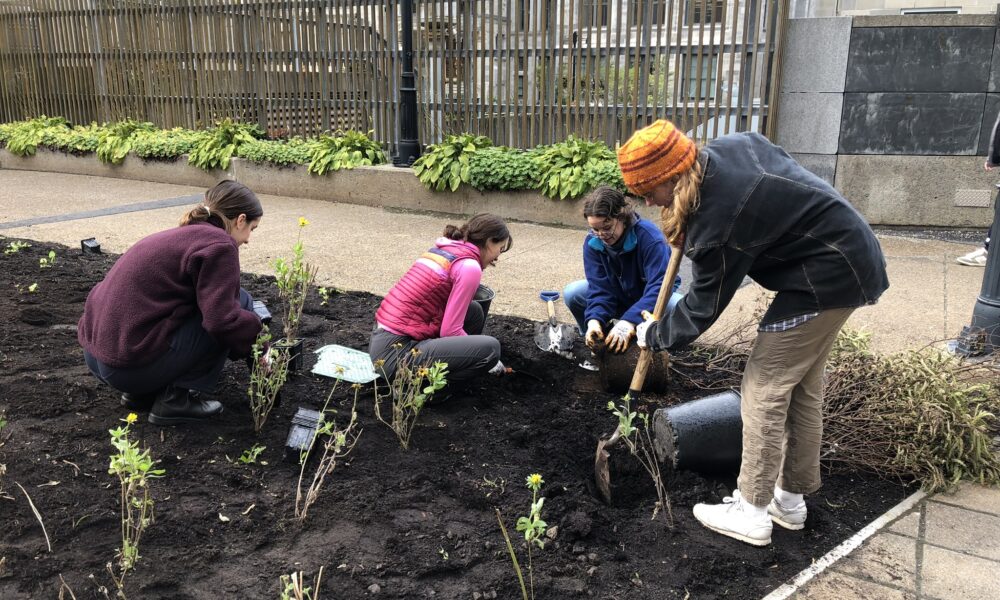
McGill community members, numbering around 10 total, gathered to plant a garden on the terrace of the Otto Maass Building on Oct. 15 as a part of the university’s Biodiversity Plan 2030. McGill adopted the plan in 2023, which commits the university to increasing biodiversity on its campuses by cultivating and supporting native plant and animal species on the land the university occupies. 

The event saw the sowing of about 365 plants, covering an area of 250 square metres on the terrasse of the Otto Maass Building. 95 per cent of the new garden is composed of indigenous species, which will take a few years to reach their mature size.

The biodiversity plan is a part of McGill’s Climate and Sustainability Strategy 2020-2025, which sets the direction for the university’s long-term approach to combating climate change, including its commitment to achieve carbon neutrality by 2040.

Marie-Claude Carignan, Climate and Biodiversity Officer at the McGill Office of Sustainability, organized the community planting event and emphasized its alignment with McGill’s biodiversity plan. 

“We’re focusing, in this case with our garden, on indigenous species, and more broadly we’re trying to see how biodiversity, […] conservation, and restoration can be better ingrained within operations at McGill,” Carignan said in an interview with The Tribune.

Ahead of the United Nations Biodiversity Conference (COP15) hosted in Montreal in December 2022, McGill joined hundreds of universities globally in signing the Nature Positive Pledge, which encourages higher education institutions to restore ecosystems damaged by their presence. This resulted in the development of McGill’s Biodiversity Plan 2030, which is the first plan of its kind implemented at McGill. 

The university’s biodiversity plan consists of six key objectives; to maintain inventories of biodiversity at McGill, analyze the university’s impact on biodiversity, increase engagement with biodiversity-focused activities, embed biodiversity in university operations, increase green spaces on campus, and develop partnerships to meet biodiversity targets.

The community planting event was in line with the plan’s goal of increasing McGillians’ engagement with biodiversity-focused activities and increasing the quality and quantity of green spaces on campus. Organizers provided volunteers with gardening gloves, shovels, and hot chocolate.

Carignan noted that student enthusiasm for the event encouraged the Office of Sustainability to involve the McGill community in future initiatives as much as possible. 

“We’ve had a lot of people requesting [to help out] when we’re doing […] events,” said Carignan. “They actually want to get their hands dirty and actually want to participate and actively be involved in the biodiversity project on campus.”

Sofija Kuzmanovic, U0 Engineering, attended the event, and reflected on the value of direct engagement in community projects. 

“People are looking to make small local efforts to combat issues with pollution and overbuilding,” Kuzmanovic said. “I know McGill is trying to meet certain goals with its biodiversity, and being able to contribute to that and see it in action makes you realize that there really is an impact in something you can do.”

Organizers will label the plants, and install a chronolog photo station, allowing community members to monitor the garden’s development through a publicly-accessible timelapse.

While McGill has long-term sustainability goals, some say the university is not going far enough. Lola Milder, U3 Arts, an organizer with Divest McGill, a climate advocacy group, wrote to The Tribune that she believes the university needs to adopt a more in-depth approach to combating the climate crisis.

“I think that McGill operates on a narrow understanding of ‘sustainability’ that focuses on individualized actions like recycling and biking to work that allow business at McGill to continue as usual,” Milder wrote.

According to Milder, McGill’s size and influence as an institution heightens its obligation to respond to the ongoing climate emergency. 

“It’s exciting that they’re moving forward to divest the university’s direct holdings from fossil fuel corporations,” Milder wrote. “But the endowment is still funding climate destruction through its indirect holdings in fossil fuel corporations, and holdings in many other destructive industries, including weapons manufacturing.”

A previous version of this article stated that McGill’s biodiversity plan was adopted in 2022. In fact it was adopted in 2023. The Tribune regrets this error.

Horoscopes, Student Life

The Tribune Predicts: Fall horoscopes

With sweater weather in full swing and a pumpkin spice latte in hand, it’s time to hunker down in a library until it’s spring again. While you’re hibernating, check out The Tribune’s predictions to round off the end of 2024. In this edition, we’re doing “ins and outs” for each sign.

Aries (Mar. 21 – Apr. 19): Whether your favourite scent is cranberry or maple wood, head to the nearest home goods store before a seasonal cold steals your sense of smell! Self-care is in, and agendas are out! All of your tasks and meetings can float into the void—that peace of mind is the best self-care of them all. In: Warm sheets, baking, scented candles. Out: To-do lists.

Taurus (Apr. 20 – May 20): This season is about relaxation and renewal. Try to take advantage of the nice weather and get some well-needed rest! In: Group texts, evening naps, aimless strolls. Out: Superlatives, cold water, wardrobe meltdowns.

Gemini (May 21 – June 21): With Mercury going into retrograde in November, it’s time to delve into your own identity. In: Personality tests, listening to new music genres, blind dates. Out: Permanent markers, repetition, monologuing.

Cancer (June 22 – Jul. 22): Have you been feeling optimistic lately? Keep that contentment flowing with journaling. This fall and Thanksgiving, list everything you’re grateful for. In: Meditation, follow-up texts after a hangout. Out: Assumptions, “if ykyk.”

Leo (July 23 – Aug. 22): Fall is the perfect time for you to dive into your passion projects. Whether you’re starting something you’ve always thought about doing, or finishing something on the shelf, it will get done before 2025. In: Minimalism, bedroom deep-cleans, screen-time restrictions. Out: Multitasking, Zoom meetings, people pleasing.

Virgo (Aug. 23 – Sept. 22): Your ruling planet will enter the house of relationships this November! Whether you’re in a relationship, seeking one, or just don’t care at all, your connections with others will be reinvigorated. In: Semi-formal, fragrantica.com, manifestation. Out: Ghosting, playing it by ear, instant gratification.

Libra (Sept. 23 – Oct. 23): Happy birthday Libras! This season—and year—don’t be afraid to get a little weird. Indulge in all the strange things that bring you joy, even if that means biking to the US/Canada border for a Carnival scunt. In: Mismatched clothes, spontaneity, fortune cookies. Out: Traditions, nostalgia, soft launch.

Scorpio (Oct. 24 – Nov. 21): It’s time to face some things that may have been bothering you for a while. Before your birthday season is up, tidy all the loose ends and resolve some grudges that are weighing you down. In: Cold calls, little treats, dinner parties. Out: Overthinking, revenge, “do not disturb”.

Sagittarius (Nov. 22 – Dec. 21): This semester is about making new connections. Send those LinkedIn requests to your highschool best friend’s cousin’s boyfriend; everything is on the table. In: Applying for club executive positions, networking events, knowing your neighbour. Out: Bedrotting, celebrity culture, playing hard to get.

Capricorn (Dec. 22 – Jan. 19): A major professional opportunity is around the corner, but you already knew that, didn’t you? Take this opportunity to get some rest. In: Penpals, 10+ picture photo dumps, manifestation. Out: Crying wolf, less than seven hours of sleep, business casual.

Aquarius (Jan. 20 – Feb. 18): Thinking about booking that trip for Christmas break? Wanderlust is fueling you right now, so switch things up and broaden your horizons. In: The unexpected, new shoes, going off-the-grid. Out: Imposter syndrome, hometowns, the word “delulu.”
Pisces (Feb. 19 – Mar. 20): Confide in your friends about the things on your mind, or branch out! You might realize someone you know is more similar to you than meets the eye. In: Double-takes, coffee dates, talking to your TA. Out: “Situationships”, FOMO, keeping up with people you don’t like.

Campus Spotlight, McGill Recommendations, Student Life

McGill Global Brigades is building bridges in global health

McGill is home to many student clubs focused on global issues like sustainability and public health. Among them, McGill Global Brigades stands out as a club that encourages students of all fields and interests to roll up their sleeves and collaborate for public health initiatives. Not only does it create new communities and build networking skills, but it also enacts tangible global change.

With 27 chapters across Canada and over 340 across the world, Global Brigades unites students in promoting sustainable international health initiatives. This non-profit organization works with various communities around the world to promote health and economic goals such as access to clean water and sanitation

At McGill, numerous programs—including medical, dental, business, public health, and engineering—work to advance sustainability initiatives in their respective spheres. The medical subgroup, for example, focuses on health and wellness, while the business program hones in on financial development initiatives. The McGill chapter raises awareness about these global health issues through fundraisers and hygiene drives in support of the organization’s remote clinics in countries around the world. 

While the club mainly holds fundraising events, they also promote academic and non-academic gatherings, such as game nights and a Spanish-language acquisition workshop in preparation for their most recent “brigade”—a trip to Honduras scheduled for May 2024.

Eva Weigle, U2 Arts, is a member of the events subcommittee for McGill’s chapter of Global Brigades. While she joined the club just this year, the chapter has helped her build on her fascination for global health and sustainability initiatives, as she explained in an interview with The Tribune

“I’m an econ major and a bio minor, and I’m really passionate about public health. I like how Global Brigades is kind of like an intersection of all things I’m interested in,” Weigle said. “It’s really focused on helping communities, specifically with global health, but also they do a lot of other things, like micro-financing.”

Global Brigades not only harnesses multi-subject interests among its members, but it also cultivates a strong sense of fulfillment and achievement within the club. 

“I’ve volunteered in vaccination events, and that’s where I feel like I’m actually informing people and helping people,” Weigle added. 

As part of the Global Brigades events subcommittee, Weigle emphasizes the networking and outreach skills she practices in the club, which extend beyond McGill to other communities around Montreal. 

“It’s actually really cool, because I get experience reaching out to local pubs and local bars. And it’s really good because it’s work experience, almost like I’m getting ready for the real world, and it’s fun,” she said.

While the club mainly conducts fundraising and awareness events at McGill itself, its hands-on practice of doing brigade trips allows its members to have real-world work experience in the medical field while seeing their fundraising efforts make an impact. 

“I really am excited to see what we do in person,” Weigle said. “And I’m just kind of excited to help out [in] any way I can.”

The club also provides a great sense of community, as its members are ecstatic and passionate about global health and sustainability efforts. 

“I really liked how I [had] never really heard of Global Brigades before, but everyone in the club is so excited about it that that really drew me in,” Weigle noted.

Weigle highlights the multidimensional aspect of the club and encourages other students to join as representatives or members of their events or design subcommittees

“If you are passionate about global health, or even if not, you’re just passionate about helping people, we do so much,” Weigle said. “If you’re interested in medicine, global health, and economics, we kind of have a little bit of everything.” 

To keep up with Global Brigades’ future events and activities, sign up for their Listserv, take a look at their Linktree and website, or follow them on Facebook and Instagram

Read the latest issue

Read the latest issue