

Latest News

Hockey, Sports

Redbirds hockey puts six past Carleton Ravens as they proceed to their final regular season game

On Feb. 3, the Redbirds hockey team (20–5–2) triumphed over the Carleton Ravens (10–11–5) in a 6-2 victory at McConnell Arena. The arena was filled with excitement as the McGill Fight Band created a lively atmosphere supporting the Redbirds and their firm grasp on first place in the OUA East.

The first period opened with sharp passing and skating from the Redbirds. In the third minute of play, Redbirds’ forward Mathieu Gagnon scored the first goal of the game, assisted by Zach Gallant and right winger Charles-Antoine Dumont. However, the lead was short-lived. The Ravens scored a tap-in only 14 seconds later after poor coverage around the McGill crease. A Carleton player pushed McGill goalie Alexis Shank after he saved a shot on goal from the Ravens. Minutes later, tensions rose between the Redbirds and Ravens in front of Carleton’s net, with players on both sides getting in each other’s faces. 

Carleton took the lead in seven minutes into the first after securing a rebound off a shot that hit the crossbar. The Redbirds managed several shots on goal in the ensuing minutes, while Carleton kept up the aggression. 

McGill continued to pressure the Carleton defence heading into the last minutes of the period. Gallant picked up his second point of the night, scoring a goal with two minutes left in the first.  Carleton picked up two penalties in the last two minutes of the period for high sticking and hooking, giving the Redbirds a five-on-three advantage, which McGill forward Eric Uba capitalized on. He scored the third goal of the period, assisted by centre William Rouleau and defenceman Scott Walford, leaving the Redbirds with a 3-2 lead. 

The second period saw no further goals for either team. However, the hostile atmosphere only strengthened.  Both teams got two penalties apiece. McGill left winger Stephane Huard took a slashing penalty just over eight minutes into the period and was quickly followed up by a penalty on the Ravens—this time for roughing after the whistle. 

Two minutes into the third period, following a commotion around McGill’s net, the Redbirds defence had to clear the puck off the goal-line to prevent Carleton from equalizing the game. Although Carleton started the period strong, McGill scored five minutes in to gain a 4-2 lead after the Ravens goalie failed to cover the puck in the crease. Throughout the period, both teams shot aggressive slap shots that the goalies thwarted. After the Redbirds took a timeout, Dumont secured a breakaway and dished it to Gallant, who scored a beautiful goal that brought the crowd to their feet. In a last-ditch effort to even the score, Carleton pulled their goalie with four minutes remaining. Redbirds defenceman Maxime Blanchard scored the final goal of the game on an empty net with just three minutes remaining. 

As the Redbirds head into their final game of the season against Carleton on Feb. 10, head coach David Urquhart explained what the next few weeks will hold. 

“Our main focus is to win that next game because we’ll get [a] bye in the first round [of playoffs],” Urquhart told The Tribune. “In terms of preparation for the playoffs, it’s [what] we’ve been preparing down the stretch […] it’s a style of play that’s more focused on defensive game that allows us to have offensive creativity.”

Moment of the game: With seven minutes left in the third period, the Redbirds got a two-on-one breakaway, leading to a top-shelf goal scored by centre Zach Gallant and assisted by right-wing Charles-Antoine Dumont.

Quotable: “[This win] means a lot, because we’re still fighting for the first spot in the playoffs […] every game is really important [….] We’re not taking anything for granted. And we’ve had a lot of success in the past couple of games, but we’re trying not to sit on our laurels. We’re just trying to treat every game like it’s a playoff game.”

– William Rouleau, on what this result means for the team
Stat corner: Two hockey sticks were broken during the flow of the game, one of which by a Carleton player after attempting a slapshot.

Arts & Entertainment, Fashion

2024 fashion is both futuristic and nostalgic

A threat of danger plagues the foggy underside of the stone bridge as a frenetic figure sprints into the audience’s view. The noir-like dimness of the cobbled structure conceals the silhouette, lit only by distant beams of pale moonlight over the bridge. The shadow stops abruptly, tripping over its feet and assuming a contorted crouch, unnerving and frightening in its severity. Lamp posts brighten to reveal model Leon Dame rising to catch his breath. His tightly corseted waist slithers into the light of the lamps’ bloom, which illuminates his unearthly face: Dame’s skin shines like a porcelain doll covered in an organized mess of pigmented pastels. 

The design aspects of Maison Margiela’s spring 2024 couture show, which premiered on Jan. 25, are avant-garde and unsettlingly strange. Creative director John Galliano’s anti-fashion designs are a retreat into the uncanny, an imagining of physical modernization to the point of bodily dystopia. With Pat McGrath’s ethereal makeup, the collection heightens to a level of contradicting otherworldliness and familiarity. This uniquely 20th-century perspective allows themes of simultaneous technological uncertainty and acceptance to find their way into today’s wardrobes.

Under rapid technological development, the visual elements of art tend to mirror innovations to process these radical changes. Creative processes—fashion styles in particular—are often reactionary, drawing from influences of everyday life to physically emulate social attitudes toward topics such as modernization. Recent advancements in artificial intelligence, communication, and augmented realities support a world reliant on technology for everyday interaction, which poses the question of its creation: What are the extents to which technology is an art form in itself?

This is not the first time that fashion has shifted with attitudes towards advancement. The stylistic futurism of the 1980s directly resulted from artists’ growing fascination with technology’s endless possibilities. Avant-garde fashion styles emerged following the invention of personal computers, cell phones, and digitized music in the form of CDs. Trends of capacious silhouettes altered the form of the body just as computers and cell phones altered life in the public sphere. Iconic ’80s designer Thierry Mugler exemplifies this influence in high fashion with his diverse designs of the exaggerated female form: Sharp shoulder pads, bold colours, and the use of unconventional materials, sometimes combining metals, latex, tulle, and exotic feathers to rebel against stylistic expectation. His work aims to transcend the expectations of traditional fashion and define the essence of the decade, one reliant on experimentation to obtain bodily modernity in a world of unrelenting transformation.

Maison Margiela’s new collection also contains several distinct influences from the ’80s subculture called New Romanticism. The New Romantics, originating in the British New Wave and glam rock music scene, adorned themselves in pale and pigmented makeup styles, androgynous silhouettes, and a sense of overall theatricality as a way of embracing the frivolity of life. New Romanticism took much inspiration from the flamboyance of 18th-century French fashion styles of the Romantic Period. The subculture was a revival of both its style and attitude, known for its ability to combine tradition with the futuristic opinions of the decade, which bears a striking resemblance to the current state of fashion. Maison Margiela’s 23rd look mirrors much of the male silhouettes and styles of the New-Romantic and foundational Romantic period with its slim-straight plaid breeches and tweed suit jacket tapered at the waist. 

By referencing trends of modernism from the past, designers such as Margiela subvert all cyclical expectations. The collection exemplifies the intentions of modern fashion: It embraces the past while carving out its own individuality based on contemporary ideals and attitudes. 

Off the Board, Opinion

An ode to the hater

At the end of sixth grade—a year fraught with the kind of drama only 11-year-old girls can come up with—I made a promise to myself: No more talking shit. I do not think I ever really thought I was going to follow through with it. It was the kind of “new year, new me” resolution that we tend to discard after two weeks. Somehow I found myself taking on my new mantle of optimism with a serious sense of commitment. 

For the next two years, I refused to engage with anything I considered negative. When my friends got into fights, I put my hands over my ears and proclaimed myself neutral. When asked to do something I did not like, I sucked it up and put a smile on my face. Sure, I let the odd complaint slip to my best friend if the task was particularly heinous, but all in all, I remained positive. Much to my surprise, my newfound pledge of positivity did not bring me the freedom or moral privilege that I desired: Instead, all those negative feelings began to build up. Two years of listening to my friends’ complaints about stupid problems, acquiescing to every monotonous school project, and silently dealing with the ever-present anxiety of high school fast approaching gave me a constant pit in the bottom of my stomach.

The solution? Embrace being a hater. Haters get a bad rap. To be fair, this is unsurprising given that identifying yourself with “hate” more likely sparks apprehension or animosity than goodwill, but I think this is a mistake. People tend to associate haters with those who claim to be devil’s advocates. In reality, we haters stand in a category of our own. Where the devil’s advocate raises nasty, spiteful points just for the sake of starting an argument, the hater simply embraces their own personal preferences—refusing to ride the train of toxic positivity.

Adopting this philosophy, my newfound freedom allowed me to expand my interests, explore new passions, and rid myself of the self-imposed constraints that coloured my middle-school years. This outlook became particularly helpful when I started my first year at McGill. 

Starting in September 2020, everyone was particularly desperate for human interaction. The phase at the beginning of the semester when you’re expected to say hello to anyone you end up stuck in the elevator with—the questions of “Where are you from?” and “What’s your major?” seemed endless. It was all too easy to get stuck in the pit of social convention and false niceties, saying yes to every plan that was offered to avoid the terrifying fate of being stuck with no friends. I quickly found myself all too close to reverting to my middle-school self—a horrifying thought. 

One night changed all this when, at an event that I never wanted to go to in the first place, someone told me that their favourite artist was The Chainsmokers. It sparked an important question in me: Why was I pretending to be into the most repetitive, asinine music I knew, to appeal to someone I clearly had nothing in common with?

Now, to be clear, I’m not saying there’s anything wrong with liking The Chainsmokers, if that’s your vibe. I’m also not saying you should scorn everyone whose interests differ from yours. Rather, you should allow yourself to feel your hate. You are under no obligation to sit through a movie you find dull and monotonous, or listen to an album by an artist whose voice you think is weak and annoying, nor—perhaps most controversially—do you need to suffer through conversations with people you don’t like.

Being the bigger person is overrated. It doesn’t do anyone any good to feign appreciation, simply for the sake of propriety. So next time someone in your conference begins a sentence with “just to piggyback off of that,” or you hear someone raving about the latest low-budget Netflix drama, allow yourself the simple pleasure of talking shit with a friend.

McGill, News

Students demand McGill divest from companies supporting Israel’s siege on Gaza in national week of action

Over 100 students gathered outside the McGill Arts Building on Feb. 2 to stand in solidarity with Palestine and demand divestment from corporations complicit in Israel’s ongoing siege on Gaza. McGill students joined those from Concordia and walked toward Université du Québec à Montréal (UQÀM), waving Palestinian flags and chanting “free, free Palestine.”

The walkout was organized by Solidarity for Palestinian Human Rights (SPHR) McGill, SPHR Concordia, Al Raya Dawson, and Solidarité pour les droits humains des Palestiniennes et Palestiniens at Université de Montréal (UdeM) and Université du Québec à Montréal (UQÀM). The event was part of a broader national week of action coordinated by National Students for Justice in Palestine (NSJP) and Palestinian Youth Movement (PYM). 

In a statement to The Tribune, SPHR underlined the tremendous scale of student activism for Palestine. 

“Our demands towards McGill administration are not isolated but part of a broader, powerful nationwide call to end Western complicity as a whole,” said a representative of SPHR who wished to remain anonymous. 

Chief among SPHR’s demands was a call for McGill to divest from weapons manufacturing companies and corporations profiting from the Palestinian occupation. In particular, SPHR urged McGill to divest from Lockheed Martin, a weapons manufacturer that continues to sell planes and weapons to Israel.

In an email to The Tribune, McGill Media Relations Officer Frédérique Mazerolle did not give a definitive answer as to whether the university would consider divesting from corporations complicit in the genocide in Gaza. Instead, she maintained that “McGill’s approach to investments aligns with its Statement on Investment Policy as overseen by the Investment Committee of the Board of Governors.” 

SPHR’s continued demands for divestment come after the Quebec Superior Court ordered the Students’ Society of McGill University (SSMU) to postpone the ratification of the Policy Against Genocide in Palestine until a final verdict is reached at a court hearing in March. The policy, that 78.7 per cent of non-abstaining McGill student voters supported in the fall referendum, would have mandated that SSMU take an official stance in support of Palestinian liberation and lobby McGill to divest from corporations complicit in the Palestinian genocide. 

SSMU President Alexandre Ashkir told The Tribune that SSMU remains committed to contesting the injunction and supports SPHR’s activism. 

“SSMU supports mobilization for the Palestinian cause and therefore this week of action,” Ashkir wrote by email.

However, at the rally, SPHR and student protesters criticized SSMU’s response to the court order. 

“An injunction such as the one they are facing must be consented to, and the fact that [SSMU] lawyers consented means that the Policy Against Genocide in Palestine has been stalled for months,” said one student protester who wished to remain anonymous. 

Another protestor, who also wished to remain anonymous, asserted that “[SSMU] has failed to represent the student body who voted in a historic referendum.” 

Despite the ongoing legal challenge to the Policy Against Genocide in Palestine, students at the rally highlighted that student activism has successfully led McGill to divest in the past. 

“It was student advocacy that got McGill to divest from fossil fuel companies, and it will be student advocacy which gets McGill to divest from the ongoing genocide,” said one student protester who wished to remain anonymous. 

A representative from Independent Jewish Voices echoed the importance of student mobilization. 

“Student activism forced McGill to divest from apartheid South Africa in the ‘80s,” the representative, who wished to remain unnamed, said. “Once again we will leave this administration no choice but to stand on the right side of history.”  

SPHR’s representative also emphasized that Friday’s walkout demonstrated solidarity with the broader Palestinian struggle. 

“This week of action was another successful effort to be coordinated with all student groups across Turtle Island, including SJPs and SPHRs from the United States and across Canada. We are showing once again the unity, coordination, and strength of the Palestinian student front.”

Science & Technology

Swimming upstream: The case of U.S.-Canada collaboration in fishery management

While “transboundary fishery governance” may not immediately evoke images of glamorous public servants heroically striving toward healthy ecological practices, it turns out to be a critical, yet often overlooked aspect of our food supply. Fishery management is the practice of regulating the extent of fishing, specifying permitted and restricted areas, and managing environmental conditions in order to ensure robust fish populations. Without it, we face the risk of depleting fish populations and the ensuing collapse of marine ecosystems.

Evelyn Roozee, a PhD candidate in Natural Resources Management and Policy at McGill, spoke to The Tribune about a recent paper investigating risk, control, and trust in transboundary fishery networks. Roozee, the first author of the paper, collaborated with researchers from Montreal, Texas, and the Netherlands to perform a quantitative analysis of fisheries in Canada and the U.S. bordering the Salish Sea. 

Roozee explained that, theoretically, each country has complete rights to use resources within 200 nautical miles of its shore. However, fish aren’t always interested in following international human law.

“Fish don’t really abide by political boundaries,” Roozee said. “They can have pretty large geographic ranges. So, oftentimes, they move between those economic exclusive zones, and that requires states to work together to conserve the species.”

As Roozee explained, the practice of fishery management within one country is hard enough, let alone trying to collaborate across national borders. 

“There’s lots of different groups that are involved. Fishers oftentimes don’t like managers, because managers are the ones telling them, ‘you can’t go out, you can’t fish this species here,’” Roozee said. “Similarly, scientists can also be seen as in opposition with fishers and managers, because they’re trying to alert everyone on what the science is saying about how the fish stock is doing. And that doesn’t always align with political goals, or with business and trade goals.”

These conflicting identities and motivations can create tense situations within a single fishery, but when two fisheries controlled by different governments have to collaborate, relationships get even hairier. 

“In the paper, I talk a lot about how to break down those identity issues or those them-versus-us perceptions, mainly through building trust, to come together collaboratively because the key to collective action is collaboration,” Roozee said.

To address this issue, the researchers applied principles from the business world, building on an influential business strategy paper that outlines the relationships between risk, control, and trust in economic alliances. Their research explores how these same concepts can be applied to natural resource management.

“Risk is sort of the key variable that needs to be reduced. Essentially, if the risk is too high, people won’t work together,” Roozee said. “However, fisheries are inherently pretty risky, because of the nature of the resource. It’s really hard to know a lot about fish: They’re underwater, they move a lot, [and] their populations are very erratic.”

Increasing trust and controls are two major ways to combat risk, both in business and fishery management. 

“For example, if I’m a fisher, and I don’t know if I will be able to catch enough fish to support my business, I need to trust the information that the scientists are giving me and the managers are telling me about where the fish will be and how much I can take,” Roozee explained.

Control, on the other hand, is more about regulation. This may take the form of banning fishing in a risky area or on risky days. 

“However, a lot of our research now is sort of showing that control doesn’t affect risk directly,” Roozee noted. “It affects risk through the building of trust.”

This reflects the general trend of the research, demonstrating that while trust is more difficult to build and maintain, it is ultimately more powerful in reducing risk than control is. Additionally, Roozee emphasized that although her research did point to some general trends, the complexity of each unique fishery area makes it impossible to adopt a one-size-fits-all strategy. 

“You can’t just storm into the situation thinking you know best,” Roozee said. “There’s a lot of history you have to learn. There’s a lot of context that’s really important before you start collaborating. You have to do your homework.”

Science & Technology

Annual hackathon abounds with creativity, camaraderie, and caffeine

There are many ways to get an adrenaline rush. For some, skydiving, horror movie jump-scares, or kickboxing does the trick. For others, it’s McHacks

McHacks is an annual hackathon that a team of McGill students organizes, where teams of hackers have just 24 hours—from Saturday noon until Sunday noon—to design a project showcasing their coding prowess to the judges. Now in its 11th year, the competition took place on the weekend of Jan. 26 and 27 in the University Centre and attracted nearly 500 competitors. 

The competition’s short time limit often guarantees a nearly sleepless night for participants as they rush to complete their projects. The organizers even converted the ballroom into a sleeping area for competitors, complete with mattresses sprawled out on the floor. 

Co-directors Judy Yun, U4 Science, and Juliette Xu, U3 Science, oversaw the event’s organization. In an interview with The Tribune, Yun explained that there are a variety of features that judges look for when evaluating projects.

“The main thing is functionality, especially for the top five. It’s generally like, ‘how complete [is this] as a project?’” Yun said. “We also judge on creativity a lot, something super innovative, really different than we’ve ever seen before. And I think design, usability, accessibility, that type of stuff is also a really big category.”

Yun also expressed that the thrill of the busy weekend is one of her favourite aspects of the event each year.

“It’s kind of like a really long adrenaline rush for like, 36 hours,” Yun explained. “And then it’s over and you’re like, ‘oh my gosh, my life is like, stopped.’ But it’s super rewarding.”

This year, Tessa Davis, U3 Science, Gabrielle Lavoie, U2 Engineering, and Gabrielle MacInnes, U2 Science, won the first place prize with their project, Danstrument. During the team’s demo of Danstrument during the closing ceremonies, Lavoie explained that the web application allows users “to meet with your friends and to dance, which will generate music.” 

Danstrument accomplishes this goal by scanning users’ movements during video calls using computer vision artificial intelligence (AI), which triggers audio cues associated with different sounds depending on the selected musical instrument. For example, on the application’s sine wave setting, the frequency of the continuous sine wave playing over the call increases or decreases as the user raises or lowers their hand, respectively. 

One challenge the team encountered was accurately mapping movement to sound using the programming language JavaScript. 

“One of the issues that we ran into was that the library that we were using in the JavaScript back end wasn’t necessarily the best at tracking continuous hand movements,” Davis said during the closing ceremonies demo. “We have another version that if we had more time, we would integrate into the back end of the web app that you just saw, which is better able to recognize movements.”

The judges awarded second prize to Gülce Apaydin, U1 Science, Negar Akbarpouran Badr, U1 Engineering, Dany Makhoul, Dawson College, and Ida Su Ozdemir, U1 Engineering, for their project, Melo-N, which uses AI to allow users to change the genre of songs. During their demo at the closing ceremonies, the team explained that the application uses AI and software library FFmpeg to separate the vocals from the instrumentals of the original songs. The application then uses MusicGen API to change the genre of the instrumentals before recombining them with the original vocals to create the final product.

In a group interview with The Tribune, the creators of Melo-N highlighted their strong collaboration with one another as a key factor in their win, emphasizing how much fun they had working as a team.

“For me, I didn’t know anything about AI or anything about machine learning,” Makhoul said. “And so we were cooperating with each other, collecting information and everything so we could build our project. So having this final project at the end is something phenomenal.” 

Badr and Ozdemir also expressed surprise at how smoothly the competition went, as it was both team members’ first ever hackathon. 

“Everyone told me, ‘you’re not going to enjoy your first [hackathon]. Like, it’s gonna be difficult,’” Badr said. “But it was so good. Brainstorming ideas, getting to do different stuff, actually implementing what I knew, it was amazing.”

Mohamad Addasi, Concordia University, Aden Bessam, Champlain College, Garance Danvin, U3 Desautels and Andrew Rowe, Concordia Engineering, claimed third prize with their project FluentFingers. The app is designed to teach users sign language by using AI to analyze photos users upload of their signs, and indicating whether the user’s sign is correct for the desired word. Disaster struck on Sunday morning when the team lost all their unsaved training on the AI—which was responsible for mapping hand signs—due to a wifi interruption. This setback meant the team was unable to demo their project at judging or during closing ceremonies.

In an interview with The Tribune, Bessam emphasized that although the team was unable to present the functional version of their project, the concept behind FluentFingers was crucial to their success.

“It was really the implementation of the ideas,” Bessam said. “Because we took a lot of time just asking ourselves, what could help the community and not only the hackathon [….] So when we came up with the Duolingo hand sign idea, it was really great.”

In addition to first, second, and third place prizes, hackers compete for a variety of awards from sponsors, as well as superlative prizes such as “Best Useless Hack.” According to Yun, something that makes McHacks unique is that it caters to participants of multiple skill levels, including beginners. Yun explained that superlative prizes play a role in keeping the competition engaging for beginner programmers.

“I think it’s much more encouraging to have all these different prizes, because you don’t necessarily have to have the best product and the most innovative idea,” Yun said. “You can still have lots of fun and get rewarded for the time that you put into all of [your] work.”

Enkai Liu and Jason He won the “Best Design” superlative award for their project Rizzmo, an application that allows users to explore a coral reef to learn more about the ecosystem. For Liu and He, first time McHacks competitors and Grade 11 students from Waterloo, Ontario, a highlight of the event was the opportunity to speak to McHacks mentors—volunteers who circulate and offer assistance to Hackers during the competition. 

“I think for us, the mentors were emotional support,” Liu told The Tribune after closing ceremonies. 

Team members Annaliese Bissel, U1 ArtSci, and Guan Xi Liu, U1 Science, acknowledged the stressful nature of the competition, but also spoke to a feeling of camaraderie that comes from the experience. 

“For me, I think it’s actually just being able to be part of a large community of people trying to work towards the same thing,” Liu said in an interview with The Tribune.

“Yeah, all the RedBull on the table and the chargers everywhere, it’s like the same as an exam season,” Bissel added. “You know, we’re just among all the other people in Redpath at 12 a.m.” 

The same sentiment was echoed by the team of Mohammad Shaheer Bilal, U4 Engineering, and Filip Snítil, U2 Science, and Daniel Blackburn, U1 Engineering. Like many teams, at the time of their interview with The Tribune they were encountering issues getting their project up and running. Despite their setbacks, the team expressed that they enjoyed the event and learned from the experience—encapsulating an attitude that many hackers shared over the course of this long, eventful weekend.

“We’re probably not going to win, because we haven’t figured it out by now,” Snítil said. “And nothing works. But it’s fine. It’s a good experience. I had way too much caffeine.”

Arts & Entertainment, Film and TV

The Oscars 2.0

The Oscars Remixed

Since the Oscar nominations were announced last Tuesday, an enormous amount of articles have been written about the snubs, surprises, and everything in between. And while it may be interesting and worthwhile to debate the artistic merits of films such as Past Lives or The Zone of Interest, both of which deservedly received some love at the nominations, it is equally important to celebrate the aspects of movies that the Academy shamefully neglects.

Best Performance by an Actor on a Press Tour: Ryan Gosling in Barbie

It is high time we honour the effort actors put into press tours. They have to spend weeks answering the same questions in two-minute interviews, fighting exhaustion as they play ridiculous games and give the same answers all day. Yet no actor in recent memory has so thoroughly committed to the ridiculousness of this process as Ryan Gosling has for Barbie. While the Academy recognized him in the Best Supporting Actor category for his masterfully comedic performance in the film itself, they would be remiss to let his star turn on the press junket go unacknowledged. Therefore, the award for Best Performance by an Actor on a Press Tour should go to Ryan Gosling. Throughout the year, Gosling blessed us with different versions of his hit song “I’m Just Ken,” telling us all the things Ken can’t live without (his horse-patterned fur coat and his rollerblades) and just being generally hilarious. Gosling’s commitment to the bit has made him the perfect honoree for this new category. 

Most Aesthetically Pleasing Movie: Saltburn

When visual-based social media platforms (Pinterest and TikTok) reign supreme, the aesthetic pleasure of a movie has become increasingly important. This year, Saltburn was the movie that captured the internet’s imagination. How exactly this bizarre movie about obsession and class reached the TikTok audience is unclear. However, I have found myself wanting to spend my summer at my rich friend’s English estate. In these trying times, wouldn’t everything be better if it were done while spending your time blissfully unaware of everything happening in the outside world while traipsing around your well-manicured lawns? Saltburn is the obvious choice for the Most Aesthetically Pleasing Movie.

Best Use of Music in Film: “Dog Days are Over” by Florence and the Machine in Guardians of the Galaxy: Vol 3

The Oscars have the Best Original Song category, but the use of well-known music in film is equally as important. While original songs can play a very important role in films, sometimes the use of songs we already know and love is what makes a scene even more impactful. Recently, Aftersun turned “Under Pressure” by Queen and David Bowie into a song addressing the desperation and loneliness many people feel compelled to hide. 

Similarly, in Almost Famous, Elton John’s “Tiny Dancer” becomes an anthem of friendship and youth. This year, the honour of Best Use of Music in Film should go to Guardians of the Galaxy: Vol 3, which uses Florence & the Machine’s “Dog Days are Over” during the final scene. Since 2015, we have spent time with the Guardians, and we have grown to love them. Ending the series the same way it starts, with a dance scene, is the perfect conclusion to this beloved trilogy. While watching the scene, we reflect on the journey we’ve gone on with these characters, and all I want to do is join them in their dance. 

On Mar. 10, I’m sure we will all enjoy watching Oscar-bait movies such as Oppenheimer and Poor Things receive their flowers from the Academy. But we should also recognize aspects of movies that award shows do not recognize. Would Barbie have been as successful without Ryan Gosling’s incredible press tour? Maybe—but he certainly helped and also made my summer more entertaining. Wouldn’t our year have been less interesting without movies like Saltburn and Guardians of the Galaxy: Vol 3? Almost definitely. It’s time we honour the sillier, but still important, aspects of filmmaking.

News, SSMU

SSMU Legislative Council debates fee increase referendum questions

The Students’ Society of McGill University (SSMU) convened for its second Legislative Council meeting of the year on Thursday, Feb. 1. The meeting discussed motions regarding fee increase referendum questions in the Winter 2024 referendum cycle. 

Deputy Speaker Sierra Fallis began by announcing that a motion regarding approval of the Student Nutrition Accessibility Club (SNAC) funding application and the rules for the 2024 Winter General Assembly—set to occur on Feb. 5— were approved over email. She also shared the Executive Nomination Kit and the SSMU Referendum Nomination Kit for the Winter 2024 SSMU executive elections.

Vice President (VP) Finance Amina Kudrati-Plummer spoke in support of a motion regarding a referendum question to increase the SSMU membership fee by $27.11 per semester for full-time students in the Faculties of Arts, Architecture, Education, Engineering, Music, Management, Nursing, Physical and Occupational Therapy, Science, and Arts and Science and by $29.92 per semester for those in the Faculties of Law, Dentistry, and Medicine. While a referendum question to increase the fee failed to pass last semester, Kudrati-Plummer emphasized that the increase was necessary in order to fund a pay raise for SSMUnion workers and that SSMU would need to reduce operations if the fee increase was not approved. The motion passed with 70 per cent of the vote. 

Following this, Gender and Sexuality Commissioner Gillian Smith discussed the motion regarding a referendum question to increase the Queer Equity Support fee by $1.32 per student per semester. Smith advocated for the motion, highlighting that this bursary gave critical support to students in need. 

“Ninety-five per cent of this fee goes to emergency bursary funding for queer students,” Smith said. “This is a response to the reality that queer people on our campus need financial support and experience severe financial barriers to being a student here.”

This motion was passed after a brief question-and-answer period. 

First-Year Council Representative Rajan Duncan then spoke in support of a motion regarding a referendum question to create a First Year $0.50 opt-outable fee to support the First-Year Council. While the motion failed to pass last semester, Duncan emphasized the vitality of the council in supporting first-year McGill students.

“We really do need this fee for the First-Year Council to be able to host events and plan giveaways and to create outreach for the first-year community,” Duncan said.

In response to a question from Kudrati-Plummer regarding an apparent jump of over $1,500 in the planned 2024-2025 First-Year Council budget from the existing budget, the motion was tabled until the council could clarify. 

Motions regarding referendum questions on fee increases for WALKSAFE, the Union for Gender Empowerment (UGE), and the Black Students’ Network (BSN) were also passed after minimal discussion. 

VP External Liam Gaither then gave a report on External Affairs, in which he highlighted action taking place on campus in response to planned tuition hikes from the Quebec government. His report noted that over 10,000 students are striking across McGill and Concordia, pointing out that the majority of those students were from Concordia. He also encouraged department executives to reach out if they were interested in taking action, and he announced a new SSMU Legislative Council working group focused on combating the tuition hikes. 

Finally, there were two reports from SSMU subcommittees. For the Gender and Sexuality Advocacy Committee, Smith noted that the committee distributes $3,000 in direct funding to queer students in need at each of their bimonthly meetings. For the First Year Council, First-Year Councillor Rajan Duncan explained that planning was underway for a McGill’s Got Talent first-year talent show, a Power Hour with various engineering student associations, and a continuation of their popular therapy dog program.  

During the question period, VP Student Life Nadia Dakdouki and Kudrati-Plummer requested that members of the Legislative Council reach out to them with any questions or concerns regarding the SSMU General Fee Increase Motion. 

“If you have concerns please bring them to me. I really want to make sure with this motion that people feel more comfortable,” said Kudrati-Plummer. “I know there were a lot of concerns about the last one regarding transparency and I tried to make sure that this motion is as transparent as possible.”

Moment of the Meeting:

In response to concerns from Gaither regarding low usage of WALKSAFE’s services among students, Arts Councillor Keith Andre Baybayon noted that his experience as a floor fellow taught him the importance of the service for ensuring that students have an option for returning home safely after dark. 

Soundbite:

“Every two weeks when I distribute these funds, I hear about how this fund saves their lives, this fund buys their groceries, this fund paid for their rent when they’re being kicked out by their parents.” — Smith, explaining the necessity for an increase to the Queer Equity Support fee.

Out on the Town, Student Life

Parlez-vous français?: Improving your French in the McGill bubble

For many McGill students, brushing up on their French is on their never-ending to-do list. Or maybe you’re a prospective McGill student worried about Quebec’s plan to have 80 per cent of non-Francophone students speak an intermediate level of French. Either way, learning French is a great way to feel more comfortable in the city, improve your resume, and become more connected to the broader Montreal community. Here are some tips for easy and low-cost ways to improve your French listening and speaking skills. 

Tip 1: Taking a French class

Preserving and increasing the use of the French language in Quebec has been the goal of the provincial government for decades. While it’s often taken to an almostlaughable-if-it-weren’t-sotragic level, it means that there are plenty of cheap and subsidized ways to learn or improve your French. Both the Quebec government and McGill offer many resources for those looking for courses. For graduate students, the Post-Graduate Students’ Society (PGSS) offers classes for different levels of French proficiency. And apps such as Duolingo and Memrise offer free self-guided lessons.

Tip 2: Taking a class in French

Going to yoga, a pottery class, or a museum tour in French is a great way to learn by listening. Even if you don’t catch everything, your ears will get more accustomed to the language, and you’ll soon realize that your vocabulary and comprehension have expanded. The great thing about taking a class is that you can always ask the instructor to repeat themself or slow down if you’re missing too much. Maybe just don’t take a first aid class or something else where it’s life-or-death if you misunderstand. 

Tip 3: Exploring Montreal, and Quebec

Practicing your French in the McGill Bubble can be difficult as many workers and residents are bilingual and will often switch to English when they hear your non-francophone accent. Certain parts of Montreal are more French than others. Neighbourhoods like Rosemont la Petite-Patrie, Pointe-aux-Trembles, Villeray, and Anjou could be good options to flex your French while seeing some new sights. If you’re feeling more adventurous, day trips to Trois-Rivières, Saint-Sauveur, or Drummondville are an even more immersive option. 

Tip 4: Joining conversational groups for practice

Both McGill and Montreal are home to many clubs and organizations geared toward helping people improve their French, which is great for those who want to practise speaking in a judgment-free environment. Conversation groups are often grouped roughly by level so that you are sufficiently challenged. Dedicating an hour or two a week to only speaking French will improve your accent, make practicing less nerve-wracking, and expand your vocabulary. 

Tip 5: Finding French-speaking friends 

Learning French through natural conversation helps build confidence and pick up on nitty-gritty details Duo won’t tell you about. An ad on Facebook Marketplace could work (although it might give off a strange vibe), but just finding some Francophones in your classes or wandering over to UQAM will do the trick as well. Let them know that you’re trying to learn French and ask them to speak a bit with you; you’ll be fluent in Franglais in no time. 

Tip 6: Watching TV in French

There are two ways of going about this: You could either find French-language shows and movies, or you could use the French dubs on your favourite shows. Both methods are valid, it just depends on whether you prefer being put off by something like Brooklyn-99 dubbed in French or the less inclusive Quebecois version, Escouade-99

Tip 7: Putting French as a default language

Changing the default language of your devices is a great trial-by-fire method of learning French. It’s the equivalent of a bridge troll who will only let you pass if you ask in French. Need to turn off your flashlight after accidentally turning it on in the middle of class? Try looking quickly for the “lampe de poche.” You’re going out for the night but your phone is only at 8 per cent? You better find the “économiseur de pile.” 

McGill, Montreal, News

McGill, Concordia students go on a three-day strike against proposed tuition increases

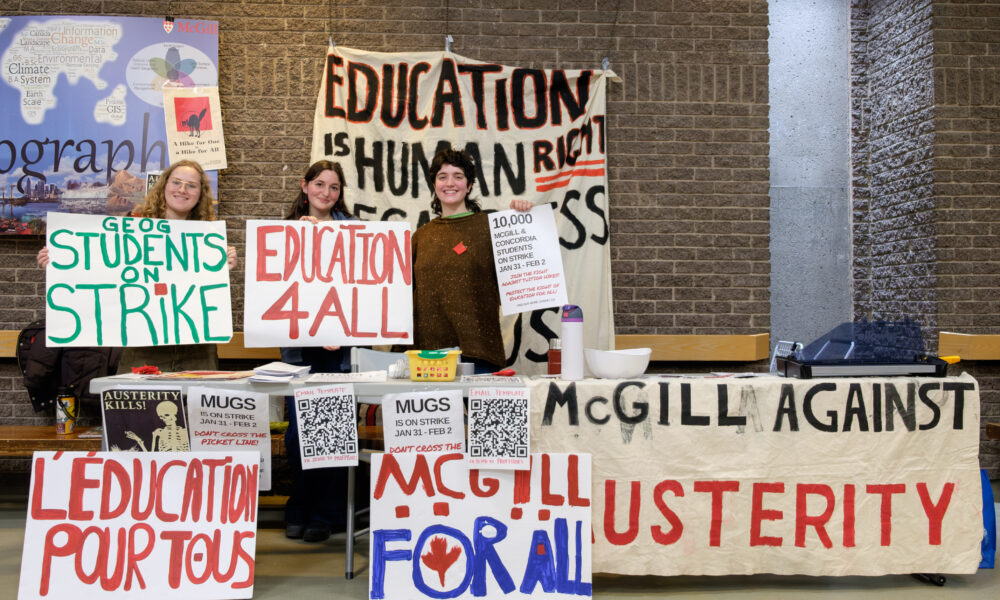
From Jan. 31 to Feb. 2, the Students’ Society of McGill University (SSMU) and Concordia Student Union (CSU) led a student strike against the Quebec government’s tuition hikes first proposed in October 2023. On Nov. 29, the provincial government announced that Canadian students from outside of Quebec will have to pay an additional 33 per cent in tuition fees, backing down on their initial plan to raise fees by nearly 50 per cent, and international students will have to pay around $20,000 starting next academic year. In response, the universities’ student unions organized three days worth of activities to inform students about the strike and encourage more to join the collective movement.

McGill departmental students’ associations called General Assemblies (GAs) in the weeks leading up to the strike to vote upon a strike mandate. The Religious Studies Undergraduate Society (RSUS), the McGill Undergraduate Geography Society (MUGS), and the Student Association of Sustainability, Science and Society (SASSS) reached quorum and a consensus concerning a strike mandate during meetings from Jan. 23 to 29. 

In an interview with The Tribune, Emily MacDougall, U3 Arts and Vice President (VP) External of the RSUS, stated that the association’s members voted unanimously on the motion to strike against tuition increases at the GA.

“Especially for smaller departments like the School of Religious Studies, it leaves us in a very precarious position,” MacDougall explained. “[Members of the McGill administration] haven’t promised any sort of safeguards for the smaller departments [….] In the process of intense financial problems, our school could literally either be closed; it could be absorbed into a different school; we could have intense layoffs; we could lose funding for some of our incredible work that we do here.”

Emma Reddy, U3 Arts and co-president of MUGS, explained that MUGS held their GA just three days before the strike began. Reddy noted that this affected the impact and reach of the strike within McGill’s student body.

“I think that because a lot of McGill students did not know how big the Concordia strike was […] it kind of just felt like we were going to be alone,” Reddy explained. “So I think that it spread some fear. Maybe people had a bit of trepidation.”

Fred Azeredo, U3 Arts and VP Finance of RSUS, expressed his disappointment at McGill students’ reaction to the strike.

“What I think just stuns me is the amount of apathy that we’ve been getting from the student body as a whole,” Azeredo said.  “I went to the […] Blue Fall protest last semester and the turnout was not great. There are a lot more Concordia people, there’s a lot more Concordia people striking. There’s so much apathy from the McGill student body. So many departments did not vote to strike, and that disappoints me.”

SSMU VP External Liam Gaither noted that although he wished that more of the large student societies at McGill had mobilized for this strike, he was still very pleased with the turnout.

“It was really amazing to be in a room when a general assembly is going down for the first time ever for some of these departmental associations. All three of them had no bylaws about general assemblies and so the executive took it upon themselves to design bylaws that were in line with others,” Gaither stated in an interview with The Tribune.

Gaither believes that McGill students do not have the same educational and institutional resources when it comes to organizing a protest or striking compared to Concordia students. Even as he is working to supply students with a “toolbox” of resources, he noted the importance of making students aware of those resources available to them.

“I think overall, what is lacking at McGill is that sense of political education, or [it] being available somewhere on campus,” Gaither said. “It seems at Concordia, it’s very palpable, it’s in the air. And there are a lot of workshops and things always going down on campus [….] I think that, as we continue to improve larger goals, we can actually expand this [movement].”

According to Global News, approximately 11,000 students at Concordia were on strike from Wednesday to Friday. In total, there were twelve student associations on strike. 

In the CSU lounge, a station was created by students who organized a schedule of picketing for different classes across faculties. One of the organizers, Alesia Chyme—a third-year Arts student and president of the UPA—expressed her awe at the number of Concordia students who mobilized for this strike in an interview with The Tribune

“It’s awesome to see how many students are mobilizing, especially [compared to] our strike last semester, to see the difference,” Chyme said. “The growth and amount of people that are going to be involved with, now, is astonishing. And like we’ve already hit almost 12,000 students that are striking just at Concordia, which is so powerful.”

As groups were heading in and out of the lounge, other Concordia students set up activities such as legal self-defence and Black radicalism workshops. 

John*, a third-year student in the School of Community and Public Affairs and Community Outreach Coordinator for the GUSS, spoke about the importance of these activities in the creation of generational knowledge within the alumni, current, and future students. 

“There’s a long history of popular education in student movements, sort of like us teaching each other [and] not necessarily having to go to an official institution to get education,” John said. “The idea here is to bring people from different generations of the student movement in Concordia and in Ontario, to be a transmission of knowledge. So that current students involved in organizing can be inspired by previous generations and not repeat the mistakes that they made. They can learn from the things that they did well, they can continue to do and really have a space for sharing.”

Marion Miller, a 2019 Concordia Fine Arts graduate, led an information session on the 2015 student tribunal that deemed some students to have violated Concordia’s Code of Rights and Responsibilities by picketing and disrupting lectures. During the activity, Miller and the attendees discussed the purpose of picketing, the different types of picketing, and the power of picketing.

In an email to The Tribune, McGill Media Relations Officer Frédérique Mazerolle stated that the university “supports the rights of students to exercise their rights in connection with civic engagement in accordance with the Charter of Student rights and applicable laws.”

“The university does not and will not take a position on the cause on which students might decide not to attend classes because of civic engagement from time to time,” Mazerolle added.

According to Gaither, there will be another strike spanning the length of a week in March. He hopes that larger McGill student associations, such as the Arts Undergraduate Society (AUS) and the Science Undergraduate Society (SUS) will join this movement and help to mobilize students. 

“We have to recognize that in 2012 everything was disruptive, and we need to bring back some of that disruption to be able to properly get gains because our power lies in a collective effort.”

The following Concordia student associations were on strike: The Geography Undergraduate Student Society (GUSS), The School of Community and Public Affairs Student Association (SCPASA), The Urban Planning Association (UPA), the Science College Student Association (SCSA), The Concordia Undergraduate Biochemistry, Chemistry & Physics Society (CUBCAPS), The Women’s and Sexuality Studies Student Association (WSSSA), The Concordia Association for Students in English (CASE), Students in History at Concordia (SHAC), The Sociology and Anthropology Student Union (SASU), The Political Science Student Association (PSSA), The Communication Studies Student Association (Coms Guild), The Fine Arts Student Alliance (FASA), The Geography Planning and Environment Graduate Students Association (GeoGrads).

*John’s last name has been left out to preserve his confidentiality.

Read the latest issue

Read the latest issue