


Latest News

Arts & Entertainment, Pop Rhetoric

An ode to Ayo Edebiri

From her roles in Bottoms to The Bear, 2023 was an incredibly busy yet successful year for Ayo Edebiri. Being Hollywood’s most in-demand young actress can’t be easy—but the people’s princess does it flawlessly. Her impeccable style and unparalleled work ethic have attracted the attention of audiences and critics alike, but what truly won us over is her magnetic personality. Edibiri’s witty and grounded sense of self has brought a sense of whimsy back to the persona of the young Hollywood celebrity

Getting her start as a writer on Netflix’s Big Mouth, Edebiri went on to star in Spider-Man: Across the Spider-verse, Bottoms, Teenage Mutant Ninja Turtles, and Theater Camp in 2023 alone. And that’s not even mentioning her breakout role as anxiety-ridden sous-chef Sydney on FX’s Emmy award-winning TV show, The Bear. Simply put, she’s everywhere. 

Endearing herself to a younger audience in a number of ways, Edebiri has connected largely with the online film community through the app Letterboxd. The app allows users to rate and share reviews—through which Edebiri has both demonstrated a clever knack for writing reviews and proven herself to be a true cinephile. Her thoughtful yet funny engagement with the medium allows her fans to really see what influences she draws upon and brings to the big screen. Whether fangirling over Zac Efron or commiserating about the relatability of a tragic love story, her reviews make cultural engagement with movies accessible for a more online audience. However, after a review of Saltburn from Edebiri received heightened attention, the actress started to take down some of her reviews. This has started a discussion around wanting to share content from our favourite celebrities vs respecting their right to connect with the films they watch in a space free of judgment. This concern has risen as the actress’s reviews have circulated from Letterboxd onto platforms for more general audiences, such as Twitter (now X). 

In addition to functioning as a social media app, Letterboxd also, somewhat infamously, conducts red carpet interviews asking celebrities to name their four favourite movies—a feature that is available to users on their profile. In an interview with Edebiri at South by Southwest Film Festival, an interviewer from the app joked around with the actress about playing the role of a donkey in The Banshees of Inisherin (a film in which she did not appear). In the video, Edebiri speaks in an Irish accent while jokingly describing the process she went through to prepare for the role. A clip from the interview later went viral online, with people declaring Edebiri as an “honorary Irish princess.” In fact, the joke has spread so far that earlier this month, Film in Dublin, an organization that works to promote Irish films, tweeted at the actress to congratulate her on her BAFTA Rising Star Award nomination. 

On that note, a moment of recognition is due for the sheer fact that Edebiri has won nearly every single award she’s been nominated for in the 2023–2024 awards season. From a Golden Globe to a Critics Choice Award and an Emmy, audiences and peers alike can’t seem to get enough of her. Her endless charm and appeal to an online demographic is backed up by heapings of comedic talent. Her undeniable ‘it’ factor doesn’t come from appearing effortlessly cool, but showing how being a real fan of comedy herself sets her apart from others in the industry.

Edebiri’s red carpet outfits capture a sophisticated yet playfully genuine style that resonates with a younger audience. In essence, she dresses really cool. From her office wear rival skirt sets by Thom Browne to her custom Prada gowns, her style feels predictive of rising trends. Her recent awards show collaborations with stylist Danielle Goldberg have also secured her spot on best-dressed lists for the foreseeable future. 

With no sign of her star dimming anytime soon, it’s safe to say Ayo Edebiri is cementing herself as a key figure in the future of film and television. Her effortlessly cool yet deeply dorky demeanour makes her an icon to both look up to and fall in love with. 

Hockey, Martlets, Men's Varsity, Sports

Varsity Round Up: Jan. 18–21

​​Martlet Volleyball (9–5)

Coming off the heels of a three-game win streak, the No. 10, nationally ranked Martlets (9–5) were upset by the UQÀM Citadins (9–6) at the Centre Sportif de l’UQÀM in a match that lasted over two hours. After losing the first set 25-23, the Martlets were able to bounce back in the second set to win 23-25. Despite close scorelines in the third and fourth sets, the Martlets were unable to regain their edge over their opponents. The Martlets now sit in a difficult position as they battle with Sherbrooke (9–6) and UQÀM for the fourth playoff spot. Co-captains Victoria Iannotti and Charlene Robitaille led the team in scoring, racking up 14 and 12 points respectively. The Martlets will have the chance to play at UQÀM once more on Feb. 4. 

While the team has been impacted by a flu bug, they hope to recover quickly as they travel to Chicoutimi to play the UQÀC Inuk (0–15) and keep their playoff bid dreams alive. The Martlets have seven games remaining until the postseason and maintain the second best win percentage (0.643) in the division. 

The Martlet’s will play the UQÀC Inuk (0–15) on Jan. 26 and 27 at the Pavillon Sportif de l’UQÀC.

Martlets Basketball (5–5) 

Coming off back-to-back wins against their rivals, the Concordia Stingers (4–6), the Martlets headed into Jan. 18’s game against the Bishop’s Gaiters (6–5) on a high note. Thursday’s game also represented the Martlets’ “Shoot for the Cure” game in which the players donned all-pink uniforms to raise awareness and funds for breast cancer research––so far the team has raised $836.60. Opening with a dominating first quarter, the Gaiters asserted themselves over the Martlets, scoring 27 points to McGill’s measly eight. However, despite the 19 basket point differential, the Martlets rallied, outshooting the Gaiters 24-15 in the second quarter. Entering the game’s second half with the score 42-32, Bishop’s regained their advantage, putting up 23 points to widen the gap between the two teams. Separated by 16 points heading into the final frame, the Gaiters’ early dominance proved to be too much for the Martlets who ended the game 81-59. 

Heading to Sherbrooke to play the Gaiters on their home turf on Saturday, the Martlets hoped to bounce back from the first games’ loss. However, despite Seyna Diggs, Emma-Jane Scotten, and Stephy Tchoukuiegno combining to score 43 of McGill’s 67 points, the Martlets fell to the Gaiters yet again. McGill failed to claim the lead at any point during the two game series, and Saturday’s 80-67 loss allowed Bishop’s to push the Martlets into third place, with the Gaiters claiming second place in the RSEQ standings.  

The Martlets’ will play next against the UQÀM Citadins (0–8) on Jan. 25 at the Centre Sportif de l’UQÀM.

Redbirds Basketball (1–9) 

Settled in last place of the RSEQ standings, the Redbirds have had a rough 2023-24 season with only one win across the opening 10 games. With many of their losses having very tight margins, the back-to-back games against the Bishop’s Gaiters (6–5) were more of the same for the Redbirds. Playing at home on Jan. 18, the Redbirds kept it close, down just one point coming out of the first quarter. With momentum flowing their way, they outscored the Gaiters 14-12 and 18-15 in the second and third quarters respectively. Leading 43-39 as the matchup entered its final frame, the lead slipped away from McGill with Bishop’s outscoring them 17-13 to tie the game and force overtime. Despite their best efforts, the Gaiters bested the Redbirds in overtime leading to a 62-59 loss. 

Unfortunately for McGill fans, Saturday’s matchup was no better than Thursday’s as the Redbirds fell to Bishop’s 75-60. Despite another strong first quarter where McGill remained in lockstep with Bishop’s, keeping an even score at 11-points apiece, things began to falter in the second with the Gaiters taking a 32-26 lead. The loss makes for a four-game losing streak for the Redbirds as they head into this week’s matchup against the second place UQÀM Citadins (7–1).

The Redbirds will next play the UQÀM Citadins on Jan. 25 at the Centre Sportif de l’UQÀM.

Redbirds Hockey (16–5–2) 

Coming off a loss against the Toronto Metropolitan University Bold that put an end to their three-game win streak, the Redbirds resurged, securing two home wins. The back-to-back victories earned the Redbirds 11 straight home wins and allowed them to snatch first place in the Ontario University Athletics (OUA) Eastern standings

On Jan. 19, the Redbirds hosted the now-second-place University of Ottawa Gee-Gees. After facing an overtime shoot-out loss against the Gee-Gees on Dec. 5, the Redbirds were able to snag a 4-3 overtime victory. Despite the Redbirds going down early 2-1, Zachary Gallant tied the game up just under five minutes into the second period. With the game 2-2, the Gee-Gees reclaimed their lead and with just under four minutes left in the second period, Alexandre Gagnon tied it right back up. After a scoreless third that pushed the game into overtime, Scott Walford scored the finisher––his second overtime winner in four games. Walford and Gagnon were crowned first and second stars of the game. 

The momentum from this win carried over to the Redbird’s overpowering 7-1 win against the Nipissing Lakers on Jan. 20. Despite the Lakers opening the score, McGill dominated the face-off, scoring seven unanswered goals. William Rouleau and Eric Uba both recorded two goals, while Gallant earned a four-point game, including three assists and a goal. This performance granted Gallant the first star of the game, while Uba and Frattaroli received second and third stars, respectively. 

Redbirds hockey will be facing the York University Lions (3–19–1) on Jan. 26 at Canlan Ice Sports Arena.

Martlets Hockey (4–13–1)

Facing off against the Bishop’s Gaiters after an overtime shoot-out loss in their last matchup, the Martlets fell 4-1. After trailing 1-0 in the first period and the beginning of the second period, defender Mia Giles capitalized on a power-play opportunity to score the lone goal for McGill. The Gaiters reciprocated when, a few minutes later, they buried their third goal of the night. Bishop’s finished the evening by widening their lead to 4-1 with no response from McGill. The frustrating lack of completed opportunities pushed the Martlets to get more physical, leading the game with seven minor penalties and fourteen total penalty minutes. 

The Martlets hit the rink on Saturday, Jan. 20, with hopes of putting an end to their nine-game loss streak on home ice. The evening started with the Université de Montréal Carabins blowing  two goals past Martlet goaltender Sarah Carmichael. After being led 2-0 for the first period, the Martlets saw the gap widen by the end of the second period, with UdeM scoring their final goal of the night. The third period saw forward Syrine Kacem scoring the first goal for McGill in hopes of bridging this gap. Elizabeth Mura continued this momentum, burying the last goal of the game. Despite their effort to come back in the last period and leading in shots-on-goal, the Martlets still fell 3-2 against the Carabins. 

The Martlets are playing the University of Ottawa’s Gee-Gees on Jan. 25th at the Minto Sports Complex Arena.

Arts & Entertainment, Pop Rhetoric, Private

Box office films are falling victim to misleading marketing

Hollywood has a marketing problem, and if recent films like Anyone But You and Mean Girls are any indication, their box office success will prolong the trend of deceptive advertising. The official trailer for Anyone But You is incredibly misleading. Instead of showcasing the rom-com’s plot and overall premise, the trailer overly emphasizes the chemistry and tension between the leads, leaving the audience unsure of what to expect from the film. The trailer only focuses on interactions that accentuate the enemies-to-lovers trope without indicating why they hate one another or the circumstances that force them to be around each other. Hollywood marketing executives are overcorrecting, trying to completely move away from trailers that practically give out the film’s entire plot to something that doesn’t resemble a trailer but rather a compilation of teaser clips masquerading as one. They forget that these moments are meaningless and empty to the audience without context.

The biggest failure of this film’s marketing is simple: It never explicitly mentioned that it is an adaptation of Shakespeare’s comedy Much Ado About Nothing. I find this especially shocking since this is clear in the film itself and, in my opinion, is the movie’s biggest selling point. The legacy, longevity, and love of adaptations of dramatic and literary classics have shown the adoration for these allusive films. Despite its marketing shortcomings, I hope this brings back the trend of rom-coms adapting the classics, such as Clueless and 10 Things I Hate About You

The new Mean Girls trailer also inadequately markets the film, but since most people are at least familiar with the original film, it is less critical to showcase its plot and characters, unlike Anyone But You. The new trailer failed to clarify that the movie is not a remake of Mean Girls (2004) but a screen adaptation of the Broadway musical, itself an adaptation of the original film. It leaves out important context regarding why this film is being released. Numerous viewers were unaware that the 2024 adaptation is a musical—leaving many confused as to whether or not it was a remake, even to the point of outrage. Some commented that this film will never live up to the original movie, which is not what this film is trying to do. 

When asked why Paramount did not clearly market the film as a musical, Marc Weinstock, President of Global Marketing and Distribution, said people often treat musicals differently. An issue I have with this marketing approach, which tries to hide the movie’s form, is that people who dislike musicals really dislike them and are incredibly vocal about it. It seems counterintuitive to market a film to an audience you know will not like it in the first place. But with the success of Mean Girls and other recent movie musicals with similarly misleading marketing, such as Wonka and The Color Purple, it appears that movie executives prefer to deceive people attending a film rather than trying to find its proper audience. Regardless of the audience’s enjoyment, the production company will make money either way.

In spite of the marketing for Anyone But You, the film has managed to consistently perform well at the box office, largely due to word of mouth on social media. Many rom-coms adapted from literary classics, such as the director’s previous work, Easy A, don’t explicitly disclose to audiences that they are adaptations. This is probably because they want this to be a film that both knowing and unknowing audiences can enjoy.

Unfortunately, due to corporate greed, big studios will always prioritize having an unknowing consumer. They care more about getting as many people as possible to purchase tickets over the audience’s overall enjoyment of the film they paid to see. 

Arts & Entertainment, Music, Pop Rhetoric

Shake it off, assumptions and all

How much does Taylor Swift owe her fans? An opinion piece published in The New York Times on Jan. 4 theorized about Taylor Swift’s sexuality, evoking backlash from Swifties and non-Swifties alike. To put it frankly: Swift owes her fans nothing, and people shouldn’t speculate about others’ sexuality—celebrity or not.

The article, entitled Look What We Made Taylor Swift Do,” by Anna Marks, suggests that Swift has been secretly sending signs that she is queer in the form of “Easter eggs,” a strategy she has used to hint at upcoming rereleasing old albums in her music. Marks believes that Swift’s hints to her fans are not being taken seriously due to a “lack of progressivity” in the mainstream media. She also writes that someone’s coming out to straight people doesn’t necessarily grant them acceptance, and therefore, Swift’s hints of queerness do not have to be obvious statements meant for everyone. Marks argues that Swift has already come out as queer to those who are accepting of her.

Fans often find commonalities with their favourite celebrity, especially when the artist is brutally honest about their emotions. In doing so, these fans may wrongly project their own qualities onto the artist. This may be Marks’s error, covered up as an opinion piece. Marks’s article provides “evidence” about Swift’s “hidden queerness” from a bracelet Swift wore in an Instagram post with the word “proud” to Swift’s use of the pronoun “you” instead of the better fitting rhyme “her” in the lyrics to her song “The Very First Night,” suggesting this choice is intentional and meant to leave the listener “unfulfilled.” It is highly problematic that The New York Times would have no issue allowing someone to spread their beliefs about the sexuality of a person they have never met. In 2022, Marks wrote a similar piece speculating about the singer Harry Styles’s sexuality. 

In the opening paragraph of Marks’s article, she brings up how gay country singer Chely Wright nearly ended her life in 2006 as an example of the way acceptance has changed in the last decade. Wright, Marks explains, would have lost her career had the world known her identity. But now queer themes are much more prevalent and accepted in pop culture. In response to her name being included, Wright wrote on X, formerly Twitter, that the article was triggering for her and that it was troubling that Swift’s sexuality was being discussed. Although Swift is a public figure, that does not give Marks the right to spread theories surrounding the singer’s private life so carelessly. 

Swift has been unfairly sexualized by the media since the start of her career. In a prologue to her album 1989’s release, she wrote that she would deliberately hang out with women friends to avoid being sexualized. Unfortunately, people continued to do so, and many began to accuse her of queerbaiting. These allegations are harmful in and of themselves because real people cannot queerbait; the term only refers to media characters of whom showrunners present as queer but never confirm their sexuality.

Swift has not pretended to be queer, and she’s made that clear on multiple occasions. In a 2019 interview with Vogue, she was asked why she has gotten louder in her support for LGBTQ+ rights, such as when she released the song You Need to Calm Down,” an anti-hate message to homophobes and transphobes. Swift replied that she didn’t realize she could advocate for a community that she didn’t belong to. 

Marks’s article poses the interesting question, ‘Do celebrities owe personal information to their fans, especially to those who see them as somewhat of a hero?’ Ultimately, the answer is no. Whether Swift is queer or not is her own business. She can still be a hero to many queer and straight people by offering support through her music, words of acceptance, and the safe space that she’s created for Swifties. Despite her fame, Swift deserves respect and freedom from intrusive speculation by the media.

Soccer, Sports

The Tribune explains: Africa Cup of Nations 2023 

On Jan. 13, 2024, the Africa Cup of Nations (AFCON) 2023 (yes, you read that correctly––it was postponed from July due to weather concerns in the host country) kicked off in Abidjan, Côte d’Ivoire. Africa’s marquee tournament is as whimsical as it is star-studded, with big names such as Egypt’s Mo Salah, Nigeria’s Victor Osimhen, Senegal’s Sadio Mané, and more competing. This year’s iteration is composed of 24 teams divided into six groups of four. The top two teams from each group and the four best third-place teams progress to the next stage, after which there is a knockout stage culminating in a final on Feb. 11. 

Egypt, Sudan, and Ethiopia competed in the first Africa Cup of Nations, in 1957. During the wave of African independence, AFCON served as a way for national leaders to unify the populations of their new large, ethnically diverse nations. Indeed, the first president of Ghana, the pan-Africanist Kwame Nkrumah, enthusiastically supported the Ghanaian national team as he recognized the importance of creating an indigenous unifying national identity separate from the European colonial institutions he had inherited upon independence. Ghana won AFCON thrice, which––at that time––meant Ghana kept the trophy permanently, then known as the Abdel Aziz Abdallah Salem Trophy. After Cameroon won the trophy for the third time in 2000, then called the African Unity Cup, this particular quirk of AFCON was retired, and three-time victors get to keep a trophy replica rather than the actual trophy itself. As well, South Africa’s surprise 1996 AFCON win with an ethnically diverse team helped bring the nation together after the dissolution of apartheid, emphasizing the tournament’s political importance. 

While six teams have a fairly even chance of coming away with AFCON’s ultimate prize this year, tournament host Côte d’Ivoire, World Cup semi-finalists Morocco, and defending AFCON champions Senegal are viewed as favourites. Egypt is the country with the most wins in the competition, having triumphed seven times with the most recent occurring in 2010. After captaining his side to finals in 2017 and 2021, Egyptian fans are hoping Mo Salah will be able to take Egypt all the way this time around. 

While football clubs in Europe tend to have a negative perception of AFCON, as players selected for the tournament will miss up to a month of club action. However, for many players, being nationally selected and competing in AFCON is one of the highest honours they can hope to receive. While other FIFA-sanctioned international tournaments take place every four years, AFCON takes place every two years as the Confederation of African Football (CAF) seeks to promote the growth of the game across Africa.

AFCON is unlike any other tournament: The juxtaposition of overlapping identities and nationalities take centre stage. Many national teams such as Morocco, Algeria, Democratic Republic of the Congo, and the Comoros rely on their diasporas to strengthen their squads. Kalidou Koulibaly, who grew up in France to Senegalese parents, was pursued by France for many years, yet reaffirmed his connection to Senegal and desire to build the future of Senegalese soccer. AFCON allows footballers who do not always feel represented in their countries of birth to feel connected to their roots. Yet players who grew up in European academy systems are not necessarily at a competitive advantage over their continental peers. The atmosphere, the pitch conditions, the energy––playing in Africa is unlike anything they have experienced before. 

Despite the tournament kicking off just a week ago, there have already been notable upsets, as the island nation of Cape Verde defeated Ghana 2-1, Namibia defeated Tunisia 1-0 and, shockingly, Equatorial Guinea defeated Côte d’Ivoire 4-0, effectively knocking them out at the group stage. As in any tournament, underdogs can go far, and there promises to be many more upsets, especially as more established nations such as Cameroon and Ghana struggle. 

In a country as diverse and multilingual as Canada, AFCON is the perfect tournament to watch as it showcases the African continent’s incredible cultural and linguistic diversity. Montreal and McGill have significant African diasporas as well. With favourable kick off times for those of us in the Eastern Standard time zone (EST), don’t be surprised if you see more and more people tuning in to matches throughout your day. With equal potential to stun and enchant, AFCON 2023 is the perfect tournament for veteran soccer fans as well as those looking to get into the sport. We will certainly be watching. 

You can live stream AFCON 2023 on FuboTV.

Off the Board, Opinion

Life expectancy inequality is a moral outrage

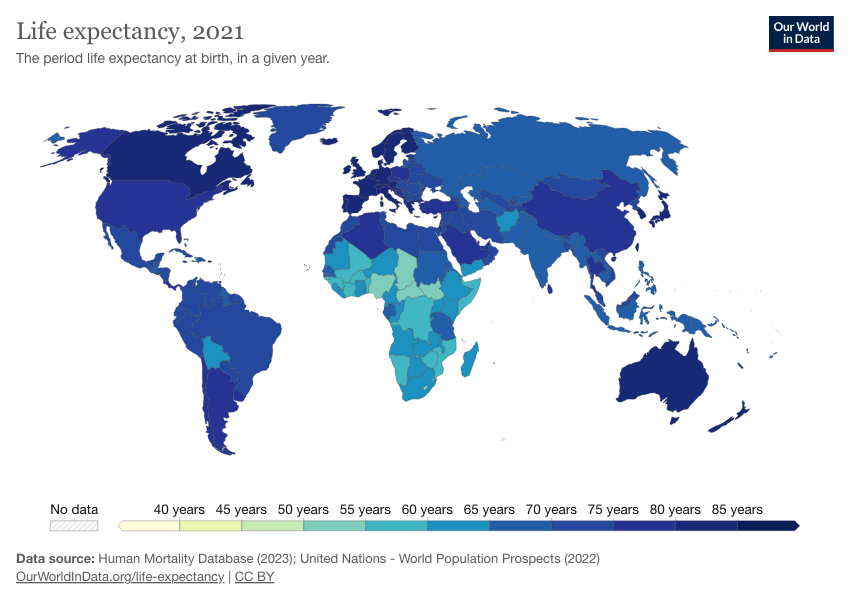
I was born in Montgomery County, Maryland, in 2004. The life expectancy of babies born at that place and time is 79 years. Three kilometres away, in Washington, D.C., it’s 74 years. I’ve spent most of my life in Seattle (in a county with a life expectancy of 83 years), where there’s comparatively ample access to education, health care, nutritious food, and economic opportunity. I’ve been lucky to benefit from these determinants of good health and a long life. But this is not the case for many Americans and Canadians. And it’s not the case for most of the world.

It is a grave injustice that the lottery of birth deprives some humans of time on Earth. Race and class have a significant role in determining life expectancy. Canadian men in the top income-earning quintile can expect to live eight years longer than men in the bottom. Majority-white Ontario has a life expectancy that’s 10 years longer than that of the majority-Inuit Nunavut. When we consider the entire globe, the disparity is even starker: Life expectancy in North America is 19 years longer than in Africa.

Life expectancy indicates a society’s ability and willingness to provide healthcare, education, security, and other important public services to its people. Most countries lack the resources necessary to provide these services, often due to unlucky geographic conditions or because of the lasting effects of colonialism. Wealthy, social democracies such as Sweden have both the ability and willingness to provide these resources (to Swedes, at least). However, the U.S.—and to a lesser extent Canada—have the ability to provide these determinants of health but comparatively lack the political will. 

In the U.S., personal freedom and responsibility are integral to the rags-to-riches national myth and social problems like poverty are therefore framed as individual failures on the part of irresponsible people. This flies in the face of sociological research that shows the systemic nature of these issues. A growing chorus among philosophers and scientists also contradicts this individualist stance by positing that our actions (like all other phenomena in the universe) are physically determined, the outcome of neurological processes determined by our environment, genetics, and education.

I began to grapple with these topics while taking Jewish Philosophy and Thought at McGill. Philosophy relentlessly dissects our assumptions and forces us to justify our beliefs. Since becoming a philosophy nerd, I’ve become convinced that free will is an illusion, abandoning what little belief I had in the you-get-what-you-deserve American economic mentality. I’ve also adopted a moral outlook that primarily values the outcomes of our actions, like their effect on length and quality of others’ lives. I no longer feel that I can live a moral life by avoiding supposedly immoral things like lying and cheating, and I no longer base what I study, what I consume, and my aspirations on loose notions of what seems respectable or what my peers are doing. Through this perspective, I believe extending life expectancy is absolutely critical.

Social science research and basic human empathy command us to address life expectancy inequality. We must view issues such as education and healthcare in terms of years of life lost or gained. This means that supporting increased social spending—even at your own expense—is not merely a political preference; it’s a moral obligation. Simple choices, like voting for a politician who will invest in early childhood education instead of one who will cut taxes, affect the length of people’s lives. For Americans, it’s a national shame that health care is not guaranteed for all, while countries such as Costa Rica provide universal healthcare—at a lower per-capita price. We must consider international aid in the light of social benefit rather than through the lens of geopolitical strategy. A quick look at American aid highlights how the U.S. prioritizes maintaining global influence over humanitarian concerns. 

Life expectancy inequality is a moral crisis, and we have the resources to solve it. By investing more in education and healthcare both at home and abroad, we can lengthen and improve people’s lives. I encourage readers to discover the life expectancy of their own geographic cohort, and to view the length of human lives as a paramount political and moral issue.

Science & Technology

Urban greenery: The surprising common thread between sustainable cities and healthy children

To the environmentalist, urban vegetation, such as rows of trees, shrubs, or flower beds, might symbolize a small act of rebellion—a patch of nature amid a concrete jungle. Beyond enhancing a city’s aesthetics and supporting mental well-being, city greenery contributes significantly to urban biodiversity and climate resilience. 

However, urban vegetation’s impact on air quality requires closer examination, especially given its seemingly positive influence, prompting research to determine how best to address this aspect of urban greening—the deliberate integration of vegetation in city settings.

A recent study in Environmental Epidemiology delves into the influence of urban trees and total vegetation on childhood asthma development. Co-authored by David Kaiser, associate medical director at Montreal Public Health and director of the Public Health and Preventative Medicine residency training program at McGill, the study focuses on the health of children born in Montreal between 2000 and 2015. It examines their exposure to various forms of urban vegetation, with linked medico-administrative databases identifying cases of asthma within this cohort.

In an interview with The Tribune, Kaiser explained that this study combined Light Detection and Ranging (LiDAR), a remote sensing technology, and satellite data, referring to the Normalized Difference Vegetation Index (NDVI), to monitor the cohort’s exposure to vegetation. This allowed researchers to distinguish between deciduous and evergreen trees, and determine the total urban vegetation in a given region. 

Although the study does not find a linear relationship between urban vegetation and childhood asthma development, it provides useful insights. For instance, asthma development in children was more frequent during the pollen, or “leaf-off” season—when deciduous trees shed their leaves, typically in autumn and winter. Conversely, during the “leaf-on” season, when deciduous trees develop a protective green canopy, usually in spring and summer, vegetation contributes to a reduced risk of childhood asthma.

“We know that exposure to air pollution is a trigger for asthma, and we have this idea that trees reduce that risk. But beyond having that idea, we don’t necessarily know the mechanism by which that may happen,” Kaiser said. 

After acknowledging certain limitations in the study, such as the absence of both annual tree canopy (upper branches and leaves) measurements within the study range and potential risk factors at home, Kaiser clarified the research paper’s goal. He emphasized that the study did not intend to comprehensively explain how trees might alleviate, or aggravate, childhood asthma. Rather, it aimed to contribute valuable data to a growing understanding on the environmental context of health.

Medical practice represents a tangible example of how this expanding knowledge pool can be applied—a shift that, according to Kaiser, is still on the horizon. 

“When you see somebody in a clinical setting, you should be asking about where they live and what they might be exposed to. In public health, we need to have an understanding of the context of health, beyond the health system and beyond individual risk factors,” Kaiser said. “In the last couple of decades, we’ve touched on that, but […] I would say the health system and education [are] still very far behind where they need to be.”

The study’s data not only illuminates the environmental context of health but can also guide action regarding urban greening. The decision to plant urban vegetation is straightforward since any additional green spaces are advantageous, whether for mitigating heat or generally enhancing respiratory health. Determining where to prioritize urban greening or what to plant, though, is a complex process requiring deeper understanding before any decision-making. 

This study is not the first and likely not the last to contribute to the exploration of this topic. Nevertheless, Kaiser expressed optimism about the inclusion of environmental health in urban planning and health policy. 

“If we take health as a global outcome, that allows us to integrate a lot of stuff that may seem kind of different, otherwise. It’s a nice way to present a more unified picture,” Kaiser noted.

Arts & Entertainment, Film and TV

No show succeeded ‘Succession’ at the Emmys

With awards show season in full swing, the Arts & Entertainment team looks at some of the standout moments from this year’s Emmy Awards.

Genre Categories in a Genreless Age 

In the 2022–2023 television season, most viewers would probably say that they laughed more at Tom Wambsgans’ rant about a “ludicrously capacious bag” that a woman mistakenly brought to Logan Roy’s birthday party in Succession than the stress-inducing character interactions in The Bear. Despite this, these two shows—the most awarded of last week’s Emmys ceremony—were placed in the separate categories of comedy (The Bear) and drama (Succession).

Before the age of streaming, media genres seemed much clearer. Comedies ran for half an hour and rarely tackled serious issues. Dramas ran for an hour and, conversely, limited their moments of levity. However, with the advent of platforms like Netflix and Hulu, these rules have mostly gone out the window. Arbitrary runtimes no longer constrain television, and most shows enjoy increased budgets, all leading to an expectation that TV shows are grander and more impactful than they were 30 years ago. 

So what should the Emmys do in an age of television where there are far fewer rules? Getting rid of the genre-defined categories would result in fewer winners and would likely benefit dramas, which the Television Academy typically considers to be the most prestigious. However, award shows’ insistence on giving out prizes based on arbitrary definitions like “comedy” and “drama” makes shows choose a category and try to convince people that it is the box that they fit into best. There is no clear answer as to what award shows should do, and certainly challenges like renegotiating contracts amidst the writers’ strike is a larger problem. But with TV shows moving further away from conventional genre trappings, the Television Academy will have to deal with this issue sooner rather than later. 

Goodbye to the era of Succession sweeps

After a triumphant awards season, HBO’s Succession swept almost all of the major awards at this past week’s Emmys, including Outstanding Drama Series, lauding the cast, crew, and producers for the final time after a mind-blowing fourth season. 

Succession centres on media mogul Logan Roy and his family, with the story being loosely based on Rupert Murdoch and his family’s corporation. In the Drama Series category, this year’s ceremony recognized cast members Kieran Culkin (Roman Roy) for Outstanding Lead Actor, Sarah Snook (Siobhan “Shiv” Roy) for Outstanding Lead Actress, and Matthew MacFadyen (Tom Wambsgans) for Outstanding Supporting Actor. Jesse Armstrong also took home his fourth trophy for Outstanding Writing—one for each season of the show. This year, it was for the show’s highest-rated and most heartbreaking episode ever, the season’s third episode, “Connor’s Wedding,” which is one of the best episodes of television ever. 

As someone who prides herself on being one of Succession’s biggest fans, I am beyond ecstatic with all of their wins. Snook won her first-ever Emmy, and though she has deserved it for years, this season really showed her embodying her role in a way we hadn’t seen before. Shiv’s marriage took a more central role in the plot, and she made her own final moves to secure a spot in her father’s company. While the show’s ‘star’ Jeremy Strong (Kendall Roy), did not win Outstanding Lead Actor—which he won in 2020—Culkin won his first Emmy, which touched my heart after his incredible performance this season. 


While there are other shows that I would have loved to see take home an award—particularly Better Call Saul, which has never won an Emmy and now never will—I still strongly believe that Succession deserved all of the awards it received. Unlike many dramas that run past their prime, Succession ended on a perfect high note and won the awards to prove it.

Montreal, News

Dozens protest against CAQ’s anti-trans policies

Around 150 protestors from across Montreal gathered in front of the Palais de Justice Courthouse on Jan. 15 to oppose the Coalition Avenir Québec’s (CAQ) decision to delay adding the “X” gender category to official provincial IDs until 2025 or later. The “X” category is increasingly being recognized across the world as an alternative option to the male “M” and female “F” categories used to designate gender on official state documents and has been central within trans inclusion debates.

The protest was organized by Celeste Trianon, transfeminist activist and executive director of Trans Legal Collective, a clinic working to support people through the process of changing their gender marker or legal name. The protest marked the start of the organization’s new campaign in response to the CAQ’s inaction on trans rights. 

On Jan. 28, 2021, the Quebec Superior Court forced Quebec to reword sections of the province’s Civil Code after ruling that certain sections were discriminatory toward trans and non-binary people. The court also concluded that non-binary people would be able to change their gender on official birth documents within Quebec and that “X” would be an option on government-issued IDs.

The protest kicked off at 4 p.m. with chants targeted towards the Quebec government and protesters roaring, “Stand up, fight back.” The protest then moved onto St. Laurent Blvd. at 4:30 p.m., heading downtown along Sherbrooke, followed by a large police presence. 

Protesters voiced frustrations over the delay in adding the “X” gender category and the lack of trans representation within the Comité de sages sur l‘identité de genrethe government committee formed in response to the turbulent nationwide debates over schools’ teaching of gender identity and sexuality in Sept. 2023. The government created the committee to contribute to LGBTQ+ policy formation, with significant influence over the “X” gender marker debate.

In an interview with The Tribune, Trianon described frustration over the lack of trans representation on the committee, which she views as strategic.

“The Comité de sages does not contain any trans people, nor experts, nor people who are actually concerned by the issues—such as parents of trans youth,” Trianon said. “We are talking about a committee that is designed to purposely be anti-representative, to reject the fact that trans people have autonomy and have dignity. We are also denouncing the fact that […] the government […] is taking action to specifically […] block individuals from accessing identification documents that align with their gender [….] This makes us last within all the provinces, and clearly violates both the Quebec and Canadian Charter.” 

Lack of representation within the committee was just as concerning for Aurora Knaut, a protestor at the event, who described the “X” category delay to be a sign of what is to come.

“The fact that they are the ones making policy on our behalf [means] that it won’t just be an ‘X’ that takes longer. It will also be trans health that gets less money, as it is deemed less important.” Knaut said.

For many, the event was a way to express the personal impact of political decisions being made by the government on 2SLGBTQIA+ rights. Tristan Clarke-Cousineau, U3 Arts, said their involvement in the protest was the result of continual disappointment in the decision-making process. Having lived in Montreal for many years, they expressed frustration over the dehumanization of the debate in recent years.

“[We want to] show the legislators and policymakers […] in Quebec that people care about this issue, and that it affects real humans,” Clarke-Cousineau said in an interview with The Tribune. “It’s not just a cultural debate to be had on the world stage. [The Quebec Government] can’t use us […] as political pawns.”

Trianon also expressed that community building and protesting will continue to be integral for strengthening the political statements in support of 2SLGBTQIA+ rights within Montreal.

“This [protest] is not just about trans people themselves; [it is about] whether we still even have a human rights paradigm here in Quebec,” Trianon said.

McGill, Montreal, News

Judge accepts McGill’s application to appeal reinstatement of archaeological panel in Mohawk Mothers case

The Kanien’kehá:ka Kahnistensera (Mohawk Mothers) and McGill appeared at the Court of Appeal of Quebec on Jan. 16, where McGill presented its application for leave to appeal against Justice Gregory Moore’s Nov. 20 decision to reinstate the court-appointed archaeological panel tasked with overseeing the ongoing investigation into potential unmarked Indigenous graves on the site of McGill’s New Vic Project. This comes after the Mothers asserted that McGill and the Société québécoise des Infrastructures (SQI) had prematurely disbanded the panel on Aug. 3. In court, McGill claimed that the panel was dissolved after its mandate had been completed, as per their interpretation of the settlement agreement and contracts with panel members. Justice Christine Baudouin ruled to accept McGill’s application of appeal on Jan. 19, meaning that the appeal will be heard and debated before the court on June 11. 

McGill’s lawyer, Olga Redko, was the first to speak before Baudouin—one of Quebec’s 22 appeal judges who hears appeals concerning civil trials. Redko argued that the issue before the court was not a dispute over the interpretation of the settlement agreement. She asserted that Justice Moore had rendered a judgment without considering the possibility of further deliberation over the merits of the contract. 

Additionally, Redko stated that Justice Moore’s judgment had a March expiration date, and that he had ignored section 13 of the settlement agreement. McGill, the SQI, and the Mohawk Mothers are bound by the recommendation of the panel regarding which techniques to use and guided by the recommendations regarding which service providers to use in the archaeological investigation. However, section 13 states that McGill and the SQI retain the discretion to acquire other providers if the circumstances warrant. By ignoring this section in his ruling, Redko argued that Justice Moore had “failed to follow jurisprudence.”

Mohawk Mother Kwetiio shared in an interview with The Tribune after the hearing that she felt that McGill’s statement to the court was “very technical” and lacked empathy toward the possibility of Indigenous children’s graves on the site. 

“Everything the [McGill] lawyer was saying, it just felt like she was regurgitating a textbook and order of operations,” Kwetiio said. “Those words didn’t care if it meant killing a child, or throwing someone in the garbage. It didn’t have any of the substance, and I think that’s the difference between our ways.”

In a roundtable discussion with The Tribune, Associate Provost (Equity and Academic Policies) Angela Campbell expanded on the dissolution of the panel, explaining that the panel consisted of three members who were named in the settlement agreement, alongside dates set for the completion of the panel’s work. She recalled that shortly after the panel had delivered its second and final report in late July 2023, one panel member wrote to all parties stating that she considered their work to be done, and she then “stepped away.” 

“I wouldn’t call that quitting because quitting suggests that you’re leaving in the middle of something. From her perspective, the work was done. So, she moved away from the work,” Campbell said. “The position that McGill has taken is [that] the panel is not fired or dissolved. Its work is complete in accordance with the terms of the settlement agreement.” 

Pierre Major, the Executive Director of the New Vic Project, also shared in a roundtable discussion with The Tribune that McGill and the SQI were responsible for paying the panel members and drafted up contracts in April 2023 with predetermined end dates. 

“With anybody that you pay, you need a contract. So, we put together a document with the help of our legal counsel, agreed on an hourly fee, and agreed on the period. We put an end date of July on the basis of when the mandate was to end, and those documents were shared with the Kahnistensera,” Major said. 

Campbell also noted that although the panel’s work was done, the settlement agreement stipulated that the panel must be consulted in the event of an “unexpected discovery,” such as historic human remains detection dogs detecting a scent on the site. 

After a brief break, the Mothers, who legally represent themselves, addressed the court. Mohawk Mother Kahentinetha explained that from her perspective, the spirit of reconciliation has not been upheld between the parties. She argued that Justice Moore determined that the McGill and the SQI’s application of the agreement was too narrow, as the defendant’s interpretation would dissolve the archaeological panel. 

Kwetiio echoed this sentiment, explaining to the court that the potential presence of human remains at the New Vic Project site has not been elucidated and pointing to numerous artifacts found on the site, such as bone fragments and a child’s shoe. She ended her statement by asserting that refusing to reinstate the panel would damage the spirit of reconciliation, and a court appeal of that nature would create a dangerous precedent for other proceedings involving missing Indigenous children and unmarked graves. 

In an interview with The Tribune after the hearing, Kwetiio explained that it felt frustrating to once again be in court where she felt the defendants were manipulating the words of the contract. 

“When you get into a contract with somebody, you’re getting into a relationship, and a contract is that everybody gets what they need to get. They needed to do their construction, we needed to have the clarity of this investigation,” Kwetiio said. “They’re trying to manipulate the intention that was put into that very contract.” 

The Mothers also shared that while they were disheartened, they felt confident based on their presentations to the court. 

“I’m pretty confident because we’re just relying on what we’ve always relied on from the very beginning,” Kahentinetha said in an interview with The Tribune after the hearing. “Now it’s all coming out into the open, and everybody can see what has been going on, what’s happening, and what we’re fighting for.”

Julian Falconer—the lawyer for the Office of the Independent Special Interlocutor, Kimberly Murray—subsequently addressed the court. He stated that Justice Moore continues to manage the trauma and fear that emerges for the Mothers out of this investigation. Falconer explained that if the appeal goes through the Quebec court system, the damage done will be “out of proportion.” He ended his statement by stating that the case should return to Justice Moore to allow him to continue to do the critical work he’s been doing. 

Baudouin adjourned the hearing without a ruling. 

“If it does come to the point where they do have an appeal, we’re just going to be ready like we’re always ready,” Kwetiio said.“We’re always going to have the ways we’ve solved things. We’re always going to have the thought of those children and the thought of my children […] and the thought that we have to show them how to keep doing this and keep living our way.” 

On Jan. 19, Baudouin announced her decision, stating that she would grant the defendants’ admission to appeal. A safeguard order has been automatically granted as the parties wait to debate the appeal, meaning that the panel will not be reinstated in the meantime. The appeal hearing is set for June 11, 2024. 

A previous version of this article stated that McGill is bound by the recommendations of the panel regarding which service providers to use in the archaeological investigation. In fact, McGill is not bound by these recommendations but is rather guided by them. The Tribune regrets this error.

Read the latest issue

Read the latest issue