Latest News

Martlets, Men's Varsity, Sports, Varsity Round UP

Varsity Report Card: Fall 2023

Redbirds Baseball (6–5): B+

Coming off a Quebec baseball championship victory last season, Redbirds baseball was afforded an exciting opportunity to play in the newly formed RSEQ baseball league. Four out of the team’s five conference losses came at the hands of the UQTR Patriotes; the Redbirds were unable to solve UQTR all season long. After sweeping the best-of-three RSEQ semifinal against the Concordia Stingers, the ‘Birds lost the first game of the best-of-three final series against UQTR. The Redbirds dominated the second game 14-4 to tie the series, but McGill ultimately succumbed to the Patriotes, unable to defend the title against their newfound rival. Despite the dropoff from last season, the Redbirds will likely improve as they continue to recover from the two seasons lost to COVID-19. 

Cross Country: Redbirds B+/Martlets B-

Despite missing star runner Matthew Beaudet, Redbirds cross country had yet another strong season while the Martlets saw great improvement from the 2022-23 season due to their significantly smaller roster. Opening the season with the McGill Invitational, Sophie Courville finished third with a time of 22:39, spearheading the Martlets’ fourth-place finish overall. The Redbirds, on the other hand, secured first place in  the men’s division of the meet, with the trio of Thomas Windisch, Noah El Rimawi-Fine, and Jerome Jacques finishing first, second, and third, respectively. The Redbirds consistently placed in the top three at meets throughout the season, coming in first place once again at the Sherbrooke Invitational. At Sherbrooke, the Martlets captured second place, rookie Sienna Matheson leading the way with a sixth-place finish. The RSEQ Championships saw the Redbirds take home bronze while the Martlets finished right in the middle of the pack in fifth place. 

Martlets Field Hockey (0–10): D

With no win on the tally, the Martlets field hockey squad remained at the bottom of the Ontario University Athletic (OUA) standings. The 2023-24 season was once again devoid of home games. McGill has not hosted any field hockey games since the 2019-20 season, when the team made it to the post-season. With a significant proportion of the current roster graduating at the end of the 2023-24 academic year, the team must remain hopeful for the coming season. However, the disappointing showing on the field did not prevent members of the squad from standing out off the field. VP Inclusion for the Varsity Council, Ada Collins, received the OUA’s inaugural Champion of Equity, Diversity and Inclusion Award, the first award granted to a McGill field hockey player since 2017. 

Sports Editor and Martlets field hockey goalkeeper Anoushka Oke did not contribute to this section of the article.

Redbirds Football (1–7):  D

The Redbirds football team took home a singular win for the third straight season. After defeating Sherbrooke Vert et Or 26-14 in their home opener, the Redbirds lost each of their subsequent games by double digits––an unfortunate outcome for McGill’s highly-touted team. Individually, however, the Redbirds had a number of impressive performances. Offensive lineman Alexandre Marcoux signed a deal with the Calgary Stampeders at the conclusion of the Redbirds’ season. Slotback Darius Simmons earned U SPORTS All-Canadian honours for the third consecutive season, leading the RSEQ in reception yards (611), receptions (54) and yards per game (76.4). Simmons, running back Brandon Ciccarello, and offensive lineman Michael Vlahogiannis were also awarded RSEQ all-star honours. Despite the individual successes, the lack of improvement from last years’ equally disappointing season leaves the Redbirds with yet another D. 

Redbirds Lacrosse (10–4): A+

Despite only seven regular-season wins, Redbirds lacrosse stunned fans across Ontario and Quebec, swiftly qualifying for the Canadian University Field Lacrosse Association (CUFLA) playoffs after beating Queen’s University in a 9-5 sudden-death win. For the first time since 2015, the Redbirds squad made it to the final of the Baggataway Cup after putting an end to a decades-old losing streak against Guelph University in the quarter-finals. The Redbirds defeated the Carleton Ravens in the semi-final but fell to the Western University Mustangs in the finals. With thirteen hat-tricks coming from four players this season, and several players honoured as CUFLA all-stars, the 2023 season was a definite success for the Redbirds’ lacrosse squad. 

Rowing: Redbirds B+ / Martlets B

Several Redbirds and Martlets rowers got on the podium throughout the season. Their first regatta, Head of the Rideau, saw McGill take home first place in the women’s lightweight four, second place in the men’s four and in both the men’s and the women’s single, and third place in the men’s lightweight double. The men’s lightweight double then went on to win second place in the following Head of the Trent regatta. Following successful bids from their two regular season regattas, twenty McGill athletes qualified for the Canadian University Rowing Association (CURA) championship showcase meet. McGill rowers got their first medal at the CURA meet since 2014, with the duo of Jacob Lofaro and Federico Sanchez earning silver in the men’s double sculls. 

Martlets Rugby (1–5): C-

After back-to-back winless seasons, the Martlets (1–5) rugby team claimed a lone victory in their season opener, defeating the Bishop’s Gaiters 22-13. Unfortunately, the remaining five games of the season looked much like those of 2022-23 and 2021-22, with the Martlets taking four straight shutout losses and only getting back on the scoreboard in their final game. While disappointing, the Martlets made strides this season with Lauren Minns leading the way. Not only did Minns take home RSEQ athlete of the week on Sept. 6 and achieve RSEQ all-star status at the end of the season, the Martlets’ back-row was awarded All-Canadian second-team honours at the U SPORTS women’s rugby awards. Despite the low C- grade, The Tribune is hopeful for greater success for the Martlets in 2024. 

Redbirds Rugby (4–3): B+ 

After a spectacular 2022-23 season, it was always going to be difficult for the Redbirds rugby team to outdo themselves. Nonetheless, the team still made fans roar in the stands all season long. They ended on three narrow wins, claiming third place in the RSEQ standings. The team faced UOttawa’s Gee-Gees in the semi-finals, one of the only two teams against whom the Redbirds lost in the regular season. After pocketing their first-ever playoff win against McGill, the Gee-Gees ultimately prevailed in the finals for the first time since 2008.

Individuals who had an outstanding season included outside-centre Martin Laval, who established the new single-game record by converting all nine tries of the game opener. Max Bernhart, Dominic Russell, Nicolas Laine, Roberto Frascione, and Elliot Descarreaux were all selected by Rugby Quebec to participate in the New York Rugby Sevens tournament. 

Redbirds Soccer (4–5–5): B- 

The Redbirds failed to make it to the playoffs once again, finishing sixth in the seven-team RSEQ league. Opening their regular season with a 1-0 loss to the UQTR Patriotes, the Redbirds oscillated between losses and ties with a few wins sprinkled in between. However, they saw some improvement from last year, doubling their win tally from the 2022-23 season’s two and losing three fewer games. At the close of the season, defender Matisse Chrétien and midfielder Nassim Kemel earned RSEQ first-team and second-team all-star honours, respectively, while Chrétien, forward Mathis Cyr, and midfielder Nathan Yee earned all-rookie honours. Chrétien was also later named to the U SPORTS all-rookie team. Despite another tough season, the Redbirds have a young team and a strong rookie base that they can hopefully build upon next season to make a bid for the playoffs.

Martlets Soccer (6–3–5): B+

With a third-place finish, the Martlets advanced to the RSEQ semi-finals against the second-place Université de Montréal Carabins, ultimately falling 2-1. Individually, midfielder Mara Bouchard and defender Stephanie Hill were awarded U SPORTS All-Canadian honours. Bouchard, Hill, and midfielder Chloé Renaud were named RSEQ conference all-stars, while goalkeeper Sophie Guilmette was named to the second squad and midfielder Amélie Beaudet-Gaudette was voted onto the all-rookie all-star team. Jose-Luis Valdes took home the RSEQ coach-of-the-year-award in his eleventh season as head coach of the team. Marginally improving from last year with three fewer losses, The Tribune remains hopeful that the Martlets will be able to boost their offense next season and secure wins in tight matches. 

Science & Technology

Navigating the government’s guide to employing generative AI in the public sector

On Nov. 30th, OpenAI’s release of ChatGPT marked its one-year anniversary. Within a relatively short period, this generative AI (GAI) brought tremendous changes in everyone’s lives. Between huge layoffs in administrative professions, and widespread controversies, such as the debate around the use of AI in classrooms, it seems crucial to survey the implications of such a tool. 

In September 2023, the Treasury Board of Canada Secretariat (TBS) published a Guide on the Use of Generative AI, providing an overview of GAI, along with challenges and concerns for responsible use as well as policy considerations. Researchers from McGill and the University of Toronto were invited to submit their feedback on the guide. They discussed their comments in a recent paper encompassing sociopolitical aspects of GAI while analyzing the guide’s strengths and weaknesses. 

Despite assessing the guide as “fit for purpose,” the paper identifies three key pathways to strengthen it: Direction on drafting new federal legislation for more comprehensive and enforceable rules, ethical sourcing practices, and environmental impact mitigation. 

The researchers emphasize the need for a more enforceable policy framework that offers greater accountability and public trust in GAI in the public sector. Regulation of the foundational model is particularly crucial as various applications of GAI use it as a base. Pre-existing biases are almost impossible to detect, and the harvested data used for its training ranges across public and private data, raising concerns about copyright violations. 

Moreover, GAI requires extensive data input. The workers have to clean, annotate, and prepare the possibly harmful data to remove biases and graphic material for the production of ‘quality’ data. Worker protection, under the proposed ethical sourcing practices, is highly compromised. For instance, Meta, OpenAI, TikTok, and Big Tech ignored Kenyan labour laws for their data workers in Kenya. Even though those companies are valorized for kick-starting the GAI revolution, they are infamous for hiding the extent of the harm; severe mental distress and even suicides of content moderation workers are well-documented. 

“As long as the status-quo business model remains profit maximizing and shareholder-driven, the exploitation will continue,” Ana Brandusescu, PhD candidate, and Renee Sieber, associate professor, both researchers at McGill’s Department of Geography, wrote in an email to //The Tribune//. 

According to Brandusescu and Sieber, extending Canadian labour laws to international data workers may resolve such exploitative practices.

“We have to go beyond soft law such as guidelines and standards to more concrete and consequential measures that are respected and enforced,” Brandusescu and Sieber wrote. “[Possible measures could be] prohibiting federal agencies from using certain products and services, remove offending companies (e.g., those who violate human rights laws) from preferred vendors’ lists, and to name and shame companies who do not comply with rules and regulations.”

The paper compliments the guide on its attention to GAI’s environmental impact, but suggests that it should include a more comprehensive examination of the environmental impact caused in each phase of GAI’s software and hardware lifecycle. Despite the immense amount of greenhouse gas emissions and water consumption for AI data centres, AI’s environmental footprint often goes unacknowledged. 

A more thorough guide may also encourage companies to incorporate feasible solutions, such as energy-efficient architecture or carbon-awareness tools. Deep Green, a UK-based company that pairs a data center with a swimming pool to transfer the heat generated to warm up the pool, is a creative alternative to letting the heat energy go to waste. 

GAI is an issue creating radical changes in numerous social areas while posing substantive harm. This issue requires a tangible enforcement of regulatory policies since a naive, hypothetical discussion about it would not propel much change. 

“Is it worth it for one of us to have AI-enabled convenience if it means that three people will lose their jobs, [Internet Protocol (IP) addresses] will be stolen, and workers in low and middle-income countries will be exploited?” Brandusescu and Sieber wrote.

Now is the time to ponder what benefits GAI brings us, whether it is actually being economically and socially distributed, and pay consistent attention to relevant policies so that the suggestions as above can come into effect.

Commentary, Opinion

To Bixi or not to Bixi?

Bixi is my religion – Monique

If taking out your first Bixi is an unforgettable experience in itself, riding one also comes with endless benefits. For starters, the convenience is unparalleled. With hundreds of stops all over the city, you can always find a bike and a place to drop it off. While having your own bike can admittedly have its advantages—like the freedom to customize it to your preferences—the consequence of having to find somewhere to lock it is cumbersome enough. 

Here’s a simple, everyday scenario: You need to get to a restaurant to meet friends in 10 minutes. Walking will take you 25, and biking will take you eight. But wait, you won’t be going back to your place afterward; you’ll be heading to a bar, which you need to take the metro to get to. Thinking of walking? Don’t even bother—the table has ordered their dinner already, and they are all wondering when you’re going to finally download the app. By temporarily renting a bike, you’ll be freed of the responsibility of carrying one around all night and you’ll be on time for your dinner. 

Significantly cheaper than a student metro pass, Bixi allows you to explore the city in unparalleled ways. Tucked away next to the Bixi stop you parked at is your new favourite Mile-End coffee shop (and let’s face it, you’d never make it to the Mile-End from Milton-Parc by foot.) 

Bixi’s infrastructure is a powerful force in the city’s transportation dynamics, alleviating traffic congestion and enhancing urban mobility by reducing reliance on private cars. Bixi’s city-wide station system ensures accessibility for a diverse range of residents, bridging transportation gaps and fostering a more equitable urban environment. Bike-sharing services like Bixi not only revolutionize transportation but also contribute to Montreal’s identity as a sustainable, healthy, and accessible city. If you ask me, there’s no better way to get around than by Bixi-ing—and I will die on this hill––the same hill I biked up with ease, using an electric Bixi. 

Down with Bixis – Liliana
The Bixi bike is a staple of the Montreal landscape, much like the ever-present construction cones and pothole-filled one-way roads that permeate the downtown. Many Montrealers have come to associate Bixis as an integral part of their identity, making the ugly, clunky bikes a centrepiece of their personality…little do they know how much better life could be. Bixi bikes are antiquated, heavy, and an overall stain on Montreal’s otherwise thriving bike scene.

Montreal has long been a city known for its strong biking culture, with over 900 km of bike paths, much of which is regularly cleared of snow to facilitate biking all throughout the cold, dark winters. This culture has flourished since 1975 when activists Robert Silverman and Claire Morissette founded Le Monde à Bicyclette to fight for bicycle-friendly infrastructure; however, the modern Bixi system not only does this culture a disservice, but flat-out embarrasses it. 

Since it first entered Montreal in 2009, Bixi has faced complaints from small independent bike shops and rental agencies who have been forced to shut down as a result of their competition. In 2011 alone, three independent bike stores reported severe impacts on their business as a result of Bixis. After bike rentals fell from 250 to just 10 per year, Roberto Rosenbluth shut down a location of his store Bicycletteries JR

Bixi also receives a consistent stream of bad reviews from customers complaining of hidden fees, shameful customer service, and malfunctioning equipment. Complaints range from bikes being un-maintained and barely usable to overcharging as a result of loopholes that are unclear to outsiders. 

Personally, I have a vendetta against Bixis. I think they’re heavy and bulky, and the first time I rode one, the experience was marred by heavy winds that almost pushed me into Sherbrooke traffic, prompting an angry old lady to yell at me for riding on the street. Personal bias aside, the Bixi system is deeply flawed and is an affront to the beauty that is Montreal’s biking culture.

Arts & Entertainment, Film and TV

“Saltburn” is a cinematic scrutinization of opulence and obsession

Spoilers for Saltburn

Opulence. Drugs. Midnight strolls. A hedge maze. Far too many shots of bathtubs. Welcome to Saltburn, Emerald Fennell’s latest cinematic endeavour. Known for her bold feature-length directorial debut, Promising Young Woman, Fennell’s newest film takes a more ironic journey, enlisting a stellar cast to portray an “eat the rich” satire filled with twists and turns at every corner.

The film takes place in 2006 at Oxford University where scholarship student Oliver Quick (Barry Keoghan) struggles to assimilate with his privileged peers, whose legacies, family names, and substantial donations guarantee their admission. Oliver befriends popular and charismatic Felix Catton (Jacob Elordi), who appears sympathetic to his plight. Their friendship takes on an imbalanced, obsessive quality, blurring the boundaries between love and companionship. Stirred by compassion for Oliver’s familial struggles, Felix extends an invitation for him to spend the summer at his family’s lavish estate—Saltburn. Saltburn’s opulence initially overwhelms Oliver, yet even as he slowly embraces it, unease permeates the locale. The audience must immediately confront the discomfort of witnessing Oliver’s excessive indulgence and the intricate ways by which he inserts himself into the fabric of the Catton family. Saltburn, with its grandeur and intricate nuances, transforms into a microcosm of the subtle interplay between class, friendship, and personal identity.

The brilliantly performed satire skillfully dissects the themes of wealth and extravagance. Through Oliver’s eyes, Fennell peels back the mystique behind each character, gradually revealing the true nature of the individuals populating this world of riches. The cast truly elevates the film to its full potential, allowing for hilariously dark moments to enhance the film’s humour. Felix’s mom, Elsbeth Catton (Rosamund Pike), is electrifying in her cheerful cruelty; Pike’s line deliveries and incisive descriptions are a genuine delight, showcasing the amused detachment often associated with affluence. Moreover, Elordi flawlessly embodies the character of Felix, expertly toeing the line between the seemingly unattainably affluent youth and the grounded, relatable best friend. The on-screen chemistry between Elordi and Keoghan is undeniably compelling, adding a gripping dimension to their characters’ dynamic. 

Fennell adeptly navigates the delicate task of presenting visually uncomfortable scenes while blending cinematography, colour palettes, and sound design to enhance the overall narrative impact. Several scenes leave the viewer grappling with conflicting emotions through an interplay of repulsion and self-reflection. Moreover, the cinematography and framing are expertly done. The film was shot in an unusual 1.33:1 aspect ratio, giving the viewer the impression that one is seeing more than they are meant to. This fosters a sense of intrigue, prompting the audience to engage more deeply with the visual nuances of the story—as if one is living in Saltburn with Oliver. Complementing this visual prowess, the soundtrack impeccably aligns with the narrative, serving as an auditory guide to the characters’ emotions and enhancing the overall cinematic experience.

The film carefully weaves its narrative tapestry to build anticipation and tension, but unfortunately, the conclusion falls short in terms of narrative coherence and a well-structured plot. Despite the film’s earlier success in building suspense, the concluding scenes diminish the overall impact of the storytelling. The resolution dissipates the heightened intrigue surrounding the main characters, culminating in an ultimately predictable ending. Nevertheless, Barry Keoghan’s performance remains effortlessly captivating until the closing credits. His methodical character exploration prompts the viewer to reflect on the broader implications of extravagance and privilege in contemporary society. In this way, the film succeeds in sparking contemplation that transcends its narrative shortcomings. Ultimately, Saltburn leaves a lasting impression by masterfully blending together visual and auditory elements, providing an immersive experience that transcends the boundaries of conventional storytelling.

‘Saltburn’ is now playing in theatres.

News, SSMU

Hundreds of ralliers flood SSMU BoD meeting, call for Society to uphold student democracy

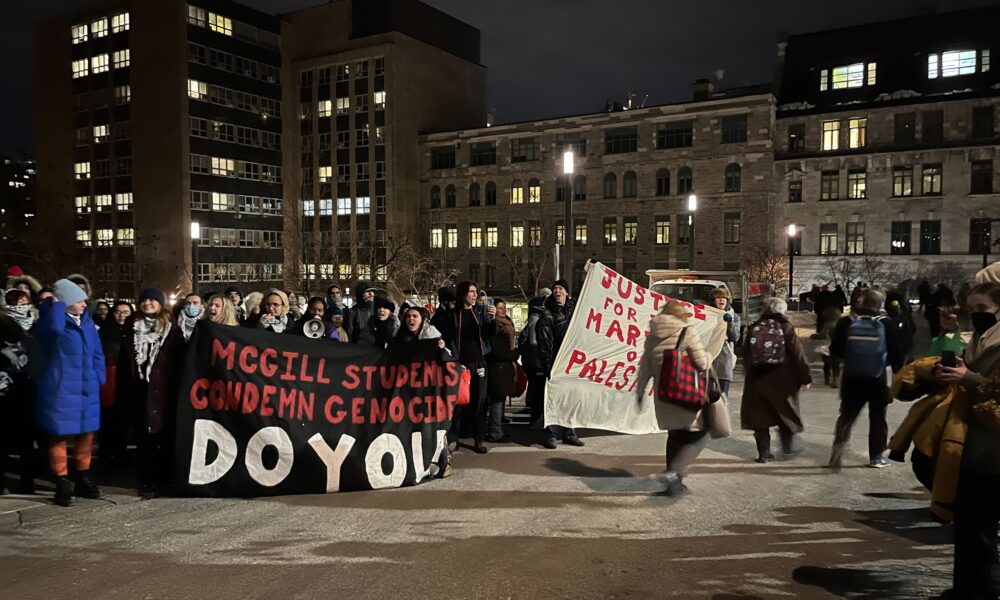
Roughly one hundred students disrupted the Students’ Society of McGill University’s (SSMU) Board of Directors (BoD) meeting on Nov. 30 to voice their support for the Policy Against Genocide in Palestine. Students questioned executives face-to-face on the Society’s decision to consent to an injunction against the policy—a decision that has paused the policy’s ratification until at least March 25, when the case will be heard in court.

The Policy Against Genocide in Palestine passed with 5,974 students—78.7 per cent of non-abstaining voters—casting a “Yes” vote in SSMU’s Fall Referendum. The injunction was filed on Nov. 21 by an anonymous McGill student with support from B’nai Brith Canada, a Jewish service and advocacy organization. On Nov. 23, the Quebec Superior Court issued a safeguard order, leading SSMU to pause the Policy’s ratification.

McGill’s administration has also resisted the Policy, telling SSMU that it would “sharpen divisions” and is thus a violation of SSMU’s constitution—making it a violation of the Memorandum of Agreement between SSMU and the university.

Solidarity for Palestinian Human Rights (SPHR) McGill held a Student Rally Against Genocide on Nov. 30 to reaffirm their support for the Policy. The rally began at 5 p.m. outside of the Arts Building and included speeches emphasizing the students’ commitment to Palestinian liberation and the Policy. An SPHR McGill representative who wished to remain anonymous asserted that they believe that the injunction stands in the way of the democratic process.

“Legal warfare is an attempt to diverge us from our path by using law and biased regulations and bureaucratic procedures designed to repress and undermine any Palestinian student activism,” the representative said. “McGill, SSMU, and Canada have clearly spoken: Democracy is conditional and not applicable when we are speaking for Palestine. This establishes a dangerous model for student democracy and activism in Montreal, a precedent that SPHR McGill rejects and vows to pursue.”

Before 6 p.m., the protesters moved from the Arts Building to the lobby of the University Centre, where the SSMU BoD meeting was taking place metres away in the SSMU offices. The meeting began with the BoD answering a pre-submitted question about what steps they would take to “make sure that […] student democratic action is upheld and respected.” The question also asked how SSMU would ensure communication of their stances regarding the Policy. In response, SSMU Vice President (VP) Student Life Nadia Dakdouki explained that SSMU communications are ultimately intended to  avoid causing confusion.

“We only really communicate final decisions [….] If there’s something being discussed that is not finalized for […] legal considerations, it is not useful in the sense that it will only cause more confusion,” Dakdouki said. “So I know there’s been concerns in the past week, but it’s really just because everything has been moving so fast, and we’re doing our best to be as transparent as we can within the bounds of legality and confidentiality.”

According to SPHR McGill, SSMU had notified the group the morning of the meeting that no student observers would be allowed to attend the public session of the meeting to ask questions—which SPHR McGill cited as a “break of [SSMU’s] normal procedure.” In lieu of attending the meeting in person, SPHR McGill says that they were allowed to ask one question over Zoom. When the group asked a second question, SPHR McGill claims that SSMU “forcibly muted” them, after which organizers led protesters into the BoD’s meeting room.

SSMU executives asserted that they did not intend to silence students’ voices in an email to The Tribune.

“The Speaker chose to move members attending the public session online in order to accommodate the large number of people wishing to attend and ask questions,” the SSMU executives wrote. “At the discretion of the Speaker (and in accordance with our standing rules), because of the large quantity of questions, the procedure for question period was that each person should ask one question, then get back in line should they have another question to allow others to ask their own questions.”

“The member started asking their second question, and the Speaker intervened to clarify that the member would have to raise their hand (on Zoom) and wait their turn in the queue to ask their next question. The member was muted so that the Speaker could clarify the rules of question period and to take the next member’s question. There was no intention to stifle the voices or questions of members.” 

The BoD meeting adjourned as protesters chanting “Free, free Palestine” crowded the meeting around 6:30 p.m. In the BoD meeting room, the protesters confronted the SSMU executives and board members about the injunction. According to a representative from SPHR McGill, none of the SSMU executives were present at the injunction hearing, a claim which no SSMU executive denied. SSMU President Alexandre Ashkir told ralliers that SSMU was not happy with its previous legal counsel, and has since hired new legal representation.

He also voiced his opinion that students should be upset at the legal process, not SSMU.“I respect the effort, I respect the rally […] but the reality is we’re stuck in legal fuckery and instead of protesting the courts and protesting the people suing us, you’re protesting us,” Ashkir said.

A student asked, “If the struggle was to find lawyers who would stand up for us, why not be in the room and hold them accountable?” The executives began to answer but were interrupted by the students’ many questions that followed. 

Next, a member of Law Students for Palestine at McGill (LS4PM) condemned SSMU’s agreement to the injunction, saying that by doing so, SSMU’s lawyers knowingly paused the ratification for months. They also asked why SSMU did not accept help from LS4PM, despite their offers. Ashkir replied saying that SSMU had indeed used LS4PM’s assistance to find new legal counsel and thanked the organization. 

LS4PM did not reply to The Tribune’s requests for clarification and comment by the publication deadline. 

In an email to The Tribune, SSMU stated that it had already begun interviewing law firms by the time LS4PM reached out. SSMU said that it nonetheless took advice from LS4PM on what firm they would recommend. By the time they heard back, SSMU had already chosen Sibel Ataogul from Melançon Marceau Grenier Cohen, which was also LS4PM’s recommendation. “While our decision was made independently of LS4PM, their offer of legal help was appreciated and considered,” the SSMU executives wrote.

In response to further questions, Ashkir explained that while SSMU had not yet met with their lawyers to discuss strategy, they intend to defend the Policy in court. After Ashkir reiterated SSMU’s support for the Policy, the protesters moved back to the lobby of the University Centre, with Ashkir joining the rally.

Back in the lobby, Ashkir requested to make a speech to the crowd. He started speaking but attendees quickly interrupted him by shouting questions about the injunction. One student asked again why Ashkir was not present for the injunction hearing. Ashkir responded that he “didn’t have the time,” prompting cries of “Shame” from the crowd.

Isaiah, a representative of Independent Jewish Voices (IJV) McGill who asked for only his first name to be used, shouted, “In less than two months, more than 15,500 people are dead. How do we have until March?” to which Ashkir responded, “We don’t. All we can do right now is […] work around a legal case that is […] pinning us down.”

Another student began chanting “The students, united, will never be defeated,” which eventually gained traction among the crowd. 

The rally ended with more speeches, including one from IJV McGill.

“I hope [SSMU] recognizes that the overwhelming support and the voice of the students isn’t just a vote or a number, it’s a real thing,” Isaiah said in an interview with The Tribune. “We brought hundreds of students here today to mobilize and make our voices heard in real life. They have a responsibility to step up to defend the […] mandate from the students right now. And we’re going to keep pushing them until we see that happen.”

Behind the Bench, Sports

AI writers cannot be the future of sports journalism

The future of sports journalism is incredibly bleak at the moment. The New York Times disbanded their sports section in July 2023, electing to rely solely on The Athletic after having bought the sports outlet for $550 million in 2022. In what was suspected to be preparation for the shift, The Athletic let go four per cent of its staff in June 2023. Amidst budget cuts, ESPN also laid off household names such as Jeff Van Gundy, Jalen Rose, and Suzy Kolber, along with 20 other on-air employees. The Ice Garden, a leader in women’s hockey coverage, had its funding pulled by Vox and SB Nation in Jan. 2023. Sports journalism needs to be revived; however, Sports Illustrated’s turn to artificial intelligence (AI) is not the solution. 

On Nov. 27, Futurism reported that it discovered Sports Illustrated (SI) published several articles written by fake, AI-generated writers. These authors’ bylines contained a series of product reviews, but no other online presence, and were accompanied by for sale stock-photo headshots. When confronted with the allegations, SI deleted the content in question; soon after, a spokesperson for The Arena Group, which operates SI, stated that a third-party marketing agency produced the material as part of a license agreement that was under review. The Arena Group further stated that AdVon Commerce, the third party in question, denied that AI generated the content and claimed the fake bylines had been used “to protect author privacy.” 

Sports Illustrated is no longer what it used to be. Gone are the days of iconic covers such as LeBron James’ ‘The Chosen One,’ March 1980’s ‘Miracle on Ice,’ and Dwight Clark’s ‘The Super Catch.’ The decline of the printing press has harmed sports just as it has the rest of journalism, so the desire to breathe life back into a dying industry has merit; however, AI writers in place of real people is not the way. 

Many sports outlets have tried to revamp content with technology. ESPN aired an interview with Damian Lillard following his first game with the Milwaukee Bucks; fans quickly pointed out that he was not wearing the same uniform he had in the game and there was no audience in the stands. It turns out the video had been doctored and repurposed from a 2020 interview in the NBA Bubble. On Nov. 28, the share price of the Arena Group fell almost 27 per cent on the New York Stock Exchange. When considered in light of the public response to other outlets’ AI-led missteps, maybe this is a sign that the world has no use for AI-generated journalism. 

Instead of turning to AI to fill the void left by the shifting environment of sports journalism, outlets must turn to people for real solutions. Perhaps returning to investigative journalism such as that of Rick Westhead, Grant Robertson, and Katie Strang, who diligently researched and uncovered the details of the 2018 Hockey Canada scandal. Or maybe investing in multimedia story-telling like The New York Times who used emotional, yet, heartwarming videos to vividly narrate the stories of teens with chronic traumatic encephalopathy who tragically passed away in their teens and twenties. Or maybe it is turning to journalists like Dave Zirin who ardently and unequivocally criticize the sports they love most. 

The industry is struggling—there is no doubt about that. However, we must resist the urge to turn to AI as the solution. In a world where misinformation runs rampant, media outlets must lean into the potential that real journalists provide. The ability to tell stories, connect with athletes, and speak truth to power––skills embodied by the industry’s best––must be embraced. We are witnessing a moment of crisis within Canadian sport. Day after day, journalists reveal new scandals of abuse and work tirelessly to protect athletes from similar fates. The revitalization of sports journalism must come from innovative storytelling, where passion seeps through the page and athletes’ voices are placed at the forefront––not AI writers who write of “close encounters of the athletic kind.”

Student Life

A comprehensive guide to finding the perfect winter coat

As the fall semester comes to an end, the infamous Montreal winter begins, and your attire may feel incapable of warding off the December chill. If so, you are primed for a new winter coat. 

The search for a good jacket can feel daunting, especially for first-year students who may have never experienced a winter quite like Montreal’s. Any good coat encompasses more than just functionality—the style matters too, and getting it right can elevate your winter look to the next level while keeping you warm. Here are a few tips on what to look for—and what to avoid. 

How to get started

The key factor in determining a coat’s quality is its ability to keep you warm. This depends mainly on the material of the coat. So, which material is the best for ensuring cozy comfort?

In an interview with The Tribune, GQ Style Editor Noah Johnson gave some advice on what to look for. 

“For a jacket, always go for down. It’s got the best warmth for its weight, by far,” Johnson said. 

The more insulation, the better, so look for anything thick enough to withstand cold and wind and trap heat. It’s always a good idea to make sure the down is ethically sourced. Some good options are The North Face and Patagonia, which are certified to the Responsible Down Standard.

If you’re not a fan of down, Johnson offered some good alternatives. 

“Go for wool, or better yet, cashmere if you can swing it,” he explained. 

Aside from down, these fabrics are the next best option in terms of warmth and are always stylish

If you enjoy the snow, look into brands like Burton, Arc’teryx, and Helly Hansen that carry more water-resistant jackets meant for winter sports and extreme weather. 

Avoid slimmer puffers and vests, which still have insulation but aren’t enough to withstand Montreal’s far-below-freezing temperatures. If you like to accessorize, choosing a jacket with extra pockets is useful for added storage, but if hats and scarves aren’t your preference, a parka-style jacket will provide added head warmth. 

For those who want more than just upper-body warmth, you may be in the market for a longer style that helps keep your legs warm, in addition to your torso. 

“I always like a winter coat to fit a bit oversized—I just think it looks cooler and it makes sense to give yourself maximum layering options,” Johnson explained. 

If you’re looking for something classic and reputable, the iconic North Face Nuptse and Uniqlo’s Seamless Down Parka are great options. If your price range is a little more flexible, go for even higher-quality brands like Woolrich, Canada Goose, and Ten c. Bear in mind that the average-priced winter jacket is still in the $100 to $200 range. A quality coat is never going to be cheap, but a hefty price tag isn’t necessarily something to be afraid of. 

“I think a winter coat should be an investment,” Johnson explained. “Buy the absolute best one you can afford, and expect to wear it for as long as it fits you.” 

A good coat maintains its quality for years, so it’s better to spend more on a long-lasting coat than to buy a cheap one that has to be frequently replaced. 

“If you’re really strapped for cash or unsure about finding the right style,” Johnson added, “Just go to an army [or] navy store and find some vintage military field jacket or peacoat. You can’t go wrong with either of those.” 

Where to look 

Montreal has plenty of amazing options for coat shopping. A ten-minute walk from McGill’s downtown campus will take you to St. Catherine Street, where you’ll find stores like Simons, Sports Experts, Uniqlo, Arc’teryx, and The North Face

If your budget is tight, walk over to St. Laurent Boulevard, where you’ll find great options at thrift stores and vintage shops like Eva B, Empire Exchange, and le Chaînon.

If you’d rather order a winter jacket online, look for brands that can ship within Canada to avoid hefty import fees. 

It’s safe to say that nobody looks forward to the cold of a Montreal winter, but with a well-chosen jacket, even an unpleasant trek to your 8:30 a.m. class will feel more like a cozy holiday stroll.

McGill, Montreal, News

Mohawk Mothers appear in court, discuss archives and records related to New Vic site

The Kanien’kehá:ka Kahnistensera (Mohawk Mothers) appeared at the Montreal Courthouse for a five-hour case management hearing on Dec. 1. The hearing came as part of the Mother’s ongoing investigation into McGill’s New Vic Project site, where they fear that there may be unmarked Indigenous graves. The Mothers argued that the defendants—including McGill, the McGill University Health Centre (MUHC), the Société québécoise des infrastructures (SQI), the Royal Victoria Hospital (RVH), the Integrated University Health and Social Services Centres (CIUSSS), the City of Montreal, and the Attorney General of Canada—were refusing to abide by the settlement agreement’s mandate to provide the Mothers with all archives and medical records related to the former RVH. 

Mohawk Mother Kahentinetha was the first to speak before Justice Gregory Moore. She reminded the court that under articles two, three, and four of the settlement agreement, McGill, MUHC, and the Attorney General of Canada are bound to provide expedited access to their archives and records. She alleged that MUHC refused to share their archival records on medical experiments on Indigenous children, which she believed to be direct evidence of denialism. 

“[The archives] is where all the information is of what they did to our children, to our people. It’s all there, it’s all in the archives,” Kahentinetha said in an interview with The Tribune after the hearing. 

The lawyer representing MUHC and RVH argued that MUHC has a right to patient confidentiality and that while MUHC wanted to assist in the investigation, they could not as confidentiality laws prohibited them from providing all patients’ records. The lawyers also explained that the medical records are only searchable by patient number, not by age or ethnicity, meaning that researchers could not search for Indigenous patients on the database. 

Julian Falconer—the lawyer for the Office of the Independent Special Interlocutor, Kimberly Murray—asserted that the settlement agreement allows the defendants to override “confidentiality concerns” without consent from the patients. He further expressed that he felt the notion of collaboration and reconciliation between the two parties had “utterly disappeared,” with credible historians working on the case being at a standstill due to limited or no access to archives. 

Falconer ended by stating that the refusal to provide full access to archives is the second breach of the settlement agreement by the defendants, the first being the defendant’s disbandment of the court-mandated expert archaeological panel, which Justice Moore ruled to reinstate on Nov. 20 after a case hearing on Oct. 27

In an interview with The Tribune after the hearing, Falconer revealed that the Mothers were made aware that the defendants were considering appealing the court’s decision to reinstate the archaeological panel during the hearing. 

“[McGill] was told that they made an agreement to be guided by a panel led by Indigenous-led best practices, and their response was to fire that panel,” Falconer said. “When a judge brought to their attention the error of their ways, their response is to appeal to that Judge. Does that sound like reconciliation to you?”

Philippe Blouin, anthropologist and associate of the Mothers, pointed out that appealing the court decision will take more financial resources from McGill and will lead the investigation away from protecting Indigenous graves. 

“The money that they are going to spend on the appeal is money from the Canadian [and] Quebec public and from McGill students, that they’re going to use against using the best practices to find unmarked graves on those lands,” Blouin said in an interview with The Tribune. “It’s going to cost them way more than abiding by the recommendation of said panel.”

McGill explained in a written statement to The Tribune, that they have chosen to appeal to obtain further clarity on how to proceed with the investigation, and that some of the legal fees will be drawn from students’ tuition. 

“McGill is seeking leave to appeal the decision that Justice Moore rendered on Nov 20. to obtain some clarity on the decision and ensure there is a clear path forward with respect to the archaeological work taking place on the site,” McGill wrote. “The University’s expenditures related to legal matters draw on the University’s operating funds. That budget is built from a range of revenue sources, including tuition and government grants.”

Kahentinetha revealed that to her knowledge, since Justice Moore’s ruling to reinstate the panel, the defendants have not taken any action to contact the members of the panel to reassemble them, all while work continues on the New Vic site. McGill confirmed in a written statement to The Tribune that they have not reached out to the members of the panel since Nov. 20. 

Justice Moore adjourned court without a decision, stating the date of the next hearing will be decided via email between him and the parties involved. 

All Things Academic, Student Life

Leaving laptops at the door

“If you were to walk around any undergraduate large lecture hall and be a fly on the wall, how many students do you think would have something unrelated to the course material open on their screen?” Aaron Erlich, a professor in McGill’s Political Science department, wondered out loud. It was not a rhetorical question, and he waited to give his own estimate until I’d hazarded a response. “‘A lot’ is probably a good answer.” 

Erlich’s POLI 311 lecture hall is one of few on campus that are peculiarly silent—not from a lack of discussion, but void of a sound so familiar that most of us probably no longer give it a second thought: The murmur of keyboards clicking as students type their lecture notes. In these courses, professors have decided to ban the use of devices in their classrooms altogether, in favour of a “tech-free” environment.

What has driven professors to implement such policies? 

First on their list was the ever-present possibility of distraction offered by our devices.  

“We live in an age where attention is a premium and distraction is easy,” Erlich reflected. “Your attention is monetized and everyone wants to get [it], so it’s very easy to lose.” 

And with limited time per class, the professors interviewed by The Tribune expressed that every minute matters, as do the perceived pedagogical benefits of hand-writing notes. 

Samuele Collu, an anthropology professor, argues that transcribing lectures word for word—a habit encouraged by typing—is an impediment to learning, which requires filtering and reorganizing information.  

“If I gave them a laptop, they’d be writing down every word I say,” Collu laughed, adding, “[It’s] kind of like this delusional idea that if you write down everything that has been said, you will understand more [….] But to learn is to transform, it is to synthesize.”

For Collu, having a tech-free class also gives students an opportunity to briefly step away from technology—sometimes the only moments in their lives where they are completely disconnected from their screens and notifications. 

“Because we’re always so wired into technology […] even to have one hour of your time or one hour and a half of your time without [it] already creates a massive difference,” he argued. “It just changes your way of being present in the classroom.”

Cristiana Furlan, a professor in McGill’s Italian Studies department, has held tech-free classes since 2017. She noted the heightened connection and quality of teaching she feels she can offer to students who comply with her policy. 

“Maybe I’m putting it in too strong a way, but it’s like a barrier somehow,” she said, referring to students who, despite her rule, continue bringing their laptops to class. “I feel like they are interacting more with the screen than with me.” 

Particularly in language classes, Furlan noted the importance of forging a space where students can be vulnerable, fully present, and learning from one another—an environment which, she argued, is improved by leaving technology at the door.

“Computers do not facilitate talking to each other, asking questions to each other […] interacting with each other,” she explained. 

All of these professors also aim to make their tech-free policies work for all students. Exceptions to the no-devices rule are included in Erlich’s syllabus, and students who require this accommodation, he noted, have been treated with respect by their peers. Collu’s strategy has been to carefully select various note-takers in each course, who upload their detailed notes to MyCourses after every class. He also offers lecture recordings and individualized office hours to students who require extra help. 

Collu, Furlan, and Erlich all noted that, while initial resistance to their policies could be intense, by the end of the term most students got used to the change. 

“[They’ll tell me they] can’t believe how good it has been to be without technology,” Collu said. “It’s a threshold that needs to be passed.” 

Student Life

A day in the life of a 4.0 student

Most of my mornings start within the healthy range of 9 a.m. and 5 p.m. Today I woke up peacefully around 11 a.m., primed for another day of academic indifference.

I listen to my body and give it all the beauty sleep it needs. After all, how you present yourself at a school such as McGill is by far the most relevant indicator of success. 

In that vein, I take the next 45 minutes getting ready. McGill is a runway; it’s imperative that I look classy (without looking like a finance bro), accessorize uniquely (without going all out Plateau-y), and try hard, but look effortless. 

Around 11:45, I’m finally set, and if I do say so myself, I’m pretty proud of this outfit. Blue Adidas Spezials to match my blue, asymmetrical sweater, and thrifted grey dress slacks. Plus, I even curled my bangs today.

My first class is at 11:35, so I grab my tote bag and head out the door. 

WHAM! 

Striding down my steps onto the sidewalk of Milton, I immediately slip on a monstrous ice patch hidden underneath a pile of nice, brown Montreal slush. Before I know it, I’m face-up on the sidewalk, my hands, behind, and ego badly bruised. 

My tote bag has taken off, skidding full-speed down the street. I consider getting up and chasing it but quickly consider the consequences—Slush Girl, they’ll call me. The incident will go viral on YouTube, and I’ll be the subject of Spotted: McGill posts and Tribune articles for decades to come. No, thank you. No recovering from that. I call off my 11:30 class and scramble right back up to my apartment. 


It’s not as if class would’ve served me much anyway. After all, my usual seat during chem class in Leacock 132 is the table. You know. The table. 

Plush chairs, no one behind you to judge your 90-minute Pinterest scroll, and excellent proximity to the lecture hall doors for easy last-in, first-out access.

If you don’t know Leacock 132 has a table, chances are you are in fact not a 4.0 student. 

For the next few hours, I heal from the horror of this morning’s slip-up by practicing some much-needed self-care: Some online shopping, a facial with my aloe mask and Jade Gua-Sha, and a midday snooze seem to do the trick.

Around 3:30 p.m, I head over to campus with one goal—start my history paper. I skip on over to Schulich, first grabbing my obligatory ‘little treat’ from Dispatch, fifteen dollars worth of toast and coffee.

An hour later, I head back home. I feel drained but proud of the work I did. Not only did I finish The Washington Post crossword, but I mapped out every single possible schedule option for my next three years on Visual Schedule Builder, I perfectly curated my LinkedIn profile, and I created the Google Doc for my essay.

Later that evening, I head to Bar des Arts with some friends. The theme is Snug as a Bug, so naturally, I dress up as a sexy cockroach. A few Sleemans deep, I ditch my friends to go on a side-quest and investigate the large crowd outside Leacock 132. 

I spot my blissfully-unaware-of-the-Leacock-132-table friend in the crowd.

After listening to her spatter off her usual “I’m so nervous,” and “I’ve barely studied,” and “I only got a 52/55 on the practice exam,” I come to the sobering conclusion that the big event of the evening is, in fact, my forgotten Chem midterm. 

I actually learned a lot from my adventures in academic indifference:

  1. Benzene rings are very hard to draw under the influence
  2. A 25 per cent midterm is practically nothing (I’ll easily make it up with the final)
  3. Snug as a Bug actually meant dress in PJ’s, but damn, do I make a super cute cockroach

Read the latest issue

Read the latest issue