


Latest News

Student Life

Reflections from the COVID class

A bulk of the undergrads who will walk the graduation stage this year spent their entire first year of university online due to the COVID-19 pandemic. Heading toward graduation myself, I can’t help but reflect upon the odd university experience that I and many other students who started in the fall of 2020 endured. 

Residences were open for those who came to Montreal, but many stayed home for the whole year. Provincial and university restrictions hindered typical first-year experiences: Frosh was virtual, dining halls had limited capacity, and for much of the school year, Montreal was under an 8 p.m. curfew

I spent my first year at home in Washington, D.C., and at first felt I had missed out on many formative experiences. I often wonder if this loss has significant effects on how fellow COVID first years view their university experience as a whole. 

Emma Chothani, U4 Science, spent her first semester at home in Pittsburgh before moving into Campus1 for the Winter 2021 semester. Chothani feels that while COVID first years missed the crazy phase that many experience when they first arrive at university, this wasn’t necessarily such a loss, as students in residence ended up creating close bonds.

Aixa Lacroix, U4 Management, also came to Campus1 during the winter. Lacroix came to cherish any chances to connect with peers in person, even if it was just sharing a meal with a friend. 

“University is what you make of it, so it’s better to take advantage of what you do have,” Lacroix said.

And take advantage we did. 

In some ways, though, COVID opened doors and encouraged first-years to delve into new opportunities and friendships.

I feel like we learned to connect with people digitally in a way that we had never had to before,” LaCroix reflected.

Harry Boutemy, U4 Science, spent his whole first year at Royal Victoria College and met one of his best friends at online Science Frosh. 

YoYo Peng, U4 Science, stayed in China during her first year. She joined the Computer Science First Year Council, which ended up being one of the best decisions she made during first year, as it helped her jump straight into the McGill community when she arrived in Montreal.

“I really wanted to join some sort of club or something,” Peng said. “Otherwise I’d just be another username on the screen.” 

I recall joining The World University Service of Canada Local Committee (WUSC) McGill. Not only did WUSC connect me to the McGill community, but it gave me a sense of purpose during my first year. Helping coordinate the arrival of Student Refugee Program students in Montreal was rewarding because it allowed me to feel like I was contributing to the McGill community even though I wasn’t in Montreal. 

It’s been hard at times.

Despite this remarkable digital adaptability, the loss of that normal first year did have impacts on the subsequent years. 

“I do feel like the graduating class of 2024 is less connected in some ways,” Arezo Farah, U4 Arts, said, having spent her first year at home in Vaughan, Ontario. 

I personally recall arriving in Montreal for the Fall 2021 semester after having been a student for a whole year and feeling on par with the 2021 freshman in terms of McGill experiences. Even for students who were in Montreal their first year, residence life during COVID was isolating and even depressing at times—especially when there was a lot of time to fill with little to fill it with.

But it works out in the end.

Everyone I interviewed felt satisfied with, or at least accepting of, their relatively truncated university experience as they head toward graduation.

“I’m leaving university with a ton of friends and great experiences,” Lacroix said. “I almost feel like if you just focus on what could’ve been, you’re not taking full responsibility for your experiences, because ultimately it is your life, and you can shape it.” 

Take this fourth-year wisdom as a lesson. Appreciate what you do have and dwell not on opportunities lost. Rather, make these years your own, and you too will leave these gates feeling just as fulfilled as us.


Arts & Entertainment, Film and TV

‘Sex Education’’s finale waves an unsatisfying goodbye to our favourite characters

Spoilers ahead for Sex Education season 4

Netflix’s highly acclaimed Sex Education released its fourth and final season on Sept. 21. With the third season ending on a cliffhanger of paternal origin, a love triangle, and several breakups, fans greatly anticipated the fourth season’s answers to these lingering questions. Unfortunately, these answers were much like most women experiencing la petite mort—quite disappointing.

A glaring issue with the season is its shift in focus. When the show was primarily concentrated on protagonist Otis’ (Asa Butterfield) sex clinic in previous seasons, all of the characters’ issues with relationships and intimacy felt like natural obstacles in their life. In light of a season with more serious personal issues, the plotlines for many characters were stretched thin and lacked the engaging, meaningful development that characterized previous seasons. Many conflicts are resolved too neatly, with resolutions feeling rushed and unsatisfying. This is especially apparent in Otis’ conflict with rival sex therapist O (Thaddea Graham), which the show drags out for eight episodes only to solve immediately in the finale. However, with fans rooting for different relationship pairings, the writers clearly felt the pressure of trying to provide an adequate conclusion to its diverse fanbase. 

This season also introduced several new main characters who were not fully fleshed out due to inadequate screen time—ultimately distracting from viewers’ favourite Moordale personalities. While sometimes a fresh breath of air—such as Ola, Cal, and Viv—new characters can often feel forced. Season four aims to represent every single marginalized group, rather than properly develop or appraise them. Newcomer Abbi (Anthony Lexa) was kicked out of her home and church due to her transgender identity. In spite of these noteworthy hardships, the show barely delves into her struggles, leaving her extremely one-dimensional. Instead, Abbi and her friend group serve as a tool to create conflict between Otis and his best friend Eric (Ncuti Gatwa) rather than serving the group’s own purpose in the plot. 

Many fans were also anticipating a conclusion to the tumultuous love triangle between Otis, Maeve (Emma Mackey), and Ruby (Mimi Keenee). No matter which pairing viewers rooted for, the writers failed to satisfy. Maeve and Otis spent much of the season apart, and Otis’ emotional development from the past seasons seemed to completely disappear, turning him into a whiny, uncaring boyfriend and friend. This lack of consistency undermined the emotional investment viewers had made in his growth over the years. While Maeve’s struggle with grief over the loss of a parent added a more sombre note to Sex Education, the show missed an opportunity to demonstrate Otis’ dedication to supporting her during this challenging time. This made the show difficult to watch, due to it hinging on Otis’ new inability to understand relationships and become a better person.

Nonetheless, the season still had some upsides. The relationship between Mr. Groff (Alistair Petrie) and his son Adam (Connor Swindells) stood out as genuine, providing a satisfying conclusion to their individual character arcs. Both Groffs’ storylines delved into the impact of toxic masculinity on sexual identity and relationships. Adam’s journey sheds light on the challenges many young people confront when accepting their sexual orientation, and Mr. Groff underscores the struggle to show affection in a society that often imposes strict gender norms. 

Ultimately, the final season of Sex Education struggles to replicate the humour and charm that made earlier seasons so enjoyable. It suffers from poor character development, unfocused storylines, and an overabundance of characters, which all lead to a subpar result. Many fans were left disappointed in the series’ ending and the development of several relationships. However, teenagers are messy and unpredictable, and Sex Education has always been a reflection of these flaws. Despite this reality, it is clear that in this case, fans deserved more thorough character development and conclusions to wrap up this series.

Season 4 of Sex Education is now available on Netflix

McGill, News

Montreal students take to the streets demanding climate action

When walking near Jeanne-Mance Park last Friday, or anywhere downtown for that matter, the blocked roads and crowds with quippy signs chanting over megaphones were hard to miss. 

Montreal’s annual climate march, held on Sept. 29 and organized this year by Rage Climatique—a coalition of environmental groups in the city—drew throngs of students to the George-Étienne Cartier Monument, where the march began. Their message: Denouncing inaction and apathy in the face of a rapidly deteriorating planet.

This year’s strike comes in the wake of a summer marked by record-high temperatures across the globe and millions of hectares of land scorched in forest fires across Canada. An estimated 50,000 students went on strike last week in Quebec to advocate for climate action, with tallies of Montreal’s protest hovering around 1,000 to 1,500 attendees according to the Montreal police department. The march marked the culmination of a week of activities organized by Rage Climatique, which included walk-outs, arts events, documentary screenings, and workshops.

As a part of the Friday strike, environmental activist groups at McGill organized their own gathering, marching independently before joining the protestors at Jeanne-Mance. One of these groups was Divest McGill, which was founded in 2012 with the intent of pressuring McGill to divest its endowment from fossil fuel companies. 

“I think Divest will be here at every annual strike,” Lola Milder, one of the group’s members, said. “We want to use this moment to engage people and have conversations with them and hand out flyers, to mobilize people beyond today.” 

Greenpeace McGill, a club aiming to promote day-to-day acts of sustainability on campus, also participated in the strike.  

“This march is important for multiple reasons: For environmentalists to gather together and connect, for people witnessing to learn about this cause and why it’s important, and to demonstrate to leaders that there is a large body of people continuing to fight for change,” Greenpeace McGill wrote in a statement to The Tribune

Gathering first at Roddick Gates with Divest leaders donning yellow construction vests and waving hand-made signs, the McGill student groups merged with others from Concordia University and Dawson College. Milder explained that McGill and other anglophone schools in the same area of the city have historically participated in such marches together. 

“We see it as a moment for coming together and feeling the urgency of action,” Milder added. 

The groups could be heard chanting as they made their way down Sherbrooke accompanied by Montreal police; “climate justice is what we need, not millionaires, not corporate greed” was a popular call, as pairs of students held up large swaths of fabric painted with the text “community control, not oil, not coal.”

The Tribune spoke with students from all three educational institutions as they made their way through the city, reflecting on what had driven them to join the march.   

“Advocating for our future is more important than going to class, it’s more important than going to your day-to-day job, because it’s what’s dictating our lives,” said Liam Greig, a U2 Science.

The group turned from Sherbrooke onto Parc Avenue, marching toward Jeanne-Mance where the larger Rage Climatique protest was waiting. Stalled car drivers and nearby construction workers honked and waved in support, as did onlookers peering down and clapping from a double-decker sightseeing bus. 

Amy Janzwood, an assistant professor of political science and environment at McGill, was present at the protest. 

“Research into the effectiveness of climate marches is still in its infancy, but early findings show promise, particularly in terms of influencing public support,” Janzwood wrote to The Tribune

The Fridays for Future movement, which began in 2018 with Greta Thunberg’s school strikes in protest of government inaction toward the climate crisis, was the impetus for Montreal’s first annual strike in 2019. According to Janzwood, the movement “breathed new life” into climate activism. 

“It has successfully connected movements advocating for climate justice, rapidly mobilized millions of new activists, and cultivated a sense of urgency and collective consciousness commensurate with the scale of the climate crisis,” Janzwood wrote. 

At Jeanne-Mance, the majority of participants were young people—mostly university and CÉGEP students, as well as younger teenagers, some as young as fourteen.

“Even if we try to get our voices heard the government seems to still do nothing,” attendee Cynthia Usabwera said, in an interview with The Tribune. “It’s time for them to take actual action.”

Janzwood, too, noted the “growing sense of frustration and desperation among activists and organizers” in the past few years. 

The march also appeared to become a catch-all for various other student and city organizations. Swaths of members from Socialist Fightback, a Marxist group active on McGill and Concordia’s campuses, gathered in their distinctive red shirts and apparel, while Grève des loyers de Montréal, a group protesting rising city-wide rents, stationed themselves at a table handing out flyers. 

“We’re here to say that capitalism is responsible for the climate crisis, the profit motive, the market, they’re made to extract and destroy the earth,” Olivier Turbide, member of Socialist Fightback, said. “There’s no green capitalism.” 

Others expressed their disappointment at this year’s turnout, specifically compared to the 2019 march headed by Greta Thunberg. Janzwood offered a potential partial explanation. 

“While protests often unite participants based on a particular grievance, how protests are framed can significantly impact their effectiveness, and the use of a frame of rage may have alienated some individuals,” Janzwood wrote. “That the event took place after the Global Climate Strike organized by the Fridays for Future movement on September 15 was also notable.” 

Nonetheless, enthusiasm remained high as the march took off from Jeanne-Mance. Creative signage, such as, “make love, not stores,” and, “you’ll die of old age, I’ll die of climate change,” made its appearance; others included “don’t burn my house” and “climate crisis = human rights crisis.” As the march made its way past the McGill gym, overlookers from adjacent apartment balconies called down their support, as student and city media scurried amidst the crowd. 

“There’s not that many things that I feel as individuals we have power on when it comes to huge issues like the climate crisis,” reflected Gabriel Villard, B.Sc. ‘23. 

For Villard, this protest felt like one of the few ways to directly contribute to change. He wasn’t the only one. 

“[The march] gives us all a sense of hope in a time where it’s so easy to feel overwhelmed and nihilistic about the climate events happening,” said Ainslet Day, U0 Arts and Science. “It makes you feel like you’re not alone in the fight.”

Behind the Bench, Sports

The unstoppable growth of sports betting must be met with education

In February 2023, Loto-Québec and Groupe CH––the parent company of the Montreal Canadiens––announced their intent to build a mini-casino adjacent to the Bell Centre. The mini-casino was set to include 350 video lottery terminals and a dedicated sportsbook area

However, Loto-Québec promptly abandoned their proposal after the office of Montreal’s Regional Public Health Director (DRSP) published a 36-page opinion on Sept. 18 opposing the project. This perceived win for public health officials in slowing the growth of sports betting and video lotteries will not prevent a continued influx of wagers. Partnerships between sports teams and local gaming authorities are common and preventing Loto-Québec from offering access to sports betting at the Bell Centre will not prevent tourists and locals from placing their bets. Rather, the DRSP should focus their energy on educating and preventing gambling addiction in children and adolescents.

The DRSP was concerned that the involvement of such an influential and prestigious organization as Groupe CH would normalize the practice of gambling. However, the Montreal Canadiens have already partnered with Mise-o-Jeu, the division of Loto-Québec responsible for sports betting. With their logo appearing on the boards at the Bell Centre, it is too late for the DRSP to prevent the provincial gambling entity from doing business with the Habs, or Groupe CH at large.

In addition to locally-revered sports teams, current and former athletes commonly use their influence and notoriety to promote sportsbooks’ business interests. In 2023, former Cincinnati Reds player Pete Rose placed Ohio’s first legal sports bet. The irony that Rose was banned from baseball for betting on his own games illustrates that there is no stopping gambling from continuing to invade the world of sports. 

Business-wise, the partnerships formed by sports leagues and their teams with sportsbooks and casinos are mutually beneficial. Teams and leagues can collect sponsorship revenue from sportsbooks while also benefiting from the increase in fan engagement––including higher viewership rates and increased gate revenue––generated by participation in betting and fantasy games. 

The Canadian Parliament recognizes sports betting as an opportunity for provinces to grow their revenue. In 2021, Parliament legalized single-event sports betting, allowing provincial gambling entities such as the Ontario Lottery and Gaming Corporation (OLG) and Loto-Québec to cash in on some of the 38 million CAD in daily wagers Canadians had been placing with offshore sportsbooks.

However, while the financial upside of single-event sports betting is obvious, dangers of gambling cannot be forgotten. A cornerstone of Loto-Québec’s proposed mini-casino was the installation of video lottery terminals, an inclusion the DRSP objected to, citing the addictive nature of these machines. Per the DRSP’s opinion, video gambling addiction, like any other addiction, has direct adverse implications, including potential loss of employment and broken social ties. 

While the cancellation of this project will limit Loto-Québec’s ability to offer convenient access to its services, the DRSP’s decision is somewhat inconsequential; it will not achieve the desired result of slowing the growth of sports betting and video lotteries. This sentiment was echoed in a recent Loto-Québec press release in which President and CEO Jean-François Bergeron expressed that despite his disappointment in its cancellation, Loto-Québec’s future does not depend on the mini-casino project. 

Regardless of the opinion of the DRSP, locals will continue looking for ways to gamble and Loto-Québec will remain happy to take their money. Instead of restricting Loto-Québec’s ability to meet consumer demand, the DRSP should focus on advocating for a comprehensive education program. From a young age, students should be taught about how gambling appeals to the human psyche, similarly to programs which explain the dangers of drugs and alcohol. Education, destigmatization, and legalization surrounding addiction works, as proven by the success of School-Based Drug Abuse Prevention programs in Canada. Gambling addiction poses the same risks to youth as substance addiction, therefore the same preventative approach must be afforded to sports betting.

Rugby, Sports

Redbirds Rugby roars in first home win of the season against Université de Montréal

Redbirds rugby welcomed Université de Montréal’s (UdeM) Carabins on Sept. 29, eager to prove themselves on home turf after two back-to-back losses.

“Last year we had an extraordinary season, so this year it was hard to lose and realize that we weren’t necessarily at the same level,” second-year fullback and team captain Gaspard Poire said in an interview with The Tribune. “We had a lot of expectations and hope [for this match], and it was much harder than we had thought.” 

As part of the Truth and Reconciliation Games played across the lacrosse, football, rugby and hockey teams on Sept. 29 and 30, players wore orange warm-up jerseys and encouraged fans to wear orange in the stands in commemoration of Orange Shirt Day, a day meant to spread awareness of the intergenerational, settler colonial impact of residential schools. Head coach Ian Baillie stressed the importance of supporting Indigenous communities. 

“This is something we need to do,” Baillie explained. “A couple of the coaching staff, myself included, are school teachers, we celebrate this at our schools through the day in orange T-shirts. [The initiative is] player-led, not from us [….] Good to see the guys recognize that responsibility.”

Earlier that day, members of the squad expressed their support for the initiative in front of the Faculty of Education.

“Our club presidents care very much about the Indigenous legacy game and they were really working hard to get us properly showing our support,” second-row Ian McDowell said. “Part of that was the orange warm-ups. Part of that was encouraging the crowd to come out with orange [shirts]. [….] We want to show that we care and that we are supporting this cause.

The opening of the game set the tone for the evening. Within the first five minutes, outside centre Martin Laval narrowly missed the opportunity to strike first by converting a penalty kick. 

Instants before half-time, UdeM scored the first breakthrough of the match, a try followed by a conversion, setting the score at 7-0. 

The second half witnessed the Redbirds consistently applying pressure on the opponents’ defensive line. The Carabins maintained their lead with an unconverted try, pushing the score to 12-0.

Despite being pointless for most of the game, the Redbirds came back in the dying moments of the match. McDowell pierced through the Carabins’ defence and buried a try in the 59th minute, and Laval’s successful conversion narrowed the score to 12-7.   

The intensity reached new heights after UdeM’s successful penalty kick extended their lead to 15-7. However, McDowell once again broke through and managed to make a second try, quickly followed by a third, leading McGill to a miraculous 17-15 comeback. 

As the game came to a close, the pressure reached its peak with the Carabins preparing for a potentially game-winning penalty kick, however,the unsuccessful attempt gave McGill its first home win of the season. 

“We worked hard for this. We worked harder than we probably needed to,” McDowell told //The Tribune//. “This is our starting point. We needed to have this win to keep our season going properly. […] We’re building from here.”

The Redbirds (2–2) will face off against the Concordia Stingers (1–2) on Oct. 15 with the hopes of ending their nine-game losing streak against them.

Moment of the game: As the final whistle sounded, the crowd and squad erupted in joy. Second-year winger Robert “Will” Storey, who was injured during the game, hopped and celebrated on his crutches. 

Quote: “We are highly involved in our rugby community, and bringing young kids to the game where we can, and giving them the opportunity to play in front of all these people is a really good piece of what we want to be about as well.”

— Head coach Baillie on the children walking onto the field alongside the teams to start the game and playing on the field after.

Stats corner: This win brings McGill on a seven-game win streak against UdeM. 

Arts & Entertainment, Film and TV

After a 146 day strike, the Writer’s Guild of America has struck a deal with the AMPTP

On May 2, the Writer’s Guild of America (WGA) went on strike against the American Motion Picture and Television Producers (AMPTP) to protest for fair wages, promises against the use of AI, guarantees about job duration, and other issues—shutting down the majority of continuing projects and stopping new shoots from starting. According to The New York Times, the strike interrupted approximately $10 billion worth of projects. 

Under the original royalties plan, the writers would get paid every time a show or movie that they were credited on was run on cable television or bought on DVD or Blu-Ray–a sensible plan when those mediums were still widely used. Consumers now rely on streaming services to the extent that other forms of motion-picture consumption have become practically obsolete, so this agreement needed restructuring to give writers fair residuals from streaming viewership. 

WGA structured their demand for a minimum number of writers per project with the aim of shutting down “minirooms” in Hollywood—writers’ rooms with only a few writers that quickly produce scripts in a period of about two to three months. The issue with these minirooms is their instability. Only a few writers are hired per show, and if the show doesn’t get picked up, the individuals have to scramble to find new jobs. Additionally, minirooms reduced the number of writing positions available, making it harder for new writers with fewer connections to break into the industry. 

The union also wanted to guarantee protections against the growing threat of AI encroaching on writers’ jobs. The WGA was unwilling to compromise on this point; they wanted guarantees that AI would not take away writers’ jobs or be used to write original material. 

On Sept. 25, day 146 of the strike, the WGA and the AMPTP reached a new deal regarding the writers’ contracts. The terms of the strike, which are now public, show that the writers were successful in obtaining many of their requested guarantees. These include a promise against the use of AI, a better residual payment plan for shows on streaming networks (an increase of 3.5 per cent to 5 per cent), and promises about minimum staffing and minimum job duration. The WGA’s leadership board has approved this deal, so it is now up to the writers to ratify the agreement by early October. However, the writers are allowed to start working again prior to the agreement’s official ratification. 

The deal has been widely lauded as a success. This contract sets a vital precedent for what is to follow with screenwriters and the entertainment industry as a whole. The streaming model is not going anywhere anytime soon, which is why it was crucial for writers to secure better residuals now rather than later. The writers, having received nearly everything they asked for, are happy with the agreements in their new contract. There were compromises on certain salary and percentage increases, such as the percentage of increased weekly rates for TV writers, as well as on the worth of their deal; after the AMPTP countered their original ask of $429 million with an offer of $86 million, the two organizations settled on a deal worth $233 million. Their contract will be renegotiated every three years and will most likely improve with each iteration.

However, the end of the WGA strike does not necessarily mean that scripted television and movie projects will be returning quickly. The Screen Actors’ Guild, American Federation of Television and Radio Actors (SAG-AFTRA) remains on strike over their contracts with the AMPTP for many of the same reasons as the writers. While the WGA strike is over for now, there are still measures that harm entertainment unions’ workers, such as California Governor Gavin Newsom’s veto of a bill requiring unemployment benefits for striking personnel. Amidst hope and anticipation of a SAG-AFTRA deal, it is vital that contracts are continuously amended to ensure fair rights and wages for all.  

Emerging Trends, Student Life

Is ‘real’ thrifting gone for good?

You’ve likely seen them on your friends and in your feeds: Tattered Carhartt jeans, 90’s Levi’s, and Nike crewnecks from the 80s. Lately, vintage items have become coveted by Gen Z fashion enthusiasts the world over. There are over 15 million posts under #VintageClothing on Instagram, and even young celebrities like Olivia Rodrigo are wearing retro clothes (albeit fancier fare like Chanel and Prada).

The vintage-clothes frenzy means that a pair of vintage Levi’s can go for upwards of $150. Used sweatshirts from brands such as Patagonia and Ralph Lauren, that could once be found for $5 on sites like Depop and Poshmark, are being scooped up and resold for 20 times as much on the same platforms. Brands like Carhartt and Dickies (historically staples for carpenters and painters) are being worn all over Instagram by kids who have never opened a can of paint, nor held a hammer. 

So what makes thrifted clothing so appealing? 

A decade ago, the answer might have been sustainability—thrifted clothes are undeniably better for the planet than fast fashion. They are also cheaper, making fashion more accessible to lower-income individuals. But while these answers still hold true today, the hype around thrifting has become less about its practicality and more about achieving a retro look. This can negatively impact people who rely on second-hand retailers for affordable clothing.

As more influencers wear and sell vintage, many people have come to prefer the distressed style and broken-in feeling that gives thrifted clothes their authenticity. 

“Wearing jeans from a retail store has that feeling and look that you don’t entirely enjoy, but getting that same pair of jeans from a thrift store is so much better, everything from the style to the worn-in feeling,” Eliot Loose, U0 Arts, explained. 

Because of the online conversations around vintage clothing, thrifters are also more informed than ever before about which brands maintain their value over time. Thus, many search for discontinued designs, like the legendary Levi’s Silver Tabs

“With apps like Depop, you can really find anything,” Myla Seder, a popular Depop seller who sells under the name @mylaseed, said. “Being able to type whatever you’re looking for into a search bar has completely changed thrifting.”

As a result of their cult following, it’s much harder to find desirable brands at a reasonable price, and many mainstream thrift stores like Salvation Army and Renaissance have been completely picked over by people who know what to look for. Thrift stores that still have coveted attire often take advantage of the high demand by hiking their prices. In Montreal, stores like Citizen Vintage and Cul-de-Sac sell used T-shirts for more than $20 and jeans for up to $150. 

Many shoppers don’t mind paying for a curated selection, and shop owners know that many would rather spend more money to know that what they’re getting is legitimate, rather than risk sifting around actual “thrift” stores for hours, potentially leaving empty-handed. 

“There’s a lot of fun in sharing ideas about new styles and selling clothes that you’re interested in,” Erika Bonneville of La Caravane Vintage, one of Montreal’s many higher-end, curated shops, explained. “For example, my business partner loves old Western clothing, so it’s nice for him to find items that he’s actually interested in, and it’s fun for us to share our knowledge and love for vintage clothing.” 

But do these curated stores take away from one of the fundamental appeals of thrifting—finding a gem for little-to-no money? And how does that squeeze the customers both online and off? 

“For a long time, Depop and Etsy were great and boosting traffic for the store and finding new pieces,” Bonneville said. “But nowadays, they’re taking bigger cuts and are huge competition for small businesses.” 

Nobody knows how thrift culture might change in the coming years, or when Gen Z will tire of it, but it’s hard to imagine that it’ll ever return to the treasure hunt it once was. 

Science & Technology

McGill experts discuss cell biology at 36th Soup and Science event

McGill’s Faculty of Science organized the 36th edition of Soup and Science from Sept. 25 to 29 in the Redpath Museum. The event offered the McGill community and beyond the opportunity to discover research from multiple fields, such as geography, physics, and computer science, in a relaxed and interactive environment. In total, it featured 25 insightful research presentations from distinguished professors and students. The Tribune compiled an overview of three talks by cell biology experts Dieter P. Reinhardt, Shuaiqi Guo, and Neha Dinesh.

Extracellular fibre systems in health and disease

Dieter P. Reinhardt, professor in McGill’s Department of Anatomy and Cell Biology and Canada Research Chair in Cell-Matrix Biology, began by discussing the role of the extracellular matrix—the materials surrounding cells—in organs and tissues such as the aorta.

“It is extremely important that [the aorta] is elastic. After every pump of the heart, the blood goes into the aorta, which expands and recoils. So, the elasticity is critical for [its] function,” Reinhardt explained.

Reinhardt’s research focuses on fibrillin-1, an extracellular protein contributing to the aorta’s elasticity. Fibrillin-1 binds to other proteins to form threadlike filaments called microfibrils, which then form elastic fibres that allow the skin, ligaments, and blood vessels to stretch. 

“There are a number of known [fibrillin-1] mutations that lead to genetic disorders like Marfan syndrome, stiff skin syndrome, and many others,” Reinhardt said.

Reinhardt’s research aims to further the understanding of fibrillin-1’s role in various pathological pathways and treatments of disorders, such as acromicric dysplasia and Weill-Marchesani syndrome.

What makes bacteria stick?

Shortages of antimicrobials—medicines used to treat infections caused by bacteria, viruses, protozoans, and fungi—are worsening worldwide, lowering access to effective therapies for life-threatening infections.

Shuaiqi Guo, assistant professor in McGill’s Department of Anatomy and Cell Biology, proposed a novel anti-adhesion therapy—an alternative in the prevention and treatment of bacterial infections. Such therapy is meant to reduce the contact between bacterial pathogens and host cells by inhibiting the pathogen’s adhesive abilities.

“Bacterial pathogens have to adhere to host cells in order to cause an infection. What if we disrupt bacterial adhesions instead of killing them?” Guo asked. “This way, we are coming up with a new way to treat infections.” 

Guo’s research focuses on a key “tool” that bacteria use to establish themselves: Type IV pilus (T4P), which is a flexible cell-surface filament with crucial functions.

“An important function of T4P is to facilitate the adhesion and motility of bacteria [via rapid cycles of extension and retraction]. For example, Pseudomonas aeruginosa, a bacterium that causes a variety of infections, uses T4P to move on [cell] surfaces,” Guo explained. 

Guo can observe T4P movements at high resolution using the imaging technique, cryo-electron tomography (cryo-EM). Cryo-EM is uniquely suited to study the fine structure of bacterial cells because it preserves their native cellular structures.

Guo’s research highlights T4P as a potential therapeutic target against bacterial infections and lays a path for the development of anti-adhesive drugs.

The role of fibronectin in skeletal development and associated pathologies

Neha Dinesh, Ph.D. student in McGill’s Department of Anatomy and Cell Biology, studies the consequences of fibronectin (FN) mutations in skeletal development.

“Fibronectin is a key extracellular matrix protein required for the development of major organ systems,” Dinesh said. “It exists [as] plasma fibronectin and cellular fibronectin.”

Dinesh’s research aims to understand how FN mutations lead to skeletal dysplasia—a group of rare conditions that affect bone development, neurological function, and cartilage growth. While skeletal dysplasia attacks different body parts for different individuals, it most commonly impacts the legs, arms, ribcage, skull, and spine.

Dinesh found that FN mutations impaired the function of chondrocytes—cells mainly responsible for cartilage formation—leading to skeletal dysplasia. This finding suggests that FN is crucial for proper skeletal development.

Although the therapeutic treatments for skeletal dysplasia are presently limited, ongoing research will continue to unravel the pathological mechanisms of FN mutations in this disease and eventually contribute to the development of pharmacological interventions. Although all three of the talks spotlighted cell biology, Soup and Science successfully assembled an assorted trio of fascinating research topics.

McGill, Montreal, News

Faculty of Education holds fifth annual Skátne Entewathahíta – We Will Walk Together event

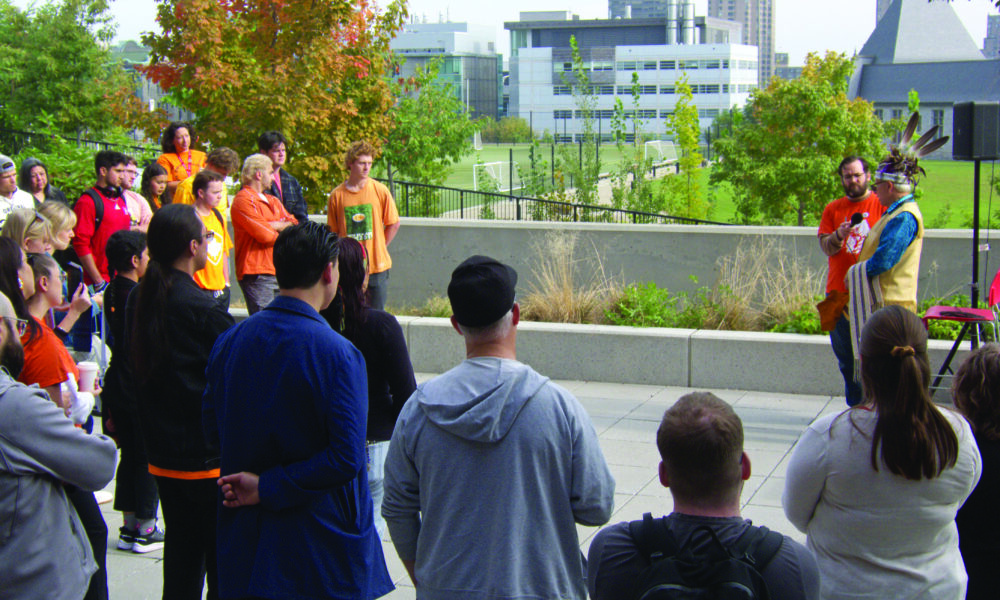
On Sept. 29, McGill’s Faculty of Education held its fifth annual event for the National Day for Truth and Reconciliation, also known as Orange Shirt Day: Skátne Entewathahíta – We Will Walk Together

The event, which is an initiative led by Indigenous students and faculty members, began with an introduction from Dennis C. Wendt, an Associate Professor in the Department of Educational and Counselling Psychology and the faculty coordinator for the event. Wendt opened with a land acknowledgement before explaining the theme of this year’s event: “Pathways from Awareness to Action: What Is Our Role?” 

Following Wendt’s introduction, Elder Ka’nahsohon Kevin Deer—who is Kanien’kehá:ka and is a member of the Kahnawake First Nation, a faithkeeper at the Mohawk Trail Longhouse, and a prominent knowledge holder—began his opening remarks. Elder Deer discussed a number of teachings, warned listeners against the continued use of fossil fuels, centred the importance of listening to Indigenous teachings in relation to the land, shared his own experience with residential schools, and concluded on a message of hope for the future of the climate. 

Celeste Pedri-Spade, the university’s first Associate Provost for Indigenous Initiatives and an associate professor of anthropology, was next to speak. Pedri-Spade discussed what Orange Shirt Day means to her as a mother, an Anishinaabekwe, and an intergenerational survivor of residential schools. 

“My kids are 10 years old now [….] Wherever they go they should see themselves reflected back,” Pedri-Spade said. “That’s not a reality for them yet [….] The plan [the 52 Calls to Action], has those actions that will work toward that because every child matters and every child should have that ability to achieve their educational goals at a place like McGill.” 

Victoria Talwar, the Interim Dean of the Faculty of Education, then discussed the important role of educators in truth and reconciliation before attendees were given the option to participate in one of two events. 

The first option was an interactive presentation about the “Walking Alongside” teacher education website. The site was developed following the first three years of the Faculty of Education’s Skátne Entewathahíta – We Will Walk Together event with the hope of incorporating the 52 Calls to Action into the Quebec curriculum. 

“If our society wants to move forward and really get towards reconciliation, it starts within our schools,” Margaret Mackenzie, who is a citizen of Métis Nation in British Columbia, B.Ed ‘23, and the Indigenous outreach coordinator of Branches, told The Tribune. “It’s so important to have children understand the impacts of residential schools, and ongoing colonial violence that’s happening today. For educators to be aware of this and to educate themselves before educating others is really important.”  

The second option was to go on the Critical Campus Tour developed by staff and Indigenous students in affiliation with the More Than Words project in the Participatory Cultures Lab this past spring. Tour participants were broken up into small groups then led around campus to the James McGill Monument by the Arts Building, the 13th century Haudenosaunee Village at the corner of Sherbrooke and Peel, and the Hochelaga Rock at the Roddick Gates to discuss the area’s colonial and Indigenous history.

Rachel Mackenzie, U3 Arts, who is a citizen of Métis Nation in British Columbia, emphasized the importance of thinking critically about the McGill name and the implications of its use during the tour. 

“It’s really interesting to think about what comes to mind when people hear McGill,” Mackenzie concluded. “Is it this academic institution? Or do you think about James McGill? […] Do you think about his history? [….] We’ve seen changes in academic institutions with Toronto Metropolitan University and we’ve seen the positive impact that a name change can have on a community.” The event also provided pamphlets with a how-to guide on creating your own critical campus tour and a QR code for an expanded version of the tour.  

Baseball, Sports

Can the Toronto Blue Jays make a deep postseason run?

With 162 games in total, the Major League Baseball (MLB) season can seem draining to some fans. From May to September, the games can feel quite meaningless, with fans just waiting for October to roll around and for the playoffs to finally begin. 

For Toronto Blue Jays fans, this postseason brings an opportunity to avenge the failure of last year’s wildcard series against the Seattle Mariners. With the Jays claiming the third wildcard spot on Sept. 30, the team is poised to face off against the Minnesota Twins. However, with the team underperforming all season long, many fans are left asking: Do the Jays have the legs to make a deep postseason run? The Tribune explores arguments both for and against the possibility. 

For: A September surge

The Jays showed a glimmer of what they are capable of when they are at their best when outfielder George Springer slid head-first into home base to cap-off an inside-the-park home run on Sept. 24 against their American League (AL) East rival––the Tampa Bay Rays. The Jays’ Achilles heel this season has been a struggling offence and a lack of timely hitting, but September has shown some promise of overcoming their weakness that can hopefully carry into the postseason. Despite a flailing series against the New York Yankees, where they lost two out of three games, the Jays have scored 45 runs in their past six games against the Rays. A struggling Vladimir Guerrero Jr. boasts a .300/.407/1.047 slashline with five home runs and ten RBIs over the past two weeks.Moreover, contributions from Cavan Biggio, Daulton Varsho and a resurgence of power from Matt Chapman may give the Jays the much needed offensive boost they need in the postseason. 

Against: Bad record against teams in the AL East 

Playing in the hardest division in baseball is tough and the Jays have proven just that. Their measly record of 21–31 against AL East opponents makes it hard to see how the Jays would come out on top in a series against the Rays, let alone a fight for the division title against the division-leading Baltimore Orioles. Moreover, their record of 42–49 against teams with a record above .500 does not bode well for the sharper competition they will face come playoff time. 

Against: Bad baserunning

Baserunning may seem like a micro-issue, however, with the new rules leading stolen bases to jump from 2,486 in 2022 to over 3,000 in 2023, its value cannot be underestimated. Not only are the Jays tied for last in total stolen bases league-wide with 99, but poor baserunning decisions have been commonplace all season long. The Jays rank 29th in stolen base percentage (stolen bases plus caught stealing divided by stolen bases), and fifth in outs on base (when a runner is put out while making a baserunning play). All to say, the Jays baserunning is one of their greatest flaws, and will surely haunt them in the playoffs.  

For: Veteran presence

Vet presence often turns out to be one of the biggest x-factors in the MLB postseason, and if the Jays want any chance of a deep run, they will have to capitalize on this advantage.The Blue Jays have a handful of veterans that can lead the team to victory. Springer, a World Series champion and World Series Most Valuable Player in 2017, has played 65 playoff games with the Houston Astros. Brandon Belt, a bright spot on a struggling Jays team, played in 35 playoff games with the San Francisco Giants and won two World Series’ in 2012 and 2014. Hyun Jin Ryu has also appeared in nine playoff games. Safe to say, playoff experience is not an issue on this Jays roster. 

Bonus For: Pitching staff 

The Jays have one of the strongest pitching staffs in all of baseball. They have the fourth lowest team era (3.78), to complement a third overall era of 3.85 amongst their starting pitchers. The staff also boasts the third highest strikeouts per nine innings (9.47) and are in the top half of the league for almost every other pitching metric. 

Read the latest issue

Read the latest issue