Latest News

Out on the Town, Student Life

There’s no coffee at this café

Most incoming McGill students know about the rites of passage that they’ll experience, like living alone for the first time or a late night at McLennan cramming for an exam. What these students don’t know is that, at this university, there is another experience considered equally formative: Their first trip to Café Campus.  

The 56-year-old club, known to most as ‘Café,’ is one of the most popular dance venues for McGill students. As a stop on Frosh bar crawls, students are introduced to Café Campus before they meet their professors—and the visits only go up from there. Its proximity to campus and themed music nights, like ‘Retro Tuesdays,’ have proven to be big draws for McGillians. Café isn’t just a freshman spot, either—it also hosts a number of McGill-affiliated events, like the Management Undergraduate Society’s Winter Carnival or the Engineering Undergraduate Society’s E-Week.  

Sofia Gobin, U0 Arts, was one of many McGill students who visited the club during Frosh week. Her introduction to the club as a McGill venue has kept her coming back so many times that she’s lost count.

“I’ve been to Café countless times,” Gobin said. When pressed on why, she responded: “Just because it has the reputation of being a student club and a lot of first-years, in particular, go there on nights out […] [it] was definitely a bit different because we were just playing games in the main area, but I think the fact that it was introduced so early on made it seem like it was a ‘McGill club.’”  

So the club is considered a quintessential part of the McGill experience. Andrea Goldstein, U0 Arts, thinks the music nights and its prime location are the main reasons. 

“It’s so close to all of us, which makes it such an easy walk,” she explained. “I [also] think Café is so popular among students because everyone is looking to go where their friends are going, so it gets really busy on certain nights, like [2000s] nights on Thursday.”  

Since so many McGill students visit the club, club-goers will often be among friends, creating a unique sense of community. Harry Brar, U0 Management, remembers that other McGill students helped him out during his first visit to the club. 

“During my first time at Café, I lost my phone there,” Brar said. “But everyone helped me find it, which was awesome.” 

The McGill community gathers at Café in the same way as they gather in McLennan during exam season, making the club a hotspot for students.  

Although many students seem to agree that Café is not a main component of McGill life, its wide variety of drink options, proximity to campus, and multiple dance floors make it a must-visit.

“It’s not essential to a student’s life at McGill in general, but you need to go at least once for the experience,” Goldstein said. “I’m not sure how many times I’ve been, maybe four-ish?”

Gobin agrees, saying that McGillians “must go at least a couple of times. At least to give it a try.” 

It seems that what makes Café so quintessential to McGill’s student life is its consistency. 

“I don’t think that it’s a vital component of McGill student life, but with that said, Café is always a good time,” Brar said. 

According to Gobin, along with many other students, there is no doubt that the club is a sort of McGill trademark. 

“It’s just kind of iconic, it’s exactly what you expect,” she said. “It’s never going to be horrible; it’s never going to be especially incredible or amazing […] it’s reliable.”  

Ask a Scientist, Private, Science & Technology

Copy–pasted nucleotides found to cause neurodegenerative disease

Neurodegenerative diseases such as Alzheimer’s, Parkinson’s, and ataxia are caused—as their categorization would suggest—by the degradation of nervous system cells. One to three individuals per 100,000 are affected by late-onset cerebellar ataxias (LOCA), a disease characterized by impaired muscle control that worsens over time. While most types of ataxia set in during childhood, LOCA is exhibited by patients older than 30. Other, more common types of ataxia are well-studied, but the causes of LOCA were unclear until Dr. Bernard Brais and his team made a breakthrough.

Brais, a researcher at the Montreal Neurological Institute (The Neuro) and McGill professor of genetics, identified a genetic mechanism highly correlated with the onset of LOCA in a recent article published in The New England Journal of Medicine. The researchers found that the accumulation of long strings of repeating GAA segments—a specific sequence of three DNA nucleotides—causes underexpression of vital proteins responsible for nerve impulses and impairs the expression of a vital gene called fibroblast growth factor (FGF14). Nucleotides, which are the building blocks of genetic information, form a code that tells the cell how to produce proteins.

Brais explained that LOCA is characterized by deteriorated movement coordination: Patients experience difficulty walking and speaking, are easily exhausted by physical exercise, and manifest a high intolerance to alcohol. 

At the cellular level, LOCA is caused by a reduced number of ion channels in nerve cells called Purkinje neurons in the cerebellum—the bulbous region on top of the brainstem—that are responsible for movement control. Ion channels are proteins embedded in the membranes of neurons that allow certain ions, which are charged atoms, to pass through. These channels regulate the number of ions travelling in and out of cells and establish a voltage difference across the membrane, which is crucial for sending signals down the neuron. Without these signals, the nervous system couldn’t perform important functions like muscle contractions, reflex responses, and sensory processing.

The FGF14 gene carries instructions for how cells should make proteins to help organize ion channels in DNA sequences. Brais’ investigation revealed that LOCA is caused by a mutation that creates more GAA repeats in the FGF14 gene: A kind of copying and pasting is happening, where three nucleotides reappear hundreds of times in the middle of a sequence. Such a mutation prevents cellular machinery from ‘reading’ the gene properly and ultimately producing the right number of ion channels. According to Brais, GAA repeats are responsible for 61 per cent of LOCA cases in French-Canadian patients.

“We think [that] from the DNA on FGF14, there is no [protein] produced. It creates a region that prevents this copy of the gene from being expressed,” Brais said in an interview with The McGill Tribune. “If [the repeated region] is large enough, it will decrease the expression of one copy to the extent that, with time, those cells will find [it] more difficult to organize their channels that are so important for their electrophysiological activity.”

This discovery also explains why patients with fewer GAA repeats in the FGF14 gene have mild or no symptoms of ataxia, as the disease’s severity depends on the GAA region’s size. Brais explained that unaffected people have eight to 35 GAA copies—as numbers approach 250, there is an increased risk of developing LOCA, and 300 repeats are sufficient to cause ataxia.

Finally understanding LOCA’s cause brings researchers closer to developing a cure. In fact, a drug developed to target GAA repeats in Friedreich’s ataxia is a promising treatment for LOCA. 

“There’s a lot known about Friedreich’s because it was cloned many years ago, […] that’s why we know so much about the GAA repeats,” Brais explained. “[The] GAA repeat in [another] gene has been studied extensively and it does the same thing as in FGF14.” 

Is there a way to remove GAA repeats from FGF14 once and for all? Yes and no. There is a powerful technology called CRISPR which, in theory, can delete any sequence in the genome. Removing over 300 repeats in LOCA patients, however, is not a straightforward task. 

“I don’t think we’re close to a therapeutic trial, at least with those long repeats for sure,” Brais said. “Delivering [CRISPR agents] to the brain is still a major challenge. But yes, at least in theory, you can […] remove that expansion.”

McGill, News

McGill announces creation of postvention framework during Quebec Suicide Prevention Week

Content warning: Mention of suicide

On Feb. 7, McGill will hold its first community consultation regarding a suicide postvention plan that has been in the works since a need was first identified in 2019. The postvention plan is one third of a larger project designed to address suicide on campus. McGill is updating the community on the status of the framework during Suicide Prevention Week in Quebec—the week of Feb. 5 to 11. The Association québécoise de prévention du suicide first launched the awareness week 33 years ago and has held it every year since. 

The postvention component, which details the procedures McGill will follow after the death of a student by suicide, will eventually be accompanied by prevention and intervention frameworks. According to Melissa Lutchman, McGill’s crisis intervention and suicide prevention specialist, the postvention plan was developed first because it was identified as the largest gap in suicide-related services at the university. 

“It’s also the largest gap for many universities across Canada,” Lutchman said in an interview with The McGill Tribune. “With student consultations, and faculty, and staff, [we learned] what the needs were around postvention, [like] knowing how to talk about suicide, knowing what to do when a student returns from a suicide attempt. What do you say? What do you not say when a student dies by suicide? What does McGill do?”

Currently, McGill is not equipped to help students experiencing a mental health crisis. McGill recommends that students go to a hospital or call Suicide Action Montreal in case of emergencies. For students not in a crisis but still experiencing difficulty, ODoS provides case managers who are trained to guide students and facilitate access to care, whether that is at the Wellness Hub or an external clinic

The postvention framework will not be immediately accessible to the student population, says Maya Willard-Stepan, the Students’ Society of McGill University (SSMU) mental health commissioner. She told the Tribune that the plan’s delayed public release is because the Students’ Suicide Prevention Framework Committee will be holding community consultations to ensure the document can properly serve students. 

“The other really important part [is] making it readable [and] ultimately smooth on the other side of things, [and] transparency around these protocols is going to be very important,” Willard-Stepan said. “We want to produce something that is safe to put out and accurate and true and that the community can take comfortably”

Lutchman was recently hired by McGill to work full-time in order to complete the three-pronged framework in a timely manner—she was initially hired on contract. Before coming to McGill, Lutchman spent 18 years working at Suicide Action Montreal and Talk Suicide Canada, formerly known as Crisis Services Canada. Her expertise in the field and deep knowledge of crisis care have allowed her to ensure the larger framework project focuses on suicide rather than general mental health care.

“There is a lot to say about not confounding mental health with suicide,” Lutchman explained. “Although there [are] a lot of people with mental health diagnoses who die by suicide, there are a lot who don’t. When you confound the two, you contribute to stigma and labelling.”

Stigma surrounding suicide is something first-year nursing student Madeline Dumouchel has come across in her time both in John Abbott College’s nursing program and at McGill. Dumouchel believes that destigmatizing suicide is crucial and something McGill should continue working toward.


“Having [an] open discussion can save [the] lives of others who are afraid to speak up and feel lost or alone,” Dumouchel wrote in a statement to the Tribune. “The university should be very involved in times of crisis, as many students rely on their school for support and access to resources [because] crises can impact students’ academic performance, their life at school and at home [….] Some individuals […] may feel like school is their safe place and comfort zone.”

Ask a Scientist, Private, Science & Technology

Should AI chatbots display emotions?

If you’ve visited an online retail store, you’ve likely encountered a chatbot before. It’s the small message that pops up in your screen’s bottom corner, saying something along the lines of, “Hi there! Thanks for visiting our site. Can we help you look for something?” 

Elizabeth Han, a Desautels Information Systems professor, investigates these AI chatbots and their use in the modern world. She recently published an article in //Information Systems Research// looking into whether it is beneficial for AI chatbots working in customer service to express, or display, positive emotions.

Existing research suggests that when human customer service representatives express positive emotions, customers feel like the quality of service is higher. Psychologists theorize this to be a result of “emotional contagion”—when a person sees someone else feeling an emotion and they begin to feel it as well. 

The question Han and her team set out to answer is if this effect translates to exchanges with chatbots. They hypothesized that while emotional contagion may still have an effect, it could be negated by customers’ feelings of discomfort toward a machine expressing human emotions. 

To answer this question, Han and her colleagues asked participants to complete online tasks using virtual chatbots, like requesting an exchange for a textbook they had previously ordered. Some participants interacted with chatbots that were programmed to express positive emotions, while others interacted with ones that were more robotic.

The emotion-expressing chatbots used lines like “I can help you with that, and I am excited to do so!” while the straightforward chatbots kept it to a simple “I can help you with that.”

After participants completed these interactions, they rated the quality of the customer service experience. Han and her colleagues found that customers who interacted with positive-emotion chatbots did not experience the increase in perceived service quality that you would have expected had they been interacting with human agents. 


This new information presents businesses with a tricky question: Save money by replacing customer service employees with chatbots, or provide a better customer experience by continuing to use human agents? 

In an interview with The McGill Tribune, Han explained how the switch to chatbots increases company efficiency. 

“Essentially, these service employees are doing emotional labour by interacting with perhaps annoying customers, but chatbots are not really affected by that,” Han said. “The chatbot doesn’t feel anything, and they can just make whatever appropriate response.”

Given how much more efficient chatbots are, some companies may be tempted to simply not tell customers that they are interacting with a chatbot instead of a human.

“There is research that has been done that has looked into the effects of disclosing the chatbot’s identity, and it actually reduces those business outcomes. There is a tradeoff between better business outcomes versus keeping the line of ethical and legal codes,” Han explained.

This then becomes an ethical and legal question: Do customers have a right to know when they are speaking to a computer? And would companies honour this right if it meant a loss in profits?

“I think there are many regulations coming up regarding disclosure so eventually companies will move more and more towards disclosing the identities of those chatbots,” Han said. 

The field of AI is rapidly developing, and thinking about how these AI chatbots have been created and will continue to evolve raises many difficult questions. It might even make you wonder the next time you’re browsing an online store and get the pop-up notification to chat: Are you talking to a human or a machine?

McGill, News

Reports of alleged predatory behaviour at Redpath raise security concerns

Content Warning: Description of sexual harassment

Since late December, multiple posts have circulated on social media reporting that a man has been preying on women at McGill’s McLennan-Redpath Complex. Posts on r/McGill, a student-run Reddit subpage for the university, have denounced the man for soliciting multiple women students in Redpath. Various sources confirmed being approached by a man with a similar description in Redpath at different dates. 

Teddy Laughton, U2 Nursing, was having lunch in the Redpath cafeteria when she was approached by a man in his late 20s who was “standing around in the cafeteria.” According to her, the man did not appear to be a McGill student.

“After making it clear that I didn’t want him to keep talking to me, a few minutes later I saw that he was talking to another group of girls, shaking their hands and I could tell that they were all uncomfortable,” Laughton told The McGill Tribune

Laughton notified the employees of Redpath Café and was assured that staff would “keep an eye on him and call security if necessary.” Yet, she recalls seeing the man in the cafeteria some 20 minutes later, and believes that he should have been removed from the premises.

Anne-Émilie Demaison, U1 Arts, also had an encounter with the man in early January, this time on the second floor of Redpath.  

“I felt an insistent gaze, and whenever I would look up from my computer he would be staring at me,” Demaison said in an interview with the Tribune. “He was sitting one table across from me and had one hand constantly on his [crotch]. There were few people on the floor and I began to panic and called as many of my friends as I could for them to come and help me. I left to go to the bathroom, and when I came back to my seat I saw that he had moved to my table. I quickly gathered all my stuff and got out of there.” 

Demaison says that her first reflex was to seek assistance from her friends instead of searching for security guards who roam the floors of the Redpath and McLennan but are otherwise difficult to locate.

Demaison feels that the security presence in the library is lacking considering the entire complex has nine floors. 

“It was late and there weren’t many people on the floor, so I didn’t have many options to turn to,” Demaison said. “Maybe security at the entrance of the libraries, or even signs to indicate how to contact security services in the case of an emergency could help students feel safer.”

An increased security presence would not necessarily guarantee the safety of all students. Many studies show that increased surveillance, even by campus security guards or police officers, lead to a disproportionate number of negative encounters for racialized students. 

The Tribune reached out to librarians at the McLennan-Redpath Complex to inquire about the university’s student safety measures. The staff present at the time declined to comment, and referred the Tribune to the university’s communications team instead. 

Fréderique Mazerolle, a McGill media relations officer, explained that the Campus Public Safety Department strives to promote a safe environment for students, faculty, and staff to work in. 

“Our agents patrol the campus, manage access, transport students and staff with disabilities as well as respond to incidents and emergencies on a 24-hour basis,” Mazerolle wrote in an email to the Tribune. “Ensuring the safety of the McGill community is our ultimate and continuous goal.”

The Tribune was unable to get a statement from the library’s security guards, whose contracts are outsourced to Garda Security Group and cannot comment on security protocols. The Campus Public Safety Department also declined to comment. 

If you are concerned for your safety on campus, McGill’s security services can be reached at 514-398-3000. The Campus Public Safety department’s Night Route Maps also outline recommended routes for navigating the campus in the dark and locate emergency phones for contacting additional security.

McGill, Montreal, News

MISC panel tackles anti-Black racism in academia and beyond

Content Warning: Mention of racist violence

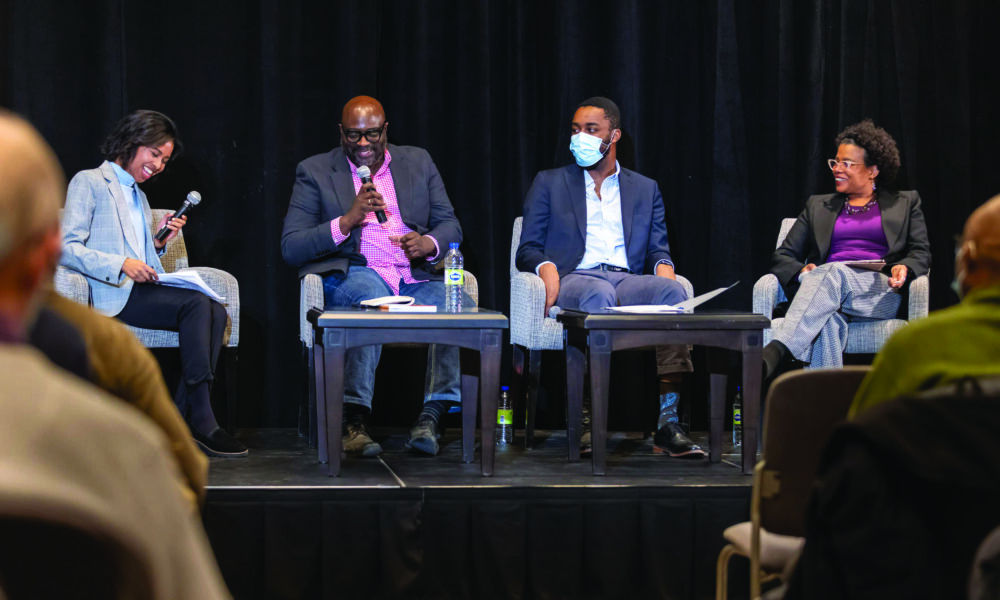
The McGill Institute for the Study of Canada (MISC) brought three McGill academics together for the “Anti-Black Racism in Canada and Beyond” panel at Centre Mont-Royal on the evening of Feb. 2. The event delved into entrenched systems of power and oppression that limit Black participation in academia and in everyday life across the country. 

Hosted by Holly Cabrera, CBC journalist, BA ‘19, MIst ‘22, and former editor at The McGill Tribune, the panel featured David Austin, a course lecturer at MISC and professor at John Abbott College; Terri E. Givens, professor of political science at McGill and the Provost’s Academic Lead and Advisor on McGill’s Action Plan to Address Anti-Black Racism; and Tari Ajadi, an assistant professor of Black politics at McGill. 

The sold-out hybrid event began a few minutes after 5 p.m. with an introduction and land acknowledgment by MISC director and professor of political science Daniel Béland

Cabrera opened the panel by addressing recent examples of police brutality: The murders of Nicous D’Andre Spring, a 21-year-old Montreal man who was killed by correctional officers while illegally detained at Bordeaux Prison in Montreal, and Tyre Nichols, a 29-year-old man who was killed by five Black police officers in Memphis, Tennessee. 

“You’ll recall that many have referred to 2020 as a moment of racial reckoning—and since police murdered George Floyd, we’ve seen more beatings, more book clubs, and more backlash,” Cabrera said. “So it bears repeating: Anti-Black racism has existed for centuries, and Black people continue to resist it.”

Austin added that defining the capitalist roots of anti-Black racism is crucial if we are to dismantle it. All panellists were clear on the historical connection between capitalism and the subjugation of Black people—from the transatlantic slave trade to mass incarceration. 

“I really believe change cannot come about until we all are willing to have that vulnerability and say, I am a part of this system,” Givens said. “Nobody wants to admit that they are part of a racist system, but we are […], and that it’s […] part of the structures of white supremacy that are built into the system of capitalism that we live in today.”

Next, Cabrera broached the question of performativity in institutional equity, diversity, and inclusion (EDI) initiatives. Though EDI initiatives seek to increase the representation of people of colour within organizations, Ajadi explained, they cannot change what an organization was originally conceived to do. 

“EDI is a tool of management, it helps you to make your organizations better. That’s not liberation,” Ajadi said. “Right? That’s not what structural change looks like. To me, it looks like changing the organization so that the organization achieves its goals in a more efficient or effective way.” 

When Cabrera asked whether the institution of policing is salvageable, the panellists agreed that reform efforts have not gone nearly far enough. 

“As the author of a report on defunding the police, you can imagine what my response is,” Ajadi quipped. “But I’d rather flip the question—what does policing do well?”

Austin pointed to policing as a prime example of how large-scale structural change is needed to address institutionalized racism.

“That’s the only way we can actually understand what happened in Memphis,” Austin said. “We’re talking about structural power, and how even with the representation of more Black faces in high places, the structures of power are not transformed.”

At McGill, there were 14 Black tenure or tenure-track faculty members out of approximately 1,800 in 2021. McGill pledged to increase this number to 40 by 2025, and 85 by 2032. Over the past two years, 28 Black tenured or tenure-track professors were appointed. Black students make up 4.6 per cent of the student body according to the Student Demographic Survey

“I think people want to say, ‘Oh, we’ve made progress [….] We’ve done enough for Black students at McGill,’” Givens said. “The point is: Have we created an environment where students want to come to McGill, where Black faculty feel like they belong and can thrive and flourish? Have we created an environment that makes McGill look like a place people want to be, period?”

SSMU

SSMU BoD debates motions about campus safety app and trans students’ rights on campus

The Students’ Society of McGill University (SSMU)’s Board of Directors (BoD) met via Zoom on Feb. 2 to vote on four motions, including two awaiting ratification that had previously been approved by SSMU’s Legislative Council.

Kerry Yang, SSMU vice-president (VP) University Affairs, presented the BoD with a motion regarding the creation of a  Memorandum of Agreement (MoA) with HAVEN—a campus safety app—for a trial period until April 2023. In instances of sexual harassment or assault, the app provides users with a quick and accessible way to call for help. Pushing the emergency button once sends a customized text message to the user’s designated contacts, pressing it twice sends the same message as a voicemail, and pressing it three times calls either campus police or 911, depending on whether the user is located on or off campus. 

Some BoD members are concerned about the potential legal risks of HAVEN, specifically a breach of privacy laws, that SSMU could incur as a result of the app’s geo-tracking capabilities. Benson Wan, a Legislative Council Representative on the BoD, is apprehensive of the security and privacy risks students may face if they use the service.

“On the one hand, I think that this is conceptually a good application to offer to students for them to opt into,” Wan said. “However, I think there are some concerns with regard to the logistics of how this would be rolled out. I think there might be some security concerns, data concerns, et cetera. They are not very strong concerns, but I think they do exist.”

Other board members echoed Wan’s worries, including SSMU VP Student Life Hassanatou Koulibaly. She pointed out that SSMU may face legal repercussions should the Society choose to sign the MoA, which was also referred to as a “memorandum of understanding,” with HAVEN.

“I think that in introducing something to our student body we are inherently endorsing it, whether it is free or not,” Koulibaly said. “So there would be some liability that would come to [SSMU] from that.”

The motion was ultimately tabled until the next BoD meeting. 

The following item on the agenda was a motion to have McGill divest from companies complicit in the ongoing Uyghur genocide, which was adopted at the Jan. 19 Legislative Council meeting. After a brief discussion, the motion was unanimously ratified and adopted by the BoD. 

The final item on the agenda was a motion to support trans students’ rights on campus, in response to the controversial event titled “Sex vs. Gender (Identity) Debate” hosted by McGill’s Centre for Human Rights and Legal Pluralism (CHRLP) on Jan. 10. The motion noted the transphobic nature of the debate and asserted that such an event endangers McGill’s transgender community by setting a precedent for the platforming of transphobic rhetoric at the university. 

SSMU VP External Val Masny explained what SSMU hopes to accomplish should the motion pass, noting that they “put forward this motion so that SSMU can adopt a future policy that will be comprehensive of the students’ needs and rights in terms of advocacy.”

The motion faced opposition from board members who expressed concern that SSMU could face accusations of defamation as a result of directly naming the event’s key speaker, a professor of human rights law at King’s College London

The motion was ratified, with five votes in favour and two votes against. 

Moment of the Meeting:

Legislative Council Representative Benson Wan, along with SSMU President Risann Wright and others, raised concern about supporting the motion on the rights of trans students, remarking that SSMU may not properly understand the potential legal ramifications of naming the debate’s speaker. Wan suggested that SSMU seek professional legal advice before adopting the motion.

Soundbite:

“If we do implement HAVEN as an app, and students do like it […] but we decide it won’t be particularly useful for students and thus decide not to move forward with having HAVEN be part of campus, there might be some backlash [….] We need to make it very clear to students that it is a trial run and not something that is permanent.”

— SSMU VP University Affairs Kerry Yang on the HAVEN free trial

A previous version of this article stated that SSMU President Risann Wright was opposed to the motion in support of trans rights. In fact, Wright asked a question as to whether SSMU could face defamation for using someone’s name in the motion and, upon receiving an answer of no, proceeded to vote in favour of the motion. The Tribune regrets the error

Features

Finding the Old Home

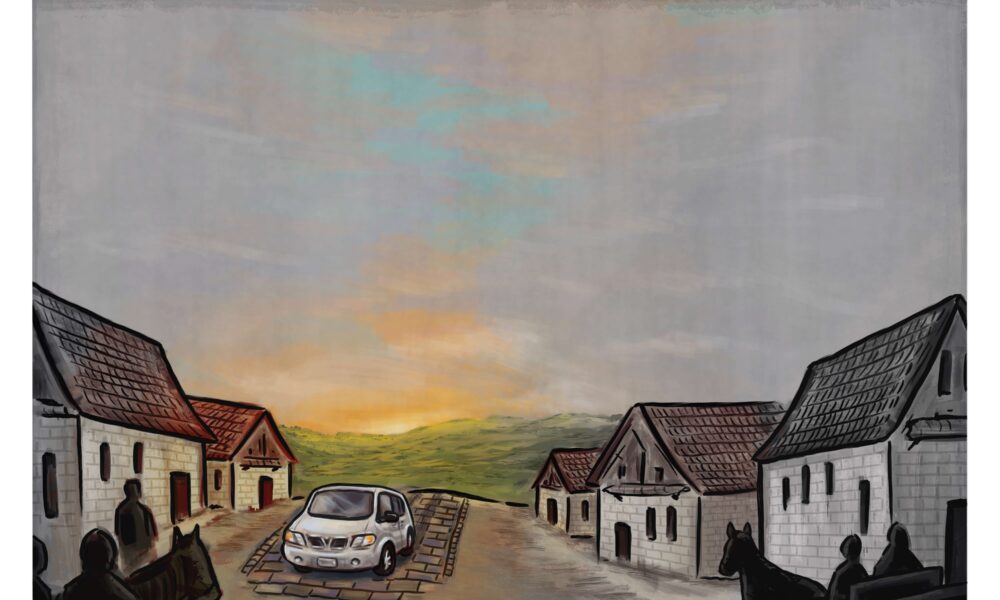
I was nine years old when I first decided to go to synagogue with my grandfather. Every Saturday, I would sit on my couch, looking out the window onto the driveway, waiting for Zaidy Ell to pick me up in his grey minivan at 9:30 a.m. 

I began this weekly tradition after accompanying my family for the year of mourning for the passing of my grandmother, Bubby Shirl. I enjoyed spending the time with Zaidy Ell, and I wanted to see if religion would speak to me, resonate with me in a way that it hadn’t with the rest of my secular family. 

I had a lot of questions about the synagogue experience. I noticed that the old men who were called up to the Torah pronounced their Hebrew differently than the younger Rabbi. Some men wore blue and white prayer shawls while others wore black and white. There were also no other kids my age there. Parents often brought their toddlers with them, but once they reached my age, they seemed to stop going. 

Looking back, I never enjoyed synagogue that much. I would time my bathroom breaks specifically to miss the longest standing part, and the food afterwards at the Kiddush was always pretty gross. But I loved the snarky remarks Zaidy Ell and I would make about people or the playful punches on each other’s thighs to make sure we weren’t falling asleep. 

Mostly, I enjoyed the car rides there and back when he would tell me stories. He told me about his grandmother, Bubbe Sarah, who had taught him Yiddish and who raised him after his father died and his mother got sick. When she drank tea, he recalled, she would pour it into the saucer to cool it down and suck the tea through sugar cubes. He also told me about his grandfather, Zaide Charles (Shaya), who deserted the Russian army during the Russo-Japanese War and always put on his shoes before his pants—a technique he was taught as a soldier. 

He would also answer the questions that I had. He explained to me that the blue and white prayer shawl, or tallis, signifies that the diasporic Jewish yearning has been fulfilled because Israel exists, while the black and white signifies that Jews are still mourning and yearning because the Messiah hasn’t yet come. He conceived it as a way of enacting a vision for the community through individual choice of dress. He wore a blue and white tallis, the same style he gave me for my Bar Mitzvah.

He taught me that the Rabbi spoke a more modern Hebrew, while he and the older Eastern European Jews, or Ashkenazim, use a different pronunciation—pronouncing many of the T sounds in modern Hebrew like S’s and pronouncing “Oh” like “Oi.”

Going to synagogue didn’t make me religious, but the folklore Zaidy Ell shared connected me to a time and place—a place that wasn’t my hometown of Toronto or that suburban synagogue. Ashkenazi Jews commonly refer nostalgically to their place of origin as the Old Home, or Alte Haym in Yiddish. However, defining what that meant for me required a synthesis of place and belonging which felt difficult to articulate.

My ancestors were from all over Eastern Europe, including Poland, Ukraine, Belarus, and present-day Russia, and I knew that I was Jewish. But apart from my dad’s mom, who was born in Poland, all my grandparents, and even great-grandparents on my mom’s side, were born in Canada. Although my family and I do identify strongly as Canadian, with my Dad growing up in strongly-patriotic rural Ontario and Zaidy Ell being an avowed monarchist, it was always a place of arrival rather than origin. 

Being a dual American-Canadian citizen and also having connections and family bonds to his diverse European background, Avishai Infeld, U3 Arts, had difficulties defining his identity when growing up.

“I was born in the U.S. and then moved to Canada when I was five, so it definitely took me a few years of people asking to finally say Canadian,” Avishai explained. “But also my background is quite mixed. My grandfather was born in Poland, and my grandmother was from Germany. On my mom’s side they’ve been in the U.S. for a hundred years but also from Eastern Europe [….] But I don’t have a very strong connection considering the circumstances that they left.”

Similarly to Avishai, my family holds ties to all these different places, many of which don’t exist anymore, like Austria-Hungary or the Russian Empire. Depending on who I asked, my Old Home was different. Some said I was from Russia, highlighting that aspect of my identity. Others said Poland. Or some said Israel—with me being part of the diaspora. So my answers always changed. 

When I was much younger, I used to say I was from Israel. I was passionate about the ideas of Jewish revival that Zaidy Ell and other family members imparted upon me. It also helped me connect more deeply with the biblical stories I was told and to this empowering idea of a unified Jewish heritage for a geographically disparate people.

But on our car rides, I realized that the stories that resonated with me weren’t ancient biblical tales; they were the stories of my ancestors, Eastern European Ashkenazi Jews. I longed to be connected to the bustling folklore, life, and joy of these communities that I imagined from the stories.

This longing for Eastern Europe manifested itself in strange ways. 

When I was around 10, I first decided that I was Russian, in line with my mom’s side of the family. My grandfather taught me a few Russian phrases that he learned from his grandparents growing up, and I parroted them proudly to any Russian I knew. But once the thrill and exoticness I felt in using my few words faded, my Russian dreams died along with them.

Then I decided I was Polish, identifying more with my dad’s mother, Bubby Sylvia (Zlate), who was born there. For the 2018 World Cup, when I was 15, I bought a Polish jersey, and did my best to pronounce all the Polish last names of the players. But when I wore the shirt in front of my dad’s Polish friend and realized that my pronunciations were all wrong, I felt more than a little fake. After that World Cup, where Poland dismally exited in the first round, my aspirations to be a Pole more or less ended. 

My Eastern-European identity side quests, however, rested on romanticization and were perhaps doomed from the start. I didn’t know who I was trying to emulate. My Polish grandmother wasn’t ethnically Polish, and she didn’t even speak Polish; she was a Jew who spoke Yiddish. More importantly, my ancestors left these places for a reason. Although only the bad experiences are remembered, the stories I heard were mostly horrific; both sides of my family suffered terribly due to pogroms-–antisemitic massacres that killed hundreds of thousands of Jews before the Holocaust. 

Avishai’s grandparents were deeply affected by the violence inflicted upon them by the Nazi regime, which profoundly shaped his conception of origin.

“My grandmother left Germany in 1938 after being subjected to all the Nuremberg laws,” Avishai said. “My grandfather from Poland, his entire family was killed—every single person except for two cousins and an aunt—his parents, his siblings, grandparents, everyone [….] So everyone left under really terrible conditions. What happened was so bad that I honestly feel very little connection to these countries. I identify with them but not in a positive way.”

My identity crisis quickly found its way to Zaidy Ell, who continued to tell me stories to feed this insatiable yearning I had. The stories he told, however, weren’t just about Eastern Europe and his ancestors; in fact, most of them were actually about him growing up in Montreal—in an intensely vibrant Ashkenazi Jewish community in the first half of the 20th century, then numbering over 100,000 people. 

He told me the story about how on one of his first dates with Bubby Shirl, they were up until 5 a.m.—doing God knows what—and they went to either St. Viateur or Fairmount bagel (I can’t remember which), just as they were making the bagels for the day.

He recounted the absurdity of being recruited while in the line-up for a deli to the YMHA’s basketball team, solely because he was 6-foot-8. He never played—it was more of an intimidation factor. 

Or he explained the dynamics of the different Jewish high schools. Baron Byng, located on St. Urbain Street, was where the poorer first-generation Jews went, while Strathcona Academy—where Zaidy Ell went—was attended by the wealthier multi-generational Jews.

When I was a bit older, he mentioned in passing—to my amazement—that he dated Leonard Cohen’s half-sister for six months. 

As I heard these stories, I started to feel the same way about Montreal as I did about the Old Home that I romanticized so much. I imagined Montreal as a place bustling with Jewish life and folklore. 

My grandfather was not alone in speaking of Montreal as a city imbued with Ashkenazi Jewish culture. Zev Moses, founder and executive director of the Museum of Jewish Montreal,  described how the area surrounding St. Laurent Boulevard, mainly the Plateau and Mile End, held a thriving Jewish community and Yiddish culture and recounted how there were over 90 buildings that served as synagogues in the area.

“They created their own society within the city that was Yiddish-speaking, strongly and tightly knit. Yiddish had become the third-most-spoken language in the city after French and English and basically stayed that way until the 1950s,” Moses explained. “There was also a publishing house [a part of Canada’s leading Yiddish newspaper, Der Keneder Adler], so Yiddish writers living in Montreal could publish their books here, and they would be exported back to Europe. So in the 1920s and 30s, there were Yiddish poets from Montreal being read in Warsaw, Kyiv, and other parts of Eastern Europe.”

My mom was also born in Montreal, in the Côtes-Des-Neiges area, but left with her family along with thousands of other Jews during the 60s and 70s in search of better opportunities. The growing Quebec nationalist movement left the mostly-anglophone community feeling ostracized. Even to this day, there is resentment in my family regarding how they were forced to feel alien in the province and city that was their home.

“For many it felt like the rug was pulled out from underneath them,” Moses said. “Of course it’s not at all the same, but the shock of a political movement tied to an ethnicity and language that was calling for major, major changes, came within a generation of the Holocaust or other upheavals in Europe [….] But that’s not necessarily the main reason most people left, the other reason was economic. If you didn’t speak French that well, the possibilities for you quickly became much fewer.”

————— 

The month before I was set to leave Toronto to study at McGill, Zaidy Ell passed away.

He was old when he passed and had prepared us for the moment, so it wasn’t a shock or a tragedy. But being in Montreal—existing in the same city as he did at the same age—it breaks my heart that I can no longer share my life with him, and that he can’t either.

I know that he would have re-lived his youth through me as I told him about my days in his city. He would have recounted the memories that he had walking down “St. Lawrence Boulevard” after I told him about my own adventures, or he would have recommended to me a restaurant that has long been closed down.

But, at the same time, the city makes me feel connected to him and to my ancestors. 

I’m less than 10 minutes away from Baron Byng—the history of which I know intimately because of Zaidy Ell. I’m also a short walk from St. Viateur and Fairmount bagel. I can’t remember which one the story is from—and that makes me a little sad—but, regardless, I can taste the same bagels that Bubby Shirl and Zaidy Ell had at 5 a.m. over 60 years ago. Or, how every day I go to campus, I walk down St. Laurent, a street he told me so much about and traditionally the beating heart of Jewish life in Montreal.

There’s also a tinge of disappointment about this return to my imagined Old Home. It’s lovely to be here, surrounded by so much personal family history, but it’s not this magical existence that I always imagined it would be. My days here feel mostly the same as they do back home—not some intrinsically meaningful experience. 

————— 

Despite the large migration out of the city along with a post-War suburbanization out of the St. Laurent core, Jewish life still remains in Montreal. 

Ben Wexler, U2 Arts, grew up in the city and attended Jewish schools throughout his childhood. He highlighted the increased diversity between Ashkenazim and Jews mainly from North Africa, called Sephardim.

“There’s a depth of diversity and experience here that’s pretty great,” Ben explained. “Language figures into it a good bit, with Jews in Montreal being outside the established anglo community to some extent and outside the franco community, and then within the Jewish community there’s also this linguistic divide between Ashkenazim and Sephardim.”

Near the end of our conversation, I tried to press Ben to answer whether the Jewish community still retains the romanticized, Yiddish-speaking character of my grandfather’s youth that I felt was truly authentic to Montreal—that the community had the same reverence for the past and viewed the city the same way I did. Ben, however, didn’t conceive of it that way.

“I don’t think you can speak about one Montreal Jewish community. I also don’t think you can speak of one Montreal community,” Ben said. “At a certain point, that search for authenticity can feel like some pastiche of Yiddishkayt [Ashkenazi culture] [….] I think you’ve got to approach the Jewish community in Montreal as it is, and it’s not going to be this sexy, disreputable Yiddish world. It’s a different world now, and that’s it.”

————— 

My conversation with Ben punctuated the struggle I was having throughout this journey. So much of my identity is tied to my constructed image of these places—that life there was somehow more beautiful. I wanted the Montreal community in the present day to fulfill that longing—but, really, it’s just a place. I can’t help but realize that Zaidy Ell’s Montreal, and even Eastern Europe were the same—just places. Of course they all carry culture and community, and it’s a tragedy that some of it was destroyed or simply no longer exists. But the people there were just living their lives; it wasn’t some magical existence.
In the same sense, returning to Montreal, my Old Home, was not this transcendent experience that brought me my long-sought clarity about who I am. Although it’s certainly nice to be here, and Montreal is a lovely city, I don’t feel like I’m living the life of Zaidy Ell or my ancestors, and I don’t feel like I’ve returned home. Montreal just feels like a place to me, and maybe that’s a good enough place to start.


Campus Spotlight, Student Life

Peer mentoring program returns to foster student connections

For many McGill first years, starting university can be quite a daunting experience—especially when you have little or no peers to turn to for advice and support. To assist with this dilemma, the McGill Student Accessibility and Achievement office (SAA) re-launched its  McGill Peer Mentor program this January. The program’s goal is to facilitate access to learning and support for all students throughout their university careers. It is devoted to creating an inclusive, supportive, and transparent environment where students can receive advice based on their needs. 

Areas the program can help with include, but are not limited to: Identifying and working towards academic and school-oriented short-term and long-term goals, transitioning to university, developing networks and skillsets, achieving academic goals with learning strategies, managing stress, and learning about resources available around campus. The program is spearheaded by learning support specialists Jacqueline Biddle and Julia Adams-Whitaker and six paid Mentor Peer Leaders who aim to reduce the connection gap between mentors and mentees.

“The importance of this mentor program is to get the mentors and mentees to know each other,” Biddle said in an interview with The McGill Tribune. “McGill is a big campus, and often finding the right support is difficult. People can find it daunting to connect and have a start on their new journey away from home.”

Prior to COVID-19 lockdowns, when the program was moved online, most students were unaware of its existence on the Student Accessibility and Achievement website. Nevertheless, Biddle and her team are working hard to make the program more mainstream by trying out new approaches.

“We figured out the program’s importance and realized it through COVID-19. First-year students required immense support during these tough times, and a tailored relationship achieved through this program is ideal for that,” Biddle said. “Not only in terms of having a semester-long relationship, but incoming students can also navigate and be involved in social activities and know wellness and academic resources to succeed in McGill.”

Mentors and mentees meet on a weekly basis (either virtually or in person), but mentees can also contact their mentors based on their needs. This schedule has been helpful for Dayley Wood, a U2 Science student, who enrolled as a mentee for the winter semester. 

“At first I heard about the mentor program from the Office of Student Accessibility and Achievement through a workshop. So, I decided to give it a try,” Wood said in an interview with the Tribune. “I recently met with my mentor and my experience so far has been very pleasant. I am able to receive a lot of advice and guidance from my mentor on how to effectively study during midterms and final exams since that was a major problem that I had.”

Despite her positive experience with the program, Wood thinks that it would be helpful to have more mentors from diverse programs. 

“I think if mentors are matched with mentees who are in the same faculty and department, then it’s very beneficial for both since [they] may have undergone very similar problems before,” Wood said. “This could also be a great way to spread the word on this program since a mentee could mention it to their friends and they could tell other people and so on.”

Anyone who wants to become a mentee can go to the learner support program tab and apply there. Each mentee is paired with a mentor (who has to have been a McGill student for at least one year) based on an array of compatibilities such as their discussions with an SAA Advisor, their academic backgrounds, their extracurricular interests, and their needs for specific resources, such as exam support. The mentee application form gives each mentee a chance to share what they want to work on most. 

“Whether we want to admit it or not, we experience life differently,” Biddle said. “We have faced challenges in connecting mentors and mentees. However, we had tremendous success due to the shift in on-campus classes for students and more spreading of the word. Therefore, we were very busy pairing up new mentors and mentees, and we expect a similar reaction in the winter semester.” 

Album Reviews, Arts & Entertainment, Music

Joesef’s ‘Permanent Damage’ delves into the messiness of breakups

On Jan. 13, Joesef released his debut album, Permanent Damage, a soulful and intimate ode to his chaotic romantic relationships. The ominous title describes the indelible mark that love and subsequent heartbreak can leave on a person. A honey-soaked voice and confessional, explorative lyrics characterize the Scottish singer-songwriter, who moved to London in 2020, as an emerging figure in the alt-pop genre. 

Throughout the album’s 13 tracks, Joesef walks his listeners through the feelings of losing and being lost, hurting and being hurt, and the residual love that lingers even when it should be gone. In “Borderline,” the instrumental quiets down, giving the stage to a close-mic narrative about meeting the right person at the wrong time. The funky and upbeat mood of  “Didn’t Know How (to Love You)” accurately conveys the feeling of not caring anymore. And “Joe”’s lively and uplifting rhythm contrasts with the subject matter of a bad relationship with oneself.  

The queer artist presents his brutally honest and unapologetic lyrics as a result of his upbringing in Glasgow’s East End, which he once described as “a rough area where what you see is what you get.” The influence of his hometown appears in “East End Coast,” which presents Glasgow as a comforting place through a melody both melancholic and uplifting.

Sonically, Permanent Damage evolves in a soul and indie pop universe. Joesef’s falsetto allows for a light breeze of airiness on themes that could easily drag you down. Alternatively, his full voice brings the listener through the tumultuousness of love with smooth delivery grounded by raw lyrics.

The 27-year-old singer emerged four years ago with the debut EP Play Me Something Nice, followed by Does It Make You Feel Good? in 2020, both exploring the theme of deep longing. With this debut album, Joesef continues digging into his emotions—especially the ones related to breakups—for inspiration. His continued authenticity and heart-infused songs are an undeniable reason for Joesef’s solid fan following, who will be the first to experience this album live on stage during his European tour starting in March.

Permanent Damage is available to stream on all platforms.

Read the latest issue

Read the latest issue