


Latest News

Emerging Trends, Student Life

What are you doing 2nite?: The app transforming event-throwing and going

“What are we doing tonight?”

It’s the question McGillians have been asking each other since the dawn of time. The answer comes to us now in the form of a social networking app taking Montreal, and soon enough, the world, by storm: The 2nite app.

2nite is a social networking app that is making organizing and attending events much easier. I sat down with the app’s founders, Antoine Delarue, U3 Management, and Ludovick Bernier-Michaud, U3 Science, to learn more about it—and also just so I can tell my future kids that I knew them once.

The idea for 2nite was brought about, Delarue tells me, by three specific frustrations:

1. When travelling in Spain with his friends, he noticed that all of the websites they looked up to find events were sorely out-of-date.

2. As an avid event organizer himself, it was hard to coordinate guests, sell tickets, and promote events across so many different apps.

3. Throughout his first year at McGill, he struggled to get involved in groups and events because information was so spread out.

Information about clubs, parties, and events, Delarue says, was “everywhere and nowhere.”

So, Delarue set to work. When he got back to Montreal, he started working with an app developer to make his party-organizing dreams a reality. Delarue teamed up with Bernier-Michaud, another passionate event organizer and one of his best friends. In one year, a couple of paper drawings and a whiteboard had turned into an app that is revolutionizing the way parties come to be. They tried, tested, and tweaked the app until Oct. 3, when they launched 2nite on the App Store and the party really got started.

2nite allows you to look for parties and events based on your location or ones tailored to your interests. It even lets you search an interactive map for events. For both the party-goers and the party-throwers, Delarue says 2nite is “one central platform for everything to do with your nightlife.” As an organizer, you can make a post, create a guest list, sell tickets, and gain a following and a reputation for your killer events.

As a party-goer himself, Bernier-Michaud emphasized that the app can be used to expand your social scene. 

“You land in another city, you have no idea what’s going on, you’re with a couple of friends, you open up the app [and] all of a sudden you have access to all these events […] happening around you,” Bernier-Michaud told the Tribune.

The two founders explained that coming to McGill as international students, they often found themselves not knowing where to go on a night out, and this app aims to make the university social scene more inclusive and accessible. 

”Beyond how fun and exciting it is to help organize events, I think we genuinely think that it can make university life and the student experience even better and even easier,” Bernier-Michaud said.

While many students use the platform to discover Montreal’s nightlife scene, Delarue pointed out that it can be used to find other, more lowkey social events. 

“[You] could be doing yoga in the park, could be getting people together just for the social aspect, getting people together monetarily, you know, if you’re fundraising, whatever it might be, the applications are endless,” Delarue said.

DJ and McGill student Emily Sofin, U2 Arts, explained that the app has been amazing for helping her create guest lists for her sets and keeping everything organized in one space. When asked if she would recommend the app to others, she turned to the brand’s slogan: “2nite I can do anything.” 

Our entire chat felt like talking to two 2022 versions of a more caring and in-touch Mark Zuckerberg. These self-described “two guys who don’t know anything about tech” wanted to bring people together post-pandemic and create a one-stop-shop for events was their way to do it.

So, what are you doing 2nite?

McGill Recommendations, Out on the Town, Student Life

The quest for Montreal’s best donut

Located in Old Montreal, 49th Parallel is a Vancouver-based chain of small cozy cafés that are mostly known for their coffee roasting. They typically focus on selling sustainably sourced coffee, but at their Montreal location, their main attraction is ‘Lucky’s Beignes,’ a donut kitchen tucked away towards the back of the café. Glass walls that enclose the kitchen offer a glimpse into a world of handcrafted and fresh donut-making. 49th Parallel offers a core set of donuts year-round which include classics like vanilla-glazed and chocolate-covered donuts, as well as seasonal flavours like the pumpkin donut my friends and I tried. Despite being on the pricey side, the synchronicity of the cream cheese glaze and pumpkin filling crafted the perfect fall donut.

Originality: 8, Taste: 8,  Price: $4 – 4.40/donut, Overall Score: 16/20 

Tunnel Espresso – 705 St Catherine St W

Part of the Time Out Market at the Eaton Centre, Tunnel Espresso is the last place I would go to get a donut. Their slew of elaborate flavours may initially draw your attention, but they are no different from your regular donut. All are made of the same simple plain dough with a flavoured glaze and they’re not worth the $4.50 they charge, plus tax and tip. Luckily, I spotted their cookie selection which made up for my lack of donut satisfaction. Tunnel Espresso, your s’mores cookie was delicious, but your ‘Salted Brownie’ donut will probably remain unfinished at the back of my fridge for the next couple of months.

Originality: 6, Taste: 4, Price: $4.50/donut Overall: 10/20 

Krispy Kreme – 375 St Catherine St W

Downtown and looking for a cheap snack? Krispy Kreme’s $2 donuts might just be your best bet. Donuts are what they do, and they can do them well. Coated with two different types of maple glaze, their maple donut was a classic—everything it needed to be. A simple donut done well can be as good as (or better than) an extravagant donut embellished with creams, toppings, sprinkles, and fillings. With a choice between the classics and rotating specials, Krispy Kreme offers variety and is a fast, effective donut stop to alleviate a sweet craving and get your sugar fix for the day.

Originality: 8, Taste: 8.5, Price: $1-2/donut, Overall: 17.5/20 (+1 for price) 

Trou de Beigne – 30 St Catherine St W

This one is tough. The best donut we tried, ‘Blizzard,’ was an Oreo donut. The soft interior working in conjunction with the crispy texture of Oreo crumbs that covered the entirety of the donut was nothing short of heavenly. It was, however, the most expensive donut we tried and smaller than the palm of my hand. With a limited selection of more ornate flavours, Trou de Beigne is definitely a gourmet donut shop, which aligns with their tiny portion sizes. Trou de Beigne also happens to be the only donut shop we explored with solid vegan options. There’s a second Trou de Beigne location in the Plateau (156 Rue-Zotique E) where you might get your money’s worth as it serves a larger version of each donut. Bottom line: If you’re feeling fancy, head over to Trou de Beigne––maybe money really can buy happiness.

Originality: 9, Taste: 9, Price: $2.50 – 3.50/donut, Overall: 17/20 (-1 for price)

La Beignerie – 3979 Saint Denis St

Overall, the best donut we tried in Montreal. Selling original flavours like Earl Grey, lime, and crème brûlée, but also the classics like the powdered donut and the Boston Cream, La Beignerie offer a good-sized, tasty, and affordable donut with a chill vibe in the Plateau—miles away from the swarms of people scampering on Ste. Catherine. A quaint porch is set up outside the shop, great for people-watching while we ate our donuts. There was literally nothing on the menu other than donuts. La Beignerie puts all of their focus into the deliciousness of their treats, and it pays off. They have both the best array of flavours, and we also agreed they had the best recipe for their actual donut dough.

Originality: 10, Taste: 9, Price: $4 -5/ donut, Overall: 19/20

McGill, News

U2 Architecture students must take 20 credits this fall or stay an extra semester

Over the summer, directors at McGill’s Peter Guo-hua Fu School of Architecture in the Faculty of Engineering developed a new core curriculum for their BSc students. The curriculum changes had unintended consequences for the School’s U2 cohort, whose members were faced with a decision this August: Take 20 credits in one semester this fall or otherwise extend their time at McGill by an extra semester. 

U2 Architecture students told The McGill Tribune that they were blindsided when their schedules were swapped with a 20-credit prescription of new and pre-existing courses. If a student opted to take a normal course load, they could, but it would come at the cost of extending their degree by an entire semester.

A student hoping to stay on track with their expected graduation time would have to adopt a schedule consisting of an intensive, six-credit architecture studio, four departmental courses, and a sketching class. This regimen exceeds the 18-credit limit recognized by the School’s own Program Advising Handbook, which requires “special permission” for students who wish to surpass it.

Riley*, one of the affected U2 Architecture students, sat down with the Tribune to talk about the alterations, noting what they thought was a lack of communication on the university’s part.

“The change was made very late, and we were not informed until after the registration date,” Riley said. “It is their responsibility to coordinate with us and the professors.”

The curriculum changes have shaken up the lives of architecture students, who, according to Riley, are given little wiggle room in choosing their courses as is.

“This semester has been impossible to navigate,” Riley explained. “Some students are going to be forced to be part-time students in the coming semester because they have no more classes left to take [.…] Some students who live far away sleep in the studio since they can’t go home, and that is really unhealthy.”

Echoing a sentiment shared by many U2 students, Riley believes that the curriculum directors did not revamp the architecture program in a way that was considerate of their students’ well-being.

“McGill makes a lot of fuss about mental health, so we all thought that they would care more when we mentioned the situation, but all they did was relegate their responsibility,” Riley said.

The Architecture Student’s Association (ASA), which oversees both undergraduate and graduate affairs at the School of Architecture, claims they were not consulted during the restructuring of the curriculum.

“[We] did not receive an invitation to participate in discussions held by the curriculum committee that made modifications to course distributions this past summer,” the ASA wrote in an email to the Tribune.

The ASA is worried about the students impacted by the schedule change, seeing as how the semester has already passed its halfway point and the deadline to withdraw from classes has elapsed. 

“[We have] exhausted everything within our powers to work internally with administration and faculty to address the weight of the U2 Fall curriculum,” the ASA wrote.

In Riley’s eyes, atonement is still possible.

“[McGill should] take some responsibility and just tell us, ‘we fucked up […] we tried to do this and it didn’t work,’” they said.

In a statement to the Tribune, Frédérique Mazerolle, a McGill media relations officer, claimed that the university has been accommodating in light of the situation. 

“The School’s leadership has been checking in with students and faculty to address issues related to workload and finding ways to accommodate students,” Mazerolle wrote. “Students have access to several resources through Students Services, including the Student Wellness Hub, the Career Planning Service and Student Accessibility & Achievement. The university’s priority remains to ensure the success, well-being and safety of our students.”

*Riley’s name has been changed to preserve their anonymity.

Science & Technology, Science Rewind

SciLearn helps connect students with course material outside of the classroom

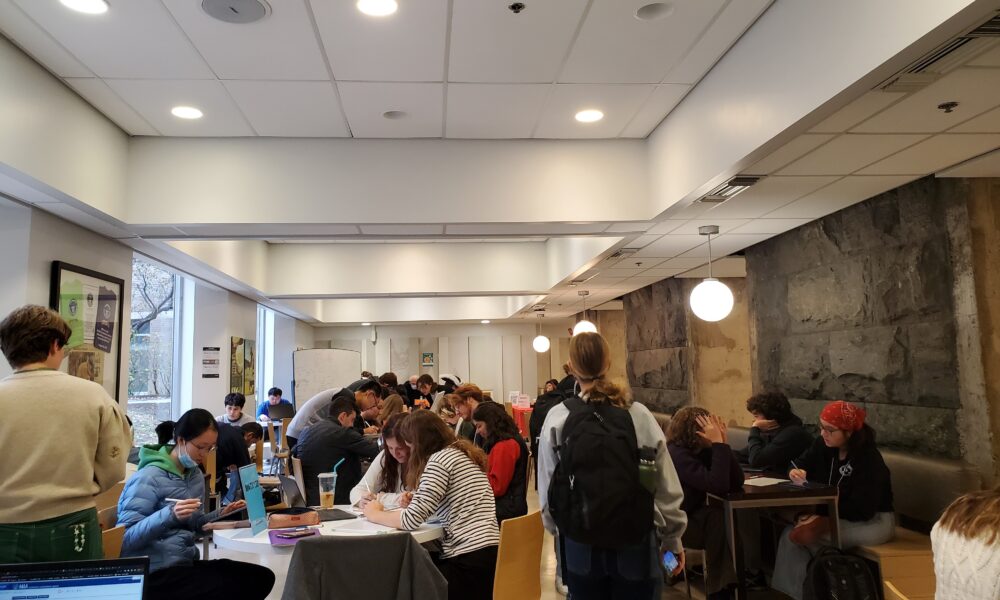
On a Monday afternoon during midterm season, the cafeteria of  Royal Victoria College (RVC) is the place to be. It’s buzzing with energy, full of people eagerly discussing a wide variety of topics—and no, they’re not there for the food. The students are there for the SciLearn Peer Collaboration, a program offered by the Office of Science Education (OSE) to help students ace their courses by working together. 

It’s no secret that intro-level science classes can be isolating: Not only is the material difficult, but in a large class, it’s easy to feel like just another face in the crowd. When you’re looking to get help for an exam or an assignment, it may seem like there’s no one to turn to. SciLearn Peer Collaboration was born from the desire of both students and instructors to have a space outside of lectures to collaborate and connect in order to combat the sense of isolation a student might feel. SciLearn offers a wide range of programs, including workshops and collaborative study sessions for topics like chemistry, math, and physics throughout the academic year. 

“The main objective [of SciLearn Peer Collaboration] is to provide an environment between classmates for learning and a mentorship environment for students,”  Ezelbahar Metin, the student engagement administrator for the OSE, said in an interview with The McGill Tribune.

In Fall 2022, SciLearn merged with FRezCa (First-year Residence Cafeteria), a program designed to create a supportive environment for students in large first-year science classes, to form the current SciLearn Peer Collaboration program.

“SciLearn focused on giving [students] strategies for learning, FRezCa focused on putting them into action, so the merger made sense,” said Kira Smith, student engagement officer at the OSE, in an interview with the Tribune.

Metin began working for FRezCa as a data collector during her second year of her bachelor’s degree. She stayed on while the program went online and through the merger with SciLearn. 

“It’s been fun seeing the changes and different forms FRezCa has taken,” Metin said. “I got involved and never left.”

Students looking to ask questions or work with classmates can find help for a number of the most challenging courses, such as BIOL 200, CHEM 110, and MATH 133. When the Tribune visited SciLearn, the CHEM 110 table was packed with students preparing for an upcoming midterm. Professors from participating courses attend sessions and will either have a designated TA attend or have their TAs conduct some of their office hours at the collaborative study sessions. Also present at SciLearn gatherings are student mentors—upper-year student staff who have taken the courses associated with SciLearn and lend their expertise to current students.

Marie Walker first participated in SciLearn as a student in a workshop. Even though the first workshops she attended were online, Walker was able to form connections with her classmates and has since become a student mentor.  

“Now that it’s in person, it’s a really great way to meet your classmates, especially in science, where there might be 300 to 400 people in a class,” Walker said.

SciLearn Peer Collaboration currently operates out of RVC Monday to Friday from 3:00 p.m. to 5:00 p.m. The program has expanded its list of participating courses lately, as well: PSYC 100 is one of its recent additions. For many undergraduate students, SciLearn Peer Collaboration sessions have become a staple resource for their studies. Whether it’s chemistry, physics, math, or psychology, sometimes the best way to learn is together. 

For more information, visit the SciLearn website at https://www.mcgill.ca/ose/initiatives/scilearn.

A previous version of this article incorrectly stated that Ezelbahar Metin and Kira Smith were employed by SciLearn. In fact, they are employed by the Office of Science Education. Moreover, the Tribune misquoted Metin. SciLearn Peer Collaboration is primarily a learning environment, not a social one. Finally, the article omitted the fact that professors accompany their TAs to SciLearn sessions. The Tribune regrets these errors.

McGill, News

Incomplete paperwork puts international nursing students at risk of falling behind

Due to an alleged lack of communication between McGill and international students at the Ingram School of Nursing (ISoN) about work and study permits, some international nursing students are at risk of being unable to complete their mandatory clinical studies this academic year. Those unable to quickly acquire the proper documentation may potentially fall behind in their courses, forcing them to spend more on tuition in order to complete the program.

Upon admission to McGill, all international students must apply for study permits, which allow them to legally reside in Canada during their time studying at a designated institution. International nursing students have additional hoops to jump through: They must obtain co-op work permits and  submit to a medical examination, which involves completing a medical questionnaire and a physical exam, before they may begin clinical work. Although the basic co-op permit allows international students to work in Canada, nursing students cannot work in the medical field without successfully completing a medical examination. 

Several international students in McGill’s nursing program contend that both Immigration Canada and the university did not clearly communicate about the additional steps required during the permit application process. Alex*, a U1 nursing student, is one of these students. 

“Immigration had never signalled a problem [….] I think they just expect you to know [to get the medical examination],” Alex said in an interview with The McGill Tribune. “McGill noted this clause when they were reviewing documents, and then signalled it, but it was a bit late to signal it.”

In a written statement to the Tribune, McGill media relations officer Frédérique Mazerolle explained that it’s up to students to make sure their documentation is correct before starting their studies at McGill.

“It is the student’s responsibility to ensure that they have met all the requirements, including proof of medical examinations, and that their paperwork is in order before they begin their studies,” Mazerolle wrote. “This year, it was discovered that a handful of students did not have the necessary paperwork to work in the clinical setting.”

Due to the protracted nature of the medical examination process—and the minimum of four weeks it takes to process results—many international students may not receive the appropriate documentation in time to complete their clinical studies. Alex reports having to put their clinicals, which were supposed to begin in October, on hold until their medical exam has been processed. 

“Once you have the exam, the physician has to send it to immigration, and once they send it to immigration, they internally have to process it,” Alex said. “Everything that immigration does takes ages, and they told me that processing times can take from three weeks to six months.”

Alex noted that after Immigration, Refugees, and Citizenship Canada (IRCC) processes the results of the medical examination, foreign nationals are then required to leave the country and re-enter in order to obtain the correct work or study permit.

“Once [the medical exam] has been processed […] I have to go to the border and cross out of Canada and into the U.S. and then come back in,” Alex said. “It’s called flagpoling, and because Canadian immigration does not have any offices inside of Canada, they only have them at the border, in order to get your work permit or your study permit you have to cross the border.”

In an email to the Tribune, Kerry Yang, vice-president of University Affairs at the Students’ Society of McGill University, asserted that the university also ought to provide additional support for students whose studies may be delayed as a result of these complications. 

“Support shouldn’t just be words and policy, otherwise it gets performative in nature. It should be sustained and committed, and […] should be given in good faith,” Yang wrote. “It also makes sense for McGill to support any student who has to take extra time to finish their degree because of issues beyond their control.”

*Alex’s name has been changed to preserve their anonymity.

News, SSMU

Three Councillors appointed to SSMU BoD during Legislative Council to fulfill constitutional requirement

On Nov. 3, the fourth Students’ Society of McGill (SSMU) Legislative Council meeting of the 2022-2023 academic year was called to order. The meeting featured the nomination of three Councillors to the SSMU Board of Directors (BoD), debate about a motion regarding the ability of campus media to report on referendum questions that concern them, and presentations about several SSMU executive-led projects. 

The first order of business was the Motion Regarding the Nomination of Council Members to the BoD. SSMU President Risann Wright insisted that three seats on the BoD, which are reserved for Legislative Councillors, needed to be filled immediately. Wright explained that if the seats were left unfilled, SSMU would be in violation of its constitution and unable to function as an organization. 

After roughly 40 minutes of deliberation and encouragement from the President and Speaker of the Council Alexandre Ashkir, Councillor Julia Nam, Councillor Coco Jie Wang, and Councillor Peter Tai put their names forward for nomination to the BoD. Their selection passed unanimously and their appointment will be submitted for ratification by students during the upcoming SSMU Fall Referendum polling period, which will take place from Nov. 14 to Nov. 18.

Councillor Matthew O’Boyle presented the Motion Regarding an Interim Provision to the Internal Regulations of Elections and Referenda, which aims to allow campus media organizations to be able to spread awareness and information about any referendum question pertaining to them. Currently, per sec. 5 article 2.3 and 2.4 of the Internal Regulations, media groups cannot report in any way about referendums that involve them during the campaigning period. The motion was brought up because the Daily Publications Society (DPS), the governing body of The McGill Daily and Le Délit, is running an existence referendum this semester. 

The motion was assigned to a committee composed of a representative from DPS, Councillor O’Boyle, and The McGill Tribune’s Editor-in-Chief for further revision as several Councillors felt its wording needed to be more specific. Councillor Charlotte Gurung pointed out that the motion could be problematic as student media could opine in favour of their own referendum questions. 

“It seems like a policy like this that would allow campus media to not just report on the referendum questions but report in favour of their own referendum questions would be a conflict of interest,” Gurung said. 

Wright followed with an update on the pilot Grocery Program, which aims to provide groceries to students facing food insecurity—the program will be financed by a new  student fee. She noted that once launched, the program will help 200 students in the short term, with the goal of creating a longer-term more sustainable program in the future. 

Vice-president (VP) Finance Marco Pizarro followed Wright with updates on his portfolio. He mentioned that there is plenty of room in the budget for students with innovative project ideas to receive funds from SSMU.

“A lot of projects are very interesting,” Pizarro said. “We still have a lot of money so don’t hesitate to spread the word that anyone can apply as long as you have any project—you don’t have to have a club.”

VP External Affairs Val Masny spoke about SSMU’s support and mobilization efforts during the Kanien’kehà:ka Kahnistensera’s court case to halt construction at the Royal Victoria Hospital site. They specifically pointed to an article SSMU put out opposing McGill’s actions and work on the site. 

Moment of the Meeting

The meeting began 20 minutes later than scheduled because SSMU executives were apparently “putting the orders in” for food delivery, according to Speaker Ashkir.

Soundbite

“We have been doing a lot of work with advocacy as well. Each individual committee, advocacy, and outreach committee are looking into many projects, a lot to do with improving the tranquility space within the library but also in working with LWAs [Local Wellness Advisors] for different faculties as well as admin.”

— VP Student Life Hassanatou Koulibaly on the work of the Mental Health Committee

Arts & Entertainment, Film and TV

Look out for ‘The Mole’: Among Us, but in real life

Netflix’s newest reality show The Mole refreshingly reinvents the group-challenge show that The Amazing Race or Big Brother brought into the limelight. This series is a reboot of the 2001 show of the same name, which was cancelled after five seasons. Luckily for audiences, Netflix seized the opportunity to bring it back for another generation to enjoy. 

The Mole follows 12 contestants as they complete multiple challenges—challenges that include a prison break, a bank robbery, and a treasure hunt—across Australia, guided by their host, Alex Wagner. But there is a catch: One of the contestants, the eponymous mole, is actively working against the group to sabotage the missions. No one in the group can fully trust anyone else, and yet, the contestants have to work together to successfully complete the challenges and bring in money for a prize pot that only one of them will take home. This dynamic of needing each other without being able to trust each other only heightens the show’s tension and entertainment value. Each of the exciting challenges raises new suspicions about the identity of the mole, creating drama because certain players are purposely causing more chaos and confusion than others.

Winning challenges is important, but unmasking the mole is the true goal. In addition to the day’s challenges, each episode features an elimination round where one player is sent home. The process of elimination consists of a quiz that every player takes individually after a group dinner and a debrief of the most recent challenges. Wagner, the host, then releases the players to take the quiz and answer questions about who they think the mole is. But the quiz itself underwhelms viewers, especially since the show hides the majority of questions and the answers to specific questions are divulged off-camera. The person with the most wrong answers is eliminated, and naturally, the mole remains because they already know all of the answers. 

It’s the elimination factor that makes this show so unique and engaging. The elimination reveal creates an intense atmosphere because nobody knows who’s at risk until their name is called. Unlike vote-oriented competitions like Big Brother, winning is not dependent on player or audience votes, so there is not as much pressure to be likable or popular. In fact, some of the players quickly realize that impersonating the mole and purposefully sabotaging the challenges gives them an advantage. Players who use that strategy become suspicious to others, causing their opponents to answer incorrectly in the quizzes. This element distinguishes The Mole from other competition shows because there is no real disadvantage to messing up or costing the group money. When a mission goes wrong, neither the viewers nor the other players can tell for sure if the person responsible is the mole, is impersonating the mole, or is simply incompetent. As a result, certain contestants are eliminated just because the impersonators got to their heads. The players who are most successful in the quizzes spread their answers out to implicate a few people rather than targeting one person and risking getting it wrong.

In future seasons, it will be interesting to witness what strategies the mole uses to stay hidden and if the other contestants decide to purposely sabotage the missions. Additionally, the shroud of mystery around the quiz, the only elimination factor, could be cleared to prevent viewers from being kept in the dark. .  Each episode introduces new potential suspects until they are narrowed down to the final two: The real culprit, as well as the winner of the prize pot of over $100,000. Ultimately, The Mole provides a great challenge for its contestants and viewers alike in the search for the real saboteur.

The Mole is currently streaming on Netflix.

Out on the Town, Student Life

Jeans Jeans Jeans is a one-stop shop for students on the denim hunt

Jeans Jeans Jeans, as the name implies, is a 6,000-square-foot jean warehouse packed from top to bottom with every cut, colour, size, and style of denim. The store, at the intersection of Casgrain and St. Viateur Street, is an unconventional jean shopping experience defined by enormous variety, low prices, and spectacular customer service. 

At Jeans Jeans Jeans, the long and burdensome task of jean shopping boils down to this one, all-encompassing store. The warehouse drips with racks dedicated to every brand you could imagine, from Levi’s and Dickies to Guess and Wranglers. Not only are the store’s offerings diverse, but the storefront is aesthetically designed: Shades of denim decorate the store like an indigo rainbow, ranging from acid light wash to inklike navy. 

Great customer service makes purchasing denim at Jeans Jeans Jeans a lovely experience. Store owner Borys Fridman shared his vision for the store in an interview with The McGill Tribune

“We wanted to offer an experience where people could come in, and they didn’t really have to worry about choosing [the right pair of jeans],” Fridman said. “We wanted to have qualified people who understood jeans and understood customers and understood how to bring the two together.” 

Fridman succeeded in tailoring the environment of his store, as customers are seamlessly guided through their shopping experience. Upon entering the store, the Jeans Jeans Jeans staff help you pick out your preferred style and find your correct size. After recommending 10 or 12 pairs of jeans, you are whisked into the changing rooms, where a new crew, known as the surgeons, offer input as to the fit and style of the jeans. 

“[The surgeons] can pinpoint what needs to change, if another model will fit better, or if another brand will fit better. Where we really excel is the dressing room area,” Fridman told the Tribune.

After the surgeons have helped you pick the perfect pair, Jeans Jeans Jeans also offers complimentary hemming on-site. 

“Sometimes you have to pick darts or tailor the waist [with other jeans] but [at Jeans Jeans Jeans] they do it for you,” said Ruling He, U2 Engineering. 

These all-inclusive opportunities are a game-changer for long-time customer Joanne Fisher. 

“It’s a one-stop shop,” Fisher declared. 

Although the jeans are bought directly from retail companies, Fridman proudly explained that his jeans are typically sold at only 30-35 per cent of their original price. 

But customers and staff insist that the incomparable customer service is what distinguishes Jeans Jeans Jeans from its retail competitors. The personalized assistance instills trust between customers and staff, as Fisher illustrates with her several positive experiences with Jeans Jeans Jeans over the years. 

“You never have to look in the mirror [when you go to Jeans Jeans Jeans]. Because when I go in and buy jeans, [the staff] look at my rear end, they go get some jeans for me to try on, I try them on, and I go to [Fridman], and he’ll say to me, good or go back, and I will never look [in the mirror] because of that,” Fisher said.  “He’s better at it than anybody else. And that’s really unique.”

The combination of variety, fair pricing, and supportive staff make shopping at Jeans Jeans Jeans an exclusive experience. Murray Frankel, another long-term customer, raved about the one-of-a-kind store in an interview with the //Tribune//.

“There’s an atmosphere [at Jeans Jeans Jeans] set by the owner. It has flavour, and the staff are trained differently,” Frankel said.  “It’s a buying experience, which is why I’ve never even looked at a price here. I just come to get the experience.”

Out on the Town, Student Life

Cinéma L’Amour: Beyond the merch

If you have walked around campus for more than five minutes, odds are you have seen someone sporting a “Cinéma L’Amour” tote bag. But what exactly is the Cinéma L’Amour? Are these people avid viewers of the erotic films played by the cinema or are they just posers? I decided to find out.

Cinéma L’Amour was originally opened in 1914 under the name “The Globe.” It served as an independent movie theatre at the heart of Montreal’s Jewish neighbourhood and played Yiddish films throughout the 1920s and 30s. It changed its name to “The Hollywood” in 1932 but remained a traditional cinema and opera house until 1969. However, the cinema truly put the 69 in the year 1969 when it changed its name to “Pussycat” and became an erotic cinema. 

The story of Cinéma L’Amour and the iconic woman who sits atop their logo began in Hull, Quebec, right across the river from Ottawa. Owner Steve Koltai, who inherited the business from his father, explained that he chose this location because Quebec’s lax censorship laws made it the only province that could play hardcore porn films for audiences. As such, politicians and diplomats would flock from Ottawa to Hull to view films that were banned just over the river in Ontario.

I met with Koltai in the lobby of Cinéma L’Amour which, behind the reflective window doors, is a lot less intimidating than one would imagine. The lobby is punctuated by beautiful vintage porn posters from the cinema’s archive, which contains posters of all movies that have been played since its inception. Many of these originals are available for purchase online at @lamour.art.gallery. There are also tongue-in-cheek posters, with my personal favourite reading: “5 stars. You Won’t Cry. But Bring Tissues.”  

You can buy movie snacks as well as various DVDs such as Schoolboy Fantasies 4 and Bisexual Cuckold 5 behind the counter. 

The interview was punctured by theatrical moans emanating from the screening room where Scream: an XXX parody was playing.

The owner seemed happy that so many people in Montreal wore the merch that can exclusively be purchased at the cinema, but did concede that these merch-wearers have no idea what the cinema represents. When asked if the clientele wears the merch, Steve laughed and made it obvious that the clients prefer to keep the anonymity granted to them in the dark of the cinema room.

The cinema, I discovered, operates more as a social club than anything else. 

“People aren’t coming for the movies, they’re here for the social interaction,” Koltai said.

The cinema serves as a starting point for those curious about anything from voyeurism to swinging.

“You have the liberty to do whatever you want as long as you are discreet and respectful,” Koltai explained.

Koltai’s son Devyn represents the third generation to manage the cinema. He is breathing new life into the cinema, with hopes to make it accessible to more traditional audiences, and has started hosting events using Cinéma L’Amour as a venue under the banner “Cinéma Erotica.” Their most recent Halloween event featured a screening of the art film “The Cook, the Thief, his Wife and her Lover,” followed by a rave with live DJs.

Overall, my experience at the cinema was very positive, even if I chose to abstain from the sexual experimentation aspect. It feels like any other family-run business, and it’s obvious the staff care greatly about their clients and want them to have the best experiences possible. So whether you are curious about what the cinema has to offer, want a tote bag to add to your collection, or a vintage poster to decorate your apartment, Cinéma L’Amour is the place to go.

Cinéma Erotica’s next event is planned for February, which will be hosted in Cinéma L’Amour and available through Eventbrite.

Baseball, Sports

We’re talking about Fightins!: Inside the Philadelphia Phillies improbable World Series run

On June 3, with a record of 22–29, Joe Girardi was fired from his job as manager of the Philadelphia Phillies. Five months later, the Phillies would face off against the domineering Houston Astros in the World Series, culminating in one of baseball’s greatest Cinderella stories.

Being an underdog is somewhat of a Philadelphian trait. The Rocky franchise. The Flyers’ 3-0 comeback against the Boston Bruins in the 2010 Conference Semifinals. The German Shepherd mask that catalyzed the Eagles’ magical Super Bowl run in 2018.  The comeback city holds pride in being an underdog. Yet, even with this background, plenty of Philadelphians are still surprised their Phillies made it this far.

“It’s been an interesting season because they had a bit of a rocky start in the spring,” said Phillies fan Madeleine McGrath, U2 Arts. “It is really special to see how far they’ve come when no one really expected them to get here.”

The turning point for the Phillies came when Rob Thomson took over as interim-manager on June 3. Affectionately known to Philly as “Topper,” Thomson led the Phillies to a 65–46 record after their poor start, edging out the Milwaukee Brewers by a single win for the last wildcard slot in the expanded 2022 playoffs.

In the Wild Card series, the Phillies quickly dispatched the St. Louis Cardinals in two games. Next, they would face the 111-win Atlanta Braves, last year’s World Series Champions. The Phillies dethroned the reigning champs in four games of the best-of-five series, averaging a remarkable six runs per game. The Phillies faced the San Diego Padres with the chance to win the National League Pennant and make it to the World Series. Once again, against all odds, the Phillies won the best-of-seven series in five.

The Phillies powerhouse offence has been led by the ‘chosen one’, Bryce Harper, who slashed an absurd .349/.414/.746 throughout the playoffs. Their postseason run revolved around his clutch at-bats, especially Harper’s two-run go-ahead homer that sent them to the World Series. Despite Harper’s outrageous 13-year, $330-million contract signing in 2019, Phillies owner John Middleton now thinks he was underpaid.

The entire city has taken this playoff run to heart, partying after wins and singing the city’s new unofficial anthem “Dancing on my Own,” a Phillies locker room favourite, in perfect unison. 

Moreover, the Phillies have been sporting shirts with the number 46,026 emblazoned on the chest during their pre-game routines. The number refers to the sum of the stadium capacity and the number of players within the Phillies roster. A video clip of a television interview from back in 2011 has even become the unofficial rallying cry of fans and players alike. The brief clip features a local fan who infamously says, “We’re talking about the Fightins!” when asked about the Phillies’ chances to come back in a playoff series, referencing the Philadelphian desire to always fight back. 

The Astros, however, stood tall as the Goliath in the path of the Phillies’ attempt to be David, winning the World Series in six games. The 2022 Astros are in the running to be one of the best teams of all time, winning 101 games in the regular season compared to the Phillies’ mere 87. Moreover, the depth of the Astros squad is almost unheard of and is the first in MLB history to post a sub-1.00 ERA with a minimum of 40 innings pitched in the postseason.

Although the Philadelphia Phillies may not have completed the ultimate underdog story this postseason, they remain the only team to even beat the almighty Astros this October. Next season, baseball will look different. Pitch-clocks, bigger bases, and shift bans along with other rule changes are set to roll in with the 2023 season that will change the sport forever. For those who will miss the old game, the Phillies’ drama-filled run provided the perfect way to say goodbye. 

Read the latest issue

Read the latest issue