


Latest News

Off the Board, Opinion

My body is not the enemy

Content Warning: Mentions of disordered eating

I started running competitively when I was eight years old. My earliest memory from that year is a race with my dad where I was kicking toward the finish, shouting, “I can’t feel my legs!” Let me tell you, as a runner who too often feels the ache of every individual muscle in her legs, running so fast that I can’t feel my legs was and will always be euphoric. 

I joined the track team in middle school and the cross-country team in high school. I started out strong, winning a few races and boosting an ego that was already much too large. However, after injuries from overtraining, I started falling behind my teammates. Desperate to get faster and mad at my body for being so easily injured, I began to dislike what I saw when I looked in the mirror. I tried to lose weight, to not eat as much, to punish my body for growing up. I still loved racing, but running now had an ugly ulterior motive. 

As my relationship with my body began to teeter, there were days when the only reason I wanted to run was to lose weight. When my final high-school race ended in an asthma attack that put me in last place, my mental health spiralled. I decided that running and I needed to take a break for a while.

After coming to university, I ran rarely and almost always as a punishment for eating “too much” or for looking a little too bloated when I took a glance in the mirror. Unfortunately, these toxic thoughts that had followed me from high school were more normalized at McGill. Eating with friends became arduous, as they would brag about their own lack of food intake. I could skip one or two meals a day, and no one would question it. I restricted my food intake until my body became so hungry that I would binge extreme amounts of food. And as my relationship with food continued to deteriorate, so did my mental health.

Last fall was an especially difficult time for my mental health and body image, and I decided I needed a trip home for a few weeks toward the end of the semester. During this time, my dad and I became semi-regular running buddies. Running with my dad felt safe and helped me begin to relearn to run for myself. Instead of thinking about how I needed to keep up a certain pace and distance to burn a specific amount of calories, I was focused on chatting with my dad about life and the goings on of the world (as well as trying to figure out how the hell this old man runs so fast). Thoughts of body image and food still plagued my mind, but running with my dad became a slight reprieve instead of an instigating factor.   

My relationship with my body hasn’t made such positive strides. I still struggle with body-image issues, and on a daily basis, I fight the urge to fall back into patterns of disordered eating. I don’t think I have gone a single day in the past seven years where I haven’t thought about my body. And frankly, it’s fucking exhausting. Being constantly surrounded by people telling me how little they ate or how they avoid eating before going out in order to get more drunk feels extremely triggering and often makes me want to book another ticket home. Luckily, running and I have become friends again, and our renewed relationship has taught me that I need to fuel my body for it to perform the way I want it to. 

Over the past few months, I have fallen in love with longer runs. I recently ran 10 miles (16 kilometres) for only the second time in my life, and it made me so proud of my body’s capabilities. I feel myself relearning to love running as much as that excited girl who couldn’t feel her legs, and I know that one day very soon, that girl is going to relearn to fully love herself too.


Rugby, Sports

We are the champions, my friend: Men’s rugby captures first RSEQ title since 2015

On Nov. 4, McGill men’s rugby (6–1) faced off against Ottawa (6–1) in the RSEQ Championship match. With the bitter taste of defeat still lingering in many Redbirds’ mouths from last year’s championship, the team came ready to fight in front of their home crowd of 1,830 fans—the largest crowd to ever watch an RSEQ rugby game in Molson Stadium.

The air thick with tension, Ottawa struck first, scoring a try in the first two minutes of the match, putting the Gee-Gees up 7-0. McGill responded seven minutes later with two penalty kicks by captain Monty Weatherall to bring the score within one. However, unable to score a try, the Redbirds fell behind once again when Ottawa responded with a penalty kick of their own, giving the Gee-Gees a 10-6 lead five minutes before the half. McGill was undaunted by the deficit with third-year inside-centre Alexander Armstrong giving the fans something to cheer for, scoring a converted try and giving the Redbirds a three-point lead heading into the half.

Alexandre Laurendeau opened the second half with a try to gain the lead despite the Redbirds being one player down due to a yellow card given to tighthead prop Alex Pantis. Six minutes later, loosehead prop Nicholas Smith received a yellow card as well, leaving the Redbirds with 13 players against the Gee-Gees’ 15. Capitalizing on the Redbirds’ mistakes, Ottawa retaliated quickly with a try. A penalty kick by Martin Laval put the Redbirds up by four. 

A game-sealing try by Laurendeau cinched the game for the Redbirds, despite a final try from Ottawa. Laval made one final penalty kick to punctuate McGill’s victory as the crowd went wild for their RSEQ champions.

Fourth-year Liam Pantis had complete faith in his team’s ability to win, even when down by seven.

“They got up early and we knew that was liable to happen,” Pantis told The McGill Tribune. “A big part of our game plan is just knowing how to deal with adversity and I mean, if anything showed that, it was this game. Coming back from a seven-nothing deficit, the guys just showed a hell of a lot of grit, a hell of a lot of heart and we went out there with a purpose and we achieved it.”

Star of the game and RSEQ Rookie of the Year Laurendeau had similar sentiments to Pantis, emphasizing the chemistry and shared mindset of the squad.

“The boys played together,” Laurendeau said. “All week we’ve been prepping for Ottawa. The word was believe and I think today everybody just had the same mindset going into this from the beginning of the day to right now.”

The next stop for the Redbirds is the University of British Columbia where the 2022 Canadian Championship will be held. Armstrong explained how nationals will serve as a great learning opportunity.

“Nationals [will allow us to] get some good experience for next year,” said the rookie. “It’s going to be great fun seeing some teams we’ve never played before.”

And if you want to know if the team is excited for the opportunity to show the country what McGill rugby can do, just ask Laurendeau.

“We can’t wait [for nationals]. Book our flight, we’re going to B.C., baby!”

Quotable:

“I only take dubs. I don’t like losing and I don’t lose, so personally, just keeping the streak alive.” —Alexander Armstrong on how he has never lost a game (except maybe the one against Concordia)

Moment of the Game:

In his game-sealing try, Alexandre Laurendeau caught the ball on one sideline before deciding to gun it to the opposite corner, running through the entirety of Ottawa’s backline and earning himself RSEQ Rookie of the Year.

Stat Corner:

McGill men’s rugby has never lost a game to the Ottawa Gee-Gees with a current match-up record of 6-0 since 2018.

McGill, News

Charles Bronfman’s $5 million donation to MISC raises concerns about academic freedom

Statement of Retraction

The original version of the article below quoted Students for Palestinian Human Rights McGill (SPHR) about Charles Bronfman’s latest donation. The quote stating that the “McGill administration [are] puppets to their Zionist donors” played into anti-Semitic stereotypes about Jewish people being “puppet masters” of institutional decisions—a trope that is both harmful and untrue. The Tribune apologizes for allowing this language to be published and deeply regrets any harm this caused to Jewish readers in the McGill community and beyond.

_______________________________________________________________________________________

On Oct. 27, the McGill Institute for the Study of Canada (MISC) announced that alumnus Charles Bronfman, LLD ’90, is donating $5 million to the institute during a special segment at the 2022 MISC Annual Conference. The donation will help launch an endowment fund for a conference series titled Conversations, sponsored by Charles Bronfman that will gather prominent Canadian and international experts for discussions on social, political, and economic issues the country is facing. 

Bronfman’s donation represents a full-circle moment for the MISC; it was his initial gift that established the institute in 1994. Daniel Béland, MISC Director and professor of political science at McGill, is excited about the “game-changing” endowment, given both its size and the “high-profile” nature of the series it will fund. 

“It is […] a gift that, for us, will […] increase really dramatically our resources as an institute […] to help […] foster these conversations outside of the Ivory Tower,” Béland said in an interview with The McGill Tribune. “I think it will […] show our commitment to really engage with Canadians about the future of the country but in a global way.”

Bronfman is an Honourary Founding Co-Chair on MISC’s Board of Trustees, and as a condition of the donation, he can appoint a member to the Advisory Committee for Conversations. Béland stressed that the committee exists for consulting purposes only and that all final decisions at MISC will be at the discretion of the director—currently Béland himself. Stakeholders at McGill and beyond, however, have raised concerns about the potential influence that donors such as Bronfman can exert over academic and political conversations on campus. 

Charles Bronfman’s net worth is estimated at $2.5 billion USD (mcgill.ca)

Solidarity for Palestinian Human Rights (SPHR) McGill worries about the implications of Bronfman’s donation for student activism and governance, especially surrounding Palestinian liberation. SPHR condemned the university’s relationship with the Bronfman family due to their alleged support for the Israeli occupation of Palestine and the Zionist agenda. Bronfman co-founded Birthright Israel, was chairman of Israeli investment holding company Koor Industries, and financed Sunday Culture events for the Israel Defense Forces (IDF). 

“With this donation, as with the Sylvan Adams donation, McGill has once again proven that when it comes to filling up its pockets, it will ignore its students’ pleas,” SPHR wrote in a statement to the Tribune. “Accepting such large donations from so-called Zionist ‘philanthropists’ ensures that no pro-Palestine policy will ever be adopted at McGill University. It stifles student activism and governance, as we’ve already seen with the failure to adopt the democratically-elected Palestine Solidarity Policy.”

David Robinson, executive director at the Canadian Association of University Teachers (CAUT), said that administrations have a responsibility to prevent donor interference in the internal matters of a university, student groups, and student governance. He believes that democratic discussions with students and faculty about donation contracts are crucial for limiting third-party influence over university affairs. 

“Have transparency, [show] the contract, […] debate whether or not it is acceptable that Charles Bronfman will have one person appointed to this committee,” Robinson said in an interview with the Tribune. “It should be the academic governance body that makes those decisions in order to protect and preserve academic integrity.”

Derek Cassoff, managing director of communications at McGill’s University Advancement (UA) office, insists, however, that the donation and its terms do not infringe on the university’s or MISC’s autonomy. 

“We are very careful at McGill […] to maintain […] academic freedom,” Cassoff told the Tribune. “We certainly do not want to be in a situation where outside parties, whether they be donors or other […] people of influence, would be in a position to be able to dictate the academic direction of the university or any of its programs. That is something that we are very clear on.”

Nonetheless, Robinson remains concerned about a tendency at universities to appease donors, especially those who make significant contributions and maintain long-standing relationships.  

“A more subtle, almost unconscious bias that is built-in is that people don’t want to offend the donor, which would cause problems,” Robinson said.  “It is sort of like the old joke […] that whoever has the gold makes the rules. So the donors do have some kind of influence, even if it is not a direct influence.” 

Arts & Entertainment, Pop Rhetoric

Quinni of ’Heartbreak High’: Finally, a successful example of autism representation

On Sept. 14, Netflix released Heartbreak High, a remake of the 1994 Australian coming-of-age TV show of the same name. Critics praised the series for its realistic portrayal of high school and the diversity of experiences the show depicts. The series remained in Netflix’s Top 10 list in 43 countries for a month after its launch, and the streaming platform quickly renewed the show for a second season. After the show’s release, the autistic community flooded the media to applaud the series’ autistic representation. 

Set in the fictional Hartley High School, a handful of students are forced to follow a sexual literacy course after their names appear on a “hookup-map” on school property. The cast navigates the ups and downs of friendships and relationships, and develops a sense of identity while also dealing with racism, structural violence, sexuality, and neurodivergence. 

Behind the acclaim is Quinni Gallagher-Jones (Chloe Hayden), an autistic Hartley High student. Hayden, herself an autistic person, writer, and disability rights activist, is one of the first openly autistic actresses to play an openly autistic lead. She collaborated closely with Heartbreak High’s writing team to create Quinni, and her success stems from the initial possibility of playing herself. A character like Quinni on a platform like Netflix is more than riveting: It is a celebration of the autistic neurotype and the possibility of feeling seen for a group that has been historically misunderstood and marginalized. The potential impact of positive and meaningful representation for young autistic people––who often report feelings of loneliness and alienation––isn’t just refreshing, it’s “life-saving.”

Quinni is one of the first notable examples of an autistic TV character outside of the stereotypical white boys who are savant geniuses and—you guessed it—played by non-autistic actors. A disturbing recent film is Sia’s //Music//, an infantilizing attempt to represent autistic folks that forgoes the notion of agency to uphold mockery and harm. Allistic actors only mimic autistic behaviours and ways of being, which can echo painful feelings of being mocked and essentialized. On the other hand, Quinni reflects an accurate experience of the spectrum. She stims to self-regulate, copes with sensory processing difficulties, relies on routines and schedules to function, masks her autistic traits to fit in, always remains honest, and loves to engage with her special interest. TV shows and films rarely depict these azutistic attributes accurately. But the portrayal of Quinni’s traits conveys humanity and honesty, allowing viewers on the spectrum to see themselves in the young student. 

Quinni’s role in the show remains meaningful because her autism is not her entire storyline and is neither exploited nor instrumentalized. Quinni explores flirting, dating, sex, and her queer identity while advocating for herself and her relationships. Folks on the spectrum are more likely to be LGBTQIA+ and often emphasize how intertwined these identities are. The depiction of Quinni’s intersectional experience opens up the possibilities of representation for autistic audiences. She develops two meaningful relationships—one which exemplifies active support, and the other, adversity. Darren (James Majoos), Quinni’s best friend, demonstrates how to actively support someone who is autistic: They accommodate Quinni’s needs when she has a meltdown and accept her when she has a non-speaking episode. Quinni’s love interest, Sasha (Gemma Chua-Tran), struggles to truly understand Quinni and infantilizes her. The series addresses Sasha’s ignorance and ableism, portraying its impact on Quinni and how the couple nurtures their growing relationship.

Quinni, however, cannot and should not represent the entire spectrum, as she is one autistic person. Black autistic activists online have pointed out how Quinni’s experience does not reflect theirs “at all.” Folks on the spectrum come with different expressions of autistic traits and across all ethnicities, races, ages, genders, and classes. They all deserve to see themselves represented across TV shows, movies, books, and other media. The casting of Chloé Hayden should not be understood as a perfect representation—there is no such thing. Despite this, Quinni is an embodiment of hope and represents new avenues for autistic portrayal in media, mirroring the true diversity of people on the spectrum.


Heartbreak High is available to stream on Netflix.

Editorial, Opinion

Abolish migrant prisons now

On Oct. 25, the Canada Border Services Agency (CBSA) opened a new migrant detention centre in Laval, Quebec. Canadian provinces, often in accordance with CBSA contracts, forcefully detain migrants for “administrative reasons” and continue to incarcerate many for indefinite periods of time. The excuse of administrative detention undermines the violent reality of the centres: People are illegally detained for months or even years, children are either separated from their families or grow up incarcerated, and individuals are being forced into solitary confinement. The grounds for imprisonment often relate to perceived risks to public safety, which are notoriously grounded in racism and ableism. Black and brown migrants, as well as disabled or mentally ill individuals, are subjected to longer sentences and harsher treatment. 

The forceful detention of migrants in the Laval facility, operated by the CBSA, is in violation of international law and is just another iteration of colonial state violence. Furthermore, the CBSA has no institutional oversight, meaning the agency is free to treat migrants as it wishes without repercussions. This lack of accountability is endemic to the immigration bureaucracy, and both federal and provincial governments who partake in these practices, such as Ontario, must take responsibility for their complicity in human rights abuses. Quebec must end its contract with the CBSA, close all migrant detention centres, and end the illegal and horrifying incarceration of innocent migrants.

Canada, much like the United States, has a shameful legacy of forcing migrants and refugees into detention centres. Canada’s government has never shied away from kidnapping minors, separating families, and attempting to rid their population of those considered a risk to the white status quo. Canadian history is scored with violence, from internment camps for Italian-Canadians and for Japanese-Canadians during World War II, to residential schools for Indigenous children. The Canadian government has long operated a brutal border regime on land unceded by its native inhabitants. No one is illegal on stolen land, and for the state to presume otherwise is ardent proof that Canada’s white supremacist project has continued into the 21st century. 

Beyond detention centres, the immigration process is inherently racist and elitist, especially when it comes to Quebec. Language and value tests, established to filter out anyone who does not fit the white Francophone ideal, are just another rendition of the exclusionary vision of a Great White North. The hypocrisy of the state is further exemplified by the admission of immigrants accepted into higher-education institutions, while also luring working-class immigrants to strengthen Canada’s declining workforce, only to illegally incarcerate many upon arrival. It is painfully ironic to see Canada claim that its doors are open while subjecting many to inhumane conditions and upholding a hostile assimilation system once immigrants settle. If Canada wants to truly embody the values of benevolence and multiculturalism it purports to have, this country must abolish the current immigration system and its violent border regime. 

Simple calls to reform the immigration process fail to recognize the true harm inflicted by the CBSA, provincial jails, and detention centres. The illegal incarceration of Black and brown migrants cannot be addressed by simply installing better plumbing in prisons or building shiny new centres. Canadian society must move past reform and fervently support prison abolition. Black American abolitionists like Angela Davis have spoken about how deeply ingrained the carceral system is in society. Abolition prompts imagination, and to envision a just world in an environment so hostile towards Black and brown lives is an act of resistance.

The government-led mission to cover up the reality of migrant prisons must not prevent the media, universities, and students from looking beyond Canada’s front of multiculturalism. Universities like McGill have a duty to inform students about the world that surrounds them, and ultimately, to hold provincial bodies accountable. Furthermore, students at McGill have the responsibility to question their positionality in Canadian society and to participate in the abolitionist movement. Not all immigrants are treated equally, and part of the path to abolition is acknowledging the ways in which the state attempts to build a national identity through eugenicist practices. The future of Quebec and Canada must be non-carceral, and it depends on the immediate decriminalization of immigration and the razing of migrant prisons.

Know Your Athlete, Sports

Know Your Athlete: Liam Pantis and Alex Pantis

On the eve of the RSEQ Championship game, I sat down with brothers Liam Pantis and Alex Pantis to talk rugby, brotherhood, and mullets. 

The Pantis brothers first touched on their sibling bond and the great opportunities that playing together has given them.

“Honestly, the best part about playing on the same team is a lot of great photo ops,” Liam joked. “Everybody seems to love the fact that we’re brothers and we look nothing alike. It’s like a really big thing when nobody believes that we’re siblings. Also, celebrations on tries are really, really fun. You know, we’ve got a picture of both of us at least three feet off the ground, chest bumping.”

As the duo completes their swan song seasons with the McGill rugby squad, we took a look back at the many memorable moments during their tenure with the team. 


The Covo Cup stands out as a highlight for both brothers. Despite 2019 being the tournament’s last edition, it remains beloved by those who still remember it at McGill rugby.

“[I] scored a hat-trick in Boston. That was one of my favourites,” said Liam, proudly reminiscing about McGill’s triumph over Harvard in 2018. He shared another special memory of the Covo Cup in [2019]. “The day before the game, the coach told me that I was going to be playing for the second team and on the bench for the first team. And at first, I was really bummed out [….] [But] it was kind of a moment that made me realize how special playing at Molson Stadium actually is [….] Seeing it from the crowd is so different. And it just kind of puts it all into perspective.”

Pumping Harvard in front of like 1,600 people,” concurred Alex fondly before adding, “There’s a lot of really good memories, but honestly, everything that’s happened this year has to be part of it.”

This 2022 season has undoubtedly been excellent for the team’s elder statesman and  self-proclaimed “forwards captain,” Alex Pantis.

“This is my last year at McGill rugby […] if this is how McGill Athletics remembers me, it’s just me being a loose guy who has fun and dominates on the rugby field,” said Alex with a laugh. 

For both Pantis brothers, the Redbirds team transcends the sport of rugby. It is also a special program that helps its athletes achieve their maximum potential on and off the field. 

“We’re two people that like to have fun and joke around. But if anything comes out of this, you know how much McGill rugby means to us,” Alex shared with much sentimentality.

Nostalgic feelings filled the room as the duo recalled one fond memory after another. They highlighted their strong relationships with their teammates and their support staff. 

“The coaches, the players, everybody involved. I think they contribute to every student athlete’s success in being a student as [much as] an athlete,” Liam said, echoing his brother’s passionate words. 

Speaking about the championship game, Alex reiterated his total confidence in his teammates ahead of the finals.

“We got a hell of a starting 15. Our reserves are the second-best team [in the league]. We’ve got the best death squad. We’ve got guys not even in the program showing up to every game. We’ve got a helluva staff. We’ve got the best announcer in the league, and that’s not even close,” explained Alex. “We will not lose this game.”

A few days later, McGill conquered Ottawa to secure the RSEQ conference title.

Before we forget, we promised a special shoutout to the newly-revived death squad, a special Halloween edition of the Redbirds team. We rounded out our conversation with some rapid-fire questions: The award for best mullet on the team was unanimously given to Jack Tucker, while both brothers collectively named Dominic Russell as the owner of the worst mullet on the team. The McGill Tribune wishes them all the best as they head west for nationals.

Art, Arts & Entertainment

SUKO Magazine seeks to uplift artists and foster a collaborative artistic community

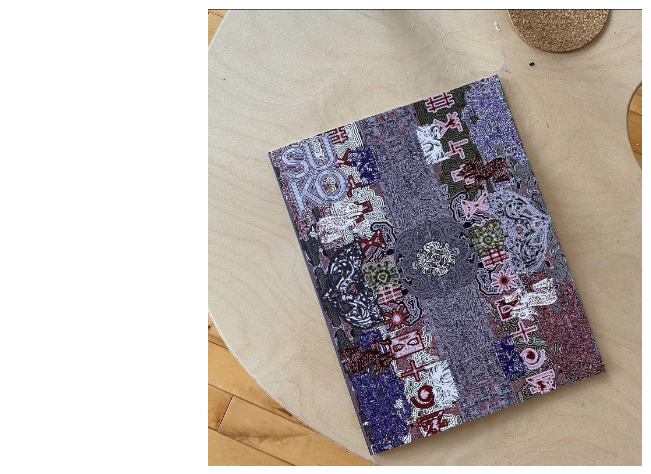
Ornate lines intersect and intertwine in an eye-catching design, etched in a variety of burgundy, gray, green, and purple hues. Designed by visual artist William Mora, this intricate image, pulling inspiration from the artist’s Colombian roots, serves as a gateway to SUKO Magazine’s glossy 100-page spread featuring interviews with and creations from 10 diverse artists.   

An ambitious artistic endeavour, SUKO Magazine was conceived by Concordia students Sophie Dixon and Kioni Sasaki-Picou. The name comes from Sasaki-Picou’s middle name “Satsuko,” meaning “child,” and with the pair’s goal for the publication to be a non-judgemental space reflective of the curiosity and creativity of children, SUKO was the perfect fit.

Developed from passionate conversations between the two friends, SUKO Magazine seeks to provide a safe and uplifting platform for artists. In particular, Dixon and Sasaki-Picou want to highlight work from Black artists, Indigenous artists, queer and trans artists, and other marginalized individuals that are often misrepresented, underrepresented, or outright excluded from traditional artistic institutions. 

“We didn’t really see a space where people felt like they weren’t being pigeonholed in an institutional sense,” Dixon explained in an interview with The McGill Tribune. “A lot of artists we know have had experiences where gallerists or different people of authority don’t allow freedom of expression in their artwork.” 

SUKO offers artists an avenue for sharing innovative pieces and grants them creative control—which they may lack in a gallery space—without sacrificing formal aesthetics. Dixon and Sasaki-Picou collaborated with a hardworking team of editors and designers to create a finished project that marries soulful, artistic content with a sleek design that could be sold in galleries or boutiques to provide featured artists with professional exposure.

“[We are aiming for] grassroots combined with the more corporate [aspect] to be able to have the best of both worlds [….] Many grassroots [projects] never get the attention, and many corporate [projects] get all the attention but lack a lot of the soul and passion that goes into it,” Sasaki-Picou said.

The pair aims to foster a sense of artistic community through SUKO’s collaborative creation process. Starting in fall 2021, they gathered a group of creatives whose artistic processes aligned with the publication’s values, hosting interviews and photoshoots with the artists throughout the year. The team gave artists ample time and space to consider which pieces they wanted to present and how to display them in the publication, allowing them to come to a conclusion on their own terms. The first edition was released in October 2022, two years after Dixon and Sasaki-Picou had the idea; however, by taking their time with the creation process, they hoped to push back against the pressures of “hustle culture” and notions of the artist as a solo creator. 

“Growing up in Toronto there is such a saturated community of artists who do so many things [….] You have this pressure to have hustle culture and be doing everything yourself,” Sasaki-Picou said. “I think [SUKO] definitely was the opportunity for us to give space to other people.”

The magazine’s second issue is slated for release in August 2023, though both Dixon and Sasaki-Picou hope to turn SUKO into a bi-annual publication. Other aspirations include featuring a greater number of artists, opening artist submissions to those from outside of Montreal and potentially even outside of Canada, and producing a theme-based issue. 

While anticipation for what’s to come is high, the SUKO team wants to give themselves time to curate and publish the next iteration. The team consists of students and artists who impressively juggle their studies with work and their own artistic endeavours. The process of collecting submissions, interviewing artists, formatting the magazine, and publishing is a time-intensive labour of love. 

It’s all worth it in the end, though, as Dixon points out.

“A lot of artists we have worked with […] have told us they’re happy to be a part of the project [which] is so uplifting to hear and also to inspire other people to do their own creative projects.”

Artists wishing to work with SUKO can contact them via email at [email protected] . Artists who identify as people of colour, Black, Indigenous, or belonging to other marginalized communities will be prioritized in the application process. Volume 1 of SUKO is currently available for purchase.

From the BrainSTEM, Science & Technology

WebMD is not all it’s cracked up to be

Pandemic-era health care has forced self-diagnosis into almost every aspect of life; figuring out whether your runny nose is a sign of seasonal allergies or COVID-19 often spells the difference between a fun night out or a dreaded two weeks of isolation. Even before the pandemic took over our lives, websites that allowed individuals to search up symptoms and determine possible causes were raking in hundreds of millions of dollars from the hordes who frequented their pages. This begs the question: Why do so many people use online sources for diagnoses rather than set up an appointment with a doctor?  

The most famous of these symptom checkers, WebMD, was visited 174.5 million times in September 2022 alone. This self-described source of credible and in-depth medical news” allows users to input their age and symptoms, then rapidly spits out a diagnosis. Users spend an average of six minutes on the website per visit. As this is a much speedier timeline than that of traditional medical appointments, WebMD has become a tempting alternative. 

Unfortunately, this quick fix is far from infallible. Although it can at times provide valuable information, a query on WebMD can also lead users down a rabbit hole, dramatizing the apparent diagnosis and causing more concern than is warranted. WebMD also runs advertisements and sponsored content for hospitals, health services, and pharmaceutical companies; in other words, the website you use to determine what horrible disease you have is bankrolled by the same entities that make money treating these diseases. 

Dr. Anne Andermann, a family doctor and public health physician in the Department of Family Medicine at McGill, explained in an email to The McGill Tribune that there is another reason to be skeptical of what we read on WebMD and sites like it.

 “The public should be wary of health information they find on the internet since there is a tremendous variability in the reliability of content available online,” Andermann wrote.

As an independent for-profit company, WebMD is not held to the same level of accountability or credibility as other health sites such as Mayo Clinic—a website run by the Massachusetts medical institute of the same name—whose articles are reviewed by three health professionals before publication. 

All this is not to say that WebMD doesn’t have its uses. Many of the published articles on the site are well-researched and informative, providing individuals with information to help them make more informed health care decisions. Where problems arise, though, is when patients decide to pursue treatment or home-made remedies based solely on harried web searches, rather than using these resources in combination with other, more reliable ones.  

“Even when using reputable sources of medical information, this cannot replace a relationship of trust with a family doctor who understands both your medical history and the broader health system context,” Andermann wrote. “The upheaval caused by the pandemic has led to an increase in unmet health needs, both in terms of physical health and mental health, particularly for young people, therefore access to a family doctor or student health service is extremely important to address any health concerns in a timely way, and avoid potentially being misled by information found online.”

At McGill, however, it isn’t just about how accessible internet diagnoses are, but rather  how difficult it can be to schedule a doctor’s appointment. For international students, especially, the process can be incredibly involved. There are several important considerations for students, such as who provides coverage, what is covered, and how to access their insurance. Even if students are comfortable with the insurance system, the wait times at McGill clinics vary wildly.

“I can understand why one would want to consult online resources,” said Angelina Low, a second-year student in Medicine at McGill, in a written statement to the Tribune. “When I was in pain with a stomach ache and I saw on WebMD that it could be an incurable chronic condition that requires surgery, I was scared. My mind went to the worst-case scenario. It turned out to just be a stomach ache [….] I understand the temptation to turn to online resources, but if you are in pain, please seek a medical professional.”

Sports, Varsity Round UP

Varsity round-up: What you missed in McGill sports from Nov. 4-6

Rebirds Lacrosse

Final: W (v. Queen’s) 13-9, L (v. Western) 12-5 

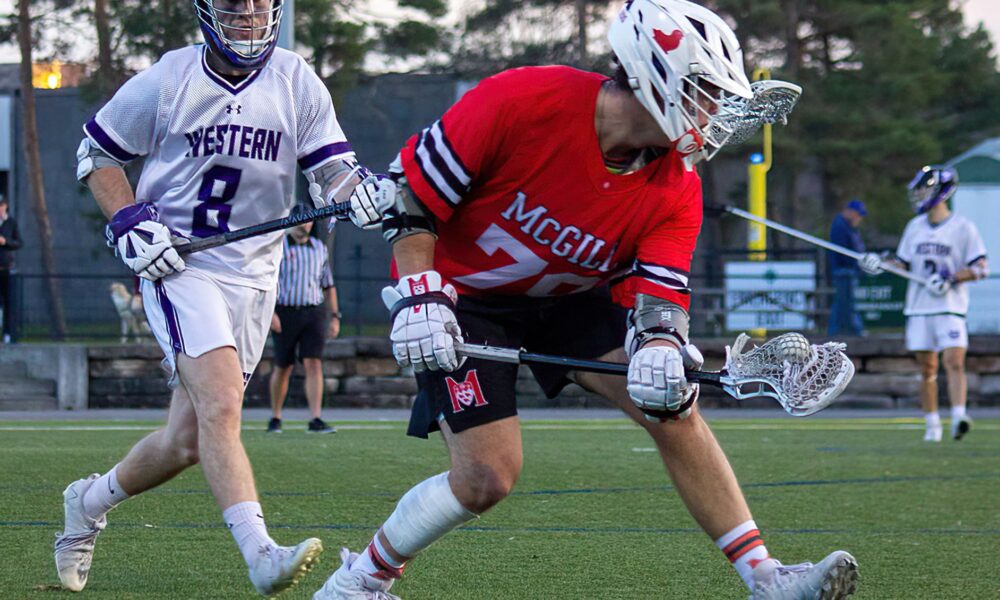
In a stunning comeback victory over the Queen’s Gaels (7–4) on Oct. 28, attacker Cameron McGinnis scored eight goals, setting a new single-game record for McGill. After a week basking in the glory of the win, the Redbirds (8–5) headed off to Peterborough for the CUFLA Baggataway Cup championship tournament. McGill faced off against the Western Mustangs (10–2) in the quarter-finals on Friday night. After a back-and-forth first half, the two teams were in lockstep, exiting the first quarter 3-3 and entering half-time 5-5. Less than two minutes into the third, McGill attacker Isaiah Cree potted his fourth goal of the night, giving the Redbirds a lead they would hold onto until the final whistle. Cree again padded the lead less than one minute into the fourth quarter with his fifth goal of the night. The Redbirds rounded out the evening with two goals from McGinnis and two from midfielder Rowan Birrell to secure a 13-9 victory. 

In Saturday’s semi-finals, the Redbirds met the first-seeded Trent Excalibur (9–1). After going down 3-0 early in the first quarter, Cree and midfielder Daniel Chand both found the back of the net, entering the second quarter with the game still in reach at 3-2. With McGill’s lead goal scorer McGinnis sidelined with an injury, Trent’s offence overpowered the Redbirds and scored five unanswered goals in the second quarter. Down 8-2 entering halftime, the Redbirds were able to round up some offensive action with goals from Birrel, Cree, and midfielder Luke Dawick, but were unable to answer the call. With a 12-5 final, the Redbirds’ lacrosse season came to a close, but Cree is optimistic about the team going forward. 

“It’s going to hurt losing the other veterans going into next season, but I feel like we will be just fine with the core we have moving forward,” Cree told The McGill Tribune. “The young guys are only going to get better, and some took a big step forward in our loss against Trent on Saturday. It will drive us to become better for next season.”

Martlets Volleyball

Final : L (v UQAM) 3-1 (25-21, 25-27, 15-25, 21-25), W (v. UQTR) 3-0 (25-16, 25-10, 25-20)

After a disappointing loss to the fifth-seeded UQÀM on Nov. 4, the Martlets (3–2) looked to bounce back at home against the UQTR Patriotes (0–6) on Nov. 6.

The Patriotes jumped to an early lead in the first set, only to be met with harsh opposition from the Martlets. A phenomenal defensive setup led by outside hitter Rachel Leduc and middle blocker Charlene Robitaille walled off the Martlets’ side of the court from any errant spiking efforts from UQTR. Robitaille put on a masterclass of vision as she reached into her bag of tricks to spike, feint, and dump the ball all over the Patriotes’ defence. The Martlets took the first set 25-16.

The second set began much the same way with a similar defensive stand from the Martlets, but power hitters Victoria Iannotti and Brook Brown each chipped in with authority. They handled their opposing blockers with grace, bullying their way to a 25-10 set as setter Audrey Trottier orchestrated pinpoint play from her hitters.

“We had a good game plan, to be really aggressive […] and very quick on offence, and we stuck to that and were able to split the block well enough that we were able to make good opportunities for ourselves,” Brown told the Tribune.

With a tight 20-19 score in the third set, Martlets’ co-captain Iannotti hammered home a timely spike to set the Martlets up for a run to the finish line. A phenomenal solo block from middle blocker Meaghan Smith cut any Patriotes efforts short as she ended the final set at 25-20 for the Martlets.

“[Our mindset] is to play together […] really to stay calm, trust each other, and to celebrate every point,” co-captain Robitaille told the Tribune. “We were playing really sharp today.” The Martlets play next on Nov. 13 at home in a game against the Université Laval Rouge et Or. 

Science & Technology, Student Research

Let’s talk about poop: McGill student won’t let Crohn’s disease stop her from becoming a doctor

Poop. There’s no shame in talking about it. We all need “to go” in one form or another and it’s completely normal. However, bathroom breaks affect some people’s lives more than others. Taylor Morganstein, a first-year medical student at McGill, wants to talk about poop more openly to start the conversation about Crohn’s disease

Crohn’s disease is a type of inflammatory bowel disease (IBD) that presents itself as swelling of the gastrointestinal (GI) tract. It is a chronic illness where the body attacks the inner lining of its own GI tract. Crohn’s can cause extreme abdominal pain, diarrhea, fatigue, and malnutrition. Approximately 300,000 Canadians live with Crohn’s disease and, yet, it is rarely spoken about in mainstream media.   

Morganstein was in her last year of her BSc in Pharmacology at McGill when she was diagnosed with Crohn’s. She had experienced some symptoms for a while but had not paid much attention to them until Dr. Edward Wild, a professor in the Faculty of Medicine and a practicing clinical gastroenterologist at the McGill University Health Centre, brought up Crohn’s disease during an EXMD 509 lecture. As he went through a list of symptoms associated with Crohn’s, a light went off in Taylor’s head. After class, she contacted her family doctor who then ran some tests that pointed to Crohn’s. 

Morganstein always wanted to pursue medicine, but Crohn’s has had a huge impact on her journey to becoming a doctor. According to Morganstein, being a patient in the hospital was a “really tough experience” that “made [her] never want to be in the hospital again.” 

“My personal experience showed me how important diagnosis is,” Morganstein said in an interview with The McGill Tribune. “It made me motivated to learn how to be a good doctor.”

Due to Crohn’s symptoms, Morganstein fell behind in her nursing studies—she would later transfer into McGill’s medical school. During more manageable flare-ups, Morganstein would participate in class virtually, but circumstances changed during the Winter 2022 semester.

Severe complications forced Morganstein to undergo surgery for a bowel obstruction, which are fairly common in patients with Crohn’s disease: Their GI tract can swell up and form scar tissue which narrows the tract. This can sometimes cause blockages requiring surgery to remove the obstruction. 

Morganstein had an added stress while preparing for her surgery: She was in the process of applying for medical school. Her surgeon scheduled the surgery around her medical school interview, and while in recovery, she found out that she got in. Getting into medical school is one thing, but being able to work long hours is another.

“When you have Crohn’s, you may not be able to stand in one place for a while so having, like, a cashier job is hard,” Morganstein said. 

She isn’t alone. Many people with Crohn’s worry about their employment. To help alleviate some of the financial concerns for students with Crohn’s, Crohn’s and Colitis Canada, a registered charity dedicated to supporting those impacted by Crohn’s and colitis, partnered with AbbVie, a pharmaceutical company, to give out 15 grants to Canadian students impacted by IBD in 2022. Morganstein received one of the 15 grants. 

“[The grants] are a yearly reminder that there are 15 students [with Crohn’s] that put in so much work and get into amazing programs,” Morganstein said. “The grant gave me peace of mind.” 

Morganstein works closely with Crohn’s and Colitis Canada and will often attend events to speak about her experience. She explained that her work with the organization has helped her connect with others diagnosed with the disease and feel supported by the Crohn’s community.

Crohn’s is an invisible disease and yet inflicts so much suffering. Morganstein insists that people should “be kind to others even if it’s not visible.” She also believes that Crohn’s shouldn’t stop anyone from pursuing their passions. In the future, she plans on specializing in pediatric gastroenterology to help kids living with inflammatory bowel diseases. 

Read the latest issue

Read the latest issue