
Latest News

McGill, Montreal, News

McGill administration, student groups hold vigil marking the fifth year since Quebec City mosque shooting

The Institute of Islamic Studies, the Muslim Students Association (MSA), and McGill’s Associate Provost (Equity & Academic Policies) Angela Campbell held a remote vigil on Jan. 28 to commemorate the six lives lost in the 2017 Quebec City mosque shooting. This year marks McGill’s first commemoration of the tragedy since the federal government declared in 2021 that Jan. 29 would officially become a national day of remembrance for the victims.

Ehab Lotayef, a founding member of Muslim Awareness Week (MAW), introduced the speakers at the vigil. This year, MAW had events in Montreal as well as Gatineau, Sherbrooke, and Quebec City. Lotayef hopes that running an informative and open MAW will help reduce the rise of Islamophobia.

​​”The goal of [MAW] is really to take the issue of ignorance and fear that led to what happened in Quebec City, to deal with it in a core way, and that core way in our belief is to have people […] know [more] about the Muslim community,” Lotayef said.

McGill’s Principal and Vice-Chancellor Suzanne Fortier began the vigil by recognizing the importance of honouring those lost and acknowledging the necessity of fighting discrimination in the McGill community.

“This tragic anniversary also reminds us of the need to reaffirm in our own community at McGill our ongoing commitment to the values of mutual respect and inclusion, and ensure that we all live up to these values,” Fortier said.

Also present at the commemmoration was Alia Hassan-Cournol, the first Arab woman with a Muslim and Christian background to sit on the Council of Montreal. Hassan-Cournol urged McGill students to get directly involved in activism resisting Islamophobia. 

“I want you guys to remember to continue on acting, to continue on being involved in politics, in your communities, in your associations, because that’s exactly what we need right now,” Hassan-Cournol said.

McGill students then took turns reading the names and honouring the lives of the victims of the shooting: Ibrahima Barry, 39, Mamadou Tanou Barry, 42, Khaled Belkacemi, 60, Aboubaker Thabti, 44, Abdelkrim Hassane, 41, and Azzedine Soufiane, 57.

Michelle Hartman, director of the McGill Institute of Islamic Studies, described the institute as a space for Muslims and non-Muslims alike to share in the research, teaching, learning, and sharing of Islam in Quebec and internationally.

“The impact of the tragedy, we have to remember, is felt not just on January 29, once a year, but all year round,” Hartman said. “The Institute of Islamic Studies continues our steadfast rejection of all forms of racism and Islamophobia and our commitment to fighting them in our local communities and beyond.”

In order to further the vigil’s discussion of Islamophobia, Sarah Abou-Bakr, this year’s recipient of the Centre culturel islamique de Québec (CCIQ) Memorial Award, spoke of her experience in combating discrimination. During the vigil, she recalled the moment she arrived at the CCIQ during an annual visit and saw a man teaching kids the Quran.

“One of the board members told me that this man [who was teaching] was shot in the stomach during the [Quebec City mosque] attack, but he made it,” Abou-Bakr said. “I think that this is a reminder that regardless of hate, we’re still here and we will be here spreading love and kindness no matter what. We will get back on our feet every single time.”

If you or someone you know if experiencing Islamophobia, support can be found at Association des musulmans et des arabes pour la laïcité au Québec (AMAL Quebec), Paroles de femmes, Justice Femme, and Lavoiedesfemmes, and the Islamophobia Legal Assistance Hotline at 604-343-3828.

In a previous version of this article stated that Sarah Abou-Bakr spoke to the Tribune in an interview. In fact, Abou-Bakr was not interviewed, her quote came from the speech she made at the vigil. The Tribune regrets this error.
McGill, News

#McGillOnStrike gains momentum as Law Students Association votes to strike

The Social Work Student Association (SWSA) passed a motion to strike on Jan. 17 after McGill denied the faculty’s decision to continue online learning until Feb. 25. Since then, many other faculty student associations have followed suit, joining forces under the hashtag #McGillOnStrike to protest the timing of McGill’s reopening amid COVID-19 and the lack of accommodations offered to immunocompromised community members. 

On Jan. 25, the Education Graduate Student’s Society (EGSS) successfully passed a motion to extend their strike until Feb. 25 at a General Assembly (GA), with 71 in favour, 13 against, and 16 abstaining. Students taking part in the strike will attend all remote activities, but will withhold in-person participation until the administration complies with their demands. 

Though the initial resolution called for exclusively online classes, the motion was amended to demand a hybrid approach instead, which would give students the choice of attending classes virtually without penalty. Striking students also insist in the resolution that McGill provide safer learning conditions, such as supplying N95 masks and high efficiency particulate air (HEPA) filtration. Additionally, EGSS members ask that instructors be given the option to teach online, independent of what the university had decided.

Emma McKay, a PhD candidate in education and one of the EGSS strike organizers, expressed skepticism over the administration’s handling of the Omicron variant, calling into question its decision to reopen. McKay explained that students pursuing a Master of Arts in Teaching and Learning (MATL)—the largest program in the Faculty of Education—are currently doing internships across Montreal that require them to come into close contact with students lacking sufficient personal protective equipment (PPE).

“Classes in that program […] are continuing online in accordance with the 20 per cent allotment of online classes and with instructors who heard about the strike,” McKay said in an interview with The McGill Tribune. “But, if those classes were to follow McGill’s instructions, McGill would be doing something really dangerous and frankly immoral [by putting] many people in danger of contracting a harmful and possibly deadly virus.”

Bryan Buraga, U4 Arts & Science and 2019-2020 president of Students’ Society of McGill University (SSMU), has called on the Faculty of Arts to implement a hybrid learning system similar to that of the Winter 2021 semester. The Arts Undergraduate Society (AUS) granted Buraga’s request to call a GA after he obtained the 200 signatures required to call an assembly. The meeting is scheduled for Feb. 2 where, if it reaches its 500 person strike quorum, attendees will vote on the motion to strike. 

Buraga expressed frustration with McGill’s continuous stifling of community efforts, such as their shutdown of the law students’ contact-tracing initiative or the School of Social Work’s decision to remain online. 

“[T]he top-down approach that the admin has been leaning on has shown it’s not working. It shows a lack of trust in community members […] but it also ignores the expertise in this university,” Buraga said in an interview with the Tribune. “If we don’t rely on our community members, who the admin continues to use whenever they put out their press releases about how prestigious McGill is, then what are we? I think with the actions that we’re taking in the next few days, it’s really going to start a discussion about who this university is really for.”

On Jan. 28, the Law Students Association (LSA) convened for a GA, after which a ballot was emailed to students to vote on whether to strike at the Faculty of Law. The motion passed with 56.6 per cent in favour of a strike, though instead of a general strike where students refuse to attend both online and in-person classes, LSA is on a targeted strike where students refrain only from attending in-person activities. 

Christopher Ciafro, 3L, who has been independently campaigning for a general strike at the Faculty of Law, shared Buraga’s comments about McGill’s lack of consultation with the student body.  

“We are seen more as consumers and not as contributing members to a greater university society,” Ciafro said. “You see that in the language, I think, from some of the administration who are denouncing strike actions, saying it’s a boycott. Well, if it is a boycott, what does that mean of how you see us? It’s a strike because there’s labour that goes into being a student. We’re contributing to the academic success of the university.”

McGill, News

Professor Debra Thompson on the ‘absented presence’ of Black communities in Canada

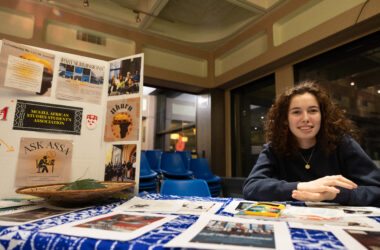
The African Studies Students’ Association of McGill (ASSA) hosted a talk by professor Debra Thompson on Jan. 27 titled “The Great White North: Blackness in Canada.” An associate professor in the political science department and Canada Research Chair in Racial Inequality in Democratic Societies at McGill, Thompson spoke about the under-valued and often obscured history and contemporary politics of being Black in Canada—ideas also expanded on in her forthcoming Sept. 2022 book, The Long Road Home.

Thompson began her talk by providing historical context on the oft-forced Black migration to Canada, surfacing the names of some of the first Black people who were enslaved in the country. Olivier Le Jeune was the first person to be bought and sold in Canada in 1629. He was between six and nine years old.

Thompson explained that in examining Black experiences, it can be harmful and misleading to compare the histories of slavery and racism in the U.S. and Canada, as people tend to falsely perceive Canada’s history as less violent or significant.

“A lot of Canadians don’t know, or don’t like to admit, that slavery existed here and my sense is that it’s because, or at least partially because, of a spectre of American slavery,” Thompson said. “On the eve of the Civil War […], there were more Black folks enslaved in the U.S. than the population of Canada at the time.”

Thompson explained how, despite the diversity of Canada’s Black communities, the flourishing tradition of Black Canadian scholarship can act as a unifying force in the fight against white supremacy. Canadian scholars use the oxymoronic term “absented presence” to describe how Canadian culture simultaneously attempts to erase Black Canada while relying on it to prove Canada’s supposed multiculturalism.

“There are active agents and there are active discourses […] which work together to give the impression that there are no Black people in Canada, that Blackness is recent, that we don’t really belong,” Thompson said. “We are interlopers on this great Canadian experiment, in the ‘Great White North.’ The ‘presence’ part of ‘absented presence’ […] talks about the ways that so many narratives of Canadian identity depend on our existence, even as they erase us.” 

In the context of Quebec, Thompson noted the rampant appropriation of Black activist rhetoric in nationalist Francophone discourse. She pointed to Pierre Vallières’ infamous 1968 analysis of the Quebecois as the “white N-words” of America.

“White Francophones have often used the language of Black freedom struggles to describe their own conflict with Anglophone Canada and it is so problematic,” Thompson said. “There are literally Black people in Canada, in Montreal, fighting […] rampant anti-Black racism […] without any kind of platform to counter the appropriation of this language, this anti-colonial, Black, freedom struggle language that white Francophones have essentially stolen and used as their own.”

ASSA co-president Leïla Ahouman, BA ‘21, and vice-president Academic Laïka Decelles, U3 Arts, spoke to The McGill Tribune after the event, explaining that the ASSA works to emphasize and spotlight Black academia. The pair highlighted Uhuru—the McGill Journal of African Studies—and discussed the importance of Black student-faculty relationships.

“It’s the connection between professors and students that’s missing,” Ahouman said. “And being of African descent [or] from the diaspora, what’s difficult is we rarely, if ever, have the chance to learn from our own. This is very sad because we are often faced with perspectives of our own lives, of our own peoples, from people outside of our cultures, and things being said are not always respectful.”

Decelles added that she believes the ASSA plays a vital role beyond the McGill community as well, acknowledging that universities tend to discount and overlook Black scholarship.

“One important point to highlight is to have Black bodies and academia together,” Decelles said. “There’s this long history of being secluded and marginalized and put aside. I think that the ASSA is just great for its members that it’s representing, but also […] it offers a platform in Montreal for others to be able to see Black scholars share their thoughts.”

Science & Technology

Millipedes: A fascinating gateway into the world of entomology

It’s safe to say that most people are familiar with the creepy-crawly known as the millipede; from scuttling out of the dirt in your garden to gnawing on leaves in your attic, millipedes are a common sighting. 

Many creatures, from spiders to snakes—and even some species of butterfly—evoke fear due to their numerous defence mechanisms, such as poison, claws, or fangs. Though these features are often perceived as a threat, they are rarely targeted at humans; they are typically used by animals to defend themselves or attack their prey.

Though millipedes are feared by many, like most other arthropod species, they are little more than many-legged composters. Millipedes are actually arthropods—invertebrates with jointed legs—not insects. Why, then, do we fear millipedes? And more broadly, why do we fear insects in general when most pose no danger? 

Morgan Jackson is a postgraduate entomologist working in the field of taxonomy at McGill’s Macdonald Campus. Jackson says that most people don’t fear bacteria in the same way they do insects or arthropods, despite bacteria being arguably more dangerous. Insects and species that resemble them are a visible unknown in our own space, and they present themselves as a surprise.

The way that [their presence] is violating our space, the way that [it] is violating our bodies, [is] in a way that very few other instances of wildlife do,” Jackson said in an interview with The McGill Tribune. 

Millipedes provide us with a fascinating look into the world of entomology—the study of insects—and are a prime example of the potential that arthropods have to captivate curious individuals. Even though they may not technically be insects, their study is often lumped in with entomology.

“All the terrestrial arthropods people stick together,” Jackson said. “Even the arachnologists go to the entomology conferences.” 

Millipedes belong to the class Diplopoda and are more closely related to crabs and shrimp than to insects. They vary from their close relatives, the centipedes, because their legs usually attach to their undersides, whereas centipedes’ legs splay out from their sides. They also differ in that they have two sets of legs per body segment, whereas centipedes only have one. 

The many-legged critters are generally harmless: They do not have pincers or stingers, and they pose no threat to building integrity. Given that they rely on plant matter as their main source of nutrients, millipedes did not evolve any adaptations for hunting prey. Rather, they have a number of defence mechanisms to keep predators from eating them. Some species roll into tight coils to better defend themselves with their hard exoskeletons, while other species have pointy protrusions that would make them quite an unpleasant meal—and then there are millipedes that secrete the poisonous gas hydrogen cyanide.

The word millipede means “thousand feet”—however, no previously known millipede species was found to have that many. The previous record holder had fewer than 800. Recently, Bruno Buzatto, an entomologist and arachnologist at Macquarie University, discovered a new millipede that had 1,306 legs—the first to exceed the thousand-leg mark. Found in Australia, this new species of millipede, named E. Persephone, lives tens to hundreds of meters underground.

With this single discovery, two assumptions were challenged: One, that most millipedes live in moist environments, and two, that no millipede species has over 1000 legs. 

Even though it may not seem groundbreaking, there is a certain satisfaction to making discoveries and learning what was before unknown, or thought to be impossible—a satisfaction that can’t be shared with those who let their fear conquer their curiosity. 

As Jackson puts it, “Just the fact that it is so long, and actually hits that thousand-foot name mark again—it’s just all cool, it’s just really, really neat.”

Science & Technology

The glowing DNA that can act as protein motion sensors

In the methodical world of scientific research, there is irony to be found in serendipitous stories of discovery. More often than expected, a scientist’s day in the lab is filled with more head-scratching than “eureka” moments. It is in these moments that a curious scientist would dig deeper, even in the negative data. Alexis Vallée-Bélisle, an associate chemistry professor at Université de Montréal, did just that, eventually coming to invent a fluorescent DNA nano-antenna that glows to indicate a change in the structure of proteins.   

The story begins in 2016, when Valleé-Bélisle developed the world’s smallest thermometer. This technology acts as a flambeau torch, where the stick is DNA and the flame is a dye attached to it, glowing bright when the temperature around proteins changes. 

However, Vallée-Bélisle told the The McGill Tribune that the team soon realized that the dye was not glowing due to the change in temperature, but due to a change in protein structure. This occurs when the protein performs its function or interacts with other molecules in the cell. The dye is sensitive to the environment around it and thus detects the nanoscale twists in the protein structures.

 “It was unexpected,” Vallée-Bélisle said. “But we knew we were on[to] something big.”  

“Structure equals function” is a well-known axiom in biochemistry. The proteins in the nails and skin and the proteins in our gut and brain are both made from amino acids, but they work differently because they fold into a variety of 3D structures

Once the structure of proteins is known, it is easy to predict their function. This knowledge, combined with synthetic biology, can be used to develop drugs that bind specific pockets of the 3D structure to inactivate the viral proteins, in order to fix the misfolded proteins observed in diseases, or to design novel proteins

Although the field of structural biology took a huge leap forward in 2020 with DeepMind’s AlphaFold2 algorithm—which could computationally predict the 3D structure of proteins from their amino acid composition—research still depends heavily on experimental studies. X-ray crystallography and Cryo-EM are the current gold-standard methods of determining protein structures. But these experiments are complex enough to consume one’s entire PhD, and require expertise in structural biology, limiting their broader use.  

“People are struggling to have a simple assay [method] to monitor their favourite protein’s activity,” Vallée-Bélisle said. “We need[ed] to come up with an antenna that probes small changes in the conformation of protein.”  

To determine the structural changes of these biological nanomachines, Vallée-Bélisle turned to his favourite molecule—DNA—for nano solutions.  

“DNA’s language is simple, its chemistry is much simpler and programmable,” Vallée-Bélisle said. “We have a DNA synthesizer and we can have a [DNA] antenna by the end of the day.”    

Researchers repurposed their serendipitous discovery of the DNA antenna to detect the changes in the structure of proteins occurring at the time scales of micro to milliseconds. One of the most important parts of this antenna is the glowing dye attached to the DNA. Since different dyes interact differently depending on a given protein structure, the researchers were able to detect five different types of structural changes in a single protein within months of using the same DNA antenna.  

Vallée-Bélisle plans to scale up this technology from detecting one protein structure at a time to detecting 96 possible structures of proteins with different antennas at the same time, all combined on a single palm-sized plate. 

“The goal of any scientist is to have your technology out there,” Vallée-Bélisle said. “If we could build those 96 well plate readers then we probably can make [this technology] available to everybody.”


Discoveries like this one will enable scientists to put more time into thinking of solutions and less time mixing solutions in the lab.  

Album Reviews, Arts & Entertainment

Electro-pop meets celestial beings on Aurora’s new album ‘The Gods We Can Touch’

After her 2015 single Runaway went viral on TikTok in 2020, Norwegian artist Aurora has become one of the most streamed artists on Spotify, sitting comfortably in the top 1000. Her third studio album, The Gods We Can Touch, is her newest release. 

Just like her two previous albums, The God We Can Touch diverges from mainstream pop music with its innovative and cinematic qualities. The album is almost conceptual in the thematic unity between its tracks, with each song dedicated to humanizing a different god or spiritual deity, from Greek mythological characters to Christian figures. 

Aurora opens the album with “The Forbidden Fruits of Eden,” a short song that sounds like mantras layered over a catchy beat, setting the album’s overall mystical ambiance. The second track, “Everything Matters,” continues in a similar tone, as Aurora’s reverbed high-pitched voice harmonizes with gentle piano and electronic beats. The song also features Montreal-based singer Pomme, whose French verses complement the song’s celestial tone.  

In the album, Aurora boldly navigates her way through an extensive sonic palette, combining her on-brand Nordic electro-pop sound with soft folkloric elements. While “Cure for Me” and “A Temporary High” have an energetic quality that makes the listener long for the reopening of clubs, “Heathers” and “Artemis”  are more enigmatic and folkish, with ethereal harmonies and delicate synths. Although the drastic variation of genres throughout the album may seem incongruous, the songs are carefully arranged so that even the most intense songs blend into slower ballads. Creating an album with such radically different sonic elements was certainly risky, but The Gods We Can Touch overcomes the challenge, proving that Aurora has the talent to conquer the pop scene.

Campus Spotlight, Student Life

A peace of home

For most McGill students who hail from outside Montreal, starting university means leaving the place that we have come to call home. When packing for college, we carefully select items that remind us of home and that we can turn to whenever we feel homesick. Arriving in a new city amidst a sea of strangers can make you feel overwhelmed and alienated, but having these items can bring us feelings of peace and comforting memories.

Yet, what is home? Is it a place, a person, a scent, a feeling? Everyone has a different meaning of home; it is usually not tied to a single place or experience, but rather a collection of memories linked to different places and people. 

Tracy Berbari (U1 Management):  Lebanon  

Laughter, family, calm, excitement, peace, fresh air, and love are all things that Berbari associates with the word “home.” 

Lebanon had always previously brought her these feelings. Its breathtaking views and nature brought her peace amidst the country’s hectic financial crisis. Because of the October Revolution, she and her family were forced to pack up the essentials and leave at the end of 2020. Though she does not have a specific item that reminds her of home, there is a place in Montreal that transports her back to Lebanon. 


“On a summer day, a kind man, who was my first friend in Canada, suggested that we take a tour of Montreal,” Berbari said. “Our first stop was the Bèlvédere d’Outremont. After a long walk up the hill, we finally arrived at the top, and when I saw the view I was mesmerized. We were surrounded by all the lovely elements that mother nature had to offer: the birds were chirping, the flowers were blooming, and at that moment in time, I reminisced [about] all of my childhood memories in Lebanon. Suddenly, the move to Canada wasn’t so scary, it felt like home, my home.”

The McGill Tribune / Tracy Berbari

Charlotte Mineret (U1 Arts): Belgium

Having moved multiple times during her time in Belgium, and now recently to Montreal, Mineret understands that a place isn’t the most important thing when it comes to feeling at home, but rather the connections formed with the people around her. 

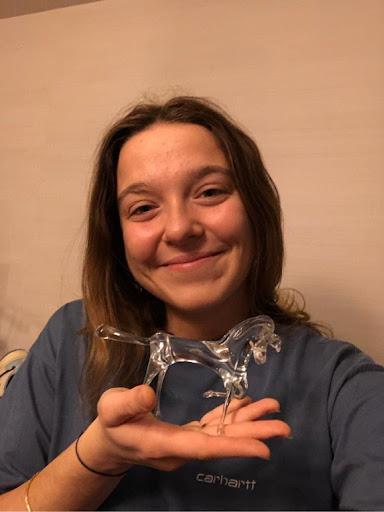
While she has brought numerous objects from home—including delectable Belgian cheese—the one item Mineret could not have left behind is her horse-shaped glass statue, gifted by her grandparents. Every time she looks at it, she is reminded of her childhood and of her time in Brussels with her family. 

“We went to this place where they made these glass statues and I saw them make it from scratch,” Mineret said. “It has always been on my desk in Brussels and it’s on my desk here in Montreal. It makes my dorm feel more personal and like a home.”

The McGill Tribune / Charlotte Mineret

Manon Fillon Ashida (U1 Arts): Tokyo/Belgium

Before coming to Montreal, Manon used to think that home was associated with one’s citizenship. Being both French and Japanese, she previously never considered Belgium as her home. However, moving to Montreal made her realize that Belgium is where she has created some of her most cherished memories.

While she did not bring many items back from home—besides tons of clothes—she did bring the picture that her best friend gave her for her fifth birthday. 

“I had just moved from Tokyo to Belgium and she was both my neighbour and my first friend,” Ashida said. “She gave me this picture for my fifth birthday and I have always had it on my desk. It’s an item of great significance to me because I have known and spent so much time with her. It reminds [me of] my time in Belgium and reminds me of home.” 

The McGill Tribune / Manon Fillon Ashida
Student Life, Word on the Y

Word on the Y: First-years’ experiences on campus

Isabella González, Staff Writer

Coming from an international school where I knew everybody, I was overwhelmed when I stepped into overcrowded lecture halls with 100 different students during my first week of in-person class. As I walked into a bustling lecture hall lit up by blinding lights, I decided to take a seat next to a stranger. The anxieties teeming in my head discouraged me from saying hello, but I pushed those feelings aside and started a conversation. After all, I’m a stranger to them too; we both have the same irrational fear of being the first one to break the dense silence between us. While 100 students in one lecture hall can seem like 100 individual things to worry about, those are also 100 exciting opportunities for meaningful conversations, valuable friendships, careless laughter, brunch outings, and late-night study dates at the library. I’ve decided to embrace these opportunities in my first year, and live boldly outside of my comfort zone. While I won’t get to know everyone in my overcrowded lectures, as long as I make one or two friends with whom I can pick up a warm and comforting chai latte after class, I’m set.

Abby McCormick, Staff Writer

As I take a seat in my first in-person class of my second semester at McGill, the aura around me is one of comfortable silence. While I initially thought that being in a sea of people once again would fill my stomach with butterflies, instead, it reminds me that I’m not the only one struggling to find a sense of normalcy amid the chaos of the pandemic. I smile at the girl next to me through my black mask. She smiles back. It reminds me how much I missed the simple gestures of human contact during these weeks of isolation. With the return to the classroom, I am hopeful for more opportunities to connect with other students and make my first year one for the books. Even though I’ve missed out on many quintessential freshman year McGill experiences, like lectures in Leacock 132 and nights at Cafe Campus, I am confident that the uncertainty of the pandemic has made me more adaptable and will—hopefully—make my upper years at McGill feel all the more worthwhile. 

Rosie Kaissar, Contributor 

After a long break filled with isolation and quarantine, I couldn’t be happier to be back on the beautiful downtown campus with lots of commotion all around. While going back to McGill brings back the stress of finals week and 3 a.m. crying sessions in McLenny, the beautiful sight of white, powdery snow and feeling of the refreshing, though extremely cold, air have made it difficult to stay away from campus—even on the days when I don’t have any in person classes. I love how I can just go for a small walk and run into friends who I haven’t seen since early December. Even with the hybrid model of school this year, campus feels like a home, and I am excited to be back.

Sabrina Nelson, Contributor  

As I enter the room of my first in-person lecture, I feel out of place amid a sea of unfamiliar faces. After two years of seeing black squares on my laptop, I had forgotten what it felt like to be in a room filled with strangers. Yet, as I take my seat, the person next to me smiles and says hello. Suddenly the butterflies are gone, and I am at ease. I quickly realized how much I had missed the small pleasures of human contact—the exchange of glances, smiles, and laughter. I had forgotten the excitement that came with meeting someone in a classroom for the first time and sharing a meaningful conversation. I have missed out on so many high school and first-year experiences because of the pandemic, yet even if things will never go back to how they used to, I hope that the return to in-person will make up for everything that I have yet to experience—like Montreal’s nightlife and art scene—and that I will still get to have the college experience that I have dreamt of having. Looking forward, I will grasp every opportunity that to form valuable friendships and push myself out of my comfort zone to make unforgettable memories. I won’t take anything for granted, even the seemingly mundane things.

Student Life

Women in law panel highlights versatility and resiliency in law

McGill Women In Leadership (MWIL) and the McGill Pre-Law Students’ Society (MPLSS) joined forces on Jan. 26 to host a panel about women in law featuring prominent lawyers and legal scholars from across Canada. During the event, panellists discussed the proudest moments of their careers, the challenges of being a woman in law, and the advice they would offer to future lawyers in the audience. 

MWIL’s vice-president (VP) Events, Lis Riveros, U1 Arts, sat down with the Tribune to discuss the motivation behind this event and the importance of connecting future lawyers with other women in the field. 

“Between me and the VP Events for McGill Pre-Law, we agreed that in order for women to advocate for themselves and move their careers forward, they can’t succeed by doing it alone,” Riveros said. “The idea of being able to succeed in law and having the ability, competence, and eventual affluence of being a lawyer are usually tied to those who are not women.”

The panel featured a diverse range of women in law, including a business owner and practicing criminal defense lawyer, a corporate lawyer, an entertainment lawyer, and a legal scholar. Riveros explained that holding the panel remotely actually enhanced the event because it allowed for more diversity in the speakers they brought in. 

“If we did the law panel in person, we could only do Montreal lawyers,” Riveros said. “Zoom and online events give endless opportunities and creativity.”

Riveros highlighted that the goal of this year’s event was to emphasise versatility in law. When planning, it was important for MWIL and MPLSS to include women who were extending the boundaries of their law degree.

For instance, panellist Jordana Goldlist, criminal lawyer and owner of JHG Criminal Law, studied civil litigation before switching to criminal law and eventually starting her own company. 

“My biggest accomplishment is my business overall,” Goldlist said. “After five years [at a criminal law firm], I wanted to do things differently. I left on a leap of faith and started my own practice in 2015. I’ve grown a fantastic practice, a great reputation, and it’s nothing but hard work and dedication.” 

The speakers were also candid about the ugly side of law and the gender bias that follows many women in the legal field. 

Sarit Batner, a corporate lawyer at McCarthy Tétrault in Toronto highlighted how challenging it is for women in law to get their foot in the door. 

“The list of challenges that women have to face in law […] is great and long, and if you’re a racialized woman you can add layers to that. What I was most surprised by were lines of referral. You come into law expecting that there’s no gender difference. However, the client sources are still men, the networks are still men, and being excellent is super helpful, […] but [it’s] often not enough.”

Despite the obstacles they have had to overcome throughout their careers, the panel emphasized to the audience that there is great potential to make positive institutional change with a law degree. 

Professor Priya S. Gupta at the McGill Faculty of Law explained that the law gave her the knowledge and leverage to address the issues she is most passionate about. 

“One of the things I loved [about law school] was how it could teach you to engage in the world, through all these different fields and all these different modes. When you have the things you’re interested in […] the law gives you the profession that allows you to make those changes in the world.” 

Campus Spotlight, Student Life

From study mates to study dates

McGill is notorious for its work-hard mindset. If you walk into Redpath or McLennan on any given day, including the weekend, you’re bound to see students studying, catching up on work, or desperately completing assignments that are due at midnight.

Although many students flood the library to study in groups, there are many stragglers who make the trek to the library to cram all by themselves. For some, this might be by choice, but for others, the pandemic and COVID-19 restrictions have made it increasingly difficult to find study partners or connect with peers in Zoom classes.

Sanghoo Oh, U3 Arts & Science and creator of StudyDate, noticed the isolating effect the pandemic was having on students, whether that was struggling with coursework, job applications, or networking. Oh himself said he experienced difficulties networking in his field of interest, UX design. These factors inspired him to create StudyDate, a student networking website designed to help students find study dates or mates.

The platform has a dating app layout, where you can customize your profile to include what classes you’re taking, random facts about yourself, what skills you have and what skills you want to build upon. Depending on your wants, needs, and interests, the website will match you with someone compatible, and you can set up a study date from there.

Although students can connect on social media platforms such as Facebook and Instagram, or dating apps such as Tinder or Bumble, Oh feels that these platforms aren’t as conducive to fostering  healthy and productive relationships.

“I don’t think any of them really have a generally positive notion to them, nor do they really act to connect people, per se, physically,” Oh said in an interview with The McGill Tribune. “It’s more for entertainment browsing nowadays, and maybe very shallow digital connection.”

Oh also believes using studying as a channel to create friendships or even find romantic interests is a much more compelling idea for students and a more effective way of creating conversation. Many of his friends, for example, had awkward encounters when meeting people from dating apps, seeing as there’s not much common ground from which to spur conversation.

“Studying can solve that issue in a way,” Oh said. “If I’m meeting someone from my same class, for example, and I’m meeting them for a date, there’s already a great icebreaker of sorts.”

Many McGillians have already begun to enjoy StudyDate. Jennifer Shi, U1 Management, found out about the website on the Facebook page Spotted: McGill and immediately signed up, looking to find more people to build friendships given the uncertainty of the pandemic.

“I think [StudyDate] is fun cause it’s in the style of a dating app,” Shi said. “You get to see people’s profiles that you wouldn’t necessarily see just through their Facebook or Instagram profile or in a group chat because you can write things you want other people to know [about you].”

After the final testing period of the platform ends in May 2022, Oh is considering extending StudyDate to the public. But for Shi, its student-community focus has been extremely valuable. 

“When you sign up, you have to use your McGill email, and it makes sure it’s all university students, which I think is just safer and also something I’m more comfortable with,” Shi said.

As StudyDate’s popularity grows on campus, its creators hope that it will be able to bring together students on campus who would have never connected otherwise. 

“It’s something I never knew that I wanted or needed,” Shi said. “It’s literally the perfect platform where you can make friends during a pandemic and not be stressed out that it’s a dating app.”

Read the latest issue

Read the latest issue