

Latest News

McGill, News

Suzanne Fortier reflects on McGill’s future and lessons learned from COVID-19

As the Fall 2021 semester and McGill’s bicentennial year comes to a close, the McGill administration has started envisioning plans for the university’s academic, ecological, and structural future. From opening a new Office for Mediation and Reporting, to assessing McGill’s Strategic Equity, Diversity, and Inclusion Plan and the Anti-Black Racism Action Plan, to adapting to a world changed by COVID-19, the administration is beginning to implement several changes. 

McGill principal and vice-chancellor Suzanne Fortier reflected on these changes in a round table interview with campus media on Nov. 24. Fortier feels that updating plans and creating new offices are the first steps toward a more equitable and globally in-tuned university.

“Next calendar year, we are [entering] a third century of our institution, so it is a great time for us to think about the future,” Fortier said. “We celebrate with the full knowledge that not all of our 200 [years of] history were great [….] As we think about our third century, it is also [about] how do we learn from our past.”

Fortier listed reducing the university’s environmental impact and carbon footprint as a key objective in the coming decades, citing McGill’s commitments to reach net-zero by 2040,  switch energy systems from gas and oil to electric, and adopt a decarbonization policy.

“We have a huge problem right now, which is climate change and the planet,” Fortier said. “We need to evolve to be terra sapiens.”

The term “terra sapiens” refers to the evolution of human action toward a more environmentally aware collective consciousness. Some students, however, like Samuel Helguero, 3L and Divest McGill organizer, feel Fortier’s words do not mark a transition to a greener and cleaner campus.

“Suzanne Fortier remains perhaps the most ardent opponent to divestment across all of Canadian universities,” Helguero wrote in an email to The McGill Tribune. “To see her attempt to brand the school as ecological is only ironic.”

Another topic Fortier touched on was the recent letter sent by Christopher Manfredi, McGill provost and vice-principal (Academic), to the Office de consultation publique de Montréal (OCPM), which subsequently published it on their website. In the letter, Manfredi explained that McGill would be open to participating in the investigation of unmarked Indigenous graves at the Royal Vic site. Fortier cautioned that McGill cannot embark on the investigation alone. 

“[McGill] cannot do anything by itself,” Fortier said. “The site does not belong to us, it belongs to the government of Quebec and to the McGill University Health Centre, what people call the Glen [….] It is unlikely that we would find [graves], but we are not totally discrediting the suspicion […], and we will do our work with the technologies that allow you to see if there are unmarked graves.” 

The ongoing COVID-19 pandemic has forced many institutions, such as McGill and large corporations, to reevaluate the way day-to-day affairs are run. A takeaway for McGill’s governing bodies—the Board of Governors and Senate—as Fortier explained, has been to trust in those who have been educated and trained to handle unforeseen situations and events like a global pandemic. 

In an interview with the Tribune, U2 Arts student Mata Bocoum described a lack of engagement with key issues such as climate change and technological advancement on McGill’s campus, and felt that the administration could do more to acknowledge campus organizations that focus on those topics. 

“I am not someone who is very engaged in extracurricular activities […] so maybe that is why I do not see any promotion for making changes with the climate […] or technological innovation,” Bocoum said in an interview with the Tribune. “But, I feel like [clubs] are not promoted enough. [Activist groups] should be a focus for promotion because they are very important in the new era, but they are not talked about enough.”


Editorial, Opinion

Valuing equality over equity stunts science

On Nov. 24, The //National Post//’s Michael Higgins wrote an exclusive article titled “Minority professor denied grants because he hires on merit: ‘People are afraid to think.’” The article documents McGill chemistry professor Patanjali Kambhampati’s refusal to take part in equity, diversity, and inclusion (EDI) hiring practices. Instead, Kambhampati wrote that he would hire the “most qualified people” in the EDI section of his application for a $450,000 grant from the Natural Sciences and Engineering Research Council of Canada (NSERC). In the //Post//’s article, he also decried that EDI and “woke culture” kill innovation, harm science, and disrupt society. Though Kambhampati’s stance on meritocracy is understandable, his choice to tank his own application for media attention speaks volumes about his commitment to science’s progress. While EDI hiring and practices alone are insufficient to dismantle systemic racism in scientific research, they are nonetheless essential; scientific innovation only improves when those at its forefront reflect the diversity of society. 

EDI hiring exists because institutions often filter out those who do not fit the old mould of the scientist archetype, such as women, people of colour, and lower-income individuals. Kambhampati’s racial colour-blindness shows the problem of individuals thinking that they alone can transcend systems of oppression. Institutions, for instance, can still perpetuate systemic racism even without overt racists within them. Valuing merit and skills is not mutually exclusive to EDI: Equitable hiring and practices allow everyone to have a fair shot in academia, not just those who fit individual professors’ subjective and flawed opinions.

Kambhampati spoke up to critique governmental agencies’ increasing implementation of EDI principles. EDI, though, is not some new dangerous revolution––it is about accessibility, which is far more compatible with enhancing current research methods. Kambhampati’s choice shows that he is willing to sacrifice scientific progress in favour of maintaining the status quo. His equality-over-equity approach continues to ostracize historically excluded groups from science. NSERC and the Social Sciences and Humanities Research Council of Canada’s EDI sections ask to proactively, intentionally, and carefully consider science’s blindspots when composing a team. Though Kambhampati commits himself to helping students of all backgrounds, his overwhelming desire to avoid discriminating against white men is suspect when EDI neither attacks them nor stops them from otherwise having myriad societal benefits. As Kambhampati suggests, EDI is not without its problems, like virtue-signalling. But these problems are not enough to dismiss it entirely—and so publicly.

Science does not and cannot exist in a social vacuum: Social issues affect science, and science affects social issues. Consider how science was, on one hand, manipulated to justify racial distinctions, colonialism, and the rigid gender binary, and on the other, the method used to disprove these myths. Consider also the eurocentric grounds for measuring systems like the body mass index (BMI), which has led to inadequate treatment toward people from other parts of the world. Clearly, science research has a cultural problem, one that prioritizes the interests of white, cisgender, straight, non-disabled men. 

It is researchers like Kambhampati who weaponize their “minority professor” identity and their own experiences of racism to rationalize their ideologies at the expense of minorities. Newspapers like the //National Post// and white commentators harp on exceptional cases like Kambhampati to dismiss equity initiatives, foregrounding a single racialized person’s experience to justify anti-woke rhetoric. Though Kambhampati fears self-censorship and “wokeism,” the more salient question is whether untenured faculty, graduate, and undergraduate students of colour could speak out to the same degree as a tenured professor who can arbitrarily sink potential funding.


Science principles itself on objectivity, but subjectively excluding people undermines the scientific method. Without fear, McGill’s Faculty of Science must follow McGill’s equitable hiring practices and stop their professors from stifling equitable science for cultural and academic capital.

Student Life

Lube: What’s good and what’s just goo?

Consumerism is a curse! There’s nothing like choice paralysis, a phenomenon exemplified by the feeling of standing in the sexual health aisle of Pharmaprix and staring at the vast lube section: Water-based, silicone-based, massage oils, and more. Here, The McGill Tribune breaks down which ones are condom-compatible, safe for use with silicone sex toys, or best for stimulating sensation, regardless of your anatomy.

  1. Water-based lube

Water-based lube is at the top of this list and my personal favourite—for good reason. If you’ve ever purchased a sex toy, there’s a good chance it’s made of body-safe silicone. Ironically, the best lube for silicone toys is anything without silicone in it, as silicone lube will degrade the material over time. Water-based lube is also a fan favourite because it’s easier to clean up than other formulas, generally less sticky, and condom-compatible as well. Add a drop or two inside a condom to provide extra sensation for the wearer, slather it all over your favourite vibrator, or even use it for the purpose of old-fashioned manual masturbation.

  1. Silicone lube

I know I made water-based lube sound like the no-contest champion, but don’t be fooled. Silicone lube can’t be used with silicone toys, but it’s otherwise condom-compatible and plenty of fun. It’s generally thicker in consistency than water-based formulas, giving it a slicker sensation and increased staying power for longer play. And for those that love a true slip-and-slide experience? Silicone lube is your friend. Penetrative sex, particularly for those who’ve experienced painful penetration, can be much more pleasant with silicone lube. Its formula makes it last longer than water-based formulas, so those that enjoy drawing things out might find this the best choice.

  1. Massage oil lubes

Speaking of slip-and-slide, it’s high time to get acquainted with the world of massage oils! For those of us with tight shoulders, a massage oil session coupled with some fun partner intimacy can be incredibly relaxing and make for titillating foreplay. There are specific massage oil lubricants on the market, which I would recommend over any garden-variety massage oil as lube. Not all generic massage oils have been tested for internal use, so it’s best to stick to the products formulated for a sexual purpose. Oil-based formulas are not latex-safe, meaning they can’t be effectively used with latex condoms. But, if pregnancy and physical barriers aren’t of concern for you, massage oil lubes can be an exciting way to engage in new foreplay and indulge yourself or your partner(s).

  1. Warming (and cooling) lube

I was hesitant about the placement of temperature-play lube on this list because I have some beef with it. To its credit, this type of lube can be either water- or silicone-based, making warming or cooling lubricant a versatile bedfellow. The sensation of warmth draws blood flow to the genitals, enhancing the sensation of orgasm for some, and cooling lubes can be a great way for beginners to experiment with temperature play. I find the artificial heat a little disconcerting, not to mention reminiscent of the symptoms of a urinary-tract infection (if you know, you know). However, I won’t let my qualms dissuade you—to each their own.

  1. And remember: Coconut oil is not a lubricant

I hope that at this point in public sexual health knowledge this wouldn’t have to be a conversation, but there’s no shame in falling victim to Gwyneth Paltrow-esque, granola-girl gospel and erring in your lube choices. Coconut oil is good for hair masks, a dry skin balm, cooking and more, but it is not a sexual lubricant. It compromises latex condoms and dental dams and its high pH might disrupt your vaginal microbiome—not to mention it’s a pain in the ass to clean up. 

I understand the desire to avoid putting chemical products with long ingredient lists in your body willy-nilly, but hopefully the list above makes you feel more confident in choosing the right water, oil, or silicone-based lube for you.

Chill Thrills, Student Life

The McGill-wide 2021 holiday wishlist

It’s Nov. 30 and the holiday season is officially upon us! With less than a month until Christmas, you may feel overwhelmed about what to ask for this year. But don’t be alarmed—The McGill Tribune has got you covered. Below, you’ll find this year’s McGill wishlist, and hopefully, the items within will provide some inspiration for your own seasonal desires.*

Upper residence kids are asking for a magical device that will help them float up the hill to Gardner Hall.

Nearly graduated students want to stay in the comfort of academia forever….

Marty the Martlet would like to one day take off his uniform (it’s getting hot in there).

SSMU wants student papers to mind their own damn business.

Cloudberry wants people to know that he is the only leucistic squirrel on campus (and that he doesn’t have red eyes).

English students would like their parents to stop asking them what they plan to do with their degree.

Science students want you to stop complaining about having one in-person final.

All students want a week-long reading week. 

Chris Buddle wanted to be cast in Peaky Blinders. Unfortunately, it didn’t work out (but he kept the page-boy hat, of course).

McLennan Library wants as many students as possible to stop by and spend the night during finals season (she gets lonely).

Minerva wants IT to stop doing construction on her over the weekends. No, really—she doesn’t like to let students down during these stressful times.

MyCourses is asking for students to stop watching lectures on 2X speed (it’s exhausting!).

Desautels Students are—as always—looking for lucrative investments.

Philosophy students want you to stop asking them about the meaning of life; they have absolutely no idea.

Gerts would be thrilled to receive some noise-cancelling headphones to drown out the sound of drunk first years singing Taylor Swift.

Redpath cafe is tired of being compared to Tim Hortons. It may be more expensive, but the coffee is definitely worth it….right?

Soupe Cafe would like to file a complaint against Gerts cafe for having cheaper grilled cheese.

Skateboarders and cyclists are asking for just a few more weeks without snow (however, with chilly days on the forecast, their chances aren’t looking so great).

Maxime (RVC) is wondering why no one talks about him (or Fight Club) anymore. Seriously, what happened to this guy?

Subway wants people to know that they exist (despite being tucked away in the depths of the Arts Building).

The McGill Nightly wants to officially be recognized as McGill’s most reliable news source.

Big Suze wants…actually, what does this woman desire? We have no idea…

Tipsy Cow bar goers on Nov. 10 want that selfie they took with Noah Centineo printed and framed. Then wish he would leave their sacred territory.

McLennan frequenters want their red fast pass sticker to unlock a portal to the seventh floor where time is endless and finals don’t exist. 

The McGill Tribune wants you to have a successful finals season 🙂

*The items listed do not necessarily correspond with the opinions and desires of those on the list.

Emerging Trends, Student Life

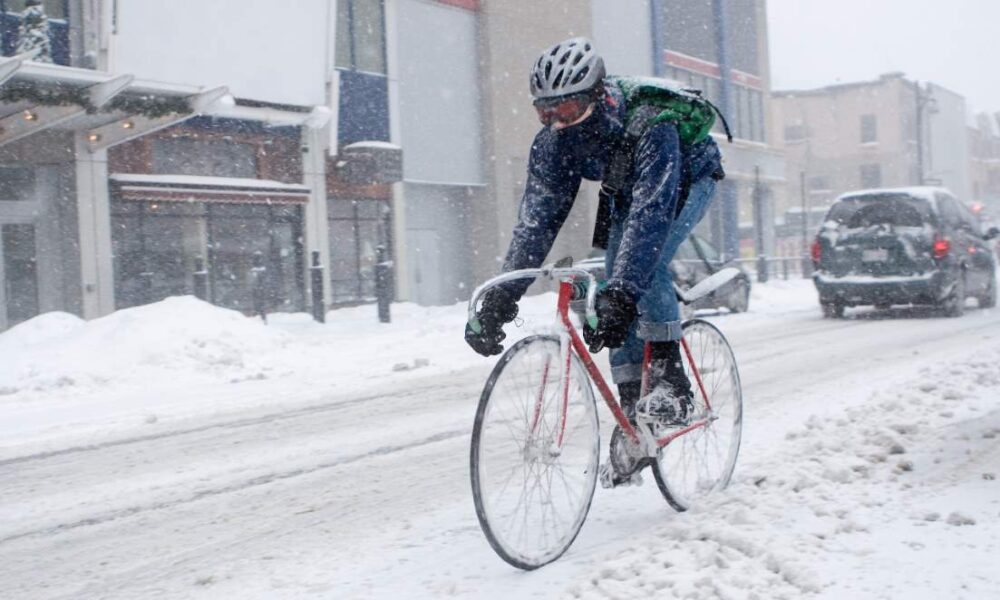
Wending your way through winter commutes

The arrival of winter, with its sub-zero temperatures and snow-packed roads, transforms students’  lifestyles—especially when it comes to their daily commute. 

Much of the student body can be seen walking or biking to school in the summer months, but far fewer cyclists are spotted on the roads once the first signs of winter approach. Though some bike owners might still be seen bracing the wind chill, Bixi, the city’s affordable and convenient public bike rental service, ended their season on Nov. 15. This means that many, including Arantza Fernandez, U3 Arts, have had to resort to other ways of travel.

“It was so easy to take the bike,” Fernandez said in an interview with The McGill Tribune. “I would be at school in five minutes, and I could come and go as much as I wanted. Now I have to walk to school, which takes me almost 15-20 minutes.”

However, unlike the weather these days, all is not bleak. Opting to walk to campus can bring about some positive and unexpected changes in one’s daily routine. 

“The good thing is I now get to call people when I walk, like my parents at home,” Fernandez said.

Nevertheless, many cyclists still pedal their way through the snow to get to their classes—and many start gearing up for the winter months far in advance. Danyal Chaudhry, U1 Science and frequent winter biker, is familiar with the preparation process. 

“Biking saves me a lot of time, and it is not as dreadful as you think when you have the proper gear for it,” Chaudhry said. “If you have big winter tires, some headlights for darker days and are wearing layers, you should not have much trouble biking to campus.”

It’s important for cyclists to know how to equip themselves and their rides to ensure safe travel. Experts suggest proper winter tires to prepare your bike for the snowy months, and regular cleaning throughout to prevent ice buildup and breakage from frozen parts. 

Although self-preparation is needed, efficient snow plowing is also crucial to avoid wipeouts. Montreal’s winter bikers have formed a community that vocalizes and lobbies for these concerns. They call themselves the “hurlus,” French for “weirdos.” 

Bikers are not alone in having to change their travel routes to school. Ibrahim Naveed, U3 Science, has become cautious, albeit hesitant, when walking to campus now; the dilemma of missing classes due to harsh weather is not unknown to the student body. 

“The weather has made me reluctant to walk to class and I often think of taking the bus or, sometimes, not going to campus at all if it’s too cold out,” Naveed explained. “In the summer, I would normally just take my bag and run to campus, but now I have to make sure I am properly bundled up to prevent myself from freezing to death.”

With many layering up in their winter boots and parkas to walk to campus, car commuters who live farther from McGill or in areas with limited public transit face different challenges. For them, endless lines of traffic, inescapable construction reroutes, and icy roads increase the risk of danger and can lead to longer travel times. The Montreal Gazette offers a comprehensive guide for those who choose to travel by car in the winter. The SAAQ is another helpful resource. 

With all these complications, many students opt for public transport, including the bus, metro, or commuter train. This is when the OPUS discount for McGill students comes in handy, reducing the monthly fee from $90.50 to $54 per month.

“I would never buy the OPUS monthly pass at its normal rate,” Naveed said.“But with the discount and the changing weather, I think it’s worth it, at least for the winter months.”

And so, every year, cylists, pedestrians, and car commuters alike prepare for safety and convenience; amidst the fierce Montreal winters, this small travel routine becomes a big part of our lives. 

Ask Ainsley, Student Life

Ask Ainsley: Should I get a part-time job next semester?

Dear Ainsley, 

I’m not sure if I should get a part-time job for next semester. I do want to start building toward financial independence, but I’m worried that an added commitment to schoolwork and extracurriculars will be difficult to manage. A lot of my friends tell me they’re able to balance working part time while taking a full course load. I’m torn—what should I do? 

Sincerely, 

Worked up about Work (WUAW)

Dear WUAW, 

“Work hard, play hard” is a refrain common to the university experience, but how each student interprets it is entirely unique. For many, financial constraints necessitate a part-time job. But if you have a bit of wiggle room, it is important to reflect on your priorities before potentially undertaking more responsibilities. 

Think carefully about your schedule. If you do get a job, is there a chance you’ll be asked to pick up extra shifts? Is your transportation reliable? Do you have courses in person as well as online? How long does your coursework actually take you to complete?

Anywhere between 10 to 20 hours per week, adjusted to fit your specific timetable, should allow you to complete academic work while also getting enough rest. Working a part-time job can help you network, refine your time management skills, or even practice speaking French or English if applicable. The decision is ultimately up to you, but remember that life is made up of checks and balances. Stretching yourself too thin in effort to accomplish everything will inevitably lead you to falter, so compromise is essential. 

Don’t feel pressured to take five courses—you can drop down to four. Select your extracurriculars carefully to ensure they align with your personal or professional goals without causing further stress. Does this club boost your CV, but impede on your well-being? Whittle down extraneous commitments to allow yourself time to breathe. Look at a calendar and sketch in potential work shifts: Do you have enough availability to properly commit yourself? Most workplaces are collaborative environments; if you have to bail on a shift to study, you’re letting down your team. While academics are, for the most part, solitary in consequence, jobs affect others around you. It’s important to bear all this in mind before dedicating your time.

It is difficult to juggle academics, extracurriculars, and part-time work while still leaving time to rest, but it is still possible. If you find your social life slipping through the cracks, try allocating some time each week to seeing friends or talking with loved ones. Once the hangouts or chats are scheduled, they will gradually stop feeling like—as terrible as it is to say—time wasted. There’s no need to feel guilty for seeking out connection, especially during the transitory and tumultuous time that is university. 

University and productivity culture in general have misled our perceptions toward rest: Too often the definitions of self care—sleep, food, and time with friends—are just the bare minimum required to function. Be sure not to treat self care only as a reward. You don’t deserve rest; you need it. Nothing is more important than your health.

None of this is to say you shouldn’t try your best to reach your goals or succeed academically. Know your limit, and play within it: Be diligent, yet also realistic so that you can sustain your physical and mental health. As most of us are under 25 years of age, our brains are still developing. It’s tempting to fill your plate with responsibilities, but remember that the state of your health will shape your future in the long term just as much as your GPA or that extra resume bullet point. 

Know that if working is a financial necessity, there are resources available to you at McGill that offer support. Consider looking into government and student aid, as well as the Work-Study program, which connects students in financial need to jobs on or near campus with flexible schedules. 

I hope you can make a decision that works best for you. 

Sincerely, 

Ainsley

Know Your Athlete, Soccer, Sports

Know Your Athlete: Mara Bouchard

Starting university is a challenging time of transition for all first-year students, both academically and socially. For student athletes, this period is particularly difficult, as they are presented with the additional challenges of meeting teammates, coaches, and staff that will become critical figures in their daily lives.

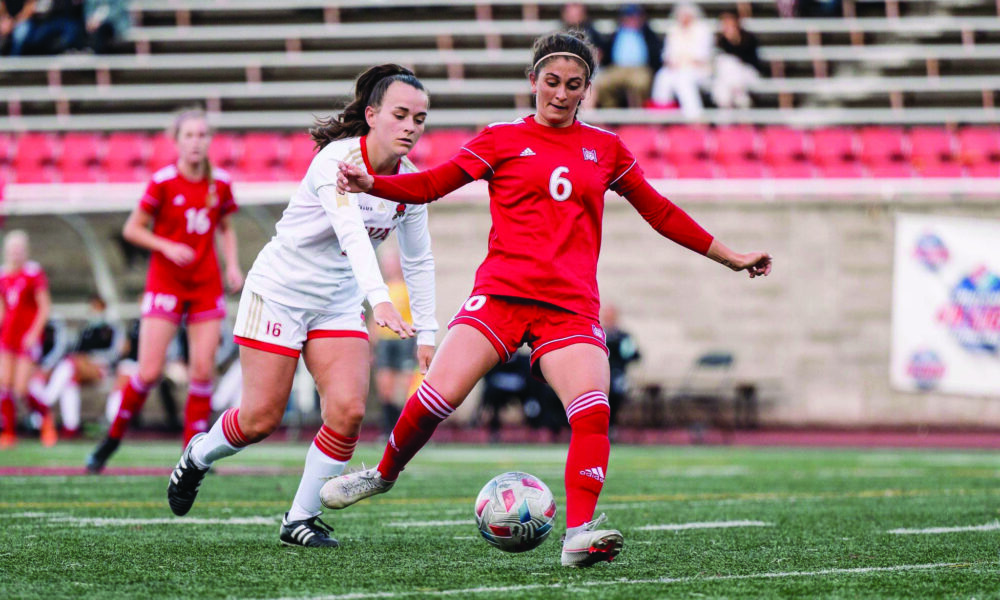
Mara Bouchard, U1 Arts, is a first-year student on the McGill Martlets soccer team who previously played for Vanier College in Montreal. Despite the barriers that many first-year student athletes face, the midfielder from Granby, Quebec found the adjustment to university life to be smooth and straightforward. 

“As a rookie and first year on the team, I was very much included by the rest of the players and veterans,” Bouchard said in an interview with The McGill Tribune. “I think being from Quebec made it easier to bond with the team, as there are a lot of other members of the squad from this province.”

Bouchard performed well in her rookie season with the Martlets, helping McGill achieve the second best defensive record in the league. Bouchard cited her past experience at the National High Performance Center (CNHP) directed by Soccer Quebec in Montreal as a reason for her success. 

“Soccer-wise, I thought it was a great season for me,” Bouchard said. “I was expecting to do well coming from a strong soccer background and playing at CNHP. Especially for my first year, I ended up in a place that I was happy with.” 

The Martlets had an especially impressive showing this season given the larger share of newcomers to the team. The squad placed third in the RSEQ, finishing the year with a 7–4–3 record. Although the Martlets fell short in the playoff semi-final game against Université Laval, they ended the season on a hot streak, winning their final four of five regular season matches. In Bouchard’s eyes, this late-season push proved the team successfully achieved their goal for the season. 

“The result of the semi-final against Laval was obviously not the one we had hoped for,” Bouchard said. “Our goal [for] the year was to become the most improved team. I think we accomplished and proved our goal to everyone, including ourselves.”

Heading into the Fall 2022 season, Bouchard is optimistic about the team’s future and is looking forward to building on this past year’s momentum.

“This year, finishing third was certainly a success for the program, particularly given the shortcomings of the recent past,” Bouchard said. “Our objective for next year is to continue to improve and earn a playoff spot once again. Our coaches have done an excellent job so far in my time here, and I know they are going to push us further to properly develop our individual and team play while we all progress toward the ultimate goal of a championship.”

Off the pitch, Bouchard is halfway through her first year as a psychology major. However, Bouchard’s top priority after university is to continue pursuing her love of and passion for the beautiful game.

“After McGill, I definitely want to keep playing soccer,” Bouchard said. “I am hoping I can find a pro contract in Europe somewhere and hopefully play professionally for a few years after I graduate. If this plan does not work, I will use my degree to pursue my goal of becoming a psychologist. I would love to be employed in this field in the future, and am enjoying studying the subject so far here at university.” 

Next August, training camp will build upon the strong bonds forged between players and coaches throughout this season. Bouchard looks to lead the midfield next season amongst a dedicated squad that is poised to improve on this season’s success.  

McGill, Montreal, News

Montrealers, McGill students march in solidarity with Wet’suwet’en land defenders

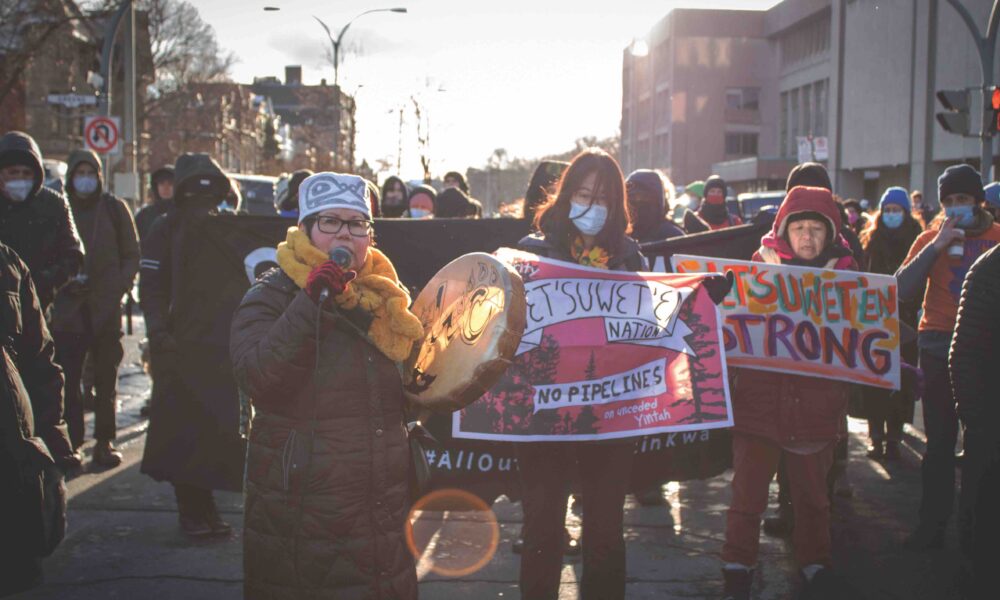
The Montreal chapter of the activist group Convergence des luttes anticapitalistes (CLAC) hosted a protest in support of Indigenous sovereignty on Nov. 27, marching in front of and around the Montreal office of the Royal Canadian Mounted Police (RCMP). McGill students and Divest McGill members participated in the demonstration alongside other environmental, Indigenous, and other activist groups.

The primary focus of the protest was a recent escalation of the construction of TransCanada Energy’s Coastal GasLink (CGL) pipeline’s through the unceded territory of the Wet’suwet’en First Nation in British Columbia, which has been ongoing since 2019. The project has garnered much criticism, as it began without the proper consent of Wet’suwet’en, and police have been quick to use force to suppress dissenters, using police dogs, destroying property, and threatening people with rifles. This November, the RCMP invaded resistance camps—like the Coyote Camp—violently arresting activists and journalists. 

Marlene Hale, a land defender from the Small Frog Clan of the Wet’suwet’en nation, spoke at the protest and expressed her frustration with the Canadian government’s seizure and occupation of their land. Hale described how government officials avoided going through the proper channels of Wet’suwet’en leadership for their consent, instead seeking approval from the twenty band councils, who all signed on to the project. Hale brought this up to Prime Minister Justin Trudeau at a town hall in Saint-Hyacinthe, Quebec back in 2019.

“[I asked him,] ‘how do you not know that [for] consent in our nation, you’re supposed to go to the hereditary chiefs?’” Hale said. “They know who’s going to sign, who is the weak link, and who they can get [consent from] to do the work they want for as little as they can [….] The consent was not given by the right land title holder, which is the hereditary chief, Woos. Right now, he is on his own territory fighting [the RCMP] to gain access to his own home.”

The RCMP has confronted Wet’suwet’en land defenders several times over the last couple of years in an attempt to quell resistance to the pipeline. From Nov. 19 to Nov. 20, they had arrested 29 people, including two journalists, in British Columbia; protestors were trying to interfere with the pipeline’s construction in order to protect the land. The latest wave of arrests spurred protests across the country, including the one in Montreal this past Saturday. Eve Saint, the daughter of Wet’suwet’en hereditary Chief Woos, described the RCMP’s treatment of the protesters and journalists who were arrested, including Wet’suwet’en land defender Sleydo’.

“I just gotta give a lot of love to Sleydo’ because she is a mother, she is an Indigenous Wet’suwet’en mother, [and] she is raising her babies on the Yintah, on the land,” Saint said. “And now, these courts have […] criminalized her and [are] trying to keep her from moving freely on her own land, on her own territory.”

Saint herself has been on the frontlines of the fight; she was arrested alongside three others at Gidimt’en Checkpoint on Feb. 7, 2020 while defending Wet’suwet’en land. Saint condemned the violence the RCMP has inflicted on her people over the past week.

“We have elders that are being dragged off the Yintah, that are being denied their medication, and that had to go to the hospital,” Saint said. “This is at the hands of the RCMP. This is how they look at Wet’suwet’en people, this is how they look at Wet’suwet’en women, mothers, matriarchs, hereditary chiefs. They point their guns at us when they want us off that land so they can steal it. It is stolen land. They want us dead.”

After Saint finished speaking, the group marched toward downtown Montreal, followed by police officers who maintained a heavy presence throughout the demonstration.

In a subsequent webinar on Nov. 28, Ellen Gabriel, who is part of the Turtle Clan within the Mohawk nation of Kanehsatà:ke, compared the situation to the Oka crisis that occurred in 1990. At the time, the Sûreté du Québec (SQ) provincial police force violently invaded Kanehsatà:ke land that developers wanted to turn into a golf course. Following SQ raids of Mohawk territory, there was a 78-day standoff as the police faced down Mohawk warriors defending their land. Then-Quebec Premier Robert Bourassa eventually brought in the Canadian military to replace the SQ, and the standoff ended whenMohawk warriors had to surrender.

“The fact that the RCMP are being the root squad for Coastal GasLink as the SQ were for the municipality of Oka and the rich developers means that we haven’t gotten very far in the reconciliation process that Trudeau and others keep talking about,” Gabriel said. “This is not reconciliation. [Indigenous peoples] were here long before Europeans arrived, and we are still being treated, 500-plus years later, as if we are disposable, as if our rights don’t matter.”

McGill, News, SSMU

SSMU Legislative Council approves motion calling for resignation of President Daryanani

The Students’ Society of McGill University (SSMU) Legislative Council convened on Nov. 25 for their last meeting of Fall 2021. During the meeting, councillors approved a motion to urge SSMU President Darshan Daryanani to submit a letter of resignation within 48 hours of the motion being ratified by the Board of Directors (BoD). 

The motion, brought forth by management representative Nathaniel Saad, pushed for Daryanani to be held accountable for failing to fulfill his presidential responsibilities as chief officer and spokesperson of the Society. While presenting the motion, Saad cited the president’s absence from Legislative Council sessions and Executive Committee meetings—which Daryanani is required to attend as president—since the start of the term. 

“I feel that the Legislative Council has been left in the dark,” Saad said. “The president needs to represent members of the student body which he is not doing, [and] we are currently unaware of whether he is being paid [….] This is an unsustainable situation and allows the situation to potentially replicate in the future. It is a dangerous precedent to set.”

Should the president fail to issue a letter of resignation, the motion dictates that the Legislative Council, pursuant to consultations from students and faculties, will call for a special SSMU General Assembly within the first week of the winter semester to vote on whether the president should be impeached. 

The session’s question period revolved around the president’s absence. SSMU executives reaffirmed that the matter is confidential. 

“When individuals go on leave it is an HR matter,” vice-president (VP) Finance Éric Sader said. “As such it is not relevant to the Legislative Council or the student body to know the precise details. All that is important is that the president is on leave and the Society is functioning quite well.”

When asked why the absence of the president and the general manager has not been communicated to the student body, specifically through SSMU’s most-used student communication channel—the SSMU listserv—vice-president (VP) Internal Sarah Paulin replied  “no comment.” 

The motion passed with 19 council representatives in favour and nine abstaining. During the roll-call vote, all five executive members present abstained.  

In other matters, arts representative Yara Coussa brought forth a motion, seconded by arts representative Ghania Javed, concerning amendments to the internal regulation of student groups. After a debate period, during which SSMU executives disclosed concern about a lack of consultation, the motion was postponed. 

Executives argued that approval of the motion contradicts the duties of the executives. For example, the motion proposes to limit the VP External’s discretionary ability to provide funding, which is granted by the Society’s constitution

Coussa apologized to the executives for the lack of consultation, and stated that the personal refutes were unnecessary.  

“I understand that we have not completed the necessary consultations for this motion and for that I apologize,” said Coussa. “However, there is no need to be rude and impolite to the mover and seconder who wanted to emphasize the voices of advocacy groups on campus [….] Being a councillor is a learning curve, and we are not perfect here.”

Moment of the Meeting: 

Councillor Saad called for the vote on the “motion regarding the absence of the SSMU president” to be conducted through a roll-call rather than through normal procedure. 

Soundbite: 

“You have all been councillors for a semester. You have all had a chance to speak to each other and debate on contentious topics. I ask that you have compassion for your fellow councillors and some amount of respect for the members of the gallery [….] I require that you please respect these people [….] It is not okay to use the type of personal and direct attacks that we have seen.”

—Speaker of Council Alexandre Ashkir responding to comments that were made concerning the motion on amending the internal regulations of student groups. 

A previous version of this article incorrectly stated the normal SSMU voting procedure keeps the voters anonymous. In fact, a voting record is posted on the SSMU website after every meeting. The Tribune regrets this error.

McGill, News

McGill changes masking policies amid rise in COVID-19 cases on campus

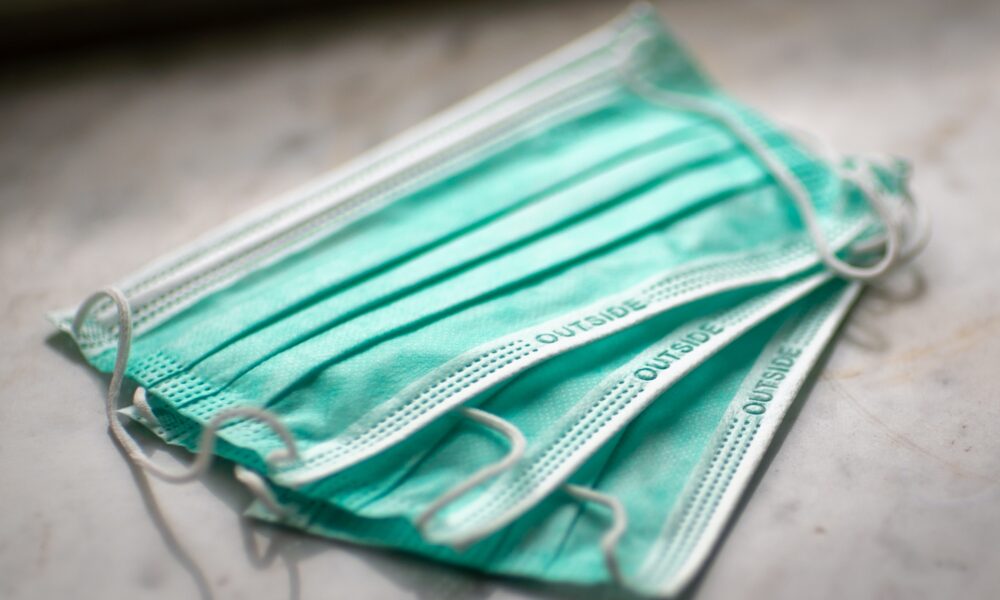
McGill announced a new masking guideline on Nov. 19 in a university-wide email from the co-chairs of the new Recovery and Operations Resumption Committee (ROR), associate provost (Teaching and Academic Programs) Chris Buddle and deputy provost (Student Life and Learning) Fabrice Labeau. The update stipulates that community members should replace their procedural masks after every four hours of use. The email also included other updates on McGill’s COVID-19 management, such as details on its rapid testing pilot project. 

The masking directive comes in the wake of rising cases on campus—there were 28 confirmed cases between Nov. 7 and Nov. 20—and is in line with the Quebec government’s contact tracing protocols. These protocols dictate that those wearing a fresh mask—i.e., one that has been worn for less than four hours—are considered “low-risk” if exposed to COVID-19 in a classroom. Those wearing a mask for more than four hours when they are exposed in a classroom will be deemed “medium or high risk” and will be required to get a COVID-19 test. 

In an email to The McGill Tribune, Frédérique Mazerolle, a McGill media relations officer, stated that the university is aiming to make this mandate as easy as possible to adhere to.

“Masks are available at the entrance to most buildings on our three campuses,” Mazerolle wrote. “It is important to stress that a number of preventive measures will continue to be in effect for the [Winter 2022] semester. The health and safety of our students and staff is the guiding principle of all of our planning. Our mission is to provide students the safest and best experience possible despite the current global pandemic.”

Despite Mazerolle’s insistence that masks are readily available to all, some, like Nagashree Thovinakere, a graduate student in the Integrated Program in Neuroscience, feel they have to stockpile masks to comply with the new directive. 

“I have access to masks in the lab where I work, but that is not the case elsewhere on campus,” Thovinakere said in an interview with the Tribune. “So what I have been doing is carrying extra masks with me.”

Bridget Griffith, a post-doctoral researcher in the Department of Epidemiology and Biostatistics, stated that the expense of buying masks—when not readily available on campus—adds to the challenge of compliance. Griffith also thought that the policy might be more effective if it drew attention to better mask hygiene and more consistency in wearing masks correctly. 

“Often, I see people not wearing the mask properly, wearing the masks multiple days in a row or storing the mask in their pocket,” Griffith said. “This puts people in situations more risky than they think they are.”

Ashika Jain, a pharmacology graduate student, on the other hand, feels that McGill has done an adequate job in making masks available to the student body. However, Jain mentioned the new requirement is still somewhat challenging to comply with because of the nature of lab work.

“It can be difficult for me [to change my mask every four hours] when I am doing an experiment in particular,” Jain said. “But, since the accessibility for masks has increased, it is feasible.”

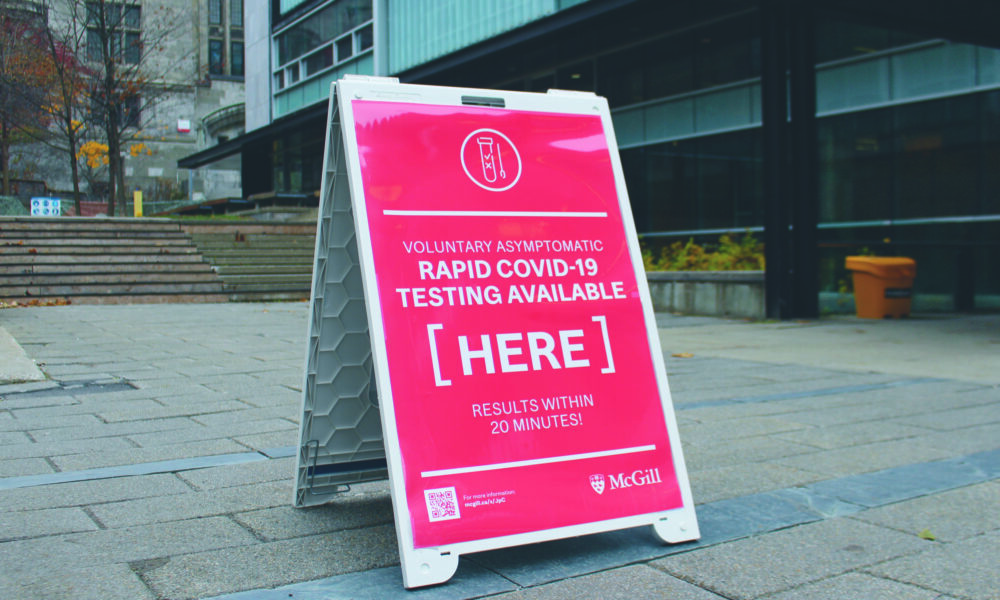
Mazerolle explained that McGill’s new masking guideline is just one of many initiatives currently in place at the university—McGill has also begun a rapid COVID-19 testing project in the Trottier Engineering Building Cafeteria.

“The voluntary rapid COVID-19 testing pilot project for asymptomatic people has been used by more than 500 students, faculty, and staff since its launch on November 8th,” Mazerolle wrote. “The initiative is open to any student, faculty or staff member who wishes to be tested. Individuals that have tested positive are directed to get a confirmatory (PCR) test from an authorized testing site and to self-isolate.”

The results of the rapid test arrive within 15-20 minutes. The testing project is set to continue for the rest of the Fall 2021 term.

Read the latest issue

Read the latest issue