


Latest News

Cross-Country / Track, Sports

McGill cross-country finishes strong at U Sports championships

On Nov. 20, cross-country runners from across Canada gathered at the Plains of Abraham in Quebec City for the U Sports championship. Representing the Martlets was fourth-year Maia Watson and graduate student Chloe Fleurent-Gregoire. The Redbirds, led by second-year Matthew Beaudet, represented McGill as a team at nationals for the first time in five years. 

The day started out with the women’s race at 12 p.m. The course, eight kilometres in total, consisted of four laps of a very technical and hilly two-kilometre course. Jessy Lacourse of Laval and Lauren McNeil of UBC Okanagan established themselves as the clear leaders early on in the race, creating a significant gap between them and the next runners. While McNeil led for the majority of the race, Lacourse had a stronger kick and passed McNeil in the last 500 metres of the race to claim the national title. Fleurent-Gregoire was the first McGill finisher, coming in 34th out of 128 runners with a time of 30:33, just over two minutes behind first place. 

Although Fleurent-Gregoire did not achieve her goal of coming in the top 30, it was extremely close and she was pleased with her performance overall. Having her teammates cheering from back home was reassuring, though she missed their presence at the race.

“I have been to nationals as a whole team before and that is a special experience,” Fleurent-Gregoire said in an interview with The McGill Tribune. “Obviously, I had my teammate Maia with me, which was nice, but it’s not the same as having your whole team. [I] knew they were watching and it inspired Maia and I to race hard for them. I hope that I am inspiring them to hopefully come to nationals as a team in the next few years.”

Watson finished almost exactly two minutes after Fleurent-Gregoire, placing 94th with a time of 32:35. This was only the second eight-kilometre race of the season for both Martlets, with the only other equidistant race being the RSEQ Championships. 

The men’s competition kicked off at 1 p.m., with a large pack of tightly clumped runners taking the lead. As the race went on, the rest of the pack spread out, but the group of runners at the front, which included McGill’s Beaudet, remained neck-and-neck. The front runners battled it out until the very end, when Guelph’s Mitchell Ubene outkicked Laval’s Thomas Fafard, winning the race by one second. 

Beaudet finished strong to come in seventh with a time of 24:47. While his time was just slightly slower than his provincial time, the conditions and the competition made the national race more challenging.

“It was very difficult, a lot muddier than provincials and the field was a lot more competitive and dense,” Beaudet said. “I knew that I had to stay with two runners from Laval, Thomas Fafard [and Jean Simon] Desgagnés, as they were going to be leading or right near the front. So the plan was to stick with them for most of it and do what I can in the last kilometre.”

With a strong showing at his first Nationals to cap off an impressive season, Beaudet was named national rookie of the year and made First Team All-Canadian.

The Redbirds boasted other strong performances as well. The next four McGill runners finished fairly close together, with third-year Henry Wellenstein leading the charge. Wellenstein ended strong, creating some distance between himself and the rest of his teammates and ending with a time of 25:52, a 41-second improvement from his time at the RSEQ Championships. 

First-years Tom Secheyron, William Davalan, and Jack Stanley rounded out the top five Redbird finishers—Davalan and Stanley finished only six and a half seconds, or five places, apart. With such a young team, the Redbirds cross-country squad have a bright future and could pose a real threat to powerhouses like the University of Laval or the University of Guelph in the years to come.


Arts & Entertainment, Film and TV

‘Ghostbusters: Afterlife’ fails to recapture the magic of its predecessor

Hollywood’s obsession with reboots has given birth to one of its worst yet, Ghostbusters: Afterlife. Arriving in theatres across North America on Nov. 19, this long-delayed film might have been better off going straight to video-on-demand. Although  director Jason Reitman is the son of the original installment director Ivan Reitman, Ghostbusters: Afterlife reinscribes the sarcastic comedy of the original movies into a cheesy story about friendship and family values. With an astounding 124-minute runtime, the movie spends nearly half of this without any significant plot development—it focuses more on self-referential jokes than it does trying to build its own plot. 

The film follows Callie (Carrie Coon), a single mom struggling to make ends meet. After her estranged father dies, she moves her family into his old farmhouse near a small mining town to the disdain of her children, Trevor (Finn Wolfhard) and Phoebe (Mckenna Grace). As they sort through the rubble of their grandfather’s life, Trevor and Phoebe discover their connection to the original Ghostbusters and the secrets their grandfather left behind. In order to solve the mysteries and save the world from impending doom at the hands of a demonic ghost, they need a little help from fan favourites like Peter Venkman (Bill Murray) of the original series. 

Avid fans of the franchise will immediately notice that the film largely ignores the original sequel as well as the 2016 reboot. Ghostbusters: Afterlife attempts to create a more dramatic take on the beloved franchise, but the result diverges too far from the source material. Lacking the signature comedic style from the 1984 film, Ghostbusters: Afterlife feels less like a faithful sequel and more like an attempt to capitalize on the nostalgia and success of the original film. It turns a beloved fantasy-comedy into what more closely resembles a melancholic family drama. 

Most of the members of the family completely lack any personality and complexity. Callie receives next to zero screen time after her introduction and Phoebe’s newfound friend is so single-minded, his name is literally just his hobby: Podcast (Logan Kim). Trevor and Phoebe are nothing more than the tired archetypes of the belligerent teenager and the overly precocious younger sibling. That being said, both young actors do a fairly good job with the dry material they were given. Grace plays possibly one of the most annoying child geniuses ever seen on film, but excellently portrays Phoebe’s growing connection with her grandfather, and Wolfhard is a bonafide veteran of the genre. His competence in making the absurd sound realistic almost allows the audience to suspend their disbelief. 

Even the ghosts in Ghostbusters: Afterlife are an uncanny shell of the original franchise, using undoubtedly some of the worst CGI in recent memory. Using a strange combination of practical effects and green screens, the film looks cheap. All attempts at suspense, terror, or seriousness are dampened by the appearances of cartoony ghosts. Straddling its identity between that of a thriller and a cartoon, the film can’t decide whether it wants its audiences to laugh at, or be scared of, the supernatural.

Ghostbusters: Afterlife epitomizes the rationality behind why reboots should end: It is impossible to recapture the magic of the original franchise. The film is purely trite ‘80s nostalgia packed with callbacks to the original, but nothing more. With a weak plot, hackneyed dialogue, and an awful combination of bad CGI and SFX, the film fails to recapture the charming cynicism of its predecessor.

Off the Board, Opinion

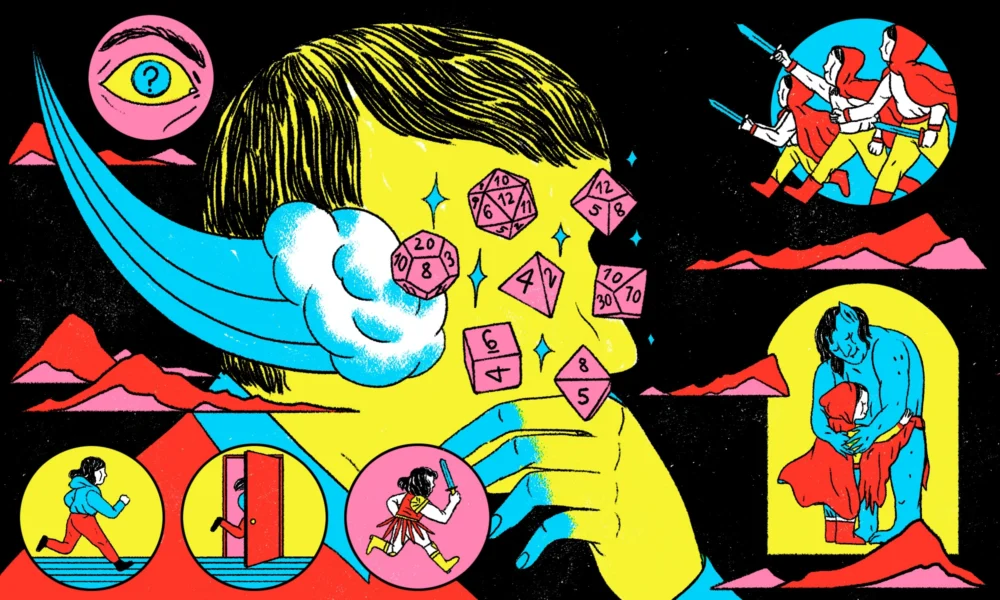
Roll for initiative

The door squeaks on its hinge, and a child, freshly orphaned, emerges from her room and pads toward the cusp of the ornate staircase. Tiny fingers thread through the balusters as she surveys the manor’s foyer. 

Our party—seven of us, a rag-tag bunch bound by circumstance and fate—freezes. Waits with bated breath. 

“Roll for stealth,” the dungeon master (DM) instructs our party’s wizard, who’s only half-concealed below in the shadow of the handrail. Discovery mid-heist would jeopardize the stability of the city, and also land us in prison. Or worse.

“…natural 20,” my friend says, smug like a sun-warmed cat, syllables stretched in satisfaction.

Filtered through my laptop speakers, the responding chorus is tinny, but our collective relief echoes through the audio.

My friends and I are playing Dungeons and Dragons, commonly abbreviated as D&D. Although some were already veterans of the game during high school, to me the game remained peripheral, overly time consuming and complex. As graduation passed and university lodged its talons into our free time, it wasn’t until the pandemic started that we decided to begin our own campaign. 

And we weren’t the only ones: As many turned to online spaces for connection and entertainment during the pandemic, D&D catapulted from the Forgotten Realms back into the zeitgeist. Sales jumped 33 per cent last year, contributing to its six-year growth streak. Originally published in 1974, the fantasy role-playing game has long held a place in popular culture as the quintessential nerd activity. But it has evolved from its roots. The fifth edition, released in 2014, prioritized storytelling over convoluted battle mechanics, attracting new players. While sessions are ideally held in person, online platforms such as Discord and Roll 20 allow sessions to be held regardless of location or time zone separating friends—or even strangers, as avenues like reddit threads or tabletop clubs in local libraries have proliferated.

Though there might not be a physical board to gather around, the game’s framework remains the same. The players design characters, the DM charts quests, and the dice dictate everything in between. Roll a one on a perception check, and my half-elf druid could stumble right into a den of thieves; roll a 20 on a dexterity saving throw, and she might successfully leap to cover. 

No other game holds a candle to the complete creative freedom D&D offers. As the adventure unfurls into being, the DM and players can manipulate its strands to weave dynamic, thoughtful narratives, a tapestry suspended between collective imaginations. Visual components like set pieces or miniatures, though they might compliment gameplay, are dressings for the ultimate stage: The theatre of the mind, an endlessly customizable space. 

It’s also inherently co-operative: Each member of the party works together during combat, diverting an attack or casting a healing spell, but also collaborates via the role-playing element. Some players value the game mechanics, tailoring warriors with carefully calibrated stats that will deliver the strongest attacks; others, like me, favour the improv aspect, an excuse to exercise intuition and think on the fly. For more still, especially young people, D&D can act as an outlet, an opportunity to project real issues onto fictional avatars in order to safely unpack trauma or experiment with gender expression or personality. In conceptualizing elements of the self onto a new form while remaining omniscient, you can explore your own identity—it’s free group therapy

What I find most valuable are the memories my friends and I forge together, sharing a laugh over in-game jokes or reflecting when combat goes wrong. As my character levels up with each completed arc, outside the game, I do too. Despite the perpetual essays my major requires, I’ve never considered myself a capital-w Writer. D&D gives me permission to have fun with the craft, and revel in the communal storytelling at its heart. 

Our campaign will reach its 1.5 year anniversary in a few days. Even through dozens of six-hour sessions, it’s taken me until now to solidify my character’s identity—a representation, perhaps, of the nebulous distress I’ve felt over these long months. Regardless, I’m proud of us. And not only for our characters’ successful heist, but the story we’ve authored, together. 

Editorial, Opinion

Trans liberation requires multifaceted action

Transgender Day of Remembrance takes place every Nov. 20, and, while not officially acknowledged in Quebec, acts as a dedicated time to reflect on the lives of transgender, non-binary, and two-spirit individuals taken too soon. Trans individuals continually experience higher rates of violence than cisgender people, with racialized trans people disproportionately affected. While Transgender Day of Remembrance pays tribute to those lost, it also presents an opportunity to chart a path forward toward trans liberation. This struggle requires a layered approach on legislative, educational, and personal levels. In order to move toward change at McGill, there must be a long-term commitment at both the individual and institutional levels to dismantle societal norms that isolate queer communities.

This year has been a tumultuous one for the trans community in Quebec, bringing with it both victories and disappointments. In January, Superior Court Justice Gregory Moore invalidated several articles of the Civil Code, such as one prohibiting individuals from changing their sex on their birth certificate, citing their transphobic and discriminatory nature. His decision noted the acute risk of suicide when one is denied the ability to affirm their gender identity on legal documentation. In response, the Quebec government introduced Bill 2, which they wrongfully believed would benefit trans people by separating gender and sex on identifying documentation. However, the bill’s proposed changes, which were allegedly made in good faith, lacked proper consultation and resulted in major push-back from the 2SLGBTQIA+ community and their allies. The bill has now been tabled and awaits edits after the government agreed to engage in proper community consultation. Fundamentally, meaningful legislation pushes for change and is developed in a way that both respects and amplifies the voices of those most affected by the policy. 

Governmental bodies are not the only institutions in Quebec rife with transphobia. Take, for example, the healthcare field. Gender-affirming surgery is essential for many to alleviate body dysphoria. Yet, it is inaccessible to those who cannot pay out of pocket for operations deemed “non-essential, including”  breast augmentations and other feminizing surgeries. A body that is representative of one’s identity should not be a luxury, but a right. 

At McGill, the administration can make changes that could contribute to breaking down the gender binary. One such action might be increasing the number of gender-inclusive bathrooms on campus. Studies have shown that over 70 per cent of trans and gender nonconforming individuals experienced discomfort when using gender-specific bathrooms, which can be detrimental to one’s mental health. The very few gender-neutral bathrooms currently available at McGill are not enough, and their sporadic and specific placement might make trans and non-binary students feel outed.  

McGill also has a role to play when it comes to supporting and encouraging trans scholarship and representation. The first step to this commitment is creating a safe space for students and staff alike. McGill has the power to mandate professors to respect their students’ pronouns––this is not. a privilege, but a necessity. 

Similarly, these changes can occur at the individual level. Trans voices must be respected and uplifted as they lead the charge toward liberation––but allies must ultimately ensure the burden of education is not placed solely on trans individuals. Being an ally must go beyond posting about Bill 2 on Instagram; it involves an active commitment to intervening in ignorant, transphobic behaviour or jokes. While positive changes such as the new inclusion of the gender-neutral personal pronoun “iel”  in the major French dictionary Le Petit Robert are welcomed, it is important to remain vigilant against backlash from those who are transphobic.

Trans communities have long been politicized by politicians and excluded by many feminists and queer activists—many of whom follow movements that were kickstarted by trans women of colour, such as Marsha P. Johnson and Sylvia Rivera. The fight for liberation is not over until it is a reality for all, so it is important to diffuse demands for change across the many institutions that all work together to isolate the trans community. Progress must be multifaceted if it is to be effective, from government and educational structures to interpersonal interactions. Transgender Day of Remembrance should double as a time for cisgender people to reflect on how to uplift trans voices, and support the push for a thriving future that supports all. 

Science & Technology

The changing landscape of industrial mining

From the diamonds in Nunavut to the gold in British Columbia to the iron ores in Labrador, Canada has a multitude of resources spanning from coast to coast to coast. Producing over 30 different minerals and metals, it is no surprise that Canada plays a substantial role in the global mining industry. As priorities shift within the industry to account for environmental and economic changes, Canada has the opportunity to set the bar for the future of mining. One way toward a new mining frontier is to embrace technological innovations that will help the industry continue playing a pivotal role in the country’s economy. 

“We can’t stop mining, but if we want to have our current society […]  if we want to keep this planet and some of our last remaining wildernesses, then we have to look at how we mine and do it very responsibly,” Scott Berdahl, the CEO of Snowline Gold Corp, a junior mining company based in the Yukon, said in an interview with The McGill Tribune.

The life cycle of a mine consists of several stages, beginning with the initial discovery of a viable reserve, to planning, then production, and finally to the closure and reclamation of the mine as operations wind down. With each stage being relatively distinct from one another, both large and small mining companies are implementing creative technological solutions to improve each stage of the mining process. 

The first stage in establishing a mine is the search for reserves. The scouting is often considered the most swashbuckling of mine operations, where small teams work in vast and often remote locations to find a viable deposit to mine. This is the stage where junior mining companies work alongside major mining companies, often selling their properties to the major players when a quantifiable increase in property value is discovered.   

One technology that has proven useful in these remote environments is x-ray fluorescence (XRF). Exposing rock samples to x-rays causes the different elements found inside to enter a higher energy stage. The elements then re-emit light at specific wavelengths, allowing scientists to determine the elemental composition of the rock sample.  

Traditionally, samples that were thought to contain sought-after minerals and metals would be sent to the assay lab so that geologists could get a completely accurate composition of the rock. In the context of exploration geology, this could mean shipping samples hundreds of kilometres away to get tested. With portable XRF, it is now possible to get compositional analyses of rock samples without ever having to leave the field. Although lab tests are still an essential part of exploration geology, as XRF technology develops, geologists will be able to get results faster and with higher accuracy.  

Another technological innovation that has revolutionized the field of exploration geology is the use of drones for surveillance. Drones have an advantage over other survey methods because they can cover vast swaths of ground while still keeping the scale of the survey specific to the area. This is in contrast to walking, which is restricted to the ground level, and satellites, which lack the necessary resolution to identify areas of interest on the single kilometre scale. 

Drones can perform a wide range of measurements using visible and near-infrared light to detect colour variation and any changes in the earth’s magnetic field. In addition to these specialized functions, they can capture high-resolution photography of exposed rock faces. Drones then allow geologists to develop more accurate models of the geology they are working with and to pinpoint specific areas of interest to explore. Due to these advantages, drones are rapidly becoming the swiss-army knife of mining exploration. 

Following the discovery of a viable deposit, the planning phase begins. This part of the operation can take years to progress as a multitude of factors must be weighed, including production and environmental costs in comparison to the value derived from the extracted materials. In addition to the extremely high start-up costs, with initial investment often being upwards of billions of dollars, mine operators need to be confident that the mined materials will offset the cost. This can be challenging as profits are tied to the value of the resource which then experiences large fluctuations, whether it be a material like lithium, nickel, and quartz or a precious commodity such as diamonds. 

One group working to make this process faster and less risky is COSMO laboratory, led by  Roussos Dimitrakopoulos, a professor in McGill’s Department of Mining Engineering.

“We are looking at industrial mine composites,” Dimitrakopoulos said in an interview with The McGill Tribune. “You have tens of millions of variables, and so, how do you follow them?  Suddenly you look at this and say we would like new methods to optimize the whole thing.” 

The project aims to optimize models to estimate ore bodies and their economic viability while taking the entire supply chain into account.

“[Our] models perform better because they account for what may or may not be in the ground,” Dimitrakopoulos said. “The conventional way is to take an average of what’s in the ground. This does not fully represent what is there [because] average in does not mean average out.” 

Once planning is complete, construction can begin, followed by the start of mine operations. In contrast to the early exploration stage of mine operations, in this phase, the landscape is fairly well understood, and the goal is to begin extracting resources from the ground. 

A group of technologies that are predicted to become commonplace by 2025 are autonomous machines. The key word here being autonomous, these machines are able to work with minimal supervision 24/7 on a variety of tasks, including drilling, blasting, loading, and hauling. Load Haul Dump (LHD) vehicles are an example of the types of machines used. These vehicles are primarily designed to cart ore out of the mine to be processed into various materials. 

Along with ore that is extracted, economically unviable material called tailings are generated as a by-product. These tailings have the potential to create major environmental damage through leaching salts and heavy metals into nearby water sources and spreading harmful dust particles to surrounding communities. Scientists are currently looking into how to mitigate the environmental risk that tailings pose. 

Greg Dipple, a professor in the Department of Earth, Ocean and Atmospheric Sciences at the University of British Columbia, is leading a research project that aims to combat this source of environmental disturbance. The project looks to repurpose mine tailings from nickel, diamond, platinum mines as carbon traps to offset carbon emissions released throughout the mining process. 

After the resource is depleted and primary production grinds to a halt, it’s time for the closure and reclamation process to begin. This involves maintaining the mine to avoid contaminating nearby areas and returning the site back to its original state as much as possible. 

New and emerging technologies within the mining sector have exciting implications for the industry. As we begin to reevaluate how resource extraction is done in Canada, it is important to continue to find new methods to make mining more efficient, economically sustainable, and environmentally conscious.

McGill, News

Divest McGill and Divest For Human Rights Coalition host democratization assembly

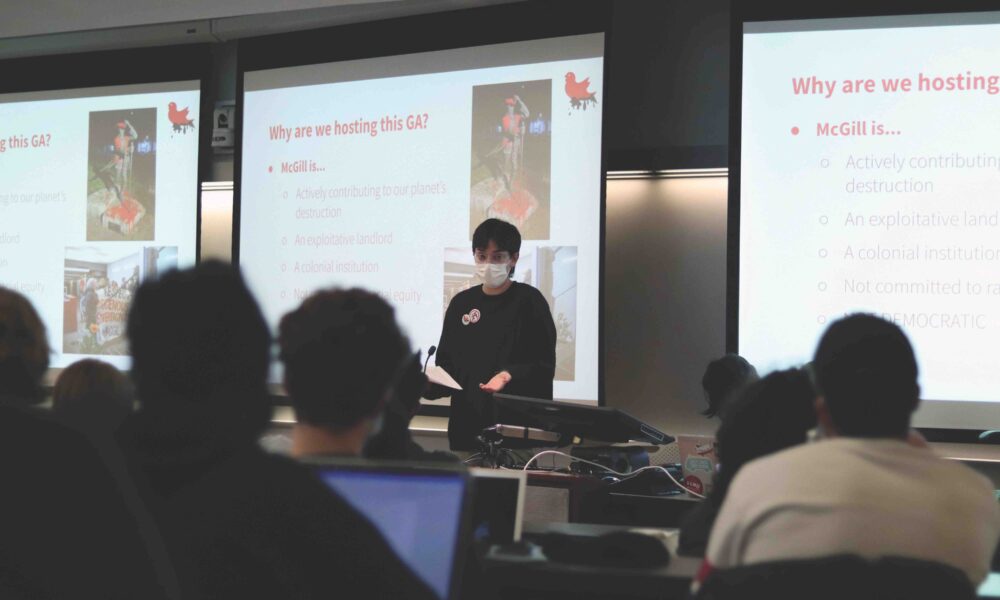
Divest McGill and Divest For Human Rights McGill hosted Democratize McGill, a hybrid open assembly, on Nov. 19 to facilitate discussion about ways to democratize the university’s many governance structures. The approximately 100 students in attendance—both in-person at Leacock 132 and on Zoom—were encouraged to share their thoughts on McGill’s current governance structure and propose formal solutions, which the entire assembly then voted on. 

In a binding vote that occurred at the end of the meeting, the assembly unanimously determined that Democratize McGill would become an independent coalition separate from Divest McGill. Votes on whether to pursue solutions were non-binding. Instead, they provided direction and objectives for the coalition to strive for.

Participants discussed how to increase student involvement and representation in McGill’s various decision-making bodies. While the event focussed on integrating democratic values and processes into current governance structures, attendees also introduced ideas about democratizing other areas such as academics and the university’s financial investments. Iryn McMechan, U1 Arts, described the energy and environment of the assembly.

“Being at this event, it was easy to detect tension in the voices of many McGill students,” McMechan said. “We are tired of not having our voices heard and experiencing a total lack of transparency when it comes to a lack of decisions.”

Many of the students present expressed discontent with McGill’s current governing structure. Participants cited the university’s ongoing investment in fossil fuels and their exclusion of Black, Indigenous, and Palestinian voices in their decision making as evidence of the disconnect between the McGill community’s values and the university’s actions.

Attendees proposed different—sometimes contrasting—solutions to address the many issues on the table. Propositions included electing—rather than appointing—the 17 members of the McGill Board of Governors, recording and releasing all meetings of the Board of Governors in a more accessible way, and transitioning McGill’s governance structure from one of a representative republic to one of direct democracy. 

Although attendees’ conception of how the university should go about democratization varied, certain concerns and ideas resonated unanimously. Sebastian Wittekindt, a second-year PhD candidate in neuroscience, feels that student organizations and political assemblies wield little power in affecting change McGill’s current governance scheme.

“The fact is that these organizations really only have a consultative role,” Wittekindt said. “We need to push for [the] direct influence of students [….] If we propose these ideas just as us sitting here, they’ll go back to lunch and ignore us.” 

While the event did not establish a concrete list of directives Democratize McGill would follow, common sentiments and ideas were highlighted as essential to the student movement going forward. Maya Garfinkel, U3 Arts, outlined an important feature of the Democratize McGill movement for the future.

“Going forward, we must prioritize and centre people who have been historically marginalized in the McGill community, specifically Arab, Palestinian, Black, and Indigenous students, staff, and faculty, in order for our movement to be more equitable,” Garfinkel said in an interview with The McGill Tribune.

Laura Doyle Péan, a U3 law student and Divest McGill organizer, explained to the Tribune that they were happy with how the event went.

“The assembly was very successful in terms of getting students excited about democratization and starting the coalition, which was our intention from the start,” Doyle Péan wrote. “We strongly encourage all community members, groups, clubs, unions and associations interested in democratizing the university to reach out and join the coalition.”

Out on the Town, Student Life

Students croon for the comeback of karaoke

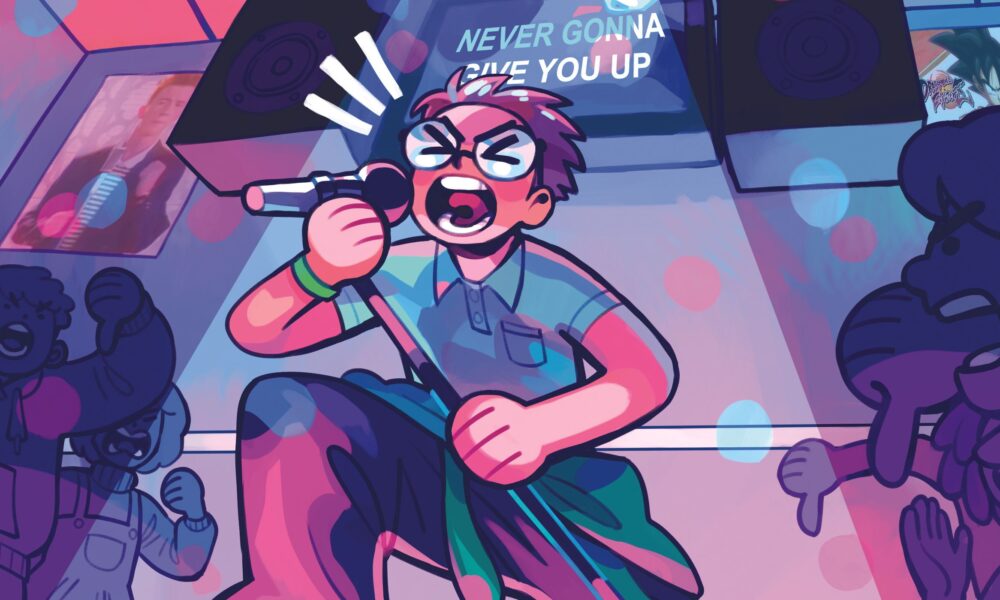
Karaoke allows people to come together and shine on the stage regardless of their musical talents; it is a stage where shower singers and professional singers stand on equal footing. When dance floors and other nightlife venues in Montreal officially reopened on November 15, people could once again head to the karaoke stage to belt their favourite songs—and McGill students are itching to grab a mic once again.

Hana Mollin, U1 Management, enjoys karaoke because it gives her the opportunity to sing freely in front of an audience. 

“It’s a very low-stress way of singing,” Mollin told The McGill Tribune. “I like to sing in the shower or when I’m driving. But I don’t tend to sing in front of people a lot, so karaoke is fun. I don’t mind singing in front of people [there] just because of the environment. It’s a place where everybody can come together and sing.”

For others looking forward to the return of karaoke, like Luciana Decormis, U2 Education, it’s all about the spotlight. 

“I think my favourite thing about karaoke is I really like attention,” Decormis said. “So I like performing and it’s just so fun.” 

Although karaoke allows individuals to indulge in the spotlight, it can be a community experience for many. Izabella Beller, U2 Arts, typically picks crowd-pleaser songs to allow others in the room to join in. Her favourite songs to sing include classics from Mamma Mia or heart-wrenching Taylor Swift ballads.

“If it’s just a song that I like that a lot of people don’t know, then it’s not fun cause I’m just by myself,” Beller said. “I want people to be as excited as I am for the songs.” 

Everyone has a go-to karaoke song that they know they can rely on no matter what. It seems that many students use the open stage to feel empowered, as if they’re on top of the world. Mollin’s go-to karaoke song is Bodak Yellow by Cardi B. 

“I feel like a badass when I sing it,” Mollin said. “It makes me feel powerful.” 

Decormis draws a similar feeling from her go-to karaoke song. 

“I really like Tusa [by Karol G],” Decormis said. “It’s one of the few reggaeton songs that empowers women and is not sexualizing [….] Girl power, you know?”

Not only does Decormis enjoy the rush of confidence she gets while performing Tusa, she also loves that it brings her back to fond memories. 

“It reminds me of the time right before quarantine and of 12th grade and all my friends,” Decormis reminisced.

Music has always had the power to transport people elsewhere, but the energizing and judgement-free atmosphere of the karaoke room allows for a unique form of escapism. 

In Quebec, karaoke bars unfortunately have been closed since September 2020, since they had been a source of COVID-19 case spikes. Financially, it was a tough year for many karaoke bar owners. Now that they’re reopening, the karaoke scene in Montreal looks forward to a resurgence. 

Mollin is already making plans after being away from the karaoke scene for a while. Since pandemic restrictions kept many first-year students away from nightlife experiences last year, Mollin looks forward to embracing her adulthood through karaoke.

“I hope to go [to a karaoke bar] with my roommates.” Mollin said. “I used to go to karaoke bars with my family a lot. But it’ll be different this time because I feel more like an adult, and I’m doing it with my friends, and I can drink too. I feel like I’ve grown up.”

Decormis and Beller checked out a karaoke location last weekend, and are excited to return now that COVID-19 restrictions in the venues have eased. 

“I’m definitely planning on going again. Especially now that you can dance,” Beller said.

Music has the magical power of bringing people together, and karaoke demonstrates that perfectly. The karaoke stage is a special one: All judgments melt away, and people can play a role for as long as their favourite song lasts.

Chill Thrills, Student Life

What does your major say about you?

What does your major say about you? The McGill Tribune spoke to students of different majors to find out whether the stereotypes about them are true. 

  1. English

With the crushing burden of endless readings and constant familial scepticism, English majors have always had a hard time.  

Although their creativity and open-mindedness makes them quite agreeable, they often find solidarity in their peers’ collective struggle. They have a diverse taste in everything artsy, and, at some point, have tried calling themselves artists.

Before entering the program, Faith Ruetas, a third-year English literature major and co-president of the Department of English Student Association, expected a homogenous crowd in her classrooms. 

“[I thought] it was just all white girls whose parents pay for their education so they can smoke and write poetry,” Ruetas said. “There are some people who might fit one or two of those characteristics, but there is nice diversity in the program.”

English majors are also often told that their degree will not amount to much and that their career prospects are hopeless. That said, Francesco Cremonini, another second-year English major, believes an English degree opens up many different paths for students.

“I like English because it’s more open ended, ” Cremonini said. “The program is really versatile.” 

Hang in there, English majors—your path will soon materialize. 

  1. Computer Science

A dark room, energy drinks, and the sound of keyboards crunching code is what a typical night looks for computer science students. 

Although it’s a well known fact that these students compete with each other to get those six hour long technical interviews—that often end up in rejection—their career prospects are still much brighter than their rooms. 

Academic success, however, can sometimes come at the expense of a social life.

“We are all sacrificing every part of our life to get into FAANG,”said Ibrahim Naveed, a fourth-year computer science major. Fitting for the bloody image it summons, this acronym refers to the five most prominent––and perhaps soul-sucking––big technology companies. Students’ mathematical and analytical skills are sure to get them there! 

To find comp sci majors, all you need to do is head up to the Trottier building at any odd hour, be it day or night. 

  1. Political Science

Individuals pursuing political science are known to have a passion for playing devil’s advocate: They enjoy pushing boundaries and get a rush when adopting controversial opinions—even if these opinions aren’t necessarily their own. They feel the urge to save the world, but believe the best way to do this is by having petty debates in their conference sections.

As some prepare for the future by role-playing as politicians in the classroom, it can be difficult to tell their real personalities from their alter egos. 

In all seriousness, poli sci majors are typically good writers and genuinely want to apply their learning into real-life political action. 

“People in poli sci seem to have a similar trajectory about what we want to do with our learning in the field of law,” Mira Cantor, a third-year political science major told The Tribune. “[Many] want to go down in a journalistic direction.” 

  1. Economics 

Devoid of a social life, these students are just trying to survive the semester without having more than five mental breakdowns. They are either the ones that are raising class averages or the ones cursing those that are. 

In this program, students have different career prospects and expect to go into diverse fields after they graduate, from financial consulting to the public sector. 

Though they’re known for having a competitive edge, most might agree that teamwork gets them further. 

“I couldn’t survive this program without collaborating with my friends,” said third-year economics student Hamza Farooq. 

Economics majors can frequently be found huddled in groups on the first floor of Redpath Library, trying to power through all of their assignments. 

Commentary, Opinion

Physical books are worth their cost

The holiday season is approaching, and as many people start the scramble to find gifts for loved ones, friends, or coworkers, a harsh discovery awaits them. Tried and true, books have remained one of the best gifts to give on any occasion, the perfect balance between thoughtful and casual. However, the tumultuous pandemic economy has caused paper, ink, and printing presses to be in high demand, leading to an increase in book prices. The days when a hardcover novel did not cost an arm and a leg are long over, with the average adult fiction book priced at around $34.00 CAD. The rising price of books is just one of the negative effects of current inflation trends threatening the extinction of libraries and smaller book businesses. Everyone must do their part by buying books from local bookstores, and remembering to plan ahead to avoid resorting to large corporate sellers like Amazon. 

Though the pandemic has led to a recent spike in demand for books, it is getting progressively more expensive to produce them. The price of wood pulp rose approximately 71 per cent this year after an environmental initiative in China led to the shutdown of many pulp and paper mills. The large price change has made book prices skyrocket and production timelines slow. Further, the supply chain has taken a hit due to the pandemic, and lengthy shipping delays are predicted for this upcoming holiday season. This seeming book shortage will certainly put a hamper on many people’s plans to shop last minute, as there will be fewer books stocked on the shelves, and delayed projected delivery times—some stretching well into the new year. 

With the many roadblocks to obtaining physical copies of books this year, the growing market for online literature like e-books, Kindles, Kobos has skyrocketed. Online literature tends to be cheaper—no manufacturing, distribution or shipping costs—so with book prices increasing this year, more cost-conscious consumers might pursue those options in lieu of purchasing a physical copy. Also more environmentally friendly, investing in a Kindle or another digital library, saves paper. While there are benefits to making the switch to online, physical books are still overall the better choice. 

McGill, too, has hopped on this online literature bandwagon. Many English courses have started to offer their texts in PDF form, selecting readings available from online resource platforms or offering online course packs so students do not have to purchase an entire short story collection. McGill courses in general have also adapted to online life: The majority of assignments can be submitted online, reducing the need for physical copies of papers—and even some exams are now delivered online. Though, with the hybrid learning scheme, many students find themselves struggling to adapt to fully remote learning. If physical copies of textbooks and novels are slowly phased out, it is almost certain that students’ productivity will suffer, with  reading on paper being important for neurological comprehension. Reducing screen time by doing readings and note-taking offline helps both concentration and retention, and reduces eye strain.

This phenomenon also has consequences for libraries. They, too, risk being rendered useless. This is especially dismaying, as libraries are one of the only public places people can visit without having to pay. Small businesses are also affected, with non-chain bookstores relying heavily on an in-person customer base. While larger names like Indigo and Barnes & Noble may be able to stay afloat in this transitioning market, smaller names like Montreal’s S.W. Welch Bookseller might not. 

However, it would be unlikely that such a change in the literary market would happen before it could be prevented. Yet, to keep the magical world of printed literature alive, everyone must do their part: Keep buying books—especially from small businesses—and get any holiday shopping done sooner rather than later to ensure there are no empty presents under the tree. 

McGill, News

Sustainability initiative ‘impact200’ project winners to be announced next month

Launched in August 2020 as part of McGill’s bicentennial celebrations, impact200 is a challenge that invites teams of students to submit proposals for projects to enhance sustainability on campus, in Montreal, and around the world. The challenge was organized by the Bicentennial Office in collaboration with the McGill Dobson Centre for Entrepreneurship, the McGill Office of Sustainability (MOOS), the McGill Sustainability Systems Initiative (MSSI), and representatives of the Faculty of Agricultural and Environmental Sciences. On Dec. 2, the winners of the challenge will be announced, with prizes ranging from $2,000 to $10,000. Once completed, the finalist teams will be offered the opportunity to refine their project through a training program provided by the Dobson Centre and to ultimately bring it into action if it places in the top three spots.

Each project aims to address one or more of the United Nations Sustainable Development Goals, such as food security, eradication of poverty, and climate action. From the 44 initial proposals, 10 finalists were selected to develop the feasibility of their concept over the summer and then deliver a final presentation of their project in November. The university’s flagship Sustainability Projects Fund (SPF) gave each finalist $5,000 to cover the project’s development expenses and connected each project with mentors for support.

Frédérique Mazerolle, McGill media relations officer, said that the university was pleased to foster sustainable solutions for local and global challenges being innovated at McGill. 

“Sustainability is an institutional priority at McGill, as evidenced by the ambitious goals we have set out for ourselves in the Climate & Sustainability Strategy 2020-2025,” Mazerolle wrote. “It is our responsibility as members of the global community that we do what we can to achieve these goals to reduce our impact on climate change and contribute positively to the sustainability of the planet.”

Simon Cleghorn, U1 Engineering and co-founder of the team 200 Urban Garden—one of the 10 finalists—explained that their project aims to make cities more sustainable by converting underutilized parcels of land into vibrant community green spaces. 

“The initiative gave us a rare opportunity as students to create and pursue a sustainable innovation with external funding,” Cleghorn wrote to the Tribune. “As six environmentalists, this was extremely exciting for us. Impact200 allowed us the opportunity to engage with other like-minded students with similar goals pertaining to sustainability.”

Two other finalists, McGill Mycelium Project and FoodMap, attempt to promote sustainability by responding to food insecurity. Another, SOlar-A,  designed water filtration backpacks to ensure areas with low resources have access to clean water through solar and biomechanical energy. McGill Engineers in Action plans to design a footbridge for rural communities in Bolivia or Eswatini, to then have a group of students work alongside these communities to develop it. The other finalists were teams Algo, CoolHealth, MentalLingual, MiniWaste, and unEarth.  

Joining forces in September 2020, Cleghorn and his team decided to participate in impact200 with the goal of implementing sustainable gardens on McGill’s downtown campus. 

“We began planning our proof-of-concept Wong Garden and formulating the vision of ‘200 Urban Garden’ at weekly meetings all throughout the 2020-2021 academic year,” Cleghorn said. “This past summer we successfully constructed the Wong Garden, which includes various forms of green technology and a wide range of produce.”

Gérald Cadet, director of bicentennial planning at the Office of the Principal & Vice-Chancellor, explained that the winning projects would be chosen based on the quality of each team’s final pitches, the applicability of each project to the SDG goals, and the project’s ability to create transformative and beneficial futures. “The judges considered many criteria, among which [was] the potential to become Bright Spots, that is, projects that transform some piece of the world for the better, clarity of the proposal, etc.,” Cadet wrote to the Tribune. “The challenge is likely to be a one-time; however, through one of the components of the Dobson Cup, students can propose sustainability-focused projects.”

Read the latest issue

Read the latest issue