


On Oct. 27, the University of Toronto (U of T) announced that it would divest from all its direct fossil fuel investments in the next 12 months, with plans to divest from all indirect investments by 2030. It also stated that it will take steps to curb more emissions than it produces to become a “climate-positive campus.” The university is the latest post-secondary institution to get on board with divestment, with Concordia and Harvard having recently made similar announcements. Yet McGill lags behind. Despite numerous performative measures and a steadfast commitment to preaching sustainability at every turn, McGill continues to operate like a business, prioritizing short-term profit above genuine concern about the future of the planet. With the climate crisis worsening with each passing day, it is increasingly important for the university to divest and take aggressive climate action––not in 10 years, but immediately. Calls for divestment are not new—in fact, they almost feel worn out. The clock is ticking for the McGill Board of Governors to divest but it might already be too late.
Rather than divesting, McGill’s response to the climate crisis prioritizes individual action, innovation, and technology. Reusable water bottles or early-stage “green tech” solutions have their merits, but are not enough on their own. The term “sustainability” has turned into a vapid buzzword, and it finds its way into many of McGill’s PR campaigns. This approach is, however, a hollow one. Band-aid sustainability efforts risk becoming a facade for meaningful climate action: Real commitment necessarily involves a thorough and immediate restructuring of systems and institutions—and that starts, but does not end, with divestment and sustainability initiatives.
For a university that places such heavy emphasis on its global standing, it is ironic that McGill shows little interest in being a leader on critical issues like climate change. McGill’s alleged commitment only manifests when it serves to benefit the university’s reputation. For example, McGill had COP26 attendees Dr. Courtney Howard and MSc. Candidate in Bioresource Engineering and Climate Mitigation William Gagnon take over their Instagram account this week. That McGill would showcase sustainability advocates while refusing to yield to student demands to remove the James McGill statue or divest from fossil fuels is a testament to this proverbial facade. Indeed, McGill cannot simultaneously ignore students’ pleas for divestment while also taking credit for the climate-conscious students who they position to represent the university favourably on the international stage.
The university’s repeated refusal to divest despite constant pressure by the student body reveals a wider structural issue. The fact that these motions continue to fail at the Board of Governors after their approval at every other level of university governance reveals a major discrepancy between students’ views on McGill’s responsibilities and the views of the board—many of whose members have backgrounds in business. Although the bureaucratization and corporate focus of post-secondary institutions is not unique to McGill, the university should nevertheless not be absolved from moral scrutiny.
Commitments to divest from various universities across Canada and the United States are necessary, especially as the window to act on climate change rapidly closes. In the context of U of T’s announcement, the choice to finally divest after years of student activism is not one that should garner applause. Divestment is long overdue for all universities—but especially those apathetic institutions that have yet to even take that first step. McGill needs to pass motions to divest, and soon, because if anything is to be taken from the “Change the Name” campaign, it is that change takes time, and time is exactly what is running out.

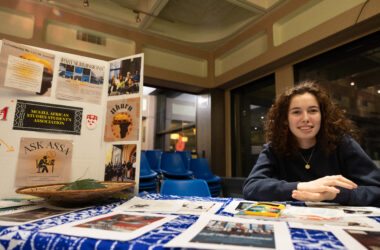
The Students’ Society of McGill University (SSMU) held Activities Night 2.0 from Nov. 1 to Nov. 3. Independent student groups, clubs, athletics groups, and others set up booths on the fourth floor of 2200 Centre Mont-Royal between 4 p.m. and 8 p.m. to showcase the breadth of student life at McGill and to encourage students to get involved.
The event was the second Activities Night of the Fall 2021 semester. The first edition, held virtually on the Gather.Town platform, was unsuccessful after a system-wide crash shut down the event. SSMU vice-president (VP) Student Life Karla Heisele Cubilla explained why she decided to host Activities Night 2.0 in person in an email to The McGill Tribune.
“Regulations have significantly changed since Sept. 1,” Heisele Cubilla wrote. “Vaccine passports were implemented, one-metre distancing became possible, and there is a limit of attendees at conventions and conferences. Given these circumstances, an in-person fair event was possible, and it did not violate any health regulations currently placed by the government.”
Due to the ongoing COVID-19 pandemic, SSMU implemented several protocols, including physically distanced booths, hand-sanitizing stations, and mandatory vaccine passports. There was also a hybrid option—students could join a virtual fair on Zoom to visit all the different booths. Many of those who attended the in-person evening, like Jordan Cowie, U1 Management, felt that it was a welcome change.
“The layout is super cool,” Cowie said in an interview with The McGill Tribune. “[SSMU] designed it very well, and the space is really close to campus, which is fun [….] Through COVID, we really missed that [in-person] communication, so now we are getting that and it is really fantastic.”
Despite Activities Night being held later than usual in the semester—typically it is held mid-September—Cowie was still happy to attend.
“I’m just looking at all the clubs McGill has to offer,” Cowie said. “[McGill] boasts a really robust student body, and I think our clubs represent that. It is really cool to see what everyone else is involved in.”
For many students, the in-person event was their first opportunity to get to know the different clubs at McGill in one place. For some brand new groups, such as the McGill Students’ Blood Donation Association (MSBDA), Activities Night 2.0 was their first chance to introduce themselves to students.
“It is really important to start to build out that network, that community, so [that] we can reach out,” said Gian-Carlo Buonamici, U2 Management and MSBDA VP Finance, who tabled for MSBDA. “Eventually, once we have grown and fundraised for our own blood drives on campus, hopefully we will have that basis of support already there.”
Buonamici, who attended the first two nights as a visitor, echoed Cowie’s statement about participating in the event in person.
“I’ve come for the past two nights as well, and it just feels really good to get a feel for what the McGill community is really like, especially after a year all online,” Buonamici said. “It is nice to see people in person, seeing what people are passionate about, seeing what people are putting their energy towards.”
After two Fall semester Activities Nights, Heisele Cubilla says the SSMU student life team has learned a lot about planning events during the pandemic.
“Activities Night 2.0 was a very successful hybrid event (the first hybrid event of this size at McGill since the pandemic started),” Heisele Cubilla wrote. “Moving forward for the Activities Night Winter 2022 planning, the SSMU team has a structure to build upon and improve the hybrid experience for the next event [….] The event [also] needs to be carried [out] at the beginning of the semester to maximize attendance and participation.”
I have always been a cautious person. Though I can bring myself to take risks in many areas of my life, when it comes to physical activities I am usually the one who stays behind, choosing instead to sit inside with a good book. It is for this reason that I never considered picking up a skateboard.
On top of the physical risks of the sport, there is the intimidation factor: The skateboarding community can come across as intense. I had also imagined skating to be one of the activities that can only be learned at a young age. In my head, there was nothing more embarrassing than a 21-year-old skateboarder in full knee pads, elbow pads, and a hot pink helmet. Not only were these thoughts limiting, they were also untrue.
Although skateboarding initially seemed daunting to me, when I started practicing seriously I was able to pick it up within a few weeks. Freshly home from a trip and stuck in quarantine in June 2021, I took a leap and ordered a penny board online. Then came learning. I took it out to the backyard to give it a try, and I won’t lie, it was scary. The first few times, I could not let go of my boyfriend. Soon enough, however, I was slowly gliding down the parking lot.
I then started skating with a friend in parking lots and quiet streets, still away from the public eye. She taught me to skate one foot at a time and in just a few days, I was making significant progress. The frustrating thing about skateboarding when you are a woman—thus not the “typical skateboarder“—you tend to draw attention to yourself, resulting in many awkward and sometimes creepy conversations. I have had to fend off many unwanted comments and dismiss the prying eyes of passers-by. Luckily, I was the one on the skateboard, and I could quickly speed away in the opposite direction.
I eventually started skating to campus, which had been my aim all along. But by August, when I still had not made as much progress as I had wanted, I thought my goal remained out of reach. I feared that perhaps it would never happen. That said, on the first day of school, I showed up with my board in hand.
Aside from the obvious benefit of a sport that doubles as a form of transportation, it is also a social one. My boyfriend has a longboard, and some of the best times we had in the summer were spent racing down Montreal bike lanes in the pitch black of night together.
Unfortunately, daytime skating involves the added consideration of cars, whose drivers often do not feel like collaborating with pesky, unpredictable skateboarders.
In addition to the dirty looks from drivers, skateboarders face another inconvenience: Montreal’s poor road quality. Every time I go over a bump, I pray I do not fall off.
I have fallen off my skateboard three times: The first time I twisted my ankle, the second time I bruised one knee, and the third time, the other one knee. Although I admit that I am still only a beginner, I place most of the blame on the unpredictable nature of the pavement; skating here is a challenge at the best of times.
Despite this, I keep getting back on the board, and I now consider skateboarding to be one of my favourite activities. As the skateboarding season comes to a close—at least for those of us who do not want to be gliding through the snow—my advice to anyone interested in taking up the sport is to not be afraid to try it out. Contrary to popular belief, you do not have to look a certain way or be fearless to skate. If you want to skate, then skateboarding is for you. Take my word for it—it is never too late to try.
As we take advantage of the last few sunny fall days in Montreal, it’s easy to forget that a frigid winter is approaching. Before the snow fully settles upon us, it’s best to prepare ahead of time for the sub-zero temperatures. For those who have yet to experience Montreal’s ice-cold weather, The McGill Tribune brings you a list of essential winter clothing items and practices, from layering to staple winter accessories.
A good jacket
Equipping yourself with the perfect winter jacket is crucial to keeping warm.
When it comes to length, the longer the better. To fight off frostbite, invest in a coat that will cocoon your body all the way down to your knees. You’ll feel like a penguin waddling around on campus.
Other important things to look for when hunting for a jacket are its insulation and fabric. For Montreal weather, water-resistant down material is the way to go. The goose down will keep your body insulated, while water-resistant fabric will be perfect for rainy and snowy days. Some down-free alternatives that are equally as warm are quilted jackets filled with nylon or polyester.
Consider as well a hood for your jacket to keep your head dry and cozy while it rains or snows. If you don’t love the look of hoods on your jackets, try to find one with a detachable hood for the best of both worlds.
Storage and warmth are what pockets are all about. Look for a jacket with large pockets to store your miscellaneous belongings and protect your hands from the cold.
Black, grey, and white are staple colours that go with anything you wear. However, if you want to add some vibrancy and style to your winter look, pick out a jacket in your favourite bright colour. Not only will it help you stand out, but it will keep you joyful during downcast winter days.
Layering
Remember this rule of thumb: You can always take off layers, but you can’t add them once you’ve already left the house.
Good fabrics for layers are always thinner, not thicker. Try shopping for cashmere, fleece, and wool sweaters with long sleeves. Thermal long-sleeved garments are also a great addition underneath a cozy sweater for an extra layer of warmth. These items are always easy to thrift at Value Village if you’re on a budget.
For your bottom half, wearing tights or long underwear underneath your favourite pair of pants ensures that your legs will be warm as you strut through the city.
Layering doesn’t have to be solely practical. For instance, try wearing funky, patterned turtlenecks underneath your favourite graphic tees to spice up your outfit, or transition your dresses into winter by wearing a thick, ribbed pair of tights and vibrant long sleeves underneath.
Accessories
Although accessories may feel like a small component of your outfit, they can be a hefty addition to your warmth. While the majority of your outfit may simply feel like insulation, it’s these added features that allow you to express your style. Good items to consider are ear muffs, hats, scarves, and mittens. Depending on how warm your jacket keeps your neck, you might want to add a scarf for more protection against the wind or for added flair.
In the early days following the first frost, it’s easy to get away with thick socks and a pair of fur-lined Doc Martens. As we move further into the season, however, it’s a smart idea to invest in a pair of proper heavy-duty winter boots.
The perfect Montreal winter boot is fur-lined, tall, waterproof, and has good traction for the icy sidewalks. Some brands to look for are Ugg, Sorel, and Merrell. To keep your boots chic, include striking, colourful laces with beads laced in, and wear long, patterned socks to peek out of your boots for a fun surprise.
It’s no surprise that frozen produce is considered inferior to its fresh counterpart: Not many of us enjoy flavourless boiled green beans or mushy carrots. But while frozen veggies alone can be unappetizing in flavour and texture, they are an easy way to avoid both food waste and a pricey grocery bill during the colder months. To avoid lackluster meals without sacrificing a healthy diet, The McGill Tribune brings you two easy recipes to bring out the best flavours in frozen fruits and vegetables.
Spiced chicken with lemon yogurt sauce
This spiced chicken recipe is easy to make and perfect for meal-prepping. The veggies and spice blend can be customized to your preferences, so you can achieve completely different tastes using the same simple steps.
Ingredients:
2 chicken breasts
¾ cup basmati rice
1 lemon
1 ½ cups chicken broth
1 ½ cups frozen zucchini, sliced
2 cups frozen carrots, chopped
1 tbsp Moroccan spice blend (or a different spice blend of your choice)
1 tbsp unsalted butter
½ cup plain Greek yogurt
Fresh parsley (optional)
Kosher salt
Black pepper
Olive oil
Steps:
Preheat the oven to 425°F.
Add the chicken broth to a pot, cover, and bring to a boil.
Add the rice to boiling water, reduce the heat to low, cover, and cook until the liquid is fully absorbed. Remove the pot from the heat and set aside, still covered.
Mix ¼ cup of the Greek yogurt with the spice blend in a large bowl. Pat the chicken dry and add to the bowl. Coat the chicken and set aside to marinate.
Juice half the lemon and mix with the remaining Greek yogurt. Season with salt and pepper and set aside.
Heat a nonstick pan over medium high, then add about 2 tbsp of olive oil. When heated, add the frozen carrots and zucchini to the pan. Cook until zucchini is slightly crisped on the outside. Season with salt and pepper. Mix in the veggies with the rice.
In the same pan over medium-high heat, add about a tablespoon of olive oil. Cook each of the chicken breasts for about 2 minutes. Add the cooked chicken to a baking sheet and place it in the oven for about 13 minutes, or until cooked through.
Juice the other half of the lemon over the rice and veggies. Add optional parsley. Mix together. Thinly slice chicken and serve over rice with lemon yogurt sauce.
Chickpea, turmeric, and coconut milk stew
Not only is this recipe easy, but it is filled with bright fall flavours. Like the other dish, this stew can be easily be adapted to your own taste. Feel free to skip the kale, add potatoes, or even change the spice level. You can serve it over rice, with naan, on a pita, or just enjoy it on its own.
Ingredients:
1 large yellow onion, chopped
A 2-inch piece of ginger
1 ½ teaspoons ground turmeric
1 teaspoon red pepper flakes
2 cans chickpeas
2 cans coconut milk
2 cups vegetable broth
2 cups frozen kale
4 garlic cloves, minced
Kosher salt, to taste
Black pepper, to taste
¼ cup olive oil
Steps:
Heat about ¼ cup olive oil in a pot over medium heat. Add the garlic, onion, and ginger. Season with salt and pepper. Stir periodically, until the onions start to brown on the edges.
Add the turmeric, red pepper flakes, and chickpeas to the pot. Season with salt and pepper, then stir the spices into the chickpeas. Cook until the chickpeas start to crisp, about ten minutes. Crush the chickpeas with a wooden spoon, leaving a few uncrushed for texture.
Add the coconut milk and vegetable broth to the pot. Bring the stew to a simmer, making sure to stir the bottom of the pot occasionally. Cook until the stew has thickened to your desired consistency, around 40 minutes.
Add the kale, then allow the stew to simmer for around five minutes, or until the kale is tender and any added liquid evaporates.
Serve! You can top the dish with red pepper flakes for some extra spice. I ate the stew with some toasted naan.
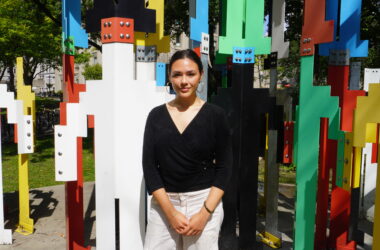
Starting university is a symbolic step in one’s independence and coming of age. This newfound freedom is, for many students, expressed in getting their first tattoos. Whether as a planned tribute to a loved one or an impulsively chosen design, tattoos serve as a vehicle for expressing one’s personality.
Olivia Bjerkelund, U0 Arts, who moved away from Vancouver for university this past September, saw her first year of independence as an ideal opportunity to get her first tattoo.
Ironically, Bjerkelund’s tattoo, a still life jug of lemonade surrounded by plums and daffodils on her inner arm, is representative of her childhood.
“I used to have a plum tree when I was a kid,” Bjerkelund told The McGill Tribune. “The daffodils are there [because] my mom gives me daffodils every year on my birthday.”
Like Bjerkelund, Gracie Thompson, U0 Arts—who already has several tattoos—decided to add to her bodily mosaic after moving to Montreal this September. Thompson made her decision within her first weeks in the city.
“I was with my parents [and] I saw a little sign that was on a compost bin,” Thompson said. “I thought it was so cute [….] I thought about it for two weeks, then decided to go for it as a ‘welcome to Montreal’ gift.”
In addition to this new piece and her previous collection, Thompson has gotten two other tattoos since moving to Montreal, creating a patchwork on her arms. For Thompson, skin can be a place to memorialize one’s personal growth.
“I like [getting tattoos] because it symbolizes who I was at the time of getting the tattoo,” Thompson said. “It makes you feel so confident [and is] a great conversation starter.”
Students looking to get their first tattoos or add to their existing collections in Montreal are in luck: The city has a wealth of local tattoo artists ranging from those working at established shops to DIY artists, each of them with unique design styles.
Among these artists is Aya Dazig, a multidisciplinary artist who has been tattooing since she was 15. Her journey in the practice began by tattooing her friends and acquaintances.
“I kind of got into tattooing by accident,” Dazig said. “I would fix my friends’ stick and pokes as a teenager, and [I] had a friend tell me, ‘you should really get into this.’”
Stick and poke tattoos have risen in popularity over the past few years. It is a method of tattooing that requires only a sterilized needle, pot of ink, and a friend’s—or one’s own—artistic hand. This DIY technique not only offers students a more affordable alternative to the hefty prices of tattoo parlours, but also an intimate memory to mark the inked design, with many receiving these hand-drawn tattoos from someone they know, and often in a personal space.
Dazig, who started out fixing stick and poke tattoos done by others for friends, turned her passion into a full-time job this past April. She now works with two other Montreal tattoo artists in a private studio located in the Plateau.
Dazig doesn’t lean toward a specific tattooing style; her inspiration comes from either her stream of consciousness or a direct reference.
“My main goal is to have all of my work feel intuitive and authentic,” Dazig said.
Dazig believes that students’ desire to get tattoos after starting university is tied to a newfound sense of independence.
“It goes hand in hand with moving out,” Dazig explained. “You have a new sense of ownership over your life and body.”
Though the permanence of tattoo ink can feel intimidating, Dazig advises students who are considering getting their first tattoos not to overthink how they will view the tattoo in the future.
“Don’t worry about pain or getting something timeless,” Dazig said. “Get something you genuinely like in the moment.”
In the fall of 2020, during the months when COVID-19 raged, concern for unhoused neighbours in the area surrounding McGill prompted Sophie Hart to found Meals for Milton-Parc, a student-led meal-share initiative that provided food and care packages.
The group recently shifted its mission and took on a new name—Mobilizing for Milton-Parc (M4MP)—in order to meet the changing needs of unhoused people.
In its early days, M4MP focussed on getting food to those in need and making sure Milton-Parc’s unhoused neighbours felt cared for. Meal distribution was a cornerstone of that effort.
“I felt like we were not doing enough to support vulnerable people in our community,” Hart said. “With the pandemic, services were closing down due to public health requirements.”
What followed was an outpouring of support from the McGill community, much of it driven by social media. In the period between October 2020 and August 2021, M4MP raised close to $20,000 and distributed some 3,000 meals.
With services for the unhoused community returning to full working capacity as pandemic restrictions loosen, M4MP is now shifting gears to focus on supporting both Indigenous-led and non-Indigenous-led organizations in Montreal.
“We started our project because there was a need for us to meet,” Hart said. “But as the pandemic has begun to wind down, the organizations in our community have been able to get back to full capacity. We want them to know how much we appreciate the work they do, and that they have our community supporting them when they need it.”
With this shift in vision, M4MP has become a conduit for funds, food and material support, community building activities, and settler education projects.
The group runs community building activities for residents of the Hotel Dieu shelter, which is open 24/7. Since October 2021, M4MP has held art, self-care, and pumpkin-carving events.
“These activities, in my mind, are important to create connections among neighbours as well as to have some fun,” Hart said. “I think people forget that at the end of the day we all like to have fun, connect with neighbours, and talk to new people.”
Much of this programming has been made possible thanks to crowdfunding efforts through M4MP’s Instagram page. This year, M4MP started an “Education Team” that uses its online platform to educate settlers, and to stress the responsibility that they have in amplifying and supporting the voices of marginalized communities.
“[The past year] has made me realize how much can be done when caring people work together,” Hart said. “This year has also made me realize how broken the systems in place to support vulnerable people are. I’ve learned so much in such a short time, but what has stood out to me most is that we really need more people to join the care and community field.”
Individuals interested in volunteering can join the Mobilizing for Milton-Parc Interest Group on Facebook and watch the volunteer training video. Donations may be e-transferred to mobilizingformiltonparc@gmail.com.
The McGill administration announced on Nov. 1 that its Emergency Operations Centre (EOC), the administrative body coordinating the university’s COVID-19 response, had been deactivated. The announcement, sent in a university-wide email, explained that the university is officially transitioning to a “recovery and resumption” response, with all COVID-19 matters now to be headed by the new Recovery and Operations Resumption Committee (ROR).
The McGill administration cited the community’s high vaccination rates as well as the Quebec government’s recent announcement that it expects to end the province’s state of emergency in early 2022, as contributing factors behind the decision to transition from the EOC to the ROR.
In an email to The McGill Tribune, Frédérique Mazerolle, a McGill media relations officer, explained that the “recovery and resumption” transition would transfer all COVID-19 matters under the university’s pre-pandemic administrative structure. Mazerolle stressed that the transition from the EOC to the ROC signals a step toward a post-pandemic environment.
“This new structure was chosen to better align with the university’s day-to-day governance structure and allow for a smoother transition to regular governance processes as the pandemic continues to evolve in the coming months,” Mazerolle wrote. “We do […] feel confident that we have reached a point where we can shift our focus from emergency response to recovery planning.”
The EOC, composed of senior administration officials with expertise in emergency planning, had been coordinating McGill’s COVID-19 response since January 2020. The COVID-19 pandemic is the longest crisis the EOC has dealt with; previously, it had only dealt with crises lasting mere days or weeks.
However, many members of the McGill community questioned the implementation of the EOC for the COVID-19 pandemic when it was initially being rolled out. Richard Gold, a professor in the Faculty of Law, criticized the administration for its lack of transparency and engagement with the wider community in its operations.
In a statement to the Tribune, Gold welcomed the deactivation of the EOC, arguing that while the members of the EOC may have been diligent in their planning, they did not have adequate knowledge on medical or legal affairs to make COVID-19 related decisions—and that they “refused to listen to experts at McGill who did.”
“[The EOC] provided the administration an excuse to take on powers that it does not rightfully have under McGill’s statutes and regulations,” Gold wrote. “The administration ruled by edict during the pandemic, failing to engage the campus and to be transparent as to the reasons for its actions [….] I hope that the ending of the emergency response signals a return to collegial governance, which has been suspended since spring 2020, and an actual engagement with campus.”
Arts Undergraduate Society (AUS) vice-president (VP) Social Affairs Sam Baron also expressed relief in not having to go through the EOC to get approval for community events, citing communication issues with the EOC when he was planning for Frosh 2021 .
“I, frankly, thought it was ridiculous that a fully anonymous body had the final say in almost all decisions made on campus,” Baron wrote in a statement to the Tribune. “Every time I wanted to get something done, I had to ask the EOC for permission. They clearly had too much on their plates to deal with, as I know that my emails to them […] went unanswered for weeks or months at a time.”
SSMU VP Internal Sarah Paulin also pointed out the administration’s lack of engagement with students and faculty in the decision-making around COVID-19 protocol. However, Paulin questioned the university’s decision to end the emergency response.
“I think the decision was very rushed,” Paulin said in an interview with the Tribune. “It would have been nice to have seen more prudence from the university [….] Especially since they have provided very little support for faculty and students who have felt unsafe with the way the university is currently operating. [The administration is] very set in their ways.”
“Oh, she’s tough!” shouted one of the boys during our 11v11 McGill intramural soccer game at the Molson stadium this October. This “insightful” observation was sarcastically directed toward one of the women on the opposing women’s team as she took a missed shot to the stomach. When I played in the match, this was only one of the many instances of derogatory behaviour directed toward the female players. When the whistle was blown, the boys immediately sought to establish a clear atmosphere of superiority: They chuckled at every header, laughed at every attempt on goal, and walked as slowly as possible back to their side to waste time and aggravate their opponents whenever a centre-kick was taken. This made for some very ugly soccer.
It was incredibly enraging, disappointing, and disheartening to bear witness to yet another display of misogynistic and sexist behaviour––one which I certainly did not expect from adult McGill students at a friendly intramural match. However, the women disregarded the boys’ outright lack of sportsmanship, and continued to support each other and play as hard as possible throughout the entirety of the game. At the end of the match, everyone in the stands, including the referees, supporters, and substitutes, ran onto the pitch in support to join the women’s team in an impromptu, informal match against the boys, ending the evening on a more positive note.
I was a participant in this match and have played in hundreds of others since I was four. Unsurprisingly, this was not the first time I had experienced sexist behaviour from my teammates or opponents. I have endured so many boys telling me that I was not allowed to play with them because of my gender. And when I did play, they often laughed at me or even sexualized me, as a means to re-affirm their masculinity. These experiences only strengthened me and taught me how to use this kind of behaviour to my advantage. Nevertheless, it is exhausting to have to constantly push my limits to challenge gender-based stereotypes in sport.
Truthfully, the reason this experience at the recent game upset me so much was because it completely dismantled the sense of security and confidence that I had cultivated. Before this match, playing intramural soccer allowed me to feel a kind of freedom that I had experienced as a youngster. It was the kind of freedom that stems from playing amongst non-judgemental peers who encouraged me to be myself with no gender-based expectations and no need for performance—something I value highly as a non-binary, queer person.
Since the event, McGill’s intramural faculty met with the captain of the team to discuss possible sanctions. But this is not enough. Although it may have only been one soccer match, it highlighted the ongoing misogyny and sexism that women, non-binary, genderqueer, and gender non-conforming people continue to face on and off the pitch. It is dangerous to let these issues go unnoticed since they are representative of the larger issues women and female-presenting individuals have to deal with on a daily basis.
This experience should serve as a reminder that, though gender inequalities are still rife in our everyday lives, we cannot remain silent about them. The fight is not over: We need to be louder than ever, we need to keep defying gender norms. When we continue to play soccer, we show them what it means to “play like a girl.”
With restrictions being lifted and parts of the world returning to in-person routines, many are anxious to get back to their pre-pandemic normal. However, preventative measures like mask wearing and physical distancing have proven to have a multitude of non-pandemic related benefits. After the high levels of hygienic scrutiny throughout the last two years, it would be regressive to disregard such simple and effective health measures in a post-pandemic society.
Mask wearing is prevalent in many non-North American countries as a courtesy to protect others from getting sick, and recent data shows there have been significantly less flu-related deaths since mask mandates were put in place. Now, masks have become an accessory, introducing endless colour-coordinating opportunities, and with colder weather approaching, they have joined the winter garment roster. Providing both fashion and function, masks can help hide a surprise pimple, or offer coverage on days when one wants to keep a low profile.
Many have adopted a “better safe than sorry” mindset, and capacity limits in stores and bars means avoiding the stress of having too many people jammed into a tiny room. With the holiday season approaching, the idea of having to elbow a path through the shopping crowds is unappealing, to say the least. And though the distanced line for the Carrefour Sherbrooke Starbucks may be hellish, avoiding larger gatherings and being mindful of enclosed spaces brings not only reduced risk of inhaling foul body odor, but also hygienic peace of mind.
This same mindset carries through with the implementation of masks and hand sanitizer at the entrance of most stores and buildings, including McGill’s. Visitors are required to sanitize their hands before entering, something that helps mollify germaphobic worries. Furthermore, this ensures that elevator buttons, railings, and door handles are touched by hands that are 99.8 per cent bacteria free.
Overall, with these hygiene solutions providing benefits for everyday lives, they should stay post-pandemic. But the thing that has been made most clear over the past year is that with scary things like crowds and germs outside, there’s no shame in staying inside.
Valentina de la Borbolla
Futile measures will falter
Although health measures like mask-wearing provide substantial protection against COVID-19 and other diseases, it is unrealistic to expect the general population to maintain these practices that are so closely associated with a state of emergency. As the COVID-19 pandemic evolves, it is important to adjust our expectations of individual behaviours, especially when the risk of infection is lower.
In many cases, public health directions have been confusing, contradictory, or downright illogical, like Quebec’s soon-to-be-lifted ban on dancing in clubs. Other measures like temperature checks and surface sanitization provide little more than reassurance, which experts have even called “hygiene theatre.” These inconsistent rules have worsened pandemic fatigue, which in turn makes people disregard public health recommendations, unreasonable or not.
Another key point of contention is how long governments and businesses should continue to enforce mask mandates. While wearing a mask for one’s own personal comfort will likely become more normalized, continued mandates are not sustainable. For one, measures like masks and lockdowns have become increasingly politicized. Masks have found themselves at the centre of culture wars, with some refusing to wear them in supposed acts of resistance. For example, protests against public measures are widespread in many cities, including Montreal. And when the CDC announced it was safe to go maskless in public, many feared doing so at risk of being viewed as anti-maskers. When measures become less about public health and more about political signalling, the likelihood of them being widely accepted decreases. In addition, as government officials express optimism over lowering cases and increasing vaccinations, people’s sense of urgency diminishes.
Furthermore, the fact that these measures would be inconsistently adopted in the long term scales down their efficacy altogether. Like vaccines, masks are most effective when the majority of people are wearing them. Even if it is sensible to continue wearing masks, it will come down to personal choice. However, this is no silver-bullet solution because not everyone will comply.
Going back to normal does not have to be reckless, but it also does not have to be about enforcing futile measures. A fully hygienic future is impossible and holding the expectation that it will be is a recipe for disappointment.